Beatrice arrived at Westfall Abbey with a marriage contract in one hand—and a debt ledger waiting for her in the other.
The room seemed to shrink around them.
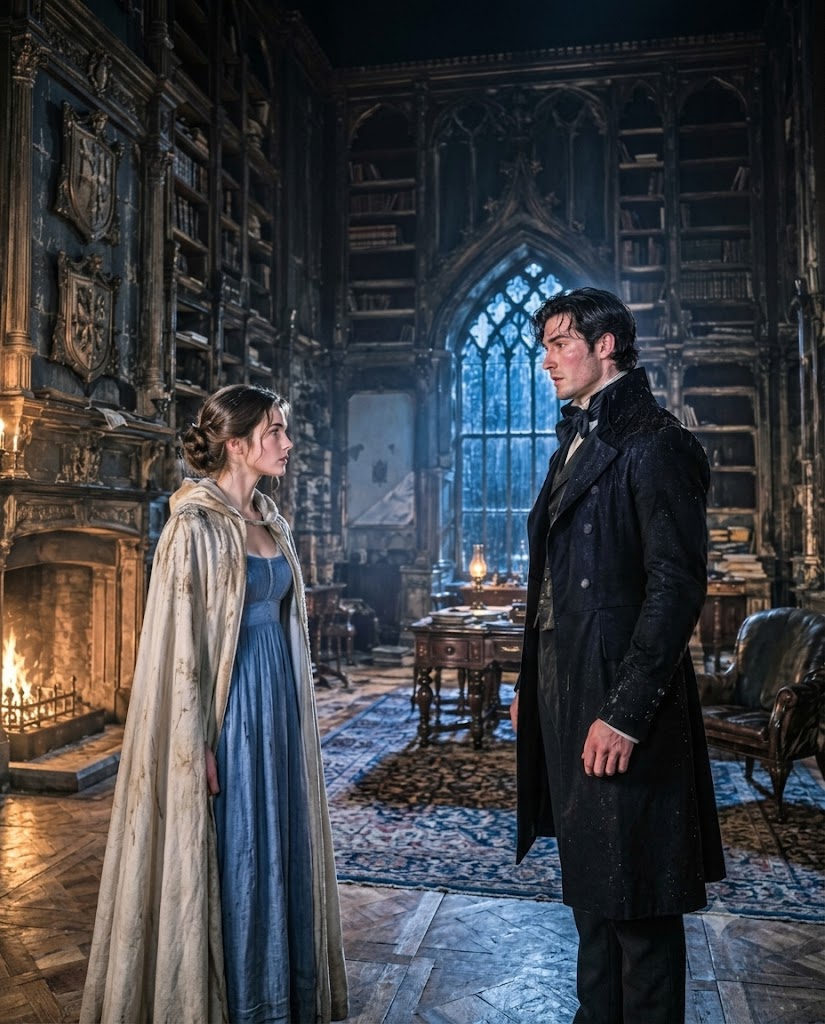
Outside, the storm pressed against the windows, throwing handfuls of snow against the glass. Inside, the dying fire gave one last crack, and a coal collapsed into ash.
Beatrice stared at Alistair.
“Because the fire wasn’t an accident.”
He did not look away.
For several seconds, neither of them spoke.
Then Beatrice picked up the letter again.
The signature at the bottom belonged to Edmund Vale, the solicitor who had represented the Westfall family for nearly twenty years.
She remembered the name.
It appeared beside payments in the oldest ledger, always attached to vague descriptions—consultation, legal expenses, private settlement.
Too many payments.
Too much money.
“Tell me everything,” she said.
Alistair’s jaw tightened.
“I was twenty-two when it happened. My father was still alive. Westfall had debts, but nothing we couldn’t survive. Then my father discovered someone had been selling portions of the estate without his knowledge.”
“Vale?”
“Not alone.”
Alistair moved toward the window, leaning heavily on his cane.
“There were bankers. Suppliers. Men who bought timber from our northern woods and reported half the quantity. Men who purchased grain and paid tenants directly, then altered the accounts. My father began investigating.”
“And the fire?”
“My father planned to expose them.”
Beatrice felt cold despite the fire.
“What happened?”
“My father died that night.”
She said nothing.
“So did my younger brother.”
The words were delivered without drama.
That made them worse.
“I was trapped upstairs. Smoke filled the corridor before I woke. Someone had locked the doors from outside.”
Beatrice’s fingers tightened around the letter.
“You survived.”
“Barely.”
He touched the edge of his collar.
“These scars are from the fire. The ones you saw are only what remained after the surgeons finished.”
“And your mother?”
“Alive.”
His voice changed.
“She left Westfall the following morning and never returned.”
Beatrice looked at him carefully.
“Why?”
“Because she believed I had started the fire.”
The silence that followed felt heavier than the storm.
“Did you?”
“No.”
The answer came immediately.
Too immediately, perhaps.
Beatrice studied him.
She had learned early in life that people lied most convincingly when they believed they were telling the truth.
But Alistair did not look like a man defending himself.
He looked like a man who had spent years waiting for someone to ask the right question.
“Then why does your name appear on the document?”
Alistair turned.
“Because three days before the fire, I signed a loan agreement.”
“For what?”
“To save the estate.”
He crossed the room and opened a drawer in the writing desk.
From beneath several papers, he removed a folded document.
Beatrice read the first page.
The loan had been for £50,000.
The same amount as her marriage settlement.
Her eyes lifted.
“You borrowed the money from the West London Banking Consortium.”
“Yes.”
“And they are now demanding Westfall in repayment.”
“They claim the loan was secured against the entire estate.”
Beatrice turned the page.
There was something wrong.
She read it again.
Then a third time.
“No.”
Alistair frowned.
“What?”
“This clause.”
She pointed to the bottom of the page.
“The loan was secured against future estate revenue, not the land itself.”
His expression hardened.
“That’s what I was told.”
“You were deceived.”
“By Vale?”
“Possibly. But look at the signature.”
She placed the document beside the letter.
The handwriting was similar.
Not identical.
Similar.
Then she noticed something else.
The ink.
“This was signed after the fire.”
Alistair went completely still.
“What?”
“The ink is wrong.”
He stared at her.
“You can tell that?”
“I can tell the ink used here was manufactured after the year written on the document.”
Beatrice had spent years reading contracts for her father before his death. Ink, paper, seals, handwriting—these were the quiet fingerprints of fraud.
She turned the page.
“This document is forged.”
For the first time since she had arrived at Westfall Abbey, Alistair looked genuinely shocked.
“Then what did I sign?”
Beatrice looked toward the locked cabinet where the oldest ledgers were kept.
“That,” she said quietly, “is what someone has been trying to hide.”
They spent the rest of the night searching.
By dawn, the study looked as though a storm had passed through it.
Ledgers covered the floor.
Invoices were stacked across chairs.
Dust coated Beatrice’s gloves.
Alistair had opened every drawer in the desk, every cabinet, every old box.
Nothing.
Until Beatrice noticed the fireplace.
The stonework around the lower grate was slightly uneven.
She knelt.
“Help me.”
Alistair crouched beside her.
Together they removed two loose bricks.
Behind them was a narrow cavity.
Inside lay a small iron box.
No key.
Alistair broke the lock with the handle of his cane.
The lid opened.
Inside was a packet of letters tied with black ribbon.
Beatrice untied it.
The first letter was from Alistair’s father.
The second was from Edmund Vale.
The third was from a banker named Henry Ashcombe.
Beatrice read the letters in silence.
Then she stopped.
“What is it?” Alistair asked.
She handed him the final page.
It contained only one sentence.
Once the duke is married, the debt will be transferred through the bride’s settlement.
Alistair looked at her.
Beatrice’s stomach dropped.
“My marriage.”
“Yes.”
“They knew I was coming.”
“Yes.”
“They arranged the £50,000 settlement.”
Alistair’s face darkened.
“They didn’t just want Westfall.”
Beatrice finished the thought.
“They wanted my money.”
For the first time, she understood the full shape of the trap.
Her stepmother’s gambling debt had not been the only reason she had been sent north.
Someone had known exactly how much money would follow her.
Someone had arranged the marriage.
Someone had made sure she would arrive at Westfall carrying precisely the amount required to keep the estate alive for another few months.
She sat down slowly.
“My stepmother couldn’t have known all this.”
“No.”
“Then who?”
Alistair said nothing.
Beatrice remembered the signature on her marriage contract.
The solicitor.
Edmund Vale.
Her throat tightened.
“Vale arranged my marriage.”
“Most likely.”
“And if I had never come?”
“Westfall would have fallen sooner.”
“But if I did come…”
“Your fortune would disappear into the same accounts that destroyed mine.”
Beatrice looked at the ledgers surrounding them.
She should have been furious.
Instead, she felt something colder.
Certainty.
“Then we let them believe they’ve won.”
Alistair’s eyes narrowed.
“What are you suggesting?”
“We stop fighting the debt.”
“That will destroy us.”
“No.”
She gathered the papers into a neat stack.
“We make them think it has.”
The next morning, Beatrice announced that Westfall could not meet its obligations.
The news spread quickly.
Too quickly.
By afternoon, three creditors had arrived.
By evening, two bankers were waiting in the entrance hall.
Among them was Henry Ashcombe.
He was a broad man with silver hair, expensive gloves, and the polished smile of someone who had never been forced to count coins before deciding whether he could afford bread.
“My lord,” Ashcombe said, bowing.
“My lady.”
His eyes lingered on Beatrice.
“You have made the correct decision.”
Beatrice smiled.
“Have I?”
“The estate is deeply insolvent.”
“So I am told.”
“Foreclosure will be unpleasant, but efficient.”
She poured herself tea.
“Then you will have no objection to showing me the original loan agreement.”
Ashcombe’s smile disappeared for half a second.
“The original?”
“Yes.”
“The copy before you is legally certified.”
“Then the original should be easy to produce.”
Ashcombe looked at Alistair.
Alistair said nothing.
Beatrice smiled again.
“Or perhaps it is not.”
Ashcombe’s eyes hardened.
“My lady, you are inexperienced in these matters.”
“I am.”
She placed a ledger on the table.
“That is why I ask simple questions.”
She opened it.
“Why did your bank receive payment from Westfall for £8,400 in the year before the fire?”
Ashcombe’s face remained still.
Beatrice turned the page.
“And why did the payment appear twice?”
No answer.
“And why did Edmund Vale receive half of it?”
Alistair watched Ashcombe carefully.
The banker stood.
“I think this conversation has become inappropriate.”
“No,” Beatrice said.
“I think it has finally become useful.”
Ashcombe left without another word.
That night, someone tried to kill Beatrice.
She woke to the smell of smoke.
Her bedroom door was burning.
For one terrible second, she could not move.
Then she heard Alistair shouting her name.
He crashed through the adjoining door.
He wrapped a blanket around her and forced the burning door open.
Smoke rolled into the corridor.
“Down!”
They crawled toward the stairs.
A beam collapsed behind them.
Alistair grabbed her waist and pulled her beneath it.
They reached the entrance hall just as servants came running.
Outside, the snow swallowed the flames.
Beatrice coughed violently.
Alistair knelt beside her.
“Are you hurt?”
She shook her head.
Then she looked back at the burning window.
“It wasn’t meant to kill me.”
“What?”
“The room.”
She pointed.
“The fire started at the door.”
Alistair frowned.
“They wanted me trapped.”
“No.”
Beatrice looked at him.
“They wanted you to save me.”
He understood.
“They wanted you seen.”
“Exactly.”
If Alistair died rescuing his wife, Westfall would lose its duke.
If Beatrice died, her fortune would become tangled in probate and debt.
Either way, the conspirators benefited.
But there was one detail they had missed.
Beatrice had seen the attacker.
Only for a moment.
A shadow crossing the courtyard.
A man wearing a dark coat.
And on his left hand, a silver ring shaped like a stag.
She had seen that ring before.
On Edmund Vale.
The next morning, Vale arrived at Westfall Abbey.
He looked deeply concerned.
“My lady,” he said, “I heard about the fire.”
“How kind of you.”
“I came immediately.”
“You came before the local magistrate.”
His smile weakened.
“I was concerned about the family.”
Beatrice stepped closer.
“Were you?”
Vale looked at Alistair.
“I understand this has been a difficult time.”
“No,” Alistair said.
“You understand too much.”
Vale’s face changed.
Only slightly.
But Beatrice noticed.
She had learned that the smallest movements often mattered most.
Vale reached inside his coat.
Alistair’s hand moved toward his cane.
But Vale produced only a folded document.
“The bankers have authorized foreclosure.”
Beatrice accepted it.
“Thank you.”
Vale turned to leave.
“Mr. Vale.”
He stopped.
“Yes?”
“Your ring.”
His left hand disappeared instinctively into his coat.
Beatrice smiled.
“You should be careful where you leave fingerprints.”
For one second, fear flashed across his face.
Then he laughed.
“My lady, I don’t know what you mean.”
“I think you do.”
He left.
By noon, Beatrice had sent a letter to London.
Not to the bankers.
Not to the courts.
To a newspaper editor her father had once trusted.
She enclosed copies of the forged agreement, the altered ledgers, and the letters from Alistair’s father.
But she kept the original evidence hidden.
If Vale realized they had proof, he would disappear.
Three days later, the trap was ready.
Beatrice told everyone that she had found the missing original loan agreement.
She announced that it would be presented at the foreclosure hearing.
The news reached London within hours.
That night, Westfall Abbey was silent.
Too silent.
Alistair stood by the window.
“You’re certain?”
“Yes.”
“If you’re wrong—”
“I know.”
He looked at her.
“You could leave.”
Beatrice smiled faintly.
“So could you.”
“I have nowhere to go.”
“Neither do I.”
He studied her.
“When this is over, you won’t owe me anything.”
“I know.”
“And the marriage?”
She looked down at her hands.
“That was a contract.”
“Only a contract?”
She looked up.
Neither of them spoke.
Then the candle beside them went out.
A sound came from the corridor.
Footsteps.
Alistair reached for his cane.
Beatrice took the hidden pistol from the drawer.
The door opened.
A servant fell inside.
Blood stained his shirt.
“Master,” he whispered.
“They’re in the west wing.”
Then he collapsed.
Everything happened at once.
A window shattered.
Gunfire echoed through the Abbey.
Alistair pulled Beatrice behind the stone fireplace.
Three men rushed into the hall.
One carried a torch.
Another carried a pistol.
The third wore a silver stag ring.
Vale.
“Give us the documents!” he shouted.
Beatrice stepped into view.
“You mean the documents proving you forged the debt?”
Vale’s face twisted.
“You were supposed to be frightened.”
“I was.”
“You should have left.”
“I considered it.”
“Then why didn’t you?”
She looked at Alistair.
“Because this is my home now.”
Vale raised the pistol.
Alistair moved in front of her.
The shot struck his shoulder.
He fell.
“Alistair!”
Beatrice fired.
The pistol flew from Vale’s hand.
The two other men fled into the snow.
Vale lunged toward Beatrice.
She struck him with the iron poker.
He collapsed.
For several seconds, the only sound was the storm.
Then Beatrice dropped beside Alistair.
Blood spread across his shirt.
“Stay with me.”
“I intend to.”
“You’ve been shot.”
“I noticed.”
Despite the pain, he smiled.
It was the first real smile she had ever seen on his face.
“You shot the banker’s solicitor.”
“Not very ladylike.”
“No.”
He winced.
“Very effective.”
The magistrate arrived before dawn.
By sunrise, Vale was in custody.
The other men were captured two days later.
Ashcombe attempted to flee London but was arrested at the docks.
The investigation lasted months.
The evidence proved that the fire years earlier had been deliberately started to destroy the records exposing the conspiracy.
Alistair’s father’s death had not been an accident.
Neither had the forged debt.
Neither had Beatrice’s marriage.
But there was one final surprise.
The £50,000 marriage settlement had never legally belonged to the conspirators.
Beatrice had protected it before leaving London.
Every penny had been placed in an account under her sole authority.
She had done it because she had never trusted her stepmother.
That money became the foundation of Westfall’s recovery.
But Beatrice did not use it to restore the old estate exactly as it had been.
She changed it.
The northern fields were repaired.
The tenants were given transparent contracts.
The coal monopoly was broken.
The estate accounts were opened for inspection.
A school was built beside the village church.
And the servants who had stayed through the worst winter received shares in the estate’s new enterprises.
Westfall did not become wealthy overnight.
It became something better.
Stable.
Honest.
Alive.
Months later, on a warm spring morning, Beatrice stood beneath the same entrance arch where she had first met Alistair.
The snow was gone.
Green vines climbed the black stone.
Children’s voices drifted from the village school.
Alistair walked toward her without his cane.
His shoulder still hurt.
His scars remained.
So did hers, though most could not see them.
“You’re leaving,” he said.
She looked at the carriage waiting beyond the gate.
“I thought about it.”
“And?”
“I decided against it.”
He stopped beside her.
“You’re free to go.”
“I know.”
“You don’t owe Westfall anything.”
“I know that too.”
He looked at her for a long moment.
“Then why stay?”
Beatrice smiled.
“Because I want to.”
The words seemed to surprise him.
Perhaps they surprised her too.
Alistair reached for her hand.
This time, there was no contract between them.
No creditor.
No family debt.
No bargain.
Only a choice.
“Beatrice.”
“Yes?”
“I don’t know how to be a husband.”
She smiled.
“I don’t know how to be a duchess.”
“That seems unfortunate.”
“It does.”
“Then perhaps we can learn.”
She slipped her hand into his.
“Together.”
Years later, people in London would tell the story differently.
Some said the Duke of Westfall had been rescued by a clever bride.
Others said Beatrice had married a ruined man and turned him into a powerful duke again.
Both stories missed the truth.
Neither had saved the other.
They had simply refused to let fear decide what their lives would become.
Beatrice had arrived at Westfall believing she had been sold for £50,000.
She had believed herself another debt being transferred from one household to another.
But the greatest thing she discovered was not hidden wealth, or revenge, or even love.
It was that a person’s worth could never be measured by what someone else was willing to pay for them.
The contract that brought her to Westfall had been written by people who believed human lives could be reduced to numbers.
She spent the rest of her life proving them wrong.
And whenever someone asked how Westfall survived the fire, the debts, and the winter that nearly destroyed it, Beatrice gave the same answer.
“Numbers told us what we had lost.”
She would pause.
“People told us what was still worth saving.”
And that was how Westfall Abbey endured—not because its debts disappeared, nor because its scars were forgotten, but because two people finally learned that rebuilding a life was not about returning to what had been.
It was about choosing, every day, what would come next.
The first year after the trial was harder than anyone expected.
Justice had closed the case, but it had not repaired Westfall.
The walls still carried the scars of the old fire.
Some rooms remained sealed because the floors had never been properly restored.
The eastern roof leaked whenever it rained.
The servants’ quarters needed new windows.
The western fields had been neglected for so long that weeds had swallowed the old irrigation channels.
And beneath all of it lay something more difficult to repair.
Memory.
Every time a door creaked at night, someone remembered the fire.
Every time smoke rose from a chimney, the older servants went silent.
Every winter wind that struck the Abbey sounded like a warning.
Alistair knew that feeling better than anyone.
He often woke before dawn, convinced he could smell smoke.
On those nights, Beatrice never asked what he had dreamed.
She simply lit a candle and sat beside him until the darkness became ordinary again.
One December morning, nearly a year after the trial, Beatrice found him standing alone in the ruined east wing.
Snow fell through a hole in the roof.
“You promised me you wouldn’t come here alone.”
Alistair turned.
“I promised I wouldn’t climb the roof.”
“You’re standing beneath half a roof.”
“Technically, that’s different.”
She frowned.
He smiled.
Then the smile disappeared.
“I found something.”
Beatrice stepped closer.
“What?”
He pointed toward the wall.
The old fire had blackened the stone, but beneath the soot was a narrow wooden panel.
Alistair pulled it loose.
Behind it was another cavity.
Beatrice stared.
“Another secret?”
“Westfall appears to have been built entirely out of them.”
Inside was a small leather-bound journal.
The cover was burned at the edges.
Alistair opened it.
The handwriting belonged to his father.
Beatrice read over his shoulder.
The first pages contained financial records.
Then came names.
Dates.
Payments.
Meetings.
People they had never heard mentioned during the trial.
Alistair’s face tightened.
“There are more.”
Beatrice turned another page.
At the bottom was a name she recognized.
Her stepmother.
She stopped breathing.
“No.”
Alistair looked at her.
“What is it?”
“She wasn’t only a gambler.”
Beatrice read the entry again.
“She worked for Vale.”
The words seemed impossible.
Her stepmother had always been cruel, careless, and obsessed with money.
But this was different.
“She knew about the Westfall debt before she married my father,” Beatrice whispered.
Alistair took the journal.
There were payments made to her.
Small at first.
Then larger.
Then one final entry, written only three weeks before Beatrice had been sent north.
Arrange the marriage. The daughter must arrive with the settlement intact.
Neither of them spoke.
The truth was suddenly much larger than they had imagined.
Beatrice had not merely been sold to settle a debt.
She had been deliberately delivered into the center of a financial conspiracy.
Her stepmother had known.
The bankers had known.
Vale had known.
And someone else had approved everything.
At the bottom of the final page was a name.
Lord Harrington.
A powerful member of Parliament.
A man whose influence had helped bury the original investigation into the Westfall fire.
Alistair stared at the page.
“He’s still alive.”
“Yes.”
“And he still has influence.”
Beatrice closed the journal.
“Then perhaps the story isn’t finished.”
Alistair looked at her.
“I was hoping you would say that.”
She raised an eyebrow.
“You were hoping?”
“No.”
He sighed.
“I was hoping you would decide to stay out of danger.”
“Then you married the wrong woman.”
He laughed softly.
For the first time, the discovery did not feel like a threat.
It felt like unfinished business.
Three weeks later, Beatrice traveled to London.
Alistair wanted to go with her.
She refused.
“You are still recovering.”
“I’ve recovered.”
“You still wince when you lift your left arm.”
“That is irrelevant.”
“It is extremely relevant.”
He stared at her.
“You are becoming difficult.”
“I learned from you.”
She kissed his cheek before leaving.
“Stay alive until I return.”
“That is an order?”
“Yes.”
“Then I shall obey.”
But London was not waiting quietly.
The moment Beatrice arrived, she discovered that Harrington knew she was coming.
Her carriage was followed.
Her hotel room had been searched.
Two letters disappeared from her luggage.
Someone had even tried to buy the driver.
But Beatrice had learned something at Westfall.
Fear was useful only if you allowed it to make you careful.
She changed hotels.
She sent false letters.
She met her contacts in crowded places.
And most importantly, she did not reveal that she possessed the journal.
Then, on the fifth night, she received an invitation.
No signature.
Only a location.
Harrington House.
She went.
Not because she trusted the man who had summoned her.
Because she knew he expected her to be afraid.
The house stood behind iron gates on one of the wealthiest streets in London.
Inside, everything was polished.
Golden mirrors.
Marble floors.
Portraits of men who had spent their lives turning power into inheritance.
Lord Harrington waited beside the fireplace.
He was older than she remembered.
His hair had turned white.
But his eyes were sharp.
“You look remarkably like your mother.”
Beatrice stopped.
“You knew her?”
“Everyone knew your mother.”
“My father?”
“I knew him too.”
“Did you know about the fire?”
Harrington smiled sadly.
“Everyone knew about the fire.”
Her hands tightened.
“Then why did no one speak?”
“Because people were afraid.”
“Of what?”
“Of losing what they had.”
Beatrice stepped closer.
“You helped them.”
“Yes.”
The admission was so calm that it frightened her more than denial would have.
“Why?”
“Because Westfall was inconvenient.”
“To whom?”
“To men who had spent years building an economic network across the north. Your father discovered it.”
“And my husband?”
“Alistair was supposed to die in that fire.”
Beatrice’s face went cold.
“But he survived.”
“Unfortunately.”
She stared at him.
“You ordered the fire.”
“No.”
He shook his head.
“I authorized it.”
The distinction meant nothing.
“You murdered his family.”
“Yes.”
“And you destroyed mine.”
“Yes.”
“And my stepmother?”
“A useful woman.”
Beatrice felt something inside her break.
Not fear.
Not grief.
Something harder.
She reached into her coat.
Harrington’s guards immediately stepped forward.
But she did not draw a weapon.
She placed the journal on the table.
Harrington looked at it.
For the first time, his composure disappeared.
“You have no idea what you’ve brought here.”
“I know exactly what I brought.”
“You think the journal will destroy me?”
“No.”
Beatrice smiled.
“I think you will.”
He frowned.
She opened the journal.
“I copied every page before leaving Westfall.”
His face changed.
“Copies are meaningless.”
“Perhaps.”
She placed another document beside it.
“But this was sent to the newspapers this morning.”
Harrington stared.
“What is it?”
“A list of every man connected to the conspiracy.”
His hands trembled.
“Where did you get this?”
“You told me.”
“I told you nothing.”
“You told me fear protects powerful men.”
She closed the journal.
“You forgot something.”
“What?”
“Fear can also expose them.”
Harrington shouted for the guards.
But before they reached her, the doors burst open.
Magistrates entered.
Then officers.
Behind them stood Alistair.
Beatrice stared at him.
“You disobeyed me.”
He smiled.
“You married the wrong man.”
She almost laughed.
Harrington was arrested that night.
The investigation that followed exposed an entire network of corruption.
Bankers.
Solicitors.
Land agents.
Politicians.
Merchants.
Men who had believed themselves untouchable.
Some fled.
Some confessed.
Others spent years in court.
But the most important truth was not found in the newspapers.
It was found in a small courtroom months later.
Beatrice stood before the judge as her stepmother was brought into the room.
They had not seen each other since the marriage.
Her stepmother looked older.
Smaller.
For the first time, she looked like an ordinary woman.
Not the terrifying figure Beatrice remembered from childhood.
“You ruined everything,” the older woman whispered.
Beatrice looked at her.
“No.”
Her voice was calm.
“You ruined yourself.”
“I did what I had to do.”
“You sold me.”
“I saved the family.”
“You saved your debts.”
Her stepmother looked away.
Beatrice could have demanded the harshest punishment.
She could have used every connection Westfall now possessed.
Instead, she simply turned away.
Because revenge had already taken enough years from her life.
She would not give it any more.
When Beatrice returned to Westfall, spring had arrived.
The first flowers had appeared beside the chapel.
The rebuilt east wing was nearly finished.
The school was full.
The fields were green.
And the Abbey no longer looked like a dying house.
It looked like a wounded one that had decided to live.
Alistair was waiting beneath the entrance arch.
“You’re late.”
“I was in London.”
“For three months.”
“I had work.”
He nodded solemnly.
“Very important work.”
“Extremely.”
He stepped closer.
“I missed you.”
Beatrice smiled.
“I missed you too.”
He took her hand.
For a while, they simply stood there.
Then he said, “I have something to show you.”
He led her through the Abbey to the library.
A new painting hung above the fireplace.
It showed the Westfall estate in spring.
Green fields.
The Abbey.
The village.
Children walking toward the school.
Workers repairing the stone walls.
At the bottom, the artist had painted two figures standing beneath the entrance arch.
Beatrice stared at it.
“You commissioned this?”
“Yes.”
“Why?”
“Because I wanted to remember what the house looked like after we stopped trying to make it what it used to be.”
She looked at him.
“You’ve changed.”
“So have you.”
“Do you regret it?”
He understood the question.
The fire.
The marriage.
The debts.
Everything.
“No.”
She smiled.
“Neither do I.”
He reached into his coat.
Beatrice frowned.
“What’s that?”
“A contract.”
Her eyes widened.
“Alistair.”
“Read it.”
She took the paper.
It was short.
Only a few lines.
At the top was written:
Agreement Between Two People Who Choose Each Other
She looked up.
“You’re joking.”
“Mostly.”
She read.
There were no financial obligations.
No inheritance clauses.
No family demands.
No duties.
Only one sentence at the end.
Both parties agree to remain together so long as they continue to choose one another freely.
Beatrice laughed.
“That isn’t a legal contract.”
“I know.”
“Then why write it?”
“Because the first contract brought you here against your will.”
He looked at her.
“I wanted the next one to give you the choice.”
Her laughter disappeared.
She folded the paper carefully.
“You understand I could refuse.”
“Yes.”
“And leave tomorrow.”
“Yes.”
“And take half the estate.”
“You could take all of it.”
She studied him.
“You’d let me?”
“It was never mine alone.”
She stepped closer.
Then she kissed him.
Not because a contract required it.
Not because duty demanded it.
Not because anyone had paid for it.
Because she wanted to.
Outside, bells began ringing from the village church.
Children ran across the courtyard.
Someone shouted for the stable boy.
A horse whinnied.
Life continued.
Ordinary.
Messy.
Beautiful.
And for the first time, Westfall Abbey was not haunted by what had happened there.
It was filled with what was happening now.
Years passed.
The scars on Alistair’s face never disappeared.
Neither did the ones hidden beneath his clothes.
Beatrice never stopped balancing the estate books.
She still caught mistakes before anyone else saw them.
She still frightened dishonest merchants.
She still woke sometimes in the night remembering the burning bedroom.
But she no longer believed that survival meant forgetting.
She understood something different.
Healing did not erase the past.
It taught you that the past no longer had the right to decide your future.
And Westfall became known for something very different from the scandal that had nearly destroyed it.
It became a place where people could begin again.
Tenants who had once feared losing their homes received fair contracts.
Widows received assistance.
Children learned to read.
Young women from poor families were given apprenticeships.
The servants who had once been treated as invisible became part of the estate’s success.
When visitors asked why the Duke and Duchess had changed Westfall so completely, Beatrice always answered the same way.
“Because a house is not saved by stone.”
She would look toward the village.
“It is saved by the people who live inside it.”
And when people asked about her marriage, she never mentioned the £50,000.
She never mentioned the contract that had brought her north.
She never spoke about being sold.
Instead, she would say:
“I came here believing I was someone’s debt.”
Then she would smile.
“I discovered I was my own person.”
That was the legacy she cared about most.
Not the estate.
Not the title.
Not the money.
Choice.
Because money could be stolen.
Titles could disappear.
Houses could burn.
Records could be forged.
But the moment a person understood that their life belonged to them, no creditor could ever truly own them again.
One evening, many years later, Beatrice and Alistair stood together beneath the entrance arch.
Snow had begun to fall.
The same kind of snow that had greeted her on the night she first arrived.
Alistair looked at the road.
“Do you remember?”
“Every detail.”
“You hated me.”
“I thought you were mad.”
“You were not entirely wrong.”
She laughed.
“You thought I was a spoiled London girl.”
“I was wrong.”
“Very.”
He smiled.
The snow settled on his dark coat.
“Would you do it again?”
Beatrice looked at Westfall Abbey.
At the warm windows.
At the lights of the village.
At the school.
At the fields sleeping beneath winter.
Then she looked at the man beside her.
“No.”
He raised an eyebrow.
“No?”
“I would never choose the same beginning.”
She took his hand.
“But I would choose the same ending.”
He squeezed her fingers.
Behind them, the Abbey doors opened.
Warm light spilled across the snow.
And together they walked inside.
Not as a duke and a woman purchased for £50,000.
Not as two people bound by debt.
Not as survivors trapped by the ghosts of a burning night.
But as two people who had been given the rarest freedom of all.
The freedom to choose.
And this time, no one was choosing for them.
THE END.