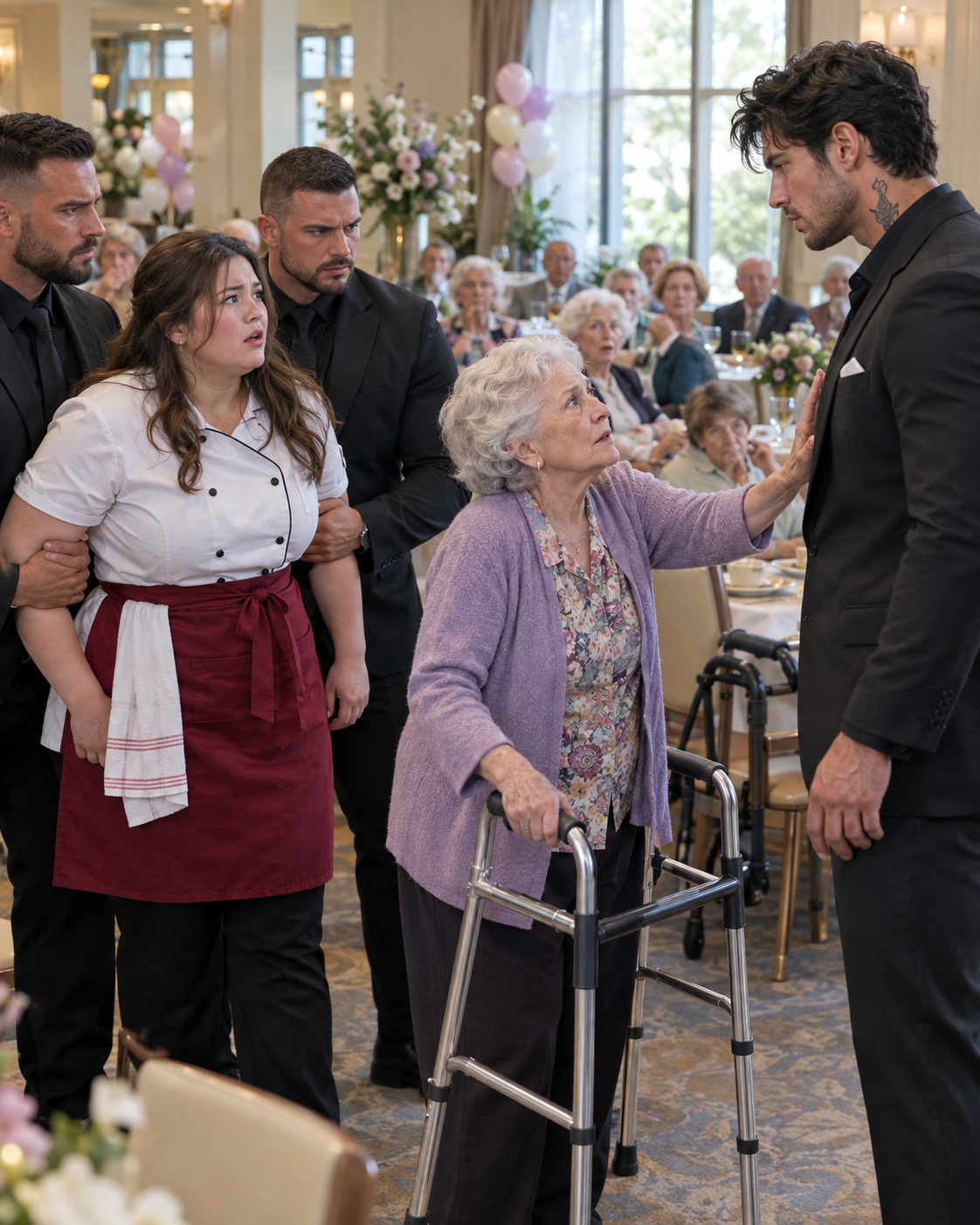
At Rosewood Senior Residence in the heart of the United States, Hannah Brooks had spent years doing something that seemed simple but meant everything to the people who lived there: she cooked for them
For several seconds, the hallway outside Rosewood’s administrative office was completely silent.
Hannah stood beside the dining room doorway, her hands folded tightly in front of her. Across from her, Dominic remained still, his expression unreadable as he studied the documents he had gathered during his investigation.
Behind them, the 67 residents waited.
No one wanted to leave.
No one wanted to be the first to break the silence.
Dominic finally looked up.
“The records don’t match Vanessa’s accusation,” he said.
A murmur moved through the hallway.
Hannah did not react immediately. She had spent too many hours imagining what it would feel like to hear those words. Relief. Anger. Vindication. Maybe even joy.
Instead, she felt tired.
“So I’m cleared?” she asked quietly.
Dominic nodded.
“The money wasn’t taken by you. The records were manipulated.”
Teresa Romano closed her eyes for a moment, as if she had been holding her breath for days.
One resident near the back whispered, “We knew it.”
Another replied, “Hannah would never do that.”
The words spread through the hallway, and for the first time since the accusation, Hannah allowed herself to breathe.
But Dominic wasn’t finished.
“There are missing financial records,” he continued. “And some of them connect directly to Vanessa’s office.”
Hannah looked toward the administrative wing.
“Then what happens now?”
Dominic’s jaw tightened.
“Vanessa is no longer going to be running Rosewood.”
The decision came quickly after that.
The evidence was presented. Vanessa was removed from her position, and the accusations against Hannah collapsed completely. What had started as an attempt to isolate one employee had exposed deeper problems inside Rosewood’s financial management.
For the residents, it was a victory.
For Hannah, it was something more complicated.
She had learned that being innocent wasn’t always enough. Sometimes, people needed courage to stand beside you before the truth had been proven.
And 67 people had done exactly that.
Over the next several weeks, Rosewood began to change.
Without Vanessa controlling every decision, the residents started asking questions about the future. Bills were reviewed. Contracts were examined. Expenses were discussed openly.
Dominic remained involved.
At first, Hannah appreciated his help.
He had the resources, connections, and financial knowledge Rosewood desperately needed. More importantly, he had proven that he was willing to investigate when everyone else might have simply accepted Vanessa’s version of events.
But Dominic had a habit Hannah quickly noticed.
He solved problems by taking control of them.
When he saw a broken system, he wanted to replace it.
When he saw uncertainty, he wanted to make the decision himself.
And when he saw Rosewood’s financial situation, he believed he had found a solution.
One afternoon, Dominic asked Hannah to meet him in the small conference room overlooking the courtyard.
He placed a folder on the table.
“I can fix this,” he said.
Hannah opened the folder.
Inside were financial projections, legal documents, debt figures, and a proposed agreement.
Dominic had arranged a plan to purchase Rosewood’s outstanding debt.
Hannah looked up.
“You want to buy the debt?”
“Yes.”
“And then?”
“I’d restructure the obligations, stabilize the property, bring in professional management, and protect the residents from another crisis.”
Hannah turned another page.
“Who would control the decisions?”
Dominic hesitated.
“I would have oversight.”
“That’s not what I asked.”
He leaned back.
“The people here need stability, Hannah.”
“They need a voice.”
“They need both.”
“But your plan gives you the final say.”
Dominic didn’t answer.
Hannah closed the folder.
“I know you mean well.”
His expression softened slightly.
“But?”
“But Rosewood isn’t a company waiting for someone to rescue it.”
Dominic frowned.
“It’s a community.”
“Exactly.”
“And communities can collapse when they don’t have money.”
“We know.”
“Then why fight the one person offering to put the money in?”
Hannah stood.
“Because there’s a difference between saving someone’s home and owning it.”
The words stayed between them.
Dominic looked at her for a long moment.
“You think I’d take it away from them?”
“I think you would make decisions for them because you believe you’re protecting them.”
“And what’s wrong with that?”
“Ask them.”
That was the moment everything changed.
Instead of another private conversation, Hannah called a residents’ meeting.
Every chair in the main common room was filled.
Some residents brought notebooks. Others brought old financial statements. Teresa sat near the front, watching her son carefully.
Dominic stood beside the wall.
Hannah faced the room.
“We have two problems,” she began. “We need money, and we need a way to protect Rosewood’s independence.”
A resident named Frank raised his hand.
“What if we could become part of the solution ourselves?”
Hannah looked at him.
“What do you mean?”
“We have assets. Savings. Families. Skills. People here used to run businesses, schools, hospitals, stores. We’re not helpless.”
The room became quiet.
Another resident nodded.
“My daughter works in finance. She said she could help us review the numbers.”
Someone else said, “My grandson is an attorney.”
A third voice called from the back, “I spent thirty years managing a nonprofit.”
Suddenly the meeting changed.
Instead of asking who would save Rosewood, they began asking what Rosewood could save for itself.
The idea of a resident-led cooperative began to take shape.
It wasn’t simple.
There were legal questions.
There were financial risks.
There were disagreements.
Some residents worried about contributing money. Others wondered whether they were too old to take on such a complicated project.
But Hannah kept bringing the conversation back to one point.
“No one is asking you to carry this alone.”
Dominic watched from the side.
For the first time, he saw something he had overlooked.
The residents weren’t simply people who needed protection.
They were people with decades of experience, relationships, knowledge, and determination.
They had spent their lives building communities.
Perhaps Rosewood didn’t need a single person at the top.
Perhaps it needed everyone at the table.
The following months were difficult.
Meetings stretched late into the evening.
Financial projections were rewritten.
Legal documents were reviewed.
Residents contributed what they could, while families and community supporters helped close the remaining gaps.
Dominic’s resources were still valuable, but Hannah refused to let them become the foundation of control.
Instead, Dominic began helping in a different way.
He connected Rosewood with advisers.
He helped negotiate with creditors.
He provided access to professionals who could explain complicated financial terms.
But every major decision went back to the residents.
At first, Dominic struggled with that.
One afternoon, he entered the office with a proposal.
“I’ve already spoken with the lender.”
Hannah looked up from her desk.
“Without the board?”
“I thought we could save time.”
She gave him a look.
He stopped.
“Right.”
He put the papers down.
“I’ll wait.”
Hannah smiled.
“You really are learning.”
“I don’t know whether I like the process.”
“You don’t have to like it.”
He smiled back.
“I suppose that’s the point.”
Their relationship changed quietly.
It wasn’t one dramatic moment.
It happened through small things.
Dominic began asking instead of instructing.
Hannah began trusting instead of assuming he would take over.
They disagreed often.
But the disagreements became conversations rather than battles.
And Teresa noticed everything.
One evening, she found Hannah sitting alone on the porch overlooking the courtyard.
“You’re worried,” Teresa said.
Hannah smiled.
“About the cooperative?”
“About my son.”
Hannah laughed softly.
“Both.”
Teresa sat beside her.
“Dominic has spent most of his life believing that responsibility means taking everything onto his own shoulders.”
“I noticed.”
“He thinks if he can solve a problem for someone, he has done his job.”
“And sometimes he forgets to ask whether they wanted the problem solved that way.”
Teresa smiled.
“Exactly.”
Hannah looked toward the courtyard.
“He’s changing.”
“He is.”
“And that’s not easy for him.”
“No.”
Teresa reached over and touched Hannah’s hand.
“But don’t change who you are just because you care about him.”
Hannah looked at her.
“I won’t.”
“Good.”
The cooperative plan was finally approved after months of work.
Rosewood would remain independent.
The residents would have a formal voice in major decisions.
Financial oversight would be transparent.
And no single outside investor would have the power to determine the community’s future alone.
When the final documents were signed, the common room erupted in applause.
Some residents cried.
Others hugged.
Frank raised his cane in the air.
“Sixty-seven of us!”
Everyone laughed.
Hannah stood at the center of the room, overwhelmed.
Then Dominic approached.
He didn’t hand her a contract.
He didn’t give her another plan.
He simply held out his hand.
“Congratulations,” he said.
She took it.
“We did it.”
He shook his head.
“They did it.”
Hannah looked around.
The residents were smiling.
“You’re right.”
Dominic squeezed her hand gently before letting go.
There was something different in his expression.
Respect.
Not the kind people showed because of his wealth or influence.
Something quieter.
Something earned.
A few weeks later, the cooperative board made another decision.
They asked Hannah to become Rosewood’s new executive director.
She initially refused.
“I’m the cook.”
Frank laughed.
“You’re the cook who stopped 67 people from losing their home.”
Another resident added, “You know everyone here.”
Teresa smiled.
“And they trust you.”
Hannah looked at Dominic.
He didn’t say anything.
She appreciated that.
He simply waited for her answer.
That was new.
Finally, Hannah accepted.
On her first morning as executive director, she walked into the kitchen before sunrise.
The familiar smell of coffee filled the air.
She tied her apron.
For a few minutes, everything felt exactly the same.
Then she heard footsteps.
Dominic appeared in the doorway.
“You realize executive directors aren’t usually supposed to make breakfast.”
“Then it’s a good thing I’m not usually an executive director.”
He laughed.
“What are you doing here?”
“I brought the financial report.”
She pointed toward a chair.
“Put it there.”
He did.
“And?”
“And what?”
“Don’t you have something else to say?”
He smiled.
“I wanted to ask if you need help.”
Hannah looked at him carefully.
“Are you offering?”
“I’m asking.”
She smiled.
“Then yes.”
He stepped into the kitchen.
They worked side by side.
No orders.
No assumptions.
Just two people doing something ordinary together.
Later that day, Dominic asked Hannah if she would have dinner with him.
Not a business dinner.
Not a meeting.
Not an emergency.
Just dinner.
She studied him.
“Are you asking me as Rosewood’s financial adviser?”
“No.”
“As Teresa’s son?”
“No.”
“As someone who thinks he can solve all my problems?”
He laughed.
“Definitely not.”
“Then who are you asking as?”
Dominic took a breath.
“Just me.”
Hannah smiled.
“Then yes.”
Their first official date was simple.
No expensive restaurant.
No private room.
No grand gesture.
They went to a small neighborhood restaurant in town, the kind of place where people knew one another and nobody cared about Dominic’s reputation.
They talked for hours.
About Rosewood.
About family.
About mistakes.
About the strange way two people could meet because of a crisis and discover something neither had expected.
At the end of the evening, Dominic walked Hannah to her car.
“I used to think being responsible meant having the answer,” he said.
“And now?”
“Now I think sometimes it means staying long enough to hear everyone else’s answer.”
Hannah smiled.
“That’s progress.”
He looked at her.
“I have one more thing to learn.”
“What?”
“How to stop overthinking this.”
She laughed.
Then she kissed him.
It was brief.
Quiet.
Nothing like the dramatic moments in movies.
But it meant something.
Because neither of them was trying to control what came next.
Back at Rosewood, life continued.
The dining room remained noisy.
Residents still argued about coffee.
Someone still complained that the television was too loud.
Someone else still hid cookies in the common room.
The building wasn’t perfect.
The cooperative didn’t erase every financial challenge.
Hannah didn’t magically solve every problem.
But something important had changed.
The people living at Rosewood knew they had a voice.
They had discovered that age had not made them powerless.
Their experience still mattered.
Their relationships still mattered.
Their choices still mattered.
And Hannah had learned something too.
Sometimes protecting a community doesn’t mean becoming the strongest person in the room.
It means making sure everyone in the room has a chance to speak.
Dominic learned his own lesson.
Helping someone doesn’t mean deciding their future for them.
Sometimes the greatest form of support is standing beside someone while they make their own decision.
Months after the crisis, Rosewood held a small celebration.
There were flowers in the dining room.
Someone brought a homemade cake.
Frank gave a speech that was supposed to last three minutes and lasted twenty.
Everyone laughed.
At the end, Hannah stood before the residents.
She looked at the 67 familiar faces.
“I thought the hardest day of my life was the day I was accused of something I didn’t do,” she said.
The room became quiet.
“But I was wrong.”
She paused.
“The hardest part wasn’t being accused. It was wondering whether anyone would believe me.”
She looked around.
“Then you opened your doors.”
A few residents wiped their eyes.
“You didn’t wait for perfect proof before you stood beside me. You reminded me that sometimes community means believing there is more to a person than one accusation.”
Hannah glanced at Dominic.
“And sometimes, the people who enter our lives during our hardest moments don’t just help us survive the crisis. They help us become different people afterward.”
Dominic smiled.
Teresa reached for his hand.
Hannah continued.
“Rosewood belongs to all of us. Not because we own every brick or every room, but because we chose to care about what happens here.”
The applause began slowly.
Then it grew.
Sixty-seven residents stood together.
Hannah looked around and smiled.
The story had begun with one accusation.
It had nearly ended with someone else taking control of their future.
Instead, it became a lesson about dignity, trust, and the strength of people who refuse to let fear make their decisions for them.
And somewhere along the way, Hannah and Dominic discovered that love works much the same way.
It cannot be built on control.
It cannot survive without trust.
And it becomes stronger when two people choose to stand beside each other rather than stand above one another.
Rosewood remained imperfect.
But it remained theirs.
And for the 67 people who had once gathered in a hallway because one of their own needed them, that was more than enough.
Six months after Hannah became Rosewood’s executive director, the residence had settled into a new rhythm.
The cooperative was functioning.
The financial reports were open for everyone to review.
The residents attended meetings with more confidence than before, and even Dominic had learned to sit quietly when someone else was speaking.
For Hannah, life had finally begun to feel peaceful.
Almost too peaceful.
On a cold Monday morning in February, Hannah arrived before sunrise and noticed an unfamiliar envelope lying beneath the front office door.
There was no name on it.
No return address.
Only three words written across the front:
“YOU SHOULD KNOW.”
She stood there for a moment before opening it.
Inside was a photocopy of an old financial statement from Rosewood.
Hannah recognized the letterhead immediately.
It was dated twelve years earlier, long before Vanessa had become director.
At the bottom of the page was a signature Hannah had never seen before.
Her eyes moved to the final line.
A payment had been made from an account connected to Rosewood to a private development company in Chicago.
The amount was enormous.
Hannah’s stomach tightened.
Someone had taken money from Rosewood long before Vanessa’s arrival.
She read the document again.
Then a second page slipped from the envelope.
This time, there was a handwritten note.
“Ask what happened to Building C.”
Hannah froze.
Rosewood had three main residential buildings.
Building A.
Building B.
And Building C.
But Building C had been closed for nearly a decade.
Officially, it had been condemned after a water-damage incident.
No one lived there.
No one used it.
Most residents barely remembered it.
Hannah folded the papers and placed them inside her desk.
She didn’t call Dominic.
Not yet.
She had learned something during the previous crisis.
Not every problem needed to be handed to the person with the most power.
Sometimes, the first step was simply understanding the question.
That afternoon, Hannah asked Frank about Building C.
He was one of the longest-term residents at Rosewood.
He stared at her for several seconds.
“Why are you asking?”
“I found an old document.”
His expression changed.
“What kind of document?”
“One that mentions money and Building C.”
Frank slowly lowered his newspaper.
“I was wondering when someone would finally ask.”
Hannah sat down.
“What do you know?”
Frank looked toward the window.
“Before you arrived, Rosewood nearly changed completely.”
“How?”
“There was a proposal to sell part of the property.”
“To whom?”
“I don’t remember the company’s name.”
“Try.”
Frank sighed.
“Westbridge Development.”
Hannah wrote it down.
“Why didn’t the sale happen?”
“Residents protested.”
“All of them?”
“Not all.”
Frank’s voice became quieter.
“There were people who thought selling was the only way to survive.”
Hannah felt a chill.
“Who?”
Frank didn’t answer immediately.
Then he said, “The board.”
Hannah returned to her office and searched through the cooperative’s archived files.
Most of the old records were incomplete.
Some had been damaged.
Others had simply disappeared.
But after nearly two hours, she found something.
An old board meeting record.
The date matched the financial statement.
One sentence had been underlined:
“Any transfer involving Building C must remain confidential until negotiations are finalized.”
Hannah stared at the page.
There had been negotiations.
But why had nobody told the residents?
And why had the money moved through a private company?
She called Dominic that evening.
He arrived twenty minutes later.
He walked into her office, took one look at her face, and stopped smiling.
“What happened?”
Hannah handed him the documents.
He read them silently.
When he finished, he looked at her.
“This could be serious.”
“I know.”
“Why didn’t you call me earlier?”
“Because I needed to know whether I was asking you for help or asking you to take over.”
Dominic paused.
Then he nodded.
“Fair.”
They spent the next several hours reviewing everything.
The old company still existed.
Westbridge Development had changed ownership twice, but its original corporate filings were available.
Dominic found something disturbing.
One of the company’s former consultants had later become a financial adviser to Rosewood’s old board.
Hannah leaned back.
“So it wasn’t Vanessa.”
“No.”
“Then who?”
“We don’t know yet.”
The next morning, Hannah called an emergency cooperative meeting.
Every seat was filled.
She placed the old documents on the table.
“We have discovered a financial transaction from twelve years ago involving Rosewood and a development company.”
The room went silent.
Teresa looked at her son.
Dominic remained quiet.
Hannah continued.
“We don’t know yet whether anyone did anything illegal. We are not going to accuse anyone without evidence.”
A resident raised her hand.
“Then why tell us?”
“Because this is our community.”
That sentence changed the mood in the room.
No panic.
No accusations.
Just attention.
The residents formed a small investigation committee.
Frank volunteered.
Teresa volunteered.
A retired accountant named Margaret joined them.
And Dominic agreed to provide legal and financial assistance, but only when requested.
For the first time, Hannah saw him deliberately step back.
It mattered.
The investigation lasted three weeks.
Then Margaret found something.
A property assessment from twelve years earlier.
Building C had been valued at nearly three times the amount recorded in Rosewood’s books.
Someone had deliberately undervalued it.
“Why?” Hannah asked.
Margaret looked at the numbers.
“Because if you’re trying to convince people to sell something cheaply, you first convince them it’s worth very little.”
The room fell silent.
They requested additional records.
What they found was even more troubling.
There had been a plan to purchase Building C at a fraction of its real market value.
The buyer would then renovate it and sell it to a larger development company.
Rosewood would have received a small payment.
The private company stood to make millions.
But the plan had collapsed after several residents refused to sign.
One of those residents was Teresa.
Hannah turned toward her.
“You knew?”
Teresa looked down.
“I knew something was wrong.”
“Why didn’t you tell us?”
“Because I didn’t know everything.”
Her voice trembled.
“At the time, I thought the deal was dead.”
Dominic reached for his mother’s hand.
“Why didn’t you tell me?”
Teresa smiled sadly.
“Because you were twenty-eight and convinced you could fix the entire world.”
Dominic laughed despite himself.
“That’s unfair.”
“It’s accurate.”
The room softened.
But Hannah’s attention remained on the documents.
“If the deal collapsed, why is there still a payment?”
Margaret pointed to the statement.
“That’s the question.”
They traced the money.
One transfer.
Then another.
Then another.
The final destination was an account belonging to a nonprofit organization.
At first, it looked like a dead end.
Then Margaret recognized the organization’s name.
“It was a charitable foundation.”
“Whose?”
Margaret searched the records.
Then she stopped.
“The founder was Samuel Brooks.”
Hannah’s face went pale.
“Brooks?”
Margaret nodded.
“Your father?”
Hannah couldn’t speak.
Her father had died years earlier.
He had never mentioned Rosewood’s financial problems.
He had never told Hannah that he had been involved in the old negotiations.
That night, Hannah went home with more questions than answers.
She opened an old box of family photographs.
There was one picture of her father standing outside Rosewood.
Hannah had seen it dozens of times.
But now she looked closer.
In the background stood a sign she had never noticed.
Westbridge Development.
Her hands began to shake.
The next morning, she found an old letter among her father’s papers.
She had kept the box untouched for years.
The letter was addressed to him.
It was from Teresa.
The date was twelve years earlier.
The message was short.
“Samuel, if they go through with the sale, the residents will lose more than a building. Please make sure they understand what they’re signing.”
Hannah sat on the floor.
Her father had known.
Teresa had known.
But what happened after that?
She called Teresa.
When the older woman arrived, Hannah placed the letter on the table.
Teresa closed her eyes.
“I wondered when you would find it.”
“Tell me everything.”
Teresa took a long breath.
“Your father wasn’t stealing from Rosewood.”
“I know.”
“He was trying to stop the sale.”
“Then why was money transferred?”
“Because he created a temporary fund.”
“For what?”
“To keep the property from being seized while the residents challenged the agreement.”
Hannah stared at her.
“My father saved Rosewood?”
“He tried.”
“What happened?”
Teresa looked away.
“He never told you because he didn’t want you carrying his battles.”
Hannah felt tears gather in her eyes.
“Did he succeed?”
Teresa nodded.
“The sale collapsed.”
“Then where did the money go?”
“Back to Rosewood.”
Hannah froze.
“All of it?”
“Almost.”
“What does that mean?”
Teresa hesitated.
“Some money disappeared.”
There it was.
The missing piece.
The mystery had never been completely solved.
Someone had taken money during the failed sale.
Not enough to destroy Rosewood immediately.
Just enough to leave a hidden weakness that would surface years later.
And now Hannah understood something else.
Vanessa’s manipulation had not created Rosewood’s financial problems.
She had inherited them.
The old corruption had simply been buried.
The investigation eventually identified the person responsible.
It was a former board treasurer who had quietly redirected part of the funds through the development company.
He had died years earlier.
There would be no courtroom confrontation.
No dramatic confession.
No final punishment.
Only documents.
Numbers.
And the truth.
The cooperative filed the necessary reports and recovered a portion of the remaining assets.
But Hannah insisted on something else.
She wanted the entire history preserved.
Not hidden.
Not rewritten.
Preserved.
“We can’t build a healthy community by pretending difficult things never happened,” she told the board.
So Rosewood created an archive.
Every major financial decision would be recorded.
Every resident would have access to the records.
Every future board would inherit the complete history.
And Building C?
It was reopened.
Not as luxury apartments.
Not as a private development.
The residents turned it into a community center.
There was a library.
A small art room.
A guest space for visiting family members.
And a kitchen where residents could teach younger people how to cook.
On the day the doors opened, Hannah stood outside with Dominic.
She looked at the renovated building.
“Your father would be proud,” Dominic said.
Hannah smiled.
“I think he’d be relieved.”
Dominic took her hand.
“What are you thinking?”
“That people spend years trying to protect places.”
“And?”
“Sometimes the best way to protect them is to make sure the next generation understands why they matter.”
He nodded.
A group of children from a nearby school entered the building for a cooking class.
Hannah watched them disappear into the kitchen.
For a moment, she saw Rosewood differently.
Not as a place where old people were waiting for life to become smaller.
But as a place where memories could become lessons.
Where experience could become guidance.
Where people of different generations could still learn from one another.
That evening, the residents gathered in the new community center.
Frank stood at the microphone.
“We’ve survived accusations, financial disasters, bad management, and more meetings than any human being should endure.”
Everyone laughed.
Then his voice softened.
“But we’re still here.”
Hannah looked around the room.
Sixty-seven residents had once stood together because one woman had been accused unfairly.
Now they were standing together because they had discovered something larger.
Their community was not valuable because it was perfect.
It was valuable because people cared enough to protect it.
Dominic leaned toward Hannah.
“Are you happy?”
She looked at him.
“Right now?”
“Yes.”
She smiled.
“Very.”
He kissed her forehead.
Across the room, Teresa watched them and smiled.
The old Rosewood had survived because people refused to surrender it.
The new Rosewood would survive because those people had finally learned how to share responsibility for it.
And Hannah understood the lesson she had been learning all along.
A home isn’t defined by walls.
It is defined by the people who refuse to let one another stand alone.
Years later, residents would still tell the story of the accusation against Hannah.
They would tell the story of Vanessa.
They would tell the story of Dominic arriving with a plan to take control and leaving with a lesson about trust.
They would tell the story of Building C.
But whenever someone asked Hannah what the most important part had been, she never mentioned the money.
She never mentioned the investigation.
She never mentioned the people responsible.
She simply pointed toward the dining room, where residents were laughing over dinner.
“That,” she would say.
“That’s what we were trying to save.”
And perhaps that was the greatest victory Rosewood ever achieved.
Not keeping a building.
Not balancing an account.
Not defeating an opponent.
But remembering that dignity, independence, and belonging are worth protecting—and that sometimes the strongest community is the one where nobody has to stand alone.
THE END.