At my own wedding in White Horn, Alberta, Tavish Moyer stared at the dress I made and coldly whispered, “That was never meant for you,” but the measurements told a darker truth.
Tavish’s fingers tightened around mine.
“Don’t look at the truck,” he whispered.
Too late.
I had already seen the driver’s door open.
A man stepped down.
He wore a dark wool coat despite the mild spring afternoon, and for one terrible second, I could not breathe.
There was something familiar about the way he stood.
Not his face.
His posture.
The same careful stillness I had noticed in the shadows outside my shop.
“Who is he?” I whispered.
Tavish did not answer.
The wedding guests were still gathered beneath the white canopy, laughing, drinking coffee, and congratulating us. My mother was speaking with Mrs. Harlow near the porch. The musicians had started packing their instruments.
Everything looked peaceful.
But Tavish’s eyes had changed.
“I should have told you before today,” he said.
“Then tell me now.”
He glanced toward the barn.
“The fraud wasn’t the whole story.”
My heart sank.
“What do you mean?”
“The cattle scheme was only one part of it.”
The man in the dark coat started walking toward us.
Tavish stepped slightly in front of me.
That small movement frightened me more than anything he could have said.
“Tavish.”
“Stay behind me.”
“I am not hiding behind you.”
He looked back at me.
For a moment, the hard rancher everyone in White Horn knew disappeared, and I saw the man who had sat quietly in my shop every Friday, watching me work as if my hands were performing something sacred.
“I’m not asking you to hide,” he said softly. “I’m asking you to trust me.”
The stranger stopped twenty feet away.
“Tavish Moyer.”
Tavish’s expression hardened.
“Jonah.”
The man’s eyes moved to me.
“So this is her.”
I felt a chill crawl up my spine.
“Who is Jonah?”
Tavish did not answer immediately.
Jonah smiled without warmth.
“Your husband has been keeping secrets.”
I looked at Tavish.
“Apparently.”
Jonah reached into his coat.
Tavish moved instantly.
“Don’t.”
Jonah stopped.
Then he slowly pulled out a photograph.
He held it between two fingers.
“Before anyone gets dramatic, look at this.”
I took the photograph.
It showed a much younger Tavish standing beside an older man in front of a cattle auction house.
The older man was Tavish’s father.
Beside them stood another man.
I recognized him immediately.
He was the same man whose name appeared on several of the suspicious company documents in the leather folder.
Elias Venn.
The accountant who had disappeared before the fraud investigation became public.
My fingers trembled.
“I thought he was gone.”
“He is,” Jonah said. “Gone from Alberta, anyway.”
Tavish’s jaw tightened.
“Why are you here?”
“Because Elias isn’t the one who started this.”
Silence fell between us.
“Then who did?”
Jonah looked directly at Tavish.
“Your father.”
The world seemed to tilt.
I stared at my husband.
“No.”
Tavish closed his eyes for a moment.
“I found out three months ago.”
My voice came out thin.
“You knew?”
“I suspected.”
“And you didn’t tell me?”
“I was trying to protect you.”
“From what?”
“From this.”
He gestured toward the photograph.
“My father was involved in the original scheme twenty years ago. He used shell companies to move cattle and land. When he died, I thought the records had been destroyed.”
Jonah interrupted.
“They weren’t.”
Tavish looked at him.
“Why didn’t you come forward?”
“Because I was waiting for proof.”
“Proof of what?”
“That the people who restarted the scheme were connected to your family.”
My stomach turned.
“Restarted?”
Jonah nodded.
“The fraud you uncovered was not some new crime committed by strangers. Someone revived the old network. They used the same companies, the same accounts, even some of the same hidden routes.”
I thought about the ledgers.
The missing cattle.
The unexplained payments.
Then I remembered something else.
The measurements.
The dress.
Tavish had come into my shop six months ago carrying a piece of paper with my measurements.
At the time, I had believed it was the strangest romantic gesture imaginable.
Now I suddenly wondered whether it had been something else.
“Tavish,” I said quietly.
He looked at me.
“Why did you really have my measurements?”
His face changed.
Jonah looked away.
Tavish swallowed.
“Because I was afraid you would be targeted.”
The answer hit harder than I expected.
“Targeted?”
“The night before I came to your shop, someone broke into my office.”
He paused.
“They didn’t take money. They didn’t take livestock records. They took one folder.”
“What folder?”
“A list of people who had access to the old accounts.”
My pulse quickened.
“Was my name on it?”
“No.”
He looked at me with unbearable sadness.
“But your mother’s was.”
Everything inside me went still.
“My mother?”
“She worked for my father twenty-two years ago.”
I stared toward the porch where my mother was still talking with Mrs. Harlow, completely unaware that my entire understanding of her life had just shifted.
“She never told me.”
“I don’t think she wanted you involved.”
Jonah spoke quietly.
“She wasn’t involved in the theft.”
Tavish nodded.
“She helped discover it.”
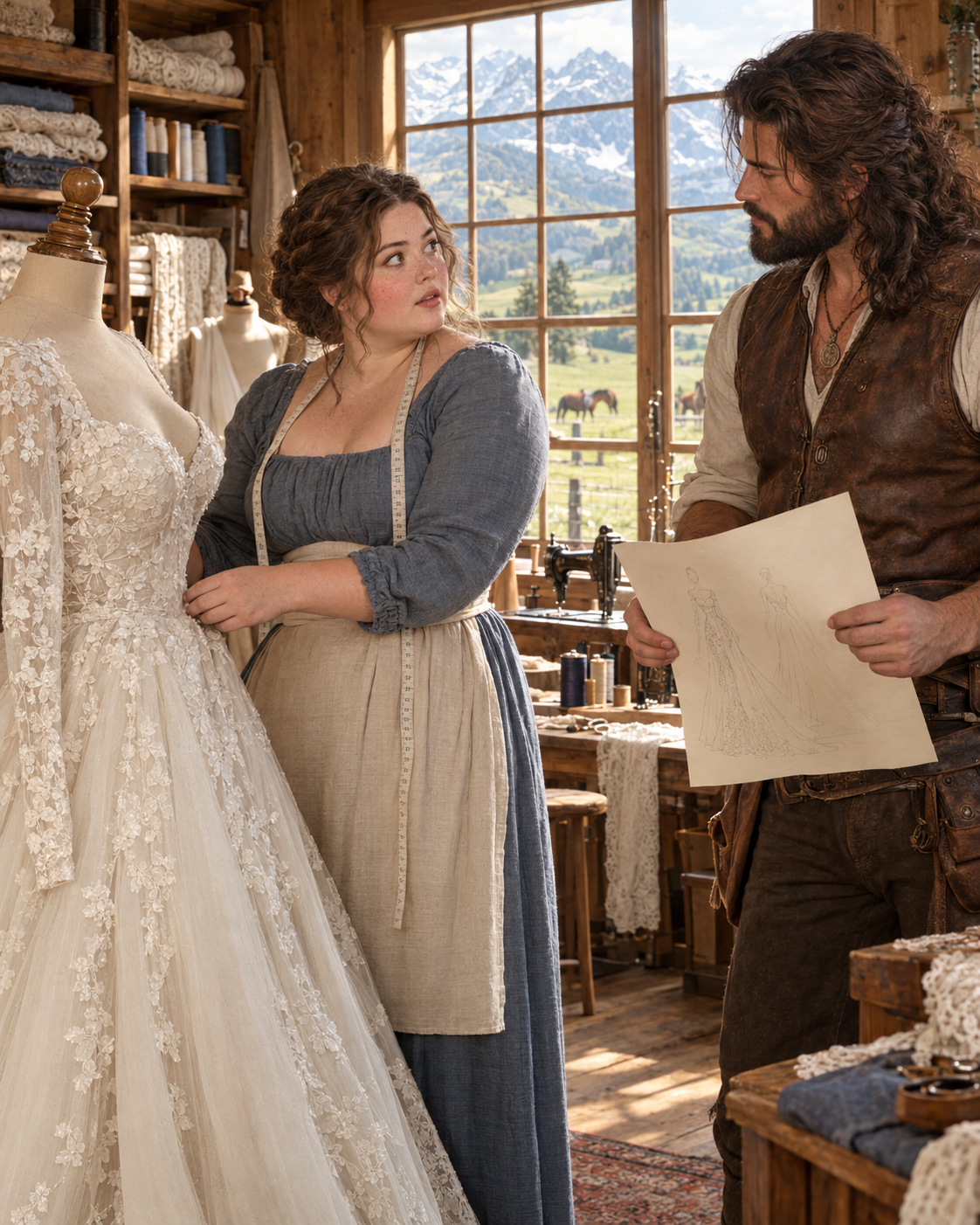
I looked at the dress I was wearing.
Suddenly, memories I had never understood began falling into place.
My mother’s old sewing box.
The locked drawer she never allowed me to open.
The strange numbers I had once found scribbled on scraps of fabric.
Her habit of becoming silent whenever someone mentioned Tavish’s father.
“Where is the drawer?”
I whispered.
“My mother’s house.”
Tavish stared at me.
“What drawer?”
“The one she never lets me open.”
Jonah stepped closer.
“You need to get it.”
“Why?”
“Because if your mother kept the original records, they’re probably still there.”
A cold wind moved across the yard.
Behind us, someone laughed.
The sound felt painfully distant.
Tavish took my hand.
“We’re going to your mother’s house.”
My mother saw our faces before we reached the porch.
She stopped speaking.
Her eyes moved from me to Tavish.
Then to Jonah.
All the color drained from her face.
“You found it,” she whispered.
I froze.
“Found what?”
She looked at Tavish.
“You told her?”
“No,” he said.
“Then why is he here?”
Jonah answered.
“Because the past finally caught up with all of us.”
My mother slowly sat down.
For several seconds, she said nothing.
Then she covered her face with both hands.
“I prayed this day would never come.”
I knelt in front of her.
“Mom, what did you do?”
She looked at me through tears.
“Nothing that should make you ashamed.”
“Then tell me.”
She took a long breath.
“Your father knew Tavish’s father.”
I had never known much about my father.
He had died when I was eight.
In my childhood memories, he existed mostly as a warm hand on my head and the smell of cedar on his coat.
“He worked at the ranch,” she continued. “He handled accounts. Your father discovered that cattle were being sold under false names.”
Tavish’s eyes darkened.
“My father knew?”
“Yes.”
“And he threatened him?”
My mother looked down.
“He told your father to keep quiet.”
I felt my throat tighten.
“What happened?”
“Your father refused.”
She paused.
“Three days later, he was killed in a truck accident.”
Nobody spoke.
The silence became unbearable.
I had spent twenty years believing my father’s death had been an accident.
My mother had allowed me to believe it.
“Was it really an accident?”
She shook her head slowly.
“I don’t know.”
That answer was somehow worse.
“But I knew enough to be afraid.”
She stood and walked into the house.
We followed.
She went to the small sewing room where I had learned to sew, where every hem, every button, and every stitch of my childhood had begun.
She opened an old wooden cabinet.
Then she removed a box from the back.
Inside was my mother’s sewing ledger.
Underneath it was a bundle of letters tied with faded blue ribbon.
She placed them on the table.
“The first one came two weeks before your father’s death.”
I opened it.
The handwriting was unfamiliar.
The message was short.
STOP LOOKING.
The second letter was worse.
WE KNOW WHERE YOUR DAUGHTER GOES TO SCHOOL.
My hands began shaking.
Tavish moved beside me.
“Why didn’t you tell anyone?”
“Who would have believed me?” my mother whispered. “Your father was dead. Tavish’s father was respected. Everyone in White Horn thought he was a good man.”
I looked at the letters.
“Why keep them?”
“Because one day I knew someone would need to know the truth.”
Jonah examined the documents.
“There are account numbers here.”
Tavish looked over his shoulder.
“These are the original numbers.”
Jonah’s face tightened.
“Then we finally have what we need.”
A noise came from outside.
A car door slammed.
Everyone froze.
Tavish moved toward the window.
I followed.
A second black truck was parked across the road.
Then a third vehicle turned the corner.
“How did they find us?”
Jonah’s expression hardened.
“Someone followed us.”
Tavish grabbed the documents.
“Everyone stays inside.”
I caught his arm.
“No.”
He looked at me.
“I’ve spent my whole life being told that fear means I should become smaller.”
I held his gaze.
“Not today.”
His expression softened.
“You’re my wife.”
“And you’re my partner.”
For the first time that afternoon, he smiled.
“Always.”
Then the front door rattled.
Someone knocked.
Three slow knocks.
My mother whispered, “Oh God.”
A voice came from outside.
“Mrs. Bell? We know you’re in there.”
Jonah looked at Tavish.
“Police?”
“No.”
Tavish locked the door.
The voice came again.
“Give us the letters, and nobody gets hurt.”
I looked down at the blue ribbon in my hand.
Something clicked inside my mind.
“The letters aren’t the evidence they want.”
Tavish frowned.
“What?”
“The numbers.”
I spread the documents across the table.
“Look.”
I pointed to the measurements written in the margins.
Everyone stared.
“They’re not just account numbers.”
Jonah leaned closer.
“What are they?”
“Coordinates.”
Tavish’s eyes widened.
“Coordinates for what?”
I grabbed my mother’s old sewing ledger.
Each page contained numbers beside fabric names, measurements, and dates.
To anyone else, it looked like the ordinary records of a dressmaker.
But my mother had been teaching me numbers my entire childhood.
Not because she loved accounting.
Because she wanted me to learn how to hide information in plain sight.
I flipped through the pages.
“She used measurements as a code.”
Tavish stared at me.
“Can you read it?”
“I think so.”
Outside, someone struck the door.
My mother flinched.
I continued.
Bust.
Waist.
Hip.
Sleeve.
Shoulder.
The same five measurements I had taken from Tavish’s paper six months earlier.
Suddenly, the dress made sense.
My heart began pounding.
“Tavish.”
“What?”
“Your measurements weren’t mine.”
He stared at me.
“I thought they were.”
“They were my mother’s.”
The room fell silent.
I looked at the numbers again.
They corresponded to dates and locations.
The dress had never been intended for another woman.
It had been a message.
A message my mother had created years ago and somehow expected me to understand.
Tavish stepped closer.
“What does it say?”
I translated the sequence.
Then my blood ran cold.
“It says the original records are hidden beneath the old barn.”
Tavish looked toward the window.
The old barn stood less than a hundred yards away.
The same barn where the black truck had appeared.
Jonah cursed under his breath.
“They’re already there.”
Tavish grabbed his coat.
“We go now.”
My mother caught his sleeve.
“You can’t.”
“If they find those records, everything disappears.”
“I’ve already lost one husband.”
Her voice broke.
“I’m not losing my daughter too.”
I took her hand.
“You’re not.”
Then I looked at Tavish.
“We’re ending this.”
We left through the back door.
Snowmelt soaked our boots as we crossed the field.
The barn stood dark against the pale sky.
The black trucks were parked behind it.
Two men were carrying wooden crates.
Tavish pulled me behind a fence.
“Stay here.”
I shook my head.
“I know what we’re looking for.”
Jonah whispered.
“There are four of them.”
Tavish studied the barn.
Then he pointed toward the side entrance.
“Jonah, take the north side.”
Jonah nodded.
I looked at Tavish.
“And me?”
“You stay with me.”
We moved silently.
The barn smelled of hay, oil, and damp wood.
One of the men was kneeling beside a loose floorboard.
He pulled it up.
Underneath was a metal box.
My heart stopped.
“They found it.”
Tavish stepped forward.
“Walk away.”
The men turned.
One reached inside his coat.
Jonah appeared behind him.
“Don’t.”
The man froze.
For a few seconds, nobody moved.
Then the barn doors opened.
Police officers entered.
My breath caught.
Tavish looked at me.
“You called them?”
I nodded.
“Before we left the house.”
The officers moved quickly.
Within minutes, the men were in handcuffs.
The metal box was opened.
Inside were ledgers, bank records, land deeds, and photographs.
Evidence spanning more than twenty years.
Evidence that connected Tavish’s father to the original scheme and the men who had revived it.
Tavish stared at the documents.
I stood beside him.
He looked devastated.
“Are you all right?”
“No.”
He closed his eyes.
“I spent my whole life believing my father built something honest.”
“You didn’t build his mistakes.”
He looked at me.
“Neither did you.”
A few days later, the investigation became the biggest story White Horn had seen in decades.
The authorities confirmed that the original fraud had involved land transfers, livestock records, and concealed financial accounts.
Several people were arrested.
Others agreed to testify.
The truth about my father’s death remained uncertain, and the authorities reopened that investigation as well.
There were no easy answers.
No perfect ending.
Some wounds did not disappear simply because the truth had finally been spoken.
But something else changed.
White Horn changed.
The women who had once whispered about me started coming into my shop.
Not to gossip.
To order dresses.
To ask for work.
To tell me stories they had kept hidden for years.
Mrs. Harlow was one of them.
She stood in my doorway one morning, holding her purse tightly.
“I owe you an apology.”
I smiled politely.
“You don’t owe me anything.”
“Yes, I do.”
She looked down.
“I thought being cruel made me important.”
I said nothing.
She sighed.
“It didn’t.”
Then she left.
I watched her disappear down the street.
Tavish found me that evening in the workroom.
He leaned against the doorframe.
“You’re busy.”
“Always.”
He looked around at the dresses hanging from the walls.
“You’ve expanded.”
I smiled.
“Three new employees.”
“Three?”
“Four if you count me.”
He laughed.
Then he placed something on the cutting table.
The battered leather folder.
I raised an eyebrow.
“Why are you giving me that?”
“Because I have a new business proposal.”
I opened it.
Inside were plans for a new ranch office and a small agricultural bookkeeping service.
At the top was a name.
Moyer & Bell.
I stared at him.
“You want me to do the books?”
“I want you to do whatever you want.”
He leaned closer.
“But I thought you might like having a second business where nobody can tell you that a woman who sews dresses doesn’t understand numbers.”
I smiled.
“I understand numbers very well.”
“I know.”
He kissed my forehead.
“That’s why I married you.”
Years passed.
The ranch survived.
The investigation eventually led to convictions, though not everyone involved was punished.
My father’s death remained a mystery, but the official investigation concluded that there was insufficient evidence to prove exactly what had happened.
I learned to live with that uncertainty.
Not because it stopped hurting.
Because I finally understood that closure does not always come in the form of an answer.
Sometimes closure is simply refusing to let an unanswered question control the rest of your life.
My dress shop grew too.
What began as a little room with one sewing machine became a bright storefront on the main street.
Above the door hung a simple sign.
BELL & THREAD.
Underneath, in smaller letters, were the words:
MADE FOR WOMEN WHO KNOW THEIR WORTH.
Every March, on the anniversary of our wedding, Tavish and I returned to the old barn.
Not because we enjoyed remembering what happened there.
Because we wanted to remember what came after.
One spring evening, years after the wedding, we stood outside while our daughter ran through the grass.
She had my stubbornness and Tavish’s quiet eyes.
She stopped beside me and pointed toward the barn.
“Mom, is that where you found the treasure?”
I laughed.
“Something like that.”
“What was inside?”
“Truth.”
She frowned.
“That’s not treasure.”
I looked at Tavish.
He smiled.
“It can be.”
Our daughter ran away again.
I rested my head against Tavish’s shoulder.
“Do you remember what you said to me at the wedding?”
“Which part?”
“The part where you said there was one more thing you never told me.”
He laughed.
“I was trying to make an entrance.”
“You nearly gave me a heart attack.”
“I know.”
I looked toward the barn.
“Do you ever wish you had never brought me into any of it?”
He was quiet for a moment.
“No.”
“Not even once?”
“No.”
“Why?”
He took my hand.
“Because I spent years thinking strength meant carrying everything alone.”
He looked at me.
“Then I met you.”
I smiled.
“And?”
“And I learned that the right person doesn’t make your burdens disappear.”
He squeezed my fingers.
“They help you carry them.”
The sun lowered behind the Alberta hills.
The same hills that had watched our story begin.
The same town that had once decided what I was worth before ever asking who I was.
I thought about the dress.
The measurements.
The rumors.
The locked drawer.
The letters.
The black truck.
The hidden records.
And the woman I had been before Tavish entered my shop.
She had been talented.
Hardworking.
Kind.
But she had spent too many years believing she had to earn the right to take up space.
I no longer did.
That was the real gift hidden inside the story of that dress.
Not the marriage.
Not the ranch.
Not even the truth we uncovered.
It was the discovery that my value had never depended on whether someone chose me.
I had value before Tavish loved me.
Before anyone believed me.
Before White Horn respected me.
The dress had not made me worthy.
Tavish had not made me worthy.
The truth had not made me worthy.
I had simply stopped hiding the worth that had been there all along.
Years later, people still asked me about that wedding dress.
They wanted to know who it had originally been made for.
Whenever they asked, I smiled.
“Me.”
They usually laughed because they expected a more complicated answer.
But I never changed it.
Because sometimes the most important truth in a person’s life is the one they almost missed because they were too busy believing they weren’t meant to receive it.
The dress was never meant for another woman.
The ranch was never meant to belong to someone else’s legacy.
My life was never meant to be lived in the shadow of other people’s expectations.
And neither is yours.
Because people will measure you.
They will decide your worth using numbers, names, money, reputation, beauty, family, or status.
They will tell you what you can become and what you should accept.
Sometimes, if you believe them long enough, you will begin measuring yourself the same way.
But worth is not a measurement.
It cannot be written on a piece of paper.
It cannot be calculated in a ledger.
And it cannot be taken away by people who refuse to see it.
I learned that on my wedding day, standing beneath a pale Alberta sky, wearing the dress I once thought belonged to someone else.
The measurements had told a darker truth.
But they had also revealed something beautiful.
The person I had been waiting for was never coming to save me.
She was already there.
She was me.
And once I finally understood that, I stopped waiting for permission to become the woman I had always been.
THE END.