“At midnight, the Salvatores will take you.” The mafia boss said it like he was discussing the sale of an old car.
Rafe’s laughter echoed through the basement, sharp and unsettling.
“You really don’t know, do you?” he asked, staring at Corrado. “You’ve been selling pieces of your own empire to the man standing beside you.”
Ottavio’s face changed.
It was only a flicker, but Ilsa noticed. The same man who had spent sixty days treating her like dirt suddenly looked terrified.
“He’s lying,” Ottavio snapped. “He’s trying to turn us against each other.”
Rafe smiled through his bloodied teeth.
“Then ask him why the Salvatores are arriving tonight instead of tomorrow.”
Corrado’s pistol remained pointed at his underboss.
“Explain.”
Ottavio opened his mouth, but a violent explosion shook the mansion before he could answer.
Dust rained from the ceiling. The emergency lights flickered red.
One of the guards pressed a hand to his earpiece.
“Boss, we’ve lost the west entrance. At least twenty armed men are coming through the gardens.”
Corrado cursed.
“Get everyone to the underground garage. Now!”
Ottavio took a cautious step backward.
“Boss, we need to—”
“Don’t move.”
The command froze him.
Corrado turned toward Ilsa.
“You. Come here.”
She didn’t move.
For sixty days, she had obeyed every order because disobedience meant hunger, bruises, or another night locked in the freezing laundry room.
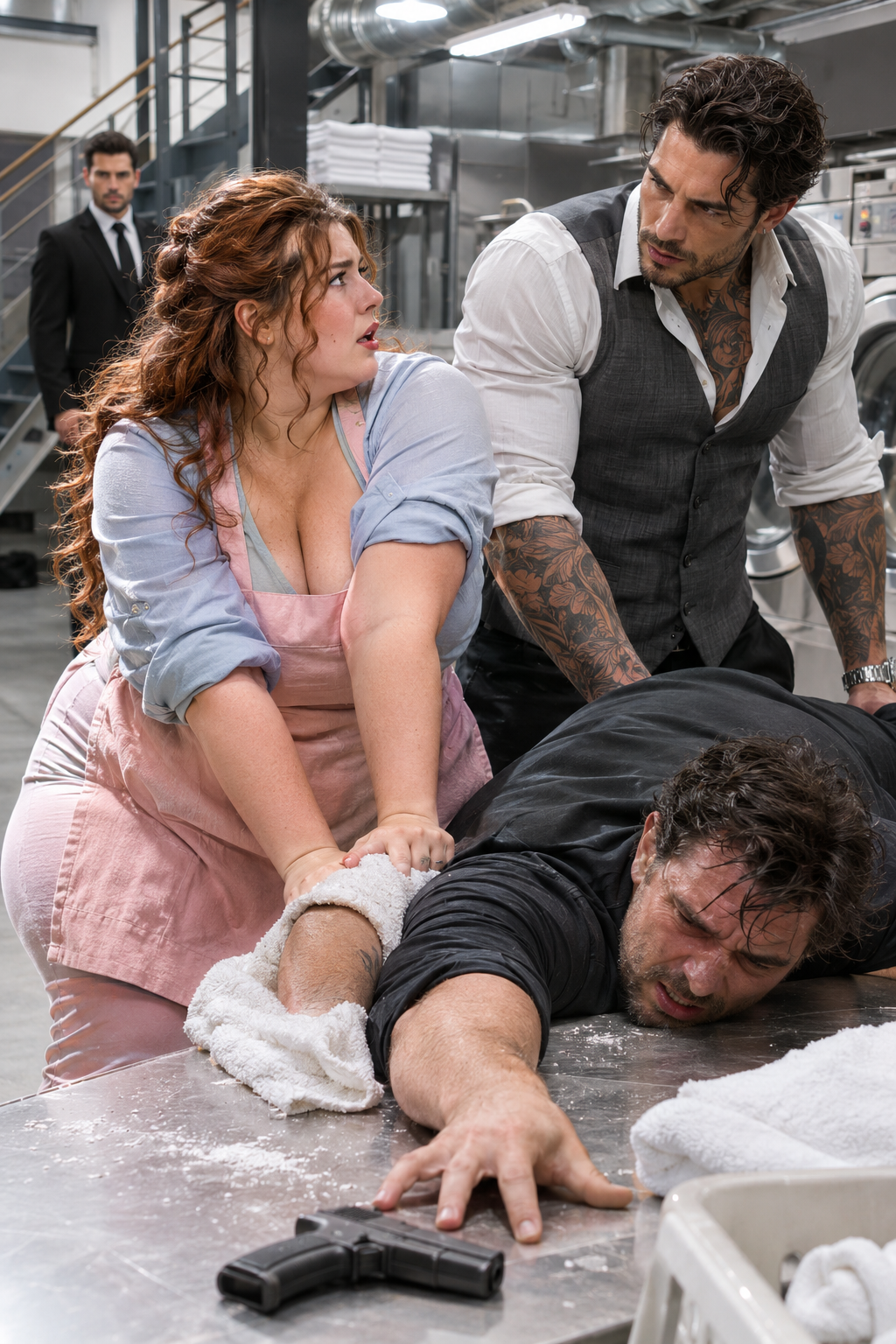
But something had changed when she wrapped that bedsheet around Rafe’s arm.
For the first time, she had seen a dangerous man helpless because of something she could do.
And she had discovered that fear did not always have to win.
“No,” she said.
Corrado stared at her.
“What?”
“I said no.”
The basement fell silent except for the distant gunfire.
Ilsa swallowed, but she kept her chin raised.
“You brought me here because of my father’s debt. You made me work until my hands bled. And now you’re selling me to people I’ve never met.”
Her voice trembled.
“I’m not following you anywhere.”
Corrado studied her for a long moment.
Then something unexpected happened.
He lowered his gun.
“You’re right about one thing,” he said quietly. “You should never have been brought here.”
Ottavio turned sharply.
“Boss?”
Corrado ignored him.
“Your father owed me forty thousand dollars. That much is true. But I never ordered anyone to take his daughter.”
Ilsa felt the floor shift beneath her.
“What?”
Corrado looked at Ottavio.
“I ordered you to collect the debt. You told me the girl volunteered to work it off.”
Ottavio’s expression hardened.
“She did.”
“No,” Ilsa whispered.
Then louder, “I didn’t.”
She remembered the night Ottavio arrived at her father’s apartment. Three men had dragged her down the stairs while her father screamed that he would find the money.
She remembered Ottavio telling her that Corrado personally wanted her brought to the mansion.
Corrado’s eyes narrowed.
“How much did you tell her she owed?”
Ottavio said nothing.
“Answer me.”
“Forty thousand.”
Corrado glanced toward the laundry room’s small security camera.
“And how many hours has she worked?”
“That’s irrelevant.”
“How many?”
Ottavio’s jaw tightened.
“Enough.”
Rafe began laughing again.
“There’s your problem, Vane. You built an empire where everyone fears you so much that nobody tells you the truth.”
Corrado turned his gun toward Rafe.
“One more word.”
But Ilsa was no longer listening.
She was staring at Ottavio.
Because suddenly, she remembered something.
Three nights earlier, while folding sheets outside his private office, she had heard him speaking on the telephone.
He had said, “The girl is worth more than the debt. Salvatore agreed to the price.”
At the time, she thought he meant forty thousand dollars.
Now she understood.
“How much?” she asked.
Ottavio looked at her.
“What?”
“How much were they paying you for me?”
His silence answered before his mouth did.
Corrado slowly turned toward him.
“Ottavio.”
The underboss wiped sweat from his forehead.
“Two hundred thousand.”
Ilsa’s stomach twisted.
Two hundred thousand dollars.
That was the price someone had placed on her life.
Corrado’s expression became unreadable.
“You arranged a private sale using my name?”
Ottavio’s eyes darted toward the stairs.
“I was trying to recover our losses.”
“By selling a woman?”
“Don’t pretend you’re suddenly a saint!”
The words burst from Ottavio with desperate fury.
“You’ve made millions through fear, Corrado. You’ve buried men for less than what her father owed. You taught me that everything has a price!”
Corrado didn’t answer.
For one terrible second, Ilsa thought he might shoot him.
Instead, Corrado said, “Take him upstairs.”
Two guards grabbed Ottavio.
He struggled violently.
“You don’t understand! Salvatore isn’t coming for the girl anymore!”
Rafe’s smile vanished.
Corrado stepped closer.
“What did you say?”
Ottavio looked at Ilsa with naked hatred.
“She’s not the merchandise.”
He began laughing, but there was nothing joyful in the sound.
“She’s the witness.”
A second explosion tore through the mansion.
The basement lights went black.
Someone screamed.
Gunfire erupted at the top of the stairs.
Ilsa dropped instinctively behind a washing machine as bullets struck the steel railing.
A guard collapsed near the doorway.
Another fired blindly into the darkness.
Corrado shouted orders, but his voice disappeared beneath the chaos.
Then someone grabbed Ilsa’s ankle.
She nearly screamed.
It was Rafe.
His wrists were still bound with the bedsheet.
“Listen to me,” he hissed. “If you want to live, get me out of these.”
“Why would I?”
“Because the men upstairs aren’t here to rescue anyone.”
A bullet shattered a light fixture above them.
Glass sprayed across the floor.
Rafe flinched.
“Please.”
That word startled her.
Men like him did not say please.
Not to women like her.
Ilsa looked toward the stairs.
A shadow appeared in the doorway, carrying a rifle.
She reacted without thinking.
Grabbing a bucket of detergent, she hurled its contents across the wet floor.
The armed man stepped forward, slipped violently, and crashed against the railing.
His rifle clattered away.
Corrado’s remaining guard subdued him.
Ilsa turned back to Rafe.
“Tell me who you really are.”
Rafe hesitated.
Then he said, “My name is Rafael Cordell. I’m an investigator.”
Ilsa stared at him.
“An investigator?”
“Federal organized crime task force. I’ve been undercover for eighteen months.”
She glanced at his pistol.
“You came here to kill Corrado.”
“I came here to retrieve evidence. The shooting started before I reached the house.”
“Evidence of what?”
Rafe looked directly at her.
“Human trafficking. Money laundering. And the murder of twelve people who tried to expose the Salvatore organization.”
A chill traveled down her spine.
“Why did you tell Corrado you were an assassin?”
“Because I needed him to believe I worked for his enemies. My cover was already compromised.”
Another burst of gunfire echoed upstairs.
Rafe leaned closer.
“Someone inside this house has been sending Salvatore information for months. I thought it was Ottavio.”
“You were right.”
“Only partly.”
His expression darkened.
“There’s someone else.”
Before Ilsa could ask who, a voice came from behind them.
“Step away from him.”
Corrado stood in the emergency doorway, his pistol raised.
Blood stained his left sleeve.
He looked exhausted, but his eyes remained cold.
“Federal investigator,” he repeated.
Rafe slowly lifted his bound hands.
“You heard.”
“I heard enough.”
Corrado aimed at his chest.
Ilsa stepped between them.
“Don’t.”
“Move, girl.”
“No.”
His eyes flashed.
“You have no idea what you’re interfering with.”
“Then explain it.”
For a moment, Corrado looked genuinely surprised.
Ilsa took another step forward.
“If he’s telling the truth, he’s the only person here who might get us out alive.”
Corrado glanced at the stairs.
The gunfire had moved closer.
Finally, he lowered his weapon.
“Untie him.”
Ilsa pulled the wet cotton loose.
Rafe rubbed his wrists.
“There’s a service tunnel beneath the boiler room,” Corrado said. “It leads beyond the eastern wall.”
Rafe shook his head.
“They’ll have it covered.”
“How would you know?”
“Because Salvatore’s men have been studying this mansion for weeks.”
Corrado went still.
“Who gave them the plans?”
Rafe looked toward the darkened hallway.
“Your head of security.”
A soft metallic click came from behind Corrado.
Everyone turned.
A tall man stood in the doorway.
His name was Dario Bellini.
Ilsa recognized him immediately.
He was the security chief who inspected the basement every evening, always carrying a silver cigarette case.
Now he carried a suppressed pistol.
“Very good, Agent Cordell,” Dario said.
Corrado’s face drained of color.
“Dario?”
The security chief smiled.
“Sorry, boss. Loyalty doesn’t pay nearly as well as betrayal.”
He fired.
Corrado staggered backward, clutching his shoulder.
Rafe lunged toward Ilsa, pulling her behind a steel table.
Another shot struck the wall.
Dario advanced calmly.
“Salvatore wants the girl alive,” he called. “The rest of you are optional.”
Ilsa’s mind raced.
Why did Salvatore want her alive?
She had no connections, no money, no influence.
She was only the daughter of a gambling addict.
Unless—
A memory surfaced.
Her father, sitting at their kitchen table three months earlier, staring at a small black flash drive.
He had been crying.
She remembered asking what was wrong.
He had told her, “If anything happens to me, remember that I did one good thing.”
The next morning, he disappeared.
Ottavio arrived two days later.
Ilsa had assumed her father ran away to escape the debt.
Now she wasn’t so sure.
“Dario!” she shouted.
The shooting stopped.
“What?”
“If Salvatore wants me alive, you can’t shoot me.”
A pause.
“That’s correct.”
“Then let the others go.”
Dario laughed.
“You’re in no position to negotiate.”
Ilsa looked toward the enormous industrial washing machine beside her.
Its drain hose lay across the floor, disconnected during the power failure.
Beyond it stood the old wringer, its heavy steel rollers locked in place.
She had cursed that machine every day since it broke.
Now she noticed something she had never considered before.
The emergency power panel was mounted directly above it.
And the floor was covered with water.
Ilsa whispered to Rafe, “Can you reach the breaker?”
He followed her gaze.
Understanding flashed across his face.
“That could kill someone.”
“Then tell him to stay where he is.”
Rafe looked at her for one brief second.
Then he shouted, “Dario! Federal agents are already surrounding the property!”
Dario fired toward his voice.
Ilsa grabbed a heavy sheet and threw it across the room.
The wet fabric struck Dario’s pistol arm.
He stumbled.
Rafe surged forward and slammed him against the steel table.
The gun discharged into the ceiling.
Ilsa ran toward the emergency panel.
She seized a wooden broom handle and slammed it against the breaker switch.
The lights flickered.
A violent crack split the air.
Sparks erupted near the damaged washing machine.
Dario recoiled from the electrified water spreading across the floor, dropping his weapon as he scrambled onto a dry concrete step.
Rafe struck him once, hard, and pinned him there.
“Don’t move!”
Ilsa released the broom.
Her entire body shook.
For several seconds, nobody spoke.
Then Corrado, bleeding heavily, whispered, “Get the girl out.”
Rafe looked toward him.
“You need medical attention.”
“I need you to get her out.”
Corrado pressed a bloodied hand against his shoulder.
“And when you reach your people, tell them I’ll cooperate.”
Rafe stared at him.
“You understand what that means?”
Corrado looked at the fallen guards.
Then at Ilsa.
“Yes.”
The distant gunfire suddenly stopped.
Silence settled over the mansion.
It was somehow more frightening than the noise.
Rafe approached the basement window and listened.
Then his radio crackled.
“Agent Cordell, this is Mercer. Tactical teams have secured the northern perimeter. Identify your position.”
Rafe closed his eyes in relief.
“Basement laundry. Multiple wounded. One civilian hostage. Send medical assistance immediately.”
Ilsa felt her knees weaken.
They were coming.
Real police officers.
People who might finally believe her.
But the radio crackled again.
“Negative, Cordell. Hold position. We have a developing situation.”
Rafe frowned.
“What situation?”
A voice came through, cold and precise.
“Salvatore has your civilian’s father.”
Ilsa stopped breathing.
Rafe slowly turned toward her.
The radio continued.
“He’s demanding an exchange. The girl for the father. Ten minutes.”
For the first time that night, Ilsa screamed.
“My father is alive?”
Nobody answered immediately.
Then Rafe said quietly, “Yes.”
The relief lasted only a heartbeat.
Because the voice on the radio added, “Salvatore says she knows where the ledger is.”
Ilsa stared at the speaker.
“What ledger?”
Corrado lifted his head.
“Your father wasn’t just a gambler.”
She turned toward him.
“What?”
“He worked as an accountant for the Salvatores. He handled their offshore transfers, false invoices, and hidden payments.”
Ilsa shook her head.
“No. My father repaired elevators.”
“That was his legitimate job,” Corrado said. “But five years ago, he started moving money for them.”
Rafe crouched beside her.
“Your father contacted federal authorities four months ago. He claimed he had copied their financial records.”
“Then why didn’t you protect him?”
Rafe’s silence told her more than his words could have.
“We tried.”
Ilsa felt anger rising through her fear.
“You tried?”
“He disappeared before we could secure him.”
She turned away.
For sixty days, she had believed her father had abandoned her.
Now she learned that he had been trapped inside the same nightmare.
Rafe continued carefully.
“Salvatore believes your father gave you the evidence.”
“I don’t have anything.”
“Think, Ilsa. Did he leave you a package? A key? Anything unusual?”
She closed her eyes.
She remembered the flash drive.
But her father had taken it away before she could touch it.
Then another memory surfaced.
The night before he disappeared, he had given her a small silver locket.
It had belonged to her mother.
He had said, “Keep this close. Some things are safer with you than with me.”
Ilsa reached beneath her collar.
The chain was still there.
Ottavio had searched her pockets when she arrived at the mansion, but he had never taken the necklace.
She pulled it free.
Rafe leaned closer.
“May I?”
Ilsa hesitated, then handed it to him.
The locket was shaped like a tiny heart, its silver surface scratched from years of wear.
Rafe examined the clasp.
There was a barely visible seam beneath the hinge.
He pressed it.
A hidden compartment opened.
Inside was a tiny memory card.
For a moment, neither of them moved.
Then Rafe whispered, “My God.”
Ilsa stared at the card.
Two months of captivity.
Sixty days of aching hands.
All because she had been carrying something worth more than the entire mansion.
Corrado gave a humorless laugh.
“Your father hid the evidence in plain sight.”
Rafe removed the card and placed it inside a sealed evidence pouch from his jacket.
“We need to get this to the task force.”
Ilsa closed her fingers around the empty locket.
“What about my father?”
Rafe looked at her.
“We’re going to get him back.”
But Ilsa had heard promises before.
She knew how easily men made them.
And how rarely they kept them.
Outside, engines roared.
The radio crackled once more.
“Five minutes, Cordell. Salvatore is threatening to execute the hostage.”
Ilsa stood.
“Tell him I’ll come.”
Rafe shook his head immediately.
“No.”
“He’s my father.”
“And Salvatore will kill you both.”
“Then what do you suggest?”
Rafe looked toward the ceiling.
He had no answer.
Ilsa took a breath.
“I do.”
Twenty minutes later, the mansion’s front gates opened.
A black sedan rolled slowly into the courtyard.
Inside sat Ilsa, with Rafe beside her.
Her hands were visible on her lap.
Her face was pale.
But her eyes were steady.
Beyond the shattered fountain stood a man in a charcoal suit.
Lorenzo Salvatore.
He was older than Ilsa expected, with silver hair and a face that might have belonged to a respectable banker.
Two armed men stood beside him.
Between them knelt Ilsa’s father.
His face was bruised.
His wrists were bound.
But he was alive.
“Ilsa!” he shouted.
She nearly opened the car door.
Rafe caught her wrist.
“Remember the plan.”
She nodded.
Salvatore smiled when the sedan stopped.
“Miss Adler. What a pleasure.”
Ilsa stepped out.
“Let my father go.”
“Of course. As soon as you give me what belongs to me.”
She held up the silver locket.
Salvatore’s eyes sharpened.
“Very clever.”
“You’ll get it when he’s safe.”
Salvatore chuckled.
“You’re in no position to make demands.”
“That’s what everyone keeps telling me tonight.”
Her voice carried across the courtyard.
“But I’m still here.”
Something flickered across Salvatore’s face.
Amusement, perhaps.
Or irritation.
He extended his hand.
“The locket.”
Ilsa shook her head.
“First, my father.”
Salvatore sighed.
Then he drew a pistol and pressed it against her father’s temple.
“Perhaps you misunderstand.”
Ilsa’s heart hammered.
Her father began crying.
“Don’t give it to him, sweetheart!”
Salvatore struck him across the face.
“Quiet.”
Ilsa flinched.
Every instinct screamed at her to surrender.
But she remembered what Rafe had told her.
The memory card had already been copied and transmitted to federal headquarters.
The locket was empty.
Salvatore didn’t know.
She raised it higher.
“There’s something else you should know.”
Salvatore frowned.
“What?”
“My father didn’t keep the only copy.”
For the first time, the mafia boss looked uncertain.
Ilsa continued.
“Every account. Every payment. Every name. The police already have everything.”
Salvatore stared at her.
Then he laughed.
“You’re bluffing.”
“Am I?”
His smile vanished.
Ilsa took another step.
“Ask yourself why the shooting stopped. Ask yourself why Corrado’s guards disappeared. Ask yourself why your men haven’t answered their radios.”
Salvatore glanced toward the mansion.
His fingers tightened around the pistol.
And in that moment, Ilsa understood something.
Powerful men were not fearless.
They simply spent their lives making sure everyone else was more afraid.
Salvatore pulled her father upright.
“You think the police can protect you forever?”
“No,” Ilsa answered.
“But they can stop you today.”
A red laser dot appeared on Salvatore’s chest.
Then another.
Then a third.
A voice thundered from hidden loudspeakers.
“Federal agents! Drop your weapons!”
Salvatore’s guards hesitated.
One lowered his rifle.
The other turned toward the fountain.
A shot rang out.
The guard collapsed, wounded in the shoulder.
Chaos erupted.
Ilsa threw herself toward her father.
Salvatore grabbed her hair and dragged her backward.
His pistol pressed against her neck.
“Nobody moves!” he roared.
Rafe stepped from the sedan with both hands raised.
“Lorenzo. It’s over.”
Salvatore backed toward the mansion, pulling Ilsa with him.
“You think I’m going to prison?”
“You’re going to stand trial.”
“I built half this city!”
“And you destroyed the other half.”
Salvatore laughed wildly.
Then he pressed the gun harder against Ilsa’s throat.
“One more step and she dies.”
Ilsa could barely breathe.
Her father’s cries echoed across the courtyard.
Rafe stopped.
For a moment, everything seemed frozen.
Then Ilsa felt Salvatore’s hand shift.
His grip loosened slightly as he glanced toward the agents.
She remembered the laundry room.
The wet sheets.
The steel rollers.
The sixty days that had taught her what her body could endure.
She dropped her weight suddenly, twisted sideways, and drove her elbow into Salvatore’s ribs.
He grunted.
His pistol slipped away from her neck.
Ilsa seized his wrist with both hands.
She twisted.
Hard.
The same movement she had repeated thousands of times while wringing sheets.
Salvatore screamed.
The pistol fell.
Rafe lunged forward.
Within seconds, federal agents surrounded them.
Salvatore hit the ground, his hands forced behind his back.
Handcuffs clicked shut.
And just like that, the man who had terrified an entire city was lying helpless on the wet stones of Corrado Vane’s courtyard.
Ilsa staggered backward.
Her father caught her.
For a moment, neither could speak.
Then he wrapped his arms around her.
“I’m sorry,” he sobbed. “I’m so sorry.”
Ilsa buried her face against his shoulder.
She had imagined this reunion hundreds of times.
In some versions, she screamed at him.
In others, she refused to forgive him.
But now, standing beneath the flashing lights of police vehicles, all she could do was cry.
“You should have told me,” she whispered.
“I know.”
“You should have trusted me.”
“I know.”
He pulled back and looked into her eyes.
“I thought I could fix everything before you found out.”
Ilsa shook her head.
“You can’t protect someone by keeping them in the dark.”
Her father lowered his gaze.
“No,” he whispered. “You can’t.”
Three days later, Ilsa sat in a hospital room overlooking the city.
Her wrists were bandaged.
Her palms were swollen.
Doctors had found old bruises along her arms and signs of prolonged exhaustion.
But she was alive.
Her father sat beside the window, recovering from his injuries.
Rafe entered carrying two cups of coffee.
“Good news,” he said.
Ilsa looked up.
“Salvatore?”
“Federal custody. His lawyers are already trying to negotiate.”
“And Ottavio?”
“Arrested. Along with Dario and seventeen others.”
She hesitated.
“Corrado?”
Rafe placed a cup on the table.
“He’s alive. He’s cooperating.”
Ilsa looked down at her hands.
“Will he go to prison?”
“Yes. Cooperation doesn’t erase what he allowed to happen.”
She nodded slowly.
That answer mattered more than Rafe knew.
For weeks, she had wondered whether Corrado’s last-minute attempt to help her made him a good man.
Now she understood.
One decent decision did not erase years of cruelty.
But it could still be the beginning of accountability.
Rafe sat opposite her.
“There’s something else.”
He handed her a folder.
Inside were documents, bank statements, and a letter.
Ilsa opened it carefully.
Her name appeared at the top.
“What is this?”
“Your father helped identify accounts containing money stolen from dozens of victims. The government is pursuing restitution.”
She turned another page.
“And this?”
“A victim compensation application. We’ll help you file it.”
Ilsa stared at the papers.
For sixty days, money had been used to measure her worth.
Now someone was finally telling her that what had happened to her mattered.
She closed the folder.
“Thank you.”
Rafe shook his head.
“You saved my life in that basement.”
She gave a tired smile.
“You pointed a gun at me first.”
He winced.
“Fair point.”
For the first time in months, Ilsa laughed.
It was a small sound.
But it felt like opening a window in a room that had been locked for years.
Six months passed.
The trials began.
Ilsa testified for three days.
She spoke about the basement, the endless laundry, the threats, and the night she was almost sold.
She described Ottavio’s cruelty without lowering her eyes.
When the defense attorney suggested that she had stayed voluntarily, she looked directly at the jury.
“Being too frightened to run is not the same as choosing to stay.”
The courtroom went silent.
Her testimony became one of the strongest pieces of evidence against the trafficking network.
Her father also testified.
He admitted his involvement in the money laundering operation and accepted responsibility for his crimes.
Their relationship was not magically repaired.
Some evenings, Ilsa still felt angry.
Some mornings, her father could barely meet her eyes.
But they were learning to speak honestly.
And for the first time, neither was hiding behind excuses.
A year after the night at the mansion, Ilsa stood outside a small brick building on the east side of the city.
A freshly painted sign hung above the entrance.
SECOND CHANCE LAUNDRY & TRAINING CENTER.
Inside, industrial washing machines hummed.
But this laundry was nothing like Corrado’s basement.
Sunlight streamed through wide windows.
The workers laughed as they folded clean towels.
Everyone had a contract.
Everyone received fair wages.
And everyone had the right to leave.
Ilsa had used a victim assistance grant, a small business loan, and her own savings to open the center.
It provided employment and training for women rebuilding their lives after exploitation.
On opening day, a young woman named Mara approached her.
She was nineteen, painfully shy, and had recently escaped an abusive employer.
“Miss Adler?” she whispered.
Ilsa smiled.
“Just Ilsa.”
Mara looked around nervously.
“I’ve never worked anywhere like this.”
“Neither had I.”
“What if I make mistakes?”
Ilsa considered the question.
Then she took the young woman’s hands.
They were soft, unscarred, and trembling.
“You’ll learn. And if something goes wrong, we’ll fix it together.”
Mara’s eyes filled with tears.
“You’re not going to shout at me?”
“No.”
“Or lock the doors?”
Ilsa felt something tighten in her chest.
She shook her head.
“The doors stay unlocked.”
That afternoon, after the visitors left, Ilsa stood alone beside the largest washing machine.
She placed her palm against its smooth steel surface.
For a moment, she remembered the basement.
The darkness.
The aching muscles.
The terrifying certainty that her life belonged to someone else.
She remembered how invisible she had felt.
How small.
How powerless.
Then she looked around at the bright room she had built.
And she understood something she wished she had known much earlier.
The work that had been used to break her had also revealed her strength.
But her strength had never justified what she suffered.
No one deserved cruelty simply because they were capable of surviving it.
She had not needed to become stronger to deserve freedom.
She had deserved freedom from the very beginning.
Her father appeared in the doorway.
“Ready to go home?”
Ilsa smiled.
“In a minute.”
He nodded and waited outside.
She walked toward the entrance, turned off the lights, and looked once more at the sign above the door.
SECOND CHANCE.
She thought of Corrado, who had mistaken fear for loyalty.
Of Ottavio, who had mistaken people for merchandise.
Of Salvatore, who had believed money could purchase anything.
And of her father, who had learned too late that secrets could destroy the people he loved.
Then she thought of Mara, and the other women who would walk through those doors tomorrow.
Women who had been told they were worthless.
Women who had been made to believe they had no choices.
Women who were beginning to discover otherwise.
Ilsa locked the building for the night, knowing she would open it again in the morning.
For sixty days, she had washed sheets in a basement where nobody knew her name.
Now her name stood on the business license of a place where nobody would ever be treated as property.
She stepped into the evening sunlight.
Her hands still carried faint scars.
She no longer tried to hide them.
They were reminders of what she had endured, not definitions of who she was.
Because the greatest victory was not that she had defeated dangerous men.
It was that she had refused to become like them.
And the woman who had once been given away as payment for a debt had finally built something no amount of money could buy.
A life that belonged entirely to her.