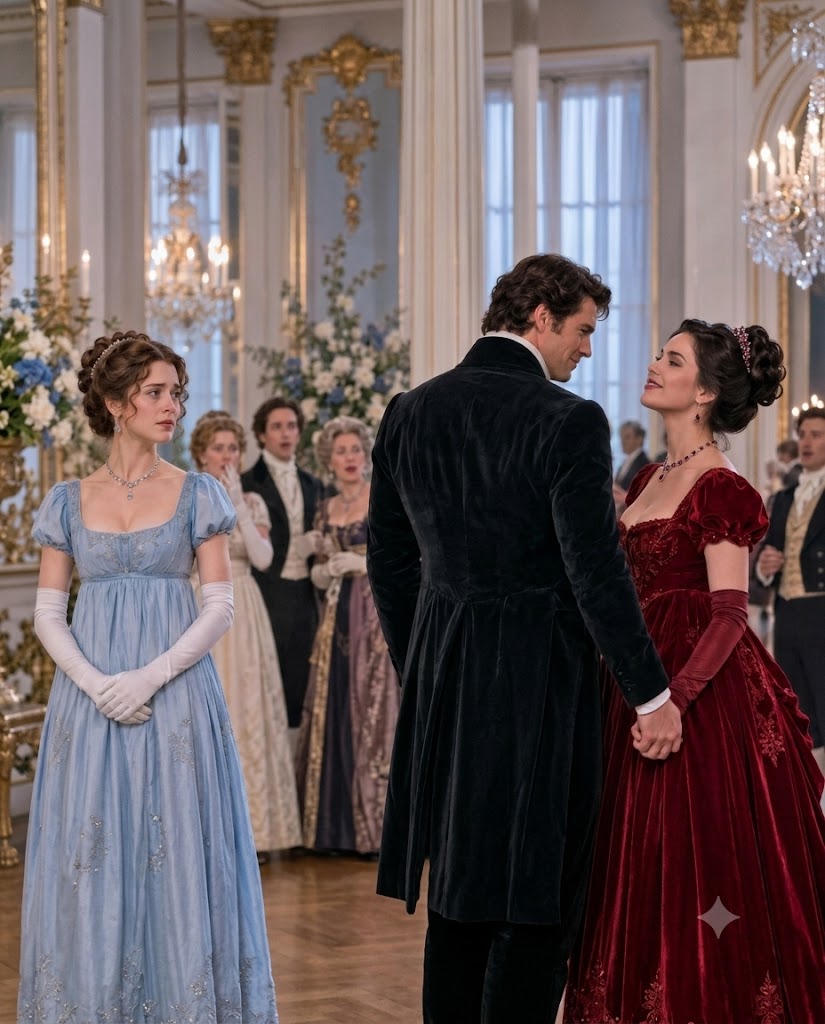
At exactly 11:00 p.m., Lady Linda watched her fiancé choose another woman—with half of London watching.
The man stepping out was not alone.
A tall gentleman followed him onto the pavement, wrapped in a dark traveling coat, his silver-headed cane resting lightly against one gloved hand.
Linda knew him at once.
Lord Edmund Waverly.
Thomas’s elder brother.
And, more importantly, the man who had disappeared from England seven years ago after a scandal so carefully buried that even London society rarely dared speak of it.
Thomas’s arm stiffened beneath Linda’s hand.
For the first time since their marriage, his composure cracked.
“Edmund.”
The older man looked at him without warmth.
“Thomas.”
The Duke of Rothmare remained behind them, watching the brothers with an expression Linda could not decipher.
Then Edmund’s eyes moved to her.
“So,” he said quietly, “you are the woman who married my brother.”
Linda inclined her head.
“And you are the man who has just returned at a remarkably convenient moment.”
A faint smile touched Edmund’s mouth.
“I see why Thomas chose you.”
Thomas glanced at her.
“I did not choose her for her tongue.”
“No,” Edmund replied. “You chose her because you needed someone the Duke could not destroy.”
The words fell between them like a knife.
Linda’s smile disappeared.
“Perhaps,” she said, “you should explain what everyone seems to know except me.”
Edmund looked toward the Duke.
“Not here.”
Rothmare finally stepped forward.
“Waverly.”
Edmund’s expression hardened.
“Your Grace.”
There was history in those two words.
Not the ordinary bitterness of rival gentlemen.
Something older.
Something dangerous.
The Duke looked at Linda.
“Lady Ashbourne, may I speak with you privately?”
Thomas moved immediately.
“She has no reason to speak with you.”
Linda raised one gloved hand.
“Thomas.”
He stopped.
She turned toward the Duke.
“You have already made your intentions toward me remarkably clear.”
“I made a mistake.”
“You made a choice.”
His jaw tightened.
“I was wrong.”
“Then live with it.”
She turned away.
The Duke caught her wrist.
Thomas stepped forward so quickly that Edmund’s cane struck the pavement with a sharp crack.
“Remove your hand.”
The Duke released her.
For several seconds, nobody moved.
Then Edmund laughed softly.
“You see?” he said to Thomas. “You were always too late.”
Thomas’s face went cold.
“Careful.”
“I have been careful for seven years.”
Linda looked between them.
“What happened seven years ago?”
Neither brother answered.
That silence told her more than any confession could have.
She withdrew her hand from Thomas’s arm.
“I believe my husband owes me an explanation.”
Thomas looked at her.
“You deserve one.”
“Then give it to me.”
“Not here.”
Linda studied his face.
The man who had proposed marriage to her in the middle of the night had seemed fearless.
Now he looked like a man standing before a locked door whose key he had spent years trying to forget.
“All right,” she said.
“Tonight.”
Thomas nodded.
“Tonight.”
But before they could leave, Edmund spoke.
“Tonight may be too late.”
Thomas turned.
“What do you mean?”
Edmund reached inside his coat and withdrew a folded document sealed with black wax.
“The Duke has been waiting seven years for this to disappear.”
He held it out to Linda.
“And now it belongs to you.”
She stared at the seal.
The crest stamped into the wax was unmistakable.
Rothmare.
The Duke stepped forward.
“Edmund, don’t.”
Linda took the document.
His warning only made her more certain.
She broke the seal.
Inside was a single sheet of paper.
Her eyes moved over the first line.
Then the second.
By the third, the world seemed to tilt.
Thomas noticed her expression.
“Linda?”
She handed him the paper.
He read it.
The color drained from his face.
“What is it?” she whispered.
Thomas looked at the Duke.
“It is your father’s signature.”
Linda froze.
“My father?”
The Duke said nothing.
Thomas folded the paper carefully.
“Come with me.”
“No.”
Thomas stopped.
She looked directly at him.
“You said I deserved the truth.”
“Yes.”
“Then tell me here.”
Rain began to fall again, fine and cold beneath the gray afternoon sky.
Thomas lowered his voice.
“Seven years ago, your father borrowed money from my family.”
Linda stared at him.
“How much?”
“Enough to destroy him.”
“He told me his debts began three years ago.”
“He lied.”
Her heart began to pound.
“Why?”
Thomas hesitated.
“Because the money was not used for your family.”
“Then where did it go?”
The Duke answered.
“To save mine.”
Everyone looked at him.
Rothmare stepped forward.
“My father was dying. Rothmare estates were on the edge of bankruptcy. Your father discovered what was happening.”
Linda’s eyes narrowed.
“And he helped you?”
“Not willingly.”
The Duke’s voice had become quieter.
“Your father invested money into one of my father’s companies. The company failed. He lost everything.”
“That still does not explain this.”
She lifted the paper.
“What does my father’s signature have to do with you?”
Thomas answered.
“He signed an agreement promising that if the debt could not be repaid, you would marry Rothmare.”
Linda stopped breathing.
The rain struck the brim of her bonnet.
“No.”
“It was seven years ago,” Thomas continued. “You were seventeen.”
She looked at the Duke.
“You knew?”
He did not deny it.
“My father told me.”
“And you accepted?”
“I was twenty-three.”
“That is not an answer.”
His eyes lowered.
“I believed the marriage would protect both families.”
Linda laughed once.
There was no amusement in it.
“Protect?”
She stepped closer.
“You humiliated me in front of half of London because you believed marrying me was an obligation?”
“I loved you.”
The words struck harder than she expected.
The Duke looked at her.
“I loved you long before I knew what love was supposed to cost.”
Linda’s expression hardened.
“Then you should have treated me like a person instead of a debt.”
He had no answer.
Thomas moved beside her.
“Enough.”
But Linda raised her hand again.
“No. Let him speak.”
The Duke swallowed.
“When I met you again last year, I intended to honor the agreement.”
“And the other woman?”
“A mistake.”
Linda shook her head.
“No. She was a choice.”
He looked at her.
“And so was this marriage.”
She touched the wedding ring on her finger.
“You chose me only when you believed you could have me.”
Thomas’s voice came quietly from behind her.
“And when he realized he could lose you, he finally discovered what you were worth.”
The Duke looked at him with hatred.
“You have no right.”
Thomas smiled without humor.
“Perhaps not.”
Then he turned to Linda.
“But I have something he never had.”
“What?”
“The freedom to let you go.”
Silence.
Linda looked at him.
For the first time, she understood why Thomas had frightened her from the moment they met.
Not because he was cruel.
Because he never tried to own her.
He had married her when she had nowhere else to turn, but he had never once demanded affection in exchange.
She looked down at the document.
“What happens if I refuse to honor this agreement?”
The Duke answered.
“Nothing.”
Thomas glanced at him sharply.
Rothmare continued.
“The agreement is unenforceable now.”
Linda looked up.
“Then why give me this?”
The Duke’s face changed.
“Because there is another document.”
Edmund stepped forward.
“I have it.”
Thomas turned.
“You knew?”
“I discovered it six months ago.”
Edmund removed another paper from his coat.
“This is the original settlement.”
Linda unfolded it.
Her eyes moved down the page.
Then she stopped.
“What is this?”
Edmund said nothing.
She read the final clause.
The woman named in the agreement could not be forced into marriage.
Instead, upon reaching twenty-one, she could demand the full repayment of every debt incurred under the settlement.
Linda looked at Thomas.
“How much?”
Thomas answered.
“Everything.”
She almost laughed.
“My father is bankrupt.”
“Your father is,” Thomas said carefully, “not the person who owes the money.”
Her eyes widened.
“What do you mean?”
Thomas looked toward the Duke.
“Rothmare does.”
The truth arrived all at once.
Her father had not sold her.
He had been tricked into believing he had.
The Duke’s family had used his desperation to secure a fortune.
And Thomas had known enough of it to understand exactly why she needed him.
Linda stepped back.
“Why did you marry me?”
Thomas did not answer immediately.
“Because you needed protection.”
“That is not enough.”
“No.”
He looked at her.
“Because I knew what your father had done. I knew what Rothmare had done. And I knew that if you entered that ballroom unmarried, they would tear you apart.”
Linda’s throat tightened.
“You could have told me.”
“I was afraid you would refuse.”
“You were right.”
A faint sadness crossed his face.
“Yes.”
The Duke suddenly laughed.
Not loudly.
Not happily.
“You believe you have won, Waverly?”
Thomas looked at him.
“This is not a game.”
“Everything is a game when men like us have something to lose.”
Edmund’s expression changed.
“Thomas.”
But the Duke was already turning away.
“There is one thing neither of you knows.”
Linda watched him climb into his carriage.
He paused at the door.
Then he looked directly at her.
“Your father is not in France.”
The carriage door closed.
The horses moved.
Linda stood frozen.
“My father?”
Thomas stared after the carriage.
Edmund swore under his breath.
“What?”
“He has him.”
“Who?”
“Rothmare.”
The carriage disappeared into the fog.
Thomas immediately reached for Linda’s hand.
“We have to go.”
“To where?”
“To your father.”
They returned to Ashbourne House before sunset.
For the first time since the wedding, Linda saw Thomas lose control.
He summoned servants, guards, messengers, and his most trusted solicitor.
Within an hour, maps covered the library table.
“Rothmare owns three properties outside London,” Thomas said. “Two are empty. One is being renovated.”
Edmund shook his head.
“He would not keep him there.”
“Then where?”
Edmund pointed to the map.
“The old Rothmare mill.”
Thomas looked up.
“It has been abandoned for years.”
“Exactly.”
Linda stepped toward the table.
“Why would he take my father?”
Thomas hesitated.
“To force you to give up the settlement.”
She looked at him.
“And if I refuse?”
Thomas’s silence answered.
Linda closed her eyes.
For years, her father had been the source of every burden she carried.
Every whispered insult.
Every humiliating dinner.
Every creditor at the door.
Yet he was still her father.
She opened her eyes.
“We go tonight.”
Thomas immediately shook his head.
“No.”
“Yes.”
“It is too dangerous.”
“He is my father.”
“He is also the reason Rothmare has leverage.”
“And I am not leaving him there.”
Thomas stared at her.
Finally, he nodded.
“Then you stay behind me.”
“No.”
“Linda.”
“If I am the reason he is being held, I will be there when he is released.”
Thomas studied her.
Then something softened in his expression.
“All right.”
At midnight, they left Ashbourne House with six men.
The journey was silent.
Snow had begun to fall.
By the time they reached the old mill, the road was almost invisible.
No lights burned inside.
No guards stood outside.
It looked abandoned.
Too abandoned.
Thomas raised his hand.
Everyone stopped.
Then they heard it.
A single gunshot.
Linda flinched.
Thomas grabbed her arm.
“Stay here.”
“No.”
He looked at her.
“Linda.”
She shook her head.
“I am coming.”
They entered through the broken wooden doors.
The smell of dust and damp timber filled the air.
A lantern swung above them.
Then a voice came from the darkness.
“Welcome, Countess.”
Linda froze.
The Duke stepped into the light.
He held a pistol.
Behind him sat her father, tied to a chair.
“Papa.”
Her father lifted his head.
His face was pale and bruised.
“Linda.”
Thomas stepped forward.
“Let him go.”
The Duke shook his head.
“Not yet.”
Linda stared at him.
“What do you want?”
“You.”
Thomas’s expression hardened.
“You cannot have her.”
The Duke smiled.
“Not as a wife.”
He lifted the pistol.
“As a witness.”
Linda frowned.
“What are you talking about?”
The Duke looked toward her father.
“Tell her.”
Her father closed his eyes.
“Tell me what?”
He whispered something Linda could barely hear.
“I forged the signature.”
The room went silent.
Linda stared at him.
“What?”
Her father began to cry.
“I forged the final page.”
The Duke lowered the pistol slightly.
“Your father borrowed the money, yes. But the clause promising your marriage was added later.”
Linda felt sick.
“By whom?”
Her father looked at Thomas.
“No.”
Thomas stepped forward.
“My father?”
Her father nodded.
“His solicitor brought me the paper. He said if I refused, Rothmare would expose the debts and have me imprisoned.”
Linda’s breathing became shallow.
“Then why did you tell me it was your fault?”
“I wanted you to hate me.”
“Why?”
“So you would never ask questions.”
The Duke’s voice came softly.
“Because the truth would have destroyed more than one family.”
Linda turned toward him.
“And what does Thomas have to do with this?”
The Duke smiled.
“Everything.”
Thomas’s face had become unreadable.
“Tell her.”
The Duke looked at him.
“You knew.”
Linda turned.
Thomas did not deny it.
“I knew there was a forged page.”
Her eyes filled with disbelief.
“You knew?”
“I did not know who forged it.”
“But you suspected.”
“Yes.”
“And you still married me.”
“I married you because I wanted to protect you.”
“From what?”
“From the truth.”
She stepped back as if he had struck her.
“Everyone keeps saying that word.”
Her voice trembled.
“Protection.”
She looked from Thomas to her father to the Duke.
“Do you know what protection feels like to me?”
No one answered.
“It feels like being locked inside a beautiful room while everyone else decides what I am allowed to know.”
The Duke lowered his weapon.
Linda continued.
“I was a daughter who was kept ignorant. A fiancée who was publicly discarded. A wife who was married without knowing why.”
She took a breath.
“But I am not a child anymore.”
Thomas whispered her name.
“No.”
She raised her hand.
“This ends tonight.”
The Duke stared at her.
“What are you going to do?”
Linda walked toward the center of the room.
“I am going to tell the truth.”
Then she turned toward the men surrounding them.
“Untie my father.”
Nobody moved.
Linda’s voice became cold.
“Now.”
One of Thomas’s men stepped forward.
The Duke raised his pistol.
Thomas moved faster.
He struck the Duke’s wrist.
The gun fired into the ceiling.
The room exploded into chaos.
Edmund tackled the Duke.
Thomas cut through the ropes binding Linda’s father.
Linda pulled him away.
“Run.”
They reached the door.
Then her father stopped.
“There is something else.”
Linda turned.
“What?”
He looked toward the Duke.
“His father did not forge the document alone.”
The Duke went still.
Thomas stared at him.
“Who?”
Her father swallowed.
“Your brother.”
Edmund froze.
For one terrible second, nobody spoke.
Then Edmund laughed.
A quiet, broken sound.
“So you finally found out.”
Thomas turned slowly.
“You?”
Edmund looked at his brother.
“I forged it.”
The truth seemed to drain the warmth from the room.
Thomas stared at him.
“Why?”
“Because Father was going to destroy us all.”
Edmund’s eyes filled with something resembling regret.
“I thought if Rothmare took Linda, our debts would disappear. I thought one sacrifice would save everyone else.”
Linda stared at him.
“And you let me believe my father had sold me?”
“Yes.”
“Why?”
“Because I was a coward.”
The word hung in the air.
The Duke lowered his head.
“My mistress,” he said quietly, “was not my mistress.”
Linda looked at him.
“She was Edmund’s informant.”
Thomas stared at him.
“What?”
The Duke laughed bitterly.
“The woman you saw me with that night was there because I was trying to uncover the forged settlement.”
Linda remembered the ballroom.
The whispers.
The humiliation.
The diamonds falling onto the silver tray.
“You could have told me.”
“I tried.”
“When?”
“Before the ball.”
He looked at her.
“You never gave me the chance.”
Linda’s eyes hardened.
“Then you should have tried harder.”
The Duke accepted the accusation.
“You are right.”
For a moment, the years of deception seemed to collapse into one exhausted silence.
Then Thomas stepped toward Linda.
“I know what you are going to say.”
She looked at him.
“You lied to me.”
“Yes.”
“You hid the truth.”
“Yes.”
“You married me because you thought you could protect me.”
“Yes.”
She touched the ring on her finger.
“And now?”
Thomas looked at her for a long time.
“Now I know that protecting you means trusting you with the truth, even when the truth frightens me.”
Linda’s eyes filled with tears.
“Do you love me?”
He did not answer quickly.
That mattered.
“I do.”
She looked away.
“And if I walk away?”
“I will let you.”
The answer broke something inside her.
Not because it hurt.
Because it was the first honest thing anyone had given her.
Weeks later, the scandal consumed London.
The forged settlement became public.
Rothmare’s accounts were investigated.
Edmund confessed before a magistrate.
Linda’s father surrendered what remained of his estate and left England—not in disgraceful exile, but by his own choice, determined to rebuild a life he had nearly destroyed.
The Duke of Rothmare abandoned his title’s social privileges and spent years restoring the properties damaged by his father’s schemes.
As for Linda, she refused every invitation that demanded she smile politely at the past.
She sold the jewels.
Every last one.
The diamonds from the ballroom became the foundation of a new trust for women whose families had been ruined by debts and fraudulent marriage settlements.
When a newspaper called her “the most fortunate abandoned bride in London,” she sent no reply.
She did not consider herself fortunate.
She considered herself awake.
One spring morning, months after the scandal had faded, Linda stood beside the lake at Ashbourne.
Thomas approached quietly.
He held something in his hand.
A small velvet box.
Linda smiled.
“If that is another ring, I am throwing it into the lake.”
Thomas laughed.
“No ring.”
He opened the box.
Inside was a single key.
“What is it?”
“The door to the west library.”
She frowned.
“I have a key.”
“This one is different.”
He placed it in her palm.
“It is yours.”
She looked at him.
“I don’t understand.”
“I had the locks changed.”
“Why?”
“Because this is your house too.”
Linda closed her fingers around the key.
“And the papers?”
“Your papers are in the library.”
“My papers?”
“Every account. Every contract. Every letter. Every document connected to the estate.”
She stared at him.
“You gave me access to everything?”
“I should have done it on our wedding day.”
Linda smiled through sudden tears.
Thomas reached for her hand.
This time, she gave it freely.
“I cannot promise you a perfect marriage,” he said.
“I would distrust you if you did.”
He smiled.
“I can promise that I will never again decide what you should know.”
Linda looked toward the lake.
The water reflected the morning sky, bright and endless.
“I don’t need a husband who protects me from the world.”
Thomas waited.
“I need one who stands beside me while I face it.”
He nodded.
“Then that is what I will be.”
She leaned against his shoulder.
For a while, neither spoke.
Behind them, Ashbourne House stood beneath the spring sun.
Ahead of them lay everything they had not yet written.
Linda thought of the ballroom.
The diamonds.
The rain.
The marriage license signed before dawn.
The secrets that had nearly destroyed three families.
She had once believed losing everything was the worst thing that could happen to a woman.
Now she understood.
Sometimes losing what was built on lies was the first moment of freedom.
And sometimes the person who breaks your heart is not the one who leaves.
It is the person who teaches you to believe that you have no choice.
Linda had spent years being treated as someone’s daughter, someone’s debt, someone’s promised bride, someone’s discarded fiancée.
But she was none of those things anymore.
She was herself.
And that, she discovered, was worth more than every diamond in London.
Years later, people would still tell the story of the night the Duke of Rothmare abandoned his bride beneath a hundred chandeliers.
They would remember the diamonds falling onto the silver tray.
They would remember the Earl of Ashbourne appearing in the rain.
They would remember the scandal, the forged papers, the ruined fortunes, and the secrets hidden behind noble doors.
But Linda remembered something else.
At exactly eleven o’clock that night, she had thought her life was ending.
In truth, it had only begun.
Because the greatest freedom is not being chosen.
It is learning that you have the right to choose yourself.
Three years passed before London finally stopped whispering Linda’s name.
By then, the scandal had become an old story told over afternoon tea, its sharpest edges softened by time and distance.
The Duke of Rothmare had left England.
Edmund Waverly had disappeared from society altogether.
Linda’s father had written only twice.
And Thomas had never once asked Linda to forget what had happened.
Instead, he had done something far more difficult.
He had learned to live with the consequences.
Their marriage had not become perfect.
It had become honest.
There were arguments.
There were silences.
There were evenings when Linda still woke from dreams of that ballroom and remembered the sound of diamonds striking silver.
But whenever fear returned, Thomas never told her what she should feel.
He simply stayed.
And slowly, Linda learned that love was not always the thunder that society wrote about in novels.
Sometimes it was a man sitting beside you in silence because he knew words would only make the wound deeper.
Sometimes it was a door left unlocked.
Sometimes it was a document placed openly on a table.
Sometimes it was being given the freedom to leave—and choosing to stay.
By the fourth year, the Ashbourne estate had changed completely.
The west wing had become a school.
The old servants’ quarters had been converted into apartments for widows and women who had lost their homes through debt.
Linda had created the Ashbourne Trust, using the money recovered from the fraudulent settlements.
It became her greatest work.
Women arrived with frightened eyes and empty purses.
Some had been abandoned by husbands.
Some had inherited debts they had never created.
Some had signed papers they had never been allowed to read.
Linda listened to every one of them.
She never promised miracles.
She simply gave them something she had once been denied.
A choice.
One autumn afternoon, a young woman named Clara arrived at Ashbourne House.
She was barely twenty-two.
Her hands trembled as she removed her gloves.
“My father says I must marry Lord Harrington,” she whispered.
Linda looked up from the papers on her desk.
“Do you want to?”
Clara lowered her eyes.
“No.”
“Then you will not.”
The girl looked startled.
“But my father says—”
“Your father is not the person marrying him.”
Clara stared at her.
Linda closed the ledger.
“Come tomorrow morning. We will review every document together.”
“Can you stop him?”
“No.”
Clara’s face fell.
Linda smiled gently.
“But I can make sure you understand your rights before you make your decision.”
For the first time, Clara smiled.
“Thank you.”
After the girl left, Thomas appeared in the doorway.
“You sounded frighteningly like a lawyer.”
Linda glanced at him.
“I learned from experience.”
He walked toward her.
“I brought you something.”
She raised an eyebrow.
“Should I be concerned?”
“Possibly.”
He placed a letter on the desk.
Linda recognized the handwriting immediately.
Her father.
She stared at it for several seconds before touching it.
“Did you read it?”
“No.”
“You could have.”
“I could have done many things.”
She looked at him.
“That is not the same as doing them.”
Thomas smiled.
“I am learning.”
Linda opened the letter.
The message was short.
Her father was ill.
He had spent years in France.
He had rebuilt little, but he had finally paid back a portion of what he owed.
He wanted to see his daughter.
Linda folded the paper.
“I don’t know if I can forgive him.”
Thomas sat opposite her.
“You don’t have to decide today.”
“What if I never can?”
“Then you don’t.”
She looked at him.
“You really believe forgiveness isn’t necessary?”
“I believe forgiveness is a gift.”
He paused.
“And nobody is entitled to a gift.”
Linda looked toward the window.
Snow had begun to fall.
“I think I want to see him.”
Thomas nodded.
“Then we will go.”
“No.”
He looked surprised.
“I’ll go alone.”
A slow smile appeared on his face.
“All right.”
Linda stood.
She walked to the window and watched the snow settle over the garden.
“I used to think being alone meant being abandoned.”
“And now?”
She turned.
“Now I know there is a difference.”
Thomas waited.
“Being abandoned is having someone decide you are no longer worth staying for.”
She walked toward him.
“Being alone is knowing you can survive without anyone.”
She took his hand.
“And loving someone after learning that is a choice.”
Thomas squeezed her fingers.
“I am glad you chose me.”
Linda smiled.
“So am I.”
The following month, she traveled to France.
Her father looked older than she remembered.
Much older.
For a moment, she saw the man who had once carried her through the garden when she was a child.
Then she remembered the forged papers.
The lies.
The debts.
The years of fear.
He rose slowly from his chair.
“Linda.”
She stood in the doorway.
“Papa.”
He began to cry.
She did not.
He apologized for everything.
Not once.
Not dramatically.
But carefully.
He named every lie.
Every mistake.
Every moment when he had chosen fear instead of courage.
Linda listened.
When he finished, he looked at her.
“Can you forgive me?”
She remained silent.
Then she said,
“I don’t know.”
He lowered his head.
“But I am here.”
He looked up.
“That means something.”
“Yes.”
She stepped closer.
“It means I decided to see you.”
She placed a small package on the table.
“What is that?”
“A ledger.”
He opened it.
Every debt he had ever owed was recorded inside.
Every payment made.
Every amount still outstanding.
He stared at her.
“I don’t understand.”
“I want you to know exactly where you stand.”
His eyes filled with tears.
“You are giving me another chance.”
“No.”
Linda shook her head.
“I am giving you the truth.”
She paused.
“What you do with it is yours.”
For the first time, her father understood what she had become.
Not his little girl.
Not the daughter he could protect with lies.
A woman who no longer needed his permission to live.
When Linda returned to England, she found Thomas waiting at the station.
He said nothing when he saw her.
He simply opened the carriage door.
On the journey home, Linda rested her head against the window.
“Did you forgive him?”
Thomas asked.
“Not entirely.”
He nodded.
“Are you angry?”
“Yes.”
“Are you relieved?”
“Yes.”
He smiled.
“Then perhaps it was worth going.”
Linda looked at him.
“I think forgiveness may take years.”
“You have years.”
She laughed softly.
“Yes.”
The carriage continued through the countryside.
Neither of them noticed the man standing beside the road.
He watched their carriage disappear into the distance.
The Duke of Rothmare.
He had returned to England quietly.
Not as a duke.
Not as the man who had once commanded every room he entered.
He had sold most of his estate and spent the last years paying what could still be repaired.
Now he carried a letter.
It was addressed to Linda.
He had written it three times.
Destroyed it twice.
Finally, he had decided that perhaps some apologies should be spoken without expecting forgiveness.
He arrived at Ashbourne House the next morning.
Linda met him in the library.
For a moment, neither spoke.
He looked different.
Older.
Less certain.
She was surprised to discover that she no longer hated him.
She simply remembered him.
That was enough.
“I came to apologize,” he said.
Linda gestured toward the chair.
“Then sit.”
He did.
“I treated you as though you were a prize to be won.”
“Yes.”
“I believed love meant possession.”
“Yes.”
“I was wrong.”
Linda studied him.
“Why did you come back?”
“To finish what I began.”
He placed a document on the desk.
“It is the final transfer of the Rothmare funds.”
She looked down.
The money was substantial.
“What is this?”
“Your trust.”
“I don’t want your money.”
“I know.”
He smiled faintly.
“That is why I want you to have it.”
She looked at him.
He continued.
“Your work has helped people my family once harmed.”
He swallowed.
“I cannot undo what we did. But I can stop benefiting from it.”
Linda remained silent.
The Duke stood.
“I don’t expect forgiveness.”
“That is wise.”
A faint smile crossed his face.
“I deserved that.”
He turned toward the door.
“Your Grace.”
He stopped.
Linda spoke quietly.
“You should know something.”
He looked back.
“I did love you once.”
His eyes tightened.
“But I loved the idea of being chosen more than I loved you.”
He nodded slowly.
“I understand.”
“No,” Linda said.
“You understand now.”
And that was the difference.
He left.
Linda watched the door close behind him.
Thomas entered a few minutes later.
“You look thoughtful.”
“I am.”
“Do you regret marrying me?”
She looked at him with surprise.
“No.”
“Good.”
“Thomas.”
“Yes?”
She smiled.
“I think I would have married you again.”
He laughed.
“That is fortunate.”
“Even if I knew everything?”
He became quiet.
She stepped closer.
“Especially if I knew everything.”
He reached for her.
This time there were no contracts.
No bargains.
No debts.
No frightened parents.
No powerful families making decisions behind closed doors.
Only two people who had survived the consequences of other people’s choices and had finally learned to make their own.
Years later, when Linda was an old woman, she would sometimes walk through the west library alone.
The shelves were filled with documents from the Trust.
Thousands of names.
Thousands of lives.
Some had found new homes.
Some had escaped terrible marriages.
Some had simply learned how to read a contract before signing it.
On the wall hung a small silver tray.
The same one from the ballroom.
Beside it sat three diamonds.
Not the original jewels.
Those had long since been sold.
These were replicas.
A reminder.
Her grandchildren often asked why she kept them there.
“Because once upon a time,” she would tell them, “I thought diamonds were the most valuable things a woman could possess.”
“And what is more valuable?”
Linda would smile.
“Knowing your own worth.”
One evening, as the sun disappeared behind the hills, Thomas found her standing beneath the portraits.
He was older too.
His hair had turned silver.
His hands were slower.
But when he looked at her, his eyes were unchanged.
“You’re thinking again,” he said.
“I often do.”
“Dangerous habit.”
She laughed.
He offered his arm.
She took it.
They walked slowly toward the terrace.
The garden was covered in roses.
The same garden where he had once given her the key to the library.
The same place where she had learned that trust could be rebuilt.
They sat together beneath the old oak tree.
Linda looked at him.
“Do you remember the first time we met?”
Thomas smiled.
“You threatened to throw my ring into the Thames.”
“I was considering it.”
“You were terrifying.”
“I still am.”
“Yes.”
He kissed her forehead.
“I am grateful.”
“For what?”
“That you chose to stay.”
Linda leaned against him.
“And I am grateful that when I wanted to leave, you let me.”
He looked at her.
“That was the hardest thing I ever did.”
“I know.”
The sun disappeared.
The garden became quiet.
Linda closed her eyes.
For years, she had believed the greatest moment of her life would be the moment someone chose her.
She had been wrong.
The greatest moment had been when she realized she did not need to wait for anyone to choose her.
She could choose herself.
She could choose truth.
She could choose love.
She could choose to forgive.
She could choose not to forgive.
And every choice belonged to her.
That was the lesson she left behind.
Not that a ruined bride could become a countess.
Not that a scandal could become a romance.
Not that a powerful man could eventually learn to love.
Those were only pieces of the story.
The real lesson was simpler.
A life built on someone else’s decisions will always feel like a cage, no matter how beautiful the walls are.
Freedom begins the moment you understand that your voice belongs to you.
Linda had once walked away from a ballroom believing she had lost everything.
She had lost a fiancé.
She had lost her father’s protection.
She had lost the future she thought she wanted.
But she had gained something far greater.
A voice.
A choice.
A life that belonged entirely to her.
And when people later asked what happened on the night the Duke of Rothmare abandoned his bride, Linda never told them about the scandal first.
She told them about the diamonds.
How they fell.
How the room went silent.
How everyone waited for her to cry.
And how she didn’t.
Because sometimes the most important moment in a person’s life does not look like victory.
Sometimes it looks like walking away.
Sometimes it looks like closing a door.
Sometimes it looks like saying, “No more.”
And sometimes, without realizing it, that single step away from the life you were given becomes the first step toward the life you were meant to choose.
At exactly eleven o’clock that night, Linda had believed her world was ending.
Years later, she finally understood.
It was not the end.
It was the first moment she had ever truly belonged to herself.
And that was worth more than every title, every estate, every promise, and every diamond in London.
THE END.