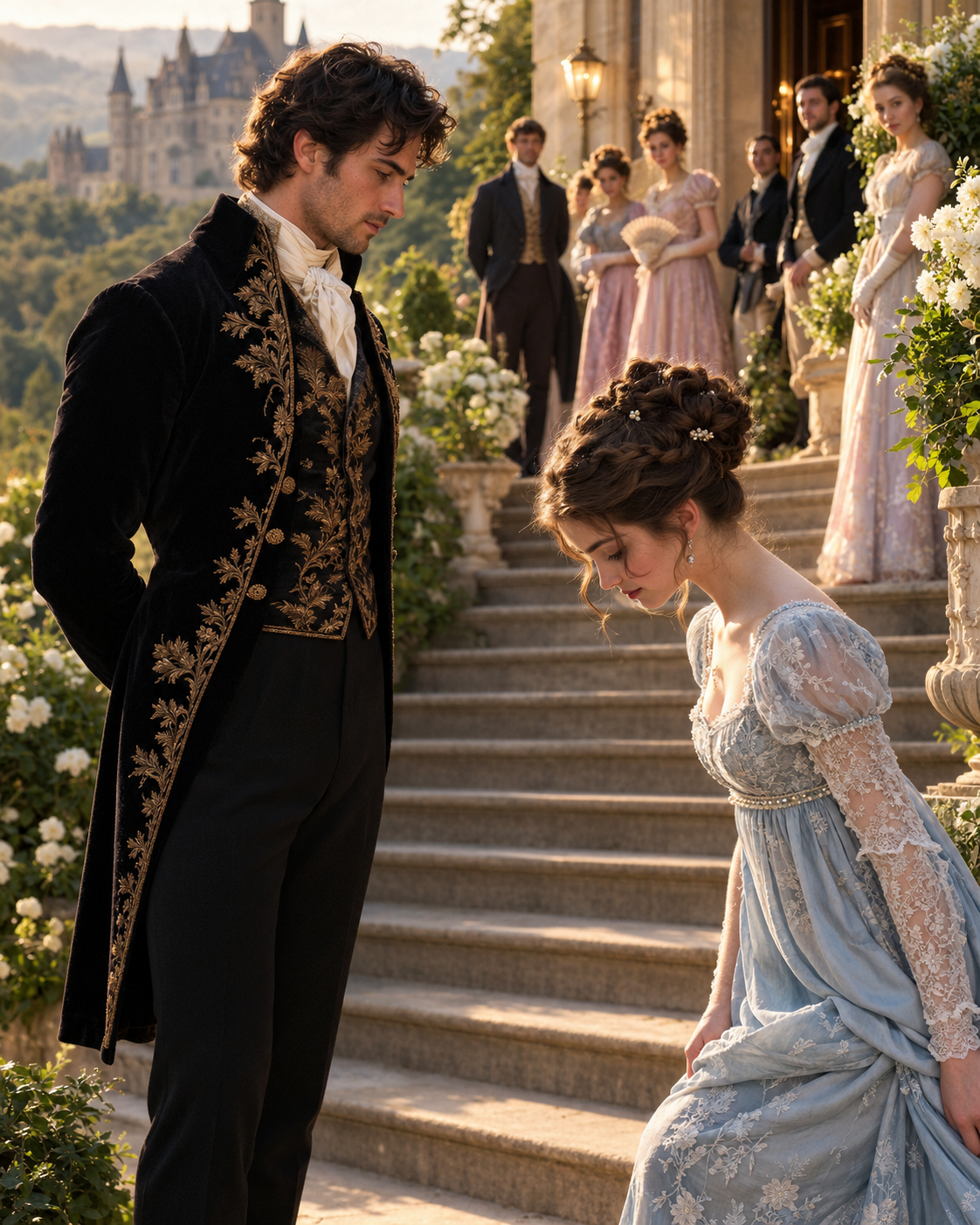
At Blackthorn Hall, on a cold evening in Virginia, Eleanor Hart stood beneath the crystal chandeliers and tried not to let anyone see how badly her hands were trembling.
Eleanor was sitting behind the narrow counter of her small sewing shop in Philadelphia when the bell above the door rang.
She looked up automatically.
For half a second, her heart stopped.
It was not Julian.
It was a young courier carrying a brown leather envelope.
“Miss Hart?”
“Yes?”
“This was left for you at the station. The gentleman who gave it to me said you would understand.”
Eleanor frowned.
“There was no gentleman waiting for me at the station.”
The courier shrugged. “He paid me to make sure it reached you.”
She took the envelope carefully.
There was no name on the front.
Only three words had been written in dark ink.
You deserve the truth.
Her fingers tightened around the paper.
For months, Eleanor had worked hard to stop asking questions about Blackthorn Hall.
She had learned that questions could become chains.
She had learned that memories could be just as dangerous.
Most importantly, she had learned that a person could survive humiliation if she refused to let it define her.
After leaving Virginia, she had traveled north with barely enough money to begin again.
Philadelphia had not welcomed her gently.
She rented a small room above a bakery on a crowded street and found work repairing dresses for women who would never have imagined that the quiet seamstress at their doorstep had once stood in one of Virginia’s grandest houses.
Then, slowly, Eleanor began taking private commissions.
One dress became three.
Three became ten.
Within months, women began recommending her work to friends.
She eventually saved enough to rent the tiny shop where she now spent nearly every waking hour.
It was not grand.
There were no chandeliers.
No marble staircase.
No aristocratic guests.
There was only sunlight through the front window, shelves of folded fabric, a secondhand sewing machine, and the quiet satisfaction of knowing that every dollar she earned belonged to her.
She should have been happy.
And sometimes she was.
But she had never managed to forget the look in Julian’s eyes on that terrible night.
That was what frightened her most.
Not the words.
The look.
He had not seemed disgusted.
He had seemed afraid.
She had wondered about it more times than she cared to admit.
Now, staring at the envelope, that old question returned.
Eleanor opened it.
Inside was a single sheet of paper.
The accounts were falsified. Your name was used without your knowledge. Julian knew.
She read the sentence twice.
Then a third time.
Her breathing changed.
At the bottom of the page was an address in Baltimore and a date from six weeks earlier.
There was also a second line.
Ask for Samuel Reed. Do not tell anyone why you are there.
Eleanor lowered the paper.
For months, she had convinced herself that Julian’s cruelty needed no explanation.
Now the explanation had found her anyway.
She folded the paper and placed it inside the drawer beneath the counter.
She did not go to Baltimore that day.
She waited three days.
On the fourth morning, she locked her shop and boarded a train.
She told herself she was going because she deserved to know what had happened.
She told herself she was not going for Julian.
That distinction mattered.
At least to her.
Baltimore was gray beneath a low autumn sky when Eleanor arrived.
She found the address after an hour of searching.
It was a modest office above a shipping company.
Samuel Reed was older than she expected, perhaps in his late fifties, with silver hair and a tired face.
When Eleanor gave her name, he immediately closed the door.
“You should not have come.”
“I was told to find you.”
“By whom?”
“I don’t know.”
Samuel stared at her for a long moment.
Then he sighed.
“Julian.”
The name landed between them.
Eleanor said nothing.
Samuel walked to a cabinet and removed a thin ledger.
“This was part of the original investigation.”
“You investigated me?”
“No. I investigated the accounts.”
He placed the ledger on the desk.
“Someone had been moving money through several businesses connected to Blackthorn Hall. Small amounts at first. Then larger ones. The transactions were disguised as payments for fabric, imported goods, and household contracts.”
Eleanor opened the ledger.
Her name appeared on several pages.
But something was wrong.
The handwriting beside her name was not hers.
“I never signed these.”
“I know.”
“Then why did everyone believe I did?”
“Because someone made sure the documents looked authentic.”
Eleanor’s eyes moved across the pages.
“Who?”
Samuel hesitated.
“That is what Julian was trying to prove.”
Her throat tightened.
“Why didn’t he tell me?”
Samuel looked away.
“That question should be answered by him.”
Eleanor closed the ledger.
“I don’t intend to speak to him.”
“You may have to.”
“Why?”
“Because the man who helped create the false records knows Julian is still looking for the evidence.”
A chill moved through her.
“Who is he?”
Samuel did not answer immediately.
Instead, he walked to the window and looked down at the street.
“Someone very close to the Ashkam family.”
Eleanor felt the room become smaller.
“Who?”
Samuel finally turned.
“Richard Vale.”
The name meant something.
Eleanor remembered him.
Julian’s uncle by marriage.
A respected businessman.
A man who had always spoken kindly to servants.
A man who had once praised Eleanor’s sewing and asked her questions about the suppliers used at Blackthorn Hall.
A man she had never suspected.
“He couldn’t have done this,” she whispered.
Samuel’s expression remained grim.
“He could.”
Eleanor stood.
“Why would he frame me?”
“Because no one would question the accounts if the scandal appeared to involve a servant. And because your name gave him something valuable.”
“What?”
“An innocent person to carry the blame.”
Eleanor left the office with the ledger hidden beneath her coat.
She did not return to Philadelphia immediately.
Instead, she walked for nearly an hour through Baltimore, trying to put together a story that still made no sense.
Julian had known.
Julian had investigated.
Julian had believed her innocent.
And yet, on the night she needed him most, he had stood before everyone and said she was never his choice.
Why?
The answer came two days later.
She was staying at a small hotel when someone knocked on her door.
Eleanor froze.
The knock came again.
She reached for the brass handle but did not open it.
“Who is it?”
A man’s voice answered.
“Miss Hart, my name is Thomas Bell. I work for Mr. Ashkam.”
Eleanor’s heart began pounding.
“I have nothing to say to him.”
“I understand.”
“Then leave.”
“I will. But first, you should know that Mr. Ashkam is in Baltimore.”
Silence.
Eleanor closed her eyes.
“Why?”
“He wants to speak with you.”
“He has had months.”
“Yes.”
“Why now?”
“Because we found the final account.”
Eleanor opened the door only a few inches.
Thomas stood alone in the hallway.
“Where is it?”
“Mr. Ashkam has it.”
“Then tell him to take it to the authorities.”
“He intends to.”
“Then there is nothing more to discuss.”
Thomas looked at her sadly.
“There is one more thing.”
Eleanor waited.
“He did not know whether you would ever forgive him. He only wanted you to know that he never believed you were guilty.”
She almost laughed.
Almost.
Instead, she said quietly, “Believing me innocent would have been easier to hear before he destroyed me in front of half of Virginia.”
Thomas lowered his eyes.
“I know.”
“No. You don’t.”
She closed the door.
That evening, Eleanor received another letter.
This one was from Julian himself.
She almost threw it into the fire.
Instead, she opened it.
Eleanor,
I will not ask you to forgive me. I have no right to ask.
I told myself that humiliating you publicly would make you hate me enough to leave before the accusations reached the newspapers. I thought I was choosing the lesser cruelty. I was wrong.
You deserved the truth. You deserved the choice. I took both from you.
The evidence is ready to be delivered to the authorities. I am prepared to testify to everything I knew, including the decisions I made that caused you pain.
If you never wish to see me again, I will accept that. But I needed you to know that when I said you were never my choice, I was lying.
You were the choice I was most afraid to make because choosing you meant admitting that the life I had been taught to protect was not the life I wanted.
I should have trusted you enough to stand beside you.
I did not.
For that, I am sorry.
There was no signature.
There did not need to be.
Eleanor knew his handwriting.
She read the letter until the words blurred.
For the first time since Blackthorn Hall, she cried.
Not because she wanted him back.
Not because she had suddenly forgiven him.
She cried because the explanation she had once desperately wanted had arrived too late to repair the wound it might have prevented.
The next morning, she went to see him.
Julian was waiting in a private room at a Baltimore hotel.
When Eleanor entered, he stood.
He looked thinner.
Older.
But she refused to let that soften her.
“Sit,” she said.
He obeyed.
For several seconds, neither spoke.
Finally, Julian said, “Thank you for coming.”
“I am not here to forgive you.”
“I know.”
“I am not here to return to Blackthorn Hall.”
“I know.”
“I am here because I want the truth.”
“You deserve it.”
Julian placed a folder on the table.
Inside were copies of bank records, letters, contracts, and statements.
Eleanor examined them carefully.
The evidence showed a pattern.
Richard Vale had been diverting money through shell companies connected to Blackthorn Hall.
He had used legitimate household purchases to disguise the transfers.
Then, when one transaction risked exposing him, he had inserted Eleanor’s name into the records.
Julian had discovered the irregularities shortly before the public confrontation.
But there was another detail.
Eleanor looked up.
“Why didn’t you tell me privately?”
Julian did not answer immediately.
“Because I believed someone inside the house was watching every conversation I had with you.”
“You could have sent a letter.”
“Yes.”
“You could have trusted me.”
“Yes.”
“You could have told me the truth.”
“Yes.”
His voice was quiet.
“You are right.”
Eleanor stared at him.
For once, he did not defend himself.
That mattered more than she expected.
“I thought power meant protecting people without involving them,” he continued. “I was raised to believe responsibility meant making decisions for everyone beneath you.”
“And now?”
“Now I understand that protection without consent can become another form of control.”
Eleanor looked down.
“That is the first honest thing you’ve said to me.”
Julian accepted the words without complaint.
“I am not asking you to come back.”
“I know.”
“I am not asking you to marry me.”
“I know.”
“I only want you to have every fact before you decide what happens next.”
Eleanor closed the folder.
“What happens next is that we expose Richard Vale.”
Julian nodded.
“Yes.”
They did not reconcile that night.
They did not kiss.
They did not promise forever.
Instead, they began with something much less romantic and far more important.
Trust had to be rebuilt.
Together, they brought the evidence to federal investigators.
Samuel Reed provided testimony.
Thomas Bell provided correspondence.
Several employees of Blackthorn Hall came forward after learning that the investigation would protect them from retaliation.
Then Richard Vale made his mistake.
He attempted to flee the country using a false business identity.
The authorities intercepted him before he could leave.
The newspapers soon reported the financial investigation, but Eleanor’s name was cleared before the story could become the scandal Richard had planned.
For the first time, the public understood that she had been falsely implicated.
But Eleanor did not care about public opinion as much as she once had.
She cared about something simpler.
Her own life.
She returned to Philadelphia and expanded her sewing business.
Within a year, she employed six women.
She insisted they be paid fairly.
She refused to tolerate anyone who believed status entitled them to disrespect workers.
Her shop became known for elegant dresses and something else: independence.
Julian visited once.
Then twice.
He never entered without knocking.
He never assumed she would see him.
He never asked her to abandon her business.
Months later, he brought her a letter.
“I have been thinking,” he said.
“That is dangerous.”
A faint smile appeared on his face.
“It is.”
She accepted the letter.
It was not a declaration of love.
It was a proposal for something else.
Julian wanted Eleanor to establish a permanent fashion house in Virginia, independent of Blackthorn Hall, with her own ownership and finances.
He offered investment.
Not control.
“I don’t want your money,” Eleanor said.
“Then don’t take it.”
She looked at him.
“Why offer it?”
“Because I believe in your work.”
She studied his face.
“And if I say no?”
“Then I will still believe in your work.”
That answer changed something.
Not everything.
But something.
Their relationship grew slowly.
There were arguments.
There were uncomfortable conversations.
There were moments when Eleanor remembered the ballroom at Blackthorn Hall and became distant.
Julian learned not to chase her when she needed space.
Eleanor learned that he could listen without trying to fix everything.
They learned how to disagree without turning disagreement into punishment.
Most importantly, they stopped confusing silence with protection.
Two years after the night at Blackthorn Hall, Eleanor returned to Virginia.
She did not return as a maid.
She arrived as the owner of a thriving dressmaking company.
Her name was printed on the carriage card.
Her contracts were signed by her.
Her employees traveled with her.
And when she stepped into Blackthorn Hall again, no one introduced her as someone beneath Julian.
Julian met her at the entrance.
He did not offer his arm until she reached for it.
Inside, the ballroom looked exactly as she remembered.
The chandeliers.
The polished floor.
The tall windows.
The same walls that had witnessed her humiliation.
Eleanor stood quietly.
“I used to hate this room,” she said.
“I know.”
“I thought I would never come back.”
“I know.”
She looked at him.
“And now?”
Julian waited.
“I think I needed to come back once.”
“Why?”
“To prove that the room did not own the memory.”
Julian’s expression softened.
“You don’t have to forgive the past.”
“I don’t.”
“You only have to decide what you want from the future.”
Eleanor smiled.
“That sounds almost wise.”
“I’ve had practice.”
She laughed.
It was the first time she had laughed with him inside Blackthorn Hall.
Later that evening, Julian asked her to walk outside.
The Virginia air was cool, and the grounds were quiet.
He stopped beneath an old oak tree.
“I have one question.”
Eleanor raised an eyebrow.
“Only one?”
“For tonight.”
“Then ask.”
Julian reached into his coat.
There was no grand audience.
No family.
No servants.
No newspapers.
Only the two of them.
“I once told you that you were never my choice,” he said.
Eleanor held his gaze.
“I remember.”
“I was wrong.”
He opened the small box in his hand.
“You were never supposed to be a choice I made because of my title, my family, or my obligations. You were supposed to be the person who chose me too.”
Eleanor looked at the ring.
Then at him.
“And if I say no?”
Julian smiled.
“Then I will respect you.”
She was silent for a long moment.
“You understand that if I marry you, I will not give up my company.”
“I know.”
“I will keep my own accounts.”
“Yes.”
“I will continue working.”
“I expect you to.”
“I will not live my life according to your family’s expectations.”
“I would not ask you to.”
“And if we disagree?”
“We talk.”
“And if you are afraid?”
“I tell you.”
“And if I am afraid?”
“I listen.”
Eleanor looked down at the ring again.
Then she took his hand.
“Then perhaps,” she said softly, “I can choose you.”
Julian’s eyes filled with emotion.
“Perhaps?”
“Don’t become arrogant.”
He laughed.
She laughed with him.
This time, when Eleanor entered Blackthorn Hall as Julian’s future wife, she did not feel like a woman who had finally been chosen by a powerful man.
She felt like a woman who had chosen her own life and invited someone to share it.
Their wedding was smaller than anyone expected.
There were no political alliances.
No extravagant demands.
No public spectacle designed to impress society.
Eleanor wrote the vows herself.
Julian accepted every word.
And when they stood before their guests, she did not promise to obey him.
She promised to speak honestly.
He promised the same.
Years later, people still remembered the scandal that had once threatened the Ashkam family.
But Eleanor remembered something else.
She remembered the train leaving Virginia.
The tiny room above the bakery.
The first dress she sold under her own name.
The first employee she hired.
The first time Julian knocked before entering her shop.
Those moments mattered more than the ballroom.
Because the real transformation had not happened when the conspiracy was exposed.
It had happened when Eleanor realized she did not need Julian to restore her dignity.
She had already restored it herself.
Julian’s greatest lesson was different.
He learned that love was not measured by how much pain a person was willing to endure to protect another.
Love required trust.
It required honesty.
And sometimes, it required giving someone the freedom to make a choice even when the answer might hurt.
The past could not be erased.
Eleanor never pretended otherwise.
But it no longer controlled them.
Blackthorn Hall remained standing on the Virginia hills, carrying its old memories beneath its elegant roof.
Yet for Eleanor, it had become something else.
Not the place where she had been rejected.
Not the place where her heart had been broken.
But the place where she finally understood that being chosen was never the same as choosing.
And that was the truth she carried with her for the rest of her life:
A love worth keeping does not ask you to disappear so someone else can protect you. It gives you the truth, respects your freedom, and allows you to choose—fully and freely—whether you want to stay.