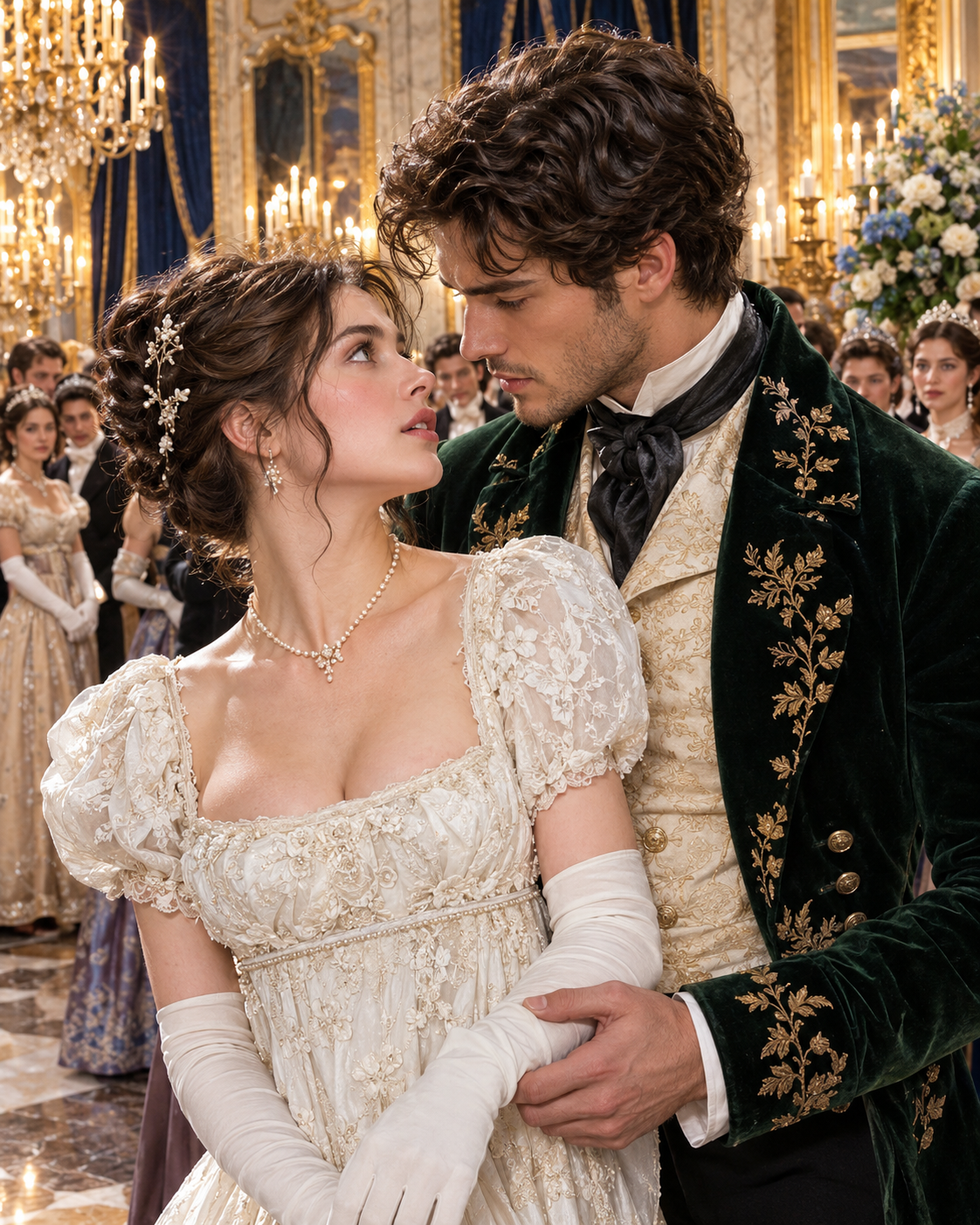
At a glittering society ball in New York, Lady Vivienne Ashcroft makes one mistake the fashionable elite can never forgive
The ballroom doors closed behind Vivienne and Sebastian, but the music seemed to follow them into the corridor.
For several seconds, neither spoke.
Behind them, hundreds of voices had already begun their work. A glance became a rumor. A dance became a scandal. A quiet conversation became a secret engagement before the first carriage had even left the front steps.
Vivienne could almost hear it happening.
She stopped beneath a tall window overlooking Fifth Avenue and drew a slow breath.
“You realize,” she said, “that your reputation has probably become considerably worse because of me.”
Sebastian leaned against the polished wall, studying her with an expression she could not quite read.
“My reputation survived a duel.”
“That is hardly comforting.”
“It was not intended to be.”
For the first time that evening, Vivienne laughed.
It was a small sound, quickly swallowed by the grand corridor, but Sebastian smiled.
“You laugh at the wrong things,” he said.
“So do you.”
“That may be why I find you tolerable.”
Vivienne lifted an eyebrow.
“Tolerable?”
“I was trying not to frighten you.”
“I am not frightened.”
“I noticed.”
The answer was so calm that she looked at him again.
There was no arrogance in his face. No performance. No attempt to impress her.
That was what unsettled her most.
Every gentleman she had met in New York society seemed to have a carefully prepared version of himself. They knew when to smile, when to compliment, when to flatter, and when to pretend not to notice something unpleasant.
Sebastian seemed to have abandoned the entire system.
“Why did you agree to dance with me?” she asked.
“Because your aunt ordered you to.”
“That is not an answer.”
“It is the most honest one.”
She smiled faintly.
“You really do speak very little.”
“I speak when I have something worth saying.”
“And the rest of the time?”
“I listen.”
The simplicity of the reply stayed with her long after they parted that night.
By the following morning, New York society had already rewritten the story.
At breakfast, Vivienne’s aunt placed a folded newspaper beside her plate.
“You are mentioned.”
Vivienne unfolded it.
The article did not name her directly. It did not need to.
A “certain outspoken young lady” had apparently caused a scene at a prominent Manhattan ball before being seen in “unexpectedly intimate conversation” with the Duke of Blackmore.
Vivienne looked up.
“We spoke for less than ten minutes.”
“Society does not measure time,” her aunt replied. “It measures appearances.”
“And what does society say about him?”
Her aunt’s expression hardened.
“That is precisely the problem.”
Vivienne folded the newspaper.
“You believe the stories?”
“I believe that when a man disappears from polite society for three years, there is usually a reason.”
“Or perhaps he simply grew tired of it.”
Her aunt stared at her.
“You are doing it again.”
“Doing what?”
“Defending what you do not understand.”
Vivienne paused.
“I am not defending him. I am refusing to condemn him without knowing the truth.”
Her aunt had no answer to that.
Three days later, a black carriage stopped outside the Ashcroft residence.
The footman announced the Duke of Blackmore.
Vivienne was in the library when Sebastian entered.
He wore a dark morning coat, carried no flowers, and looked entirely unlike a man who had come to charm a young woman.
He looked like a man who had come to make a decision.
“Lady Vivienne.”
“Your Grace.”
“I have come to speak with your aunt.”
Vivienne glanced toward the door.
“She is in the drawing room.”
“I know.”
“And yet you came here first.”
“Yes.”
“Why?”
“Because I wished to speak to you.”
Her heartbeat changed before she could stop it.
Sebastian reached into his coat and removed a small envelope.
“I intend to formally court you.”
Vivienne stared at him.
“That is remarkably direct.”
“I thought you might appreciate it.”
“I do.”
He waited.
“But I did not say yes.”
“I know.”
“Then why announce it as though you have already decided?”
“Because I have decided what I want. I am not deciding for you.”
That distinction struck her.
He placed the envelope on the table.
“It contains a formal request to your aunt. I will follow every proper custom. I will call at reasonable hours. I will make my intentions clear. And if you tell me no, I will accept it.”
Vivienne looked at the envelope.
“What if I say yes?”
“Then I will spend the rest of my life attempting to understand how I became fortunate enough to deserve it.”
She looked away before he could see her smile.
“You are much more dangerous when you are sincere.”
“I have been told I am dangerous in several different ways.”
“That was not a compliment.”
“I know.”
Their courtship began quietly.
At least, Sebastian intended it to.
Society had other plans.
They attended dinners together. They walked through Central Park in the afternoon. Sebastian sent books instead of extravagant gifts because he had noticed Vivienne preferred stories to jewelry. Once, he arrived at the Ashcroft house carrying a packet of handwritten notes from a composer she admired.
“You remembered,” she said.
“I listen.”
She touched the notes.
“You truly do.”
He looked at her.
“That surprises you?”
“A little.”
“Why?”
“Because people usually listen only until it is their turn to speak.”
Sebastian’s expression softened.
“That is one of the reasons I wanted to know you.”
The words stayed with her.
But the whispers became sharper.
At a luncheon on Madison Avenue, two women stopped talking when Vivienne approached.
At a charity reception, an elderly gentleman deliberately moved his wife away from Sebastian.
At another dinner, Vivienne overheard a conversation about the duke’s broken engagement.
Some claimed he had been rejected.
Others claimed he had abandoned his former fiancée.
A few suggested the duel had been fought over a woman.
No one seemed to know the truth.
Everyone seemed certain they did.
One evening, Vivienne finally asked Sebastian.
“What happened three years ago?”
They were sitting on a terrace overlooking the Hudson. The city lights trembled across the dark water.
Sebastian did not answer immediately.
“I knew you would ask eventually.”
“I nearly asked three times before.”
“I know.”
“Then why didn’t you tell me?”
“Because I wanted you to decide whether you liked me before you heard the version of me that everyone else has created.”
Vivienne frowned.
“That is unfair.”
“Yes.”
“You admit it?”
“Of course.”
She waited.
Sebastian looked toward the river.
“My engagement was arranged when I was twenty-nine. She was kind. Intelligent. And completely wrong for me.”
“What happened?”
“I discovered she had been carrying on a private correspondence with another man.”
Vivienne’s expression changed.
“Did you confront her?”
“No.”
“Why not?”
“Because her family would have been ruined by the scandal. So I released her from the engagement and allowed society to believe I was the one who had broken it.”
Vivienne was silent.
“That is why they think you were responsible.”
“Yes.”
“And the duel?”
“The other man challenged me.”
“Why?”
“Because he believed I had insulted her.”
“Did you?”
“No.”
“What happened?”
Sebastian’s jaw tightened.
“We fought at dawn outside the city. He was injured. I was not.”
“Was he badly hurt?”
“No. But the story became something else by evening.”
Vivienne looked at him.
“And you said nothing.”
“I thought silence would protect everyone involved.”
“Did it?”
“No.”
The answer was almost a whisper.
Vivienne looked at the river.
“So you let people hate you because telling the truth would have exposed someone else.”
“I thought I was being honorable.”
“And now?”
“Now I think honesty without courage is simply another form of silence.”
Vivienne turned toward him.
For the first time, she understood the loneliness behind his reputation.
“You should have told me.”
“I know.”
She nodded slowly.
“Then we agree on something.”
“What?”
“You are not as wise as you look.”
Sebastian smiled.
“And you are considerably more troublesome than you look.”
“I have been told.”
The following week brought the crisis.
A letter arrived at the Ashcroft residence just before dinner.
It was addressed to Vivienne.
Inside was a single page containing allegations about Sebastian and the woman from his former engagement.
The letter claimed that Sebastian had deceived her, humiliated her, and then used the duel to silence the man who knew the truth.
There were dates.
Names.
Details convincing enough to frighten anyone who did not know the man involved.
Vivienne read it twice.
Then a third time.
Her aunt entered the room.
“What is it?”
Vivienne handed her the letter.
Her aunt read it slowly.
“This is what I warned you about.”
Vivienne looked toward the window.
“Who sent it?”
“There is no signature.”
“Then it proves nothing.”
“It contains details.”
“Details can be invented.”
Her aunt folded the paper.
“You cannot build your future on faith.”
“No.”
Vivienne took the letter back.
“I can build it on what I have seen.”
That night, she sent Sebastian a message asking him to meet her.
He arrived before midnight.
She gave him the letter.
He read it without surprise.
“I wondered when this would happen.”
“So you knew?”
“I knew someone would eventually use the past against us.”
“Why did you not warn me?”
“Because I did not want to make you suspicious of every person around you.”
“You should have trusted me with the truth.”
“Yes.”
His admission was immediate.
No excuses.
No anger.
Vivienne looked at him.
“Is any of this true?”
“Some of the facts are true. The conclusions are not.”
“Explain.”
“The woman I was engaged to did correspond with another man. She did ask to end our engagement. I accepted responsibility publicly because her father begged me to protect the family.”
“And the man you fought?”
“He was her brother’s friend. He believed I had dishonored her. He challenged me before I could explain.”
“And why did you accept?”
Sebastian’s expression darkened.
“Because I was angry.”
That was the answer Vivienne had been waiting for.
Not a polished explanation.
Not an excuse.
The truth.
“You could have lied,” she said.
“I have lied by omission enough for one lifetime.”
Vivienne folded the letter.
“Then we will not let them decide our story.”
Sebastian looked at her.
“We?”
“Yes.”
Something changed in his expression.
“You are certain?”
“No.”
He almost laughed.
“I appreciate your honesty.”
“But I am certain of one thing.”
“What?”
“I would rather discover the truth beside you than believe a lie because it is fashionable.”
The next morning, Vivienne did something society considered reckless.
She accepted an invitation to the very house where the rumors had begun.
It was a formal reception hosted by families who had spent months treating Sebastian as an outsider.
When she entered on his arm, the room fell noticeably quieter.
Sebastian leaned toward her.
“You do realize everyone is staring.”
“I know.”
“Still willing to continue?”
Vivienne looked at him.
“Absolutely.”
They moved through the room together.
Some greeted them politely.
Others did not.
Then a woman approached.
She was elegant, composed, and older than Vivienne had expected.
Sebastian stopped.
The woman looked at him for a long moment.
“Your Grace.”
“Miss Eleanor.”
Vivienne understood immediately.
This was the woman.
The former fiancée.
For a moment, nobody spoke.
Then Eleanor looked at Vivienne.
“I suppose you have heard many versions of what happened.”
“I have.”
“And do you believe them?”
“No.”
Eleanor’s eyes narrowed.
“Why?”
“Because I have learned that people who were not there often speak with the greatest certainty.”
Sebastian said quietly, “Vivienne.”
But Eleanor smiled.
Not warmly.
Not coldly.
Simply with recognition.
“You are exactly as they described.”
Vivienne raised an eyebrow.
“Which description?”
“Too honest.”
“I have been called worse.”
Eleanor glanced at Sebastian.
“He always needed someone who would say that.”
The conversation became quieter.
Then Eleanor revealed something neither of them expected.
“I wrote the letter.”
Vivienne’s face went still.
Sebastian stepped forward.
“Why?”
“Because I wanted to know whether she would abandon you when she heard the worst version.”
“You tested her?”
“Yes.”
“That was cruel.”
“I know.”
Eleanor looked at Vivienne.
“I spent three years watching people decide who he was without asking him. I wanted to know if you would do the same.”
Vivienne did not know what to say.
Eleanor continued.
“The truth is much less dramatic than society wanted. I was in love with someone else. Sebastian knew. He protected my family. The duel was unnecessary, but once it began, neither man would retreat.”
She looked at Sebastian.
“You should have told her.”
“I did.”
“Eventually.”
“Yes.”
Eleanor nodded.
“Then perhaps you have finally learned.”
She turned to Vivienne.
“Do not marry him because you pity him.”
Vivienne answered immediately.
“I would never.”
“Good.”
Eleanor smiled faintly.
“Then perhaps he has a chance.”
She walked away.
Vivienne watched her disappear into the crowd.
Sebastian remained beside her.
“Well,” he said, “that was unexpected.”
“You attract complicated people.”
“So do you.”
She smiled.
Then the orchestra began to play.
Sebastian offered his hand.
“May I?”
Vivienne placed her hand in his.
“This time,” she said, “I am dancing because I want to.”
They stepped onto the floor.
The same society that had once watched their forced dance now watched them choose one another.
But this time, Vivienne did not care.
Neither did Sebastian.
Their story did not end with everyone changing their minds.
Some never did.
Some continued to whisper.
Some friendships disappeared.
Some invitations stopped arriving.
But something more important changed.
Vivienne stopped measuring her worth by the approval of people who only knew her reputation.
Sebastian stopped allowing his past to dictate the shape of his future.
Months later, beneath the soft summer light of an American garden, they married.
There was no grand attempt to silence the gossip.
No carefully staged declaration designed to win society’s approval.
There was simply a promise between two people who had discovered that honesty could be frightening, imperfect, and sometimes painful—but it could also be the foundation of something real.
Years afterward, Vivienne would still remember the night her aunt forced her onto the ballroom floor.
She would remember the chandeliers.
The music.
The curious eyes.
The hand of a stranger closing around hers.
And she would remember thinking that the dance was supposed to be a punishment.
Sebastian would remember it differently.
To him, it was the first moment in years when he had stopped caring what the room thought.
Their life together was not perfect.
They disagreed.
They misunderstood one another.
They sometimes spoke too sharply and apologized too slowly.
But they never again allowed strangers to tell them what they were supposed to feel.
And perhaps that was the real lesson hidden inside the scandal.
A reputation can be built by hundreds of voices, but a relationship is built by two people willing to listen.
Truth does not always arrive dramatically.
Sometimes it appears in a quiet conversation after midnight.
Sometimes it is an uncomfortable admission.
Sometimes it is simply the courage to say, “I was wrong.”
And sometimes, the moment meant to humiliate you becomes the moment that changes your entire life.
For Vivienne, it began with a forced dance.
For Sebastian, it began with a woman who refused to believe a story merely because everyone else repeated it.
And together, they discovered something society had almost convinced them to forget:
being understood by one honest person can be worth more than being admired by an entire room.
The wedding did not silence London.
Nor did it silence New York.
If anything, Lady Vivienne Ashcroft’s marriage to the Duke of Blackmore gave society an entirely new subject to discuss.
Some called it reckless.
Some called it romantic.
Others insisted it could not possibly last.
Vivienne heard every version.
She simply stopped listening.
For the first few months of their marriage, she and Sebastian divided their time between his estate in the countryside and their townhouse in New York. The change was strange for both of them.
Sebastian had spent years building walls around himself.
Vivienne had spent years walking directly through other people’s.
Now they were learning what happened when two stubborn people shared the same home.
Their first serious argument came over breakfast.
“You cannot dismiss the entire household staff without speaking to me,” Vivienne said.
Sebastian lowered his newspaper.
“I did not dismiss anyone.”
“You told the butler he could leave.”
“I told him he could take three months away to care for his mother.”
“You made the decision without consulting me.”
“I assumed you would approve.”
“That is precisely the problem.”
Sebastian stared at her.
“You are angry because I did something kind?”
“I am angry because you did something kind and then assumed that kindness did not require conversation.”
For a moment, neither moved.
Then Sebastian folded his newspaper.
“You are right.”
Vivienne blinked.
“That was surprisingly easy.”
“I am trying to improve.”
“Do not make it too easy. I have built an entire personality around arguing with you.”
He smiled.
“I noticed.”
She tried not to smile back.
She failed.
Their disagreements never disappeared.
But neither did their habit of returning to the same table afterward.
That was the difference.
They learned that love was not the absence of conflict.
It was the refusal to turn conflict into punishment.
A year into their marriage, Sebastian received a letter that changed everything.
It came from England.
The Duke’s father had died unexpectedly, leaving behind a complicated inheritance dispute involving a distant relative who claimed Sebastian had no right to certain properties.
Sebastian traveled to London alone.
Vivienne wanted to accompany him.
He refused.
“Why?”
“Because this is my family’s mess.”
“And I am your wife.”
“That is exactly why I do not want you dragged into it.”
Vivienne folded her arms.
“You have learned absolutely nothing.”
Sebastian sighed.
“I knew you would say that.”
“You keep trying to protect me by keeping me outside the truth.”
“I do not want your name damaged because of mine.”
“My name is already attached to yours.”
“I know.”
“Then stop treating me as though I am something fragile you must lock away.”
His expression softened.
“I am afraid.”
The admission stopped her.
“Of what?”
“Losing you.”
Vivienne’s anger disappeared.
She stepped closer.
“You will not lose me because someone starts another rumor.”
“What if they succeed?”
“Then we face it together.”
He looked at her for a long moment.
Finally, he nodded.
“Pack your things.”
“I already did.”
He laughed.
“You are impossible.”
“So you married me.”
“Yes.”
“And you are still surprised?”
“Every day.”
They traveled to England together.
The dispute was worse than Sebastian had expected.
Old family papers were missing.
A distant cousin claimed Sebastian had manipulated the inheritance.
Several members of the aristocracy, still resentful of his marriage, quietly supported the challenge.
Vivienne watched Sebastian return to the world he had once abandoned.
She saw how easily old wounds reopened.
People who had not spoken to him in years suddenly appeared with polite smiles.
Men who had once condemned him now offered advice.
Women who had once spread rumors about him complimented Vivienne’s gown.
It was all familiar.
It was all false.
One evening, after a formal dinner, Vivienne found Sebastian standing alone in the library.
“You hate this,” she said.
“Yes.”
“Then why stay?”
“Because I need to settle the estate.”
“That is not what I meant.”
He looked at her.
She continued.
“You hate pretending.”
“I do.”
“Then do not.”
He was silent.
“What would happen,” she asked, “if you simply told them what happened?”
“Some would believe me.”
“And some would not.”
“Yes.”
“Then let the ones who refuse remain unconvinced.”
Sebastian stared at her.
“You make it sound simple.”
“It isn’t simple.”
“Then why say it?”
“Because complicated does not mean impossible.”
The next morning, Sebastian requested a public hearing.
It shocked everyone.
For the first time in years, he chose not to defend himself through silence.
He presented the letters that had been hidden.
He produced testimony from the solicitor who had handled the original inheritance.
He admitted where he had made mistakes.
He did not make himself a hero.
He did not accuse everyone else.
He simply told the truth.
The hearing lasted three hours.
When it ended, the claim against him collapsed.
But Sebastian did not celebrate.
He walked outside into the cold London air and stood silently beneath the stone steps.
Vivienne joined him.
“You won,” she said.
“I settled a legal dispute.”
“You know what I mean.”
He looked at the sky.
“For years I thought if I could make everyone understand what happened, I would finally be free.”
“And now?”
“I realize I was waiting for permission from people who never intended to give it.”
Vivienne slipped her hand into his.
“You have mine.”
He looked at her.
“I never needed it.”
“No.”
She smiled.
“But you are allowed to have it.”
That night, Sebastian kissed her beneath the quiet lights of their London house.
Not like a duke claiming his wife.
Not like a man proving something to society.
Like a man who had finally stopped running from his own life.
Years passed.
Their home became known for something unexpected.
People came there to speak freely.
Artists.
Writers.
Young women who had been told they were too outspoken.
Men who had made mistakes and believed their mistakes defined them forever.
Vivienne listened to them.
Sebastian listened too.
Sometimes they disagreed.
Sometimes they offered advice.
But neither pretended to have all the answers.
Their marriage became a place where people could tell the truth without immediately being judged for it.
One winter evening, many years after their first dance, Vivienne stood beside the fireplace reading letters while Sebastian sat across the room.
“You have another invitation,” he said.
“To what?”
“A society dinner.”
She looked at the card.
“Absolutely not.”
“You did not even read it.”
“I know who sent it.”
“You have become predictable.”
“You have become sarcastic.”
“I learned from you.”
She threw the card onto the table.
Sebastian smiled.
Then he noticed the expression on her face.
“What is it?”
Vivienne hesitated.
She held up another letter.
This one was from America.
Their eldest daughter had written from Boston.
She was considering marrying a man her family had never met.
Vivienne read the final lines again.
“He asked her to choose between him and her family.”
Sebastian’s smile disappeared.
“What did you tell her?”
“Nothing yet.”
“Why?”
Vivienne looked at him.
“Because I know what it feels like when everyone else tries to decide your life for you.”
Sebastian nodded.
“Then perhaps we should tell her something else.”
“What?”
“That she should choose the person who allows her to remain herself.”
Vivienne smiled.
“You have learned.”
“I had an excellent teacher.”
She crossed the room and sat beside him.
“Do you ever regret that night?”
“What night?”
“The ball.”
He looked at her as though the question were absurd.
“Never.”
“Even though my aunt forced you to dance with me?”
“She forced you to dance with me.”
“That is true.”
“You were furious.”
“I was humiliated.”
“You threatened to step on my foot.”
“I considered it.”
“I remember.”
“You looked far too amused.”
“I was.”
She laughed.
Then the room became quiet.
Outside, snow began to fall.
“I thought that night was the worst thing that could happen to me,” Vivienne said.
“And instead?”
She looked at him.
“It became the beginning.”
Sebastian took her hand.
“Do you know what I remember?”
“What?”
“The moment the music stopped.”
“Why?”
“Because everyone else was watching us.”
“And?”
“I realized I did not care what they thought.”
Vivienne smiled.
“I did not either.”
Their story became family legend.
Their children heard about the infamous dance.
Grandchildren heard about the duke who had once been considered untouchable and the woman who refused to believe gossip.
But with time, the details became softer.
The scandal mattered less.
The rumors faded.
The names of the people who had tried to separate them disappeared into history.
What remained was much simpler.
Two people had met at a moment when neither trusted society.
One had been punished for speaking the truth.
The other had been punished by silence.
Together, they learned a different way to live.
Years later, when Vivienne’s hair had turned silver, she returned to the ballroom where they had first danced.
The room looked smaller than she remembered.
The chandeliers seemed less impressive.
The walls no longer carried the weight they once had.
Sebastian stood beside her.
“You are disappointed,” he said.
“A little.”
“Why?”
“I thought it would feel more important.”
He looked around.
“It was important.”
She turned toward him.
“Because we were here?”
“No.”
“Then why?”
“Because we left.”
She understood.
The room had never been the prison.
Fear had been.
Reputation had been.
The need to be approved of had been.
But they had walked out together.
And that had changed everything.
The orchestra began playing a slow waltz.
Sebastian extended his hand.
“May I have this dance?”
Vivienne looked at him.
After all those years, she still saw the man beneath the title.
The lonely duke.
The guarded stranger.
The man who had finally learned that silence could protect a reputation but only truth could build a life.
She placed her hand in his.
“You may.”
They stepped onto the floor.
There were no curious spectators now.
No aunt waiting to punish her.
No society ladies whispering behind fans.
No newspaper waiting to turn a dance into a scandal.
Only the two of them.
Sebastian moved slowly, carefully.
Vivienne rested her head against his shoulder.
“Do you remember what you said to me that first night?”
“I said many things.”
“You said I was tolerable.”
“I was being cautious.”
She laughed softly.
“And now?”
He held her closer.
“Now I cannot imagine a life in which you are not beside me.”
She closed her eyes.
“That is better.”
“I have had years to improve.”
The music continued.
When it ended, neither immediately stepped away.
Vivienne looked at the man she had once met as a stranger and realized something.
The punishment had never been the dance.
The real punishment would have been allowing fear to decide the rest of their lives.
They had escaped that punishment together.
And perhaps that was why their love endured.
Not because they had never been hurt.
Not because society had eventually approved.
Not because their lives had become perfect.
But because every time the world tried to tell them who they were, they returned to the same simple promise:
Tell me the truth.
Listen when I speak.
And when the world becomes loud, remember who we are when no one else is watching.
Vivienne looked at Sebastian one final time.
“Come home.”
He smiled.
“With you?”
“Always.”
They walked out of the ballroom together.
Behind them, the music continued for a little while.
Then the doors closed.
And this time, there was no scandal waiting on the other side.
Only a lifetime they had chosen for themselves.
Sometimes the moment that seems designed to humiliate us is the moment that introduces us to the person who will change everything.
Sometimes the truth costs us a comfortable place in the crowd.
And sometimes, losing the approval of the many is the price of finally finding one person who sees us clearly.
For Lady Vivienne Ashcroft and the Duke of Blackmore, it all began with a punishment.
A single dance.
A room full of strangers.
And one woman brave enough to tell the truth.
In the end, the dance was never about society.
It was about choice.
And they chose each other.
THE END.