At 28, Norah Bellamy had learned that life in Buffalo, New York, could be brutally unforgiving.
The woman standing in the doorway was perhaps sixty, with silver-streaked hair, sharp green eyes, and the kind of quiet confidence that suggested she had survived things most people would never understand.
Norah stared at her, still clutching the photograph of her mother.
“What second recording?”
The stranger stepped inside and closed the door carefully behind her.
“My name is Elena Moretti,” she said. “And if Vittorio discovers I’ve spoken to you, neither of us will be welcome in this house again.”
Norah glanced toward the hallway.
“Then why are you here?”
Elena looked at the photograph in Norah’s trembling hands.
“Because twenty-eight years ago, I made a promise to your mother. And I have spent almost three decades wondering whether I would ever have the courage to keep it.”
The room suddenly seemed colder.
Norah felt the weight of the old recording, the unfamiliar photograph, and the impossible questions gathering around her.
“You knew my mother?”
Elena gave a faint, sorrowful smile.
“I knew Isabella Conti before she became the woman you called Mom.”
Norah’s breath caught.
“My mother’s name was Margaret Bellamy.”
“No,” Elena whispered. “Margaret Bellamy was the name she chose when she disappeared into America.”
For several seconds, Norah could hear nothing except the rain tapping against the tall windows.
Her mother had been Isabella Conti.
The woman Vittorio Cenino had supposedly spent three years hunting.
The woman whose voice had brought Norah across the Atlantic.
And suddenly, every detail of the past few days rearranged itself into something far more disturbing.
“Why would she change her name?”
Elena approached the table.
“Because she was afraid of what would happen if certain people discovered she was still alive.”
Norah shook her head.
“That doesn’t make sense. My mother died twelve years ago in Buffalo. I was there when they buried her.”
“I know,” Elena replied gently. “And her death was real. But the life she lived before America was something she never dared explain.”
Norah sat slowly, struggling to understand.
Elena took a small brass key from her pocket and placed it beside the recording.
“Your mother was a gifted linguist. In Turin, she worked for an international shipping company owned by the Cenino family. Officially, she translated contracts and correspondences. Unofficially, she was trusted with conversations that powerful men believed nobody else would ever understand.”
“What conversations?”
“Payments. Hidden accounts. Agreements disguised as legitimate business transactions. And the names of people whose lives could be destroyed if those recordings became public.”
Norah looked at the cassette.
“And my mother recorded them?”
“She discovered what was happening. Then she began making copies.”
A sudden noise echoed somewhere beyond the room.
Elena immediately lowered her voice.
“Your mother believed that evidence could protect innocent people. Unfortunately, the men she trusted believed that silence was more valuable.”
Norah remembered the whispered warning from the first tape.
Keep the little girl away from the Cenino family.
“Who was the man speaking to her?”
Elena’s expression changed.
“Your father.”
Norah felt a sharp, unexpected wave of relief.
“My father was there?”
“Yes. Daniel Bellamy wasn’t always the quiet American mechanic you knew. He once worked as an aviation engineer on private charter flights between New York and northern Italy.”
Elena paused.
“He helped your mother escape.”
Before Norah could respond, the door opened again.
Vittorio Cenino stood in the entrance, his expression unreadable.
For a moment, nobody moved.
Then he looked at Elena.
“You should not be here.”
Elena lifted her chin.
“She deserves the truth.”
Vittorio closed the door behind him.
“The truth is precisely what has made this family dangerous for thirty years.”
Norah stood.
“Then stop speaking in riddles.”
Vittorio looked at her, and something resembling regret passed across his face.
“Your mother was the reason my younger brother spent fourteen years in prison for crimes he did not commit.”
The accusation stunned her.
Elena stepped forward.
“That’s not what happened.”
“Then tell her,” Vittorio replied sharply. “Tell her why Marco died without ever seeing his children again.”
Norah looked from one to the other.
For the first time, she understood that the mystery surrounding her mother wasn’t simply about money or criminal secrets.
It was about competing memories of a woman neither of them had ever truly understood.
Vittorio walked toward the window.
“In 1998, a shipping investigation uncovered a network of falsified documents, illegal transfers, and offshore accounts. My brother Marco was arrested after authorities received an anonymous recording.”
He turned.
“The recording contained Isabella’s voice identifying him as the man responsible.”
Elena shook her head.
“It was edited.”
Vittorio’s jaw tightened.
“That is what you have claimed for years.”
“Because I heard the original.”
The silence that followed was immediate.
Norah suddenly understood why her technical expertise mattered.
“You brought me here to restore a recording that might prove someone altered my mother’s words.”
Vittorio nodded slowly.
“And because the voice on your restoration sample sounded so much like hers, I began to suspect you were her daughter.”
“Then why didn’t you tell me?”
“Because I didn’t know whether you were part of the deception.”
Norah stared at him.
“You offered me eight thousand dollars, put me on a private plane, and brought me into a house full of strangers because you thought I might be lying?”
Vittorio accepted the accusation without argument.
“Yes.”
His honesty did nothing to make her less angry.
“My father is in a hospital in Buffalo. I came because I needed money to keep him alive. Whatever happened between your family and my mother, I had nothing to do with it.”
Vittorio lowered his gaze.
“I understand that now.”
“No,” Norah replied. “You understand why I am here. That isn’t the same thing.”
Elena stepped between them.
“There is another recording.”
Vittorio’s attention shifted immediately.
“Where?”
Elena pointed toward the brass key.
“In the old chapel beneath the east courtyard. Isabella left instructions that it should only be opened by someone who could recognize her voice.”
Vittorio stared at the key as though it were something impossible.
“That chapel was sealed after my father’s funeral.”
“Your father ordered it sealed,” Elena corrected.
Norah noticed the implication.
“Your father knew?”
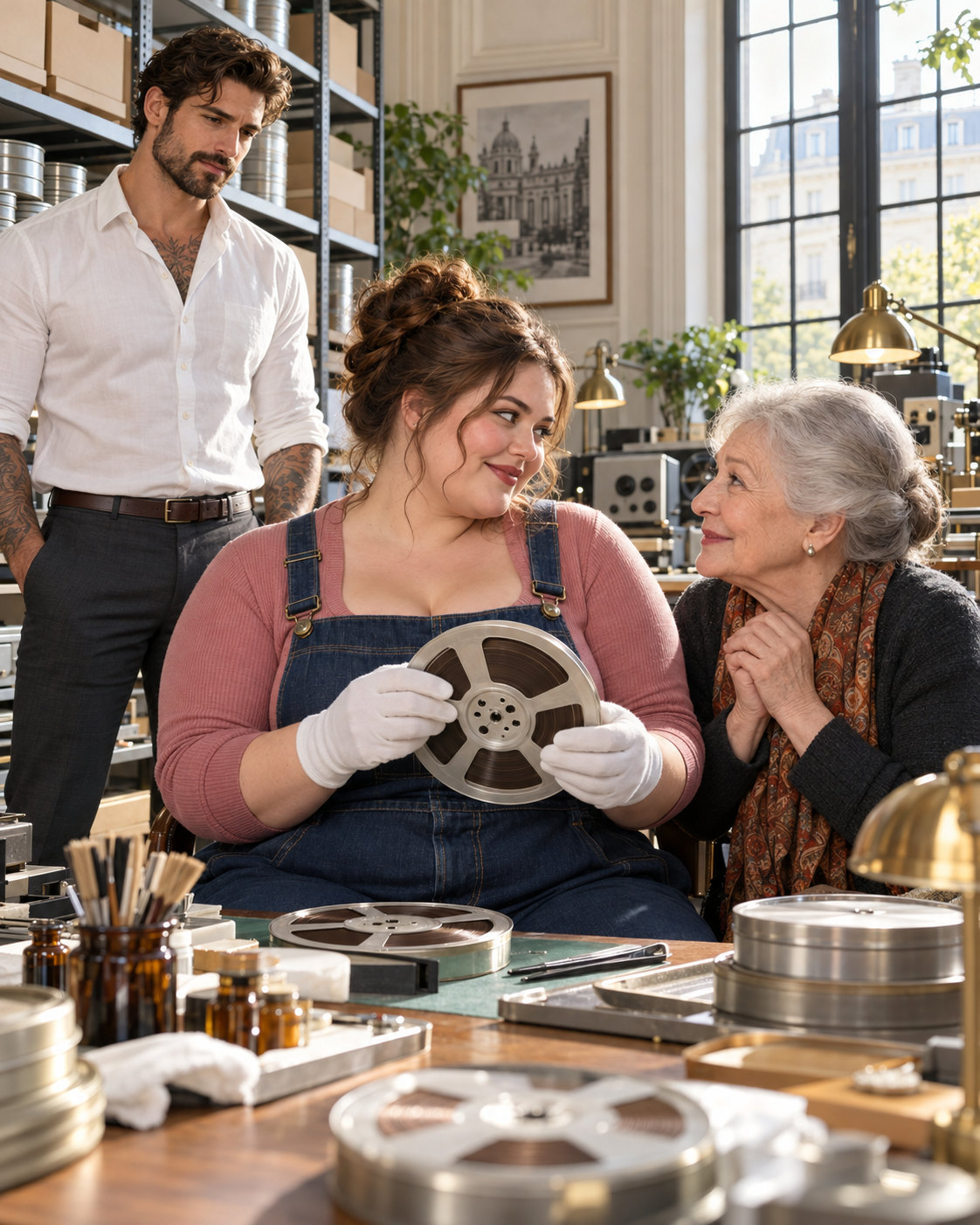
Vittorio said nothing.
Elena answered instead.
“He knew far more than he ever admitted.”
Outside, thunder rolled across the hills surrounding Turin.
Vittorio reached for the key, but Norah moved it away.
“No.”
He looked at her.
“If we’re going down there, we do it my way.”
“And what would that be?”
“No threats. No secrets. And no more decisions about my family made without me.”
For several seconds, Vittorio studied her.
Then he stepped aside.
“Agreed.”
The chapel stood beyond a covered stone passageway, tucked beneath the oldest wing of the estate.
Its carved wooden doors were worn, and a faded painting of the Madonna hung above the entrance.
Elena led them down a narrow staircase illuminated by small wall lamps.
The air smelled of dust, damp stone, and extinguished candles.
Norah had expected something dramatic.
Instead, she found a modest prayer room with six wooden benches, a small altar, and a cabinet built into the wall.
Elena inserted the brass key.
The cabinet opened with a reluctant metallic click.
Inside sat a wooden box, a handwritten letter, and a sealed magnetic tape reel.
Across the envelope, Norah recognized her mother’s handwriting.
For my daughter, when the truth becomes safer than silence.
Her throat tightened.
She had seen that handwriting on birthday cards, grocery lists, and tiny notes her mother used to slip into her school lunches.
The sight of it here, thousands of miles from home, nearly brought her to tears.
Norah opened the envelope.
The letter began simply.
My darling girl,
If you are reading this, the past has finally found its way to you.
I wanted to tell you everything. Every year, I promised myself that when you were older, when we were safer, when the fear had finally disappeared, I would explain who I had been.
But fear has a terrible way of convincing us that tomorrow is always the better day to be brave.
Norah pressed her lips together.
Vittorio looked away, giving her a moment of privacy.
She continued reading.
I was born Isabella Conti in Turin, and I believed that speaking the truth was enough to make the world fair.
I learned that truth can be twisted when the wrong people control who gets to hear it.
If this letter has reached you, then you must know one thing above all others.
Your father never betrayed me.
He saved my life, and he saved yours.
A tear slipped down Norah’s cheek.
The letter continued.
The recording hidden with this letter contains the conversation that changed everything. I could not make it public without endangering people who were still alive.
I trusted Elena to protect it until the day someone could finally listen without being afraid of the people named within it.
Whatever you discover, my daughter, do not allow our family’s past to become your prison.
You deserve a life that belongs to you.
Norah lowered the letter.
For several moments, nobody spoke.
Then Vittorio reached toward the tape reel.
“We have equipment upstairs.”
Norah shook her head.
“This has been stored for decades. Playing it without inspecting the condition could destroy the recording.”
She carefully examined the reel beneath the chapel light.
“The binder may be unstable, and the tape could have become brittle. I need a controlled workspace.”
Vittorio nodded.
“Use anything you require.”
They returned to the estate’s private media room, where a collection of vintage audio equipment had been arranged alongside modern computers.
Norah was surprised by the quality of the restoration setup.
Someone had spent considerable money preparing for this moment.
As she inspected the reel and carefully prepared the transfer, Vittorio remained near the doorway.
Elena sat beside the window, watching the rain.
Nearly two hours passed before Norah completed a stable digital capture.
The initial audio was almost unintelligible.
Voices rose and vanished beneath a blanket of hiss.
But as Norah worked through the frequencies, individual words began emerging.
The first voice belonged to Isabella.
The second belonged to a man speaking sharply in Italian.
A third voice interrupted several times.
Norah isolated the speakers and began comparing their vocal patterns.
Then she stopped.
Something was wrong.
The recording used as evidence against Marco Cenino had contained Isabella directly accusing him.
But the newly recovered original revealed that she had been repeating someone else’s accusation.
Norah played both versions side by side.
In the older version, Isabella appeared to say, “Marco Cenino authorized the transfers.”
In the original, her complete statement was different.
“Someone wants us to believe Marco Cenino authorized the transfers, but the documents prove he refused.”
Vittorio gripped the back of a chair.
For a moment, he looked unable to breathe.
Norah continued.
“The original recording was manipulated. Someone removed the beginning and end of her sentence.”
Elena closed her eyes.
“I told you.”
Vittorio approached the monitor.
“Can you identify who edited it?”
“Not from this alone,” Norah replied. “But the recording may reveal who ordered the changes.”
She resumed the playback.
The third voice spoke again.
Vittorio’s expression changed instantly.
He knew that voice.
Norah looked toward him.
“Who is it?”
He remained silent.
Then he whispered two words.
“My father.”
The man who had built the Cenino family empire.
The man who had arranged Marco’s legal defense.
The man who had publicly blamed Isabella Conti for everything.
And the man whose portrait hung above the grand staircase.
His name was Alessandro Cenino.
The recording continued.
Alessandro’s voice emerged through the static, calm and deliberate.
“Marco will be blamed. Isabella will disappear. The company survives, and nobody asks about the accounts.”
Norah felt a chill travel down her spine.
Another man objected.
“You’re sacrificing your own son.”
Alessandro replied without hesitation.
“I am saving what matters.”
Vittorio stepped away from the desk.
For years, he had believed that Isabella destroyed his brother.
Now he was hearing his own father admit that Marco had been sacrificed to protect the family’s business interests.
The foundations of his life were collapsing inside a quiet room.
But Norah noticed something else.
A faint sound beneath the conversation.
It was barely audible, hidden behind the speakers’ voices.
She enlarged the waveform.
Then listened through her headphones again.
A telephone rang in the background.
A woman answered.
And a few seconds later, a voice said something that made Norah sit upright.
“Daniel, they’re sending someone to Buffalo.”
Norah immediately paused the recording.
“Buffalo?”
Elena opened her eyes.
“That was the beginning of the escape.”
Norah turned toward her.
“My father was already in America?”
“Yes,” Elena replied. “He was preparing a new home for Isabella. But someone discovered the plan.”
“Who?”
Elena hesitated.
Before she could answer, a loud knock sounded at the door.
One of Vittorio’s security officers entered.
“Signor Cenino, your nephew has arrived.”
Vittorio frowned.
“Luca is supposed to be in Milan.”
“He says the matter is urgent.”
Elena stood immediately.
“Don’t let him see the recording.”
Norah noticed the fear in her voice.
“Why?”
Elena looked toward Vittorio.
“Because Luca’s father was the lawyer who handled the original evidence.”
Vittorio’s expression hardened.
“And Luca inherited his father’s private archives.”
Seconds later, a man in his early thirties entered the room.
Luca Cenino was polished, confident, and dressed in an expensive charcoal suit.
He smiled when he saw Norah.
“So this is the American technician.”
Norah didn’t return his smile.
“You seem to know a lot about me.”
“I make it my business to know who visits the family estate.”
His eyes moved toward the computer.
“Especially when they arrive to investigate matters that should have been forgotten.”
Vittorio stepped forward.
“Leave us.”
Luca’s smile faded.
“Uncle, I know what you’ve found.”
The words settled heavily over the room.
Vittorio remained still.
“How?”
Luca reached into his jacket and removed a folded document.
“Because my father left instructions concerning this exact situation.”
He placed the paper on the table.
It was a signed agreement dated shortly after Marco’s conviction.
The document described secret financial arrangements involving Cenino family assets and several international accounts.
But the most disturbing detail was a handwritten note.
If the original recording survives, Daniel Bellamy must never be allowed to speak publicly.
Norah felt her stomach tighten.
“My father?”
Luca looked directly at her.
“Your father has been keeping something that doesn’t belong to him.”
Norah stepped backward.
“What are you talking about?”
“Last month, he contacted a law firm in Manhattan. He told them he possessed documents that could reopen the Marco Cenino investigation.”
Vittorio stared at him.
“How do you know that?”
Luca didn’t answer immediately.
And that hesitation told Norah more than any explanation could.
Her father’s hospitalization had occurred only days after that meeting.
A terrifying possibility entered her mind.
“Did something happen to my father?”
Luca spread his hands.
“People become ill, Miss Bellamy.”
Vittorio’s voice turned dangerously quiet.
“Answer her question.”
Luca looked toward his uncle.
“You spent three years searching for Isabella Conti, never realizing that the answer was sitting in an American hospital.”
Norah grabbed her phone.
Her hands shook as she called the hospital in Buffalo.
The first attempt went unanswered.
She called again.
A nurse finally picked up.
Norah explained who she was and asked about Daniel Bellamy.
There was a pause.
Then the nurse said something that made the room tilt beneath her feet.
“Your father was transferred from his room earlier this evening.”
Norah pressed the phone closer.
“Transferred where?”
“We received instructions indicating that a private medical team would be assuming responsibility for his care.”
“Who authorized that?”
The nurse hesitated.
“The paperwork listed a family representative.”
Norah felt panic rising.
“I didn’t authorize anything.”
Vittorio reached for another phone.
“Find out who arranged that transfer,” he instructed his security chief.
Luca moved toward the door.
Vittorio blocked his path.
“Stay.”
For the first time, Luca looked genuinely uncertain.
“This is unnecessary.”
“Then you have nothing to fear.”
Within minutes, Vittorio’s American attorney confirmed that Daniel Bellamy had been moved to a private facility outside Buffalo.
The transfer had been arranged through a medical services company connected to one of Luca’s business associates.
Luca’s face lost its color.
“It was supposed to be temporary.”
Norah stared at him.
“You moved my sick father without telling me?”
“I was trying to protect the family.”
“From what?” she demanded. “A dying man who wanted to tell the truth?”
Luca looked away.
Vittorio took a step closer.
“You will give us the location, the authorization documents, and every name involved.”
Luca finally understood that the influence he expected from his family name would not protect him.
“My father told me the Bellamys were dangerous,” he said.
Elena shook her head.
“Your father was afraid of what they knew.”
Luca stared at the floor.
“I never intended for anyone to be hurt.”
Norah’s voice broke.
“Intentions don’t erase what you’ve done.”
The next several hours unfolded in a blur.
Vittorio contacted independent attorneys in New York, arranged for local authorities to review the disputed transfer, and instructed his security team to preserve every document connected to Luca’s involvement.
Norah remained on the telephone until a hospital administrator confirmed that her father had been located and was receiving appropriate medical care.
He was weak, frightened, but alive.
When she finally heard his voice, she nearly collapsed with relief.
“Dad?”
There was a pause.
Then Daniel Bellamy whispered, “Nora-bird?”
It was the childhood nickname he had used whenever she couldn’t sleep.
Norah covered her mouth.
“I’m here, Dad.”
“Where are you?”
“Italy.”
Silence.
Then a trembling breath.
“Oh, sweetheart. You found her, didn’t you?”
Norah closed her eyes.
“I found the truth about Mom.”
Her father began crying softly.
It was the first time she had ever heard him cry.
“I wanted to tell you,” he whispered. “Your mother made me promise you would have a normal life.”
“Dad, why did you contact that lawyer?”
“Because I found something in an old storage box. Your mother had left instructions, and I realized there were still people suffering because of what happened.”
He paused to catch his breath.
“I thought if I could make things right before I was gone, maybe she would finally forgive me.”
Norah’s heart ached.
“Forgive you for what?”
“For being afraid.”
She leaned against the desk.
“Dad, you saved us.”
“I got us out,” he whispered. “But I never found the courage to help the others.”
Norah looked across the room at Vittorio.
He stood beside the window, listening without interrupting.
“Then maybe we can do that now,” she told her father.
The following morning, Norah made a decision that surprised everyone.
She would not leave Italy immediately.
Not because Vittorio asked her to remain.
Not because of the eight thousand dollars.
But because the evidence needed to be authenticated, preserved, and delivered to people capable of acting on it.
With the assistance of independent forensic specialists, Norah prepared a full technical report comparing the edited recording against the newly discovered original.
The discrepancies were unmistakable.
The missing words.
The altered timing.
The abrupt transitions hidden beneath artificial noise.
And the complete conversation identifying Alessandro Cenino as the person responsible for shifting blame onto his own son.
Vittorio brought the materials to attorneys who arranged for them to be submitted to the appropriate Italian authorities.
He also authorized a review of the Cenino businesses, including records that might expose additional wrongdoing.
The decision cost him.
Within days, several longtime associates distanced themselves from him.
Business partners demanded explanations.
Members of the family accused him of destroying their legacy.
And Luca, facing investigation over Daniel’s unauthorized transfer and questions about inherited financial records, was removed from his managerial position.
For a man who had spent his life protecting the Cenino name, Vittorio had finally done something unthinkable.
He had placed the truth above the family reputation.
One evening, Norah found him alone in the estate’s garden.
The rain had stopped, and the distant hills were glowing beneath the last light of sunset.
“You could have hidden the recording,” she said.
Vittorio looked toward the mountains.
“Yes.”
“You could have destroyed it.”
“Yes.”
“Then why didn’t you?”
He was silent for a long time.
“Because my brother died believing his family had abandoned him.”
His voice grew quieter.
“And I spent years blaming the one woman who tried to save him.”
Norah sat beside him.
“My mother never told me who she really was.”
“Perhaps she wanted you to remember her without the fear.”
“I used to think she was ordinary,” Norah admitted. “She made terrible pancakes, cried at old movies, and kept every birthday card I ever gave her.”
Vittorio smiled faintly.
“That sounds like a remarkable woman.”
Norah looked at the fading sky.
“She was.”
For the first time since arriving in Turin, the silence between them felt peaceful rather than threatening.
Three weeks later, Norah returned to Buffalo.
There were no photographers waiting at the airport.
No dramatic reunion beneath flashing cameras.
Just an exhausted young woman carrying one suitcase, a copy of her mother’s letter, and the knowledge that her life would never feel quite the same.
Her father was resting in a hospital room overlooking a narrow street lined with autumn trees.
When Norah entered, he opened his eyes and smiled.
“You look like your mother.”
She pulled a chair beside his bed.
“For most of my life, I thought you meant my face.”
Daniel reached for her hand.
“I meant your courage.”
Norah shook her head gently.
“Mom was brave, but she was also afraid.”
He nodded.
“That’s what courage is, sweetheart. Doing what matters even when you’re afraid.”
For a while, they simply sat together.
Then Norah took the restored recording from her bag.
“I brought something.”
Daniel looked at the small storage drive in her hand.
“Is it her?”
Norah nodded.
“I cleaned up a few recordings that Elena found. There’s one from before I was born.”
She connected her laptop and pressed play.
At first, there was soft background noise.
Then Isabella’s voice filled the room.
Warm.
Young.
Full of laughter.
She was speaking to Daniel, teasing him about his terrible Italian pronunciation.
A moment later, she began singing a familiar lullaby.
Daniel closed his eyes.
Tears slipped down his cheeks.
Norah reached for his hand and held it as the song continued.
For twelve years, her mother’s voice had existed only in memory.
Now it was there again.
Not as evidence.
Not as a secret.
Not as something dangerous.
Just as the voice of a woman who had loved them.
Months passed.
The investigation into the old Cenino records continued, and officials began reviewing the evidence surrounding Marco’s conviction.
The truth could not restore the years he had lost, and it could not bring him back to his children.
But it could finally challenge the false story that had followed him into his grave.
Vittorio arranged for Marco’s family to receive the documents and a personal apology.
He also established an independently administered fund to support people harmed by the old business operations, making clear that compensation could not replace accountability.
Norah did not accept an offer to become the Cenino family’s permanent audio specialist.
She returned instead to her small restoration studio in Buffalo.
But something had changed.
After covering the medical bills that had once seemed impossible to manage, she began volunteering her skills to help families recover recordings of relatives they had lost.
Old answering-machine messages.
Damaged wedding tapes.
Voicemails saved from broken phones.
Fragments of ordinary lives that people desperately wanted to hear again.
One winter afternoon, a woman arrived carrying a cassette recorder that had belonged to her late husband.
She apologized repeatedly for its poor condition.
Norah smiled and carefully accepted it.
“Don’t worry,” she said. “Sometimes the most important voices are the hardest ones to recover.”
Later that evening, after closing the studio, Norah received a package from Italy.
Inside was a small silver necklace and a handwritten letter from Elena.
The necklace had belonged to Isabella.
Elena explained that Isabella had worn it on the day she boarded the flight to America, leaving behind her old name and everything she had ever known.
Norah turned the pendant over.
Engraved on the back were three Italian words.
La verità libera.
The truth sets us free.
Beneath the necklace was another letter.
This one came from Vittorio.
He wrote that the estate’s chapel had been reopened, no longer as a hiding place for secrets, but as a memorial to those whose lives had been damaged by silence.
He had also found a photograph of Isabella holding a baby girl beside a window overlooking Lake Erie.
On the back, in her mother’s handwriting, were the words:
Norah, my second chance.
Norah stared at the photograph for a long time.
Then she placed it beside her desk, near a picture of her father smiling on the day he finally returned home from the hospital.
Outside, snow began falling over Buffalo.
Cars moved slowly along the icy streets.
Somewhere in the distance, a church bell rang through the cold evening air.
It was an ordinary American winter night.
The kind of night Norah had lived through hundreds of times before.
Yet everything felt different.
She finally understood that her mother had not built a quiet life because she lacked an extraordinary past.
She had built it because, after witnessing what power and fear could do to people, she wanted her daughter to grow up knowing something far more precious.
Peace.
Freedom.
And the ability to choose her own future.
Norah switched off the studio lights and reached for her coat.
Before leaving, she glanced once more at her mother’s photograph.
For years, she had believed that the greatest gift she could receive would be the chance to hear Isabella’s voice again.
But now she knew the greater gift was understanding the life behind that voice.
Her mother had been frightened, imperfect, courageous, and deeply human.
So had her father.
So, in unexpected ways, had Vittorio.
The past had hurt all of them, but it no longer had to decide what came next.
Norah locked the studio door and stepped into the falling snow.
Tomorrow, there would be more recordings to restore, more bills to pay, more ordinary problems to solve.
And for the first time in months, she welcomed every one of them.
Because an ordinary life, she had learned, was never something to take for granted.
It was something worth protecting.
Years later, whenever someone asked Norah why she dedicated her life to saving old voices, she would give the same quiet answer:
“Because sometimes the truth doesn’t disappear. It simply waits for someone brave enough to listen.”
And somewhere between a forgotten recording in Italy and a little restoration studio in Buffalo, one woman’s secret had finally become her daughter’s greatest lesson.
We cannot change the silence of those who came before us, but we can choose not to pass that silence on to the people we love.
THE END.