After the wedding, Alora had learned the art of becoming invisible in a house that was supposed to be hers.
The final page was folded at the corner.
Alexander stared at it for several seconds before his hand finally moved.
He knew he should stop.
He knew the journal was private.
He knew every line he had already read was something Alora had written for herself, not for him.
But his eyes had already found the words.
And the first sentence made his breath catch.
“I think I would have forgiven him everything if I had not finally realized that I was the only one fighting for this marriage.”
Alexander closed his eyes.
For a moment, the storm outside the windows seemed louder than the beating of his heart.
Rain struck the glass of the Ashworth estate in relentless waves. Beyond the darkened windows, the Hudson Valley had disappeared beneath clouds and mist. The American countryside that usually stretched beneath the hill was nothing but shadows.
He looked down again.
The next lines were worse.
“I used to wonder what it would take for Alexander to love me. Now I wonder what it will take for me to stop waiting.”
His fingers tightened around the edge of the journal.
Then he saw the final paragraph.
“I saved a boy from the river once. I was only a child, but I remember his hand in mine. I remember the crescent scar on his palm. I remember being afraid he would die before I could pull him to shore. I remember how grateful he looked when he opened his eyes.
I never knew his name.
Years later, when I first saw Alexander Ashworth, I recognized the scar.
I knew immediately.
He was that boy.
And perhaps that is why leaving him has always felt like abandoning someone I once promised, without words, that I would never let him drown.”
Alexander stopped breathing.
The journal slipped slightly in his hands.
A memory rose from somewhere deep inside him.
Cold water.
A violent current.
A child’s desperate struggle.
Then a small hand.
A girl’s voice.
A face blurred by rain and sunlight.
He had spent most of his life remembering the rescue as a dream.
His mother had told him he had been lucky.
His father had said a local girl had pulled him from the river.
But the family had left the area soon afterward, and the details had faded.
Only one thing had remained.
The crescent-shaped scar across his palm.
He looked at it now.
Then at the words in Alora’s journal.
“You were her,” he whispered.
The door behind him opened.
Alexander turned sharply.
Alora stood in the doorway.
She was wearing a simple dark-blue dress, her hair loosely pinned, one hand still resting on the brass handle.
Her eyes moved from his face to the journal.
For several seconds, neither spoke.
Then the color drained from her expression.
“You read it.”
Alexander could have lied.
For once in his life, he did not.
“Yes.”
The single word hung between them.
Alora walked into the room and closed the door.
“Give it to me.”
Alexander immediately held out the journal.
She took it without looking at him.
Her hands were trembling.
“I had no right to read it,” he said.
“No.”
“I am sorry.”
She looked up.
It was not anger he saw in her eyes.
That would have been easier.
It was disappointment.
“You always say that when you finally understand something,” she said quietly. “But understanding after the damage is done does not undo it.”
“I know.”
“No, Alexander. I don’t think you do.”
She walked to the writing desk and placed the journal inside the drawer.
“You heard one conversation, and you walked away from me.”
His brow furrowed.
“I heard what you said.”
“And I heard what you said about our marriage.”
He lowered his eyes.
“I never meant for you to hear that.”
“But you meant it.”
He had no answer.
That silence told her enough.
Alora turned away.
“I spent months trying to become the kind of wife you could respect. I thought if I was patient enough, useful enough, quiet enough, you might eventually look at me and see something other than an obligation.”
Her voice remained calm.
That somehow made every word hurt more.
“But then I realized I was disappearing while waiting for you to notice me.”
Alexander stepped forward.
“I noticed you.”
“Too late.”
The words struck harder than any accusation.
He stopped.
Alora continued.
“I don’t want your pity because you discovered something about my childhood. I don’t want you to love me because you feel guilty. And I certainly don’t want you to stay because you believe you owe me your life.”
“I don’t.”
She looked at him.
“You don’t what?”
“I don’t want you because you saved me.”
Alexander’s voice shook.
“I want you because you are you.”
She said nothing.
He forced himself to continue.
“I don’t know when it happened. Perhaps it happened slowly. Perhaps I was too proud to see it. But somewhere between the day you arrived here and the day you began changing everything around you, I started waiting for you.”
Alora’s expression softened for the briefest moment.
Then the wall returned.
“You started waiting after I stopped waiting for you.”
“I know.”
“And you became jealous.”
“Yes.”
“That isn’t love.”
“No,” he said. “It isn’t. But it made me realize how much I could lose.”
She looked away.
Alexander swallowed.
“I have spent years believing that needing someone was weakness. My father taught me that affection was a luxury and duty was enough. When we married, I thought the safest thing was to keep everything simple. No promises. No expectations. No vulnerability.”
He gave a humorless laugh.
“I thought if I never let you close, you could never hurt me.”
Alora’s eyes filled with tears.
“You hurt me anyway.”
“I know.”
This time, he did not say it as an excuse.
He said it as a confession.
“I know.”
The room fell silent.
Finally, Alora asked, “What do you want from me?”
Alexander looked at her.
“For you to give me a chance to earn what I should have given you freely.”
“And if I can’t?”
“Then I will accept it.”
She seemed surprised.
“You would?”
“Yes.”
“You wouldn’t force me to stay?”
“No.”
“You wouldn’t use the marriage agreement?”
“No.”
“You wouldn’t remind me of everything your family gave mine?”
“No.”
His voice became quieter.
“I have spent enough of my life confusing obligation with love. I won’t do it again.”
For the first time, Alora looked directly into his eyes.
There was pain there.
But there was also something else.
Uncertainty.
And Alexander understood that uncertainty was more than he deserved.
So he did something the Duke of Ashworth had rarely done.
He walked away.
Not because he wanted to leave her.
Because he wanted her to know she was free to choose.
The next morning, Alexander did not appear at breakfast.
Nor did he send a servant to summon her.
Instead, Alora found a letter beside her plate.
There were only a few lines.
“I will not ask you to forgive me today.
I will not ask you to love me.
I will only ask for the privilege of showing you, through my actions, that I finally understand what I almost lost.
—Alexander”
She read it twice.
Then folded it carefully.
She did not answer.
For the next several weeks, Alexander kept his word.
He did not become suddenly perfect.
He did not transform into a romantic hero overnight.
He simply began paying attention.
When Alora visited the tenant farms, he went with her only when she invited him.
When she spoke, he listened.
When she disagreed with him, he did not dismiss her.
When a tenant family needed repairs after a winter storm, Alexander arrived with lumber before anyone asked him.
When Alora suggested changing the estate’s winter provisions, he approved the plan without taking credit.
And when the people of the valley began praising the Duchess, Alexander corrected them whenever they thanked him.
“Thank her,” he would say. “It was her idea.”
At first, Alora thought it was another performance.
Then she began to notice something.
He never asked whether she had noticed.
That was what made it different.
One crisp morning in early spring, Alora rode toward the western fields and saw Alexander standing beside a broken fence.
He had removed his coat and was helping two workers repair the posts.
She slowed her horse.
Alexander looked up.
Their eyes met.
He smiled.
Not the polished smile he used at society gatherings.
A tired, genuine smile.
“You’re late,” she called.
He glanced at the fence.
“I was told you had better things to do than repair fences.”
“I was told the same about you.”
He laughed.
It was the first time she had heard him laugh without restraint.
Something inside her shifted.
But she did not forgive him that day.
She simply stayed for breakfast.
A month later, she agreed to walk with him beside the river.
The same river.
The one that had carried a frightened boy away from the shore decades earlier.
They stopped beneath a line of old trees.
Alexander looked at the water.
“I used to hate this river.”
“Why?”
“Because I remembered being helpless.”
Alora watched him.
“And now?”
“Now I think perhaps I was meant to remember something else.”
“What?”
He looked at her.
“That someone reached for me.”
She lowered her eyes.
“I was a child.”
“So was I.”
“And I was terrified.”
“So was I.”
A quiet smile appeared between them.
Alexander extended his hand.
Not demanding.
Not commanding.
Simply offering.
After a long moment, Alora placed her fingers in his.
His hand closed gently around hers.
The crescent-shaped scar was beneath her thumb.
She traced it once.
Alexander’s eyes softened.
“You remembered it all these years.”
“I remembered you.”
He brought her hand to his lips.
“And I forgot you.”
“You were a child.”
“I know.”
She looked at him.
“You don’t have to punish yourself forever.”
“I don’t want to punish myself.”
“Then what do you want?”
“To remember what gratitude should have taught me.”
“And what is that?”
“That a person who saves your life once deserves more than a lifetime of silence.”
Her eyes became wet.
Alexander continued.
“But you deserve more than gratitude, Alora. You deserve to be loved without having to earn it.”
She looked down at their joined hands.
“Can you do that?”
“I don’t know.”
His honesty surprised her.
“But I want to learn.”
That was the answer that finally reached her.
Not a grand promise.
Not an extravagant declaration.
Just the truth.
He wanted to learn.
And so did she.
Their marriage did not become perfect.
There were still arguments.
There were still misunderstandings.
There were mornings when Alexander withdrew into silence and Alora had to remind him that silence could become a wall.
There were evenings when Alora became afraid that the old distance would return.
But now they talked.
Sometimes awkwardly.
Sometimes angrily.
Sometimes until midnight.
They learned each other’s habits.
Alexander learned that Alora preferred the windows open during summer storms.
Alora learned that he hated crowded parties but loved quiet evenings by the library fire.
He learned that she always hummed while reading letters.
She learned that he touched the scar on his palm whenever he was anxious.
He learned to ask before making decisions that affected her.
She learned to tell him when she was hurt instead of pretending she wasn’t.
Little by little, the marriage that had begun as an arrangement became something neither of them had planned.
A partnership.
Then a friendship.
And eventually, a love neither could deny.
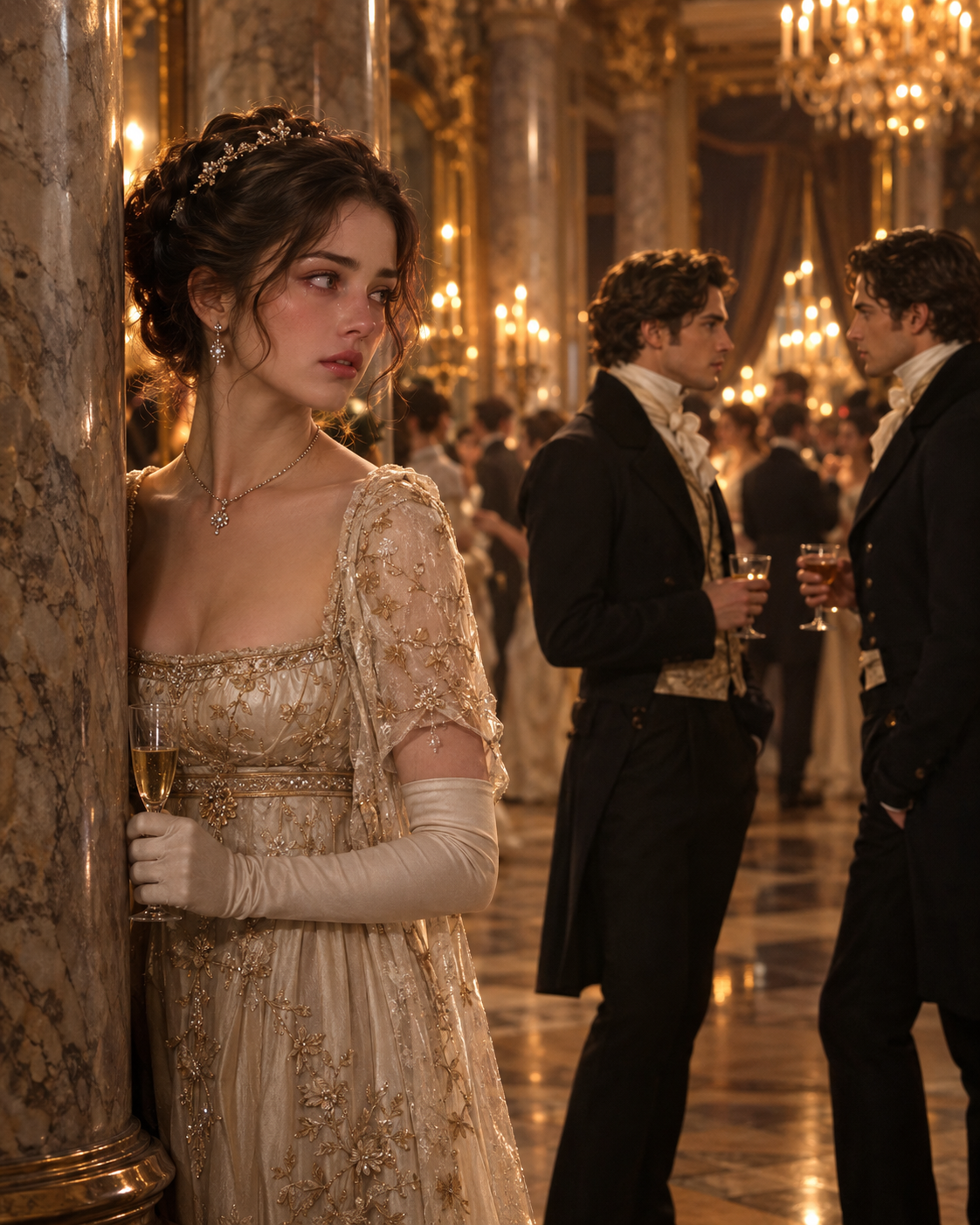
Months later, the Ashworth estate held its annual autumn gathering.
Guests arrived from New York, Boston, Philadelphia, and neighboring towns across the Hudson Valley.
Music filled the ballroom.
Candles glittered against the tall windows.
Alora stood near the fireplace speaking with several tenants and their families when Alexander approached.
He held out his hand.
“May I?”
She smiled.
“You’re asking?”
“I’ve learned that asking is generally safer.”
She placed her hand in his.
They stepped onto the dance floor.
Around them, conversation faded.
Alexander leaned closer.
“You look happy.”
“I am.”
“Because of the dance?”
“No.”
She looked at him.
“Because you finally stopped trying to make me stay.”
His expression softened.
“I almost lost you.”
“Yes.”
“I won’t forget that.”
“You don’t have to live afraid of it.”
He smiled.
“Then what should I do?”
She squeezed his hand.
“Love me while I’m here.”
Alexander’s eyes shone.
“I can do that.”
The music carried them slowly across the floor.
For the first time since their wedding, Alora did not feel as though she was performing the role of Duchess of Ashworth.
She felt like herself.
And Alexander no longer looked like a man trapped inside a marriage he had never wanted.
He looked like a man who had finally discovered that love was not a shackle.
It was a choice.
The following spring, Alora opened the estate’s old schoolhouse to the children of the surrounding tenant families.
Alexander funded the renovation.
But when the local newspaper praised his generosity, he refused the credit.
“The idea belonged to my wife,” he said.
“And what did you contribute?”
Alexander smiled.
“I finally learned to listen.”
Years later, people in the Hudson Valley would remember the Ashworths for many things.
They would remember how the estate prospered.
They would remember how the tenant families gained a voice.
They would remember how the Duke who once avoided public affection became the man who never hesitated to reach for his wife’s hand.
But Alora remembered something simpler.
A rainy night.
A journal.
A confession.
And a man who had finally understood that love could not be demanded, negotiated, or owed.
It had to be chosen.
Every day.
Alexander understood that too.
On quiet evenings, when the estate settled beneath the golden light of sunset, he would sometimes sit beside Alora on the veranda overlooking the river.
He would take her hand.
His thumb would rest over the old crescent-shaped scar.
And she would smile.
Neither of them needed to speak.
They had already learned the lesson that had taken them years to understand.
A marriage could begin with duty and still become love.
A person could make a terrible mistake and still choose to become better.
And sometimes, the person you are most afraid of losing is not someone you were destined to possess.
They are someone you must continually choose—and allow to choose you in return.
For Alora and Alexander, that choice became the foundation of everything that followed.
The river that had once nearly taken a boy’s life became a quiet reminder of the day their story had unknowingly begun.
The scar that had once marked a childhood tragedy became a symbol of recognition.
And the marriage that had once felt like a heavy shackle became, through patience, honesty, and deliberate kindness, the safest place either of them had ever known.
Because love did not arrive when Alexander finally realized that Alora had saved his life.
Love arrived when he understood that saving a marriage required something far more difficult than gratitude.
It required humility.
It required listening.
It required showing up when no one was watching.
And most of all, it required choosing the same person again and again—not because duty demanded it, but because the heart finally did.
Years passed quietly at Ashworth.
The estate that had once felt like a beautiful prison slowly became a home.
The old stone walls were still covered in ivy, the long corridors still carried the echoes of footsteps, and the river still moved beyond the western fields with the same patient rhythm it had carried for generations.
But everything inside those walls had changed.
Especially the people.
Alora became known throughout the Hudson Valley for more than being the Duchess of Ashworth.
She became the woman tenants trusted.
Families came to her when crops failed, when a child needed schooling, when a roof collapsed beneath winter snow, or when someone simply needed to be heard.
She never pretended she could solve every problem.
Instead, she listened.
Alexander watched her become the person she had always been beneath the quietness he had once mistaken for weakness.
And, in time, he stopped being surprised by her strength.
He became proud of it.
Their marriage also changed in ways neither of them could have predicted.
There were no dramatic declarations every morning.
There did not need to be.
Love lived in smaller things.
In the cup of tea Alexander left beside her desk when she worked late.
In the shawl Alora placed over his shoulders when he fell asleep beside the library fire.
In the way he still reached for her hand whenever they entered a crowded room.
In the way she always looked for him first when something wonderful happened.
And sometimes, in the middle of an argument, one of them would stop and remember how close they had once come to losing everything.
That memory was enough to make them soften.
One autumn afternoon, nearly a decade after the night Alexander had discovered her journal, Alora received a letter from New York.
She opened it while sitting beneath the old oak tree overlooking the eastern pasture.
The letter contained an invitation to a charity gathering hosted by several prominent families.
At the bottom was a handwritten note from an old acquaintance.
“You and the Duke have become something of a legend,” it read. “People still speak of your marriage as though it were a storybook romance.”
Alora laughed quietly.
A storybook romance.
If only they knew.
There had been nothing simple about it.
Their love had not begun with tenderness.
It had begun with obligation.
With pride.
With loneliness.
With two people who had been too afraid to admit how badly they wanted to be understood.
She folded the letter.
Alexander approached from behind.
“What are you smiling at?”
She looked over her shoulder.
“A letter.”
“Good news?”
“Apparently we’re a legend.”
He raised an eyebrow.
“That sounds dangerous.”
“They say our marriage is romantic.”
Alexander sat beside her.
“Whoever wrote that clearly wasn’t present during our first year.”
Alora laughed.
“No. They weren’t.”
He looked toward the river.
For a moment, neither spoke.
Then Alexander said, “Do you ever regret it?”
She turned toward him.
“Regret what?”
“Marrying me.”
The question was quiet.
Serious.
Even after all these years, there were moments when Alora could still hear the old insecurity beneath his voice.
She placed her hand over his.
“No.”
He looked at her.
“Not even once?”
“I regret the years we wasted.”
Alexander lowered his eyes.
“So do I.”
“But I don’t regret what we became.”
He lifted her hand and kissed it.
“Neither do I.”
A gust of wind moved through the trees.
Leaves scattered across the grass like small golden sparks.
Then Alexander noticed something in the distance.
A group of children were running toward the riverbank.
One of them slipped on the damp grass.
Another immediately reached for his hand.
Alexander watched them silently.
Alora knew what he was remembering.
“The river,” she said.
He nodded.
“I sometimes wonder what would have happened if you hadn’t been there.”
“You would have survived.”
“Perhaps.”
He smiled.
“But I wouldn’t have met you when I did.”
Alora leaned against his shoulder.
“Maybe we would have met another way.”
“Do you believe that?”
“No.”
She looked at him.
“I believe some moments change the direction of a person’s life. We simply don’t recognize them until much later.”
Alexander thought about that.
“You were a child when you saved me.”
“So were you.”
“And you carried that memory all those years.”
“Yes.”
“Why?”
Alora smiled faintly.
“Because I never forgot your hand.”
He looked down at the crescent-shaped scar.
“I never forgot the river.”
She squeezed his fingers.
“And now?”
“Now I remember the person who reached for me.”
The words were simple.
But they carried the weight of years.
That evening, they returned to the house together.
Dinner was waiting.
The fire was burning.
The servants had already lit the lamps.
Nothing seemed unusual.
Yet halfway through dinner, Alexander suddenly placed his fork down.
“Alora.”
She looked up.
“Yes?”
“I have something for you.”
He reached into his coat and withdrew a small wooden box.
Her expression changed.
“What is that?”
“Open it.”
Inside was a delicate silver pendant.
At its center was a tiny crescent.
Alora stared at it.
“You remembered.”
“I remember everything now.”
She touched the pendant with one finger.
“Alexander…”
“There is something else.”
He turned the pendant over.
Engraved on the back were four words.
“Chosen, not owed.”
Alora’s eyes filled with tears.
He took the pendant from the box and fastened it around her neck.
“You once told me you didn’t want to be loved because I owed you something.”
“I remember.”
“I spent years thinking love was something that could be proven by grand gestures.”
He stepped back.
“I was wrong.”
She touched the pendant.
“What is love, then?”
Alexander smiled.
“Coming home.”
Alora looked at him for a long moment.
“And if home changes?”
“Then we change with it.”
She smiled.
“That sounds almost wise.”
“I’ve had a very good teacher.”
She laughed.
He pulled her gently into his arms.
Outside, the wind moved across the fields.
The river continued its endless journey toward the sea.
And somewhere between the first snowfall and the next spring, the Ashworth estate welcomed a new generation.
Their first child was born on a quiet morning in March.
A daughter.
They named her Clara.
Alexander held the baby for the first time with a look of astonishment that Alora had never seen on his face.
He had faced business disputes, political pressure, family expectations, and storms that had damaged half the estate.
None of them had frightened him as much as the tiny child sleeping against his chest.
“She is so small,” he whispered.
Alora smiled from the bed.
“That’s usually how babies begin.”
“I don’t know what I’m doing.”
“Neither do I.”
He looked at her.
“You’re sure?”
“Completely.”
He laughed softly.
For once, the great Duke of Ashworth looked utterly helpless.
Alora reached for his hand.
He came closer.
Together, they looked down at their daughter.
“She’ll know the story,” Alexander said.
“What story?”
“The river.”
Alora smiled.
“Maybe when she’s older.”
“And the scar.”
“Perhaps.”
He looked at the crescent on his palm.
“I want her to know that sometimes the most important person in your life enters it before you even realize who they are.”
Alora’s expression softened.
“But I want her to know something else.”
“What?”
“That no one owes another person love.”
Alexander nodded.
“Love is chosen.”
“Every day.”
Years later, Clara would indeed hear the story.
Not as a tale of a perfect marriage.
Her parents refused to pretend they had been perfect.
They told her about the distance.
The misunderstandings.
The hurt.
The mistakes.
And the moment they finally learned to speak honestly.
When Clara asked her mother why she had stayed after everything Alexander had said, Alora answered carefully.
“I didn’t stay because I had to.”
“Then why did you?”
“Because your father changed.”
Clara looked at Alexander.
“Did you?”
He smiled.
“I tried.”
“Was it difficult?”
“The hardest thing I’ve ever done.”
“Why?”
“Because changing meant admitting that I had been wrong.”
Clara considered this.
“Were you?”
Alexander glanced at Alora.
“Very.”
Alora laughed.
“And your mother?”
“She was wrong sometimes too,” Alexander said.
“Alexander.”
He grinned.
Clara laughed.
For them, that became one of the greatest gifts of all.
Their home was no longer a place where silence was used as protection.
It was a place where people could disagree and still feel safe.
A place where apologies were not signs of weakness.
A place where affection did not need to be earned through perfection.
As Clara grew older, she began riding through the estate with her mother.
She learned the names of the tenant families.
She attended the school Alora had helped establish.
She spent evenings beside her father in the library.
And every year, on the first warm day of spring, the family walked together to the river.
It became a tradition.
On one such day, when Clara was sixteen, she asked a question that made Alexander smile.
“Father, is it true Mother saved your life?”
“Yes.”
“Then you owe her everything.”
Alexander looked at Alora.
“No.”
Clara frowned.
“Why not?”
“Because that’s not how love works.”
He crouched beside his daughter.
“Your mother saved me once. That is something I will always be grateful for. But I don’t love her because I owe her.”
“Then why?”
He glanced toward Alora.
“Because every morning, I choose her.”
Alora smiled.
Clara looked between them.
“Even when she annoys you?”
“Especially then.”
“Alexander!”
He laughed.
Clara ran away before her mother could respond.
Alora shook her head.
“You’ve taught her terrible things.”
“She’ll survive.”
“She gets that from me.”
Alexander stepped closer.
“And that is exactly why I’m grateful.”
They stood together beside the river.
The water moved quietly beneath the afternoon sun.
For a moment, Alora remembered the little girl she had once been.
She remembered cold water.
Fear.
A boy’s hand slipping from hers.
The impossible determination to pull him back.
She had believed that day was over once the boy survived.
She had never imagined the river would lead her back to him years later.
She had never imagined she would marry him.
And she certainly had never imagined she would love him.
Life rarely announced its turning points.
Sometimes they looked like accidents.
Sometimes they looked like mistakes.
Sometimes they looked like endings.
Alora finally understood that the most painful chapter of her life had not been the end of her story.
It had been the chapter that taught her how to write the next one.
Alexander learned something similar.
He had once believed strength meant never needing anyone.
Now he knew strength could also mean admitting fear.
Apologizing.
Listening.
Changing.
And choosing love without being forced to do so.
That night, after Clara had gone to bed, Alora and Alexander sat together on the veranda.
The stars were bright above the valley.
Alexander reached for her hand.
She rested her head against his shoulder.
“Do you remember what you called our marriage?” she asked.
He closed his eyes.
“Yes.”
“A heavy shackle.”
“I was a fool.”
“A very proud fool.”
“The worst kind.”
She smiled.
“And now?”
He turned toward her.
“Now I think the shackle was never the marriage.”
“What was it?”
“My fear.”
She looked at him.
He continued.
“I was afraid that loving someone would give them the power to hurt me. So I tried to make myself impossible to hurt.”
“And did it work?”
“No.”
“Why?”
“Because shutting you out hurt more.”
Alora leaned closer.
“I suppose we both had something to learn.”
“Yes.”
He kissed her forehead.
“I’m glad we learned it together.”
The years continued.
The estate prospered.
The school grew.
The tenant families became more secure.
And the Ashworth name, once associated mainly with wealth and status, slowly became associated with something else.
Responsibility.
Kindness.
Community.
No one could say exactly when the transformation had begun.
Some believed it was when the Duchess first arrived.
Others said it began when the Duke finally opened his heart.
Alora knew the truth was somewhere in between.
It began the day she decided she could survive without Alexander’s love.
And it became complete the day Alexander realized he wanted to give her love without asking her to survive on it.
That distinction changed everything.
Because Alora no longer needed him.
And Alexander no longer wanted to possess her.
They simply wanted to walk beside each other.
Years after their wedding, on a quiet evening when the sky above the Hudson had turned pink and gold, Alexander and Alora returned once more to the river.
They were older now.
The world had changed around them.
But the water remained.
Alexander looked at his palm.
The crescent scar was still visible.
Alora touched it gently.
“Still there.”
“Of course.”
“You’ll carry it forever.”
“I don’t mind.”
She smiled.
“Neither do I.”
He took her hand.
“Do you ever wonder what that little girl would think if she could see us now?”
Alora looked toward the water.
“She’d probably be surprised.”
“Why?”
“Because she thought she was saving a stranger.”
Alexander smiled.
“And instead?”
“She was saving the beginning of a story.”
He kissed her hand.
“No.”
Alora looked at him.
“You were saving a boy.”
He paused.
“And years later, that boy finally learned how to love the woman who saved him.”
She smiled.
“Then perhaps the story turned out all right.”
Alexander looked at the river.
Then back at her.
“It did.”
They stood there until the sun disappeared beyond the trees.
There were no grand speeches.
No witnesses.
No audience.
They didn’t need any.
Their entire life together had become the answer.
A marriage that began as an arrangement had become a partnership.
A woman who once believed she was unwanted had discovered that her worth had never depended on being chosen.
A man who once feared love had learned that vulnerability was not weakness.
And two people who had once lived like strangers had spent the rest of their lives learning how to become home for each other.
The river kept moving.
So did life.
And perhaps that was the greatest lesson of all.
Love is not proven by how fiercely someone holds on.
It is proven by how freely two people choose one another.
Not once.
Not because of duty.
Not because of guilt.
But again and again.
Every ordinary morning.
Every difficult evening.
Every season that changes.
Every year that passes.
Alexander had once called their marriage a shackle.
By the end of his life, he would call it the greatest freedom he had ever known.
And Alora, who had once stopped waiting to be loved, discovered something even more precious.
She had never needed to become someone worthy of love.
She had only needed to stop believing that someone else’s inability to love her was proof that she was unlovable.
The rest came slowly.
One apology.
One conversation.
One act of kindness.
One hand reaching across the distance.
One choice at a time.
And beneath the endless sky of the Hudson Valley, where their story had begun and where so many of their memories had been made, Alora and Alexander finally understood what neither of them had known on their wedding day.
A lasting love is not a perfect beginning.
It is two imperfect people deciding that, despite everything, they will keep choosing each other.
And this time, neither of them was afraid of the choice.
THE END.