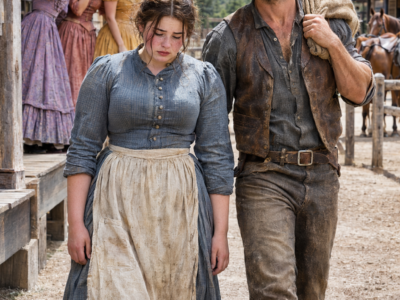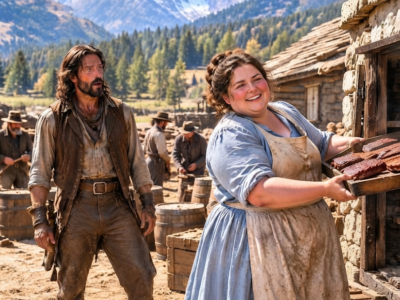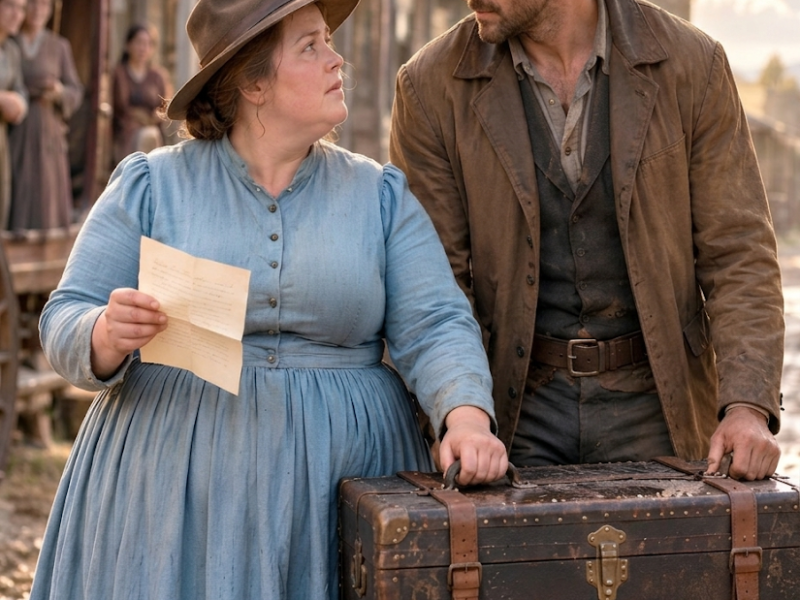
“You’re not the woman I expected,” Peter said, looking Rebecca up and down. “I won’t marry you.” Rebecca Foster stood frozen on the dusty Wyoming station platform. She had traveled more than a thousand miles to marry a man who now refused to even take her hand.
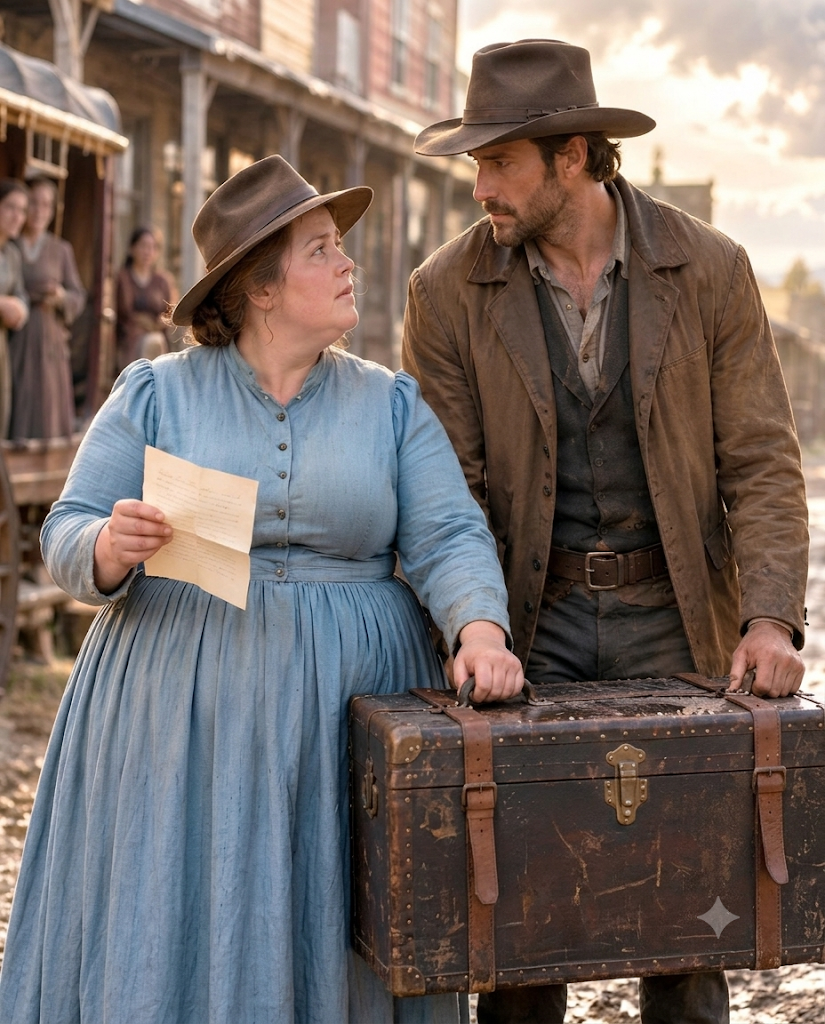
“What have I done?” Andrew repeated, stepping between Peter and Rebecca. “I’ve hired someone to help keep this ranch running. Something you might have considered doing instead of riding into town every afternoon.”
Peter ignored the insult. He unfolded the document and slapped it onto the kitchen table.
“You’ve got thirty days.”
Andrew looked down at the paper. The color drained from his face.
Rebecca watched his expression change. “What is it?”
“A notice of foreclosure,” Andrew answered.
Peter smiled. “Father left you the ranch, brother. But he left me the right to collect the outstanding debt. And I’ve decided it’s time you paid.”
“You know I can’t raise that kind of money in thirty days.”
“Then I suppose you’ll have to leave.”
Rebecca stepped closer to the table. The document was covered with numbers, legal language, and signatures.
“How much?” she asked.
Peter turned toward her. “This is family business.”
“How much do you claim he owes?”
“Four thousand dollars.”
Rebecca felt her stomach tighten. Four thousand dollars was a fortune, particularly for a ranch whose fences were falling apart.
Andrew gripped the back of a chair. “Father never borrowed that much.”
“Then perhaps you should have kept better records.”
Peter reached for his hat.
At the doorway, he paused and looked at Rebecca.
“You should have stayed back East. There’s nothing here for a woman like you.”
Rebecca met his eyes.
“Then it’s fortunate I didn’t come here to please you.”
Peter’s smile disappeared.
After he left, Andrew remained motionless beside the table.
Rebecca waited until the sound of hooves faded.
“May I see your accounts?”
Andrew gave a bitter laugh. “You haven’t even unpacked.”
“And you haven’t answered my question.”
For the first time that evening, something resembling amusement crossed his face.
“The books are in Father’s office.”
“Then we’d better get started.”
Upstairs, Molly sat on the top step, listening.
She had heard Peter’s voice.
And beneath her nightdress, she clutched a small brass key.
It was the same key her mother had pressed into her hand on the night she died.
The next morning, Rebecca discovered that the ranch was in far worse condition than Andrew had admitted.
The barn roof leaked. Two horses needed new shoes. Nearly half the cattle had been sold during the previous winter, and the remaining herd was scattered across grazing land that had suffered through months of drought.
Andrew had been working from dawn until midnight, barely earning enough to feed himself, Molly, and the animals.
Yet the accounts troubled Rebecca more than the broken buildings.
She had spent six years keeping books for a merchant in Philadelphia. Her employer had taught her one important lesson: numbers could reveal truths that people desperately wanted hidden.
By noon, she had found three payments recorded twice.
By supper, she had discovered that several receipts bore signatures Andrew didn’t recognize.
And by midnight, she found something that made her put down her pencil.
“Andrew,” she whispered.
He looked up from the other side of the desk.
“What is it?”
“These interest charges. They’re calculated against money your father supposedly borrowed after he died.”
Andrew stared at her.
“That isn’t possible.”
“Exactly.”
She turned the ledger toward him.
His father had died in February. The disputed loan was dated April.
For a long moment, Andrew said nothing.
Then he rose so suddenly his chair struck the wall.
“Peter.”
“We don’t know that yet.”
“I know my brother.”
Rebecca closed the ledger.
“Knowing someone’s character isn’t the same as proving what they’ve done.”
Andrew looked at her, anger and helplessness fighting across his face.
“What do we do?”
“We find the original documents.”
He shook his head.
“Peter controls the bank records.”
“Then we’ll find something he doesn’t control.”
Outside the office, the floorboards creaked.
Rebecca opened the door.
Molly stood in the hallway, barefoot, her dark hair falling across her face.
“Were we too loud?” Rebecca asked gently.
The child shook her head.
Rebecca noticed Molly staring at the open ledger.
“Would you like some warm milk?”
Another shake.
Then Molly’s gaze moved to a framed photograph hanging above Andrew’s desk.
It showed a smiling young couple standing beside a newborn calf.
Her parents.
Molly lifted one trembling finger toward the picture.
Then she turned and hurried upstairs.
Andrew watched her go.
“She hasn’t pointed at that photograph in months.”
Rebecca said nothing, but she remembered.
Over the following days, she worked harder than she ever had in Philadelphia.
She rose before sunrise, prepared breakfast, helped mend the fencing, and spent her evenings studying accounts.
She discovered Andrew had quietly paid several struggling neighboring families for work he could have done himself.
When she confronted him, he shrugged.
“They needed the money.”
“So did you.”
“They had children to feed.”
Rebecca looked at the man standing before her.
Peter had judged her by her dress and appearance.
Andrew seemed determined to judge himself only by what he could give others.
Both men were foolish in different ways.
But only one kind of foolishness made her heart ache.
Molly remained distant, although she gradually stopped disappearing whenever Rebecca entered a room.
One afternoon, Rebecca found the little girl sitting outside the chicken coop, watching a wounded sparrow struggle to fly.
She sat beside her without speaking.
After several minutes, Molly placed the bird in Rebecca’s hands.
Its wing hung awkwardly.
“We can help him,” Rebecca whispered.
Together, they made a nest from a wooden box and soft cloth.
Molly watched as Rebecca carefully wrapped the injured wing.
“Sometimes,” Rebecca said, “something gets hurt so badly that it forgets how to do what it once knew.”
Molly looked up.
“But forgetting doesn’t mean it can never learn again.”
The child reached out and touched the sparrow’s head.
That evening, Rebecca found a folded piece of paper outside her bedroom.
On it was a drawing of a bird.
Beneath the picture, written in uneven letters, were two words.
Thank you.
Rebecca held the drawing against her chest.
It was the first time she had cried since arriving in Wyoming.
But these tears felt entirely different.
Three days later, trouble came riding through the eastern pasture.
Andrew returned from checking the cattle with blood on his sleeve and fury in his eyes.
Someone had cut the fencing and driven twenty head of cattle toward the neighboring valley.
“Rustlers?” Rebecca asked.
“Maybe.”
But she could tell he didn’t believe it.
That evening, a stranger arrived at the ranch.
He introduced himself as Mr. Harlan, a representative of the Territorial Land Company.
He wore a fine black coat and carried a silver-tipped cane.
“I understand you’re experiencing financial difficulties,” he told Andrew.
Andrew remained standing.
“I understand you make a habit of visiting other people’s property uninvited.”
Harlan smiled.
“My company is prepared to purchase your ranch for three thousand dollars. Cash.”
Rebecca looked sharply at him.
The offer was insultingly low, but suspiciously close to the amount Andrew might accept if he had no other choice.
“The land is worth considerably more,” she said.
Harlan examined her with undisguised irritation.
“And you are?”
“The person who keeps the accounts.”
“Then perhaps you should understand that the alternative is losing everything.”
Andrew stepped forward.
“You’ve made your offer. Now leave.”
Harlan adjusted his gloves.
“Thirty days pass quickly, Mr. Foster.”
After he departed, Rebecca noticed something peculiar.
His horse had been watered before entering the property.
And there were only two wells along the road from town.
One belonged to Peter.
That night, Rebecca searched the old maps stored in Andrew’s office.
She discovered that the ranch included a narrow stretch of rocky land near the northern boundary.
The soil there was too poor for grazing, yet someone had recently marked it with red ink.
“What is this?” she asked.
Andrew glanced over her shoulder.
“Blackstone Creek. Mostly dry these days.”
“And what’s beyond it?”
“Railroad land.”
Rebecca studied the map.
A new railway spur was planned through the valley. If the route crossed Blackstone Creek, Andrew’s property would provide the most direct access to the main line.
She felt a sudden chill.
“Andrew, your brother isn’t simply trying to collect a debt.”
He frowned.
“Then what is he doing?”
“He’s trying to take land that may soon be worth ten times what he’s offering.”
Andrew stared at the map.
For the first time, the threat before them seemed larger than a family dispute.
And far more dangerous.
The following Sunday, Rebecca accompanied Andrew and Molly to church.
She wore her best dress, an old blue garment she had carefully repaired.
As they entered, conversations stopped.
Several women glanced at her, then whispered behind their gloves.
Rebecca recognized the expression.
She had endured it in Philadelphia when people learned she was unmarried at thirty-two.
She endured it again when Peter publicly rejected her.
But she was unprepared for what happened after the service.
Peter approached with a beautiful young woman on his arm.
“Rebecca,” he said brightly. “I’d like you to meet Miss Charlotte Whitmore. My fiancée.”
Charlotte was slender, fair-haired, and dressed in expensive silk.
She offered Rebecca a sympathetic smile.
“Peter told me about your unfortunate misunderstanding.”
Rebecca looked from Charlotte to Peter.
“How fortunate he found someone who understood him perfectly.”
Peter’s jaw tightened.
Charlotte blinked, unsure whether she had been insulted.
Then Molly suddenly gripped Rebecca’s hand.
Her entire body had gone rigid.
Rebecca followed the child’s terrified gaze.
Mr. Harlan stood near the church doors.
He was speaking quietly to Peter.
When Harlan noticed Molly watching him, he stopped talking.
Molly began trembling.
Rebecca immediately knelt.
“Sweetheart, what’s wrong?”
Molly could only shake her head.
Andrew came toward them.
But before he reached the child, Molly broke free and ran outside.
Rebecca followed her behind the church, where the girl crouched beside a rain barrel.
“Molly?”
The little girl covered her ears.
Rebecca sat on the ground a few feet away.
“You don’t have to tell me anything.”
Minutes passed.
Then Molly whispered a single word.
“Bad.”
Rebecca’s breath caught.
It was the first word she had heard the child speak.
“Who is bad, sweetheart?”
Molly began to cry.
“The man.”
Rebecca gently took her hand.
“The man with the cane?”
Molly nodded.
And suddenly Rebecca understood that the little girl’s silence might have nothing to do with grief alone.
That night, she told Andrew what had happened.
His face became frighteningly pale.
“Molly’s parents died in a wagon accident,” he said. “Their horses bolted near Blackstone Creek.”
“Who found them?”
“Peter.”
“And who was with him?”
Andrew stared at her.
“Harlan.”
For several seconds, neither spoke.
Then Andrew shook his head.
“No. Peter is greedy. He’s selfish. But he wouldn’t hurt our sister.”
Rebecca lowered her voice.
“I’m not accusing anyone. But Molly is afraid of that man for a reason.”
Andrew turned away.
His sister, Eleanor, had been the gentlest person he’d ever known.
She had helped raise him after their mother died.
The idea that someone might have deliberately harmed her was unbearable.
Rebecca stepped closer.
“Andrew, we need to know what Molly saw.”
“And if remembering destroys whatever peace she has left?”
“Then we don’t force her.”
Rebecca glanced toward the stairs.
“We make her feel safe enough to tell us when she’s ready.”
Two days later, Rebecca found Molly kneeling beside the old fireplace in her parents’ former bedroom.
She was trying to loosen a brick.
Rebecca helped her remove it.
Inside the narrow opening lay a small tin box.
Molly pulled the brass key from beneath her dress.
Her hands shook as she fitted it into the lock.
The lid opened.
Inside were several letters, a photograph, and a folded legal document bearing Eleanor’s signature.
Rebecca read the first page.
Then the second.
By the time she reached the final letter, her heart was pounding.
Eleanor had discovered that Peter and Harlan were attempting to sell mineral and railway access rights on land they didn’t own.
She had also uncovered forged loans against their father’s estate.
Her last letter was addressed to Andrew.
If anything happens to me, don’t trust Peter’s papers. The original deed and repayment receipts are with Mr. Bellamy, the attorney in Cheyenne. I intended to tell you myself, but I fear I’ve waited too long.
Rebecca’s fingers tightened around the paper.
Below the signature was a final sentence.
Peter knows I have discovered everything.
Molly watched her with enormous, frightened eyes.
Rebecca folded the letter carefully.
“Your mother was very brave.”
Molly swallowed.
“Bad man shouted.”
Rebecca felt every muscle in her body stiffen.
“Was that before the accident?”
The child nodded.
“Uncle Peter was there?”
Another nod.
Then Molly whispered, “Mama said run.”
Rebecca pulled the trembling little girl into her arms.
She did not ask another question.
There would be time for answers.
First, Molly needed to know she was safe.
Andrew read Eleanor’s letters that evening.
He sat at the kitchen table long after the lamps burned low.
Finally, he pressed his hands over his face.
“I should have protected her.”
Rebecca sat beside him.
“You couldn’t have known.”
“She came to me once. A week before she died. She wanted to talk about Peter.”
“What happened?”
“I told her we would speak after the spring roundup.”
His voice broke.
“I was too busy.”
Rebecca reached for his hand.
“Andrew, your sister trusted you. That’s why she left those papers.”
He looked at her.
“And now?”
“Now we finish what she started.”
The next morning, Andrew prepared to ride to Cheyenne.
But before he could saddle his horse, smoke rose from the northern pasture.
Rebecca spotted it first.
“Andrew!”
They ran outside.
Flames were spreading across the dry grass, driven by a fierce western wind.
The fire was moving toward the barn.
Andrew shouted for the ranch hands while Rebecca rushed to release the horses.
Within minutes, smoke filled the yard.
Sparks landed on the roof.
Molly stood on the porch, frozen.
Rebecca ran toward her.
“Get to the well!”
But Molly suddenly screamed.
“The bird!”
The wounded sparrow was still inside the kitchen.
Before Rebecca could stop her, the child darted through the doorway.
“Molly!”
Rebecca followed.
Inside, smoke rolled across the ceiling.
The little girl had reached the bird’s box, but a burning beam crashed across the doorway.
Rebecca pulled Molly against her.
The heat was unbearable.
She grabbed a heavy blanket, soaked it in a bucket, and wrapped it around them.
Then she heard Andrew shouting outside.
“Rebecca!”
“We’re here!”
He struck the burning beam with an iron bar.
Once.
Twice.
The wood shifted.
Andrew forced himself through the narrow opening.
He seized Molly and carried her out.
Rebecca stumbled behind them as the kitchen ceiling collapsed.
They fell into the dirt together.
For a moment, no one moved.
Then Molly began sobbing.
“Don’t leave me! Please don’t leave me!”
Andrew stared.
His niece was speaking.
She clung to Rebecca’s neck.
“Please, Mama said people go away!”
Rebecca held her tightly.
“I’m here, sweetheart. I’m right here.”
Andrew knelt beside them, tears cutting through the soot on his cheeks.
He wrapped both of them in his arms.
The ranch house survived, but the kitchen and half the barn were destroyed.
More devastating still, the office was reduced to ashes.
All Andrew’s account books were gone.
Only the letters Rebecca had tucked inside her traveling bag remained.
When the sheriff arrived, he declared the fire an unfortunate consequence of dry weather.
Rebecca disagreed.
She had seen a rider leaving the northern pasture just before the smoke appeared.
And beside the broken fence, Andrew found a discarded oil flask.
They took it to Sheriff Dalton.
He turned it over, then set it aside.
“Could belong to anyone.”
“Someone deliberately burned my property,” Andrew insisted.
“Prove it.”
Rebecca watched the sheriff carefully.
“Have you spoken to Mr. Harlan?”
Dalton’s expression changed.
“Be careful what accusations you make, Miss Foster.”
That evening, she told Andrew they could no longer trust the sheriff.
Andrew was exhausted.
Their home was damaged, their cattle scattered, and the foreclosure deadline was only nine days away.
“We’ll never make it to Cheyenne and back in time,” he said.
Rebecca unfolded Eleanor’s letter.
“Then I’ll go.”
Andrew looked at her.
“Absolutely not.”
“Someone must remain here with Molly.”
“And you think I’ll send you alone?”
She lifted her chin.
“Andrew, I traveled more than a thousand miles to reach Wyoming. I can manage sixty more.”
“This is different. Those men have already killed—”
He stopped.
The words hung between them.
Rebecca stepped closer.
“That’s exactly why we cannot surrender.”
Andrew stared into her eyes.
Then, very quietly, he said, “I couldn’t bear it if something happened to you.”
Rebecca’s heart gave a painful little leap.
For weeks, she had been careful not to mistake his kindness for affection.
She had learned what happened when a woman imagined herself wanted.
But there was no pity in Andrew’s expression.
Only fear.
And something deeper.
“Then give me a reason to come back,” she whispered.
Andrew lifted his hand and brushed a loose strand of hair from her cheek.
“You already have one.”
He glanced toward the staircase where Molly slept.
Then he looked back at Rebecca.
“Two, if you’ll allow it.”
Before either could speak again, a horse whinnied outside.
Someone had entered the yard.
Andrew grabbed his rifle.
A moment later, Charlotte Whitmore appeared at the kitchen door, pale and breathless.
“Please,” she whispered. “You have to help me.”
Her silk dress was torn, and there was blood on her wrist.
Peter had discovered that she overheard his conversation with Harlan.
“He intends to sell the ranch to the railroad company,” Charlotte said. “But he needs the foreclosure completed first.”
Rebecca helped her sit.
“What about Eleanor?”
Charlotte’s eyes filled with tears.
“I heard Harlan say the girl should have died with her parents.”
Andrew went utterly still.
Charlotte began trembling.
“Peter told him to keep quiet. Then he said if Molly remembered anything, he’d deal with her himself.”
Andrew turned toward the door.
Rebecca caught his arm.
“Don’t.”
“He threatened my niece.”
“And if you ride over there now, he’ll have you arrested or killed.”
Andrew’s hands shook with rage.
Charlotte took a breath.
“There’s something else. Peter has the original debt notes locked in his office. He’s planning to destroy them tomorrow.”
Rebecca considered this.
“Can you get us inside?”
Charlotte nodded.
“He still believes I intend to marry him.”
They made their plan before dawn.
While Andrew remained at the ranch with Molly, Rebecca and Charlotte rode into town.
Charlotte entered Peter’s house first, pretending she had come to apologize for leaving him.
Rebecca slipped through the rear entrance.
She found the office exactly where Charlotte described it.
Inside the desk drawer lay the forged loan documents and a small leather ledger.
Rebecca opened it.
Every payment was recorded.
Every fraudulent charge.
And beside several entries were initials she recognized.
P.F.
H.H.
She tucked the ledger beneath her coat.
Then the door opened.
Peter stood in the doorway.
For one terrible second, neither moved.
“Well,” he said softly. “The ugly bride has become a thief.”
Rebecca straightened.
“I’m taking back what belongs to Andrew.”
Peter closed the door.
“You should have accepted my rejection and gone home.”
“I used to think so.”
He stepped closer.
“But now?”
“Now I thank God you showed me who you were before I married you.”
His face twisted.
He lunged for the ledger.
Rebecca struck his hand with a heavy brass paperweight.
Peter cried out.
She ran for the window.
But Harlan appeared outside.
Rebecca was trapped.
Peter seized her arm.
“You’ve caused me enough trouble.”
Before he could pull her away, Charlotte struck him across the head with a fireplace shovel.
He collapsed.
Harlan rushed through the doorway, but Charlotte pointed Peter’s revolver at his chest.
“Don’t move.”
Her voice shook, but her hands were steady.
Rebecca climbed out the window.
Charlotte followed.
They ran to their horses and galloped toward the main street.
Behind them, Harlan shouted for help.
Sheriff Dalton emerged from the courthouse.
“There they are!”
Rebecca’s heart sank.
He was working with Peter.
“Keep riding!” Charlotte cried.
They reached the telegraph office moments before Dalton’s men caught them.
Rebecca threw open the door.
The young telegraph operator stared in astonishment.
“Send a message to the territorial marshal in Cheyenne,” she gasped. “Tell him we have evidence of fraud, attempted murder, and a corrupt sheriff.”
Dalton entered behind her.
“Step away from that machine.”
The operator hesitated.
Rebecca placed Eleanor’s letters on the counter.
“Please. A child may die if you don’t.”
The young man looked at the letters.
Then at Dalton.
And began tapping.
Dalton drew his pistol.
Charlotte raised hers.
For several seconds, the room held its breath.
Then a voice rang out from the street.
“Put it down, Sheriff.”
Andrew stood in the doorway.
Behind him were six neighboring ranchers, all carrying rifles.
Rebecca stared.
“Andrew?”
He gave her a faint smile.
“You didn’t think I’d let you fight the whole territory alone?”
Dalton lowered his weapon.
The operator continued transmitting.
By sunset, the marshal had replied.
He was coming.
But Peter had disappeared.
And Molly was missing.
Andrew discovered her absence when he returned to the ranch.
One of the hired hands lay unconscious beside the porch.
Molly’s little blue ribbon had been dropped in the dirt.
Pinned to the door was a note.
Bring the ledger to Blackstone Creek at midnight. Come alone.
Andrew crushed the paper in his fist.
Rebecca read it over his shoulder.
“We’re not giving him the evidence.”
“He has Molly.”
“And he’ll kill all of us if we do exactly what he wants.”
Andrew looked at her, desperate.
“She’s all I have left of Eleanor.”
Rebecca took his face between her hands.
“Then we’re going to bring her home.”
At eleven thirty, Andrew rode toward Blackstone Creek carrying a leather satchel.
Inside were blank sheets of paper wrapped to resemble the stolen ledger.
Rebecca and three ranchers followed along a concealed ridge.
Charlotte rode toward town to meet the approaching marshal.
The moon was high when Andrew reached the dry creek bed.
Peter waited beside an abandoned mining shed.
Harlan stood behind him with a rifle.
Molly sat on the ground, her hands tied.
Her face was streaked with tears.
“Uncle Andrew!”
Andrew swung down from his horse.
“I’m here, sweetheart.”
Peter extended his hand.
“The ledger.”
“Release her first.”
Peter laughed.
“You’ve always been sentimental.”
Andrew threw the satchel onto the ground.
Harlan opened it.
His expression darkened.
“It’s a trick.”
Peter drew his revolver.
Before he could fire, Rebecca stepped from behind the rocks.
“There’s no point killing him.”
Peter turned.
“You?”
“The marshal already has copies of Eleanor’s letters. Even if you destroy the ledger, people know what you’ve done.”
Peter hesitated.
It was a bluff.
The marshal had received the telegraph message, but the actual evidence remained with Rebecca.
Still, Peter couldn’t know that.
“You think you’re clever,” he snarled.
“No,” Rebecca answered. “I think you’ve mistaken cruelty for intelligence.”
Harlan suddenly grabbed Molly by the collar.
“Enough talking!”
The little girl screamed.
Andrew lunged forward.
A gunshot shattered the night.
Andrew staggered.
Rebecca cried out as he fell to one knee.
Blood darkened his shoulder.
Peter stared at his own smoking revolver.
For a heartbeat, even he seemed stunned.
Then Molly twisted free.
She ran toward Rebecca.
Harlan aimed his rifle.
But a horse thundered down the ridge.
Charlotte appeared, followed by the territorial marshal and his deputies.
“Drop your weapons!”
Harlan fired wildly.
One deputy returned fire, striking the rifle from his hands.
Peter tried to flee, but Andrew, despite his wound, caught his ankle as he passed.
Both brothers crashed into the dirt.
Peter struggled.
Andrew held him down until the deputies reached them.
Then Andrew collapsed.
Rebecca ran to him.
“Andrew!”
His eyes fluttered.
“Is Molly safe?”
Rebecca nodded through her tears.
“She is. She’s safe.”
He smiled faintly.
“Good.”
Then his eyes closed.
The next three days passed like a fever dream.
Andrew lay unconscious while the town doctor fought to control the infection in his wound.
Rebecca scarcely left his bedside.
Molly slept in a chair beside him, refusing to be separated from either of them.
Peter and Harlan were taken into custody.
Sheriff Dalton was arrested after the marshal uncovered payments made to him through Harlan’s company.
A search of Peter’s property revealed additional forged deeds, stolen ranch funds, and a bloodstained harness matching the one from Eleanor’s fatal accident.
Under questioning, Harlan finally confessed.
He had frightened Eleanor’s horses on Peter’s orders, intending to stop her from reaching Cheyenne with the evidence.
Peter claimed he had only wanted to delay her journey.
But two people had died.
And a child had carried the terror of that night in silence.
On the third evening, Andrew opened his eyes.
Rebecca was sitting beside him, reading Molly a story.
He listened to her voice for several moments before speaking.
“You’re reading that wrong.”
Rebecca nearly dropped the book.
Molly sprang from her chair.
“Uncle Andrew!”
He winced as she threw herself against him, but he laughed.
Rebecca covered her mouth.
Andrew reached toward her.
“Come here.”
She took his hand.
“You frightened us.”
“I’ve been told I have a talent for causing trouble.”
“An extraordinary talent.”
He looked at her for a long moment.
Then his expression grew serious.
“Rebecca, when Peter left you standing at that station, I thought he was a fool.”
She lowered her eyes.
“You don’t have to talk about that.”
“Yes, I do.”
His hand tightened gently around hers.
“I thought I was offering you a job. But every day since, you’ve given this house something I couldn’t restore myself.”
Rebecca felt tears gathering.
“Andrew—”
“You brought laughter back. You made Molly feel safe. And you reminded me that surviving isn’t the same as living.”
He swallowed.
“I don’t want you here because I need a housekeeper.”
Molly watched them with bright, hopeful eyes.
Andrew smiled.
“I want you here because I love you.”
Rebecca stared at him.
For so many years, she had believed love was something a woman had to earn by being prettier, younger, softer, or more pleasing.
But Andrew had seen her exhausted, frightened, stubborn, soot-covered, and furious.
And somehow, he loved her anyway.
“I love you too,” she whispered.
Molly clapped both hands over her mouth.
Then she leaned toward Andrew.
“Does that mean she can stay forever?”
Andrew looked at Rebecca.
“That depends on whether she’ll have us.”
Rebecca laughed through her tears.
“I believe I might.”
Molly threw her arms around them both.
For the first time since her parents’ deaths, she laughed without fear.
The legal proceedings lasted several months.
Peter was convicted for his part in the fraudulent land scheme and the conspiracy that led to Eleanor and her husband’s deaths.
Harlan received a lengthy prison sentence, while Dalton lost his office and faced punishment for corruption.
The forged debts were declared invalid.
Andrew’s ranch was safe.
More surprisingly, the railroad company approached him with a legitimate offer to purchase a narrow right-of-way across his northern land.
The payment was enough to repair the house, replace the lost cattle, and settle every genuine debt.
But Andrew refused to sign until Rebecca reviewed the contract.
She examined every page.
Then she smiled.
“This one is honest.”
Andrew grinned.
“That’s a refreshing change.”
They married the following spring beneath a flowering cottonwood tree near the ranch house.
Charlotte stood beside Rebecca as her closest friend.
The neighboring ranchers who had helped rescue Molly filled the yard with music, food, and laughter.
Molly wore a pale yellow dress and carried a bouquet of wildflowers.
When the preacher asked who gave the bride away, Rebecca stepped forward before anyone could answer.
“I give myself,” she said.
A ripple of surprised laughter passed through the guests.
Andrew smiled as though he’d never loved her more.
Then he took her hands.
“I promise,” he whispered, “that you will never stand alone again.”
Rebecca squeezed his fingers.
“And I promise never to let you face your troubles alone either.”
Years later, people in the valley still told the story of the woman who arrived to marry one brother and ended up saving the other.
Some spoke of the forged documents and the midnight confrontation.
Others remembered the fire, the stolen child, and the remarkable courage of a woman no one had expected to become a heroine.
But Rebecca rarely spoke about those things.
Instead, she spent her days helping Andrew build a prosperous ranch and teaching Molly to keep accounts, ride horses, and trust her own judgment.
She also opened a small schoolhouse on the property for children whose families couldn’t afford an education.
Above its doorway, she hung a wooden sign bearing a simple message.
Your worth is not decided by someone else’s inability to see it.
One autumn afternoon, many years after her arrival, Rebecca stood beside the same Wyoming station platform where Peter had rejected her.
Molly, now a confident young woman, was leaving to study medicine in Denver.
Rebecca adjusted the collar of her daughter’s traveling coat.
“Are you frightened?”
“A little.”
“Good,” Rebecca said softly. “That means you’re about to do something brave.”
Molly smiled.
“Did you feel brave when you came here?”
Rebecca looked across the platform.
She remembered her battered suitcase, her worn dress, and the terrible humiliation of watching Peter drive away.
“No,” she admitted. “I felt unwanted.”
Molly took her hand.
“And now?”
Rebecca looked toward Andrew, who stood beside their wagon, waiting with the patient smile that had become the safest place in her world.
She thought of the home they had built, the hardships they had survived, and the love they had chosen every ordinary day.
“Now,” she said, “I know that being unwanted by the wrong person can be the beginning of being truly loved by the right ones.”
The train whistle sounded.
Molly embraced her mother, then climbed aboard.
As the train pulled away, Rebecca leaned against Andrew’s shoulder.
He kissed her forehead.
“Any regrets about coming to Wyoming?”
She smiled.
“Only that I wasted so many tears on your brother.”
Andrew laughed.
Then he offered his hand.
“Ready to go home?”
Rebecca looked once more at the platform.
Long ago, she had stood there believing her life was over because one man had decided she wasn’t beautiful enough.
She knew better now.
Beauty had never been the measure of her courage, her kindness, her intelligence, or her capacity to love.
And rejection had never been proof that she was unworthy.
Sometimes, the door that closes most painfully is the very one that keeps us from walking into the wrong life.
Rebecca took Andrew’s hand.
Together, they walked toward the wagon, toward the home they had saved, and toward the beautiful life neither of them could ever have imagined.
For Rebecca Foster, the greatest blessing had not been finding a man who finally recognized her worth.
It had been discovering that her worth had existed all along, even when nobody else could see it.