
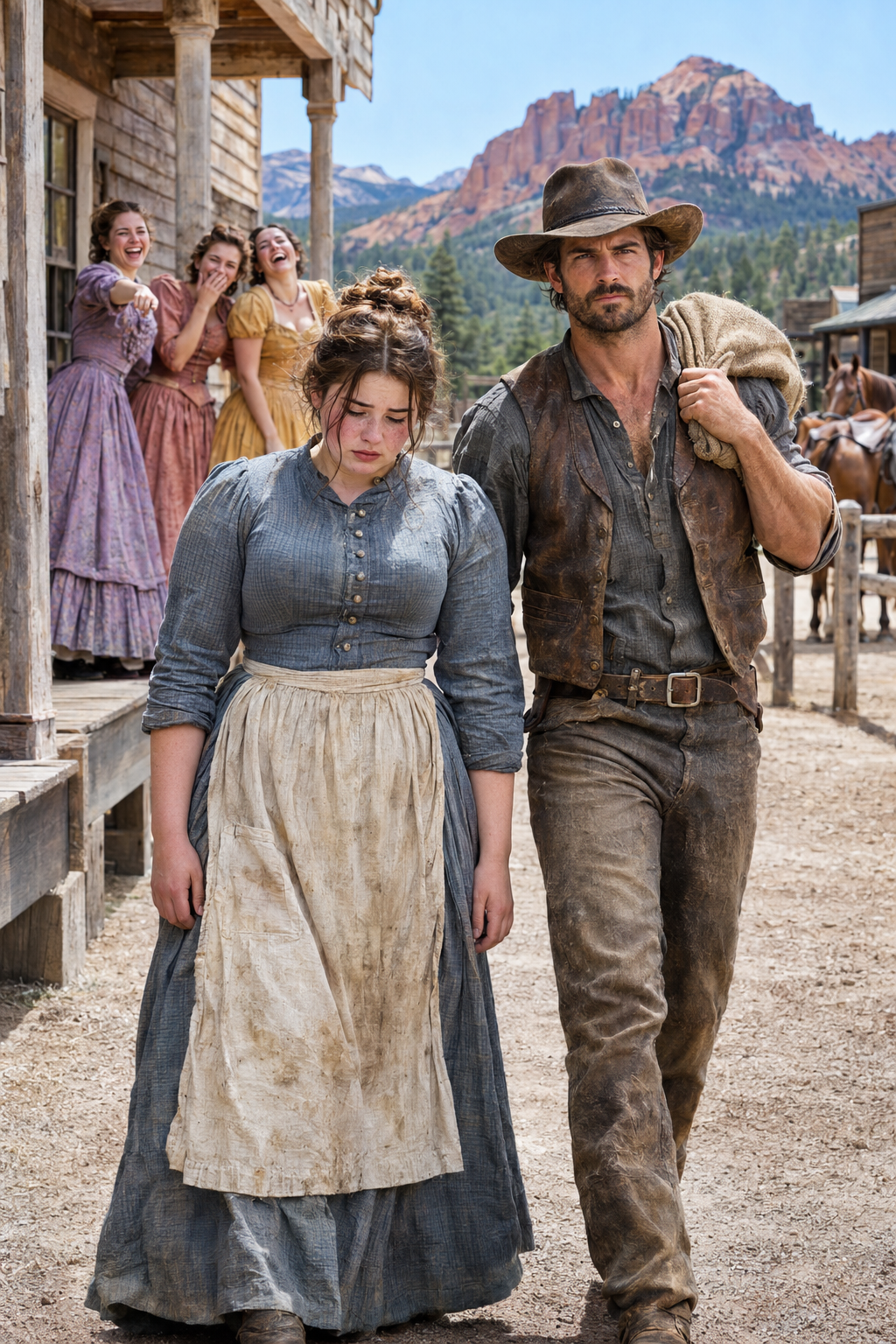
The richest cattle rancher in the territory walked into Cedar Bend wearing torn boots and carrying an empty stomach. The only woman willing to feed him was the one everyone in town made fun of.
“Wade Ashford,” Danner whispered.
His fingers trembled as he examined the document. Beneath Wade’s name was the official seal of the territorial governor, confirming his ownership of the Ashford Cattle Company, nearly eighty thousand acres of grazing land, and controlling shares in several freight operations.
One of those operations was the very company Royce Danner managed.
Danner slowly raised his eyes.
“Mr. Ashford, I had no idea you were visiting Cedar Bend.”
“That much is obvious,” Wade replied.
Danner attempted a smile, but the color had already drained from his face.
“Surely we can discuss this misunderstanding somewhere more appropriate.”
“The only misunderstanding here is your belief that you can steal a widow’s home.”
Clara stood motionless beside the laundry door. For six days, she had shared her meals with this man, washed his clothes, and worried that his thin blanket wasn’t enough to keep him warm.
Now she was discovering that he could probably purchase every building on the street without noticing the expense.
Danner hurriedly folded his eviction notice.
“There appears to have been an accounting error. I’ll investigate immediately.”
“You’ll do more than that,” Wade said. “Tomorrow morning, I want every document concerning this property and the railroad’s unpaid compensation to Mrs. Bennett.”
Danner nodded before retreating with his men.
When they disappeared around the corner, Wade turned toward Clara.
She wasn’t smiling.
“You lied to me.”
“Clara, I can explain.”
“Was my bread not good enough for a wealthy man? Did you find it amusing watching me count pennies before buying flour?”
“No. Never.”
“Then why?”
Wade removed his hat.
He had faced stampeding cattle, armed thieves, and businessmen who would gladly ruin him for another dollar. Yet standing before this wounded woman, he found himself struggling to speak.
“I wanted to know what people were like when they believed I had nothing.”
Clara stared at him for a long moment.
“And did you ever consider what it would feel like for someone who truly has nothing to discover she was being tested?”
Her words struck harder than any fist.
Wade lowered his head.
“No,” he admitted. “I didn’t.”
Clara walked inside and closed the door.
That evening, Wade returned to the shed. He could have rented the finest room in Cedar Bend, ordered an expensive dinner, and sent for clean clothes.
Instead, he sat on the wooden floor beneath the blanket Clara had given him.
For the first time in years, his wealth felt like something he needed to apologize for, not because having money was wrong, but because he had allowed it to make him suspicious of everyone.
Across town, Royce Danner locked himself inside his freight office.
He opened a steel safe and removed a thick ledger, several property deeds, and a bundle of envelopes bearing the railroad company’s seal.
His assistant, a nervous young clerk named Samuel Pike, watched from the doorway.
“What are you doing, sir?”
“Correcting a problem.”
Danner pulled Clara’s file from the bundle.
Inside was a compensation draft issued eighteen months earlier following the death of her husband, Thomas Bennett.
The amount was eighteen hundred dollars.
Clara had never received a single cent.
Danner had forged her signature, collected the money, and arranged for her property taxes to remain unpaid despite the payments Thomas had made before his death.
But Clara wasn’t his only victim.
There were eleven other families whose compensation had disappeared into Danner’s pockets.
If Wade examined the original records, everything would come to light.
Danner threw several documents into the stove.
Samuel stepped forward.
“Those are company records.”
Danner turned sharply.
“And you’re a company employee who would do well to remember who pays his wages.”
Samuel backed away.
“Of course, sir.”
What Danner didn’t know was that Samuel had spent months secretly copying suspicious transactions into a small notebook.
His own father had died in a mining accident. He knew what it meant for a family to wait for money that never arrived.
Until that evening, fear had kept him silent.
Now someone powerful enough to challenge Danner had finally arrived.
The following morning, Clara found Wade repairing the broken step outside her laundry.
“You don’t have to do that anymore,” she said.
“I know.”
“Everyone knows who you are now.”
“I expect they do.”
“Then why are you still here?”
Wade drove another nail into the wood.
“Because the step is still broken.”
Clara almost smiled, but stopped herself.
Before she could answer, three elegantly dressed women approached the laundry.
Among them was Mrs. Eleanor Whitcomb, the banker’s wife, who had once told Clara that a woman of her size should be grateful any man had married her.
“Mr. Ashford!” Eleanor exclaimed. “What a delightful surprise. Had we known you were visiting, we would have arranged a proper reception.”
She glanced at Clara’s faded dress.
“You certainly shouldn’t be wasting your time in such uncomfortable surroundings.”
Wade stood.
“I’ve been more comfortable here than in most mansions.”
Eleanor laughed uncertainly.
“My daughter is hosting dinner this evening. Perhaps you’d care to join us?”
“No, thank you.”
“Surely you don’t intend to dine here?”
Wade looked directly into her eyes.
“The woman standing beside me fed a hungry stranger when the rest of this town wouldn’t even acknowledge him. I consider her company an honor.”
Eleanor’s smile vanished.
Clara watched the women leave without another word.
“You didn’t have to embarrass them.”
“I didn’t embarrass them, Clara. Their own behavior did.”
Before noon, Danner arrived carrying a neat collection of documents.
According to his records, Clara’s husband had never completed the necessary paperwork for compensation. Her property had supposedly been acquired through a lawful tax sale.
Wade examined the papers carefully.
“Where are the original ledgers?”
“Unfortunately, a stove accident destroyed some older records last night.”
“How convenient.”
Danner shrugged.
“These things happen.”
Clara disappeared inside and returned with a small wooden box.
From it, she removed receipts, letters, and a photograph of Thomas wearing his railroad uniform.
“My husband kept everything,” she said. “He paid those taxes.”
Danner barely glanced at the receipts.
“Those documents prove nothing.”
“They have your signature.”
“Then perhaps your husband obtained them dishonestly.”
Clara’s expression changed.
For eighteen months, she had endured hunger, humiliation, and loneliness. She had sold her wedding dishes, her mother’s silver comb, and nearly everything Thomas had left behind.
But she would not allow anyone to disgrace his memory.
“My husband was an honest man.”
Danner sneered.
“Dead men are remarkably easy to defend.”
Wade stepped forward, his voice dangerously calm.
“Leave.”
Danner gathered his papers.
“You may own the company, Ashford, but you don’t own the territorial courts. Unless you can prove fraud, this property legally belongs to me.”
He walked away wearing the satisfied expression of a man who believed he had destroyed every piece of evidence against him.
That afternoon, Wade sent a telegram requesting an independent investigator and a certified copy of the railroad’s compensation records.
The reply informed him that the necessary documents would take several days to arrive.
Clara’s eviction was scheduled for the following morning.
Wade offered to purchase the property from Danner immediately.
Clara refused.
“I won’t have you reward him for stealing from me.”
“It’s only money.”
“To you, perhaps. To me, it’s eighteen months of waking before sunrise and working until my hands bleed. It’s my husband’s grave and every promise he made me. I want what belongs to me, Wade. Not something bought with your kindness.”
He looked at her with growing admiration.
Most people he knew would have accepted his offer before he finished speaking.
Clara wanted justice more than comfort.
“Then we’ll fight for it,” he promised.
Shortly after sunset, someone knocked urgently on the laundry door.
Clara opened it and found Samuel Pike standing outside, pale and breathless.
“Mrs. Bennett, I need to speak with Mr. Ashford.”
Wade invited him inside.
Samuel pulled a notebook from beneath his coat.
“Mr. Danner has been stealing compensation payments. I’ve copied the amounts, dates, and names. Your husband’s payment was collected almost a year and a half ago.”
Clara gripped the edge of the table.
“How much?”
“Eighteen hundred dollars.”
She sank into a chair.
Eighteen hundred dollars would have paid every debt she owed. It would have repaired her roof, purchased firewood, and allowed her to spend a single winter without wondering whether she would survive it.
Instead, she had gone hungry while Danner grew richer.
“Why didn’t you tell me?” she whispered.
Samuel’s eyes filled with shame.
“I was afraid.”
Clara looked at his trembling hands.
“Are you still afraid?”
“Yes, ma’am.”
“Then it took courage to come here tonight.”
Samuel swallowed hard.
Wade examined the notebook.
“This is enough to demand an emergency hearing. But we’ll need you to testify.”
“I will.”
Outside, a floorboard creaked.
Wade rushed toward the window, but whoever had been listening disappeared into the darkness.
Less than an hour later, Samuel returned home.
His mother and younger sister were waiting for him.
A threatening letter had been slipped beneath their door.
If Samuel testified against Danner, his family would suffer the consequences.
Meanwhile, Danner sat inside the saloon with two men who owed him money.
“A little accident at the widow’s laundry,” he told them, sliding several bills across the table. “Nothing that can be traced back to me.”
Near midnight, Wade awoke to the smell of smoke.
He stumbled from the shed and saw flames climbing the rear wall of Clara’s laundry.
“Clara!”
He ran toward the building.
Inside, Clara was coughing violently as smoke filled her bedroom. She had been awakened by the sound of breaking glass, but the fire had already spread across the hallway.
Wade forced open the front door and called her name.
“I’m here!”
He found her struggling near the bedroom entrance, clutching the wooden box containing Thomas’s belongings.
“Leave the box!”
“No!”
A burning beam crashed behind them.
Wade grabbed Clara’s arm and guided her toward the front entrance, but part of the ceiling collapsed, blocking their escape.
Outside, neighbors gathered in the street.
Some shouted for water. Others stood helplessly watching the flames.
Then a small window shattered.
Wade had forced it open, cutting his forearm against the broken glass.
Clara hesitated.
“I won’t fit.”
“You will.”
“Wade, save yourself!”
“I’m not leaving you.”
He pushed a heavy table beneath the window. With considerable effort, Clara climbed onto it while Wade supported her from behind.
Two men outside finally rushed forward and helped pull her through.
Moments later, Wade followed.
They fell onto the frozen ground just as the laundry roof collapsed.
Clara stared at the burning building.
Everything she had worked for was disappearing before her eyes.
Her washing tubs, furniture, clothing, and the little home she had shared with Thomas were consumed by flames.
Then she noticed blood running down Wade’s arm.
Without hesitation, she tore a strip from her nightdress and wrapped his wound.
“You foolish man,” she whispered through her tears. “You could have died.”
Wade looked at her.
“So could you.”
For a moment, neither spoke.
Then Clara rested her forehead against his shoulder and cried.
By sunrise, nothing remained of the laundry except blackened walls and a smoking pile of timber.
The sheriff declared the fire suspicious, but no one claimed to have witnessed anything.
Danner arrived wearing an expression of exaggerated concern.
“Such a terrible tragedy.”
Wade turned toward him.
“You seem remarkably well rested.”
“I hope you’re not suggesting something improper.”
Clara stepped between them.
“Where is Samuel?”
Danner smiled.
“I believe the young man has reconsidered his employment. His family left town early this morning.”
Wade felt his stomach tighten.
Without Samuel’s testimony, the notebook could be challenged as fabricated evidence.
Danner leaned closer.
“You should have stayed with your cattle, Ashford.”
He walked away.
Clara watched him disappear down the street.
For a moment, Wade expected her to collapse beneath the weight of everything she had lost.
Instead, she straightened her shoulders.
“Where is the courthouse?”
“Clara, you haven’t slept. You’ve lost your home.”
“And if I stay silent today, he’ll do this to another woman tomorrow.”
At nine o’clock, the courthouse was filled with townspeople.
News of Wade’s identity and the fire had traveled quickly.
Judge Hollis examined the disputed property documents while Danner sat confidently beside his attorney.
Clara wore a borrowed dress. Her face was marked with soot, and her hands were covered in small burns.
When she approached the witness stand, several people lowered their eyes.
She described Thomas’s death, the missing compensation, and the repeated visits she had made to Danner’s office.
“I wasn’t asking for charity,” she told the judge. “I was asking for money my husband earned with his life.”
Danner’s attorney stood.
“Mrs. Bennett, grief can sometimes affect a person’s judgment. Is it possible you misunderstood the arrangements?”
“No.”
“Your financial difficulties may have caused you to become desperate.”
Clara looked directly at him.
“Being poor doesn’t make a person dishonest.”
A murmur spread through the courtroom.
Wade presented Samuel’s notebook, but Danner denied its authenticity.
“Anyone could have written those figures.”
Judge Hollis frowned.
“Without the clerk’s testimony or the original company records, I cannot establish the source of these entries.”
Danner leaned back triumphantly.
The judge was preparing to announce a temporary ruling when the courthouse doors opened.
An elderly woman entered, leaning heavily on a cane.
Her name was Martha Bell, a widow who lived near the railroad crossing.
“I recognize those figures,” she said.
Danner stiffened.
Martha held up a letter.
“My son died working for the railroad. Mr. Danner told me there was no compensation. But this letter says otherwise.”
Behind her came another woman carrying an envelope.
Then a former railroad worker stepped forward.
“My brother’s family was cheated too.”
One by one, people began rising from their seats.
For months, they had suffered separately, believing their misfortunes were isolated incidents.
Samuel’s notebook had revealed a pattern.
Danner’s attorney whispered urgently into his client’s ear.
Suddenly, another voice came from the doorway.
“Your Honor, I believe I can explain the ledger.”
Samuel Pike stood there with his mother and sister.
Danner shot to his feet.
“You ungrateful little coward!”
Samuel flinched, but continued walking.
“I took my family to the neighboring ranch for safety. Mr. Ashford’s telegram reached the ranch foreman this morning, and he brought us back under protection.”
Wade released a breath he hadn’t realized he was holding.
Samuel testified for nearly an hour.
He described the forged signatures, stolen compensation, altered tax records, and destruction of evidence.
Then he reached inside his coat and produced a folded document.
“I also removed this from Mr. Danner’s office before he burned the remaining files.”
It was Clara’s original compensation draft.
Her forged signature appeared beneath the payment authorization.
Danner’s attorney stopped taking notes.
Judge Hollis ordered the sheriff to seize the freight company’s remaining records and placed Danner under arrest pending a full criminal investigation.
Danner looked around desperately.
The same townspeople who had once greeted him with admiration now watched in disgust.
As the sheriff approached, Danner pointed at Clara.
“This entire disaster started because of you!”
Clara remained seated.
“No, Mr. Danner. It started because you thought people like me didn’t matter.”
The courtroom fell silent.
Several days later, certified records arrived from the railroad’s headquarters, confirming Samuel’s testimony.
The investigation also uncovered evidence linking Danner to the laundry fire.
One of the men he had paid confessed after learning that Danner intended to blame everything on him.
Months later, Danner was convicted of fraud, forgery, and conspiracy to commit arson.
His assets were seized to compensate his victims.
Clara’s property was legally restored, and she received the money that had been stolen from her, along with additional damages.
Wade offered to build her a new house.
This time, she considered his offer carefully.
“I’ll accept your help,” she said, “but I want to contribute my own money.”
“Whatever you wish.”
“And I don’t want another laundry.”
“What do you want?”
Clara looked toward the railroad station, where hungry travelers frequently arrived with nowhere to sleep.
“A boardinghouse. Somewhere people can find a warm meal and a clean bed.”
Wade smiled.
“I think Cedar Bend could use a place like that.”
Construction began the following spring.
Samuel became the new freight office manager after the company reviewed his conduct and qualifications.
He established strict accounting procedures to ensure no family would suffer the way Clara had.
Meanwhile, Wade remained in Cedar Bend far longer than he had originally intended.
He helped build shelves, painted window frames, and carried sacks of flour into Clara’s new kitchen.
He never again pretended to be someone he wasn’t.
One evening, as they sat outside the unfinished boardinghouse, Clara asked him a question.
“Did you find what you were searching for when you came here?”
Wade thought for a moment.
“I came looking for someone who could love a man without money.”
“And?”
“I discovered I needed to become a man who deserved that kind of love.”
Clara looked down at her hands.
“I’m not young and beautiful like the women who usually chase wealthy ranchers.”
Wade gently took her hand.
“Clara, the first night I met you, you gave me half your dinner when you didn’t have enough for yourself. I’ve never seen anything more beautiful.”
Her eyes filled with tears.
For years, people had made her feel ashamed of her appearance. Even after Thomas’s death, she had heard cruel remarks suggesting she would spend the rest of her life alone.
Wade didn’t ask her to change.
He didn’t treat her as a woman fortunate to receive his attention.
He treated her as someone whose company made his life richer.
“I loved my husband very much,” she said quietly.
“I know.”
“Part of me always will.”
“I would never ask you to stop.”
Clara squeezed his hand.
That was the moment she realized her heart had room for another love without betraying the first.
They married beneath a cottonwood tree the following autumn.
Their wedding was simple, attended by ranch hands, railroad workers, widows, and families whose lives had changed because someone finally stood against injustice.
Above the entrance to Clara’s completed boardinghouse hung a wooden sign that read, THE OPEN DOOR.
No hungry traveler was ever turned away.
Those who could pay did so. Those who couldn’t were offered work if they wanted it, but no meal was ever withheld because someone lacked money.
Years later, during a particularly bitter winter, a young stranger arrived wearing torn boots.
Clara welcomed him inside and placed a steaming bowl of stew before him.
“I’m afraid I can’t pay you,” he admitted.
From beside the fireplace, Wade smiled.
Clara handed the stranger a thick slice of bread.
“You don’t have to earn the right to be treated like a human being.”
The young man lowered his head, overcome with gratitude.
Wade watched his wife return to the kitchen, where their little daughter was helping arrange fresh bread on the counter.
He thought about the enormous ranches he owned, the thousands of cattle bearing his brand, and the fortune that had once made him distrustful of nearly everyone.
None of those things had given him the peace he felt beneath this modest roof.
He had entered Cedar Bend pretending to be a poor man, believing that wealth was the greatest obstacle standing between him and genuine love.
But Clara had taught him something far more important.
A person’s worth was never determined by the clothes they wore, the shape of their body, the money in their pockets, or the opinions of their neighbors.
It was revealed in the choices they made when kindness offered them nothing in return.
And the richest man in the territory would spend the remainder of his life remembering that his greatest fortune had begun with half a piece of bread, offered by a woman who believed she had nothing left to give.