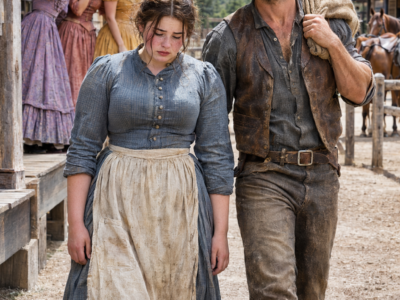
The first thing Hester Fog heard when she stepped off the wagon was a man whispering, “That’s the bride?” The second was another man saying, “She’ll never last a week out here.”
Ewan took the paper from Hester’s hands and held it closer to the lantern.
His face changed as he read the crooked handwriting beneath his signature.
“In the event of failure to repay the full amount by October fifteenth, all buildings, equipment, timber rights, and improvements upon the Sutter property shall become the sole possession of Wallace Kums.”
He read the sentence twice.
Then a third time.
“That wasn’t there,” he whispered.
Hester watched him carefully. “Are you certain?”
“I signed for a loan to replace the broken mill wheel. Three hundred dollars. Kums said I could repay it after the autumn timber shipment.”
“And how much does he claim you owe now?”
Ewan swallowed.
“Eleven hundred and forty.”
Hester looked at the date.
October fifteenth.
Only twelve days remained.
Outside, the wind rattled the kitchen shutters, carrying the distant sound of axes and falling timber.
“Who witnessed your signature?” she asked.
“His clerk. A man named Silas Venn.”
“And did you receive a copy?”
“This is my copy.”
Hester studied the paper again.
The ink beneath Ewan’s signature was darker than the rest, and the handwriting leaned sharply to the right.
Someone had added the clause afterward.
But proving it would be another matter.
“Ewan,” she said, folding the document carefully, “I believe someone intends to steal your camp.”
He gave a bitter laugh.
“They won’t have to steal it. The law will hand it over.”
“Then perhaps,” Hester replied, “we ought to give the law something else to consider.”
Ewan stared at her.
They had known each other less than a day.
Yet something in her expression made him feel, for the first time in months, that surrender was not inevitable.
The next morning, Hester rose before dawn.
She baked bread, boiled coffee, and served breakfast to twenty-three lumbermen who watched her as though she had arrived carrying a miracle.
But while they ate, she asked questions.
How much timber had been cut?
How much remained unsold?
Who purchased their lumber?
Why was the smokehouse locked?
At that last question, the entire table fell silent.
A broad-shouldered man named Angus McBride finally spoke.
“Because the last fellow who opened it ended up in the river.”
Hester set down her coffee.
“Did he drown?”
“No, ma’am. But he wished he had.”
A few men chuckled nervously.
Angus continued.
“Smokehouse belonged to old Mr. Sutter, Ewan’s father. He used it to preserve meat for winter. After he died, Kums claimed there was unpaid rent on the building. Said nobody could use it until the debt was settled.”
Hester frowned.
“Rent? On a building standing on Sutter land?”
“That’s Kums for you,” Angus muttered.
Ewan entered just in time to hear the conversation.
“Leave it alone, Hester.”
She turned toward him.
“Why?”
“Because Kums owns the supply store, the freight wagons, and half the men who enforce the law around here.”
“Does he own your courage as well?”
The room went still.
Ewan’s expression hardened.
“You don’t understand what he can do.”
“No,” Hester answered quietly. “But I understand what happens when decent people become so frightened of a bully that they begin doing his work for him.”
She returned to kneading dough.
Ewan stood motionless.
Then he walked out without another word.
For the first time since arriving, Hester wondered whether she had gone too far.
That afternoon, she found a boy sitting behind the woodpile, staring hungrily at a biscuit.
He was perhaps twelve, with oversized boots and a face too serious for his age.
“You can eat it,” she said.
The boy startled.
“I wasn’t stealing.”
“I didn’t accuse you.”
He took a cautious bite.
“What’s your name?”
“Tommy.”
“Do you work here?”
“Sometimes.”
“Where are your parents?”
His eyes lowered.
“Mum died last winter. Pa went looking for work in Victoria. Never came back.”
Hester sat beside him.
“Who looks after you?”
Tommy shrugged.
“Mostly nobody.”
She felt something tighten in her chest.
Years earlier, she had known that same feeling: being unwanted in a world full of people.
Before answering Ewan’s advertisement, Hester had spent eleven years cooking in a boardinghouse in Halifax. When its owner died, her nephew inherited the property and dismissed her without a penny.
At thirty-six, unmarried and nearly penniless, she had been told she was too old to begin again.
She had crossed a continent partly because she needed a home.
But more than that, she needed somewhere her presence mattered.
“Well, Tommy,” she said, “you can begin by helping me carry firewood.”
He looked suspicious.
“Will you pay me?”
“With supper, clean clothes, and a proper bed.”
His eyes widened.
“All three?”
“All three.”
He grinned for the first time.
That evening, Hester discovered something else.
The camp’s supply ledger showed that Ewan had paid for twelve barrels of salted pork, six sacks of flour, and forty pounds of coffee the previous month.
Only half had arrived.
The delivery receipts, however, bore his signature.
“Did you sign these?” she asked.
Ewan examined them.
“No.”
Hester placed them beside the debt agreement.
The forged signatures were almost identical.
Whoever was stealing supplies was also preparing to take the camp.
And they were becoming careless.
Three days later, Wallace Kums arrived.
He rode into camp on a black horse, wearing a polished coat and a smile that never reached his eyes.
Two armed men followed.
Kums was thick around the waist, with a silver watch chain stretched across his vest.
“Well, well,” he announced. “I hear Sutter’s finally purchased himself a housekeeper.”
Hester stepped onto the porch.
“Then you’ve been misinformed.”
Kums looked her over.
“Have I?”
“I’m his intended wife.”
His smile widened.
“My condolences.”
Behind her, several lumbermen stiffened.
Hester merely smiled.
“And mine to anyone unfortunate enough to lend you money.”
Kums stopped smiling.
Ewan appeared beside her.
“What do you want, Wallace?”
“Payment. Or possession.”
“You know I haven’t got eleven hundred dollars.”
“Then you know what happens on the fifteenth.”
Hester stepped forward.
“Mr. Kums, would you mind explaining why a three-hundred-dollar loan has become an eleven-hundred-dollar debt?”
“Interest, madam.”
“At what rate?”
“A rate agreed upon by the borrower.”
“And the clause added beneath his signature?”
Kums’s eyes narrowed.
“You accusing me of something?”
“I’m asking a question.”
“Then ask your husband why he signs papers he cannot understand.”
Ewan moved forward, but Hester caught his sleeve.
Kums leaned closer.
“Listen carefully, Mrs. Sutter. This wilderness has a way of swallowing people who meddle in matters beyond their understanding.”
Hester met his gaze.
“Then I suggest you be careful where you step.”
For one dangerous moment, neither moved.
Finally, Kums laughed.
“October fifteenth. Not a day later.”
He mounted his horse and rode away.
Only when he disappeared beyond the trees did Ewan speak.
“You’ve made an enemy.”
Hester watched the road.
“No, Ewan. I’ve merely introduced myself to one you already had.”
That night, someone poisoned the camp’s water barrel.
Tommy discovered it when he found two dead mice floating near the bottom.
Hester ordered every barrel emptied.
The men spent hours carrying fresh water from an upstream spring.
By morning, three workers were sick, though none died.
Ewan was furious.
He wanted to ride into town and confront Kums.
Hester stopped him.
“He wants you angry enough to make a mistake.”
“What would you have me do? Thank him?”
“No. Outthink him.”
She spread the supply ledger across the kitchen table.
“We have timber. We have men. We have twelve days.”
“Eleven,” Ewan corrected.
“Then we had better stop wasting them.”
Her plan sounded impossible.
They would bypass Kums’s freight company entirely.
Instead of selling their logs through his agents, they would float a shipment downriver to a railway depot forty miles away, where independent buyers paid nearly twice as much.
Angus shook his head.
“The river’s running high. The gorge below Blackwater Bend is dangerous.”
“How dangerous?”
“Three men died there five years ago.”
Ewan folded his arms.
“We cannot risk it.”
Hester looked around the table.
“Can we afford not to?”
Silence followed.
Then Tommy spoke from the doorway.
“I know another way.”
Everyone turned.
“There’s an old logging channel beyond the eastern ridge. My pa used to take me fishing there. It joins the river below the gorge.”
Angus frowned.
“That channel’s been blocked for years.”
“By a fallen cedar,” Tommy said. “I saw it last month.”
Hester looked at Ewan.
“Could your men clear it?”
Ewan considered.
“With enough time.”
“How much?”
“Four days, perhaps five.”
“Then we begin tomorrow.”
For the next week, the camp transformed.
Men who had been exhausted and hopeless worked with renewed purpose.
Axes rang through the forest.
Teams of horses dragged logs toward the river.
Hester organized meals, mended torn clothing, and kept a careful record of every board, barrel, and expense.
Even Ewan changed.
He laughed occasionally.
He ate at the table instead of alone.
And every evening, he lingered in the kitchen long after the other men had gone to bed.
One night, while Hester washed dishes, he asked, “Why did you really come here?”
She paused.
“You needed a wife.”
“That isn’t an answer.”
She dried her hands.
“Because I was tired of being useful to everyone and important to no one.”
Ewan looked down.
“My wife, Margaret, died two years ago. Fever took her in three days.”
“I’m sorry.”
“I buried her beneath the cedar behind the house.”
Hester said nothing.
“I wrote that advertisement because the camp was failing. Because I was lonely. Because I thought perhaps a stranger might find something worth saving here.”
“And have you?”
He looked at her for a long moment.
“I believe I have.”
Hester felt warmth rise to her cheeks.
But before either could speak again, a gunshot shattered the night.
Then another.
Ewan grabbed his rifle.
Outside, flames were climbing the walls of the smokehouse.
Men rushed from the bunkhouse carrying buckets.
The fire spread quickly through the dry boards.
Hester ran toward the well, shouting instructions.
Tommy appeared beside her.
“Miss Hester! Someone’s inside!”
She turned.
Through the smokehouse window, she saw a shadow moving.
A man was trapped behind the locked door.
Ewan seized an axe and struck the padlock.
Once.
Twice.
The door burst open.
A figure stumbled out, coughing violently.
It was Silas Venn.
Kums’s clerk.
His coat was burning.
Angus threw a blanket over him while Ewan dragged him away from the flames.
Venn collapsed, clutching his chest.
“He’ll kill me,” he rasped.
Hester knelt beside him.
“Who?”
“Kums.”
“Why were you inside?”
Venn shook uncontrollably.
“He sent me to burn it. Said the old papers had to go.”
Hester froze.
“What papers?”
Venn stared at the burning building.
“Your father’s records,” he whispered to Ewan. “The original land deeds. The old timber agreements. Kums has been lying about what he owns.”
Ewan looked toward the flames.
His father had kept a small iron strongbox beneath the smokehouse floor.
He had forgotten it existed.
Before anyone could stop him, he pulled his coat over his head and ran inside.
“Ewan!” Hester screamed.
The roof groaned.
Sparks flew into the darkness.
Seconds passed.
Then a minute.
The men shouted his name.
Hester started toward the doorway, but Angus caught her.
“You’ll die in there!”
She fought him.
“Let me go!”
At that instant, the roof collapsed.
A thunderous crash sent burning timbers into the yard.
Hester stopped breathing.
Then, through the smoke, a figure appeared near the rear wall.
Ewan staggered out through a broken window, clutching a blackened iron box.
His hair was singed, and blood ran down his forehead.
But he was alive.
Hester reached him first.
She caught his face between her hands.
“You foolish, impossible man!”
He managed a weak smile.
“I found it.”
She hugged him so fiercely he nearly dropped the box.
And for one brief moment, surrounded by smoke and chaos, neither cared who was watching.
By dawn, the smokehouse was ashes.
But the strongbox had survived.
Inside were property deeds, old correspondence, and a ledger belonging to Ewan’s father.
One document changed everything.
Twenty years earlier, Wallace Kums had purchased a narrow strip of land beside the river.
He had spent years claiming that strip included the only legal access route for transporting timber.
But the original survey showed otherwise.
A public logging easement crossed Sutter land and connected directly to the eastern channel.
Kums had no legal right to block it.
More importantly, another document showed that Ewan’s father had already paid off an older debt Kums continued using to justify his claims.
Hester spread the papers across the table.
“He has been charging you for something your father settled years ago.”
Ewan stared at the receipts.
“My father told me never to trust that man.”
Venn, resting on a cot nearby, spoke weakly.
“There’s more.”
Everyone turned.
“Kums has been buying distressed timber camps for years. He lends money, alters agreements, steals supplies, then forces owners into default.”
“Can you prove it?” Hester asked.
Venn closed his eyes.
“I kept copies.”
“Where?”
“In my office. Under the floorboards.”
Ewan looked toward the road.
“Then we go to town.”
Venn shook his head.
“Kums has men watching the office.”
Hester considered the problem.
Then she looked at Tommy.
“Do you know the back streets?”
The boy nodded.
“Better than anybody.”
For the first time, Hester smiled without warmth.
“Good. Because we’re going to need a little mischief.”
The following afternoon, Tommy entered town driving a wagon piled with dirty laundry.
Hester sat beside him wearing an old bonnet pulled low over her face.
They stopped outside Kums’s supply store.
Hester marched inside carrying a torn sack.
“I demand to speak with the proprietor!”
The clerk behind the counter blinked.
“Mr. Kums is occupied.”
“Then he can become unoccupied. Your flour is full of beetles!”
She emptied the sack across the counter.
A cloud of flour rose into the air.
Customers began coughing.
The clerk shouted.
Hester shouted louder.
Within moments, Kums appeared from his office, red-faced and furious.
While every eye followed Hester, Tommy slipped through the rear door.
He found Venn’s office, lifted the loose floorboard, and retrieved a packet wrapped in oilcloth.
But as he turned to leave, a hand seized his collar.
“Well,” a voice said, “what have we here?”
It was one of Kums’s armed men.
Tommy twisted desperately.
The packet fell.
The man bent to retrieve it.
Tommy kicked him hard in the shin and bolted.
He burst into the store just as Hester was accusing Kums of selling flour unfit for pigs.
“Miss Hester!”
She saw his terrified face.
Then the armed man appeared behind him.
“Stop that boy!”
Hester reacted instantly.
She grabbed a heavy jar of molasses and hurled it at the floor.
Glass shattered.
Sticky syrup spread across the boards.
The pursuing man slipped, crashed into a barrel, and brought down an entire shelf of crockery.
Hester seized Tommy’s hand.
They ran.
Behind them, Kums roared threats that followed them halfway down the street.
Only when the wagon reached the forest road did Tommy produce the packet.
Hester opened it with trembling fingers.
Inside were forged agreements, false delivery receipts, and records of payments to local officials.
Enough evidence to ruin Kums.
Perhaps enough to imprison him.
But the most alarming discovery was a letter dated only three days earlier.
It instructed two hired men to destroy the eastern logging channel before October fifteenth.
Hester looked toward the mountains.
“Tommy, we must get home.”
They returned to find the camp in chaos.
Someone had cut the ropes securing the timber rafts.
Half the logs had broken loose and floated downstream.
Worse, a blasting charge had been placed beneath the newly cleared channel.
Angus had discovered it moments before detonation.
One worker lay injured.
Another was missing.
Ewan stood beside the river, his face gray with exhaustion.
When Hester showed him the letter, he read it silently.
Then he said, “It’s over.”
She stared at him.
“What?”
“We cannot move enough timber before the deadline. Even if we reach the railway, payment will take days.”
“You haven’t lost yet.”
“Hester, look around!”
His voice cracked.
“My men are hurt. My father’s smokehouse is gone. Every time we fight, Kums strikes harder.”
He looked toward Tommy.
“Next time, someone dies.”
Hester felt the force of his despair.
For a moment, she had no answer.
Then she took his hand.
“You’re right about one thing. We cannot keep fighting him the same way.”
Ewan looked at her.
“So what do we do?”
“We stop trying to save the camp alone.”
That evening, Hester wrote six letters.
One went to the railway depot.
Another to the provincial land office.
Two went to neighboring timber camps.
One went to a magistrate in New Westminster whose reputation for honesty Venn remembered.
The last went to a newspaper editor.
In every letter, she described the forged debts, stolen supplies, and illegal threats.
She enclosed copies of the evidence.
Then she asked the lumbermen a question.
“How many of you have worked for men who lost their camps to Kums?”
Nearly every hand rose.
“And how many would testify?”
No one moved.
Fear settled over the room.
Then Angus stood.
“My brother lost his mill to that devil. Died owing money he never borrowed.”
He looked around.
“I’ll testify.”
Another man rose.
Then another.
Within minutes, sixteen men had volunteered.
The following morning, riders departed in every direction.
But Kums was not finished.
On October fourteenth, the day before the deadline, he arrived with eight armed men and a deputy sheriff.
Ewan met them at the gate.
“You’re early.”
Kums smiled.
“I’m here to ensure my property remains intact.”
“It isn’t yours.”
“Tomorrow it will be.”
He pulled a document from his coat.
“Unless, of course, you wish to surrender it now.”
Hester stepped beside Ewan.
“We have evidence of fraud.”
Kums laughed.
“Evidence means nothing without someone willing to listen.”
The deputy sheriff avoided her eyes.
Kums leaned closer.
“Sign the surrender, Sutter. I’ll even let your men leave with their tools.”
Ewan took the paper.
For a terrible moment, Hester thought he might sign.
Then he tore it in half.
Kums’s smile disappeared.
“You’ll regret that.”
He raised one hand.
His men drew their rifles.
The lumbermen emerged from the bunkhouse carrying axes and logging hooks.
The yard became terribly still.
One wrong movement would begin a massacre.
Hester stepped between them.
“Mr. Kums, are you prepared to shoot twenty-three men over a disputed debt?”
“I’m prepared to defend what belongs to me.”
“Then perhaps you should explain that to the magistrate.”
Kums sneered.
“What magistrate?”
A voice answered from behind him.
“That would be me.”
A carriage had stopped near the gate.
A silver-haired man stepped down, accompanied by two provincial constables.
Behind them rode the newspaper editor and three owners of neighboring timber camps.
The magistrate introduced himself as Jonathan Bell.
“I have received some very disturbing documents.”
Kums turned pale.
“Your Honor, this woman is a liar.”
“Then you should welcome an investigation.”
Bell held up one of the forged agreements.
“Especially since Mr. Venn has provided a sworn statement describing how these signatures were altered.”
Kums looked toward the bunkhouse.
Venn stood in the doorway, supported by Angus.
For a moment, hatred transformed Kums’s face.
Then he lunged for the deputy’s revolver.
Everything happened at once.
The deputy shouted.
A constable drew his weapon.
Kums seized the revolver and fired.
The bullet struck the wooden post inches from Hester’s head.
Ewan threw himself in front of her.
A second shot rang out.
Ewan staggered.
Blood spread across his shirt.
Hester screamed.
The constables tackled Kums before he could fire again.
He fought wildly, cursing everyone around him.
But Hester barely heard.
She was on her knees beside Ewan.
His eyes were open, though his breathing was shallow.
“Don’t you dare,” she whispered.
He tried to smile.
“Hester—”
“Don’t speak.”
“I was going to ask you something.”
“You can ask me when you’re well.”
His hand found hers.
“Will you stay?”
Tears blurred her vision.
“You ridiculous man. I crossed half a country to find you.”
He closed his eyes.
For one awful second, she thought she had lost him.
Then he breathed again.
“Good,” he whispered.
The bullet had passed through Ewan’s shoulder without striking his heart or lungs.
The camp doctor, summoned from a neighboring settlement, removed fragments of cloth from the wound and stitched it carefully.
For two days, fever threatened him.
Hester scarcely slept.
She changed his bandages, cooled his forehead, and sat beside his bed through the long hours of darkness.
Sometimes he called Margaret’s name.
Hester listened without resentment.
She understood that love did not vanish simply because life demanded another beginning.
On the third morning, Ewan opened his eyes.
Hester sat beside the window, exhausted, with her head resting against the wall.
“You look terrible,” he murmured.
She opened her eyes.
“And you look like a man who owes me a considerable apology.”
He smiled weakly.
“Did we win?”
She took his hand.
“Kums has been arrested. The magistrate suspended his debt claims, and the provincial authorities are examining his records.”
“And the camp?”
“Still ours.”
Ewan stared at her.
Then his eyes filled.
He turned his face away.
Hester pretended not to notice.
But the struggle was not entirely finished.
The camp still owed legitimate money for equipment and supplies.
Winter was approaching.
The men needed wages.
And half their timber shipment remained scattered along the river.
Victory in court would mean little if hunger defeated them afterward.
That was when the neighboring camp owners surprised everyone.
One offered horses.
Another offered a freight wagon.
A third sent workers to help retrieve the lost logs.
The railway buyer, having read the newspaper account, agreed to purchase the timber directly and advance part of the payment.
Within three weeks, the camp’s immediate debts were settled.
For the first time in years, Ewan paid every man his full wages.
But Hester had another idea.
She gathered the workers in the dining hall.
“We have survived because people helped us when they had nothing to gain,” she said. “I think we ought to remember that.”
Angus scratched his beard.
“What are you suggesting?”
“A shared winter store. Every camp contributes what it can. Flour, dried meat, medicine, blankets. When one settlement suffers, the others help.”
A younger worker frowned.
“And who decides who gets what?”
“We do. Together. With honest records anyone may inspect.”
The men considered.
Then Angus nodded.
“My brother might still be alive if something like that had existed.”
The proposal passed unanimously.
Over the following months, the Sutter camp became more than a lumber operation.
Its kitchen fed stranded travelers.
Its storeroom supplied families during harsh weather.
And when an injured worker from a neighboring mill needed shelter, no one asked whether he could pay.
Tommy began attending lessons with a retired schoolteacher who lived near the railway.
He learned to read quickly, though he still preferred climbing trees.
One evening, he brought Hester a letter.
It was from his father.
The man had been injured while working on Vancouver Island and had spent months recovering without money for the journey home.
A notice published by the newspaper editor had finally reached him.
He was coming back.
Tommy read the letter three times.
Then he cried into Hester’s apron.
She held him until the tears stopped.
When his father arrived two weeks later, thin and limping but alive, Hester watched their reunion from the kitchen doorway.
She expected to feel only happiness.
Instead, a small ache surprised her.
Tommy had become part of her daily life.
She would miss him.
But that evening, the boy returned to the kitchen with his father.
“Pa says we can stay and work here, if Mr. Sutter agrees.”
Hester smiled.
“I believe Mr. Sutter can be persuaded.”
Tommy grinned.
“Good. Because nobody makes biscuits like you.”
By December, snow lay deep across the forest.
The repaired smokehouse stood behind the kitchen, its chimney sending a steady ribbon of smoke into the cold air.
Ewan had insisted on rebuilding it himself, despite his injured shoulder.
One afternoon, Hester found him standing beside the finished building.
A small wooden sign hung above the door.
THE FOG-SUTTER STOREHOUSE.
She stared at it.
“Fog-Sutter?”
Ewan shifted nervously.
“I thought it sounded respectable.”
“It sounds as though someone has made an assumption.”
He cleared his throat.
“Perhaps.”
Then he reached into his pocket.
Inside was a simple gold ring, worn smooth with age.
“It belonged to my mother,” he said. “My father gave it to her when they had nothing but a cabin and two horses.”
Hester’s breath caught.
“I know I’m not much of a prospect,” he continued. “I’m stubborn, I’m often foolish, and I nearly lost everything my father built.”
“That much is true,” she whispered.
“But you came here when nobody else would. You fed men who had forgotten how to hope. You stood against someone the rest of us feared. And you reminded me that being alive is not the same as living.”
He took her hand.
“I asked for a wife because I needed help. But somewhere along the way, I discovered I wanted you beside me even if there were no camp to save.”
Hester’s eyes filled with tears.
“Ewan—”
“Will you marry me? Properly, this time. Not because of an advertisement or an arrangement. Because you choose to.”
She looked at the ring.
Then at the man who had once greeted her with embarrassment outside a failing timber camp.
She thought of Halifax, of the boardinghouse, of all the years she had been told that her best days were behind her.
And she laughed softly.
“Yes,” she said. “But only if you promise never to negotiate another loan without me.”
Ewan laughed.
“I swear it.”
Their wedding took place on Christmas Eve.
The dining hall was decorated with cedar branches, handmade ribbons, and candles.
Angus wore a jacket two sizes too small.
Tommy carried the rings with such solemn pride that everyone struggled not to smile.
The magistrate returned to perform the ceremony.
And when Ewan kissed his bride, twenty-three lumbermen cheered so loudly that snow slipped from the roof.
Later, as music filled the hall, Hester stepped outside for a moment.
The forest stretched around her, dark and magnificent beneath the stars.
She remembered the whispers that had greeted her arrival.
She would never last a week.
She had been too old.
Too plain.
Too ordinary.
A woman with nothing remarkable to offer.
Yet those judgments seemed impossibly small now.
Ewan joined her on the porch and wrapped his coat around her shoulders.
“Cold?”
“A little.”
“Happy?”
She looked through the window.
Inside, Tommy danced awkwardly with the schoolteacher.
Angus was arguing over the last slice of pie.
Men who had once eaten in silence now laughed like brothers.
Beyond them stood a camp that had nearly been destroyed by greed, saved not by wealth or power, but by courage, trust, and people willing to stand together.
“More than I expected,” she answered.
Ewan kissed her forehead.
“You saved us, Hester.”
She shook her head.
“No. I helped you remember you were worth saving.”
Years later, travelers passing through the forests of British Columbia would hear stories about the woman who arrived at a failing timber camp carrying one suitcase and an iron determination.
Some claimed she had defeated a powerful businessman with nothing but a ledger and a jar of molasses.
Others said she had rescued twenty-three lumbermen from starvation.
The stories grew more extravagant with every telling.
Hester never corrected them.
But whenever someone asked what had truly changed the camp, she gave the same answer.
“A good meal opened the door. The truth gave us a fighting chance. But people standing together saved the place.”
And sometimes, when young women arrived at the storehouse seeking work, frightened by failure or convinced their lives had already passed them by, Hester would invite them into the kitchen.
She would pour hot coffee, place fresh bread before them, and listen.
Then she would tell them something she wished someone had told her long ago.
“Never let another person decide the value of your life simply because they cannot see what you have to offer.”
For Hester had learned that a person did not need youth, beauty, wealth, or a grand title to change the world around them.
Sometimes all it took was the courage to enter a broken place, roll up your sleeves, and begin.
And the greatest reward was not proving the doubters wrong.
It was discovering that the life you feared was over had, in fact, only just begun.