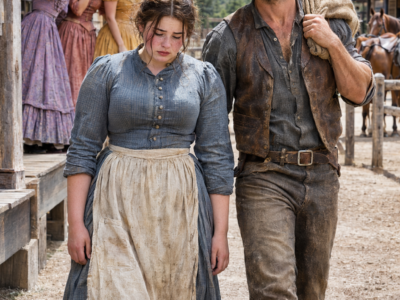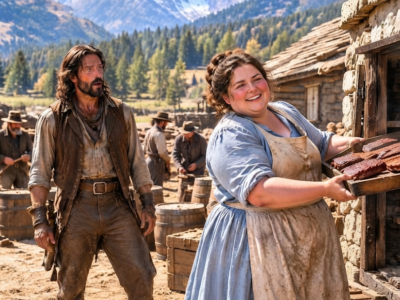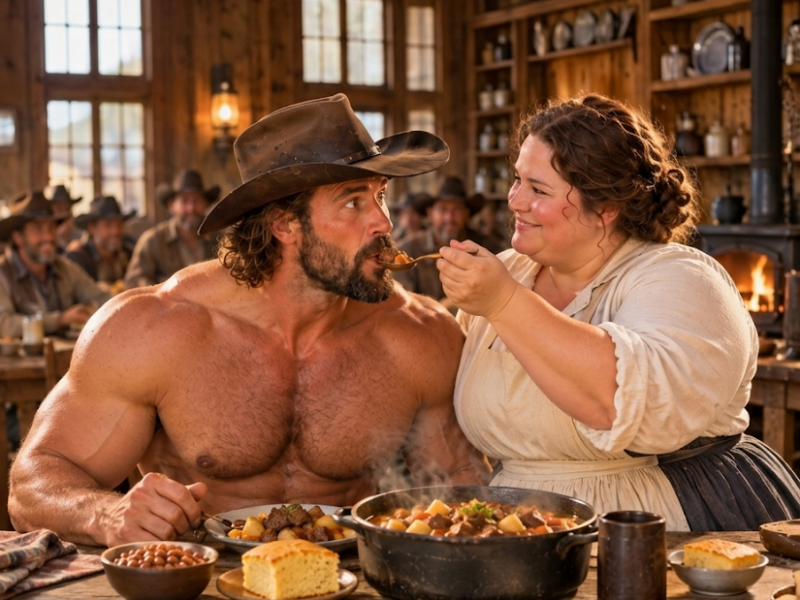
When Jonathan Hale accused me of stealing flour before twenty-two hungry ranch hands, I saw him watching another man, unaware of how deep the betrayal ran.
For several seconds, I could only stare at the photograph.
The woman had Thomas’s dark eyes, and the infant wore a tiny knitted cap.
“Does he know?”
Jonathan nodded.
“His mother told him before she died. He was thirteen.”
I carefully returned the photograph.
“Then why does he carry another man’s name?”
“Because I was a coward.”
Jonathan sank into his chair, suddenly looking less like the powerful owner of Pine Hollow and more like a man exhausted by his own memories.
“Her name was Margaret Reed. Her father worked for mine. We were young, and when she became pregnant, my father threatened to throw her family off their land if I married her.”
“And you obeyed him?”
“I convinced myself I was protecting her.”
He laughed bitterly.
“Funny how a man can dress up cowardice until it resembles kindness.”
Margaret had raised Thomas alone while Jonathan inherited the ranch. He sent money secretly, but she returned nearly every dollar.
When tuberculosis took her life, Jonathan brought Thomas to Pine Hollow.
He gave him employment, education, and eventually responsibility over the entire ranch.
Everything except his name.
“I thought providing for him would be enough.”
I looked toward the darkened window.
“Perhaps Crowley offered him something you never did.”
Jonathan’s expression tightened.
“What?”
“A reason to believe he mattered.”
Before he could answer, the kitchen door slammed violently.
Samuel stumbled into the room, his face pale beneath his gray beard.
“Jonathan, you’d better come outside.”
We followed him into the freezing night.
The western barn was burning.
Flames climbed through the wooden roof while terrified horses kicked against their stalls.
Men ran carrying buckets, shouting desperately over the roar of the fire.
Jonathan rushed toward the entrance.
I grabbed his sleeve.
“The roof’s coming down!”
“There are six horses inside!”
He disappeared through the smoke before I could stop him.
I ran toward the water trough, soaked two blankets, and followed.
The heat struck me like an open furnace.
Through the smoke, I saw Jonathan struggling with a frightened mare whose halter had become tangled around a broken board.
I threw one blanket over the animal’s head while Jonathan cut the rope.
Together, we guided her outside.
Four more horses escaped behind us.
Then someone shouted from the far end of the barn.
A young ranch hand named Billy was trapped beneath a fallen beam.
Jonathan turned immediately.
But another figure reached Billy first.
Thomas.
He lifted the burning timber with a strength born of desperation, screaming as flames caught his coat.
Jonathan dragged Billy free while I beat the fire from Thomas’s shoulders with the remaining blanket.
We barely reached the yard before the roof collapsed.
Thomas fell to his knees, coughing violently.
Jonathan knelt beside him.
“Son, look at me.”
The word escaped before he could stop it.
Several ranch hands turned toward them.
Thomas looked up, his face streaked with soot.
For one terrible moment, I thought he might cry.
Instead, he pushed Jonathan’s hands away.
“I’m fine, Mr. Hale.”
By morning, the western barn was nothing but smoking ruins.
We lost one horse, nearly half our winter hay, and several valuable saddles.
Billy survived with a broken leg.
Thomas suffered burns across his shoulders and left arm.
While I dressed his injuries, he refused to meet my eyes.
“You could have died saving that boy,” I said.
“He has a mother waiting for him.”
“And nobody’s waiting for you?”
His jaw tightened.
“Nobody who’d admit it.”
I finished wrapping his arm.
“Your father told me.”
Thomas jerked away so violently that the bandage nearly came loose.
“He had no right.”
“Perhaps he should have told everyone years ago.”
Thomas stared at me, breathing heavily.
“You don’t know anything about us.”
“Then tell me.”
For a moment, I thought he would.
Instead, he stood and walked out.
That afternoon, Edwin Crowley returned.
He surveyed the burned barn with an expression of practiced sympathy.
“Terrible misfortune, Jonathan.”
Jonathan stood on the porch without inviting him inside.
“What do you want?”
Crowley removed his gloves.
“I’ve heard your supplies are running dangerously low. With the coming storm, I imagine your situation has become rather uncomfortable.”
He withdrew a folded document from his coat.
“I’ll provide everything you need. Hay, flour, meat, even money to rebuild.”
“And what do you expect in return?”
“The northern pasture.”
Jonathan’s face hardened.
That pasture contained the only reliable spring for miles, supplying water to nearly three thousand cattle.
Without it, Pine Hollow would slowly die.
“You can leave now.”
Crowley smiled.
“Think carefully. Pride won’t feed your men.”
As he stepped into his carriage, he glanced toward Thomas, who stood beside the stable.
Thomas lowered his head.
That small movement told me more than any confession could have.
After supper, I searched the ruined barn.
Beneath a pile of blackened timber near the entrance, I found a broken lantern.
Its glass had shattered, but the metal handle remained intact.
Someone had wrapped a strip of cloth around its base.
The cloth smelled strongly of kerosene.
I carried it into the kitchen, where Samuel was sharpening a knife.
His face changed the instant he saw it.
“Where’d you find that?”
“Inside the barn.”
Samuel put down his knife.
“Leave it alone.”
“Why?”
“Because some things are better left buried.”
I placed the lantern on the table.
“People nearly died last night.”
Samuel covered his face with both hands.
Then, slowly, he began speaking.
He had seen Thomas meeting Crowley’s men several times.
At first, he believed Thomas was arranging the purchase of cattle.
Then he noticed supplies disappearing.
When he confronted Thomas, the young man begged him to remain silent.
“He said Crowley had papers belonging to his mother.”
“What kind of papers?”
“I don’t know.”
Samuel looked toward the doorway.
“But whatever they are, that boy’s scared to death.”
I found Jonathan in his study and told him everything.
He listened, then opened a locked drawer and removed a bundle of old letters.
“Margaret’s father borrowed money from Crowley’s father years ago. I paid the debt after she died.”
“Do you have proof?”
Jonathan searched through the papers.
His movements became increasingly frantic.
Finally, he stopped.
“The receipt is missing.”
A horrible possibility entered my mind.
“Could Crowley claim the debt was never paid?”
“Not against Thomas personally. But Margaret inherited a small piece of land from her father.”
Jonathan looked up.
“She’s buried there.”
Suddenly, Thomas’s behavior made terrible sense.
Crowley had found the one thing the young man could not bear to lose.
His mother’s grave.
We decided to confront Thomas together.
But when Jonathan entered his room, the bed was empty.
His saddle was gone.
So was his rifle.
Outside, snow had begun falling in thick, heavy sheets.
Samuel discovered fresh tracks leading toward Crowley’s property.
Jonathan saddled his horse immediately.
“I’m coming with you,” I said.
“No.”
“You need someone Thomas might listen to.”
“This isn’t your fight.”
I looked directly into his eyes.
“You made it my fight when you accused me before twenty-two men.”
He opened his mouth, then closed it.
Minutes later, we rode into the gathering storm.
The journey took nearly two hours.
By the time Crowley’s house appeared through the snow, my fingers were numb and Jonathan’s beard was white with frost.
We left our horses behind a line of cottonwood trees and approached the house on foot.
Voices drifted from an illuminated window.
Thomas stood inside Crowley’s study, his injured arm hanging awkwardly at his side.
Crowley sat behind an enormous desk.
“You promised nobody would get hurt,” Thomas said.
“I promised your mother’s land would remain untouched if you followed instructions.”
“The barn wasn’t part of our agreement.”
“Consider it encouragement.”
Thomas slammed his fist against the desk.
“Give me the papers.”
Crowley laughed.
“Bring me Hale’s signature first.”
“And if he refuses?”
“Then he’ll spend the winter watching his cattle starve.”
Crowley leaned forward.
“And come spring, I’ll have your mother’s remains removed from my property.”
Thomas reached for his rifle.
Jonathan burst through the door before I could react.
“Don’t touch that gun!”
Both men spun around.
Crowley rose slowly, smiling.
“Well, isn’t this a touching family reunion?”
Jonathan ignored him.
He approached Thomas with his hands open.
“Put the rifle down.”
Thomas’s eyes filled with tears.
“You don’t understand.”
“I do now.”
“No, you don’t! You never did!”
His voice cracked.
“She died waiting for you to choose her. I spent my whole life waiting for you to choose me.”
Jonathan stopped.
Thomas wiped his face angrily.
“Every Christmas, every birthday, every time somebody asked why you took me in, I waited for you to say it.”
The room became painfully quiet.
Crowley reached beneath his desk.
I noticed the movement just as his hand emerged holding a pistol.
“Jonathan!”
The gun fired.
Jonathan staggered backward.
Blood spread across his shirt.
Thomas lunged at Crowley, knocking the pistol from his hand.
They crashed against the desk, scattering papers across the floor.
I rushed to Jonathan.
The bullet had struck high in his shoulder.
He was conscious, but his face had gone frighteningly pale.
Behind me, Thomas wrestled Crowley to the ground.
Then two men entered carrying rifles.
Crowley’s employees.
One struck Thomas across the head with his rifle stock.
He collapsed.
Crowley straightened his coat.
“Lock them in the cellar.”
The men hesitated.
“You heard me!”
They dragged Thomas downstairs while I struggled to support Jonathan.
The cellar door closed behind us with a heavy metallic click.
Darkness swallowed everything.
For several minutes, I could hear only Jonathan’s uneven breathing.
I tore strips from my underskirt and pressed them against his wound.
Thomas eventually regained consciousness.
When he realized what had happened, he crawled toward us.
“Is he dying?”
“Not if I can help it.”
Thomas took Jonathan’s hand.
“I’m sorry.”
Jonathan opened his eyes.
“Thomas.”
“I’m so sorry.”
The young man began sobbing with the helplessness of a frightened child.
Jonathan struggled to raise his uninjured arm.
“I should have said it years ago.”
Thomas bent closer.
“You’re my son. And I’ve been proud of you since the day you were born.”
Thomas pressed his forehead against Jonathan’s hand.
I turned away, giving them the privacy that twenty years of silence had stolen.
Then I began searching the cellar.
There were barrels of whiskey, crates of vegetables, and several sacks stacked against the wall.
When I touched one, my fingers encountered a familiar rough seam.
I pulled it closer.
Pine Hollow’s flour.
Every sack bore the small red mark I had stitched into its corner while checking inventory.
There were barrels of pork and boxes of salt as well.
Crowley hadn’t merely stolen our provisions.
He had stored them beneath his own house.
“Thomas, how many men does Crowley have here?”
“Four, perhaps five.”
“Does anyone know we came?”
“Samuel might have guessed.”
That was hardly comforting.
The storm was growing worse, and Jonathan needed a doctor.
I continued searching until I found a narrow ventilation opening near the ceiling.
Its wooden frame had rotted from years of moisture.
Thomas climbed onto a barrel and kicked repeatedly until the frame broke loose.
The opening was too small for either man.
But not for me.
Thomas helped me climb.
Before I pulled myself through, Jonathan caught my wrist.
“Don’t come back alone.”
“I won’t.”
His fingers tightened.
“And there’s something else.”
“Tell me when we’re home.”
I kissed his forehead and crawled into the snow.
The cold nearly stopped my heart.
I dragged myself through the darkness, keeping close to the house until I reached the trees.
Our horses were still there.
I mounted mine and rode toward Pine Hollow.
I had traveled perhaps a mile when several riders appeared through the storm.
I reached for Jonathan’s rifle, which remained attached to my saddle.
Then a familiar voice shouted my name.
Samuel.
Behind him rode eight ranch hands and Sheriff Daniel Mercer.
I had never been so grateful to see another human being.
Samuel explained that after discovering our absence, he had ridden to town.
He told the sheriff everything he knew.
We returned to Crowley’s house together.
The sheriff approached the front door while the ranch hands surrounded the building.
Crowley attempted to escape through the rear entrance, carrying a leather document case.
Samuel caught him before he reached the stable.
Inside, the sheriff unlocked the cellar.
Jonathan was barely conscious.
Thomas refused to leave his side.
While the men carried Jonathan upstairs, I retrieved one of the flour sacks and showed the sheriff its red stitching.
He examined the remaining supplies.
Then he opened Crowley’s document case.
Among several forged agreements, he discovered Margaret’s original debt receipt.
Stamped across its bottom were the words PAID IN FULL.
There were also letters instructing Crowley’s employees to damage Pine Hollow’s property and intercept shipments traveling from town.
The final letter contained an order to burn the western barn.
Crowley had signed it himself.
By sunrise, he was under arrest.
But our troubles were far from over.
Jonathan developed a dangerous fever before we reached Pine Hollow.
The doctor removed the bullet and warned us that the next three days would determine whether he lived.
I remained beside his bed, changing bandages and forcing spoonfuls of broth between his lips.
Thomas sat on the opposite side.
Neither of us slept much.
On the second night, Jonathan began speaking Margaret’s name.
Thomas looked at me helplessly.
“She’s been dead for twenty years.”
“Sometimes grief doesn’t understand time.”
He lowered his head.
“I hated him for so long.”
“Love and anger can live in the same heart.”
Thomas stared at his father’s face.
“I helped Crowley steal from him.”
“Then spend the rest of your life becoming someone who would never do it again.”
Near dawn, Jonathan’s fever finally broke.
He opened his eyes and asked for water.
Thomas laughed and cried simultaneously.
I went into the kitchen and wept where nobody could see me.
The following weeks tested Pine Hollow more severely than any winter in recent memory.
Snow buried fences, cattle disappeared beneath enormous drifts, and the remaining hay had to be carefully rationed.
But the recovered supplies kept everyone fed.
Thomas worked from sunrise until darkness, repairing buildings, tending injured animals, and sleeping in the stable whenever the weather threatened the livestock.
He never asked anyone to forgive him.
One evening, he entered the dining room while the ranch hands were eating.
Jonathan, still wearing a sling, followed him.
Thomas stood before the long table.
“I owe every man here an explanation.”
He confessed everything.
The stolen flour.
The spoiled pork.
The letters he had delivered to Crowley’s men.
He explained the threats against his mother’s grave, but he never used them as an excuse.
“I endangered your lives because I was afraid of losing something precious to me.”
Billy, whose broken leg was healing, stared at him.
“You saved my life.”
Thomas shook his head.
“That doesn’t erase what I did.”
“No,” Billy replied. “But it tells me you ain’t beyond saving.”
Samuel stood and placed a hand on Thomas’s shoulder.
One by one, the other men returned to their supper.
It wasn’t complete forgiveness.
But it was a beginning.
Then Jonathan stepped forward.
“There’s something else everyone deserves to know.”
He looked at Thomas.
“This man is my son.”
Nobody spoke.
“His mother was Margaret Reed, a woman I loved but failed to stand beside when she needed me most.”
Jonathan’s voice trembled.
“I allowed my father’s opinion to matter more than my own child’s dignity. Whatever shame exists in that story belongs to me.”
Thomas looked down, his eyes shining.
Jonathan turned toward me.
“And I owe another apology.”
My breath caught.
“I publicly accused an innocent woman because I thought exposing a thief justified humiliating her.”
He removed my inventory notebook from his coat.
“I was wrong. Pine Hollow owes its survival to her courage, her intelligence, and her refusal to look away when the rest of us found silence more comfortable.”
Samuel began clapping.
Soon, the entire dining room joined him.
I had spent thirty years being overlooked, dismissed, and blamed for things I could not control.
Standing there, I finally understood how powerful it was to have someone acknowledge the truth before the same people who had witnessed the injustice.
Later that evening, Jonathan found me washing dishes.
He took the towel from my hands.
“You should be resting.”
“So should you.”
He smiled.
It was the first truly unguarded smile I had ever seen on his face.
“I believe I owe you twelve dollars.”
“Several times over.”
He laughed.
Then his expression became serious.
“Clara, I nearly died with something left unsaid.”
Hearing my name in his voice made my heart ache.
He reached into his pocket and withdrew a small velvet box.
“I don’t want you to stay because you need employment.”
Inside rested a simple gold ring.
“I want you to stay because this could be your home. Because Thomas needs someone who believes in the man he can become. And because I’ve fallen terribly, inconveniently in love with you.”
Tears blurred my vision.
“But I won’t ask you to accept a man who hasn’t learned from his mistakes.”
I looked at him for a long moment.
“Then promise me something.”
“Anything.”
“Never again confuse protecting someone with deciding what they’re allowed to know.”
He nodded.
“I promise.”
“And I’m keeping my inventory notebook.”
His laughter filled the kitchen.
“God help anyone who tries taking it.”
I held out my hand.
He slipped the ring onto my finger.
We married the following spring beneath a cottonwood tree overlooking the northern pasture.
Samuel cried more than anyone.
Billy walked without crutches.
Thomas stood beside his father, wearing a new suit and the same shy expression I recognized from Margaret’s photograph.
Crowley was eventually convicted of several crimes, including arson and attempted murder.
His property was sold to satisfy his debts and legal judgments.
Jonathan purchased the small parcel containing Margaret’s grave and transferred ownership to Thomas.
Together, father and son built a white fence around it.
On the day they finished, Thomas asked Jonathan to accompany him to town.
He returned with legal papers confirming that he would henceforth be known as Thomas Reed Hale.
He kept his mother’s name.
And finally accepted his father’s.
Years passed.
Pine Hollow prospered, though not every season was kind.
Thomas married a schoolteacher and became a father himself.
When his first daughter was born, he named her Margaret.
Jonathan held that little girl as though the world had granted him something he had no right to expect.
One autumn evening, I found him sitting on the porch, watching Thomas teach his daughter how to ride a pony.
He reached for my hand.
“Do you ever wonder what would have happened if you hadn’t come here?”
“Frequently.”
“And?”
“I imagine your biscuits would still be terrible.”
He laughed until his eyes watered.
Then he grew quiet.
“I wasted so many years being afraid.”
I rested my head against his shoulder.
“But you didn’t waste the ones that came afterward.”
Across the yard, Thomas lifted his daughter from the pony.
She wrapped her tiny arms around his neck.
He kissed her cheek without caring who watched.
Jonathan squeezed my hand.
The mountains turned golden beneath the setting sun, and smoke rose gently from the kitchen chimney.
I thought about the woman who had arrived at Pine Hollow carrying a battered suitcase and believing that twelve dollars a month was the most she could reasonably hope for.
She had found something infinitely more valuable.
Not a wealthy husband or a comfortable house, but a family that had learned the difference between keeping secrets and keeping promises.
We had discovered that betrayal could destroy what generations had built, yet truth, spoken with courage and followed by action, could rebuild something stronger.
Forgiveness had not changed our past.
It had changed what our past was allowed to do to our future.
And sometimes, when I opened my old inventory notebook, I smiled at the faded numbers written beside those missing sacks of flour.
I had come to Pine Hollow expecting to count provisions.
Instead, I learned that the most important things in life could never be measured in pounds, dollars, or acres.
They were measured in the people who stood beside us when standing beside us became difficult.
In the apologies spoken when pride demanded silence.
And in the love we finally became brave enough to give before it was too late.