At the Cheyenne train station, Owen Lawson humiliated me before twenty strangers, rejecting my body while hiding the betrayal that could destroy his family.
PART 3:
I stared at the envelope in Matthew’s hand, feeling as though the floor beneath me had begun to tilt.
“My father never told me about that letter,” I said.
Owen leaned against the kitchen doorway, smiling like a man who had finally drawn the winning card.
“Of course he didn’t. Some truths are easier to bury.”
Matthew unfolded the yellowed paper. His eyes moved slowly across the page, and with every line, his expression became harder to read.
“Twenty-three years ago,” he said quietly, “your father loaned mine twelve thousand dollars.”
I blinked.
“Twelve thousand?”
“It says here that without the money, Pine Hollow would have been lost.”
Owen gave a theatrical sigh.
“Not exactly the proud Lawson family history, is it?”
I looked at him.
“How did you get that letter?”
“Your father entrusted it to someone who understood its importance.”
“Who?”
He smiled.
“Does it matter?”
“It matters to me.”
Matthew continued reading, then stopped abruptly.
His face had gone pale.
“What is it?” I asked.
He turned the letter toward me.
At the bottom, beneath my father’s familiar signature, were words that made my breath catch.
If the debt remains unpaid, ownership of one-third of Pine Hollow Ranch shall pass to my daughter, Hannah Porter, upon my death.
I read the sentence twice.
Then a third time.
My father had died believing we owned nothing but a struggling restaurant and a house already mortgaged beyond its value.
Yet here was a letter claiming I owned part of a Wyoming ranch.
“That’s impossible,” I whispered.
Owen’s laughter filled the kitchen.
“Not impossible, Hannah. Just inconvenient.”
Matthew lowered the paper.
“Why didn’t Father tell me?”
“Because our father was a liar,” Owen answered smoothly. “And apparently, yours wasn’t much better.”
I felt something fierce rise inside my chest.
“Don’t speak about my father that way.”
Owen straightened.
“Then perhaps you should ask why he kept his precious daughter ignorant while she scrubbed floors for strangers.”
Matthew studied the letter again.
“This isn’t a deed. It’s a statement of an agreement.”
“An agreement signed by two men who are now dead,” Owen replied. “And I happen to know where the original papers are.”
The room went silent.
“Where?” Matthew demanded.
Owen buttoned his coat.
“Somewhere safe.”
He turned toward me.
“You see, Hannah, I didn’t invite you west because I wanted a wife. I invited you because your name is attached to something valuable.”
My stomach twisted.
Every tender sentence in his letters suddenly felt poisoned.
The promises of a home, of children, of growing old together.
All of it had been bait.
“You planned to marry me for the land,” I said.
“Naturally. Marriage would have made everything much simpler.”
“Then why abandon me at the station?”
His eyes traveled over my body with the same deliberate cruelty.
“Because I discovered I couldn’t stomach the bargain.”
Matthew moved so quickly that Owen stumbled backward.
He seized his brother by the collar.
“Apologize.”
Owen’s smile faltered.
“Take your hands off me.”
“Apologize to her.”
I stepped forward.
“Matthew, don’t.”
For a terrible moment, I thought he would strike him.
Instead, Matthew released his brother with enough force to send him against the doorframe.
Owen straightened his coat, humiliation burning in his eyes.
“You’ll regret that.”
“Get off my property.”
Owen paused on the threshold.
“Your property?”
His voice was suddenly quiet.
“That’s precisely what we’re going to settle.”
After he rode away, I stood beside the table, trembling.
Matthew placed the letter down carefully.
“Hannah, I need to know something.”
I raised my eyes.
“Did you know about any of this before you came?”
The question wounded me more deeply than I expected.
“No.”
He studied my face.
I could see the struggle behind his eyes.
Trusting me meant accepting that his brother had deceived us both.
Doubting me meant protecting the family name he had spent his life defending.
Finally, he nodded.
“I believe you.”
Relief nearly brought me to my knees.
But Matthew wasn’t finished.
“Whatever this letter means, we’ll find the truth. And if my father owed yours something, I’ll make it right.”
I looked at the worn floors, the patched curtains, and the man standing before me with a ranch slipping through his fingers.
“Even if it costs you Pine Hollow?”
He swallowed.
“Even then.”
That was the moment I understood how different the Lawson brothers truly were.
One would destroy another person to keep what he wanted.
The other would surrender everything rather than keep what wasn’t his.
Neither of us slept much that night.
By breakfast, I had made a decision.
“We need to find the original agreement before Owen does something with it.”
Matthew nodded.
“Father kept his old records in the attic. I searched them after he died, but perhaps I missed something.”
We spent the morning opening trunks and examining brittle papers.
There were tax receipts, cattle inventories, photographs, and letters tied with faded ribbons.
Near noon, I found a small leather journal hidden beneath a stack of hymnbooks.
Inside the cover was written a name.
Samuel Lawson.
Matthew’s father.
I turned the pages carefully.
Most entries described weather, cattle prices, and the relentless difficulties of ranching.
Then I reached an entry dated September 14, 1868.
Daniel Porter saved my land today. He offered me twelve thousand dollars when no bank would extend another cent. I gave him my word that his daughter would never want for anything while the Lawson name endured.
My vision blurred.
I remembered my father sitting beside our kitchen stove, explaining that a person’s promises mattered most when keeping them became difficult.
I hadn’t known he was speaking from experience.
“Matthew,” I whispered.
He came to my side.
We read the entry together.
On the following page, another sentence appeared.
The signed agreement is secured where Margaret insisted I keep what matters most.
“Margaret was my mother,” Matthew said.
“Where did she keep valuable things?”
He frowned.
“Her jewelry box. But Owen took that after she died.”
My heart sank.
Then Matthew’s eyes sharpened.
“Wait.”
He rushed downstairs.
I followed him into the sitting room, where an old upright piano stood against the wall.
“My mother used to say the most precious things in life weren’t meant to be locked away. They were meant to make music.”
He knelt and removed a loose wooden panel beneath the keyboard.
Inside lay a narrow tin box.
But when he opened it, we found only a small silver locket and a folded scrap of paper.
The paper contained six words.
The truth waits beneath the first snow.
I stared at the message.
“What does that mean?”
Matthew turned the locket over.
His face changed.
“Mother called the north meadow First Snow. It was where she met Father.”
He closed the box.
“There’s an old stone springhouse there.”
We rode out immediately.
The wind swept across the prairie, carrying the smell of approaching snow.
The springhouse stood half-hidden beneath a hillside, its roof sagging and its doorway choked with weeds.
Matthew pushed aside the rotten door.
Inside, an old wooden shelf hung crookedly above a stone basin.
We searched every corner.
Nothing.
Then I noticed one stone beneath the shelf had a thin scratch across its surface.
“Matthew, look.”
He worked it loose with his pocketknife.
Behind it was a hollow space.
Inside rested a wax-sealed packet.
My hands shook as I opened it.
There was the original loan agreement, signed by both fathers and witnessed by the county clerk.
Attached was a second document.
A deed conveying one-third of Pine Hollow to Daniel Porter if the loan remained unpaid after five years.
And beneath that was a handwritten confession.
Matthew read it aloud.
I failed my friend Daniel. Pride kept me from honoring the debt, and cowardice kept me from telling my sons. If this paper is found after my death, let the wrong be corrected.
For several moments, only the wind spoke.
Matthew sank onto a broken stool.
“My father knew.”
I sat beside him.
“He wanted to make it right.”
“But he never did.”
“No,” I answered gently. “He didn’t.”
Matthew looked at the papers in my lap.
“Then the land belongs partly to you.”
I should have felt triumphant.
Instead, I felt sorrow for two men whose friendship had been buried beneath pride.
And for their children, who had inherited the consequences.
When we returned to the ranch, Caleb was waiting at the gate.
His horse was lathered with sweat.
“Mr. Lawson, we’ve got trouble.”
Matthew dismounted.
“What happened?”
“Three riders came through the eastern pasture. They cut the fence and drove off another twenty head.”
“Did you recognize them?”
Caleb hesitated.
“One was Owen.”
Matthew’s expression hardened.
“Where are they headed?”
“Toward Black Creek.”
I gripped the leather packet beneath my coat.
“Owen knows we’re searching.”
Matthew looked toward the mountains.
“Then we have to move before he does.”
That evening, we rode into Cheyenne to speak with Sheriff Brennan.
He was a thickset man with a silver mustache and eyes that suggested he’d heard too many lies to believe any of them.
He listened while we explained the missing cattle.
Then he examined the ledgers.
“These numbers are troubling,” he admitted.
“Troubling?” Matthew demanded. “My brother has stolen enough livestock to ruin this ranch.”
“Accusations aren’t proof.”
I placed the broken cattle tag on his desk.
“We found this beside the northern trail.”
Brennan turned it over.
“And?”
“It matches the missing shipment records.”
The sheriff leaned back.
“Miss Porter, a cattle tag doesn’t tell me who committed a crime.”
I studied him.
“Then perhaps the money does.”
His eyes narrowed.
I opened my notebook and showed him the payments routed through a livestock broker named Silas Mercer.
Mercer had purchased cattle from Pine Hollow for years.
But several recent payments had gone into an account that wasn’t recorded in Matthew’s books.
Brennan shifted uncomfortably.
“Where did you get this information?”
“From the invoices your deputy witnessed.”
A silence followed.
Matthew looked from me to the sheriff.
“What aren’t you telling us?”
Brennan stood.
“I suggest you go home and let the law handle this.”
Outside, Matthew seized my arm gently.
“You saw something.”
“His face changed when I mentioned Mercer.”
“Mercer owns the largest stockyard in the county.”
“And who owns the bank holding Pine Hollow’s mortgage?”
Matthew stopped.
“Mercer.”
Suddenly, the pieces began fitting together.
The missing cattle.
The false invoices.
The approaching foreclosure.
Owen wasn’t simply stealing from his brother.
He was helping another man take Pine Hollow.
We returned to the ranch under a moon hidden behind clouds.
Halfway home, gunfire cracked across the road.
Matthew shouted and pulled me from my saddle.
A bullet struck the wagon track beside us, spraying frozen dirt.
“Stay down!”
I crawled behind a fallen cottonwood as another shot splintered the branches overhead.
Matthew fired into the darkness.
A horse screamed.
Then came the thunder of retreating hooves.
For a long moment, neither of us moved.
Finally, Matthew crawled toward me.
“Are you hurt?”
I shook my head.
His hands trembled as he touched my face.
“I thought I’d lost you.”
Something in his voice broke through every defense I had built since the train station.
“You haven’t.”
He pulled me into his arms.
I felt his heartbeat against my cheek.
Neither of us mentioned Owen.
Neither of us mentioned the ranch.
For that one moment, there was only the frightening knowledge that our lives had become precious to each other.
When Matthew kissed my forehead, I closed my eyes.
I had traveled west expecting a husband.
Instead, I had found a man who made me feel safe without ever asking me to become smaller.
The following morning brought a letter from the bank.
Foreclosure proceedings would begin in ten days.
Matthew read the notice at breakfast and set it aside.
“Mercer’s moving faster.”
I unfolded the original deed.
“We need to record this at the courthouse.”
“That could take weeks.”
“Not if we find the clerk who witnessed it.”
Matthew shook his head.
“That was twenty-three years ago.”
“Then we find his records.”
I refused to let despair become our only plan.
We rode into town and discovered that the old county clerk, Amos Whitcomb, had retired to a farmhouse twelve miles west of Cheyenne.
He was eighty-one, nearly blind, and deeply suspicious of visitors.
But when I said Daniel Porter’s name, his expression changed.
“Daniel Porter?”
I nodded.
“He was my father.”
Whitcomb removed his spectacles.
“Your father was the finest man I ever knew.”
My throat tightened.
“Then you remember the agreement?”
“I remember Samuel Lawson begging me to witness it.”
He leaned forward.
“Your father never wanted the ranch. He wanted his friend to survive.”
“Why wasn’t the deed recorded?” Matthew asked.
Whitcomb sighed.
“Because Daniel asked me to hold it until Samuel could repay him. Samuel promised it would be settled privately.”
He shook his head.
“I warned them both.”
“Can you testify?” I asked.
The old man stared at me for a long moment.
Then he nodded.
“For Daniel’s daughter, I can.”
Hope returned with such sudden force that I almost laughed.
But hope, I soon learned, could be dangerous.
We were leaving Whitcomb’s farmhouse when a rider appeared on the road.
Caleb.
He was pale and breathing hard.
“Mr. Lawson, the barn’s on fire.”
We rode as though the devil himself were chasing us.
Smoke rose above Pine Hollow before we reached the final hill.
Flames devoured the hayloft.
Men formed a bucket line from the well while horses screamed inside their stalls.
Matthew leaped from his saddle.
“Get the animals out!”
I ran toward the kitchen, where two ranch hands were carrying water.
Then I heard a child’s cry.
Caleb’s younger sister, Ruth, had been visiting the cookhouse that afternoon.
She was trapped near the tack room.
Without thinking, I wrapped a wet blanket around my shoulders and rushed through the smoke.
The heat struck like an open furnace.
“Ruth!”
“Miss Hannah!”
I followed her voice.
She crouched behind an overturned barrel, coughing violently.
I lifted her into my arms.
At twelve years old, she was all elbows and fear, but I carried her toward the doorway.
A burning beam crashed behind us.
For one dreadful second, I thought the roof would fall.
Then strong arms seized us.
Matthew pulled us into the open air.
We collapsed onto the frozen ground.
Ruth sobbed against my shoulder.
Matthew knelt beside us.
His face was streaked with soot.
“You could have died.”
“So could she.”
His jaw worked.
Then he drew us both against his chest.
The barn burned until midnight.
By morning, only blackened beams remained.
We had saved most of the horses.
But the winter hay was gone.
Without feed, the surviving cattle would starve before spring.
Matthew stood among the ashes while snow began falling around him.
“I can’t save this place,” he whispered.
I walked beside him.
“You saved the people.”
He looked at me with unbearable sadness.
“That doesn’t pay the bank.”
“No,” I said. “But it tells me what kind of man deserves to own it.”
He lowered his head.
For the first time, I saw Matthew Lawson cry.
Not loudly.
Not dramatically.
Just a few silent tears that disappeared into the soot on his cheeks.
I took his hand.
And this time, he didn’t hesitate to hold mine.
The next afternoon, Owen arrived carrying a polished leather briefcase.
He surveyed the ruins with an expression of practiced sympathy.
“Terrible accident.”
Matthew stepped toward him.
“Get out.”
Owen raised both hands.
“Before you throw me off the property, you should hear my offer.”
He opened the briefcase.
Inside was a purchase contract.
“Mercer will pay your debts and give you five thousand dollars to start over.”
I felt my stomach tighten.
“After stealing his cattle and burning his barn, that’s very generous.”
Owen’s face twitched.
“Careful what you accuse people of.”
Matthew took the contract.
Then he tore it in half.
Owen’s expression turned murderous.
“You foolish bastard.”
“Leave.”
“Mercer will have this ranch within a week.”
“Then he’ll have to come take it.”
Owen turned toward me.
“You could still walk away, Hannah. I could make sure you receive a settlement.”
I stared at him.
“You think everything can be purchased.”
“Most things can.”
“Not the things worth having.”
His gaze dropped to the document pouch in my hand.
Suddenly, his expression sharpened.
“You found the papers.”
I said nothing.
He lunged.
Matthew intercepted him, but Owen drove a fist into his injured shoulder.
Both men crashed against the porch railing.
I stumbled backward as Owen grabbed the pouch.
The leather strap snapped.
Papers scattered across the snow.
Owen snatched the deed.
Then he drew a revolver.
Matthew froze.
“Put it down,” he said.
Owen’s hand shook.
“You were always Father’s favorite.”
Matthew stared at him.
“Is that what this is about?”
“He left you everything.”
“He left me debts, Owen.”
“He left you his name!”
Matthew’s voice softened.
“It was your name too.”
For an instant, pain flickered across Owen’s face.
Then he aimed the revolver at his brother’s chest.
I stepped forward.
“Owen.”
He turned.
I held the old journal against my heart.
“Your father wrote about you.”
His eyes narrowed.
“Don’t lie.”
“He wrote that you were clever, fearless, and that he hoped you would someday find a purpose worthy of your gifts.”
Owen swallowed.
I had read those words the previous night.
They were buried between entries about drought and livestock prices.
“He didn’t hate you,” I continued. “You just couldn’t bear loving someone who didn’t give you everything you wanted.”
“Stop talking.”
His voice cracked.
I took another step.
“You can still put the gun down.”
For a moment, I thought he might.
Then another shot rang out.
Owen jerked.
His revolver fell into the snow.
Caleb stood beside the barn ruins, rifle smoking in his hands.
Owen collapsed onto one knee, clutching his bleeding arm.
Matthew rushed forward and kicked the weapon away.
I ran for clean cloth.
Even after everything Owen had done, I couldn’t watch him bleed to death.
As I pressed a bandage against his wound, he stared at me in confusion.
“Why are you helping me?”
“Because I won’t become cruel just because you were cruel to me.”
He looked away.
And for once, Owen Lawson had nothing to say.
Sheriff Brennan arrived an hour later.
But he wasn’t alone.
Deputy Ellis rode beside him with two armed men.
The sheriff surveyed Owen’s wound, then looked at Matthew.
“You’re under arrest for attempted murder.”
I stepped forward.
“That’s ridiculous.”
Brennan ignored me.
“Hand over the deed, Miss Porter.”
The command revealed everything.
I understood then that the sheriff wasn’t merely protecting Mercer.
He was part of the scheme.
I tightened my grip on the papers.
“No.”
His face hardened.
“Don’t make this difficult.”
Matthew moved beside me.
“Touch her, and you’ll regret it.”
Brennan drew his revolver.
“Last warning.”
Then a voice came from behind the riders.
“I believe I’ve heard quite enough.”
Amos Whitcomb sat in a small carriage, accompanied by three men.
One wore a federal marshal’s badge.
The others carried rifles.
Whitcomb climbed down with surprising steadiness.
“I was worried when these young people told me about the county sheriff,” he announced. “So I sent a telegram to an old friend.”
The marshal stepped forward.
“Jeremiah Cole. Territorial marshal’s office.”
Brennan went white.
Cole turned toward him.
“We’ve been investigating Silas Mercer’s livestock transactions for six months.”
The sheriff tried to speak.
The marshal continued.
“And now we have reason to believe you’ve been helping him.”
Deputy Ellis quietly unbuckled his gun belt.
Brennan wasn’t so cooperative.
He spun toward his horse.
But Caleb’s rifle rose.
“Don’t.”
The sheriff stopped.
Within minutes, he was disarmed.
Owen watched from the porch steps, his face gray with shock.
The marshal took the deed and examined its seals.
Then he looked at me.
“Miss Porter, I believe you’re going to be a very important witness.”
The following days changed everything.
Mercer was arrested at his stockyard while attempting to transfer stolen cattle across the territorial border.
His ledgers revealed years of fraudulent sales, forged invoices, and manipulated loans.
Owen had received payments for diverting Pine Hollow cattle into Mercer’s shipments.
The stolen money had been used to deepen Matthew’s debts, forcing him toward foreclosure.
And the fire had been ordered when Mercer learned we had discovered the original deed.
But the most devastating revelation came from Owen himself.
Facing prison and abandoned by the man who had promised him wealth, he finally confessed.
He had discovered my father’s claim two years earlier while searching through Samuel Lawson’s papers.
He knew that marriage could give him influence over my property.
He had written to me for months, pretending affection while planning to gain control of the land.
When he saw me at the station, he had changed his mind about the marriage but not about taking what belonged to me.
So he abandoned me, expecting I would return east penniless and ashamed.
Instead, I had walked straight into the house of the brother he intended to ruin.
And that single decision had destroyed his entire scheme.
At the preliminary hearing, Owen wouldn’t look at me.
I watched him enter the courtroom with his arm in a sling.
He seemed smaller somehow.
Not because he had lost weight or stature.
But because the arrogance he wore like armor had finally cracked.
When the judge asked whether he wished to make a statement, Owen stood.
“I treated Miss Porter shamefully.”
His voice was hoarse.
“I thought she would be easy to deceive because she wanted a home.”
He looked at me then.
“I was wrong.”
I didn’t answer.
His apology mattered.
But it didn’t erase what he had done.
The court ordered the stolen livestock and proceeds recovered where possible.
Mercer’s fraudulent foreclosure notices were suspended while the financial claims were examined.
And the original deed was recognized as evidence of my father’s ownership interest, subject to formal settlement of the estate.
Weeks passed before the legal work was completed.
Winter settled hard over Wyoming.
Snow buried the fences.
The surviving cattle gathered near the sheltering hills.
Pine Hollow remained wounded, but it was alive.
And so were we.
The first morning after the court approved the property settlement, Matthew found me sitting in the kitchen with the deed spread before me.
“One-third of Pine Hollow,” he said.
I smiled faintly.
“It sounds larger than it feels.”
He sat across from me.
“What do you want to do with it?”
I looked out the window.
The barn was gone.
The fences needed repair.
The accounts were still fragile.
But the land stretched toward the mountains, beautiful and stubborn.
“I want to rebuild.”
Matthew studied me.
“You don’t have to stay.”
“I know.”
“You could sell your share. Start a restaurant in town. Go anywhere you please.”
I folded my hands.
“Is that what you want?”
“No.”
His answer came so quickly that my heart stumbled.
He looked down.
“I’ve spent my whole life trying to keep this ranch because I thought it was all I had left of my family.”
He raised his eyes.
“Then you arrived, and I realized a home isn’t worth much if there’s no one you want to share it with.”
I could barely breathe.
Matthew rose and walked around the table.
He knelt beside my chair.
“Hannah, I don’t have a fine house or a fortune. Half my buildings are falling apart, and I suspect you’ll spend the next twenty years telling me my accounts are dreadful.”
I laughed through sudden tears.
“But I love you,” he said.
“Not because you saved this ranch. Not because you can cook or keep books. Not because you own a piece of this land.”
He took my hands.
“I love the woman who demanded thirty dollars when I offered twenty-five. The woman who carried a child out of a burning barn. The woman who looked at a broken man and saw someone worth believing in.”
Tears slipped down my cheeks.
“I love your courage,” he whispered. “And your kindness. And every part of you that my brother was too blind to appreciate.”
He drew a small ring from his pocket.
It was plain silver, set with a tiny blue stone.
“My mother’s ring.”
I covered my mouth.
“She told me to give it to the woman who made this place feel like home.”
He swallowed.
“Will you marry me?”
For a moment, I remembered the Cheyenne station.
The cold wind.
The curious strangers.
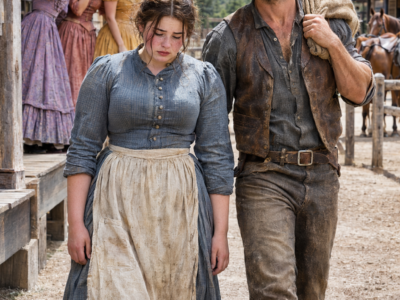
The humiliation of standing in a blue dress while a man told me I was too large to love.
Then I looked at Matthew.
His eyes held no calculation.
No shame.
No desire to change me.
Only love.
“Yes,” I whispered.
His face transformed.
“Yes?”
I laughed.
“Yes, Matthew Lawson. A thousand times yes.”
He slipped the ring onto my finger.
Then he stood and kissed me with a tenderness that made every lonely mile seem worth traveling.
We married in spring.
The ceremony took place beneath the old cottonwood beside the ranch house.
Caleb stood beside Matthew.
Ruth scattered wildflowers along the path.
Amos Whitcomb insisted on attending despite the long carriage ride.
I wore the blue dress I’d sewn for Owen.
For weeks, I had considered burning it.
But on our wedding morning, I took it from the wardrobe, brushed the fabric, and carefully repaired the seam that had torn during my journey.
It was still beautiful.
And so was I.
When I stepped onto the porch, Matthew looked at me as though the sun had risen just for him.
“You look beautiful,” he whispered.
I smiled.
“I know.”
He laughed, and the sound filled the spring air.
Our wedding wasn’t grand.
There were no silk decorations, no expensive feast, and no wealthy guests.
There was fresh bread, roasted beef, wildflowers, and a small gathering of people who had stood beside us when standing beside us was dangerous.
It was everything I had ever wanted.
Over the following years, Pine Hollow slowly prospered.
We built a new barn, stronger than the first.
We repaid the remaining legitimate debts.
We expanded the kitchen and opened a small boarding house for travelers who arrived in Wyoming seeking work or a second chance.
No one was turned away because of appearance, poverty, or the clothes they wore.
Matthew said that was my greatest contribution to Pine Hollow.
I disagreed.
My greatest contribution was teaching him that accepting help didn’t make him weak.
And his greatest gift to me was teaching me that love never required me to apologize for taking up space.
Five years after our wedding, a letter arrived from the territorial prison.
Owen had been released after serving his sentence.
He wrote that he had found employment repairing railroad tracks in Nebraska.
He didn’t ask for money.
He didn’t ask to come home.
He simply apologized again, this time without excuses.
At the bottom of the letter, he had written:
I spent my life believing I deserved more than everyone else. I lost everything because I never learned to be grateful for what I had.
I folded the letter and placed it in my desk.
I forgave him.
But I did not invite him back into our lives.
Forgiveness, I had learned, didn’t mean giving someone another opportunity to hurt you.
Sometimes it simply meant putting down a burden you no longer wished to carry.
One autumn evening, years later, I stood beside the station platform in Cheyenne.
Matthew had brought me there to collect supplies for the boarding house.
Our daughter, Grace, held my hand while our little son, Daniel, slept against his father’s shoulder.
A train had just arrived.
Among the passengers stood a young woman holding a battered suitcase.
She was alone.
Her dress was worn, and she looked frightened.
I watched as she searched the crowd for someone who apparently wasn’t coming.
Something inside me tightened.
I recognized that expression.
The desperate effort to appear brave while your whole future collapsed around you.
I walked toward her.
“Are you waiting for someone?”
She nodded.
“My fiancé. He said he’d meet me here.”
“How long have you been waiting?”
“Since morning.”
I glanced at the setting sun.
Then at Matthew, who understood without a word.
He smiled and adjusted our sleeping son.
I turned back to the young woman.
“Well, if he doesn’t come, we have room at our ranch. A warm meal, a clean bed, and work if you need it.”
Her eyes filled.
“Why would you help a stranger?”
I looked down at the old blue dress beneath my traveling coat.
I had worn it that day without thinking.
And suddenly, I understood why.
“Because once,” I told her, “I was standing exactly where you are.”
She began to cry.
I took her suitcase.
Then I led her toward the wagon where my husband and children waited.
As we traveled home beneath the broad Wyoming sky, I thought of the frightened girl who had arrived in this town with eleven dollars and a broken heart.
She had believed that being rejected meant she wasn’t enough.
She had believed that her body, her dreams, and her hopes made her somehow unworthy.
But she had been wrong.
The man who abandoned her had never possessed the power to determine her value.
He had only possessed the power to reveal his own.
And the greatest blessing of her life had begun the moment she stopped begging to be chosen by someone incapable of loving her.
Matthew reached across the wagon seat and took my hand.
Our children slept between us.
Ahead, the windows of Pine Hollow glowed warmly against the approaching darkness.
I rested my head against his shoulder.
I had crossed sixteen hundred miles searching for someone who would give me a home.
Instead, I had discovered something far more precious.
I had always been worthy of one.
And once I learned that, I finally knew how to build a home where other people could discover it too.
Because sometimes the door that closes in your face isn’t the end of your story.
Sometimes it is the very thing that leads you toward the life you were meant to live.
And sometimes, the person who refuses to see your worth gives you the greatest gift of all.
The freedom to find someone who does.
THE END