“You have sixty seconds, Mr. Mercer. If you can make this car run, I’ll admit I was wrong about you.”
The following Monday, I returned to my workshop before sunrise, expecting the week to unfold exactly as it always had.
A delivery van needed a new alternator. An elderly couple had left their sedan overnight because the brakes were making a noise they couldn’t afford to ignore. A local restaurant owner was waiting for me to look at his battered pickup, which had refused to start for the third time that month.
Nothing about the morning suggested that my life was about to change.
I liked it that way.
The workshop was small, with a corrugated metal roof, a stubborn garage door, and a coffee machine that made more noise than the old compressor in the corner. There were no polished floors or glass walls. The tools were arranged according to how often I used them, not how impressive they looked on a presentation slide.
Lucy had once described it as the place where broken things came to feel better.
I had written that sentence on a piece of cardboard and taped it above my workbench.
At 8:17 a.m., my phone rang.
The number was unfamiliar, but I recognized the voice immediately.
“Mr. Mercer, this is Vivien Cross.”
I set down the wrench in my hand.
“Good morning.”
“I was hoping we could speak.”
“About the car?”
“Partly.”
There was a pause. I could almost hear her reorganizing her thoughts into the kind of precise language she used in boardrooms.
“I’ve spent the weekend reviewing what happened at the exhibition. I’ve spoken with the engineers, examined the vehicle’s preparation records, and requested an independent assessment.”
“And?”
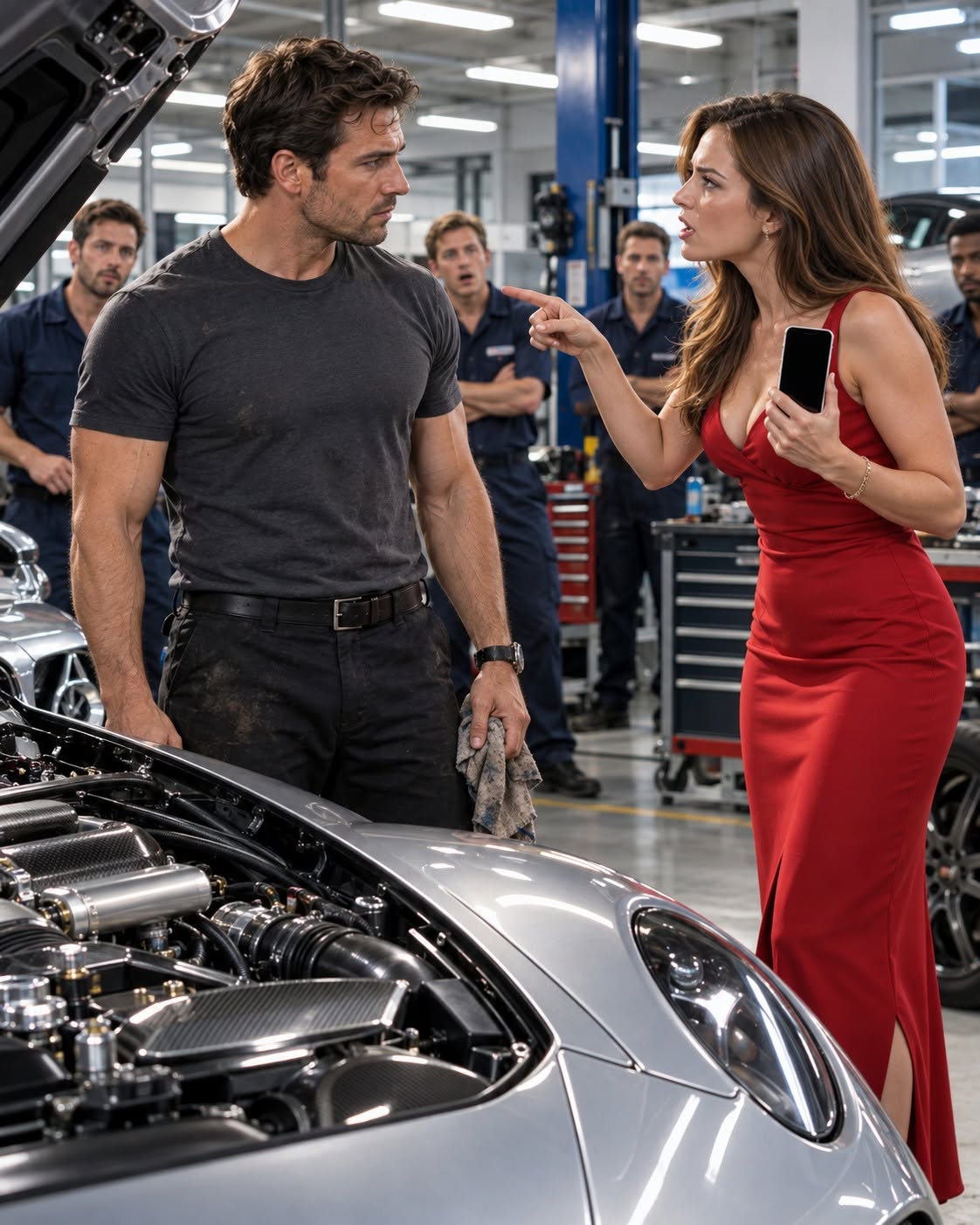
“And your explanation was correct.”
I waited.
“The isolation sequence was incomplete. The diagnostic system had registered conflicting readiness states, but our team interpreted the warnings as a software communication issue. They followed the procedures they had been trained to follow, even when the evidence suggested those procedures weren’t addressing the real problem.”
“That happens,” I said.
“Apparently, it happens more often than I realized.”
She sounded less certain than she had in the exhibition hall.
“I’d like you to visit our headquarters,” she continued. “Not to demonstrate anything. I want you to tell us what we missed.”
I looked around my workshop at the jobs waiting for me.
“I can spare a morning next week.”
“Excellent. My assistant will arrange—”
“There’s one thing you should understand first.”
She stopped.
“I don’t cancel appointments with customers who have already booked their repairs. If you want me there, we’ll work around my schedule.”
Another pause followed, longer this time.
“Of course,” she said finally. “We’ll work around your schedule.”
When the call ended, I returned to the van.
I didn’t tell myself that I had won anything. I had repaired a car, and someone had asked me to help solve a larger problem. That was all.
Still, when Lucy arrived after school that afternoon, she found me staring at the business card Vivien’s assistant had emailed.
“Are you going to work for the billionaire?” she asked, dropping her backpack beside the door.
“I’m going to a meeting.”
“That means yes, but you’re trying not to make it sound exciting.”
I laughed.
“Maybe.”
She studied the card, then looked up at me.
“Will you still pick me up on Thursday?”
“Absolutely.”
“Okay.”
That was enough for her.
It was enough for me, too.
Three days later, I drove to Cross Automotive Systems, a sprawling complex of glass buildings and immaculate test facilities outside the city.
The reception area was larger than my entire workshop. Engineers moved through the corridors carrying tablets, while screens displayed vehicle telemetry, production targets, and performance charts.
Everything looked expensive, efficient, and perfectly controlled.
I had seen places like it before.
What I hadn’t expected was the way the room changed when I walked in.
Two engineers recognized me from the exhibition. One whispered something to his colleague. Another looked at my work boots, then quickly turned away when he realized I had noticed.
I followed the assistant to a conference room where Vivien stood beside a wall-sized display.
She wore a dark suit and carried no folder.
“I thought you might prefer to see the people involved rather than another presentation,” she said.
Around the table sat six engineers, the head of diagnostics, and a gray-haired man introduced as Martin Hale, the company’s chief technical officer.
Martin shook my hand politely.
“Your solution at the exhibition was impressive,” he said. “Although I should point out that the R9’s startup procedure is documented in the service manual.”
“I believe you.”
“Then you understand why the team relied on the prescribed diagnostic sequence.”
“I do.”
He seemed relieved that I wasn’t going to argue.
I took a seat and opened the folder they’d prepared for me.
The first pages contained diagnostic logs. The next showed the transport preparation checklist. There were photographs of the vehicle, inspection notes, and a timeline of the failed startup attempts.
I read everything without speaking.
The engineers shifted in their chairs.
Finally, I turned to a photograph taken beneath the R9.
“Who prepared this vehicle for transport?”
A young engineer named Daniel Price raised his hand.
“I supervised the process.”
“Did you personally verify every isolation point?”
“I followed the checklist.”
“That wasn’t my question.”
His face tightened.
“No. I assigned the final inspection to another technician.”
“Was the inspection recorded?”
“Yes.”
“Did you verify the record?”
Daniel hesitated.
“The system showed the inspection as complete.”
I nodded and turned another page.
“Here is the first problem. Your paperwork says the inspection was completed. It doesn’t tell us whether the physical inspection actually happened.”
Martin leaned forward.
“The system requires confirmation before a technician can close the task.”
“Then the system confirms that somebody pressed a button.”
Silence settled over the room.
I continued before anyone could turn the observation into an argument.
“I’m not saying your system is useless. It records what people tell it. But a record of a completed task isn’t the same as evidence that the task was completed correctly.”
Vivien folded her arms.
“What else?”
I pointed to a second photograph.
“These marks here. They suggest the vehicle was repositioned after the isolation procedure began. Was the car moved?”
Daniel looked at the photograph, then at the table.
“Yes. The transport team needed to adjust its position on the loading platform.”
“Was the isolation procedure repeated afterward?”
“No.”
“Why not?”
“We were told the system would retain its previous state.”
I looked at Martin.
“There’s your second problem. A procedure designed around a stationary vehicle was treated as if the vehicle could be moved without changing anything that mattered.”
Martin studied the photograph for a long time.
Then he asked a question I hadn’t expected.
“How did you know where to look in less than a minute?”
“Because I wasn’t trying to prove the computer was wrong. I was trying to understand why the car and the computer disagreed.”
For the first time, Martin stopped looking at me as though I were an interesting exception to a rule.
He looked at me as though I had identified something he needed to understand.
The meeting lasted nearly three hours.
By the end, we’d identified gaps in the transport checklist, weaknesses in the handoff between teams, and a training culture that rewarded technicians for following procedures more than questioning them.
None of those failures could be blamed on one careless employee.
The system had made it possible for several reasonable decisions to combine into one unreasonable outcome.
Vivien listened without interrupting.
When I finished, she walked to the windows overlooking the test track.
“How much would you charge to help us fix it?”
I gave her a number.
Martin raised his eyebrows.
Vivien didn’t.
“Agreed.”
“I haven’t finished explaining the terms.”
She turned back.
“I assumed you hadn’t.”
“I’ll work on specific projects. I’ll train your teams, help revise the procedures, and report directly on what I find. I won’t become a permanent executive, and I won’t be available at all hours. My daughter comes first.”
Vivien glanced at the folder on the table.
“How old is she?”
“Eleven.”
“My father traveled constantly when I was young,” she said. “He used to tell me he was building a better future for our family.”
She looked back at me.
“I suppose he believed that.”
“Perhaps he did.”
“Did it work?”
I thought about Lucy waiting by the school gates, her backpack hanging from one shoulder, scanning every passing car until she saw mine.
“Not if the future arrives and the people you built it for no longer know you.”
Vivien said nothing.
Then she held out her hand.
“Specific projects. Your own business. Your schedule.”
I shook it.
“And no public countdowns,” I added.
For the first time since I’d met her, she laughed without checking whether anyone else was watching.
“Agreed.”
I believed that was the difficult part.
I was wrong.
The first serious challenge came two weeks into the engagement.
A prototype electric performance car had failed a high-load test at the company’s proving ground. The vehicle had entered a protective shutdown, and engineers couldn’t reproduce the fault consistently.
The shutdown itself wasn’t unusual. Modern vehicles were designed to protect themselves when a system detected dangerous conditions.
What worried the team was the pattern.
Three tests had ended normally. The fourth had triggered a shutdown. After the vehicle cooled, the system appeared healthy again.
The engineering team suspected a control software defect.
Martin called me to the test facility.
“We’ve run the standard diagnostic procedure six times,” he said. “Nothing conclusive.”
“What changed between the successful tests and the failed one?”
“Ambient temperature, load, and battery conditions. We’ve accounted for all three.”
“Have you accounted for the people?”
He frowned.
“The people?”
“Who prepared the vehicle? Who connected the equipment? Who decided when the test was ready to begin?”
Martin gave me the look of a man who had already spent too much time entertaining an unlikely suggestion.
But Vivien, standing behind him, said, “Let’s find out.”
I requested the complete test records, including maintenance notes and technician handoffs. Then I asked to observe the next run.
The team prepared the prototype while I watched from behind the safety line.
Their work was professional. They checked the connections, reviewed the battery state, and confirmed the software configuration.
Everything appeared correct.
When the test began, I watched the instruments.
The vehicle accelerated smoothly. The power output climbed. Temperature readings remained within their expected ranges.
Then the system shut down.
Alarms sounded, and the test operator brought the vehicle to a controlled stop.
The engineers gathered around their screens.
“Same fault,” someone announced.
I walked toward the service area.
“Don’t touch anything yet.”
Martin looked annoyed.
“We need to capture the fault before the system clears it.”
“Then capture it. But don’t dismantle the car.”
I crouched beside the rear service compartment.
A faint smell of warm insulation hung in the air. One of the technicians had already reached for a tool.
“Did you notice that?” I asked.
“Notice what?”
“The smell.”
He paused.
I asked the team to isolate the vehicle according to the approved safety procedure. Once it was safe to inspect, we examined the accessible connections and the surrounding equipment.
Nothing obvious appeared damaged.
Then I noticed a narrow strip of dust along the edge of a protective cover. The dust had been disturbed in a small crescent, as though the cover had shifted slightly under movement.
I asked when it had last been removed.
The maintenance technician checked his notes.
“Yesterday morning.”
“Why?”
“Routine inspection.”
“Was the cover replaced with the original fasteners?”
He looked uncertain.
“I think so.”
We checked the maintenance record, then examined the cover’s mounting points. One fastener was the wrong specification. It held the cover in place, but not with the intended clearance.
Under vibration, the cover could shift just enough to interfere with a nearby cable support.
The resulting movement was subtle. The insulation showed early signs of abrasion, and the intermittent electrical disturbance was enough to trigger the vehicle’s protective shutdown.
The control software had done exactly what it was supposed to do.
The fault was physical, intermittent, and dependent on conditions the standard stationary inspection hadn’t reproduced.
Martin stared at the fastener.
“How did that get past the inspection?”
The technician who had performed the work turned pale.
“I followed the maintenance instructions.”
He wasn’t lying. The instructions specified that the cover should be secured, but the replacement fastener had come from an approved general-purpose kit. The procedure didn’t clearly distinguish between hardware that could hold a cover in place and hardware that maintained the required clearance under vibration.
The technician had done what the documentation allowed.
I felt the old tension settle in my shoulders.
This was the danger I’d tried to explain at the first meeting. When a procedure was incomplete, people could follow it faithfully and still produce the wrong result.
Vivien arrived at the test bay a few minutes later.
“Is it fixed?”
“Not yet,” I said. “We need to replace the fastener with the specified component, inspect the cable support, and verify the assembly under controlled conditions. Then we need to change the maintenance instructions so this doesn’t happen again.”
“How long?”
“Long enough to do it properly.”
She glanced at Martin.
He nodded.
“No shortcuts.”
The repair took the rest of the day.
The following morning, the prototype completed the high-load test without shutting down.
But that wasn’t the result that mattered most to me.
What mattered was the meeting afterward.
The technician who had installed the fastener sat at the end of the table, looking as if he expected to be dismissed.
Instead, Martin asked him to explain the maintenance procedure from beginning to end.
The technician described the instructions, the available hardware, and the assumptions he’d made.
Nobody interrupted.
When he finished, Martin asked the team to identify how the procedure could be improved.
It was a small change in behavior, almost invisible compared with a multimillion-dollar vehicle returning to service.
Yet it was the first time I’d seen the company treat a mistake as information rather than an opportunity to find someone to punish.
I thought we were finally making progress.
Then, on a Thursday evening, my phone rang while I was picking Lucy up from school.
Vivien’s voice was unusually tense.
“Ethan, I need you at headquarters tomorrow morning.”
“What’s happened?”
“Someone has accused your team of falsifying the prototype investigation.”
I looked at Lucy, who was climbing into the passenger seat.
“Falsifying what?”
“The maintenance records. The allegation is that your findings were manufactured to justify a change in our testing procedures.”
“Who made the allegation?”
“I can’t tell you yet. Legal is investigating.”
I gripped the steering wheel.
“Then investigate the records. They’re all there.”
“The records are incomplete.”
I went still.
“What do you mean?”
“The original maintenance log was replaced by a revised version after the incident. The revised document contains the correct fastener specification, but the audit history is missing.”
For a moment, I couldn’t speak.
We had corrected the maintenance instructions after discovering the problem. The revised version was supposed to make the distinction clear.
But someone had apparently replaced the original record without preserving the change history.
Now it looked as though the company had documented the correct specification before the failure, making our discovery appear fabricated.
“Did you change the original file?” I asked.
“No.”
“Did Martin?”
“Not according to the access records we’ve reviewed.”
“Then someone else did.”
“Yes.”
I looked at Lucy.
She was pretending not to listen, but her eyes were fixed on my face.
“Tomorrow morning,” I said. “I’ll be there.”
After I ended the call, Lucy waited until I had started driving.
“Are you in trouble?”
“I don’t know yet.”
“Did you do something wrong?”
“No.”
“Then why do you sound worried?”
I considered giving her the easy answer.
Instead, I told her the truth.
“Because sometimes doing the right thing doesn’t mean everyone will immediately believe you did it.”
She watched the houses pass outside her window.
“That’s not fair.”
“No,” I said. “It isn’t.”
The next morning, the conference room was crowded.
Vivien sat at the head of the table. Martin was beside her, his expression unreadable. The company’s legal counsel had brought copies of the original inspection records, the revised maintenance instructions, and a report from the internal audit team.
Daniel Price was there, too.
He looked exhausted.
The allegation had spread beyond the engineering department. A senior executive had suggested that my consultancy was pushing unnecessary procedural changes to secure a larger contract. Another had questioned whether my workshop experience qualified me to challenge a team of specialists.
It was the exhibition hall all over again, except this time nobody was laughing.
They were deciding whether my reputation could survive their suspicion.
Vivien began the meeting.
“We will establish what happened before making any decisions. Mr. Mercer, please explain your findings and the changes you recommended.”
I laid out the timeline.
The failed test. The observed disturbance. The incorrect fastener. The physical inspection. The controlled repair. The successful retest.
Then I explained when the maintenance instructions had been revised and who had authorized the change.
Martin reviewed the records.
“The revised instructions were uploaded at 6:42 p.m. on Wednesday,” he said. “The original document was last modified at 6:19 p.m.”
“By whom?” Vivien asked.
The legal counsel turned a page.
“The user account belongs to the quality assurance director, Richard Sloane.”
Every head turned toward the far end of the table.
Richard Sloane had been sitting silently near the door.
He was a polished executive in his late fifties, with silver hair and a voice that rarely rose above a measured calm.
“That account is shared with my department,” he said. “I didn’t personally alter anything.”
“Then someone using your account did,” Vivien replied.
“Possibly. But that doesn’t prove the investigation was compromised.”
“No,” I said. “It doesn’t.”
Richard looked surprised that I’d agreed.
I leaned forward.
“But it does mean we need to establish why the original record disappeared, why the audit history is missing, and who benefited from making the investigation look unreliable.”
He folded his hands.
“Are you accusing me of something?”
“I’m asking the same questions I’d ask if the missing record belonged to a mechanic in my workshop.”
The room fell silent.
Daniel suddenly spoke.
“I know why the file was changed.”
Martin turned toward him.
“Daniel?”
The young engineer swallowed.
“Two days before the test failure, I received an email asking me to close the transport preparation review. It said the remaining documentation was administrative and shouldn’t delay the prototype schedule.”
He looked at Vivien.
“The message came from Mr. Sloane’s office.”
Richard’s expression hardened.
“Many departments contact engineering about schedules.”
“I know. But the message also told me not to reopen the inspection record after the vehicle was moved. It said the existing approval was sufficient.”
“Do you have that email?” Vivien asked.
Daniel nodded and opened his laptop.
The message appeared on the screen.
It had been sent from an assistant’s account, with Richard copied on the original thread. The wording was careful. It didn’t explicitly order anyone to falsify a record, but it encouraged the team to treat an incomplete inspection as closed.
Then the legal counsel found another email.
It showed that Richard had been warned about inconsistent transport preparation records months earlier.
He had acknowledged the warning.
Nothing had been done.
Richard stood.
“This is being taken out of context. The company was facing delivery deadlines. I was trying to prevent unnecessary delays.”
“By removing the audit history?” Vivien asked.
“I did not remove it.”
“Then help us establish who did.”
He glanced around the table, searching for support.
Nobody spoke.
For the first time, his confidence faltered.
The investigation eventually established that Richard had directed an employee to replace the original maintenance document with a cleaned-up version after the incident. The employee had believed the instruction was authorized and had not understood that removing the audit history would make the original record impossible to trace through the normal system.
Richard had not personally changed the file, but he had ordered a record to be replaced without preserving the required history. He had also ignored earlier warnings because acknowledging the procedural gaps would have delayed a major product launch.
His decisions had not caused every failure.
They had made it harder for the company to see those failures clearly.
Vivien removed him from his position pending a formal review. The company referred the records issue for independent examination and suspended the affected approval process until the documentation controls were repaired.
Daniel was not punished for raising the issue.
Instead, he was asked to help rebuild the review procedure.
As for me, Vivien offered to terminate the consultancy if I wanted to avoid the controversy.
I looked at her across the table.
“If I leave now, what changes?”
“The company will continue the investigation.”
“And the engineers?”
“They’ll still need better procedures.”
“Then I won’t leave.”
She seemed to study me for a moment.
“Even after what happened?”
“Especially after what happened.”
I wasn’t staying because I wanted to defeat Richard Sloane or prove that a workshop technician could outthink an executive.
I was staying because the people who would eventually work on those vehicles deserved instructions that told them the truth, records they could trust, and leaders who listened when something didn’t make sense.
The next few months were difficult.
The company delayed its launch, reviewed hundreds of maintenance records, and retrained teams across several facilities. Some managers resisted the changes. Others quietly admitted that they’d noticed similar problems but had assumed they weren’t important enough to challenge.
We introduced a new rule: whenever a technician found a discrepancy between the documented state of a vehicle and its actual condition, the discrepancy had to be recorded before anyone could close the task.
We also changed the training sessions.
Instead of showing technicians a fault and asking them to identify the correct answer, we gave them incomplete information and asked what they needed to know next.
Sometimes the answer was in a diagnostic log.
Sometimes it was in a maintenance history.
Sometimes it was a faint mark beneath a panel or a connector that didn’t sit quite right.
And sometimes, the most important step was admitting that nobody yet understood the problem.
Martin became one of the strongest supporters of the new approach.
One afternoon, after a training session, he stayed behind while the others left.
“I owe you an apology,” he said.
“For what?”
“For assuming your practical experience was narrower than our technical expertise.”
I leaned against the workbench.
“Your team knew things I didn’t. I knew things they hadn’t been taught to look for. That’s why we needed each other.”
He considered that.
“I spent twenty-five years believing that better instruments would eventually eliminate uncertainty.”
“Better instruments help.”
“But they don’t eliminate judgment.”
“No,” I said. “They make judgment more important.”
Martin smiled faintly.
“I wish someone had explained that to me twenty-five years ago.”
“Maybe someone did.”
He laughed.
“Perhaps I wasn’t listening.”
By the end of the year, the consultancy had become a permanent part of the company’s technical improvement program, although I remained an independent contractor. My workshop stayed open. I still repaired delivery vans, old sedans, and the occasional machine whose owner had been told it wasn’t worth fixing.
I also taught engineers who earned more in a month than I sometimes earned in a quarter.
Some arrived expecting me to reveal a secret.
There was no secret.
I taught them to slow down when the evidence contradicted their assumptions, to inspect before replacing components, to question incomplete records, and to remember that a machine couldn’t care less about the prestige of the person examining it.
The best students were the ones who eventually stopped asking me for answers and started asking better questions.
One Saturday, Vivien visited the workshop.
She arrived without an entourage, wearing a simple coat and carrying a paper bag.
Lucy was at the workbench, helping me organize a box of old sockets.
Vivien placed the bag on the counter.
“I brought lunch,” she said. “I thought that might be more appropriate than another contract.”
Lucy looked up.
“Do you know how to fix cars now?”
Vivien laughed.
“Not even slightly.”
“Dad says you can learn a lot by watching.”
“Your dad is right.”
Lucy considered this, then handed her a socket.
“Can you sort these by size?”
Vivien looked at the scattered tools.
“I believe I can manage that.”
For the next twenty minutes, a billionaire who had once challenged me in front of an exhibition hall sat beside my daughter, sorting sockets into trays while I finished repairing a customer’s car.
At one point, Lucy held up two nearly identical pieces.
“Which one goes here?”
Vivien examined them carefully.
“They look the same.”
“They’re not.”
“How can you tell?”
Lucy pointed to a tiny difference in the markings.
Vivien smiled.
“Then I suppose I should look more closely.”
I watched them for a moment and returned to my work.
It struck me that the most meaningful part of everything that had happened wasn’t the R9 starting in fifty-eight seconds. It wasn’t the contract, the training program, or the executives who eventually learned to listen.
It was this ordinary afternoon.
No audience. No countdown. No one trying to prove anything.
Just a child teaching an adult to pay attention.
Later, after Vivien had left, Lucy and I sat on the steps outside the workshop eating the lunch she’d brought.
“Do you think she feels bad about what she said at the exhibition?” Lucy asked.
“I think she understands it differently now.”
“Is that the same as being sorry?”
“Not always.”
She thought about that.
“Would you forgive her if she apologized?”
“Yes.”
“Why?”
I looked at the workshop door, where the cardboard sign still hung above my workbench.
“Because forgiveness doesn’t mean pretending something never happened. It means deciding that what happened doesn’t have to control everything that comes afterward.”
Lucy nodded slowly.
“Would you still have fixed the car if she hadn’t offered you the job?”
“Of course.”
“Even if everyone laughed?”
I took a moment before answering.
“Yes.”
“Why?”
“Because the car needed fixing.”
She smiled.
“I think that’s a good reason.”
Years later, I would remember that conversation more clearly than the engine’s roar in the exhibition hall.
I would remember it because Lucy had understood something I had spent much of my adult life trying to put into words.
We don’t always get to choose how people see us. We cannot prevent every insult, correct every assumption, or make every unfair person admit they were wrong.
But we can choose what kind of person we become when those things happen.
We can let humiliation turn us bitter, or we can let it remind us that other people’s judgments are not reliable measures of our worth.
We can chase recognition until it consumes the things we once hoped recognition would help us protect.
Or we can define success for ourselves.
For me, success was no longer a prestigious title or an office overlooking a test track. It was a business that paid its bills, work that mattered, and the freedom to close the workshop at four o’clock when Lucy needed me at school.
It was knowing that I could stand in a room full of people who doubted me without needing to become someone else to deserve my place there.
And it was understanding that expertise meant more than having the right answer.
Sometimes, it meant recognizing the limits of what you knew.
Sometimes, it meant listening to the person everyone else had dismissed.
And sometimes, it meant having the courage to say that the system was wrong, even when the system had been built by people far more powerful than you.
The Veyronics R9 eventually returned to the road. Its owners would never know how close it had come to becoming an expensive exhibit, or how much its failure had revealed about the company that built it.
The engineers would remember.
Vivien would remember.
And Lucy, I hoped, would remember the part that mattered most.
Not that her father had defeated a billionaire.
Not that he had made a three-million-dollar car roar back to life in less than a minute.
But that when someone tried to make him feel small, he hadn’t needed to make anyone else feel smaller in return.
He had simply looked at the problem, done the work, and stood by what he believed was right.
One evening, long after the exhibition, I found Lucy studying the cardboard sign above my workbench.
“Broken things come here to feel better,” she read aloud.
“Do you still believe that?”
I wiped my hands and looked around the workshop.
The battered van near the door. The old sedan waiting for its owner. The tools arranged in their familiar places. The small office where I’d once sat with bills spread across the desk, wondering whether leaving my old career had been a terrible mistake.
“Yes,” I said. “I do.”
She turned toward me.
“Even people?”
I thought about Vivien, Martin, Daniel, and the people who had made mistakes because they were afraid to question instructions.
“Especially people.”
Lucy leaned against my shoulder.
Outside, the evening traffic moved steadily past the workshop. Somewhere beyond the ordinary streets, expensive machines were being built, tested, and delivered by people who might never know the names of the technicians who kept them running.
I was content to be one of those technicians.
I had learned that a person’s worth wasn’t determined by the size of their bank account, the title on their business card, or the number of people willing to applaud them.
It was revealed in the choices they made when applause was absent.
And the greatest lesson I could give my daughter was not how to win a challenge in fifty-eight seconds.
It was how to live a life in which she never needed someone else’s permission to believe she mattered.
That night, I locked the workshop, took Lucy’s hand, and walked home.
For the first time in a long while, I didn’t think about what I had left behind.
I thought about everything I had chosen to keep.
And I knew, without needing a screen, a certificate, or a billionaire’s approval to confirm it, that I had made the right choice.