“What I really need isn’t an employee,” I told the mysterious woman standing in my struggling auto shop. “I need a wife.”
The document was a legally binding pre-emptive purchase agreement. It gave me a right to buy the building before it could be sold to another party, provided I met the terms laid out in the contract.
I’d never heard of it. Stanley Kowalski had owned the property before Whitfield acquired it, and the agreement had apparently been overlooked—or deliberately buried—during the transition.
“If this is valid,” I said, “why haven’t they told me?”
Claire’s expression answered before she spoke.
“Because Graham Pruitt has been working to get tenants out before anyone can exercise rights like yours.”
We needed proof that the agreement was genuine, so Claire arranged for us to meet Ruth Kowalski, Stanley’s elderly widow. Ruth remembered the deal and confirmed that her husband had insisted on protecting the small businesses that depended on his property.
With help from Denise Okafor, a discreet attorney Claire trusted, we verified the document and prepared to challenge the eviction.
Pruitt didn’t take kindly to the interference.
Suddenly, my shop was subjected to aggressive health inspections. Minor issues were treated as major violations, and threats arrived disguised as official warnings. Every time I thought we’d made progress, another obstacle appeared.
Then my phone lit up with a text message.
It contained a photograph of Lily leaving school.
No explanation. No words were needed.
My stomach tightened. Until that moment, I’d been willing to risk my business to fight back. Now someone had dragged my daughter into it.
Claire was furious, but she didn’t rush into a confrontation. Denise contacted Detective Ortiz, a patient investigator who understood that threats were sometimes designed to provoke people into making mistakes. Together, they began building a case against Pruitt.
They needed him to reveal how much he knew and how far he was willing to go.
The opportunity came at his fourteenth-floor office.
I went there with Claire, carrying copies of the agreement and the evidence we’d gathered. Pruitt greeted us with the easy confidence of a man who believed the outcome had already been decided.
He dismissed the agreement, questioned its validity, and suggested that continuing the dispute would cost me far more than the shop was worth.
Claire remained calm.
“You’re certain the acquisition was handled properly?” she asked.
“Absolutely,” he replied.
But as the conversation continued, Pruitt became careless. Faced with specific questions about the inflated fees and the pressure placed on tenants, he made statements that contradicted the company’s records. The evidence Denise and Detective Ortiz had helped assemble exposed the pattern behind his actions.
His confidence disappeared when he realized the meeting had become the moment his own words could be used against him.
The investigation moved forward, and the company’s board could no longer ignore the evidence. The purchase agreement was recognized, and Pruitt’s scheme was exposed.
For the first time in months, I could make plans that extended beyond the next rent payment.
Claire helped me secure a small-business loan, allowing me to exercise my purchase rights and buy the building. The paperwork took time, and the financial commitment was frightening, but the shop was finally ours to protect.
Spring arrived in Dayton with warmer mornings and sunlight pouring through the garage doors. Lily insisted that the roof needed flowers, so we built a long planter box and filled it with soil. She planted sunflower seeds in a careful row, patting the dirt around each one as if she were tucking it into bed.
Claire kept visiting. Sometimes she helped with paperwork; sometimes she sat with Lily while I finished a repair. There was no grand announcement about what we were becoming. Trust grew through ordinary things: shared meals, long conversations, and the quiet certainty that none of us had to face every problem alone.
One morning, I poured three cups of coffee and set them on the counter.
I didn’t put one away.
Lily noticed immediately. She looked at the cups, then at Claire, and finally at me.
“You finally filled the third cup,” she said, smiling.
I looked at the little girl who had drawn an empty space beside her sunflower months earlier, back when I thought my only choices were to work harder or watch everything fall apart.
That first morning, I had joked that I needed a wife because I was too tired to imagine another solution.
What I really needed was someone who could see the possibility in a life I was struggling to hold together—and someone I could trust enough to let in.
The building was ours. The sunflowers were growing. And for the first time in years, home felt like a place that wasn’t going to disappear overnight.
The third cup wasn’t a promise that life would always be easy.
It was simply a place at the counter for someone who had chosen to stay.
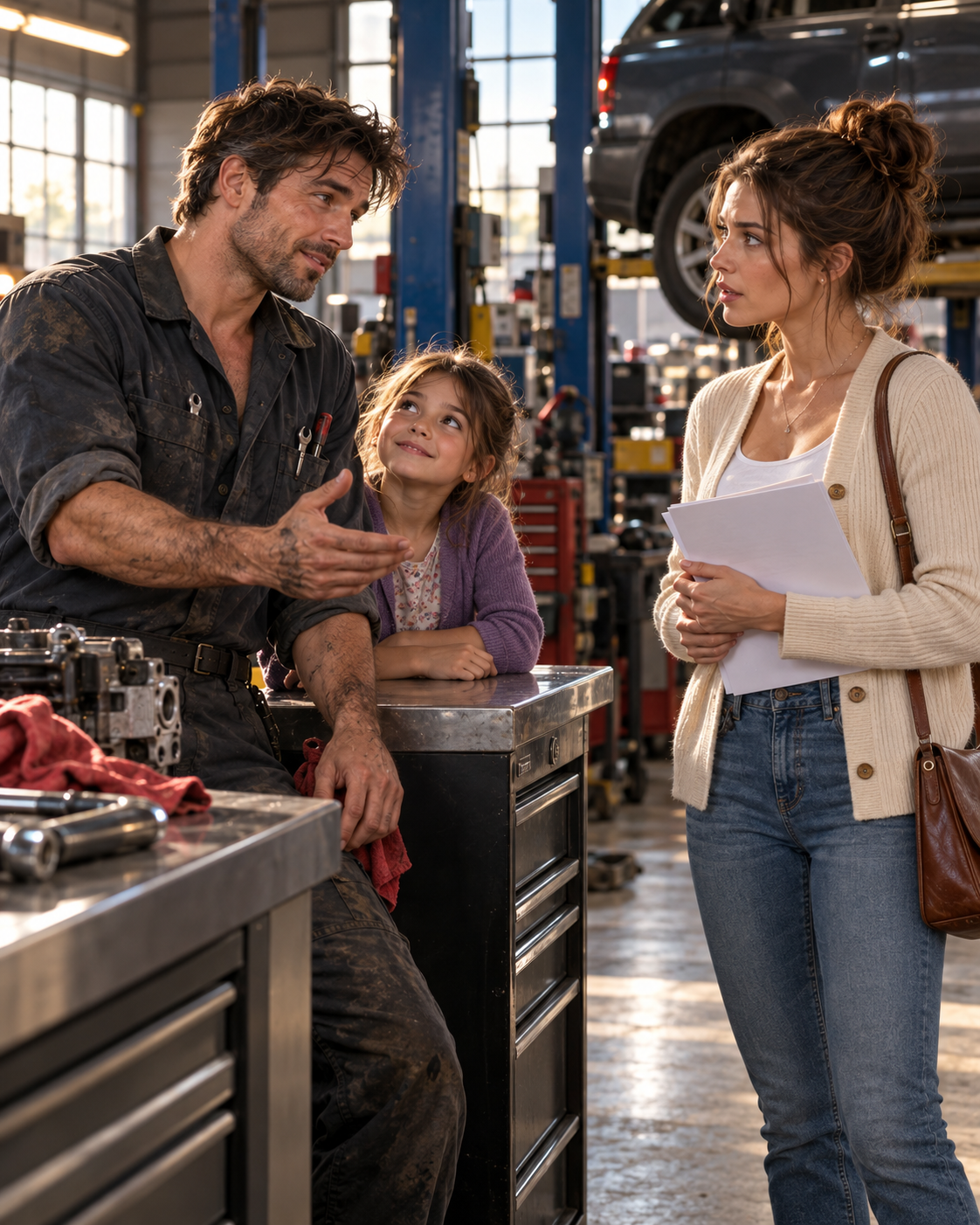
The first thing I learned about owning a building was that the deed didn’t make the fear disappear.
For years, I’d worried about losing my auto shop. I’d worried about unpaid bills, broken equipment, and whether I could keep food on the table for Lily. I’d worried that one bad month would undo everything I’d spent my life building.
Now the building belonged to us, yet I still woke before sunrise with my heart racing, convinced I’d forgotten to pay someone.
Some habits, I discovered, survived even after the danger passed.
But there was another thing I hadn’t learned how to do.
I didn’t know how to be happy without waiting for something to go wrong.
Claire seemed to understand that before I did.
One Tuesday evening, she found me standing beneath the garage’s new sunflower planter, staring at a small crack in the concrete wall.
“Are you planning to fix that tonight?” she asked.
“I was thinking about it.”
“You’ve been thinking about it for twenty minutes.”
“That’s how you know it’s a serious crack.”
She glanced at the wall, then back at me. “It’s a hairline fracture in a building that survived decades of Ohio winters. I think it can wait until morning.”
I wanted to argue, but her smile made it difficult.
“Come on,” she said. “Lily made dinner.”
I looked toward the office, where my daughter was arranging paper napkins beside three mismatched plates.
“She made dinner?”
“She supervised pizza delivery and informed me that heating the oven was unnecessary.”
“That sounds like her.”
Claire reached for my hand.
I let her take it.
It was such a small gesture, but it stopped me more effectively than any argument could have. For so long, I’d treated every good thing in my life as something temporary, something I had to protect by working harder than everyone else.
I was beginning to understand that protecting a life and actually living it were two different things.
I just didn’t know yet how much courage the second one would require.
Three weeks later, the first sunflower opened.
Lily discovered it before breakfast and came running into the shop wearing one sock, her pajama shirt inside out, and an expression of such complete astonishment that I thought something terrible had happened.
“Dad! Dad! You have to come!”
I dropped the wrench I was holding.
“What is it?”
“It’s happening!”
I followed her outside, already imagining a dozen disasters.
Then I saw the flower.
Its yellow petals had unfolded around a dark center, and its face tilted toward the morning sun as though it had been waiting all its life for that exact moment.
Lily stood beside it with her hands clasped beneath her chin.
“I knew they would grow,” she whispered.
“You did.”
“Even when the dirt looked empty.”
I crouched beside her.
“That’s usually how growing works, sweetheart.”
She considered that, then leaned against my shoulder.
“Do people grow that way too?”
The question caught me off guard.
I looked at the flower, at the little girl who had spent years watching me hide my exhaustion behind jokes, and at Claire standing in the doorway with two cups of coffee.
“Sometimes,” I said. “Especially when somebody gives them a chance.”
Lily nodded as if I’d confirmed something important.
Then she ran inside to find her notebook.
I stayed where I was, watching the sunlight move across the garage floor.
For the first time, the future didn’t look like a list of bills waiting to be paid.
It looked like something that might actually bloom.
Unfortunately, happiness didn’t arrive alone.
It brought questions with it.
Claire had been visiting the shop for months, but there was still a distance between the life she had built and the one we were building together. Her work at Whitfield Property Group demanded long hours, difficult decisions, and constant travel. She was helping the company repair the damage Graham Pruitt had caused, and the board had begun relying on her to lead the reforms.
Sometimes she arrived after Lily had gone to bed.
Sometimes she canceled dinner because an emergency meeting had run late.
And sometimes, when her phone rang, I saw the familiar tension return to her shoulders.
I understood responsibility. I respected her work.
What frightened me was how easily I could become the man I’d been before: the man who assumed that if someone became distant, it meant he had failed to give them a reason to stay.
One Friday night, Claire called to cancel our plans.
“I’m sorry,” she said. “The board has called an emergency session. There’s a problem with the acquisition records, and I have to be there.”
I stood beside the kitchen sink, staring at the three plates I’d set out.
“Another problem with Pruitt?”
“Not exactly. Some of the old files are missing, and the board wants to know whether other properties were affected.”
“How late?”
“I don’t know.”
I heard papers rustling on her end.
“Don’t wait up for me.”
The words were ordinary.
My reaction wasn’t.
“Of course,” I said. “You have your company. I’ve got the shop. We’ll manage.”
She fell silent.
“That’s not what I meant.”
“I know.”
“Daniel, are you upset?”
“No.”
I was upset. I was lonely. I was embarrassed by how much I’d been looking forward to an evening with her.
But most of all, I was afraid that asking for more would make me sound ungrateful for what she’d already given.
So I did what I had always done.
I pretended I needed nothing.
When she arrived at the shop the next afternoon, I was underneath a pickup truck. She waited until I slid out, wiped my hands, and stood.
“Can we talk?”
“Sure.”
She looked tired, with dark circles beneath her eyes and a crease between her eyebrows that hadn’t been there a few months earlier.
“I know I’ve been distracted,” she said. “But I need you to understand that the company is trying to make sure what happened to your shop doesn’t happen to anyone else.”
“I understand.”
“Then why do I feel as if you’re shutting me out?”
I reached for a rag and began cleaning my hands, although they were already clean.
“Because I don’t want to become another obligation on your list.”
Her expression changed.
“Is that what you think you are to me?”
“I didn’t say that.”
“You didn’t have to.”
She looked toward the office, where Lily was coloring quietly.
“Daniel, I spent years believing that being useful was the same thing as being loved. I stayed late, solved problems, and made myself indispensable. It took me a long time to realize that people can depend on you without ever really knowing you.”
She took a breath.
“I’m not asking you to pretend you don’t need me. I’m asking you to let me know when you do.”
I had no answer.
She stepped closer.
“If you want me here, tell me. If you’re disappointed, tell me that too. I can’t promise I’ll always be available, but I can promise not to make you guess what you mean to me.”
I stared at her.
My instinct was to tell her everything was fine.
Instead, I forced myself to say the truth.
“I missed you last night.”
Her eyes softened.
“I missed you too.”
“And I was disappointed.”
“I know.”
“I hate that I was disappointed.”
“Why?”
“Because I know you have important things to do.”
Claire took the rag from my hands and set it on the workbench.
“Having important things to do doesn’t make your feelings unimportant.”
For a moment, neither of us spoke.
Then she asked, “Can we try again?”
I nodded.
“Tonight?”
“Tonight.”
She smiled.
“And Daniel?”
“Yeah?”
“Three plates. Not two.”
That evening, we ate dinner together at the little kitchen table behind the office. Lily told us a long, complicated story about a girl at school who had apparently declared war on a pencil sharpener. Claire listened as if the outcome might affect national security.
When Lily finally went to bed, Claire stayed.
We talked until midnight.
Not about work, or the building, or the people who had tried to take it from me.
We talked about her childhood, about my years with Lily’s mother, about the things we regretted and the things we were still afraid to want.
I told Claire that after my wife died, I’d become so focused on keeping Lily’s world intact that I had forgotten a child needed more than a roof and a dependable father.
She needed to see that love could exist without being accompanied by constant worry.
Claire told me that she’d spent much of her life trying to prove she deserved her place in her father’s company, even after his death had left her with more responsibility than she’d ever wanted.
Neither of us offered easy solutions.
We simply listened.
And when she left that night, she kissed me at the door.
It wasn’t a dramatic kiss. There was no music, no sudden revelation, no promise that everything would be simple from then on.
There was only the warmth of her hand against my cheek and the quiet understanding that we had chosen to be honest with each other.
It felt like a beginning.
Then, on a rainy Monday morning, everything threatened to fall apart again.
I was opening the shop when a black sedan pulled into the parking lot.
Two men stepped out.
One introduced himself as a representative of a commercial lending firm. The other carried a thick folder and asked whether I was Daniel Miller, the owner of the property.
I confirmed that I was.
The first man handed me a letter.
According to the document, the building’s previous owner had taken out a loan years earlier, secured against several properties. Whitfield had acquired the loan portfolio during a restructuring, and a newly discovered clause suggested that my building might still be subject to an outstanding lien.
The lender was demanding immediate clarification of the property’s title.
Until the dispute was resolved, it warned, my recent purchase could be challenged.
I read the letter twice.
Then a third time.
The shop, the building, the future I’d only just begun to trust—all of it seemed to tilt beneath my feet.
“Who authorized this?” I asked.
The representative gave me a practiced smile.
“We’re simply notifying you of a potential claim.”
“Potential?”
“We’ll need to review the original documents.”
“Then review them.”
“We’ll be in touch.”
They left me standing in the rain with the letter in my hand.
For several minutes, I couldn’t move.
The fear that returned was so familiar that I almost welcomed it. Fear was something I knew how to handle. It gave me instructions: work harder, trust less, prepare for the worst.
By the time Claire arrived, I’d already decided not to tell her.
She was dealing with enough.
But she saw the letter on my desk.
“What is this?”
I watched her read it.
The color drained from her face.
“Where did you get this?”
“They came this morning.”
She turned the page, scanning the details.
“This isn’t right.”
“That’s what they said about the eviction notice.”
“Daniel, listen to me. I’m not saying you shouldn’t be concerned. I’m saying we need to establish whether this claim is legitimate before we react.”
I wanted to believe her.
But I remembered Pruitt’s smile, the photograph of Lily outside school, and all the months when every answer had revealed another hidden problem.
“Did you know about this?”
She looked up sharply.
“What?”
“The loan. The lien. Any of it.”
“No.”
“You work for the company that sold me the building.”
“I know.”
“And now somebody says the building might not even be mine.”
“Daniel, I would never knowingly put you in that position.”
“Would you have told me if you had known?”
She didn’t answer immediately.
That hesitation hurt more than I expected.
Finally, she said, “Yes. I would have.”
I looked away.
“I can’t do this again, Claire.”
“Do what?”
“Build something around the hope that another person will help me keep it. I have Lily to think about.”
“And I have never asked you to stop thinking about her.”
“I can’t afford another mistake.”
Claire’s eyes glistened, but her voice remained steady.
“Neither can I. That’s why I need you to let me help.”
I wanted to reach for her.
Instead, I folded the letter and put it in a drawer.
“I’ll handle it.”
She stood quietly for a moment.
Then she nodded.
“All right.”
She walked out without slamming the door.
Somehow, that made it worse.
For the next two days, I buried myself in work.
I called the lender, hired an independent title attorney, and reviewed every document I could find. Denise Okafor agreed to examine the claim, but she warned me that resolving a complicated property dispute could take weeks.
Meanwhile, the uncertainty began to spread.
A supplier postponed a delivery after hearing rumors about the building. One of my regular customers asked whether the shop would still be open next month. I reassured him, although I had no idea whether that was true.
At home, Lily noticed everything.
Children have a way of recognizing changes adults believe they’ve hidden.
On Wednesday night, she brought her sunflower notebook to the kitchen.
“Dad?”
I looked up from the papers covering the table.
“What’s up, sweetheart?”
“Did I do something wrong?”
My stomach dropped.
“What? No. Of course not.”
“You and Claire haven’t had dinner together.”
I pushed the papers aside.
“That’s grown-up stuff, Lily.”
She studied me with the seriousness of someone trying to understand a language she had never been taught.
“Is she not coming back?”
I opened my mouth, but no reassuring answer came.
Lily looked down at her notebook.
“I drew three people because I thought we could all be a family. But if Claire doesn’t want to, you don’t have to make her.”
Something inside me broke.
I pulled her into my arms.
“Oh, sweetheart. You didn’t do anything wrong.”
She pressed her face against my shoulder.
“I just liked having her here.”
“I know.”
“And I liked when you laughed more.”
I closed my eyes.
There it was. The truth I’d been avoiding.
I’d told myself I was protecting Lily by refusing to depend on anyone. I’d convinced myself that love was a luxury we couldn’t risk losing.
But my daughter wasn’t asking me to guarantee that nothing bad would ever happen.
She was asking me to stop treating happiness as something dangerous.
The next morning, I called Claire.
She answered on the second ring.
“Daniel?”
“I’m sorry,” I said.
There was a pause.
“I’ve been frightened, and I’ve been acting as though shutting you out will somehow make things safer.”
She didn’t interrupt.
“I don’t know what’s going to happen with the building. I don’t know how long the legal fight will take. But I know I was wrong to decide what you could handle without giving you a chance to choose.”
Her voice softened.
“Thank you for telling me.”
“Can we meet?”
“Of course.”
We met at the same diner where she’d first revealed her identity.
The coffee was terrible, the tables were sticky, and the waitress remembered us well enough to bring Claire’s usual order without asking.
For a few minutes, we talked about the weather.
Then Claire reached into her bag.
“I brought something.”
She placed a document on the table.
It was a preliminary report from the independent review she had quietly commissioned after the lender’s letter arrived.
The alleged lien was connected to an old financing arrangement, but the records contained inconsistencies. More importantly, the company claiming the debt had acquired its interest through a chain of transactions that appeared to overlap with several acquisitions Graham Pruitt had overseen.
Denise had already identified a discrepancy between the original loan schedule and the version now being used to challenge my title.
“If the discrepancy is confirmed,” Claire said, “the claim against your building may have no valid basis.”
I stared at the report.
“Why didn’t you tell me you were looking into it?”
“Because you asked me to step back.”
She paused.
“I respected that, even though I didn’t agree with it. I also knew you needed independent legal advice, not just my assurances.”
I read the report again.
“You’ve been doing all this without me?”
“Not without you. For you, while you decided whether you wanted me beside you.”
Her words settled between us.
I had spent so long believing love meant finding someone who could rescue me that I hadn’t realized how unfair that expectation could be.
Claire wasn’t there to take over my problems.
She was there to face them with me, if I allowed her to.
“I want you beside me,” I said.
She reached across the table.
“Then stop making me stand outside the door.”
I took her hand.
This time, I didn’t let go.
The next several weeks were the hardest we’d faced.
Denise traced the disputed financing documents through three different companies. Detective Ortiz, who had continued investigating Pruitt’s activities, discovered that one of those companies had shared a former consultant with the acquisitions director.
The evidence didn’t prove that Pruitt had personally orchestrated the lien claim, but it revealed enough suspicious connections to warrant a deeper investigation.
Then Ruth Kowalski made an unexpected discovery.
While searching through her late husband’s belongings, she found an envelope addressed to the original property manager. Inside was a copy of a letter Stanley had written shortly before selling his building.
The letter specifically instructed the manager to preserve the pre-emptive purchase rights granted to qualifying tenants and to disclose any outstanding financing obligations before a transfer of ownership.
It also referred to a separate release document that should have been recorded when the original loan was settled.
That release was missing from the company’s records.
Ruth remembered her husband telling her that the matter had been resolved years earlier.
But memory alone wasn’t enough.
Denise followed the references in Stanley’s letter to a retired bank officer who had handled the account. He confirmed that the loan had been paid off and helped locate a certified copy of the release in an archived file.
When the document was authenticated, the supposed lien began to unravel.
The lender withdrew its immediate claim pending a final review, and the title attorney confirmed that the property remained protected by my purchase agreement and the completed sale.
For the first time since the black sedan had appeared, I slept through the night.
The investigation into Pruitt continued separately. The company’s internal review uncovered additional evidence of manipulated acquisition records and improper fees, while Detective Ortiz pursued the threats connected to Lily’s photograph.
I learned that justice rarely arrived in a single dramatic moment.
It arrived through patient questions, careful records, people who refused to look away, and the stubborn willingness to keep telling the truth even when the truth was inconvenient.
One afternoon, Denise called with an update.
“The title is clear,” she said. “Your attorney has confirmed it in writing.”
I sat down on the nearest stool.
“You’re certain?”
“As certain as the documents allow us to be.”
I covered my face with both hands.
For several seconds, I couldn’t speak.
Then I laughed.
It wasn’t a particularly dignified sound. It was half relief, half exhaustion, and entirely genuine.
When Claire arrived that evening, she found me standing outside beside the sunflower planter.
I handed her the letter confirming the title.
She read it, then looked at me.
“How does it feel?”
I considered the question.
“Like I can finally breathe.”
She smiled.
“Good.”
I reached into my pocket.
I’d been carrying something there for nearly a week, unsure whether I was brave enough to give it to her.
It wasn’t an engagement ring.
Not yet.
It was a small brass key, newly cut to match the lock on the shop’s front door.
“I know this isn’t much,” I said. “And I know a key doesn’t mean someone owes you anything.”
Claire looked down at it.
“I wanted you to have one because I want you to feel welcome here. Not as the person who helped save the building. Not as someone who has to solve every problem. Just as you.”
She closed her fingers around the key.
For a moment, she didn’t speak.
Then she stepped forward and kissed me.
“I think,” she whispered, “that’s the nicest thing anyone has ever offered me.”
From inside the office came a loud, deliberate cough.
We turned.
Lily stood in the doorway with her arms crossed.
“Are you two going to keep kissing, or can we have dinner?”
Claire laughed.
I laughed too.
And Lily, satisfied that the matter had been properly addressed, marched back inside.
That summer, the garage changed in ways that had nothing to do with its roof or its equipment.
I hired a part-time mechanic to help with the workload. I stopped taking every job that came through the door, even when turning one away made me nervous. On Sundays, I closed the shop early and took Lily to the park.
Sometimes Claire came with us.
Sometimes she had work to finish, and we went without her.
The difference was that we no longer treated every separation as a warning that something was wrong.
We had learned to trust the space between us.
In September, Lily started fourth grade.
She was taller, more confident, and increasingly convinced that she understood the world better than either of us.
One evening, she sat at the kitchen table drawing a new picture for the garage wall.
I watched her fill the page with blue lines and yellow circles.
“What are you drawing?”
“The shop.”
“I can tell.”
“And the flowers.”
“I can see those too.”
She frowned at me.
“Dad, you ask too many questions.”
I held up my hands in surrender.
A few minutes later, she carried the drawing over.
It showed the garage with its crooked blue sign, the sunflower planter on the roof, and three people standing beneath the open doors.
This time, there was no empty space between them.
Claire was holding a coffee cup.
I was holding a wrench.
Lily stood between us, holding a sunflower nearly as tall as she was.
At the bottom, she’d written in careful letters: OUR PLACE.
I swallowed against the sudden tightness in my throat.
“It’s beautiful, sweetheart.”
She looked pleased.
“Can we put it next to the old one?”
“Absolutely.”
We hung it beside the original drawing, the one that had started everything.
The two pictures looked different, but neither seemed incomplete.
The first showed a little girl who had hoped for something she didn’t know how to ask for.
The second showed a little girl who had learned that people could choose one another without having to be perfect.
That evening, after Lily had gone to bed, Claire and I sat on the front steps.
The air smelled of cut grass and warm pavement. Across the street, a streetlamp flickered to life.
“I’ve been thinking,” I said.
Claire glanced at me.
“That usually means trouble.”
“Probably.”
I reached into my pocket and took out a small velvet box.
Her expression changed.
I opened it.
Inside was a simple ring, nothing extravagant, with a small stone that caught the light.
“I don’t want to ask you to marry me because I need help keeping the shop open,” I said. “Or because Lily wants us to be a family. Or because being alone scares me.”
Claire’s eyes shone.
“I want to ask because my life is better when I share it with you. Because you challenge me when I’m wrong, tell me the truth when I’d rather hear a comforting lie, and make ordinary Tuesdays feel like something worth remembering.”
I paused, suddenly aware that my hands were shaking.
“I can’t promise we’ll never face another lawsuit, another difficult year, or another night when one of us is too tired to talk. I can’t promise I’ll always know how to get things right.”
She smiled through her tears.
“But I can promise to stop pretending I don’t need anyone. I can promise to listen, to show up, and to make room for you even when life gets complicated.”
I took a breath.
“Claire Whitfield, will you marry me?”
For one terrible second, she said nothing.
Then she laughed softly and wiped her cheeks.
“Daniel Miller, you are asking me to marry you on the steps of an auto shop.”
“I considered the diner, but the coffee seemed too expensive for a proposal.”
She laughed harder.
“And there isn’t even a sunflower in bloom.”
“Give it a few months.”
She looked at the ring, then at me.
“Yes.”
The word was quiet.
It was also the clearest answer I’d ever heard.
She slipped her arms around my neck, and I held her as the evening settled around us.
We didn’t call anyone that night. We didn’t make announcements or start planning a ceremony.
We sat on the steps, talked about the future, and let the happiness arrive without demanding that it explain itself.
The following morning, Lily noticed the ring before either of us said a word.
She stared at Claire’s hand.
Then she stared at mine.
Then she slowly lowered her spoon into her cereal bowl.
“You’re getting married?”
Claire smiled.
“If that’s all right with you.”
Lily’s face became very serious.
“Does that mean you have to move in?”
“No,” I said. “It means we’ll decide together what works best for everyone.”
She thought about this for several seconds.
“Can Claire keep her key?”
Claire held it up.
“Already have one.”
Lily nodded approvingly.
“Then I think it’s a good plan.”
She returned to her cereal as if she had just approved an important business merger.
But a moment later, she looked up.
“Can I be the flower girl?”
Claire reached across the table and squeezed her hand.
“You can be anything you want to be.”
That winter, we married in a small ceremony in the garden behind the garage.
Ruth Kowalski attended, along with Denise and Detective Ortiz. A few longtime customers came too, carrying gifts that ranged from practical kitchen supplies to a handmade wooden sign that read MILLER & WHITFIELD AUTO REPAIR.
Lily wore a yellow dress and carried a bouquet of sunflowers she’d helped grow.
When the time came for Claire to walk toward me, I felt the familiar tightening in my chest.
For years, I had believed that the strongest thing a father could do was stand alone between his child and the world.
Now I understood that strength could also mean allowing good people to stand beside him.
Claire reached me, took my hands, and smiled.
There was no grand promise to make life effortless.
There was something better: a promise to keep choosing one another when life wasn’t.
Afterward, we celebrated with homemade food, a crooked wedding cake, and enough laughter to make the neighbors complain about the noise.
At the end of the evening, when the last guests had left and Lily was asleep in the office chair, I went behind the counter to prepare coffee.
I took out three cups.
Then I stopped.
There were four people in our family now, including the future we were slowly building together. I reached into the cupboard for another cup and set it beside the others.
Claire came up behind me and wrapped her arms around my waist.
“Four?” she asked.
I looked at the cups.
“Four.”
She rested her cheek against my shoulder.
“Good.”
Outside, the sunflowers had long since dropped their petals, leaving dark seed heads that bowed beneath the winter sky. In a few months, we’d plant more.
The shop still needed repairs. The business still had difficult days. Sometimes the bills arrived faster than the customers, and sometimes I woke before dawn with old fears trying to convince me that everything could disappear.
But now, when fear came, I no longer mistook it for a prediction.
I could ask for help.
I could admit I was tired.
I could let someone love me without trying to earn that love by being useful every minute of the day.
And I could teach Lily that a family wasn’t a perfect picture in which nobody ever stood apart. It was the decision to keep making room for one another, even when the picture changed.
Years earlier, I had told a stranger that I needed a wife.
I’d said it because I was exhausted, desperate, and unable to imagine a future beyond the next unpaid bill.
I thought I needed someone to rescue me from a life I couldn’t manage alone.
What I really needed was to learn that I didn’t have to carry every burden in silence.
Claire hadn’t saved me by taking over my life. She had helped me reclaim it. And in doing so, she had shown me that love wasn’t a contract promising that nothing would ever go wrong.
It was a choice to face what went wrong together.
On the wall beside the office door, Lily’s two drawings hung side by side.
The first showed three people with a space between them.
The second showed them standing together beneath the sunflower.
I kept both.
Because the empty space in the first picture wasn’t a mistake.
It was room for something none of us had learned how to imagine yet.
And the full picture in the second wasn’t proof that our lives would always be easy.
It was proof that the space had been filled, one small act of trust at a time.
Sometimes, the most important thing a person can offer isn’t money, security, or a solution to every problem.
Sometimes, it’s simply an open door, an honest answer, and a place at the table.
And sometimes, the bravest words a struggling father can learn to say aren’t “I’ve got this.”
They’re “I need you.”
Because a life becomes a home not when every problem disappears, but when the people inside it no longer have to face those problems alone.