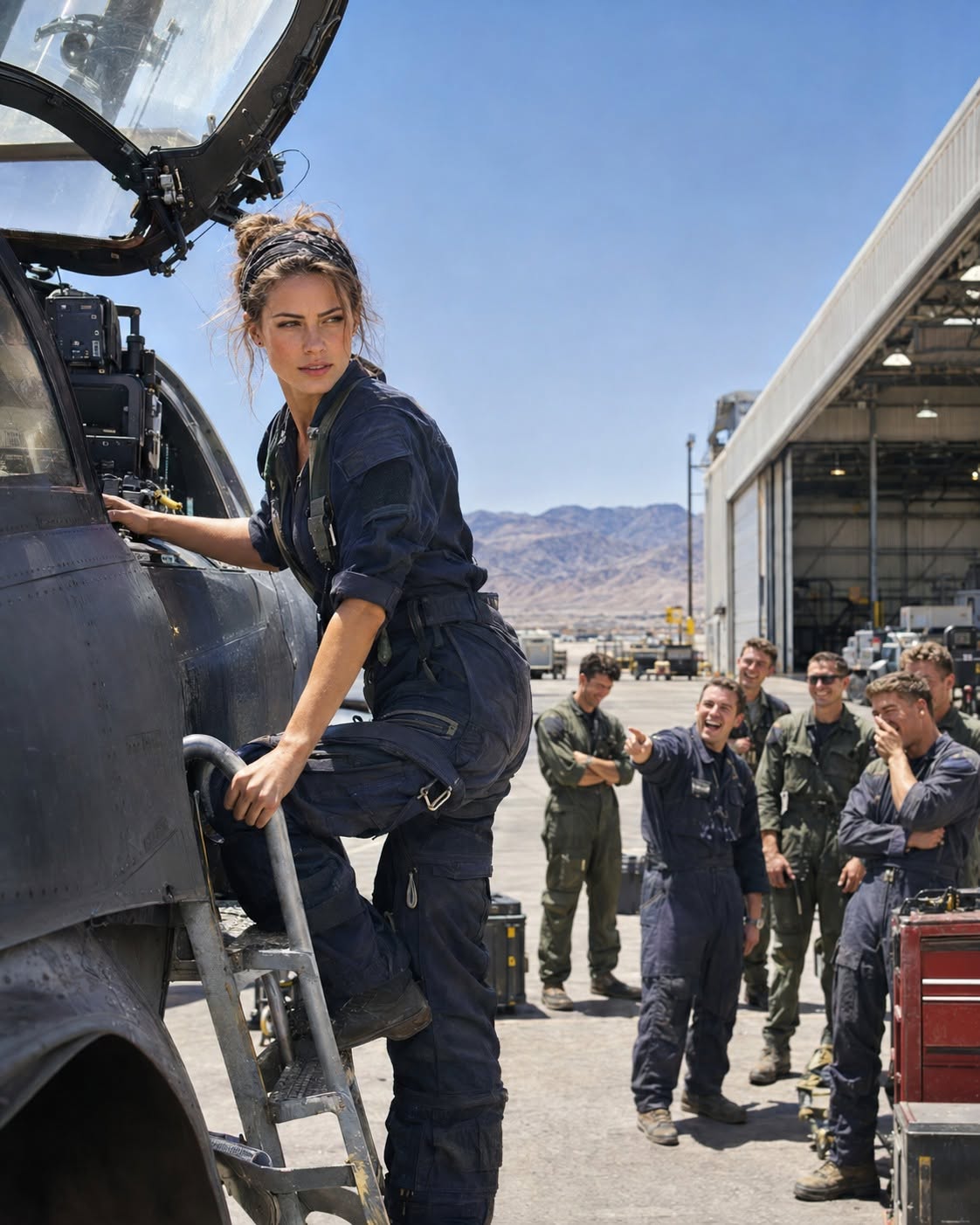
They ordered me to stay away from the $30 million F-15 Eagle because, according to the chief mechanic
THE WOMAN BEHIND THE CALL SIGN
I stared at the F-15 for several seconds before answering Jared.
“I don’t know if I’m ready to go back.”
He nodded, as though he’d expected that answer.
“Then don’t go back for the reasons you think you should. Go back because there’s still something worth doing.”
I looked down at my hands. They were still trembling slightly.
Eight months ago, those same hands had been gripping a fighter’s control stick at nearly the speed of sound. I’d spent years trusting them with my life and the lives of other pilots. Then one mission had changed everything.
“Jared,” I said quietly, “you weren’t there when it happened.”
His expression softened.
“I know.”
“No, you don’t. You know the reports. You know the headlines. You know what people said afterward. But you don’t know what it feels like to hear someone calling for help over the radio and realize there’s nothing you can do.”
For the first time, Jared didn’t have an immediate response.
Before he could speak, a loud voice interrupted us.
“Everyone needs to clear the area!”
A group of federal aviation investigators had arrived. Two of them approached the F-15 while another began questioning the ground crew.
One investigator introduced himself as Daniel Brooks. He wore a dark suit, carried a tablet, and had the kind of expression that suggested he rarely believed the first explanation he heard.
“Who authorized the engine modification?” he asked.
Nobody answered.
His eyes moved toward Caldwell.
“Mr. Caldwell?”
Kevin swallowed.
“I supervised the maintenance.”
“Did you approve the manual bypass installed on the main engine control unit?”
Caldwell looked at the ground.
“Yes.”
“Did you receive any warnings about the potential consequences?”
His eyes briefly met mine.
“Yes.”
The investigator typed something into his tablet.
“From whom?”
Caldwell hesitated.
“Emma.”
“Did you document those warnings?”
“No.”
“Did you have the aircraft independently inspected before today’s demonstration?”
“No.”
Brooks stopped typing.
“Then I suggest you don’t make any more modifications or remove any components until our investigation is complete.”
Caldwell nodded.
I watched him walk away.
For a moment, I almost felt sorry for him. Almost.
But sympathy couldn’t erase the fact that someone could have died because he’d mistaken confidence for competence.
“Major Jenkins,” Brooks said, turning toward me, “I’d like to speak with you privately.”
I followed him toward a small operations office beside the hangar.
He closed the door.
“Your military service record is impressive.”
“Thank you.”
“Your last operational assignment ended under unusual circumstances.”
My stomach tightened.
“That’s one way to describe it.”
He studied me carefully.
“Do you mind telling me what happened?”
I looked through the office window at the aircraft.
The black F-15 reflected the harsh desert sunlight.
“I was leading a four-ship formation during a nighttime training exercise. One of our aircraft suffered a catastrophic electrical failure. The pilot was my closest friend, Captain Daniel Hayes.”
Brooks remained silent.
“We were flying through a storm system when his aircraft began losing control. I stayed with him, trying to guide him toward a safe recovery. We were communicating constantly.”
I paused.
“I heard him say he was ejecting. Then I lost his signal.”
“What happened?”
“He didn’t survive.”
The words felt as heavy as they had the first time I’d spoken them.
“The investigation eventually determined that a maintenance error had contributed to the failure. The technicians involved had ignored several warnings. I had recommended additional inspection procedures before the exercise, but my concerns were dismissed.”
I swallowed.
“Afterward, everyone wanted someone to blame. The investigation cleared me of wrongdoing, but that didn’t make it easier. I kept replaying the final minutes in my head, wondering whether I’d missed something.”
Brooks lowered his tablet.
“Is that why you left?”
“Partly.”
“And the rest?”
I gave a tired smile.
“I couldn’t stand hearing another engine start without wondering whether someone had missed something important.”
He nodded slowly.
“Major, I understand that you may not want to hear this, but your testimony could be critical to this investigation. What you noticed about the bypass could prevent something similar from happening again.”
I looked at him.
“I’ll cooperate.”
“Thank you.”
When I stepped outside, I found Jared waiting.
“How are you holding up?”
“Honestly? Not particularly well.”
He smiled faintly.
“That’s probably the most honest answer I’ve heard all day.”
Then he handed me a business card.
“There’s something I want you to consider.”
I looked at it.
Draken International.
Below the company name was a handwritten phone number.
“We’re expanding our advanced flight operations and safety training program,” he said. “I want you to help lead it.”
I shook my head immediately.
“Jared, I haven’t flown operationally in months.”
“Then we’ll start with what you’re comfortable doing.”
“I’m not sure I want to fly again.”
“Then don’t. I need someone who understands what happens when people stop listening to the people responsible for keeping an aircraft safe.”
I looked at the card.
“You want me to teach pilots?”
“I want you to build a culture where nobody is afraid to say something is wrong.”
His words stayed with me.
Before I could respond, we heard a commotion near the hangar entrance.
Ryan Montgomery was arguing with one of the investigators.
“This is ridiculous! I’ve spent thirty million dollars on that aircraft. You can’t just shut down my entire demonstration!”
Brooks approached him.
“Mr. Montgomery, your aircraft is evidence in an ongoing safety investigation. Its condition must be documented before any further operation.”
“But I have guests here!”
“Then perhaps you should explain to them why your maintenance team ignored repeated warnings.”
Montgomery’s face turned crimson.
He looked toward me.
“Major Jenkins, surely there’s something you can do. You’re the one who saved it.”
I crossed my arms.
“I saved the people standing around it. The aircraft comes second.”
He stared at me.
For the first time, I saw something other than arrogance in his expression.
Fear.
Not fear of losing money.
Fear of understanding how close he’d come to losing something money couldn’t replace.
He lowered his voice.
“Can we talk?”
I nodded.
We walked several feet away from the crowd.
“I owe you an apology,” he said.
I waited.
“I was disrespectful earlier. I assumed you were just another employee who didn’t understand what we were doing.”
“You weren’t the only one.”
He looked uncomfortable.
“I’ve built my business by trusting people who know more than I do. But I suppose I stopped doing that somewhere along the way.”
“Then start again.”
He nodded.
“Will you help us get the aircraft back in the air?”
I considered the question.
“Only after a complete inspection, proper documentation, and approval from the appropriate authorities. And only if the people working on it are qualified and willing to speak up.”
“Agreed.”
“One more thing.”
“Anything.”
“Kevin Caldwell shouldn’t be anywhere near that aircraft until the investigation is finished.”
Montgomery glanced toward the hangar.
“I understand.”
I wasn’t asking for revenge.
I was asking for accountability.
And there was a difference.
The following two weeks were unlike anything I’d experienced in years.
The investigation uncovered more than a single bad modification.
The F-15’s maintenance records revealed that Caldwell had repeatedly bypassed inspection recommendations to meet Montgomery’s demonstration deadline. Several technicians had noticed inconsistencies but remained silent because they feared losing their jobs.
One junior mechanic, a twenty-three-year-old named Lucas Bennett, eventually came forward.
He admitted he’d discovered the manual bypass three days before the demonstration.
“Why didn’t you report it?” I asked him during an interview.
He stared at his boots.
“Mr. Caldwell said I’d be finished in this industry if I went over his head.”
I recognized the expression on his face.
It was the same one I’d seen in the mirror after Daniel died.
“I know you were scared,” I told him. “But silence doesn’t make a dangerous situation disappear. It just means the next person has to discover it the hard way.”
He nodded, his eyes watering.
“I should have said something.”
“Yes. And next time, you will.”
The investigation also uncovered that Captain Reed had raised concerns about the engine startup sequence.
Caldwell had assured him everything was within acceptable limits.
Reed had trusted him.
When I finally met the captain in the operations office, he looked considerably less confident than he had on the first day.
“I owe you an apology,” he said.
I leaned against the desk.
“For what?”
“Everything. The comments. The way I treated you. I thought because I’d been hired to fly the aircraft, I knew more than the people working on it.”
“Did you?”
He shook his head.
“No.”
I studied him for a moment.
“Then remember this. A pilot’s responsibility doesn’t begin when the wheels leave the ground. It begins the moment someone hands him an aircraft and tells him it’s safe.”
He looked down.
“I’ll remember.”
Three days later, Caldwell requested a meeting with me.
I almost refused.
But something told me I should hear him out.
He was sitting alone in the hangar when I arrived. His usual confidence had disappeared. His hands rested on a workbench, and he looked as though he’d aged ten years in two weeks.
“I resigned,” he said.
I didn’t respond.
“The investigation isn’t finished, but Montgomery has suspended me. I figured there wasn’t much point pretending I could continue working here.”
“That’s your decision.”
He looked at me.
“I’ve been thinking about what you said.”
“Which part?”
“That I refused to listen because I didn’t want to admit someone else knew more than I did.”
I folded my arms.
“I remember.”
He took a breath.
“I’ve been in this industry for twenty-six years. I thought experience meant I could make decisions without having to explain myself to anyone.”
“And now?”
“Now I understand that experience without humility can become dangerous.”
For several seconds, neither of us spoke.
Then he said something I hadn’t expected.
“Daniel Hayes.”
My entire body went still.
“What did you say?”
“Your friend. Captain Hayes.”
I stared at him.
“How do you know that name?”
He looked uncomfortable.
“I worked at a military maintenance contractor before joining Ironwood. Years ago, I was part of a team that reviewed an engine component involved in a training incident. I remember seeing the investigation report.”
My throat tightened.
“Did you work on his aircraft?”
“No. But I knew about the maintenance concerns.”
I felt something cold settle in my chest.
“What concerns?”
Caldwell hesitated.
“There was a preliminary report about an electrical connector that had been flagged for replacement. The replacement was delayed because the aircraft was scheduled for an exercise.”
I took a step closer.
“Who made that decision?”
“I don’t know. I never saw the final authorization.”
“Did the report say the connector contributed to the failure?”
“It mentioned it as a possible contributing factor.”
I gripped the edge of the workbench.
For years, I’d believed I had failed Daniel because I hadn’t been able to bring him home.
Now someone was telling me there might have been another explanation.
“Why didn’t you say anything earlier?”
“Because I didn’t remember the details until I heard his name during the investigation. And I didn’t want to make claims I couldn’t prove.”
I stared at him.
“Do you still have the report?”
“No. But the contractor’s records should.”
I turned away.
My heart was pounding.
After all these years, I had a question I’d never thought I’d be able to ask.
What if Daniel hadn’t died because I’d failed him?
What if the failure had begun long before we ever took off?
That night, I barely slept.
I called my former commanding officer, Colonel Margaret Hayes, who had been involved in the original investigation.
She answered on the fourth ring.
“Emma?”
“Colonel, I need your help.”
Her voice immediately changed.
“What’s happened?”
I explained what Caldwell had told me.
There was a long silence.
Then she said, “I’ve been waiting for you to call.”
I sat upright.
“What do you mean?”
“The original investigation was reopened six months ago. New maintenance documentation was submitted by a former contractor employee.”
My hands began shaking.
“Why wasn’t I informed?”
“We attempted to reach you through your last military contact information. You had already left the service and changed your address.”
I closed my eyes.
“What did the new documents show?”
“The electrical connector had been reported as defective twice before the accident. The replacement order was delayed. The final review found evidence that the aircraft had been cleared for flight without the required corrective action.”
I couldn’t speak.
“Emma, the findings haven’t been publicly released. But the evidence strongly suggests the incident was preventable.”
I pressed my hand against my mouth.
For years, I’d carried the weight of a death I believed I should have prevented.
Now I was learning that the responsibility might have belonged to people who had ignored the warnings before we ever entered the cockpit.
“Colonel…”
My voice broke.
“Did Daniel know?”
“I don’t believe he did.”
I looked toward the dark window.
“Then he trusted us.”
“Yes,” she said softly. “And you did everything you could to bring him home.”
I finally started crying.
Not the quiet kind of crying I’d done alone in hotel rooms.
Not the kind I’d hidden behind closed doors.
I cried for Daniel.
For the years I’d spent blaming myself.
For the pilot who had trusted me to lead him.
And for the woman I’d become because she couldn’t forgive herself.
The colonel stayed on the phone until I could breathe normally again.
Before we hung up, she said something I’d remember forever.
“Emma, you were responsible for leading that mission. You were never responsible for controlling every failure in the world.”
I put the phone down.
For the first time in years, the silence didn’t feel like punishment.
It felt like room to breathe.
A month later, the final investigation report was released.
It confirmed that the F-15’s engine fire had been caused by an unauthorized modification that disrupted the ignition sequence and compromised critical safety protections.
Caldwell’s decisions had directly contributed to the emergency.
He was removed from his position and referred for further professional review.
Montgomery publicly apologized for allowing commercial pressure to influence maintenance decisions. He also agreed to fund an independent safety oversight program for his aircraft collection.
But the most important news came from the military investigation.
Daniel Hayes’s accident had been reclassified.
The final report identified the defective electrical connector and the delayed replacement as major contributing factors. It also confirmed that the pilots had followed their procedures and that the incident could not reasonably have been prevented by the formation leader.
I read that paragraph several times.
Then I printed the report and placed it beside Daniel’s photograph.
He was smiling in the picture, wearing his flight suit and holding a helmet under one arm.
I touched the edge of the frame.
“I’m sorry it took so long,” I whispered.
For the first time, I didn’t feel as though I was apologizing for failing him.
I was apologizing for spending so many years punishing myself.
Jared’s offer remained on my desk.
For weeks, I’d looked at the business card without making a decision.
Eventually, I called him.
“I’ll accept.”
He sounded delighted.
“That’s excellent news.”
“On one condition.”
“Name it.”
“I want authority to establish an independent safety and technical review process. No executive, owner, pilot, or mechanic gets to override a legitimate safety concern just because there’s money or a deadline involved.”
There was a pause.
Then Jared laughed.
“Emma, that’s exactly why I called you.”
Three months later, I walked into a brand-new training facility in Florida.
The walls were lined with aircraft photographs, technical diagrams, and framed mission records. A small plaque near the entrance carried the name of the program:
THE HAYES STANDARD — SAFETY THROUGH ACCOUNTABILITY.
I had chosen the name because Daniel deserved to be remembered for more than the way he died.
He deserved to be remembered for the way he lived.
On my first morning, a group of young pilots gathered around a briefing table.
Some were experienced military aviators. Others had recently transitioned into civilian flight operations.
I stood at the front of the room.
“I’m Major Emma Jenkins,” I began. “Most people in this industry know me by another name. Wraith.”
A few exchanged surprised glances.
I continued.
“But before we talk about aircraft performance, tactics, or emergency procedures, I want to establish one rule.”
I placed a maintenance report on the table.
“If you see something wrong, you speak up. If someone dismisses you, you speak louder. And if the person making the decision refuses to listen, you have my permission to stop the operation.”
One young pilot raised his hand.
“Even if the person refusing to listen is the commanding officer?”
I looked directly at him.
“Especially then.”
A few people smiled.
I didn’t.
“An aircraft doesn’t care about your rank. Gravity doesn’t care about your paycheck. And an engine doesn’t care how important the person standing beside it thinks he is.”
The room became quiet.
“Your job isn’t to impress the people watching from the ground. Your job is to make sure everyone who climbs into that aircraft has a reasonable chance of coming home.”
I paused.
“Never confuse confidence with competence. And never confuse silence with loyalty.”
Nobody moved.
Then one of the instructors began to applaud.
The others followed.
I looked down at the report on the table and thought about Daniel.
For the first time, I felt as though I was doing something that might make his loss mean something.
Six months later, I returned to Ironwood Aviation.
The F-15 had undergone a complete inspection and extensive restoration under independent supervision. Every modification had been documented, every component checked, and every safety concern addressed.
The aircraft was ready for its first authorized flight.
Montgomery had invited me to attend.
So had Jared.
Even Lucas Bennett was there, now working as a junior safety inspector under the new oversight program.
Caldwell was absent.
I later learned he’d enrolled in a professional accountability and maintenance safety program. He had also sent a letter apologizing to the technicians he’d intimidated.
I didn’t know whether he’d truly changed.
But I hoped he would.
As I approached the F-15, Montgomery stepped forward.
“Major Jenkins. Thank you for coming.”
I smiled.
“How’s the aircraft?”
“Better than ever. And this time, we’re doing everything properly.”
I examined the maintenance documentation.
Lucas stood beside me, holding a clipboard.
“All inspections completed,” he said. “Independent sign-offs are attached. No outstanding discrepancies.”
I nodded.
“Good work.”
He smiled.
Then Montgomery asked the question I had expected.
“Would you like to fly it?”
I looked at the aircraft.
The familiar black wings.
The twin engines.
The cockpit that had once represented everything I had lost.
For a moment, I heard Daniel’s voice in my memory.
“Don’t let the aircraft beat you, Wraith.”
I smiled faintly.
“Only if the flight is approved and the aircraft is cleared.”
Montgomery laughed.
“Wouldn’t dream of doing it any other way.”
I climbed the ladder.
The cockpit felt familiar, but it no longer felt like a place where I had to prove something.
I secured the harness and adjusted the controls.
Then I reached for the radio.
“Tower, this is Wraith. Requesting clearance for the approved demonstration profile.”
The response came through clearly.
“Copy, Wraith. You are cleared.”
I advanced the throttle.
The engines came alive with a deep, powerful roar.
This time, there were no warning lights.
No unauthorized modifications.
No ignored reports.
Just a carefully inspected aircraft and a team of people who had done their jobs properly.
As the F-15 accelerated down the runway, I felt the familiar pressure against my chest.
Then the wheels left the ground.
The desert stretched beneath me.
I climbed into the clear blue sky, and for the first time in years, I didn’t feel as though I was running away from my past.
I was finally flying beyond it.
When I returned, the crowd applauded.
But I wasn’t looking at the investors, the governor, or the cameras.
I was looking at the young mechanic standing near the hangar doors.
Lucas was smiling.
I gave him a thumbs-up.
He returned it.
And in that small exchange, I saw something far more important than a successful demonstration.
I saw a workplace where the quietest person could finally speak without fear.
That evening, I stood alone beside the aircraft.
The desert sunset painted the F-15’s black surface in shades of gold and orange.
Jared approached with two cups of coffee.
“Regretting your decision yet?”
I laughed.
“Ask me again after the next twelve-hour briefing.”
He handed me a cup.
“You seem different.”
“I feel different.”
“Better?”
I considered that.
“Not necessarily better every minute. Just more at peace.”
He nodded.
I looked toward the horizon.
“For a long time, I thought being strong meant carrying everything by myself. The guilt, the memories, the mistakes, all of it.”
“And now?”
“Now I think strength means knowing when to put something down. And knowing when to speak before someone else gets hurt.”
Jared took a sip of coffee.
“Sounds like a good lesson.”
“It took me a while to learn it.”
We stood quietly for a moment.
Then I looked back at the aircraft.
People had spent years defining me by my rank, my call sign, my awards, and the missions I’d flown.
At Ironwood, they’d tried to define me by my uniform and the grease on my hands.
But none of those things had ever told the whole story.
I was a pilot.
I was a mechanic.
I was a friend who had lost someone.
I was a woman who had made mistakes, survived heartbreak, and learned to forgive herself.
And I was still becoming someone new.
Before leaving, I walked to Daniel’s photograph, which I’d brought with me and placed inside the new training facility.
I straightened the frame.
“Made it home today, Danny,” I whispered.
Then I smiled.
“And this time, I brought everyone with me.”
I turned off the lights and walked toward the exit.
Behind me, the F-15 stood beneath the hangar lights, silent and ready for another day.
I no longer needed to hide who I was.
I didn’t need applause to prove my worth.
And I certainly didn’t need permission from someone who refused to listen.
Because the greatest lesson I’d learned wasn’t about flying faster, climbing higher, or surviving an engine fire.
It was about understanding that every life deserves to be protected, every warning deserves to be heard, and every person deserves the chance to speak—even when their voice is the only one challenging the room.
Sometimes the most dangerous failure isn’t mechanical. It’s the moment someone decides they’re too important to listen.
And sometimes the person everyone underestimates is the very person who reminds them what courage, humility, and responsibility truly look like.