They laughed when Commander Kelly assigned me to fly beside the squadron’s most arrogant Navy pilot
The room remained silent as Commander Kelly opened the classified file.
I stood beside the briefing table, staring at a photograph I had spent years trying not to remember.
It showed three aircraft flying through a pale desert sky.
One of them was mine.
The other two belonged to Captain Michael Reeves and Lieutenant Sarah Mitchell.
They had been my wingmen.
And they were the reason I had never considered the call sign Wraith a compliment.
“Four years ago,” Commander Kelly began, “Major Elena Hayes was assigned to a classified combat search-and-rescue operation over western Syria. Her unit was tasked with protecting a downed reconnaissance aircraft and recovering its two-man crew.”
He turned another page.
“During the operation, an unexpected enemy missile strike damaged her aircraft. Despite severe damage, Hayes remained in the combat zone long enough to coordinate the extraction of the surviving personnel.”
Cobra leaned forward.
“What happened to the other aircraft?”
Kelly paused.
“That’s the part most people don’t know.”
I closed my eyes.
The desert came back.
Not as a photograph.
As a sound.
A warning alarm.
A distorted radio transmission.
And a voice calling my name.
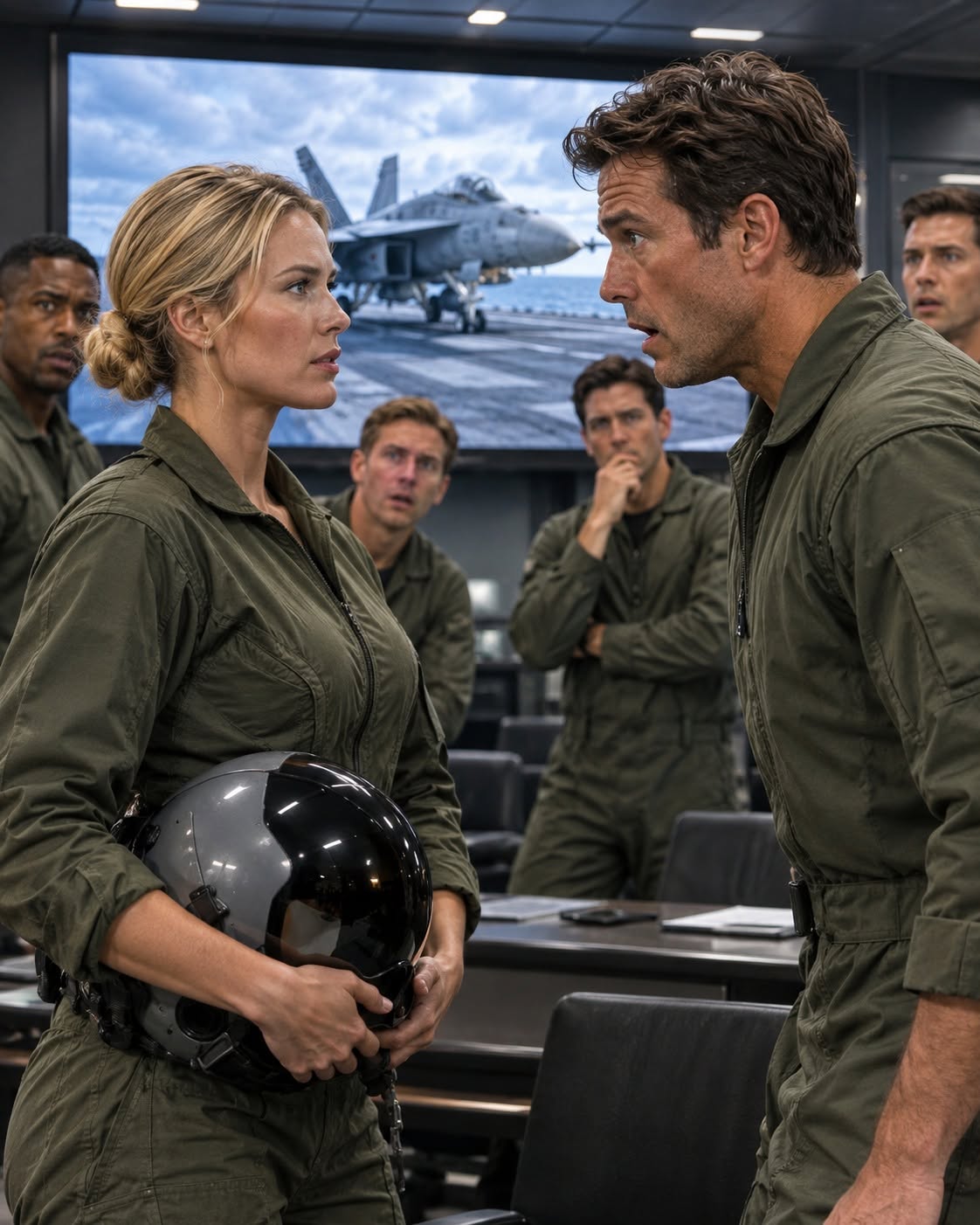
Four years earlier, I had been flying as part of a three-aircraft formation over Syria. Our mission had been straightforward: escort a rescue helicopter into hostile territory, protect the recovery team, and bring everyone home.
Captain Michael Reeves was leading the formation.
He was thirty-two, married, and the kind of pilot who could make an entire room laugh without trying.
Sarah Mitchell was younger, fiercely intelligent, and constantly challenging me to improve.
We were more than colleagues.
We were family.
“Hayes, you still awake back there?” Michael joked over the radio.
“Unfortunately, Captain.”
“Good. I was worried you might fall asleep and miss the spectacular landing I’m about to demonstrate.”
Sarah laughed.
“That’s assuming you actually land on the runway this time.”
I smiled inside my helmet.
It was an ordinary conversation.
The kind of conversation people have when they believe they have plenty of tomorrows.
Then the warning system sounded.
“Missile launch! Break right!”
Everything happened at once.
Michael’s aircraft banked hard.
Sarah descended toward the valley.
I pulled away from the incoming threat, but a second missile exploded close enough to shake my aircraft violently.
The cockpit filled with warning lights.
Hydraulic pressure dropped.
My left engine temperature began climbing.
“Hayes, status!” Michael shouted.
“Taking damage. Controls are responding.”
“Get out of there!”
I checked the tactical display.
The rescue helicopter was still approaching.
Two crew members were waiting for extraction, and enemy ground forces were closing in.
If our formation abandoned the mission, those men would have little chance of surviving.
I made my decision.
“Michael, continue escorting the helicopter. I’ll cover the eastern approach.”
“Negative. Your aircraft is damaged.”
“I can still fly.”
“Elena, that’s an order. Get clear.”
Then Sarah’s voice interrupted.
“Michael, I’ve got multiple launches from the ridge!”
The radio exploded with overlapping warnings.
A missile struck Sarah’s aircraft.
Her jet disappeared behind a cloud of smoke before reappearing at a dangerously low altitude.
“Sarah! Eject!”
No response.
“Sarah, do you hear me?”
A weak voice finally came through.
“I’m losing hydraulics. I can’t hold altitude.”
Michael immediately turned toward her position.
I watched the radar.
Three enemy aircraft were moving toward the rescue helicopter.
There was no time to debate.
“Michael, protect the helicopter. I’ll find Sarah.”
“Hayes, don’t you dare—”
The transmission broke apart.
I pushed my damaged aircraft toward Sarah’s last known position.
The desert stretched beneath me.
My fuel was falling.
My warning system continued screaming.
And somewhere ahead, my wingman was fighting to keep her aircraft in the air.
I found her barely two minutes later.
She was descending toward a rocky valley.
“Sarah, eject now!”
“I can’t. The canopy system isn’t responding.”
I swallowed.
“Then keep your hands on the controls. I’m coming alongside.”
I knew the maneuver was dangerous.
My aircraft was already damaged, and the terrain offered almost no room for error.
But I couldn’t leave her.
I positioned myself near her aircraft, transmitting her coordinates to the rescue helicopter.
Then I saw the enemy fighters turning toward us.
“Elena,” Michael’s voice returned, strained and distorted. “I’ve got trouble. Two aircraft on my tail.”
I looked between Sarah’s position and the approaching threats.
Three people.
One damaged aircraft.
And a rescue helicopter that was running out of time.
I did what I could.
I transmitted the enemy positions, guided the helicopter away from the immediate threat, and kept Sarah’s location visible on our shared tactical picture.
For several minutes, it seemed as though we might actually make it.
Then Michael’s transmission came through.
“Hayes… I’ve been hit.”
His aircraft dropped off the display.
I shouted his name.
Nothing.
A few seconds later, Sarah managed to transmit one final message.
“Elena, get out. Please.”
Her aircraft struck the desert beyond the ridge.
The explosion illuminated the valley.
I didn’t remember breathing.
I didn’t remember speaking.
I only remembered staring at the empty position on my display where Sarah’s aircraft had been.
The rescue helicopter eventually recovered one of the downed crew members.
The other had already died before the rescue team arrived.
Michael was never recovered.
Sarah’s body was found several days later.
I made it back to base with an aircraft that should never have survived the flight.
The official report praised my actions and credited me with protecting the extraction.
But the report couldn’t explain why two people who had trusted me never came home.
It couldn’t explain why I had survived.
And it certainly couldn’t explain the last message Sarah had sent.
Get out.
Please.
For months, I barely spoke.
I stopped attending social gatherings.
I stopped answering calls from people who wanted to tell me how brave I had been.
Eventually, I requested a transfer.
My superiors offered me another assignment, away from the operational spotlight.
I accepted.
The call sign Wraith followed me.
It had originally been given to me because I could disappear from an enemy radar picture and reappear where nobody expected.
After Syria, I began to hate hearing it.
Because a ghost was exactly what I felt like.
Someone who had survived while the people around her had become memories.
Back in the ready room aboard the USS Nimitz, Commander Kelly closed the file.
“That’s the history,” he said quietly.
Nobody moved.
Cobra was staring at the photograph.
He looked at me.
“Those two pilots…”
I nodded.
“Michael Reeves and Sarah Mitchell.”
He lowered his eyes.
“I’m sorry.”
I studied his face.
“Don’t be sorry because you found out what I’ve done. Be sorry if you ever treat another pilot the way you treated me.”
He looked as though I had struck him.
Then he nodded.
“You’re right.”
Commander Kelly placed the file on the table.
“There’s one more reason I requested Hayes for this assignment.”
He turned toward the intelligence officer.
“Tell them.”
The officer stepped forward.
“Four months ago, we received intelligence indicating that a foreign military organization had obtained portions of the Syrian operation’s classified mission data. We believe someone has been attempting to identify the personnel involved.”
My stomach tightened.
“Who?”
“We don’t know yet. But your call sign appeared in an intercepted communication two weeks ago.”
The room became noticeably colder.
Cobra straightened.
“What did the message say?”
The intelligence officer hesitated.
“It referred to Wraith as the pilot who escaped the valley.”
I stared at the screen.
For four years, I had believed the past was something I could leave behind.
Apparently, someone else had been keeping track.
Commander Kelly dismissed the junior personnel and asked me to remain.
Cobra stayed too.
“Sir,” he said, “if this is connected to the previous operation, I want to remain part of the team.”
Kelly looked at him.
“That’s not your decision to make.”
“No, sir. But if Hayes is being targeted because of something that happened four years ago, I don’t intend to let her handle it alone.”
I glanced at him.
For the first time, his words sounded sincere.
Kelly considered the request.
“Very well. But from this point forward, you follow Hayes’s lead without hesitation.”
“Understood, sir.”
The intelligence officer brought up another image.
It was a photograph of a small coastal installation on an island several hundred miles from our position.
“Satellite surveillance has identified unusual activity at this location. We believe it may be connected to the aircraft involved in tonight’s operation.”
I examined the photograph.
There were several buildings, a communications structure, and what appeared to be a temporary aircraft shelter.
“What makes you think it’s connected?” I asked.
“An intercepted transmission originated from this general area. We also detected a signal matching the electronic interference used during the fighter engagement.”
I studied the image longer.
Something about the arrangement bothered me.
“Can you enlarge the western building?”
The officer did.
A rectangular structure appeared near the coastline.
There was a small marking on its roof.
I leaned closer.
It was a symbol I recognized.
A black circle with a narrow white line through its center.
My blood ran cold.
I had seen that marking before.
On the equipment carried by the ground team that had attacked our rescue operation in Syria.
“That’s not just a communications station,” I said.
Commander Kelly looked at me.
“Then what is it?”
I took a breath.
“It’s a relay site. Whoever is operating it has access to the same electronic warfare network used during the Syrian mission.”
The intelligence officer exchanged a glance with Kelly.
“Are you certain?”
“I spent enough time trying to identify those signals four years ago. I would recognize them anywhere.”
Kelly folded his arms.
“Can you identify the operator?”
I shook my head.
“Not from this photograph.”
The next morning, the carrier group changed its operational posture.
Our intelligence team worked through the night, analyzing the intercepted transmissions and comparing them with the electronic signatures recorded during the bomber attack.
I was assigned to coordinate the air operations alongside Cobra.
The change in the squadron was remarkable.
The jokes had stopped.
The younger pilots approached me with questions instead of assumptions.
But one thing remained unfinished.
Cobra.
He found me alone near the aircraft elevators shortly before sunrise.
“Mind if I sit?”
I nodded.
He lowered himself onto the bench beside me.
For a while, neither of us spoke.
Finally, he said, “I used to think confidence meant never admitting you were wrong.”
I looked toward the flight deck.
“Most people learn that lesson eventually.”
“I’ve been flying for eleven years. I’ve received awards, commendations, and more praise than I probably deserved.”
He paused.
“And somehow, I never realized how little I actually knew about the people standing next to me.”
I didn’t respond.
He continued.
“When Kelly assigned you as my wingman, I thought it was an insult. I assumed you’d be a burden.”
“Why?”
He looked uncomfortable.
“Because you weren’t one of us. Because you were an Air Force pilot. And because I didn’t know what else to think.”
I turned toward him.
“That’s a poor excuse.”
“I know.”
He rubbed his hands together.
“My father was a Navy pilot. He taught me that a good aviator never lets anyone question his ability. I spent so much time trying to live up to his reputation that I forgot what being a good aviator actually meant.”
I considered his words.
“Your father wanted you to become a good pilot, not an arrogant one.”
Cobra nodded.
“Probably.”
Then he looked directly at me.
“I can’t change what I said. But I’d like to earn the right to fly beside you.”
I studied him for a moment.
“Then start by being someone your wingman can trust.”
He extended his hand.
I shook it.
Not because everything was forgiven.
But because sometimes the first step toward becoming better is admitting you were wrong.
Three days later, the intelligence team made a breakthrough.
The intercepted transmissions contained a reference to a scheduled data transfer from the island installation.
The timing coincided with a planned reconnaissance flight.
Commander Kelly called an emergency briefing.
“We have reason to believe this site is collecting information about our carrier group. We need to determine what they’re transmitting and whether the activity represents an immediate threat.”
He looked toward me.
“Hayes, you’re leading the reconnaissance escort.”
I nodded.
Cobra would fly as my wingman.
Two additional aircraft would provide support.
The mission was scheduled for early evening.
Before departure, the intelligence officer approached me with a tablet.
“We found something else.”
He showed me a decoded fragment of an intercepted message.
It contained a name.
Michael Reeves.
I stared at it.
“That can’t be right.”
“The message refers to the Syrian operation. It mentions the pilot who disappeared and the aircraft that returned alone.”
I read it again.
Then I noticed another line.
A reference to an individual identified as M. Reeves.
My hands tightened around the tablet.
“Are you telling me Michael survived?”
“We don’t know.”
“Then don’t speculate.”
The officer nodded.
But the possibility had already taken hold.
For four years, I had imagined every possible ending to Michael’s final flight.
Somewhere deep inside, a part of me had always wondered whether he might have survived the crash.
I had never allowed myself to believe it.
Now, suddenly, I had a reason to hope.
The reconnaissance mission launched at 1900 hours.
The sea was calm, but the sky was covered by thick clouds.
I maintained formation with Cobra as we approached the designated area.
“Wraith, I’ve got the relay signal,” he reported.
“Confirmed. Keep your distance.”
Our sensors began detecting unusual activity.
The island appeared below us.
The buildings were almost completely dark.
Only the communications tower remained illuminated.
“Something’s wrong,” I said.
“What do you see?”
“The signal is moving.”
The intelligence officer had told us the relay equipment was stationary.
But the electronic signature was shifting across the island.
I looked at the display.
Then I understood.
“They’re using a mobile transmitter.”
Cobra checked his instruments.
“Where?”
“Near the western shoreline.”
Before he could answer, a warning tone sounded.
Our aircraft had been detected.
“Multiple contacts!” Cobra announced.
The radar picture filled with unexpected returns.
Two enemy fighters were climbing from the eastern side of the island.
A third contact appeared behind them.
“All aircraft, defensive formation. Maintain separation.”
We began turning away.
Then a new transmission interrupted our frequency.
It was a man’s voice.
Weak.
Distorted.
But unmistakably familiar.
“Elena… if you can hear this, don’t attack.”
I stopped breathing.
The voice continued.
“It’s Michael.”
For a moment, the entire world seemed to disappear.
Cobra looked toward my aircraft.
“Wraith?”
I couldn’t answer.
The voice returned.
“Elena, listen carefully. They’re using the relay station to identify the carrier’s electronic signatures. You have to stop them from transmitting the complete data package.”
I stared at the display.
“Michael, is that really you?”
There was a brief pause.
Then he said something only the three of us would have understood.
“Tell Sarah I still owe her dinner.”
My eyes filled with tears.
Michael was alive.
But before I could say another word, the transmission cut out.
The enemy fighters were closing.
Cobra’s voice became urgent.
“Wraith, we need to move!”
I forced myself to concentrate.
“All aircraft, disengage. We’re not engaging without a clear picture.”
One of the enemy fighters changed course and began following us.
I watched its position.
Then another signal appeared.
A distress beacon.
It was coming from the island.
The same frequency used by our rescue personnel four years earlier.
Someone was trying to communicate with us.
“Commander Kelly, this is Wraith. We have a possible friendly survivor at the installation. Requesting permission to investigate.”
Kelly responded immediately.
“Negative. You are not authorized to enter hostile airspace. Return to the carrier.”
I knew he was right.
But I also knew that Michael might be the only person who could explain what had happened in Syria.
“Sir, I believe we have a surviving American pilot.”
There was silence.
Then Kelly answered.
“Understood. Do not compromise your aircraft. We are coordinating with intelligence and special operations.”
I turned toward Cobra.
He was watching me carefully.
“You’re thinking about going back.”
“I’m thinking about bringing someone home.”
He nodded.
“Then let’s do it properly.”
We returned to the carrier.
I spent the next several hours in a secure briefing room with Commander Kelly and the intelligence team.
The information was fragmented, but a disturbing picture was beginning to emerge.
Michael had apparently survived the crash in Syria.
He had been captured by an armed group operating in the region and transferred several times between detention locations.
During his captivity, he had learned that the group was collecting military electronic signatures and selling intelligence to foreign buyers.
The same network had eventually expanded its operations into the Philippine Sea.
The intercepted message containing his name had been part of a coded attempt to contact American forces.
But there was a problem.
The island facility was scheduled to transmit a large intelligence package within hours.
If it succeeded, the enemy could obtain valuable information about the carrier group’s movements and defensive systems.
Commander Kelly looked around the room.
“We have a narrow window. A joint recovery operation is being prepared, but we need to confirm whether Reeves is actually alive.”
I leaned forward.
“Let me speak to him.”
The intelligence officer shook his head.
“We’ve only received one transmission.”
“Then use the same frequency.”
Kelly considered it.
Finally, he nodded.
“Five minutes.”
The communications specialist opened the channel.
Static filled the room.
I leaned toward the microphone.
“Michael, this is Elena Hayes. If you’re alive, I need you to answer.”
Nothing.
I tried again.
“Michael, you once promised to buy me dinner after our first successful deployment. You still owe me.”
Several seconds passed.
Then a voice emerged.
“Only if you’re paying this time.”
I covered my mouth.
A few people in the room smiled.
I couldn’t.
I was crying.
“Michael?”
“Hello, Wraith.”
For the first time in four years, I heard my friend’s voice without distortion or static between us.
“Where are you?”
“Underground. Western side of the facility. I don’t have much time.”
“Are you injured?”
“Nothing a decent hospital can’t fix.”
He paused.
“Elena, listen to me. There’s another reason I contacted you.”
“What?”
“Sarah.”
My heart stopped.
“What about Sarah?”
Michael’s voice became quieter.
“She didn’t die because of your decision.”
I stared at the microphone.
He continued.
“After the crash, I learned that the enemy had already identified our formation before we entered the valley. They knew our route, our timing, and the rescue helicopter’s destination.”
I felt the room growing smaller.
“Someone gave them our mission information?”
“Yes.”
“Who?”
“I don’t know the name. But I found the evidence here. The relay system contains the original transmission records.”
The intelligence officer immediately began typing.
Michael continued.
“Elena, they knew where we were going. They knew what we were carrying. And they knew you would stay behind if one of us went down.”
I closed my eyes.
For four years, I had blamed myself for making the wrong decision.
But now I understood that someone had deliberately placed us in that situation.
“Can you access the records?” Kelly asked.
Michael responded.
“Yes, but the transfer is scheduled to begin soon. If it goes through, they’ll erase the original files.”
The room became tense.
Commander Kelly looked at the clock.
“We need those records.”
I stepped forward.
“Then we bring him home.”
Kelly nodded.
“Special operations has the lead. Your job is to provide air support and maintain the surveillance picture. Nothing beyond that.”
“Understood, sir.”
Within an hour, the recovery operation was underway.
A team of American personnel approached the island under cover of darkness.
Our aircraft remained at a safe distance, monitoring the situation.
Cobra was beside me.
Neither of us spoke much.
We watched the tactical display.
Then Michael’s voice returned.
“Elena, they’re moving.”
I leaned toward the radio.
“Who?”
“The guards. They know someone is coming.”
The signal became unstable.
“Michael, stay where you are. Our team is approaching.”
“I can’t. The server room is on the opposite side of the facility.”
“Forget the server room. Your life matters more.”
He laughed weakly.
“Still giving orders, Hayes?”
“Somebody has to.”
For a moment, I heard something that sounded like a door opening.
Then Michael spoke again.
“Elena, I found the original mission file.”
The intelligence officer immediately asked for confirmation.
“Can you transmit it?”
“Trying.”
The radio filled with static.
Then a series of encrypted data packets appeared on the command display.
The technical team began processing them.
A minute later, the officer looked up.
“We have it.”
Commander Kelly moved closer.
“What’s in there?”
The officer scanned the first document.
His expression changed.
“Sir… this is serious.”
The original mission briefing had been altered before it reached our unit.
The coordinates of the rescue helicopter’s approach had been leaked.
The enemy had known exactly where we would be.
But the most disturbing discovery was the authorization record.
The information had been accessed through an American military intelligence account.
Someone inside our own system had provided it.
A name appeared in the audit trail.
Colonel Richard Voss.
I recognized it immediately.
He had been the senior intelligence officer responsible for coordinating our mission in Syria.
He had personally delivered the briefing.
He had shaken my hand afterward and told me I had done everything I could.
For four years, I had believed him.
“Is this confirmed?” Kelly asked.
The officer nodded.
“The access records are authentic. We have the transmission logs and the corresponding authorization.”
Cobra stared at the screen.
“You’re telling me one of our own people sent those pilots into a trap?”
Kelly’s expression hardened.
“That’s what we’re investigating.”
I looked at Michael’s last known position.
“Can we get him out?”
The communications officer checked the signal.
“His beacon is still active.”
Then the tactical display changed.
The recovery team had reached the western building.
But enemy personnel were moving toward their position.
“Contact!” someone shouted over the radio.
The operation was suddenly in danger.
Kelly issued instructions to the recovery team.
Our aircraft maintained surveillance and relayed the changing situation.
I watched the display with my heart pounding.
Then a familiar voice broke through.
“This is Reeves. I’ve got visual contact with friendly personnel.”
I nearly stood up.
“Michael, stay with them!”
“Working on it.”
Several tense minutes passed.
Then the recovery team confirmed that they had reached the extraction point.
One by one, the personnel were accounted for.
And then the radio operator announced the words I had waited four years to hear.
“All personnel recovered. One American pilot confirmed alive.”
I lowered my head.
My hands were shaking.
Cobra looked toward me.
“He’s coming home.”
I nodded.
“Yeah.”
For the first time since Syria, I allowed myself to believe that the story might have a different ending.
The carrier was unusually quiet when the recovery aircraft returned.
Medical personnel were waiting.
Commander Kelly stood near the hangar entrance.
I was beside him.
The aircraft door opened.
Two recovery specialists stepped out first.
Then a stretcher appeared.
Michael Reeves looked thinner than I remembered.
His hair was almost completely gray at the temples, and his face carried the exhaustion of someone who had spent too many years surviving one day at a time.
But when he saw me, he smiled.
“Hayes.”
I stepped forward.
“You’re late.”
He laughed.
“Traffic was terrible.”
I wanted to say a thousand things.
Instead, I reached for his hand.
He squeezed it.
And for a moment, four years of grief seemed to loosen their grip.
The medical team moved him toward the treatment area.
Before they took him away, he looked at me again.
“Elena?”
“Yes?”
“You didn’t leave us.”
I shook my head.
“I couldn’t save Sarah.”
His expression became serious.
“You tried. And you saved the men in that helicopter. You saved me by refusing to let the enemy decide how our story ended.”
He paused.
“Don’t spend another four years punishing yourself for surviving.”
I couldn’t answer.
He gave my hand one last squeeze.
Then the medical team carried him away.
The investigation that followed lasted several months.
Colonel Voss was arrested after investigators uncovered financial transfers, encrypted communications, and evidence that he had supplied classified operational information to foreign intelligence brokers.
The leak had compromised multiple missions.
The Syrian operation was only one of them.
Michael’s testimony helped establish the full extent of the conspiracy.
The people responsible were eventually prosecuted.
And the original records from Syria were formally corrected.
Sarah Mitchell and Michael Reeves were no longer listed as casualties of an operation whose outcome had been left unexplained.
Their actions were recognized.
Their families received the truth.
For the first time, Sarah’s parents learned that she had remained committed to the mission until her final moments.
I attended the ceremony held in her honor.
Her mother approached me afterward.
She was holding a small photograph of Sarah in her flight suit.
“She always talked about you,” she said.
I swallowed.
“She was my best friend.”
Her mother smiled sadly.
“She told us you were the strongest person she’d ever flown with.”
I looked down.
“I don’t know about that.”
She placed a hand on my shoulder.
“Then perhaps it’s time you started believing her.”
I carried those words with me.
Six months later, I returned to the ready room aboard the Nimitz.
The same scratched metal desk was still there.
The same burnt coffee.
The same smell of aviation fuel and old leather.
But something had changed.
Cobra was standing near the briefing board, talking with two younger pilots.
When he noticed me, he walked over.
“Morning, Wraith.”
“Morning, Cobra.”
He handed me a cup of coffee.
I took one sip and immediately regretted it.
“This is terrible.”
He laughed.
“Welcome to the Navy.”
A younger pilot approached us.
“Ma’am, could I ask you something?”
“Of course.”
He glanced toward Cobra, then back at me.
“I heard you used to fly classified combat missions. Is it true you were involved in the Syrian rescue operation?”
I considered the question.
“Yes.”
He hesitated.
“How do you become that good?”
I looked at the aircraft photographs lining the wall.
For years, I had believed the answer was endurance.
That being a good pilot meant being fearless, making perfect decisions, and never showing weakness.
I knew better now.
“You learn to listen,” I said.
“Listen to what?”
“Your aircraft. Your instruments. Your wingman. And especially the people who disagree with you.”
The young pilot nodded.
I continued.
“Never assume you’re the best person in the room. Never confuse confidence with competence. And never let your pride become more important than the lives depending on you.”
He looked thoughtful.
“Yes, ma’am.”
After he left, Cobra leaned against the table.
“That was good advice.”
“It was free. Don’t expect it again.”
He laughed.
Then his expression became serious.
“I got my evaluation yesterday.”
“Congratulations.”
“I was assigned to lead the next training cycle.”
I smiled.
“Then I hope you remember what happened when you thought you knew everything.”
He nodded.
“I won’t forget.”
A few days later, Commander Kelly called me into his office.
There was a new assignment waiting.
A joint aviation training program designed to bring Navy and Air Force pilots together.
I would be responsible for leading the exchange unit.
I read the document twice.
“Sir, why me?”
Kelly smiled.
“Because you understand something most experienced pilots learn too late.”
“What’s that?”
“Being a leader isn’t about making people afraid to question you. It’s about making them confident enough to speak when something doesn’t look right.”
He paused.
“And because you have earned the trust of people who once doubted you.”
I accepted the assignment.
That evening, I walked alone along the carrier’s flight deck.
The sun was disappearing behind the horizon.
The ocean stretched endlessly in every direction.
I thought about Michael.
I thought about Sarah.
And I thought about the young woman I had been four years earlier, sitting in a damaged cockpit, believing that survival was something she needed to apologize for.
I finally understood what Sarah had been trying to tell me.
Get out.
Please.
She hadn’t been asking me to abandon her.
She had been asking me to live.
My radio crackled.
“Wraith, this is Cobra. You copy?”
I smiled.
“Go ahead.”
“Just wanted to let you know Reeves is doing well. Medical says he’ll be back on his feet soon.”
“Good.”
There was a short pause.
Then Cobra added, “He also says you still owe him dinner.”
I laughed.
“Tell him I’ll buy the first round.”
“Copy that.”
I looked toward the darkening sea.
For years, I had thought my call sign meant I was a ghost.
Someone who disappeared from the sky.
Someone who survived when others didn’t.
But perhaps that was never what Wraith meant.
Perhaps it meant something else.
The ability to remain calm when everything disappeared.
The strength to keep moving when the past refused to let go.
And the courage to return when others needed you.
The next morning, I walked into the ready room and found a new photograph pinned beside the squadron’s mission board.
It showed three pilots standing together in front of an aircraft.
Michael Reeves.
Sarah Mitchell.
And me.
Someone had written a small message beneath it.
“The best wingmen aren’t the ones who never make mistakes. They’re the ones who never leave each other behind.”
I stood there for a long moment.
Then Cobra approached.
“Looks like somebody finally understands what this squadron is supposed to be.”
I nodded.
“Let’s hope they remember.”
He looked at the photograph.
“Do you think Sarah would have liked this?”
I smiled.
“She would’ve complained about the lighting.”
Cobra laughed.
For the first time in years, so did I.
Later that day, twelve aircraft lined up for another training mission.
I climbed into my cockpit and completed the preflight checks.
Fuel.
Hydraulics.
Avionics.
Communications.
Everything was ready.
The familiar voice returned over the radio.
“Wraith flight, ready for launch.”
I looked across the flight deck.
Cobra was waiting in his aircraft.
The younger pilots were positioned behind us.
No one questioned why an Air Force officer was leading a Navy formation.
No one cared about the uniform.
They cared about the person beside them.
I keyed the microphone.
“Wraith copies. Let’s bring everyone home.”
The catapult fired.
The carrier dropped away beneath us.
And as the morning sun broke across the Philippine Sea, I realized something I had spent years trying to understand.
A person’s worth is not measured by how loudly they announce themselves, how many awards they wear, or how many people they can intimidate.
It is measured by what they do when the people around them are depending on them.
Cobra had once called me a liability because I didn’t look or sound like the pilot he expected.
But when the sky turned hostile, his assumptions couldn’t save him.
Trust did.
Training did.
And the willingness to follow someone who knew more than he did made the difference between coming home and becoming another name on a memorial wall.
I still carried the memories of Syria.
I always would.
But they no longer controlled every decision I made.
Michael had come home.
Sarah’s story had finally been told.
And I had stopped confusing survival with guilt.
My call sign was still Wraith.
But I wasn’t a ghost anymore.
I was a pilot, a leader, and a friend.
And somewhere above the endless blue ocean, flying beside a man who had finally learned the meaning of respect, I understood that the greatest victory of my life had never been defeating an enemy.
It had been finding the courage to live beyond the day I thought I had lost everything.
Because the strongest people aren’t those who never fall apart. They’re the ones who find a reason to rise again—and make sure nobody beside them has to face the darkness alone.