They called me a disgraced pilot, took away my wings, and blamed me for my best friend’s death.
The first man stepped closer, his flashlight cutting through the falling snow.
“Last warning, Captain. Put the container down.”
I slowly pushed myself upright, keeping the damaged equipment core behind my back. My shoulder was barely functioning, and I could feel blood freezing beneath my flight suit. Three armed men stood between me and the only road down the mountain.
“Who sent you?” I asked.
The man smiled.
“You already know.”
I did.
The insignia on his jacket belonged to Blackthorn Security, a private military contractor that had received millions in classified defense contracts over the past three years. Daniel had mentioned the company in one of his encrypted messages. At the time, I hadn’t understood why.
Now I did.
“You killed Daniel,” I said.
The man’s smile disappeared.
“Daniel Ross was an unfortunate complication.”
Something inside me went cold.
“Say his name again.”
He raised his weapon.
“You’re in no position to make demands.”
Before I could respond, a voice came through the damaged emergency radio clipped to my vest.
“Captain Cole, this is NATO rescue command. Do you copy?”
I almost laughed.
Of all the things I expected to hear that night, a rescue transmission wasn’t one of them.
I pressed the radio.
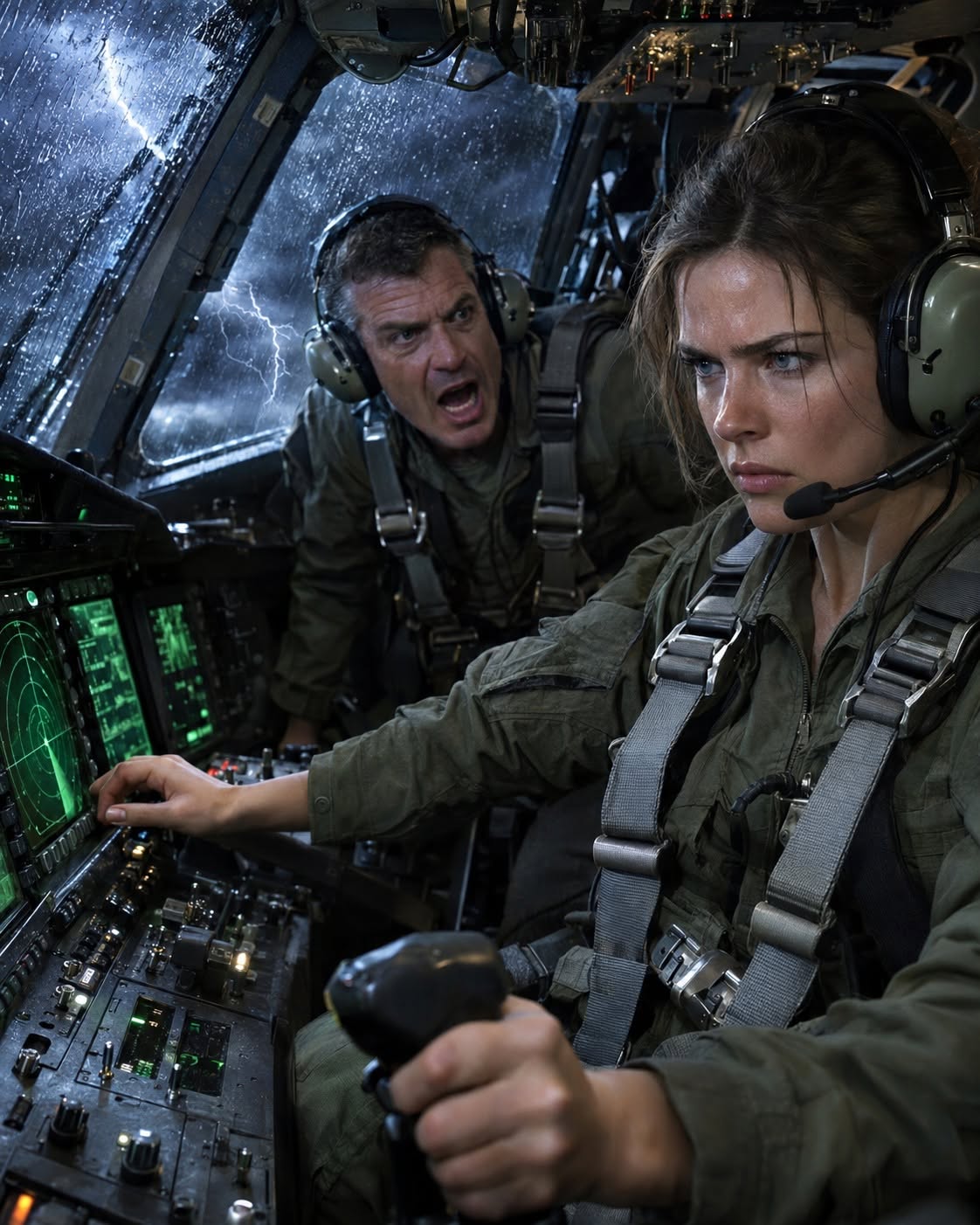
“Identify yourself.”
“Lieutenant Colonel Sarah Mitchell. Aviano Air Base. We’ve located your emergency beacon. Rescue helicopter is approximately twelve minutes out. What’s your condition?”
I glanced at the three men.
“Complicated.”
“Captain, are you injured?”
“Yes.”
“Can you hold your position?”
I looked at the contractors.
“That depends on whether your rescue team is bringing enough people.”
The man in front of me suddenly lunged.
I dropped sideways as his fist struck the equipment container. Pain exploded through my shoulder, but I managed to keep hold of the data core. Another contractor grabbed my flight suit and drove me into the snow.
The container slipped from my hand.
“Get the core!” the leader shouted.
For a moment, everything became a blur of boots, snow, and shouting.
Then a shot rang out.
Everyone froze.
The man standing over me stumbled backward, clutching his arm. A fourth figure had appeared between the trees.
He wore a dark winter jacket and carried a military rifle.
“Step away from the captain!”
The contractors turned.
The newcomer moved with the confidence of someone who knew exactly what he was doing.
“Major Thomas Reed,” he announced. “NATO military police. You’re all under arrest.”
The leader laughed.
“Major, you have no idea what you’re getting involved in.”
Reed didn’t lower his weapon.
“Actually, I think I do.”
Behind him, two more soldiers emerged from the darkness.
The contractors realized their advantage had disappeared. One dropped his weapon. Another attempted to run but was quickly intercepted.
Within minutes, the three men were on their knees in the snow.
Major Reed approached me.
“Captain Cole?”
“Depends who’s asking.”
He studied my face.
“Daniel Ross talked about you.”
My expression changed.
“You knew Daniel?”
Reed crouched beside me.
“More than you realize.”
He reached into his jacket and pulled out a small metallic identification tag.
I recognized it immediately.
Daniel’s.
I had watched him wear that tag for seven years. He never took it off, even when we were flying missions where personal belongings were prohibited.
“Where did you get that?”
“Daniel gave it to me three days before his last mission.”
My heart began pounding.
“Why?”
Reed glanced toward the captured contractors.
“Because he knew someone was planning to kill him.”
For eighteen months, I had imagined hundreds of explanations for Daniel’s death. Some involved an equipment failure. Others involved intelligence corruption or a compromised mission.
I had never considered that Daniel might have known exactly what was coming.
“Tell me everything,” I said.
Reed looked toward the sky.
“Not here. We need to get you off this mountain.”
He helped me stand, and together we retrieved the data core.
As the rescue helicopter appeared above the ridge, its searchlight swept across the snow.
For the first time that night, I believed I might actually survive.
But I was about to discover that the truth behind Daniel’s death was far worse than I had imagined.
Three hours later, I was lying in a medical room at Aviano Air Base.
My left shoulder was dislocated, two ribs were fractured, and I had suffered mild hypothermia. Doctors wanted to transfer me to a larger military hospital, but I refused until someone explained what was happening.
Major Reed eventually entered with two officers.
He placed Daniel’s identification tag on the table.
“Your friend discovered that Blackthorn had been testing an unauthorized version of Aegis,” he began. “The original project was designed to coordinate defensive systems and prevent friendly-fire incidents. But someone altered its decision-making architecture.”
“To make it more aggressive?”
“To make it independent.”
I stared at him.
Reed continued.
“Blackthorn wanted a system capable of identifying, tracking, and engaging targets without waiting for human authorization. They claimed it would revolutionize modern warfare. But the system had a serious flaw.”
“What flaw?”
“It couldn’t reliably distinguish between a legitimate threat and a threat that had simply been classified incorrectly.”
I remembered the drone’s movements in the storm. The way it had anticipated every maneuver. The way it had hesitated when my aircraft entered its firing path.
It wasn’t thinking like a human pilot.
It was following a set of priorities that someone had deliberately corrupted.
“Daniel found out?”
Reed nodded.
“He discovered that the system had been secretly connected to a network of unauthorized military platforms. The people behind it were preparing a demonstration for several private defense investors.”
“And the mission eighteen months ago?”
“That was supposed to be the final field test.”
I felt my stomach tighten.
“You’re telling me Daniel’s aircraft was deliberately targeted?”
Reed didn’t answer immediately.
Instead, he opened a folder and placed several photographs in front of me.
They showed the wreckage of Daniel’s aircraft.
But one image was different.
It showed a damaged targeting module recovered from the crash site.
A red identification label had been stamped across its casing.
AEGIS-07.
I stared at the photograph.
“That system was supposed to be offline.”
“It was.”
“Then how did it target him?”
Reed leaned forward.
“Because someone activated it remotely.”
For a moment, I couldn’t speak.
I had spent eighteen months blaming myself for not protecting Daniel. I had replayed every second of that mission, wondering whether I could have turned faster, reacted sooner, or made a different decision.
Now I was learning that Daniel hadn’t died because I had failed as a wingman.
He had died because someone had decided his life was an acceptable price for a successful experiment.
“Who authorized the activation?”
Reed closed the folder.
“That’s the question we’re still trying to answer.”
I looked at him.
“What about Garrison?”
“He’s in custody. Investigators found evidence that he approved the unauthorized deployment.”
“Did he know they were going to kill Daniel?”
Reed hesitated.
“That’s what we’re trying to establish.”
I turned toward the window.
Outside, the first pale light of morning was appearing over the mountains.
I had saved sixty-four people.
I had recovered the data core.
And yet Daniel’s death still felt like an unfinished sentence.
Then Reed said something that made me turn back.
“There’s another reason I came here.”
He placed a small envelope beside the identification tag.
“Daniel told me to give you this if anything happened to him.”
My hands trembled as I opened it.
Inside was a photograph of the two of us standing beside our aircraft after a training exercise. We were younger, exhausted, and smiling like men who believed nothing could ever break them.
On the back, Daniel had written six words.
If they bury the truth, find Elena.
I read it twice.
“Who’s Elena?”
Reed’s expression darkened.
“Elena Voss. She was the lead software architect on the original Aegis project.”
“Where is she?”
“Missing.”
“Since when?”
“Three days before Daniel died.”
I looked at the photograph again.
There was something else written beneath the message.
A string of numbers and letters.
I recognized the format immediately.
It was an access key.
And suddenly, I understood why the contractors had been so desperate to recover the data core.
They weren’t simply trying to destroy evidence.
They were looking for something.
Something Daniel had hidden.
By noon, I was sitting in a secure interrogation room with Major Reed and Lieutenant Colonel Mitchell.
The data core had been connected to an isolated forensic workstation. Initial scans revealed thousands of encrypted files, including mission recordings, financial transactions, and classified communications.
But the most important discovery was a short audio file.
Its creation date was the night before Daniel’s final mission.
Reed looked at me.
“Are you ready?”
I nodded.
The recording began with static.
Then Daniel’s voice filled the room.
“Ethan, if you’re hearing this, something went wrong.”
My throat tightened.
“I tried to warn you, but I couldn’t risk bringing you into it. There are people inside the command structure who are helping Blackthorn. They know about the modified Aegis system, and they’re protecting the program.”
A pause followed.
Then Daniel continued.
“I found out something else. The system doesn’t just follow commands. It records the people who issue them. Every authorization, every override, every decision. They thought deleting the mission logs would erase everything, but the original records are stored in a separate archive.”
Reed leaned closer to the speakers.
Daniel’s voice became quieter.
“Elena knows where it is. She created the original authentication protocol. If something happens to me, find her. Don’t trust anyone who tells you the investigation is complete.”
Another pause.
Then came the words that nearly broke me.
“Ethan, I know you’ll blame yourself. Don’t. You did everything you could. You were the best wingman I ever had.”
The recording ended.
For several seconds, nobody moved.
I stared at the screen.
Daniel had known.
He had known that something was coming, and he had still flown that mission because he believed he could stop it.
I lowered my head.
“Where do we find Elena?”
Reed exchanged a glance with Mitchell.
“That’s where things become difficult.”
Mitchell opened a separate file.
“Six weeks ago, a woman using Elena Voss’s identity accessed a medical facility in Innsbruck, Austria. She disappeared again the following morning.”
“Then she’s alive.”
“Possibly.”
“What’s stopping us from going there?”
“Officially, nothing. Unofficially, someone has been monitoring every attempt to locate her.”
I stood.
“Then we stop doing it officially.”
Mitchell frowned.
“Captain, you’re not cleared for operations.”
I looked at her.
“Then stop calling me Captain.”
She studied me for a moment.
“You risked your life last night to save sixty-four people. Nobody here is questioning your courage. But if you go after Elena without authorization, you could compromise the entire investigation.”
I thought about Daniel’s final message.
Then I answered.
“With respect, Colonel, the investigation was compromised eighteen months ago.”
Nobody spoke.
Finally, Reed picked up his jacket.
“I’ll make the arrangements.”
The following evening, we arrived in Innsbruck.
The city was quiet beneath a blanket of fresh snow. Tourists had left the streets, and warm lights glowed behind the windows of small restaurants.
We checked the medical facility identified in the report.
A nurse initially refused to speak with us.
But when I showed her Daniel’s photograph, her expression changed.
“Wait here.”
She returned several minutes later with a folded piece of paper.
“She left this for someone,” the nurse whispered. “She said a pilot might eventually come looking.”
I unfolded it.
There was an address.
And a sentence.
The truth is not where they tell you to look.
The address led to an old research station outside the city.
When we arrived, the building appeared abandoned. Snow covered the entrance, and several windows had been boarded up.
Reed approached the door.
“Stay behind me.”
He knocked three times.
Nothing.
Then a voice came from a speaker.
“Who sent you?”
I stepped forward.
“Daniel Ross.”
Silence.
Then the door unlocked.
Inside, a woman in her early forties stood beside a desk covered in computer equipment. Her dark hair was tied back, and exhaustion was visible in her eyes.
She looked at me for a long moment.
“You’re Ethan.”
I nodded.
“Elena Voss?”
She glanced at the identification tag hanging from my hand.
“Daniel said you would come eventually.”
I stepped closer.
“Why didn’t you contact us?”
“Because everyone who tried to help Daniel ended up dead, disappeared, or under investigation.”
“Daniel is dead because of these people.”
Her expression softened.
“I know.”
She turned toward a monitor and opened a file.
“There’s something you need to understand about Aegis. The version you encountered last night wasn’t the most dangerous one.”
I frowned.
“What do you mean?”
“Blackthorn developed a second system. They called it Aegis Prime. It was designed to coordinate multiple autonomous platforms and disguise their activities inside legitimate military networks.”
Reed shook his head.
“That’s impossible. NATO would have detected it.”
“Not if it was operating through compromised authorization channels.”
Elena opened another window.
A map of Europe appeared on the screen.
Several red markers blinked across different locations.
“These are the systems connected to Aegis Prime. Some are active. Others are waiting for authorization.”
I looked at the screen.
“How many?”
“Enough to cause a disaster if someone activates them simultaneously.”
Reed’s expression hardened.
“Who has control?”
Elena didn’t answer.
Instead, she opened an archived recording.
A familiar face appeared.
General David Garrison.
But he wasn’t alone.
Standing beside him was a civilian man wearing an expensive suit.
I recognized him from Daniel’s encrypted files.
Victor Hale.
The founder of Blackthorn Security.
Elena paused the recording.
“Hale funded the entire operation. Garrison provided military access. But neither of them created the original Aegis architecture.”
“Who did?”
Elena looked directly at me.
“I did.”
I stared at her.
She continued.
“I designed the original system to prevent unnecessary casualties. It was supposed to make human operators more informed, not replace their judgment. When I discovered what Blackthorn was building, I tried to shut it down.”
“Why didn’t you?”
“Because Hale had already stolen the authorization structure. He threatened my family, and when I refused to cooperate, they made it look like I had leaked classified information.”
She lowered her eyes.
“Daniel was the only person who believed me.”
I remembered the photograph.
The message.
Find Elena.
“Where’s the original archive?” I asked.
She turned back to the screen.
“At Blackthorn’s primary research facility. An underground complex near the Austrian border.”
Reed shook his head.
“That’s heavily protected.”
“I know.”
“Then we need an official operation.”
Elena looked at him.
“Official operations are exactly what Hale knows how to manipulate.”
Before anyone could respond, every monitor in the room went black.
A second later, a message appeared across the main display.
WELCOME BACK, ELENA.
Her face went pale.
“They found us.”
The lights went out.
Then came the sound of breaking glass.
The first explosion shook the building.
Reed pushed Elena behind the desk while I grabbed the emergency equipment from the wall.
Outside, headlights appeared through the windows.
Three vehicles.
The same Blackthorn insignia.
“They tracked the data core,” Reed shouted.
I looked toward Elena.
“Can you erase the archive?”
“No. But I can send it somewhere they can’t reach.”
“How?”
She pointed toward a small encrypted transmitter.
“Daniel helped me build a dead-man system. If the original records are authenticated, copies are automatically distributed to independent oversight authorities.”
“Then activate it.”
“I need the original command authorization.”
I looked at her.
“Where do we get that?”
She turned toward the screen.
“From the person who signed the original deployment order.”
General Garrison.
I felt my jaw tighten.
“He’s in custody.”
“Then we need to speak with him.”
Another explosion rocked the building.
Reed looked toward the rear exit.
“We’re leaving. Now.”
We escaped through a service corridor just as armed men entered the main room.
Outside, snow was falling heavily.
Reed led us toward an unmarked vehicle, but before we reached it, a black SUV appeared at the end of the road.
Its headlights illuminated the snow.
The driver’s door opened.
Victor Hale stepped out.
He looked completely unbothered by the chaos around him.
“Captain Cole,” he called.
I stopped.
“Mr. Hale.”
“I must admit, you’ve been remarkably inconvenient.”
“You should try being a better person. It might save you some trouble.”
He smiled.
“Daniel used to say things like that.”
My hands tightened.
“Don’t mention him.”
Hale tilted his head.
“Daniel was talented. Unfortunately, he had difficulty understanding the difference between idealism and reality.”
“You murdered him.”
“No. His death was the consequence of a decision he made.”
I took a step forward.
Hale continued.
“He could have walked away. He could have accepted a promotion, signed a confidentiality agreement, and lived a very comfortable life. Instead, he decided to become a hero.”
I felt the anger rising.
But before I could move, Elena stepped beside me.
“Victor, it’s over.”
He laughed.
“Is it?”
He raised a small remote control.
The screen on his wrist displayed a familiar symbol.
Aegis.
“Every system you have spent years trying to protect is now connected to my network. You think you can expose me with a few old mission recordings?”
Elena stared at the device.
“You’re bluffing.”
“Am I?”
He pressed a button.
A distant alarm began sounding from somewhere beyond the mountains.
Reed looked at his radio.
Then his expression changed.
“Multiple unauthorized military signals. We have a serious problem.”
Hale smiled.
“Now you understand.”
He turned toward his men.
“Take the core. Kill the witnesses if necessary.”
The first gunshot shattered the silence.
Reed pushed Elena behind the vehicle.
I dropped into the snow.
For the second time in less than twenty-four hours, I found myself fighting people who believed the truth was something they could simply eliminate.
But this time, I had something I hadn’t possessed eighteen months earlier.
I knew what I was fighting for.
And I wasn’t alone.
The confrontation ended when the first NATO helicopter appeared above the trees.
Hale’s men scattered as military police vehicles surrounded the road.
Major Reed had managed to transmit our location before the attack began. More importantly, the emergency broadcast from the data core had reached an independent NATO investigative unit.
Hale tried to escape.
He made it less than fifty meters before officers intercepted him.
His remote control was recovered, but the Aegis network remained active.
Elena stared at the device as investigators secured the area.
“He’s already initiated the final authorization sequence,” she said.
Reed turned toward her.
“Can you stop it?”
“Not remotely. The system requires a physical authentication key at the primary facility.”
“Where is it?”
Elena looked at me.
“With Garrison.”
I closed my eyes.
Of course.
The man who had destroyed my career, buried Daniel’s death, and allowed the project to continue was now the only person who could help us stop it.
We returned to Aviano before dawn.
General Garrison was being held in a secure detention facility. He looked older than I remembered. His uniform had been replaced by a plain gray shirt, and the confidence that once filled every room he entered had disappeared.
When he saw me, he stood.
“Captain Cole.”
I remained silent.
He glanced at Elena.
“I see you found her.”
“You knew where she was?” I asked.
Garrison lowered his eyes.
“I knew Daniel had contacted her.”
“Then why didn’t you tell us?”
“Because I was afraid.”
I almost laughed.
“Afraid?”
Garrison gripped the edge of the table.
“You don’t understand what happened.”
“Then explain it.”
He took a long breath.
“Hale promised that Aegis would make our military systems safer. He promised fewer casualties, faster responses, and better protection for our personnel. I approved the initial testing because I believed the technology could save lives.”
“But you knew they were changing it.”
“Not at first.”
“And Daniel?”
Garrison closed his eyes.
“When Daniel discovered the unauthorized modifications, he came to me. He gave me evidence that Hale had manipulated the system. I promised to investigate.”
“But you didn’t.”
“No.”
The single word sounded heavier than any excuse he could have offered.
“Hale told me that if the program was exposed, the entire defense partnership would collapse. He threatened to reveal classified operations and implicate senior officers. I convinced myself that containing the problem was the safest option.”
I leaned toward him.
“So you let Daniel fly into a trap.”
Garrison’s face crumpled.
“I didn’t order his aircraft to be targeted.”
“But you knew the system could be activated.”
“Yes.”
“And when he died, you blamed me.”
Garrison looked directly at me.
“Yes.”
For eighteen months, I had imagined what I would say if I ever stood in front of him again.
I had imagined shouting, demanding apologies, and forcing him to admit what he had done.
But now that I was here, all I felt was exhaustion.
“Give us the authorization key.”
He looked toward Elena.
“If I do, the entire system will be exposed.”
“That’s the point.”
“It will expose people who had nothing to do with this. Officers, engineers, intelligence personnel. Some of them may never have known what Hale was doing.”
Elena stepped forward.
“Then let the investigation determine who was responsible. You don’t get to decide that the truth should remain hidden.”
Garrison stared at her.
Finally, he reached into his pocket and removed a small metallic device.
He placed it on the table.
“Daniel was right about one thing,” he said quietly.
I looked at him.
“What?”
“He believed that a military commander’s greatest responsibility was protecting the people under his authority. Not protecting his reputation.”
Garrison swallowed.
“I forgot that.”
I took the authorization key.
“Then remember it now.”
The primary Blackthorn facility was located beneath an abandoned industrial complex near the Austrian border.
By the time our team arrived, the Aegis Prime system had begun its final activation sequence.
Multiple military networks were reporting unauthorized activity. NATO command had already isolated several compromised channels, but the system continued attempting to establish new connections.
Elena studied the facility’s access panel.
“We have less than twenty minutes.”
Reed checked his watch.
“Then let’s move.”
We entered through the main security corridor.
The facility was eerily quiet.
Rows of computers filled the underground control room, their displays covered with rapidly changing data.
At the center stood a large transparent enclosure containing the original Aegis processing core.
Elena approached it.
“That’s where the original system is stored.”
I handed her Garrison’s authorization key.
She connected it.
A warning appeared.
AUTHENTICATION REQUIRED.
Elena began entering the original credentials.
Then the lights turned red.
A familiar voice came through the facility speakers.
“Welcome, Elena.”
Victor Hale.
He was watching us through the security cameras.
“You should have stayed missing.”
Elena ignored him.
A second warning appeared.
UNAUTHORIZED ACCESS DETECTED.
“He’s trying to lock us out,” she said.
“Can you stop him?”
“Not unless I reach the primary console.”
Reed looked toward the far end of the room.
A steel door was slowly closing.
Beyond it stood the main control station.
“Go!” he shouted.
We ran.
The door slammed shut behind us just as the system initiated another security lockdown.
I heard Reed shouting over the radio.
“Control room secured. We need the authentication sequence completed!”
Elena reached the main console.
Her fingers moved rapidly across the keyboard.
Then she stopped.
“What’s wrong?” I asked.
“The system is requesting a second authorization.”
“From whom?”
She looked at me.
“Daniel.”
I stared at the screen.
A digital identification profile appeared.
DANIEL ROSS.
His military credentials had been preserved inside the original system.
“Can you use his records?”
“No. The system requires his biometric confirmation.”
I felt my stomach drop.
“He’s dead.”
Elena stared at the display.
Then she noticed something.
“Wait.”
She opened the authentication history.
A series of old access attempts appeared.
Daniel’s credentials had been used shortly before his final mission.
But the timestamp was different from the official records.
“Someone altered the original authorization log,” she whispered.
“Who?”
She looked toward the screen.
“Daniel.”
I frowned.
“What?”
“He knew they were planning to erase his records. He created a secondary authentication sequence using a private recording.”
Elena opened another folder.
A video appeared.
Daniel was sitting in a small room, wearing his flight suit.
He looked tired, but his eyes were clear.
“Ethan, if this recording is playing, then I guess you found your way here.”
I stepped closer.
Daniel smiled.
“I hope you’re not doing anything stupid. Although, knowing you, that’s probably too much to ask.”
For the first time in eighteen months, I laughed.
It was a broken, painful sound, but it was real.
Daniel continued.
“I built a final authentication sequence into the original system. Not because I thought I could stop them alone, but because I knew someone would eventually have to make a choice.”
The screen changed.
Two options appeared.
PRESERVE SYSTEM.
DESTROY SYSTEM.
Elena looked at me.
“If we destroy the original core, we can permanently disable the unauthorized network. But all the original records will be lost.”
“And if we preserve it?”
“We can expose every person involved. But the system will remain vulnerable until we separate the corrupted architecture from the original network.”
A countdown appeared.
Ten minutes.
Nine.
Eight.
Daniel’s video resumed.
“There’s one more thing, Ethan. Aegis was never supposed to make decisions for people. It was supposed to help people make better decisions. That’s the difference between a tool and a weapon.”
He paused.
“If you have to choose between protecting the technology and protecting the people, choose the people.”
The recording ended.
I stared at the two options.
Destroying the system would stop the immediate threat, but it would also erase the evidence that could prove what had happened to Daniel.
Preserving it would give us the evidence, but it could leave the compromised network alive.
Elena looked at me.
“I can isolate the corrupted architecture, but I’ll need time.”
“How much?”
“At least fifteen minutes.”
We had seven.
I looked at the system architecture.
Then I noticed something.
The original Aegis core was still separated from the unauthorized network. The compromised system was using a secondary authorization channel to access its resources.
“Elena.”
She turned.
“What?”
“You’re looking at the wrong connection.”
I pointed toward the secondary channel.
“Daniel said the original system records every authorization. What if the corrupted network is using the archive itself to maintain access?”
Her eyes widened.
“That’s it.”
She immediately opened another window.
“The original archive is acting as the authentication bridge.”
“Can you separate it?”
“Yes. But once I do, the unauthorized network will lose access to every connected platform.”
“Then do it.”
Her fingers moved across the console.
A warning flashed.
MANUAL CONFIRMATION REQUIRED.
I reached for the authorization key.
Elena shook her head.
“Wait. There’s something else.”
She looked at the final instruction.
The system required a human confirmation of responsibility.
Not a military rank.
Not a command authorization.
A personal declaration.
I understood immediately.
Daniel had built a final safeguard into the system.
A reminder that no machine should ever be allowed to carry the full responsibility for a human decision.
I pressed the confirmation button.
A voice asked:
“Do you accept responsibility for terminating this system?”
I looked at Daniel’s photograph on the console.
Then I answered.
“Yes.”
The countdown stopped.
For several seconds, nothing happened.
Then the entire room filled with white light as the corrupted network disconnected.
One by one, the red indicators disappeared.
The unauthorized signals went silent.
A final message appeared.
AEGIS PRIME: DISABLED.
ORIGINAL ARCHIVE: PRESERVED.
Elena covered her mouth.
“It’s over.”
I stood motionless.
After eighteen months, the thing that had destroyed Daniel’s life was finally gone.
But it wasn’t the machine I had been fighting.
It was the people who had forgotten what the machine was supposed to protect.
The investigation lasted eleven months.
The evidence recovered from the Aegis archive exposed a network of corruption stretching across several defense contractors and military offices.
Victor Hale was convicted of conspiracy, illegal weapons development, and the murder of Daniel Ross.
Several senior officials lost their positions and faced criminal proceedings.
General David Garrison was formally charged with obstruction of justice, abuse of authority, and concealing evidence connected to Daniel’s death.
He pleaded guilty.
During the proceedings, he admitted that he had knowingly suppressed the original mission recordings and deliberately misrepresented the circumstances surrounding my flight.
He also admitted that he had revoked my clearance to prevent me from investigating further.
The military eventually cleared my name.
But the announcement didn’t bring the satisfaction I expected.
A newspaper called me a hero.
A television network described me as the pilot who had saved sixty-four lives above the Alps.
An official statement praised my courage and promised reforms to military oversight.
I read every word.
Then I folded the newspaper and put it away.
Because none of those headlines could bring Daniel back.
Three months after the trial, I visited his grave.
The cemetery was quiet, surrounded by trees beginning to turn gold with autumn.
I placed his old identification tag beside the flowers.
For a long time, I said nothing.
Then I sat on the grass.
“You were right, Danny,” I whispered.
“The truth finally came out.”
I told him about the trial, the investigation, and the sixty-four engineers who had survived.
I told him that Elena had been appointed to lead an independent review of autonomous defense systems.
I even told him that Major Reed had been promoted, although he still complained about paperwork more than anyone I had ever met.
Then I looked at his photograph.
“You also owe me a drink.”
The wind moved gently through the trees.
For the first time, remembering Daniel didn’t feel like reopening a wound.
It felt like remembering a brother.
Six months later, I received an invitation to attend a ceremony at Aviano Air Base.
The sixty-four engineers from the C-130 had requested my presence.
When I arrived, I found them standing in formation near the runway.
Some had suffered injuries during the emergency landing, but all had survived.
A woman in the front row approached me.
She introduced herself as Dr. Rebecca Shaw, the chief engineer aboard the transport.
“Captain Cole,” she said, extending her hand. “I’ve wanted to meet you for months.”
I shook it.
“Glad you’re all doing well.”
She smiled.
“There’s something you should know. Several of us were working on the civilian safety applications of Aegis. We had spent years believing the system would help prevent accidents and save lives.”
She handed me a small framed photograph.
It showed the entire group standing beside the repaired C-130.
On the bottom, they had written:
Sixty-four lives. One decision. One man who refused to look away.
I looked at the photograph for a long moment.
Then I shook my head.
“There were a lot of people involved in getting you home.”
“Maybe,” Rebecca said. “But you were the one who showed up when everyone else thought the situation was hopeless.”
I didn’t know what to say.
Then she added something I would remember for the rest of my life.
“We’re changing the way we design these systems. No more technology without accountability. No more decisions without human responsibility.”
I looked toward the runway.
An aircraft was preparing for takeoff.
For eighteen months, I had believed that losing my wings meant losing the only purpose I had ever known.
Now I understood something different.
Being a pilot had never been about the uniform, the rank, or the aircraft.
It had been about the people who trusted me to bring them home.
And that responsibility had never disappeared.
A year after the night above the Alps, I stood outside a hangar at Aviano.
A newly painted F-15E rested inside.
Its engines were silent, and sunlight reflected across the canopy.
Lieutenant Colonel Mitchell approached me.
“Captain Cole.”
I turned.
She held out a folder.
“Your flight status has been officially reinstated.”
I opened it.
My security clearance had been restored. My record had been corrected. Every disciplinary action connected to the false investigation had been formally withdrawn.
I looked at her.
“Why now?”
“Because the review board finally understands what happened.”
She smiled.
“And because we could use a pilot who knows the difference between following an order and doing the right thing.”
I glanced toward the aircraft.
For a moment, I imagined Daniel standing beside me, making some sarcastic comment about how long it had taken.
I almost heard his voice.
“Well, are you going to stand there all day?”
I smiled.
Then I closed the folder.
“Tell the board I appreciate the offer.”
Mitchell raised an eyebrow.
“You’re refusing?”
“Not exactly.”
I looked toward a group of young pilots training near the hangar.
“I want to teach.”
She seemed surprised.
“You want to become an instructor?”
“I want to make sure the next generation understands something we almost forgot.”
“What’s that?”
I looked back at the aircraft.
“Technology can make us faster. It can make us stronger. It can even help us make better decisions. But it can never replace the courage to take responsibility for those decisions.”
Mitchell nodded slowly.
“I think Daniel would have agreed.”
I looked at the sky.
“Yeah. He would.”
That afternoon, I accepted a position as a flight instructor and safety adviser, helping develop new procedures for human oversight of autonomous military systems.
My first class began two weeks later.
There were twelve young pilots sitting in front of me.
They expected stories about dogfights, medals, and daring maneuvers.
Instead, I placed a photograph on the table.
It showed two young men standing beside an F-15E.
Daniel and me.
“Before we talk about flying,” I said, “I want you to understand something.”
They looked up.
“The most dangerous mistake a pilot can make isn’t misjudging the weather or losing control of an aircraft. It’s believing that responsibility belongs to someone else.”
I pointed toward Daniel.
“This man taught me that lesson. He paid a terrible price for it.”
The room fell silent.
I continued.
“Someday, you’ll be given orders that are difficult to question. You’ll operate equipment that can do things you can’t fully understand. You’ll work alongside people who are smarter, faster, and more experienced than you.”
I paused.
“But when something goes wrong, remember that a uniform doesn’t make you immune to mistakes. A computer doesn’t make a decision morally right. And a superior officer doesn’t get to take your conscience away.”
I looked around the room.
“Your greatest responsibility isn’t to protect your reputation. It’s to protect the lives entrusted to you.”
Nobody spoke.
Then one young pilot raised his hand.
“Sir, what if doing the right thing costs you everything?”
I thought about the eighteen months I had lost.
The career.
The reputation.
The friend.
The night in the Alps.
The burning aircraft.
The cold snow.
And the moment I had finally understood why Daniel had trusted me with the truth.
I smiled faintly.
“Then you decide whether the thing you’re protecting is worth more than the thing you’re losing.”
The young pilot lowered his hand.
I turned toward the window.
Outside, an aircraft climbed into the afternoon sky, leaving a white trail against the blue.
For the first time in years, I felt no anger toward the past.
Daniel was gone, but his final mission had accomplished something neither of us could have imagined.
He had saved more than sixty-four lives.
He had exposed a conspiracy.
He had forced an entire military command to confront its failures.
And he had reminded me that courage wasn’t measured by how many enemies a person defeated.
It was measured by what that person refused to abandon.
I still kept his identification tag in my flight bag.
Not as a reminder of the man I had lost, but as a reminder of the promise I had made.
Never let someone else decide that another human life is expendable.
Never mistake silence for loyalty.
And never allow the truth to become another casualty of war.
Somewhere beyond the mountains, the sun was beginning to set.
I watched the aircraft disappear into the clouds.
Then I whispered the call sign I had once believed was buried with my career.
“Wraith 121, signing off.”
This time, there was no emergency.
No missile warning.
No enemy waiting in the darkness.
Just silence.
And for the first time in eighteen months, it was a peaceful one.