The young F-22 pilot barely looked up when I walked into the briefing tent at Kestrel Ridge Air Base.
Bear waited until the engine noise settled enough for Lucas to hear him clearly.
“Fifteen years ago, I was on the ground in Koresh Valley,” he said. “Our company was pinned down. We had wounded men, no safe route out, and enemy fire closing around us. Then an A-10 came through weather most pilots would have avoided.”
Lucas said nothing.
“That pilot lost an engine and every hydraulic system the aircraft depended on. Still, she stayed with us. When the evacuation helicopters needed cover, she drew the enemy’s attention toward herself.”
Bear glanced at the Mustang.
“When we finally reached her, she was barely able to move her hands. She had held that aircraft together by sheer strength and determination. The men who made it home never forgot her.”
He turned back to Lucas.
“Ghost Rider wasn’t a nickname someone invented to impress a crowd. It was the name soldiers gave the pilot who refused to leave them behind.”
Lucas looked toward me. Whatever assumptions he had made about the woman in the faded cardigan were gone.
“She was the pilot?” he asked quietly.
Bear nodded.
“The same one.”
I didn’t climb down from the Mustang to accept an apology or explain my past. There were no medals to display, no dramatic speech to make, and no reason to turn an old mission into a performance.
The men in Koresh Valley had needed help. I had been in a position to give it. That was what mattered.
I checked my harness, adjusted my headset, and went through the familiar preflight routine. The Merlin engine settled into its powerful rhythm, reminding me that an aircraft’s age meant very little compared with the hands guiding it.
Before stepping away, Bear placed a hand on the side of the fuselage.
“Good to see you flying again,” he said.
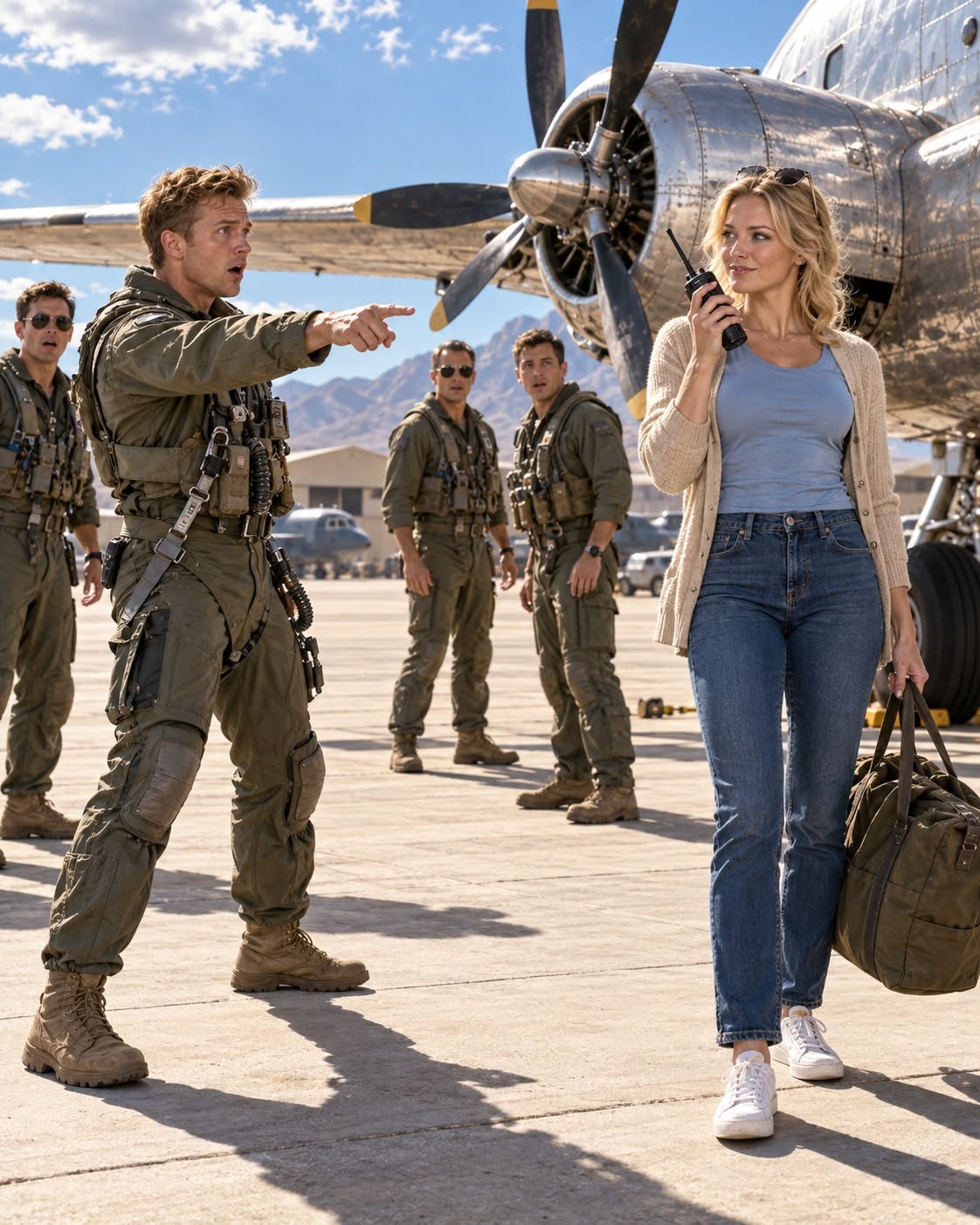
I gave him a nod.
Then I taxied toward the runway.
Lucas and the other pilots watched as the Mustang rolled forward, its tail lifting as the aircraft gathered speed. A moment later, the wheels left the ground, and the old warbird climbed into the open sky.
For those watching from the flight line, it was a beautiful sight: a piece of aviation history flying with the confidence of an aircraft that still had a purpose.
For Bear, it was a reminder of a mission that had never really left him.
And for Lucas, it was a lesson no simulator could teach. The newest fighter, the fastest climb, and the most advanced technology could never tell the whole story of a pilot.
Sometimes, the person who looks least impressive in the briefing room is the one who has already faced the hardest test of all.
That morning, I had come to Kestrel Ridge to fly a Mustang.
I left the ground with something far more important than the respect of a room full of pilots: the quiet knowledge that fifteen years later, the people I had fought to bring home still remembered.
The first thing I noticed after lifting the Mustang into the morning sky was how quiet the world could become when you were exactly where you belonged.
The runway disappeared beneath me, the hangars shrank into neat rows, and the hills surrounding Kestrel Ridge stretched toward the horizon like waves frozen in green and gold. Sunlight slid across the Mustang’s polished wings. The Merlin engine spoke through the airframe in a deep, familiar rhythm that I had missed more than I wanted to admit.
For a few minutes, I forgot about the briefing tent, the young F-22 pilot, and the expression on Bear’s face when he had read my call sign.
I was simply flying.
Then the radio crackled.
“Ghost Rider, Kestrel Control. We have you on visual. Beautiful climb. Continue to holding point Bravo and prepare for your demonstration slot.”
“Copy, Kestrel Control.”
My voice sounded steadier than I felt.
Fifteen years had passed since Koresh Valley. Fifteen years since I had climbed out of a crippled A-10 with bloodless fingers and the knowledge that several men who should have died that afternoon were still breathing.
I had spent much of that time telling myself the mission was finished.
I had returned to civilian life, taken contract flying jobs when I could, and eventually found my way back to the aircraft that had first made me fall in love with aviation. The Mustang was not a replacement for the Warthog. Nothing could be. But its old-fashioned controls, mechanical honesty, and unmistakable sound had given me somewhere to put the memories when they became too heavy to carry on the ground.
I had never expected to hear Ghost Rider again.
“Ghost Rider, this is Viper Two. Request permission to join your formation.”
The voice belonged to Lieutenant Lucas Vance.
I glanced at the radar display, then toward the eastern sky. A moment later, the F-22 appeared as a dark shape against the sun, its angular wings catching the light as it approached.
“Viper Two, Mustang copies. Maintain appropriate separation.”
“Understood.”
His tone was different now. The teasing confidence was gone, replaced by a careful professionalism that sounded almost uncomfortable in his mouth.
The Raptor settled several hundred yards off my left wing, far enough away to give us both room. Even at that distance, its sleek shape looked as though it had been drawn by someone who had never accepted the limitations of ordinary machines.
The Mustang, by comparison, was a collection of rivets, curves, and compromises. It had no digital flight controls, no sophisticated radar, and no computer quietly correcting a pilot’s mistakes.
It demanded that you feel every decision.
I wondered what Lucas saw when he looked at me now.
Perhaps he expected a legendary pilot to fly differently from everyone else. Perhaps he imagined that courage announced itself in perfect turns, flawless radio calls, and an unshakable voice.
If so, the next few minutes would disappoint him.
Because courage had never felt like that to me.
It felt like cold fingers struggling to hold a control stick. It felt like a pounding heart behind a damaged instrument panel. It felt like knowing you were frightened and choosing the next necessary action anyway.
“Viper Two,” I said, “you ever flown alongside a Mustang before?”
“Only during training events, ma’am.”
“Then don’t watch the airplane. Watch the air around it. The airplane is only part of the picture.”
There was a brief silence.
“Understood, Ghost Rider.”
I rolled gently into a climbing turn. The Mustang responded with a familiar pressure through the controls, and the Raptor adjusted its position to remain clear.
Below us, the air demonstration was beginning to take shape. Smoke generators marked the display area. Ground crews moved around parked aircraft, while spectators gathered behind the safety barriers. I could almost imagine the crowd waiting for the F-22’s dramatic arrival, its afterburners and impossible-looking maneuvers.
The old warbird was supposed to be the opening act.
I had no objection to that.
But as I completed my turn, a warning tone sounded in my headset.
“Ghost Rider, Kestrel Control. We have an incoming weather update. Building cells approaching from the northwest. All demonstration aircraft, stand by for revised instructions.”
I looked toward the mountains.
The morning had seemed perfectly clear when I took off. Now a dark smear of cloud was spreading above the ridgeline, its lower edge ragged and heavy. The wind shifted against the Mustang’s wing, and the aircraft gave a small shudder.
I had seen weather like that before.
Not all storms announced themselves with lightning. Some began as a change in the air, a strange stillness beneath the clouds, a subtle warning that the sky was about to become a different place.
“Control,” I said, “Ghost Rider recommends suspending the display until the cells pass. The northwestern ridge is already showing signs of turbulence.”
“Copy. Stand by.”
The Raptor’s voice came through a moment later.
“Ghost Rider, Viper Two. Weather radar indicates a rapidly developing cell. I recommend we return to base.”
“Agreed.”
We turned east toward Kestrel Ridge.
Then the radio erupted with overlapping voices.
“Control, we have a problem on the west side!”
“Ground team reports an aircraft down near the maintenance road!”
“Say again, Control. Identify the aircraft.”
A burst of static swallowed the answer.
My stomach tightened.
I leaned forward, trying to distinguish the voices. Through a gap in the clouds, I caught sight of a pale plume of smoke rising from beyond the western hangars.
“Control, Ghost Rider. Confirm the location of the incident.”
“Ghost Rider, an emergency ground vehicle has overturned near the western access road. We have personnel trapped and another vehicle unable to reach them because of debris. The storm is interfering with communications.”
I looked down.
The western service road ran between a low ridge and a series of maintenance buildings. From our altitude, the damaged vehicle was barely visible, but the smoke told me where to search.
“Are there aircraft involved?”
“Negative. Ground emergency only. Rescue teams are responding.”
That should have been enough.
We had been ordered back. The weather was deteriorating. I was flying a seventy-year-old aircraft with none of the protection or capabilities of a modern fighter.
There was no military mission here, no enemy fire, no battlefield commander waiting for an answer.
And yet I knew what it meant to be trapped somewhere help could not easily reach.
“Viper Two,” I said, “remain clear of the weather and return to base. I’m going to assess the road from above.”
“Ghost Rider, that area is outside the approved demonstration profile.”
“I understand.”
“Ma’am, the cloud base is dropping.”
“I can see that.”
For a moment, the radio was silent.
Then Lucas spoke again.
“I’m staying with you.”
“No,” I replied. “You have a modern aircraft and the equipment to coordinate with Control. Get back safely and relay what you can see. We need information more than we need another airplane in bad weather.”
He hesitated.
“Understood.”
The Raptor banked away, climbing toward clearer air.
I eased the Mustang toward the western ridge, keeping well clear of the worst of the developing cloud. I was not going to pretend that old memories made me invulnerable. I knew the limits of my aircraft, and I knew the difference between accepting risk and surrendering to foolishness.
My task was to observe, communicate, and help the ground teams understand the situation.
The smoke thickened as I approached.
Below, a utility truck lay on its side near the maintenance road. A second vehicle had stopped behind a fallen section of fencing. Several figures were moving around the wreckage, but I could not tell whether anyone was injured.
I transmitted the position and the visible obstacles to Control.
Then a flash of lightning illuminated the clouds to my right.
The Mustang jolted.
A sudden gust pushed the nose sideways, and I corrected carefully, feeling the pressure build against the controls. The air was becoming rougher by the second.
“Ghost Rider, Kestrel Control. Return immediately. Weather conditions are deteriorating beyond the safe demonstration limits.”
I looked once more toward the road.
A rescue vehicle was approaching from the south, but its path appeared blocked by debris. From above, I could see an alternate access route along the eastern edge of the maintenance buildings.
“Control, Ghost Rider. Rescue vehicle may be able to reach the incident by the eastern service lane. The southern approach appears blocked.”
“Copy. Dispatching the ground team to investigate.”
My work was done.
I turned toward base.
Then another transmission came through, weak and distorted.
“Control, this is Medical Two. We have a trapped ground technician. Conscious, but injured. We need the rescue vehicle through immediately.”
I tightened my grip on the controls.
The words were ordinary. A trapped technician. An injured man. A rescue vehicle trying to reach him.
But in my mind, another place rose from the past.
A narrow valley. A radio filled with frightened voices. Men calling for help while the sky above them seemed to close.
For one brief, dangerous moment, I was back in Afghanistan.
I could almost feel the frozen control stick beneath my hands.
Then I blinked, drew a slow breath, and looked at the Mustang’s instruments.
I was not in Koresh Valley.
I was not flying an A-10.
And I was not going to let a memory make decisions for me.
“Control,” I said, “I am returning to base. Ground rescue has the route information.”
“Copy, Ghost Rider.”
I guided the Mustang away from the ridge, making a wide turn toward the runway. The weather was getting worse, but the path home remained manageable.
Ahead, the airfield appeared through a break in the clouds.
“Ghost Rider, Viper Two. I have you in sight. You are clear to land. Runway conditions are being checked.”
Lucas’s voice was calm now, precise and focused.
“Thank you, Viper Two.”
I lowered the aircraft toward the approach path.
The Mustang touched down with a firm bounce, settled, and rolled along the runway. I brought it to a stop near the designated parking area, where ground crew members waited with chocks and fire equipment.
When the engine finally fell silent, I realized how tightly I had been holding my breath.
I climbed out slowly.
The wind had strengthened, carrying dust across the apron. Rain began to tap against the canopy, and somewhere beyond the hangars, a siren sounded.
Bear was waiting beside the parking line.
He had abandoned his place in the VIP tent and come straight to the flight line. His expression was grave, but when he saw me standing beside the Mustang, some of the tension left his shoulders.
“You all right?” he asked.
“I’m fine.”
He looked at the sky, then at the aircraft.
“You did the right thing coming back.”
“I only passed along what I could see.”
“Sometimes that’s enough.”
Before I could answer, Lucas landed his Raptor on the parallel runway. The aircraft taxied toward its shelter while the ground crew rushed to secure the remaining demonstration aircraft.
A few minutes later, he appeared beside us, his flight helmet tucked under one arm. His hair was damp from the rain, and his face had lost the last traces of the easy arrogance I had seen that morning.
“Ma’am,” he said, “I owe you an apology.”
I waited.
“For what I said in the briefing tent. About the Mustang being something to warm up the crowd before the real show.”
He glanced at the old fighter beside us.
“I thought the aircraft told me everything I needed to know about the pilot.”
“No,” I said gently. “You thought the aircraft told you everything you needed to know about the aircraft. Those are two different mistakes.”
He absorbed that without looking away.
“I also wanted to stay with you out there.”
“I know.”
“I thought I could help.”
“Maybe you could have. But you had a responsibility to bring your aircraft home and keep the radio clear. Sometimes the hardest decision is accepting that someone else has the better view of the problem.”
Lucas lowered his eyes.
“I didn’t understand that this morning.”
“Most people don’t understand everything they need to know at the beginning of their careers.”
Bear gave a quiet chuckle.
“That includes a few of us who have been doing this for decades.”
For the first time since the storm began, I smiled.
Then a crew chief hurried across the apron.
“Chief McKinnon! The technician is out. Medical team has him on the way to the clinic. He’s conscious and talking.”
Bear closed his eyes for half a second.
“Thank God.”
The crew chief continued, “They followed the eastern route. The ambulance got through just before the worst of the rain.”
Lucas looked at me.
“You spotted that route from the air.”
“I spotted a road. The rescue team did the difficult part.”
“And the technician is alive because people listened to you.”
“Then make sure they listen to the ground team, too.”
He nodded slowly.
The storm rolled over Kestrel Ridge with a force that silenced every remaining engine. Within minutes, the demonstration was officially canceled. Aircraft were secured, spectators were directed toward shelters, and the base settled into the practical urgency of people dealing with a problem rather than performing for an audience.
I stood beneath the hangar roof, watching rain sweep across the runway.
Bear joined me, holding two cups of coffee.
He handed me one.
“You know,” he said, “when I saw your call sign on that schedule, I thought I’d never see you again without remembering the valley.”
“I never expected you to remember it at all.”
“Remember it? I remember every man we carried out of there. I remember the ones who didn’t make it. And I remember looking up and seeing your aircraft turn toward the fire when every instinct should have been telling you to get away.”
I wrapped both hands around the warm cup.
“I didn’t save everyone.”
“No,” Bear said. “You didn’t. And I know you still carry that.”
The words landed more heavily than I expected.
For years, I had avoided conversations like this. People liked to tell stories about courage, but they rarely asked what happened afterward. They remembered the rescued men, the damaged aircraft, the call sign. They seldom spoke about the names that never came home.
“I used to think surviving meant I had to prove the mission had been worth it,” I admitted. “I flew whenever I could. Took every difficult job. Told myself that if I kept moving, I wouldn’t have to think about the people I lost.”
Bear listened without interrupting.
“But eventually, I realized I couldn’t repay the dead by putting myself in danger forever.”
He nodded.
“That’s a hard thing to learn.”
“It took me longer than I’d like to admit.”
“Then maybe you can help somebody else learn it sooner.”
He looked toward Lucas, who was speaking with the operations officer near the hangar entrance.
“He’s a good pilot,” Bear said. “Talented. Smart. But he grew up in a world where every answer comes with a display, a warning light, or a procedure. Sometimes a person has to learn what the instruments can’t tell him.”
I followed his gaze.
“Then he has a chance to become a good leader.”
Bear smiled faintly.
“You think he’ll listen?”
“I think he already started.”
The following morning, the storm had passed.
The airfield glistened beneath a pale blue sky, and maintenance teams moved between the aircraft, inspecting every surface for damage. The demonstration had been postponed, not abandoned, and the organizers were discussing whether the weather would allow a reduced flying program later in the day.
I was checking the Mustang’s wing when Lucas approached.
He carried a small notebook.
“May I ask you something?”
“Depends on the question.”
He laughed nervously.
“Would you mind showing me the preflight routine you use on the Mustang?”
I looked at the notebook.
“You’ve flown a Raptor. You want to learn to check an old piston engine?”
“I’ve read the manuals. I know the theory. But I realized yesterday that I don’t know how much I take for granted.”
He hesitated, then added, “I also want to understand how you read the aircraft without all the systems we have.”
I studied him for a moment.
Then I handed him a flashlight.
“Start with the landing gear. Check the tires, look for leaks, and don’t assume yesterday’s inspection means today’s aircraft is ready. Tell me what you see, not what you expect to see.”
He crouched beside the Mustang.
For the next hour, I showed him the small things that years of flying had taught me to notice: a fastener that looked slightly different, a trace of fluid where there should be none, a change in the feel of a control, a sound worth investigating rather than dismissing.
I explained how experience could sharpen judgment, but also how it could deceive a pilot into believing familiarity was the same as certainty.
Lucas took notes on everything.
At one point, he stopped beside the cockpit.
“Can I ask about Koresh Valley?”
I looked at the mountains beyond the runway.
“You can ask.”
“Why did you stay when your aircraft was damaged?”
I thought carefully before answering.
“Because there were people who needed help, and I believed I could still give it. But don’t confuse that with believing I was unafraid. I was terrified. I knew the aircraft might not bring me home.”
“Then what made you continue?”
“I kept asking myself one question: What is the next useful thing I can do? Not what will make me look brave. Not what will prove I’m the best pilot. Just what can I do that might help?”
He wrote the words down.
“What if the answer is to leave?”
“Then leaving can be the bravest thing you do.”
He looked up.
I continued, “A pilot who ignores limits doesn’t become a hero just because the situation is dangerous. Sometimes that pilot creates another emergency for everyone else. You need courage, but you also need judgment. One without the other can get people killed.”
Lucas closed the notebook.
“I think I understand.”
“Good. Keep checking whether you do.”
He smiled at that.
Later that afternoon, the demonstration resumed in a shortened format after the weather was cleared for flying. The organizers removed several planned maneuvers, shortened the program, and established stricter limits for the remaining aircraft.
I considered withdrawing from the event.
The Mustang had been inspected and cleared, but the previous day’s storm had stirred something inside me that I hadn’t expected. I could fly. I knew I could. The question was whether I wanted to put myself in front of a crowd and turn a private part of my life into public entertainment.
Bear found me standing beside the aircraft.
“You don’t owe anyone a flight,” he said.
“I know.”
“And you don’t have to prove anything to Lucas.”
“I know that, too.”
He waited.
I looked at the Mustang’s wings, at the careful rows of rivets that held its old structure together.
“When I first started flying again, I thought I needed to show myself that I wasn’t finished. Every flight was an argument with the past.”
“And now?”
“Now I think I want to fly because I love it. Not because I’m trying to win a fight that ended years ago.”
Bear nodded toward the runway.
“That’s a better reason.”
I checked the weather one last time, reviewed the approved flight profile with the operations officer, and climbed into the cockpit.
The Mustang’s engine came alive with its familiar thunder.
This time, when I lifted into the sky, I felt no need to chase the horizon or demonstrate that I could endure more than anyone else. I followed the planned route, made the approved turns, and let the aircraft do what it had been built to do.
Below, the crowd watched the old warbird cross the field.
I could see the Raptor parked near the far hangar, its sharp silhouette standing in contrast to the Mustang’s rounded wings. Lucas was beside it, helmet in hand, looking up.
I dipped the Mustang’s wings once in a restrained salute and continued toward the designated turning point.
There were no dramatic maneuvers. No dangerous dives. No attempt to make the crowd gasp.
Just a clean, steady flight beneath an open sky.
When I landed, the applause began before the propeller had stopped turning.
I climbed down and found Lucas waiting near the parking line.
“I used to think respect was something you earned by being the most impressive person in the room,” he said.
“And now?”
“Now I think it starts with being willing to learn from the person you overlooked.”
I smiled.
“That’s a good place to start.”
He glanced at the Mustang.
“Will you be here tomorrow?”
“No. I have a flight back home in the morning.”
His expression fell slightly.
“Then I suppose I should say thank you now.”
“For what?”
“For not treating me like an idiot when I gave you every reason to.”
I laughed softly.
“You weren’t an idiot, Lucas. You were inexperienced in a way that had become comfortable. There’s a difference.”
He nodded, as if he intended to remember that distinction.
Then he asked one final question.
“Do you ever wish people knew what you did in Koresh Valley before they met you?”
I looked at the crowd dispersing beyond the barriers. Families were gathering their children. Ground crews were securing equipment. A group of young airmen were taking photographs beside the Mustang, grinning as though they had discovered something remarkable.
“No,” I said. “Because if they knew my story first, they might mistake the story for the person.”
I rested a hand against the fuselage.
“I’d rather be treated with ordinary courtesy before anyone knows what I’ve done. That tells me more about them than applause ever could.”
Lucas was quiet for a long moment.
Then he extended his hand.
I shook it.
There was no ceremony, no announcement, and no official recognition. The moment was small enough that nobody nearby paid attention.
But I knew it mattered.
That evening, I returned to my hotel and found a message from Bear.
It contained a photograph taken fifteen years earlier in Koresh Valley. The image was grainy and washed out by the harsh afternoon sun. Several exhausted soldiers stood beside a rescue helicopter, their faces streaked with dirt. Behind them, barely visible through the haze, was the damaged A-10 I had once believed I would never fly away from.
On the back, Bear had written a single sentence.
We made it home because you gave us a chance.
I sat with the photograph for a long time.
For years, I had remembered that day through the engine failure, the broken controls, and the men I had not been able to save. Bear’s message reminded me that the mission had contained something else, too: people who had survived, families who had received phone calls instead of condolences, and lives that had continued long after the valley disappeared behind the horizon.
I placed the photograph in my travel bag beside my flight documents.
Then I turned off the light.
The next morning, as my rental car rolled away from Kestrel Ridge, I looked once through the rear window at the airfield. The hangars were already catching the sunlight. Somewhere beyond them, the Mustang waited for its next flight.
I knew the world would continue to admire the fastest aircraft, the newest technology, and the pilots who could perform the most extraordinary maneuvers. There was nothing wrong with that. Progress mattered. Skill mattered. Innovation could save lives in ways earlier generations had never imagined.
But none of those things could tell you everything about the person inside the cockpit.
A uniform could not reveal whether someone would remain calm when the plan collapsed. A call sign could not explain the cost of a difficult decision. An old aircraft could not make its pilot less capable, just as an advanced fighter could not make its pilot wise.
Those qualities had to be built through experience, humility, and the willingness to take responsibility for other people.
I had entered Kestrel Ridge as an unremarkable woman in worn jeans and a faded cardigan. I had expected to fly my Mustang, thank the ground crew, and leave without anyone remembering my name.
Instead, I had been reminded that the past never belonged to one person alone. The men who had survived Koresh Valley carried their own memories, their own losses, and their own reasons for remembering Ghost Rider.
I could not change what had happened there.
I could only decide what I would carry forward.
And as the road opened before me, I finally understood something I had spent fifteen years trying to learn.
A person’s worth is not measured by how impressive they appear when everything is going well. It is revealed by the choices they make when nobody is watching, when fear is real, and when doing the right thing comes at a cost.
The Mustang had been built in another era, yet it had carried me into a new understanding of my own life. The young pilot had arrived believing that greatness announced itself through speed, technology, and spectacle. He left with a different lesson: the best pilots were not the ones who never made mistakes or never felt afraid, but the ones who kept learning, knew their limits, and understood that the mission mattered more than their pride.
As for me, I no longer needed to prove that Ghost Rider had been brave.
I had been frightened. I had made mistakes. I had lost people I wished I could have saved. I had survived when others had not, and for a long time, I had mistaken that survival for a debt I could never repay.
Now I knew better.
The people we save do not ask us to spend the rest of our lives trying to earn the right to have saved them. They ask us, in ways they may never say aloud, to remember what mattered and to keep living with purpose.
Sometimes that means flying into danger.
Sometimes it means turning back.
And sometimes it means looking past an old cardigan, a polished flight suit, or the gleam of a modern fighter to recognize the human being standing in front of you.
The world may remember the call sign.
The aircraft may eventually return to a museum.
The medals may fade, and the stories may grow quieter with time.
But kindness, courage, and humility leave their marks in places no weather can erase.
That was the legacy I wanted to carry home.
Not the legend of Ghost Rider.
Just the responsibility of being the person behind the name.