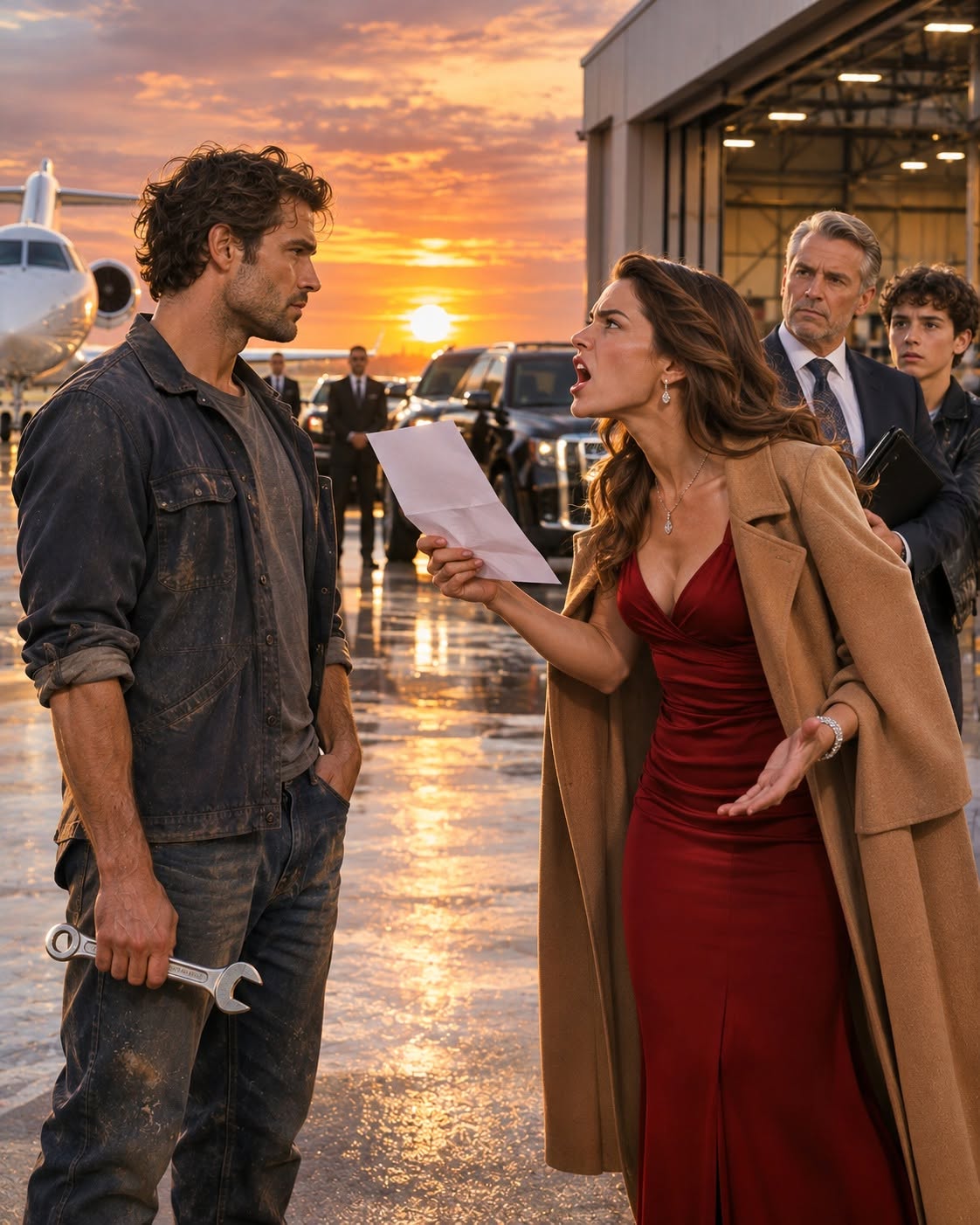
The woman walked into my garage carrying a demolition notice, glanced at my single vehicle lift, and laughed.
THE LITTLE GARAGE THAT BROUGHT A CORPORATE GIANT TO ITS KNEES
The inspectors didn’t immediately arrest anyone.
Instead, the senior investigator, a broad-shouldered man named Daniel Reeves, placed a thick folder on my workbench and asked everyone in the garage to step back.
“Before anybody makes another offer, I think we should establish exactly what we’re dealing with,” he said.
Morgan Hawkins stood beside the entrance, her arms folded tightly across her chest. Todd, the vice president who had brought the envelope, kept glancing toward the parking lot.
I noticed something strange about him.
He wasn’t looking at the inspectors.
He was looking at Jenna.
The delivery driver who had first brought her van to my garage was standing near the office, holding her phone in both hands. Her face had gone pale.
“What’s wrong?” I whispered.
She shook her head.
“I think I know why they wanted me to stop talking.”
Before I could ask another question, Daniel opened the folder.
Inside were photographs of brake components, purchase orders, shipping documents, and several pages of financial records. Some of the part numbers matched the counterfeit pads I had removed from Jenna’s van.
But there was something else.
The same supplier had provided replacement brake systems for three regional transportation companies, including a contractor responsible for maintaining school buses.
Daniel pointed to a photograph.
“These components were sold as certified products from a reputable manufacturer. However, the manufacturer has confirmed that these serial numbers were never issued by them.”
Todd immediately stepped forward.
“This is ridiculous. We purchase thousands of components every month. Nobody can personally verify every shipment.”
Daniel didn’t raise his voice.
“That’s exactly why companies have compliance departments.”
Todd turned toward Morgan.
“Tell them. You know how these operations work.”
Morgan didn’t answer.
For the first time, I saw uncertainty on her face.
Then Daniel placed another document on the workbench.
“This is an internal report from Brooks Logistics. It was submitted by an employee eight months ago. The report specifically warned management about suspicious brake failures and unauthorized suppliers.”
Morgan leaned closer.
“Who submitted it?”
Daniel looked toward Jenna.
She lowered her eyes.
“I did,” she said quietly.
The garage fell silent.
Jenna explained that she had noticed something unusual after several drivers complained about longer stopping distances. She had reported the problem through the company’s maintenance system, attached photographs, and requested an investigation.
Her report had disappeared.
She submitted another one.
That one disappeared too.
Eventually, her supervisor warned her that repeatedly questioning maintenance decisions could affect her employment.
She had stopped reporting the problems because she needed the job.
“I have two children,” she said. “I couldn’t afford to lose my paycheck.”
My stomach tightened.
I knew what it felt like to watch people make dangerous decisions from comfortable offices. But hearing Jenna explain how fear had kept her quiet made the situation feel much worse.
Daniel nodded.
“Your report was recovered during an independent audit. We also found evidence that several employees were instructed to close maintenance complaints without performing the required inspections.”
Todd laughed nervously.
“This is becoming a circus. You’re taking ordinary administrative mistakes and turning them into a criminal investigation.”
“Then you shouldn’t have any trouble answering a few questions,” Daniel replied.
Two inspectors approached Todd.
He stepped backward.
“Wait. I want legal representation.”
“Of course,” Daniel said. “You’ll have an opportunity to speak with your attorney.”
But before the inspectors could lead him outside, Todd made one final mistake.
He pointed at me.
“That mechanic is responsible for all of this. He has been collecting defective components and making accusations against our company for weeks. He’s probably trying to destroy us because of the property dispute.”
I stared at him.
“I met Jenna yesterday morning.”
“You expect anyone to believe that?”
“I don’t need anyone to believe me. I have the inspection records.”
Daniel closed the folder.
“Mr. Todd, your company’s records will speak for themselves.”
That was when Morgan finally stepped forward.
“Daniel, I want to know something.”
He turned.
“Yes?”
“Did anyone in my office know about this?”
Daniel hesitated.
“We’re still investigating.”
“That’s not what I asked.”
Her voice had changed.
“Did anyone know?”
Daniel looked at the documents again.
“We have evidence that senior management received multiple warnings. Whether those warnings reached your office is something we need to establish.”
Morgan looked as though someone had pulled the floor out from beneath her.
She had come to my garage believing the problem was a stubborn property owner refusing to cooperate with a development project.
Now she was discovering that the company she represented might have been putting hundreds of people in danger.
And I had a feeling the worst was still ahead.
The following morning, I arrived at the garage before sunrise.
I had barely slept.
The previous day’s events had brought television reporters, transportation officials, angry company representatives, and more phone calls than I could answer.
My small office looked like a filing room after a tornado.
Photographs covered the desk. Inspection forms were stacked beside the coffee machine. Several suspicious brake pads sat inside clear evidence bags.
Oliver was already awake when I entered.
He sat at his workbench, studying a diagram of a marine braking system.
“Morning, Dad.”
“You’re early.”
He shrugged.
“I couldn’t sleep either.”
I placed my lunch bag on the counter.
“Any particular reason?”
He hesitated before answering.
“Someone came by last night.”
My hands stopped moving.
“Who?”
“I don’t know. A man in a black truck.”
Oliver explained that the stranger had parked outside our property shortly after dinner. He had watched the garage for several minutes before walking toward the side entrance.
When he noticed Oliver looking through the window, he returned to his truck and drove away.
“Did he say anything?”
Oliver shook his head.
Then he pointed toward the back of the building.
“He left something.”
I followed him outside.
Under the rear workbench, we found a small cardboard box.
Inside was a damaged brake pad, a printed photograph of our garage, and a handwritten note.
STOP ASKING QUESTIONS. YOU HAVE A SON TO THINK ABOUT.
For several seconds, I couldn’t speak.
I looked at Oliver.
His face was pale, but he was trying hard not to show fear.
“Pack your school things,” I told him. “You’re staying with your aunt today.”
“But Dad—”
“No arguments.”
He looked at the note again.
“Are we in trouble?”
I knelt beside him.
“Sometimes people do frightening things when they’re afraid of the truth coming out. That doesn’t mean the truth is wrong.”
He nodded slowly.
I drove him to my sister’s house and called Daniel immediately.
By nine o’clock, an investigator had photographed the note, collected the box, and arranged additional security around the property.
Daniel wasn’t pleased.
“Someone inside that operation knows we’re getting close,” he said.
“Do you have any idea who?”
“We’re looking at several possibilities. But there’s something else you need to know.”
He opened his laptop and showed me a document.
It was a list of vehicles maintained by Brooks Logistics over the previous eighteen months.
Beside each vehicle were dates, repair descriptions, and supplier codes.
One particular code appeared repeatedly.
I recognized it.
It belonged to a supplier called Northstar Industrial Components.
The company supposedly operated from a warehouse in another state.
However, according to the investigators, the address was nothing more than an abandoned office building.
Daniel leaned back.
“Northstar is a shell company. It appears to have received millions of dollars in payments from Brooks Logistics.”
“Who owns it?”
“That’s what we’re trying to establish.”
I stared at the screen.
“Why would a company pay millions for counterfeit parts?”
Daniel turned the laptop toward me.
“Because someone was making a lot more money than they would have made purchasing legitimate components.”
Then he pointed to another column.
The payments had increased sharply during the same period that Brooks Logistics began expanding its fleet.
Someone had turned maintenance into a business opportunity.
And every dollar saved had been taken out of the safety of the vehicles.
Three days passed before the next major development.
I was repairing a delivery van when a woman in her sixties walked into the garage.
She wore a faded blue coat and carried a thick envelope.
“Are you the mechanic who reported the brake problems?”
“Yes, ma’am.”
“My name is Patricia Wells. I used to work in the accounting department at Brooks Logistics.”
She glanced toward the office.
“Can we talk somewhere private?”
I brought her inside and offered her a chair.
She declined the coffee.
Instead, she opened the envelope and placed several printed documents on my desk.
“I’ve been waiting for someone to investigate this properly.”
The documents contained payment records, supplier approvals, and internal correspondence.
Patricia explained that she had worked for Brooks Logistics for fourteen years. Her job had involved reviewing invoices and checking whether purchases matched approved budgets.
About two years earlier, she had noticed unusual payments to Northstar Industrial Components.
At first, she assumed it was a legitimate new supplier.
Then she noticed that the invoices described identical products but listed dramatically different prices.
Some were marked as certified replacement parts.
Others were classified as ordinary industrial supplies.
The differences allowed the company to bypass several approval procedures.
Patricia had raised concerns with her supervisor.
He told her to stop investigating.
She had then approached the finance director.
Two weeks later, she was transferred to another department.
Six months afterward, she was dismissed during a supposed restructuring.
“I thought I was the only one who had noticed,” she said.
I looked through the documents.
One email caught my attention.
It contained a request to approve an emergency purchase of brake components.
The sender was Todd.
But the approval had come from someone else.
Morgan Hawkins.
I looked up.
“Did she know what she was approving?”
Patricia shook her head.
“That’s the question I’ve been asking myself.”
According to Patricia, Morgan had approved several large contracts during the company’s expansion. But the documents had been presented as routine procurement agreements.
Some of the attachments had been replaced after approval.
Others contained misleading descriptions.
Patricia couldn’t prove Morgan had knowingly participated in the scheme.
However, she could prove that someone had used her executive authorization to move millions of dollars.
“Why bring this to me?” I asked.
She looked toward the garage doors.
“Because every other place I tried to report it told me it was an internal company matter. You’re the first person who actually looked at the parts instead of the paperwork.”
I immediately called Daniel.
Within an hour, Patricia was sitting across from him with her documents.
The investigation had just become considerably larger.
Morgan returned to the garage that afternoon.
This time, she came alone.
She stood near the entrance for several seconds before speaking.
“I heard about the threat against your son.”
I looked up from the vehicle I was repairing.
“How did you hear?”
“Daniel told me.”
She glanced at the damaged garage door.
“I’m sorry.”
I wiped my hands.
“An apology doesn’t change what happened.”
“I know.”
She took a slow breath.
“I also know you probably don’t want to hear anything from me right now. But I need to tell you something.”
She explained that she had spent the previous night reviewing every document connected to the development project.
She had discovered that the demolition schedule had been accelerated after Todd requested an early clearance of the surrounding properties.
The official explanation was that construction needed additional space for a drainage system.
But there had been no engineering justification for removing my garage.
The land was valuable for another reason.
A buried utility corridor ran directly beneath the rear portion of the property.
According to the development plans, the corridor had been scheduled for relocation before construction began.
But the relocation had never happened.
Morgan stared at the floor.
“Todd wanted your property cleared before anyone inspected that section of the site.”
I felt something cold settle in my chest.
“Why?”
She hesitated.
“Because the original logistics facility had been built with an unauthorized drainage connection. It was discharging contaminated industrial runoff into a stormwater channel.”
I stared at her.
The garage wasn’t simply standing in the way of a warehouse.
It was standing in the way of an investigation.
“How long have you known?”
“I didn’t know until yesterday.”
“That’s convenient.”
She accepted the accusation without defending herself.
“I understand why you don’t trust me.”
Then she placed a document on the workbench.
It was a revised development map.
A red line marked the drainage corridor.
At the edge of that line was my garage.
“The demolition was supposed to happen before the environmental inspection. Once the building was gone, the contractors could access the underground connection and replace the damaged section without drawing attention.”
I looked at the map.
“People have been driving over contaminated ground?”
“Possibly. We don’t know the full extent yet.”
For a moment, neither of us spoke.
Then Morgan said something I hadn’t expected.
“I’ve resigned from the project.”
I raised an eyebrow.
“Why?”
“Because I refuse to sign another document until I know exactly what my company has done.”
She looked at the old chairs in the waiting room.
“I spent years measuring success by the size of a project, the number of jobs created, and the amount of money invested. I never thought to ask what was happening underneath the surface.”
I leaned against the workbench.
“Sometimes that’s where the most important problems are.”
She nodded.
Then she left.
The environmental investigation began the following Monday.
Inspectors sealed off part of the development site and brought in specialized equipment to examine the drainage system.
What they discovered was worse than anyone had expected.
Several industrial waste containers had been improperly connected to the stormwater network. The system had carried contaminated runoff toward a small creek that passed behind a residential neighborhood.
The creek supplied water to several private wells.
No one knew how long the contamination had been occurring.
The local authorities immediately issued precautionary notices and arranged independent water testing for nearby residents.
The town was furious.
People who had supported the logistics project began demanding answers.
The company released a statement claiming it was cooperating fully with the investigation.
But that wasn’t enough for the families living near the creek.
One afternoon, a farmer named Harold came into my garage.
He had been one of my earliest customers.
His hands trembled as he placed a folded newspaper on my counter.
“That’s my property,” he said.
The newspaper contained a photograph of the contaminated creek.
His farm sat less than a mile downstream.
“I’ve been using that water for my livestock.”
I didn’t know what to say.
He looked at me.
“Can they fix it?”
“I don’t know, Harold. But they need to find out exactly what’s in the water before anyone uses it again.”
He nodded.
Then he surprised me by asking whether I could inspect his tractor.
I almost laughed.
“Now?”
“Well, it isn’t going to fix itself.”
I checked the tractor.
He sat quietly in the waiting room while I worked.
When I finished, he paid me and thanked me.
As he was leaving, he stopped at the door.
“You know, I used to think this whole project would be good for Cobden Falls. New jobs. Better roads. More business.”
He glanced toward the development site.
“I guess progress doesn’t mean much if it poisons the place you’re supposed to improve.”
I watched him drive away.
That evening, I received a call from Daniel.
He had an update.
The investigation had uncovered a connection between the counterfeit brake supplier and the environmental contractor responsible for the drainage system.
Both companies had received payments through the same network of shell businesses.
And one name appeared in both sets of financial records.
Todd’s.
But there was another name.
Patricia’s former supervisor.
And a third.
Morgan’s former chief financial officer.
The investigation was no longer about one corrupt vice president.
It was about a network of people who had learned how to hide dangerous decisions behind complicated paperwork.
Two weeks later, I received a letter from the town council.
The demolition order had been suspended.
The property dispute would be reviewed independently, and the council wanted to discuss purchasing a small portion of my land for a public safety facility.
I wasn’t interested.
I had spent years building the garage.
I didn’t want to sell it just because people had suddenly decided it was important.
But the next meeting changed my mind.
The council invited transportation inspectors, local business owners, school administrators, and several residents affected by the contaminated water.
They wanted to discuss how the town could prevent similar problems in the future.
I arrived expecting a long argument.
Instead, I found a room full of people who were genuinely worried.
A school principal explained that the district had no independent maintenance inspection program.
A local trucking operator admitted that he often relied entirely on supplier certifications because he couldn’t afford a full-time mechanic.
A mother described how frightening it had been to learn that school buses might have been fitted with counterfeit components.
Then Daniel stood.
“We have learned something important during this investigation,” he said. “A company can have policies, certificates, departments, and expensive offices. None of those things guarantee that the work is being done properly.”
He looked toward me.
“Sometimes the only person who notices a problem is the person standing next to the machine.”
The council proposed creating an independent vehicle inspection cooperative.
Local transport operators could bring their vehicles for periodic safety checks. School buses would receive additional inspections. Smaller businesses would have access to qualified technicians without needing to employ their own full-time specialists.
They wanted my garage to become the first inspection location.
I wasn’t sure.
My shop was small.
I had one lift.
I couldn’t imagine handling the responsibility of an entire town.
Then Oliver spoke.
He had been sitting beside my sister at the back of the room.
“Couldn’t we just build another inspection bay?”
Everyone turned toward him.
He stood up, holding a notebook.
“I drew a plan,” he said.
He opened the notebook and showed the council a rough sketch.
It wasn’t perfect.
The measurements were slightly uneven, and one of the walls appeared to be missing.
But the idea was surprisingly practical.
He had designed a small additional workshop with a dedicated inspection area, a storage room for documented components, and a separate space for training young mechanics.
The council members smiled.
One of them asked where he had learned to design it.
Oliver shrugged.
“My dad lets me watch him fix things.”
I looked at my son.
For the first time in weeks, I felt something other than anger or exhaustion.
I felt proud.
The next major surprise arrived in the form of a telephone call from the state transportation authority.
They wanted to offer me a position on an independent technical review panel.
The panel would examine maintenance standards, counterfeit component detection, and reporting procedures for commercial fleets.
The offer included a respectable salary and the opportunity to influence regulations across the region.
I declined the first time.
I had no interest in leaving my garage.
But the official called again.
“We don’t need you to abandon your business,” she explained. “We need someone who understands what happens when a maintenance decision becomes a financial decision.”
I considered it.
For years, I had believed the only way to protect people was to work on one vehicle at a time.
That belief had brought me to Cobden Falls.
But perhaps there was another way.
I accepted a part-time position.
I would continue running the garage while attending monthly review meetings and helping develop independent inspection standards.
The first meeting was uncomfortable.
Several executives arrived wearing expensive suits and speaking in polished corporate language.
One of them presented a proposal that would allow fleet operators to certify their own maintenance records.
I listened for twenty minutes.
Then I asked a simple question.
“Who checks whether the certification is true?”
The room became quiet.
The executive explained that companies would be subject to random audits.
“How often?”
“Depending on the risk profile.”
“Who decides the risk profile?”
He looked at his notes.
“That’s still being developed.”
I leaned forward.
“Then you’re asking people to trust a system that hasn’t decided how to verify itself.”
A few people shifted in their seats.
The chairperson asked me what I would recommend.
I suggested independent inspections, traceable component records, protected reporting channels, and mandatory disclosure when a vehicle was removed from service for safety reasons.
I also proposed a rule that would prevent companies from using internal maintenance approvals as substitutes for independent verification.
The proposal wasn’t glamorous.
It would cost money.
It would require additional training and paperwork.
But it would make it harder for someone to hide a dangerous repair behind a signature.
The panel eventually adopted several of the recommendations.
I returned to my garage that evening and found Oliver waiting with a new drawing.
This time, he had designed a small hydraulic inspection platform.
“Do you think they’ll let us build it?”
I studied the sketch.
“I think we should find out.”
Meanwhile, the criminal investigation continued.
Todd was eventually charged with fraud, conspiracy, and offenses related to the falsification of safety records. Several other executives were placed under investigation.
Patricia became a key witness.
Jenna also agreed to testify.
Morgan cooperated with investigators and handed over internal correspondence, including messages that revealed how Todd had repeatedly bypassed normal approval procedures.
But her cooperation came at a price.
The company’s board accused her of damaging its reputation and violating confidentiality obligations.
She received legal threats.
Her professional network distanced itself from her.
For a while, she became one of the most unpopular people connected to the project.
I didn’t feel sorry for her.
She had participated in decisions that affected our town, and she needed to accept responsibility for the consequences.
But I also understood that admitting a mistake was different from pretending it had never happened.
One afternoon, she came to the garage again.
She was carrying a cardboard box.
“I thought these might be useful.”
Inside were old technical manuals, inspection equipment catalogs, and several engineering reference books.
“They belonged to my father,” she explained. “He was a mechanic before he became a factory manager.”
I picked up one of the books.
Its cover was worn, and several pages contained handwritten notes.
“Why are you giving these to me?”
She looked at Oliver’s workbench.
“Because your son reminds me of the person my father wanted me to become.”
She hesitated.
“I spent so much of my career trying to prove I belonged in rooms where people measured everything in money. Somewhere along the way, I stopped listening to the people who actually understood the work.”
I closed the book.
“What happens now?”
“I’m going to testify. Whatever happens after that, happens.”
She glanced toward the garage doors.
“And I’m going to help the residents affected by the contamination. Not through another corporate statement. Through an independent fund that will pay for water testing and cleanup.”
“Who controls the fund?”
“An independent board. Residents, environmental specialists, and local officials. No executives.”
I nodded.
“That sounds better.”
Before leaving, she stopped beside the old coffee machine.
“Do you think people can change?”
I considered the question.
“Some can. But changing doesn’t mean people have to forget what you did.”
She smiled faintly.
“I suppose that’s fair.”
By the following spring, the little garage looked different.
The green paint had finally been replaced.
The waiting room had four chairs instead of two.
The old coffee machine was still there, despite repeated suggestions that it should be retired.
And beside the original building stood a new inspection bay.
The council had helped fund its construction through a public safety grant. Local transport companies contributed equipment, and several residents volunteered to help prepare the site.
We called it the Cobden Falls Vehicle Safety Center.
I insisted that the name be painted in ordinary black letters.
No giant corporate logo.
No executive portraits.
No expensive slogan about innovation.
Just the name.
On opening day, the parking area filled with vehicles.
School buses arrived first.
Then delivery vans, farm trucks, and commercial vehicles from neighboring towns.
Jenna drove in with a new van.
She had left Brooks Logistics and joined a regional transport cooperative that had adopted independent maintenance standards.
She was now responsible for driver safety training.
“I never thought I’d be doing this,” she said, stepping out of the vehicle.
I smiled.
“Neither did I.”
She looked toward the inspection bay.
“Looks like your little garage got bigger.”
“Only a little.”
Oliver stood nearby, holding a clipboard.
He was now helping organize the inspection records and had been accepted into a summer engineering program.
He still wanted to study marine systems.
He had even begun building a small model of a hydraulic braking mechanism.
His enthusiasm reminded me of the person I had been before the accident that changed my life.
Only this time, I hoped he would grow up in an industry that valued his principles instead of testing them.
The opening ceremony was brief.
There were no expensive speeches.
Daniel attended with several inspectors.
Patricia came with her daughter.
Harold brought a basket of vegetables from his farm.
The school principal thanked everyone who had helped.
Then Oliver surprised me by asking for the microphone.
He was nervous.
His hands shook slightly.
But he stepped forward.
“My dad says a machine doesn’t know whether the person fixing it is rich or poor,” he began. “It just needs someone to make sure it’s safe.”
He looked around at the crowd.
“And the people who use those machines deserve someone who cares.”
Nobody applauded immediately.
For a moment, everyone was quiet.
Then Harold stood and began clapping.
Soon the entire parking area joined him.
I looked at my son and felt my throat tighten.
I had spent years trying to teach him that doing honest work mattered.
That morning, he reminded me why.
The court proceedings took another year.
Todd eventually pleaded guilty after investigators uncovered additional financial records linking him to the counterfeit supplier network.
Several other individuals faced penalties.
Brooks Logistics was required to pay substantial fines, fund environmental remediation, replace defective vehicle components, and submit to independent safety monitoring.
The company also agreed to compensate affected drivers and former employees who had been punished for reporting concerns.
Morgan testified for several days.
She admitted that she had approved contracts without demanding sufficient verification.
She also acknowledged that her desire to accelerate the development project had made her less willing to question the people responsible for delivering it.
The judge did not treat her cooperation as a complete excuse.
She received professional sanctions and was barred from holding certain management positions for a period of time.
But she was not the only person held accountable.
The board members who had ignored documented warnings were also investigated.
The environmental cleanup took longer.
The creek had suffered damage that couldn’t be reversed with a single payment or public apology.
Residents received independent water testing, and several affected properties required long-term monitoring.
Harold eventually learned that his well was safe after extensive testing.
He returned to the garage with a bottle of water from his farm.
“Thought you might like to know,” he said.
I accepted it.
“That’s good news.”
He nodded.
“Not everything is fixed. But at least someone finally bothered to look.”
That sentence stayed with me.
Because that was what the entire story had been about.
Someone bothering to look.
One afternoon, nearly eighteen months after Morgan first walked into my garage, I found an envelope beneath the office door.
It contained a handwritten letter.
There was no company logo.
No legal language.
No proposal.
Just a few lines.
I read it twice.
She wrote that she had spent months trying to understand how she had become the kind of person who could look at a small business and see nothing but an obstacle.
She remembered laughing at my single vehicle lift.
She remembered assuming that because the garage was old, the work inside it must be outdated.
And she remembered the moment the inspectors showed her the evidence.
“I thought authority came from the position printed on a business card,” she wrote. “I now understand that authority without accountability is just power looking for an excuse.”
At the bottom, she had written one final sentence.
“I hope your son grows up in a world where he never has to choose between doing his job and doing what is right.”
I placed the letter in my desk drawer.
Not because I wanted to remember Morgan’s apology.
Because I wanted to remember that people could be wrong about others in ways they never imagined.
Sometimes the person you dismiss as insignificant is the person who sees the danger everyone else has learned to ignore.
On a quiet Saturday morning, I found Oliver standing beside the original vehicle lift.
He was looking at the faded paint on the wall.
“Are you going to replace this one day?” he asked.
I followed his gaze.
The old green paint was almost completely gone.
The floor still had stains.
The coffee machine still made terrible coffee.
And the single lift had become a little slower over the years.
“Probably,” I said.
He looked surprised.
“Really?”
“Everything wears out eventually. Even good equipment.”
He smiled.
“Then we should keep the old sign.”
I looked toward the front of the garage.
The original sign was still hanging above the entrance.
It read:
NO VEHICLE LEAVES UNTIL IT IS SAFE.
I had painted those words myself nine years earlier.
The letters were uneven.
One corner of the sign was chipped.
But it had survived everything.
The demolition notice.
The threats.
The investigation.
The corporate pressure.
And the day an entire town discovered what had been happening behind the walls of a company that claimed to represent progress.
I placed my hand on Oliver’s shoulder.
“Some things are worth keeping.”
He nodded.
Then he returned to his workbench.
Outside, a school bus pulled into the parking area.
The driver stepped out and waved.
I grabbed my inspection tools.
Another vehicle.
Another family depending on someone to do the job properly.
Another opportunity to make sure people got home safely.
I used to think my greatest achievement would be building a successful repair business.
I was wrong.
It wasn’t the new inspection bay.
It wasn’t the transportation authority position.
It wasn’t even the investigation that brought a powerful corporation to account.
It was the fact that a frightened delivery driver had found someone willing to listen.
That an accountant who had been dismissed for asking questions finally had a place to present the truth.
That a little boy had learned that engineering was not simply about designing machines, but about protecting the people who depended on them.
And that an entire town had discovered that progress should never require people to sacrifice their safety, their health, or their dignity.
Morgan Hawkins had once looked around my garage and seen a worthless piece of property.
Todd had seen an opportunity to make money.
The executives had seen numbers on a spreadsheet.
But Jenna had seen a danger.
Patricia had seen a pattern.
The inspectors had seen evidence.
And I had seen people who deserved better.
The garage never became a massive corporation.
I never became wealthy.
I still repaired ordinary vehicles for ordinary people, and I still charged what I believed was fair.
But something had changed.
Whenever a new customer arrived, they no longer looked at the peeling paint or the old tools.
They looked at the sign above the entrance.
And sometimes, before handing me their keys, they would point toward it and say:
“I heard you really mean that.”
I always gave them the same answer.
“I do.”
Because a business doesn’t become valuable because it occupies expensive land, employs hundreds of people, or has an impressive name on its building.
It becomes valuable when the people who depend on it can trust the work being done inside.
And if there was one lesson I hoped Oliver would carry into whatever future he chose, it was this:
Never measure a person’s worth by the size of their workshop, the money in their account, or the title attached to their name.
Measure it by what they refuse to compromise when nobody is watching.
Because sometimes, the smallest place in town is the only place brave enough to tell the biggest people in town that they’re doing something wrong.
And sometimes, the most important thing a person can build isn’t a company, a career, or a fortune.
It’s a reputation that no amount of money can buy.