The woman standing in my garage was worth more money than I would earn in ten lifetimes.
I looked at Diana, then at the engineering drawings spread across the table.
“Yes,” I finally said. “I designed it. But that was a long time ago.”
Diana pulled out a chair and sat down.
“Do you understand what this means?”
I shook my head.
She turned the document toward me. “This transmission system was developed for a prototype Shelby project in 1969. The original team never completed the production version. The design was considered too complicated, too expensive, and too dangerous for ordinary drivers. But the engineering notes say the modified linkage solved a problem that had plagued the entire racing program.”
I studied the familiar handwriting at the bottom of the page.
My handwriting.
There was something else beneath it. A second signature.
Daniel Mercer.
My name.
I hadn’t seen that document in more than fifty years.
“Where did you find this?” I asked.
“Inside the original racing archive,” Diana replied. “We purchased the collection from a private estate six months ago. We knew the Shelby had unusual mechanical components, but we had no idea who had designed them.”
I looked back at the car.
“Then why hasn’t anyone been able to repair it?”
One of the technicians stepped forward. His name tag read Richard Cole. He was probably in his early forties, with neatly combed hair and the confident expression of someone accustomed to being the smartest person in the room.
“Because the design doesn’t make sense,” he said. “The linkage operates against conventional mechanical principles. We’ve recreated the measurements, replaced the bushings, and checked every connection. It still binds under load.”
I leaned closer.
“Have you checked the secondary return spring?”
Richard folded his arms.
“Of course.”
“Both sides?”
He hesitated.
I pointed toward the underside of the assembly.
“There’s supposed to be a second spring on the inside of the housing. It balances the tension when the engine reaches higher torque. Without it, the linkage twists just enough to jam.”
Richard glanced at his colleagues.
“There’s no reference to a second spring in the restoration manual.”
“That’s because there was never supposed to be a restoration manual,” I replied. “We built the first one from whatever we could find in the workshop.”
I asked for a flashlight.
Ten minutes later, I found the problem.
A small mounting bracket had been installed backward. Someone had also replaced the original spring with a modern component that was too stiff.
It was a simple mistake, but it had taken an entire team of specialists three weeks to overlook it.
Richard stared at the assembly.
“That’s impossible.”
I smiled faintly.
“No. It’s just old-fashioned.”
For the first time, Diana laughed.
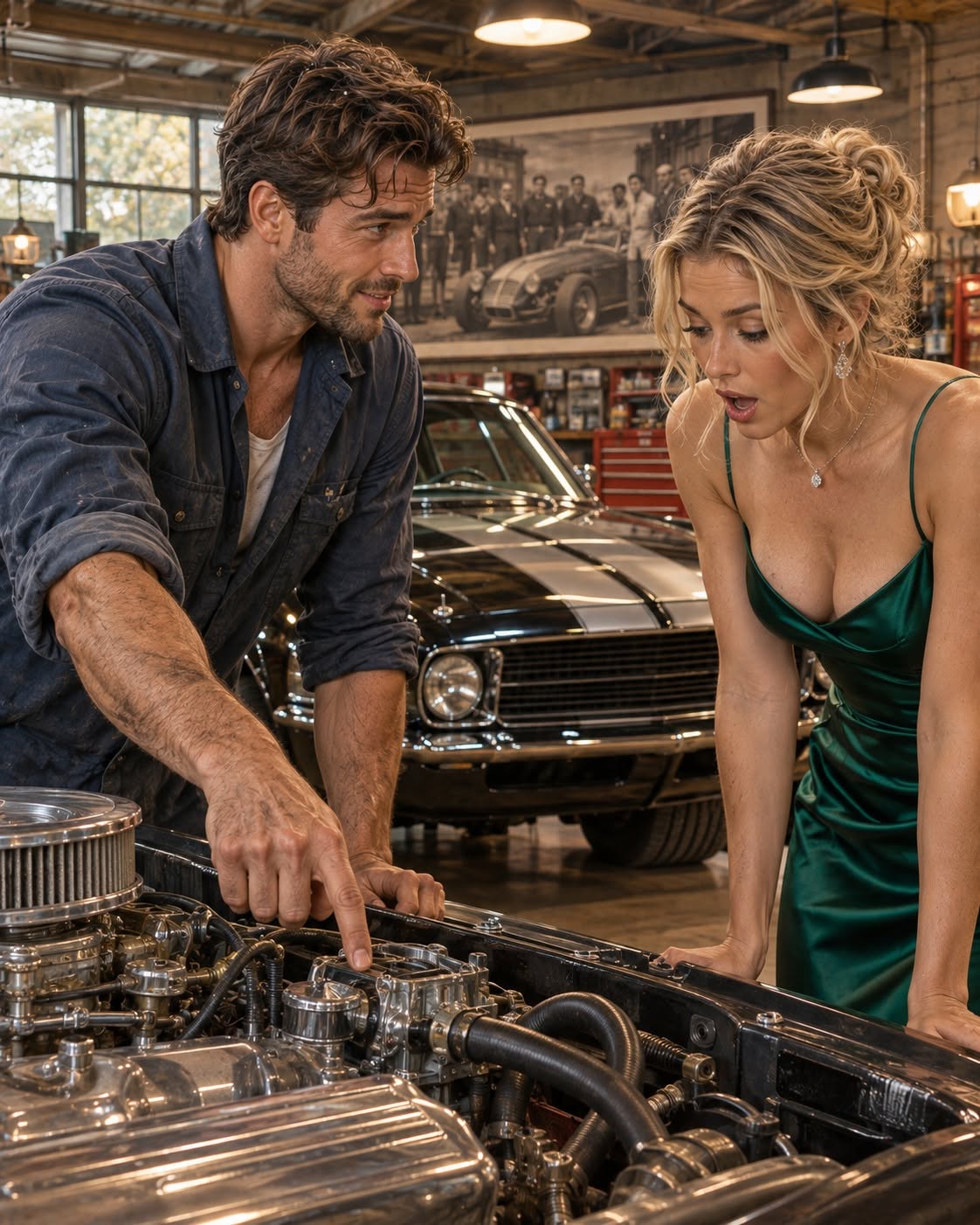
But I wasn’t celebrating.
I was staring at the car’s chassis number, trying to understand something that bothered me.
“Who owns this Shelby?”
Diana answered immediately.
“The company. It was purchased through a private collector.”
“Who was the collector?”
She looked toward Sandra.
Sandra opened the folder and checked a page.
“An estate belonging to a man named Edward Vance.”
My stomach tightened.
I knew that name.
Edward Vance had been the chief engineer of the racing program I worked for in 1968. He was a brilliant man, a demanding supervisor, and someone I had once considered a friend.
He was also the reason I had walked away from professional racing.
“Is he still alive?” I asked.
Diana shook her head.
“He passed away eleven years ago.”
I looked down at the transmission.
“Then there’s something you should know about this car.”
Everyone gathered closer.
“That Shelby wasn’t supposed to survive.”
I explained that the vehicle had originally been part of an experimental racing project. Its purpose had been to test a new transmission system under extreme conditions. The team had built several prototypes, but most had been dismantled after the project was abandoned.
One car, however, had disappeared.
I remembered working late one evening, making final adjustments to the linkage. Edward had entered the workshop carrying a stack of documents.
He told me the company was shutting down the project.
I had argued that we were close to solving the remaining problems.
He told me the decision had already been made.
Then, a few days later, I discovered that the engineering records had been altered. My name had been removed from several documents and replaced with Edward’s.
When I confronted him, he told me I was too young to understand how business worked.
I was twenty-seven.
I had a wife, a newborn son, and no desire to spend the rest of my life fighting powerful people over credit.
So I left.
A few years later, my wife became seriously ill. I abandoned my plans to return to racing and focused on raising Marcus.
I never looked back.
Until now.
Diana listened without interrupting.
When I finished, she closed the folder.
“There’s something else you need to see.”
She walked toward her office and returned carrying a large envelope.
Inside was a handwritten letter.
It was addressed to Daniel Mercer.
The signature at the bottom belonged to Edward Vance.
I recognized his handwriting immediately.
My hands began to tremble as I opened it.
The letter was dated November 1969.
It read:
“Daniel,
If you’re reading this, I hope you’ve found the courage to forgive me.
The transmission system was your design. The improvements, the calculations, and the final working prototype were all your work.
I allowed the company to place my name on the project because I believed it would protect the program from being canceled. I told myself I would correct the record once the car proved successful.
I never did.
I have spent years regretting that decision.
The car is being preserved with the original engineering documents. One day, I hope someone will find you and give you the recognition you deserved.
You were the best mechanic I ever worked with.
Edward.”
I read it twice.
Then I put it down.
For fifty years, I had convinced myself that my work didn’t matter.
Now a dead man was telling me he had been wrong.
“Why are you showing me this?” I asked Diana.
She looked directly at me.
“Because I want you to finish the restoration. And because I want your name on the exhibition.”
I glanced toward the Shelby.
“What about your team?”
“They’re excellent technicians. But they don’t know this car’s history. You do.”
Richard cleared his throat.
“I think we should discuss the budget before making any promises.”
Diana turned toward him.
“Daniel will be paid as the lead restoration consultant. His rate will be whatever he considers fair.”
I almost laughed.
Fair?
I hadn’t received a proper paycheck for my engineering work in decades.
But before I could answer, my phone vibrated.
It was Marcus.
“Hey, Dad. The bank called again.”
I closed my eyes.
“How bad?”
“They’re giving you until Friday. After that, they’re moving forward with foreclosure.”
I looked at the Shelby, then at the people standing around it.
For the first time in years, I saw a possibility beyond another overdue bill.
“I’ll handle it,” I told him.
When I hung up, Diana had already heard enough to understand.
“How much do you owe?”
I hesitated.
“That’s not your problem.”
“Maybe it is.”
“Diana, I don’t want charity.”
She nodded.
“Good. Because I’m not offering charity. I’m offering a contract.”
She placed a document on the table.
The restoration project had a substantial budget. The company needed someone to supervise the original mechanical systems, verify the engineering records, and prepare the car for exhibition.
The payment would be enough to save my garage.
But there was one condition.
The Shelby had to be ready in six weeks.
I stared at the deadline.
“Six weeks?”
“Six weeks,” she confirmed. “The exhibition opens in Monterey. There will be collectors, journalists, racing historians, and several former executives from the original program.”
I looked at the old drawings again.
Then I picked up the pen.
“I’ll need my own tools.”
Diana smiled.
“Of course.”
“And I want my name on every engineering document.”
“Agreed.”
“One more thing. Richard stays on the team.”
Richard looked surprised.
I turned toward him.
“You know more about modern materials and equipment than I do. I know this particular machine. If we work together instead of against each other, we might actually finish it.”
He studied me for a moment.
Then he extended his hand.
“Deal.”
For the first time in decades, I felt like I had somewhere important to be.
The next morning, I returned to my garage.
Marcus was waiting outside.
He was thirty-eight years old, taller than me, with the same dark eyes his mother used to have. He had spent most of his adult life working in construction management, and although he had always supported me, I knew he had never understood why I refused to sell the garage.
When he saw my expression, he raised an eyebrow.
“What happened?”
I handed him the contract.
He read it silently.
Then he looked up.
“Dad, is this real?”
“Looks real to me.”
He scanned the payment amount again.
“You’re going to Los Angeles?”
“For six weeks.”
He shook his head, smiling.
“After all these years, you’re finally getting your big break.”
I looked around the garage.
The cracked concrete. The aging hydraulic lift. The toolbox my wife had bought me for our first anniversary.
“Maybe,” I said.
Marcus folded the contract.
“Then let’s make sure you don’t lose this place while you’re gone.”
He offered to help organize the paperwork and speak with the bank.
I wanted to refuse.
He was my son, not my business partner.
But he gave me a look that reminded me of his mother.
“Mom didn’t spend her last years worrying about you just so you could spend the rest of your life worrying about everything alone.”
That stopped me.
I nodded.
“All right.”
We spent the afternoon cleaning the garage, organizing invoices, and preparing the equipment I would take to Los Angeles.
Before leaving, I stopped beside the photograph of the Riverside racing crew.
For years, I had looked at that picture as a reminder of the life I had abandoned.
Now I saw something different.
It was a reminder that some parts of us never really disappear.
They simply wait.
The first two weeks of restoration were exhausting.
The Shelby had spent decades in storage, and its mechanical systems showed the effects of time. Several components had deteriorated. The fuel lines needed replacement, the rear suspension required reinforcement, and the transmission housing contained hairline fractures that nobody had noticed during the initial inspection.
I worked alongside Richard and the other technicians for twelve hours a day.
At first, Richard questioned nearly every suggestion I made.
But gradually, something changed.
He began bringing me problems before attempting solutions.
I began asking him for help with the equipment I didn’t understand.
We discovered that our different experiences made us stronger.
One evening, while examining the original transmission housing, Richard found a series of tiny marks along the interior surface.
“Daniel, come look at this.”
I leaned over the workbench.
He pointed toward the markings.
“They’re not machining defects.”
I examined them carefully.
Then I recognized the pattern.
“Those are temperature indicators.”
Richard frowned.
“Paint?”
“Special heat-sensitive compound. We used it to measure localized stress during testing.”
He brought up the old engineering drawings.
We compared the markings with the original diagrams.
Something was wrong.
The transmission had been modified after the original testing phase. Whoever had made the changes had increased the torque capacity but weakened the housing in a critical area.
The car hadn’t simply been abandoned because the program was canceled.
It had been abandoned because someone had discovered a serious structural problem.
And nobody had documented the correction.
I spent the entire night reviewing the calculations.
By morning, I understood what had happened.
Edward had altered the final design without telling me.
The modification had made the car faster, but it had also created a dangerous stress concentration near the bellhousing.
If we restored the car using the original specifications, the transmission could fail under heavy acceleration.
I brought my findings to Diana.
She was not pleased.
“The exhibition is in four weeks,” she said. “Are you telling me we have to redesign the transmission?”
“I’m telling you we have to make it safe.”
“How long?”
“I don’t know yet.”
She stared at me.
“Daniel, this exhibition represents millions of dollars in sponsorships.”
I understood her position.
But I also understood what could happen if we ignored the problem.
“I won’t put someone in that car until I’m sure it won’t hurt them.”
For a moment, neither of us spoke.
Then Diana nodded.
“Then make it safe.”
That afternoon, Richard and I began designing a reinforcement system.
We worked through several versions. The first was too heavy. The second changed the balance of the drivetrain. The third worked mechanically but created excessive vibration.
On the fourth attempt, we found a solution.
It used a lightweight reinforced mounting structure that preserved the original geometry while distributing the stress more evenly.
Richard studied the final simulation.
“This might actually work.”
I smiled.
“Don’t sound so surprised.”
He laughed.
But the biggest surprise was still waiting.
Three days later, Sandra entered the workshop carrying a laptop.
“Daniel, I found something in the original company archives.”
She placed it on the table.
It was an internal memorandum from 1970.
The document described the experimental Shelby project and the reason it had been discontinued.
According to the official report, the prototype had failed during a high-speed test because of a mechanical defect attributed to poor workmanship.
The report named me as the responsible mechanic.
I felt the room become very quiet.
“That’s a lie,” I said.
Sandra nodded.
“I know. Look at the next page.”
The following document was an internal letter from Edward Vance to the company’s legal department.
It revealed that Edward had discovered the structural weakness in his modified transmission system but had failed to notify the testing team before the final run.
The driver had survived the resulting mechanical failure, but the accident had nearly destroyed the vehicle.
Edward had then blamed the incident on my original design to protect his reputation.
I read the document twice.
Then I sat down.
For more than fifty years, I had carried a failure that wasn’t mine.
I had never told Marcus the whole story.
I had never explained why I stopped racing.
I had simply allowed him to believe that I had grown tired of the industry.
Now I understood how much of my life had been shaped by someone else’s lie.
Diana stood beside me.
“We can make this public,” she said. “The exhibition organizers would support a correction.”
I looked at the document.
“Would they?”
“They have no reason to protect Edward anymore.”
I shook my head.
“I don’t want to spend the rest of my life fighting a dead man’s reputation.”
“But your reputation matters.”
I looked at her.
“Yes. It does. But there’s a difference between correcting the record and trying to destroy someone.”
I handed the memorandum back.
“Let’s finish the car first.”
Diana seemed disappointed, but she didn’t argue.
The following week brought another unexpected challenge.
The exhibition organizers announced that the Shelby would be driven during a demonstration event.
They wanted a former racing driver behind the wheel.
The original driver, a man named Thomas Reed, was still alive. He was seventy-nine years old and had retired decades earlier.
Diana arranged a meeting.
Thomas arrived at the facility in a wheelchair, accompanied by his granddaughter.
He was thin, silver-haired, and moved slowly.
But when he saw the Shelby, his eyes filled with tears.
“I never thought I’d see her again,” he whispered.
I stepped forward.
“Hello, Tom.”
He stared at me.
Then his face changed.
“Daniel Mercer?”
I nodded.
He reached for my hand.
“Good Lord. I thought you disappeared.”
We talked for nearly an hour.
Thomas told me about the original testing program, the late nights, the engineering arguments, and the accident that had ended everything.
Then he said something I hadn’t expected.
“Edward came to see me in the hospital after the crash. He told me the transmission failure was your fault. I believed him.”
He looked down.
“Years later, I found out the truth. I tried to contact you, but I couldn’t find you.”
I felt something tighten in my chest.
“I wish you’d found me.”
“So do I.”
Thomas looked toward the car.
“Do you think she’ll ever run properly?”
I smiled.
“Better than ever.”
He reached into his jacket and pulled out a small envelope.
Inside was an old photograph.
It showed the Shelby during its original testing phase, with me standing beside the transmission housing.
On the back, someone had written:
“Daniel’s machine. The one that could change everything.”
Thomas handed it to me.
“I kept this because I wanted someone to remember what you really did.”
I couldn’t speak.
For the first time in fifty years, I felt that the past was finally being put in its proper place.
Then Thomas asked a question that changed the entire direction of the project.
“Would you let me sit in her one more time?”
I looked at Diana.
She nodded.
We carefully helped Thomas into the driver’s seat.
His hands rested on the steering wheel.
He closed his eyes.
For a moment, he wasn’t an old man in a wheelchair.
He was a young racing driver preparing for a lap at Riverside Raceway.
“I can still hear the engine,” he whispered.
We started it for him.
The Shelby roared to life.
The sound filled the workshop, echoing off the metal walls and glass windows.
Thomas smiled.
And so did I.
But the car wasn’t finished.
We still had to complete the final road testing, and the exhibition was only days away.
The first test took place on a private track outside Los Angeles.
I stood beside the pit wall while Richard monitored the telemetry.
The Shelby accelerated smoothly through the first corner.
The transmission shifted perfectly.
Then, on the third lap, the temperature began rising.
“Daniel!” Richard shouted. “Oil pressure is dropping!”
The driver immediately slowed and returned to the pits.
I rushed toward the car.
There was no visible leak, no smoke, and no obvious mechanical failure.
But the temperature readings were climbing dangerously.
I checked the transmission.
Then the cooling system.
Nothing.
Richard pulled up the data.
“Could be a sensor problem.”
I shook my head.
“Not taking that chance.”
We spent the next hour checking every component.
Finally, I noticed a small detail.
The transmission cooler had been mounted slightly higher than the original design.
It looked harmless.
But under sustained acceleration, air was collecting in the upper section of the cooling line, restricting circulation.
The fix took two hours.
We lowered the mounting position, changed the routing, and installed a proper bleed connection.
On the second test, the temperature remained stable.
On the third, the Shelby completed the entire session without a problem.
Richard looked at me.
“I think we did it.”
I nodded.
“We did.”
Then my phone rang.
It was Marcus.
“Dad, I need you to come home.”
His voice sounded strange.
“What’s happened?”
“The bank. They won’t accept the extension.”
I felt my stomach drop.
“I thought you had an agreement.”
“We did. But there’s a problem with the garage title. Someone filed a claim against the property.”
I looked toward Diana.
“Who?”
“An investment company. They say they purchased the outstanding debt.”
I closed my eyes.
The garage had been in my family for nearly thirty years. My wife and I had built our life around it.
Losing it would mean losing the last physical piece of the life we had shared.
“I’ll come home tomorrow,” I said.
After the call, I told Diana what had happened.
She listened carefully.
Then she asked for the company’s name.
When I told her, her expression changed.
“I know them.”
“How?”
“They approached us last year about acquiring several historic automotive properties. They specialize in buying distressed businesses and converting them into luxury storage facilities.”
I felt sick.
“They want my garage?”
“Possibly.”
Diana made a few calls.
By evening, she had discovered something troubling.
The investment company had been purchasing overdue loans from several local banks. They were targeting older automotive businesses with valuable land.
My garage was one of them.
But Diana found another connection.
The company was owned by a holding group whose largest investor had been Edward Vance’s former business partner.
The same man who had helped bury the original Shelby project.
His name was Charles Whitmore.
I stared at her.
“You’re telling me the people who destroyed my career are trying to take my garage?”
“I can’t prove that yet,” she replied. “But the timing is suspicious.”
For a moment, I wanted to abandon the exhibition, drive home, and fight for everything I had left.
Then I looked at the Shelby.
We were so close.
And for once, I wasn’t alone.
Diana offered to have her legal team review the claim.
I accepted.
The next morning, Marcus called again.
“Dad, something else happened.”
“What?”
“There’s a man outside the garage. He says he’s representing the investment company. He wants to inspect the property.”
I felt anger rising.
“Tell him he needs to speak with my lawyer.”
“I did. He says he has legal authority.”
“Don’t sign anything.”
“I won’t.”
Then Marcus hesitated.
“Dad, there’s something I haven’t told you.”
I waited.
“Last month, I started looking through Mom’s old paperwork. I found a letter from the bank dated shortly before she died. She had arranged something with the original property owner.”
“What kind of arrangement?”
“I don’t know yet. But there’s a reference to a separate ownership agreement.”
I went quiet.
My wife had always been better at handling paperwork than I was.
She had also been fiercely protective of the garage.
“Send me a picture,” I said.
Five minutes later, Marcus sent the document.
It was an old agreement from the year we purchased the property.
My wife had insisted on a clause stating that if the garage ever faced foreclosure, the original seller would have the first right to repurchase it before any third-party investment company could acquire it.
I read the clause carefully.
Then I called Diana’s legal team.
By the end of the afternoon, they had confirmed that the clause was still enforceable.
The investment company had purchased the debt, but it had not acquired unrestricted ownership rights.
They couldn’t simply take the property.
For the first time in days, I felt hopeful.
Still, there was one problem.
The legal fight would take time.
Time I didn’t have.
The exhibition was scheduled for Saturday.
I needed to return home.
But the restoration had reached its final stage, and the Shelby was ready for its public debut.
Diana offered a solution.
“We’ll bring the exhibition to you.”
I stared at her.
“What?”
“The car can be transported to your garage for the final unveiling. We’ll invite the press, the collectors, and the racing historians. Your shop will become the place where this story is told.”
I didn’t know what to say.
A week earlier, she had considered my garage unworthy of a million-dollar car.
Now she was proposing to make it the centerpiece of an international exhibition.
“Why?” I asked.
Diana smiled slightly.
“Because I was wrong about your garage.”
She paused.
“And because I think the world should see where real engineering begins.”
On Saturday morning, a convoy of transport vehicles arrived outside my little two-bay shop.
Marcus was standing beside the entrance.
When he saw me step out of the car, he grinned.
“Looks like we have company.”
The Shelby was unloaded carefully.
Its deep blue paint gleamed beneath the morning sunlight.
A crowd began gathering.
Local mechanics, former customers, journalists, collectors, and people who had known me for decades stood outside.
I recognized faces I hadn’t seen in years.
Some had come to congratulate me.
Others simply wanted to see the famous Shelby.
Then Thomas Reed arrived.
He had insisted on attending.
His granddaughter pushed his wheelchair through the crowd.
When he saw the car, he smiled.
“She made it.”
I walked over and shook his hand.
“She made it, Tom.”
The exhibition began with Diana addressing the crowd.
She explained the history of the Shelby project, the restoration process, and the rediscovery of the original engineering records.
Then she turned toward me.
“And now, I’d like to introduce the man whose work made this restoration possible.”
Applause filled the street.
I stepped forward.
For a moment, I couldn’t move.
I had spent decades avoiding attention.
Now dozens of cameras were pointed at me.
Diana handed me a microphone.
I looked at the people gathered outside my garage.
“I’ve worked on cars most of my life,” I began. “And I’ve learned that people often make the mistake of judging a machine by how it looks.”
A few people laughed.
I continued.
“They see an old engine and assume it’s finished. They see a small garage and assume nothing important can happen there. They see a person who’s been away from an industry for a long time and assume they’ve forgotten everything.”
I looked toward the Shelby.
“But knowledge doesn’t disappear just because the world stops asking for it.”
The crowd became quiet.
“Sometimes the most important things are the things we almost throw away. Old photographs. Forgotten drawings. A handwritten note. A mechanic who never got the credit he deserved.”
I paused.
“And sometimes, all it takes is one person willing to look twice.”
Diana stepped forward.
She announced that the company had officially amended its historical records to recognize me as the original designer of the transmission system.
She also announced that the Shelby would be exhibited with my original engineering drawings and a permanent record of the team’s work.
Then she revealed something I hadn’t expected.
The company wanted to establish a restoration scholarship in my name.
It would provide training and financial assistance to young mechanics who wanted to specialize in historic motorsport engineering.
I looked at her in disbelief.
“Daniel Mercer Technical Scholarship,” she said. “For the next generation of people who believe that skill matters more than prestige.”
I felt my eyes burning.
Marcus stood beside me.
He reached over and squeezed my shoulder.
My wife would have loved that moment.
But the biggest surprise came afterward.
As the crowd began moving toward the Shelby, a black luxury sedan pulled up across the street.
A man stepped out.
He was in his late seventies, dressed in an expensive suit.
I recognized him immediately from the old racing photographs.
Charles Whitmore.
He approached Diana’s legal representative and handed him a document.
“Mr. Mercer,” he said, turning toward me. “I believe we need to discuss your property.”
I looked at him.
“I don’t think we do.”
He smiled coldly.
“You may want to reconsider. My company holds the debt on this building.”
“Your company holds the loan,” Diana’s attorney interrupted. “It does not hold unrestricted title. We’ve reviewed the original repurchase agreement, and your acquisition notice is legally defective.”
Whitmore’s smile disappeared.
He glanced at the lawyer.
“That agreement is outdated.”
“It’s legally binding,” the attorney replied. “And we have the original signed copy.”
Whitmore turned toward me.
“You have no idea how much trouble you’re creating.”
I looked him directly in the eyes.
“For fifty years, I let men like you decide what my work was worth. I’m not doing that anymore.”
He said nothing.
The attorney handed him a formal notice disputing the foreclosure claim.
Whitmore read it, folded it, and walked back toward his car.
Before getting inside, he turned once more.
“This isn’t over.”
I nodded.
“Maybe not. But today isn’t yours.”
The crowd had heard every word.
And for the first time, I didn’t feel like a mechanic defending a small garage against a powerful man.
I felt like someone who finally understood his own worth.
The legal dispute continued for several months.
There were letters, hearings, and negotiations.
Eventually, the investment company withdrew its foreclosure claim after the original agreement was upheld and its acquisition documents were found to contain serious legal deficiencies.
The garage was safe.
But something else changed during those months.
Diana began visiting regularly.
She brought young mechanics from her restoration program to learn from me.
Richard became one of my closest friends.
He even started calling my garage “the most expensive classroom in California.”
I told him it was still the cheapest place to get an oil change.
Marcus also became more involved.
He had always worked in construction management, but now he helped modernize the garage, improving its layout without destroying the character that made it special.
We installed better lighting, upgraded the equipment, and repaired the old roof.
But we kept the original tool cabinet.
And the Riverside photograph remained exactly where it had always been.
One afternoon, almost a year after the Shelby exhibition, I received an unexpected package.
It came from the estate of Edward Vance.
Inside was a small metal box.
There were several old engineering notes, a handful of photographs, and another letter.
This one had been written shortly before Edward died.
It contained only a few paragraphs.
“Daniel,
I know an apology cannot return the years you lost.
I cannot ask you to forgive me.
But I hope you will understand that my greatest mistake was not stealing credit for your work.
It was believing that success meant being remembered by powerful people.
I spent my life trying to protect my reputation.
You spent yours raising a son and building something that mattered to ordinary people.
I suspect you accomplished more than I ever did.
The drawings belong to you.
Edward.”
I read the letter in silence.
Then I placed it inside the metal box.
I didn’t feel anger anymore.
Nor did I feel the need to forgive him immediately.
Some wounds take time.
Some never completely disappear.
But I no longer needed an apology to know who I was.
That evening, Marcus came into the office.
He noticed the letter on my desk.
“From Edward?”
I nodded.
“What did he say?”
I handed it to him.
Marcus read it carefully.
Then he looked at me.
“Do you wish things had gone differently?”
I thought about the years I’d spent away from racing.
The nights I had worked overtime to pay the mortgage.
The birthdays I’d nearly missed.
The mornings I had driven my son to school after staying up all night repairing someone else’s car.
I thought about my wife.
And I thought about the life we had built.
“Sometimes,” I admitted. “But then I remember that if I had stayed in racing, I might have missed everything that mattered.”
Marcus smiled.
“You didn’t miss me.”
“No,” I said. “I didn’t.”
A few weeks later, the scholarship program officially opened.
The first recipient was a nineteen-year-old named Luis Ramirez.
He had grown up in a working-class neighborhood, repairing bicycles and lawn mowers with his grandfather.
He had excellent mechanical instincts but couldn’t afford formal training.
When he arrived at my garage for his first day, he looked nervous.
“Mr. Mercer,” he said, “I’ve read everything I could find about the Shelby restoration.”
I laughed.
“Then you probably know more about it than I do.”
He smiled.
I handed him a toolbox.
“Let’s see what you can do.”
His first assignment was a neglected vintage engine sitting in the back of the garage.
He spent two hours examining it without touching a single bolt.
Finally, he looked up.
“I think the previous owner installed the wrong camshaft.”
I raised an eyebrow.
“Why?”
“The timing marks don’t match the valve sequence. Somebody probably replaced the original cam without checking the specifications.”
I walked over and examined it.
He was right.
I smiled.
“Good eye.”
He looked relieved.
And I realized something important.
The best part of the Shelby restoration had never been the exhibition, the money, or the recognition.
It was what came afterward.
A young mechanic had been given an opportunity because someone had finally recognized the value of experience.
Years passed.
My garage became known as a place where old machines received new lives and young mechanics learned to respect the people who came before them.
We restored classic racing cars, trained apprentices, and occasionally helped museums identify forgotten engineering components.
The Shelby remained the centerpiece of the collection.
Every year, it returned to the exhibition circuit.
And every year, Diana invited me to stand beside it.
I never got used to the applause.
But I learned to accept it.
Then, on the fifth anniversary of the restoration, something happened that brought everything full circle.
A young woman arrived at the garage carrying a framed photograph.
She introduced herself as Emily Reed.
Thomas Reed’s granddaughter.
She had become an automotive engineer.
“Grandfather passed away last month,” she told me gently. “Before he died, he asked me to bring you this.”
She handed me the frame.
Inside was a photograph of Thomas sitting in the Shelby during the exhibition.
He was smiling.
His hands rested on the steering wheel, and the sunlight illuminated his face.
On the bottom, someone had written:
“To Daniel. Thank you for giving me one last ride.”
I stared at the photograph for a long time.
Emily smiled through her tears.
“He talked about you until the end.”
I nodded, unable to find the right words.
Then she added something that surprised me.
“Grandfather left me something else. He wanted me to give you the original racing gloves he wore during the 1969 testing program.”
She opened a small box.
Inside were a pair of worn leather gloves.
The fingers were stained, the seams faded, and one glove had a small tear near the thumb.
I recognized them immediately.
They were the gloves Thomas had worn during the accident.
I carefully picked them up.
For a moment, I could almost hear the old engine again.
Emily looked around the garage.
“Would you mind if I worked here sometimes? I want to learn more about historic racing systems.”
I smiled.
“Do you know how to use a wrench?”
She laughed.
“Yes.”
“Good. We have plenty.”
That afternoon, I hung Thomas’s photograph beside the original Riverside crew picture.
Two photographs.
Two different moments.
One showed a young team believing they could build something extraordinary.
The other showed two old friends finally getting the ending they had deserved.
I stood back and looked at them.
Marcus walked in carrying a cup of coffee.
“Still thinking about the old days?”
I shook my head.
“No. Thinking about what’s next.”
He looked toward the photographs.
“Funny, isn’t it? You spent years thinking that leaving racing meant losing your future.”
I nodded.
“And I spent years thinking the garage was the only thing I had left.”
Marcus leaned against the workbench.
“Turns out you had a lot more.”
I smiled.
He was right.
I had spent too much of my life believing that success was something measured by money, reputation, and the number of people who knew your name.
But the years had taught me something different.
Success was seeing your son become a good man.
It was keeping a promise to the woman you loved.
It was helping someone younger discover a talent they didn’t know they had.
It was building something that remained useful long after the applause had faded.
And sometimes, success was simply having a place where someone could walk through the door, ask for help, and know they would be treated with respect.
A month later, Diana visited the garage.
She was no longer the woman who had once looked at my oil-stained floor with disappointment.
She walked inside, greeted everyone by name, and stopped beside the Shelby photograph.
“Do you ever regret taking this project?” she asked.
I looked at her.
“Not for a second.”
She smiled.
“Neither do I.”
Then she handed me an envelope.
Inside was an invitation to a major international classic motorsport exhibition.
The organizers wanted me to give the opening address.
I laughed.
“Diana, I’m a mechanic. I’m not a public speaker.”
She shook her head.
“You’re a man with a story worth hearing.”
I glanced toward Marcus and the young mechanics working at the benches.
Then I looked at the old tool cabinet.
The photograph was still there.
The same faded image that had once made Diana stop at the door.
I accepted the invitation.
On the day of the exhibition, I stood before a packed auditorium.
Collectors, engineers, historians, racing enthusiasts, and young mechanics filled the seats.
Behind me, a massive screen displayed the original Riverside photograph.
I took a breath.
“Fifty-eight years ago, I stood in a workshop much like this one, surrounded by people who believed we could build something extraordinary.”
I paused.
“Some of us became famous. Some disappeared from the history books. Some made mistakes. Some were treated unfairly. But the machines we worked on remained.”
The audience listened.
“I used to believe that my greatest achievement was designing a transmission system for a racing car. I was wrong.”
I looked toward the front row.
My son was sitting there.
Beside him were Luis and Emily, both now qualified engineers.
“My greatest achievement was never a machine. It was the people who came into my life because of the work I loved.”
I smiled.
“Cars can be rebuilt. Engines can be repaired. Even reputations can be restored. But time is something we never get back. So don’t spend all your years chasing recognition from people who may never understand your worth.”
The room was silent.
“Build something useful. Teach someone what you know. Take care of the people who depend on you. And never assume that a small place or an ordinary life cannot produce something extraordinary.”
When I finished, the applause lasted longer than I expected.
But I wasn’t thinking about the audience.
I was thinking about my wife.
About the little boy who had once fallen asleep in the office while I repaired engines.
About the young mechanic who had finally received credit for his work.
And about the old racing driver who had been given one last chance to sit behind the wheel.
That evening, I returned home with Marcus.
The garage was quiet.
The lights above the workbenches were still on, illuminating the tools and photographs.
I stopped at the entrance and looked around.
The place was no longer struggling to survive.
It had become something bigger than a business.
It was a school, a workshop, a meeting place, and a home for people who believed that craftsmanship still mattered.
Marcus put a hand on my shoulder.
“Ready to go, Dad?”
I nodded.
Then I looked once more at the old photograph.
The young man standing beside the race car looked confident, ambitious, and certain that his future would be spent on racetracks around the world.
He had no idea what life had waiting for him.
He didn’t know he would lose the woman he loved.
He didn’t know he would raise a son alone.
He didn’t know that one day, a wealthy woman would walk into his little garage, judge him by the stains on his floor, and then discover that the man she had underestimated was the very person who had built the machine she was trying to save.
But perhaps that was the point.
Life rarely gives us the story we planned.
Sometimes it takes away the future we imagined and gives us something we never knew we needed.
I switched off the lights.
As we walked toward the door, Marcus turned back.
“Dad?”
“Yeah?”
“Do you think Mom would be proud?”
I looked at the photographs one last time.
I could almost picture her standing beside the old tool cabinet, smiling the way she used to whenever I finished a difficult repair.
“More than you know,” I said.
And for the first time in many years, I didn’t feel as though I had lost the life I once dreamed of.
I felt grateful for the one I had actually lived.
Because the world had spent decades overlooking a small garage and the old mechanic who worked inside it.
But the garage had never been small to the people whose lives had changed there.
And I had finally learned that a person’s worth is never measured by the size of their workshop, the price of their tools, or the number of zeros in their bank account.
It is measured by what they build, what they preserve, and what they leave behind in the hands of others.
Sometimes the greatest restoration isn’t bringing an old machine back to life.
It’s reminding a person that their life still has something extraordinary left to offer.