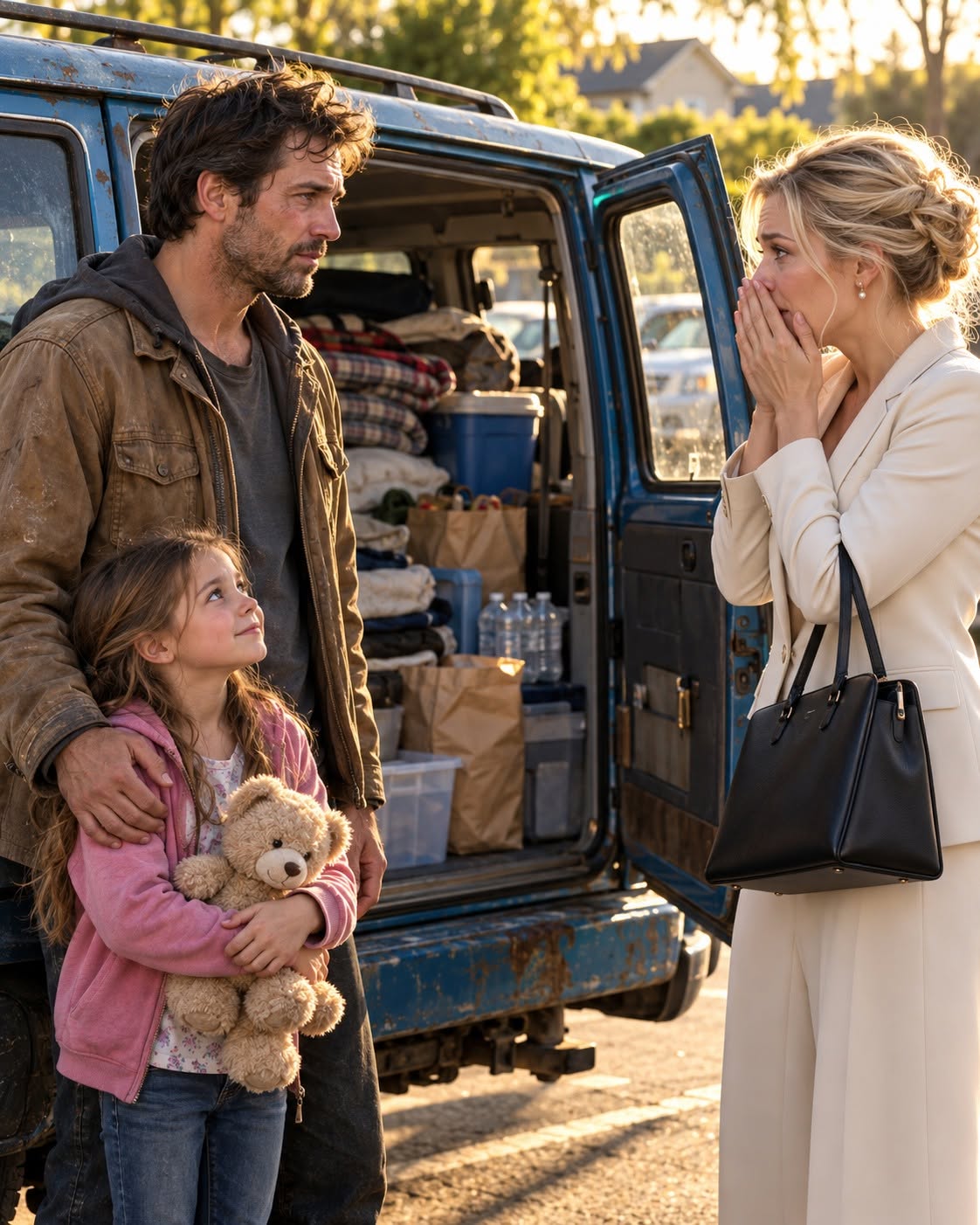
The wealthy woman stepped out of her luxury SUV, looked at my rusty blue pickup, and laughed. “Did that thing survive a war?”
Victoria didn’t spend those four hours talking about donations, business opportunities, or how generous she was being. She carried boxes, listened to people, and learned their names.
We visited mothers sleeping in minivans with their children, veterans struggling to get back on their feet, and workers who had lost their housing after rent increases swallowed what little they had left.
One mother accepted a bag of toiletries and immediately began apologizing because she couldn’t offer us anything in return.
Victoria knelt beside her and said, “You don’t owe us anything.”
The woman began to cry.
I watched Victoria quietly hand her another bag, this one containing children’s books and a handwritten note from Daisy.
By the end of the afternoon, Victoria looked exhausted. Her expensive hands were red from carrying boxes in the cold, and she had spent more time listening than speaking.
On the drive back, she admitted something that stayed with me.
“I’ve invested in buildings all over this city,” she said. “I thought I understood the housing market. But I never really understood the people struggling to afford a place to live.”
I told her that most people weren’t asking for miracles. Sometimes they just needed a little help getting through the week.
She never forgot that conversation.
Over the following year, Victoria helped us expand our efforts without turning our small project into a publicity campaign. She arranged storage space for supplies, secured emergency motel vouchers for families who had nowhere safe to sleep, and quietly asked several corporate partners to contribute essentials.
She never put my face on a billboard or asked me to tell our story at a fundraising gala.
She understood that I was a father first, not someone looking for recognition.
Daisy kept writing her notes.
“You matter.”
The words went into grocery bags, winter coat pockets, and boxes of supplies. Sometimes recipients tucked them away carefully. Sometimes they read them immediately and wiped their eyes.
And Old Blue kept making its rounds.
Then, three years later, on a bitter January morning, the engine finally gave out.
I sat behind the steering wheel, turning the key while the starter struggled. The familiar dashboard rattled, but the engine wouldn’t catch.
Daisy sat beside me, staring at the old truck as if it had just told her some terrible news.
“Is Old Blue going to be okay?” she asked.
I looked at the cracked dashboard and the worn steering wheel my father had held for years.
“I don’t think we can fix this one, sweetheart.”
She didn’t cry, but she reached over and rested her hand on the dashboard.
For the next few days, I worried about replacing it. I needed a dependable vehicle with enough room for our supplies, but buying one outright would take money away from our household and Daisy’s medical expenses.
When Victoria heard what had happened, she didn’t show up with a shiny new truck and a giant ribbon.
Instead, she helped me find a reliable used pickup with plenty of cargo space. It was practical, well-maintained, and already paid for when I took the keys.
There was no loan hanging over my head. No extravagant gesture. Just a vehicle that could get us where we needed to go.
When we brought it home, Daisy and I transferred every supply bin from Old Blue into the new truck.
Then she climbed into the cab, reached beneath the old dashboard, and carefully unscrewed the vintage metal emblem we’d kept from my father’s truck.
She held it in both hands for a moment before placing it inside the new pickup.
“Now Old Blue can come with us,” she said.
I swallowed hard and nodded.
Victoria stood nearby, watching without saying a word.
That was when I understood something I’d been too busy surviving to recognize: the value of what we’d built had never depended on the age of our truck, the money in our bank account, or whether anyone knew our names.
My old pickup had carried my father’s memory. It had carried my daughter through difficult years. And it had carried food, blankets, and small reminders of hope to people who needed them.
Now another truck would do the same.
Victoria had helped us reach more people, but Daisy and I had taught her something, too. Kindness didn’t need an audience, and helping someone didn’t require having all the answers.
Sometimes it began with noticing that another person was cold, hungry, or afraid—and deciding not to look away.
As Daisy settled into the passenger seat, she patted the dashboard of our new truck.
“Okay, buddy,” she whispered. “Let’s go help somebody.”
I started the engine.
And for the first time in a long while, I realized that even after everything we’d lost, we still had something worth carrying forward.
That first trip in the new truck was supposed to be an ordinary Saturday delivery. We had twelve supply kits, several bags of groceries, and a list of families we planned to visit before sunset.
But halfway through our route, my phone rang.
It was Melissa, a social worker we had met during our first year of deliveries. Her voice sounded strained, and I could hear people talking frantically in the background.
“Daniel, I need help. An apartment building in Antioch has been evacuated. The pipes burst overnight, part of the ceiling collapsed, and the fire department says the building isn’t safe to occupy. Thirty-four families have nowhere to go.”
I pulled onto the shoulder.
“Are they all out safely?”
“Yes, but it’s freezing. Some families left with whatever they could grab. Others were at work and haven’t even seen their apartments yet. The emergency shelters are full.”
I looked at Daisy, who had already stopped sorting the delivery bags.
“Can we bring supplies?” I asked.
“Supplies, yes. But what they really need is somewhere to sleep tonight.”
I promised Melissa we would help and ended the call.
For a moment, I sat silently behind the steering wheel, trying to calculate what we could realistically do. We had a truck, some supplies, and a small network of people who cared. We didn’t have a shelter, a staff, or enough money to place dozens of families in hotel rooms.
Then Daisy touched my arm.
“Dad, remember what you told me about not looking away?”
I nodded.
“Then we shouldn’t look away now.”
I looked at my eight-year-old daughter, who had somehow learned to recognize a person’s need before I had finished calculating the cost of meeting it.
“All right, sweetheart,” I said. “Let’s find out what we can do.”
We drove to the apartment complex. The parking lot was filled with emergency vehicles, and families stood in small groups beneath a gray winter sky. Some clutched plastic bags containing their belongings. One elderly man sat on a suitcase while a little girl leaned against his knee.
A woman in a thin sweater was holding a sleeping baby against her chest. She kept asking an emergency worker whether she could return to her apartment for the baby’s medication and extra clothes.
Everywhere I looked, I saw the same expression: shock mixed with the fear of not knowing what came next.
Victoria arrived twenty minutes later in the same practical clothes she had worn on our deliveries. She had brought blankets, thermoses of hot soup, and two employees from her property management office.
She surveyed the scene, then came directly to me.
“How many families?”
“Thirty-four households. At least that many, according to Melissa.”
“Where are they going tonight?”
“That is the problem.”
Victoria glanced toward the building. Several windows were fogged with condensation, and water had frozen in patches along the pavement.
“I have a vacant property about fifteen minutes away,” she said. “A former motor lodge. We bought it six months ago. The renovation hasn’t started, and the building is empty.”
Hope rose in my chest before I could stop it.
“How many rooms?”
“Forty-two.”
“Could we use it?”
She didn’t answer immediately.
“The building is structurally sound, but the rooms haven’t been prepared for occupancy. The utilities are partially disconnected, and we haven’t completed the fire safety inspections.”
“So we can’t put people in there tonight.”
“Not without making certain it’s safe.”
She said it reluctantly, but I respected her for saying it. Desperation could make a person careless, and the last thing these families needed was another emergency.
Victoria pulled out her phone.
“I’m calling the city inspector, the fire marshal, and my renovation contractor. Meanwhile, we need somewhere warm for everyone.”
That was how our ordinary Saturday became the longest day I could remember.
Melissa arranged for a nearby community center to open its multipurpose room as a temporary warming space. Victoria’s employees contacted local churches and charitable organizations to find additional hotel rooms. I drove back and forth with our new truck, delivering blankets, food, bottled water, and hygiene supplies.
Daisy stayed at the community center with Melissa, sorting donated clothes by size and helping younger children find books and coloring pencils.
Every few minutes, I caught sight of her handing a child one of her notes.
“You matter.”
An exhausted mother read one, closed her eyes, and held it against her chest.
I turned away before she could see me wiping my face.
By late afternoon, we had found temporary rooms for most of the families, but twelve households still had nowhere suitable to stay together. Several motels were full, and the community center could only offer floor space for the night.
Victoria returned from the vacant property with her contractor and the city inspector.
“The main structure is sound,” she told me. “The problem is getting enough rooms approved for temporary use. Some smoke detectors need replacing, the emergency lighting needs inspection, and the hot water system has to be tested.”
“How long?”
“If every contractor gets here tonight, perhaps we can have a limited number of rooms ready by tomorrow afternoon. But nothing opens until the authorities sign off.”
I glanced toward the families sitting beneath the community center’s fluorescent lights.
“Tomorrow afternoon is better than nothing.”
Victoria looked at me, then at the children sleeping on folded coats.
“No,” she said quietly. “It is. But it’s not good enough for me to pretend this is just a temporary inconvenience.”
I knew that look. It was the expression she wore whenever she was about to make a decision that would cost her something.
“I’m going to talk to my partners,” she said. “The renovation may have to wait.”
I assumed she meant a few days.
I was wrong.
The following morning, I arrived at the motor lodge shortly after sunrise. Contractors were inspecting the electrical systems, workers were clearing debris, and the fire marshal was checking the emergency exits.
Victoria stood beside a stack of inspection reports, speaking to a man in a charcoal suit.
He looked irritated.
“Victoria, we have a signed redevelopment plan. Every month this property sits idle costs us money. Now you’re proposing to turn an investment asset into an emergency shelter?”
“Temporary housing,” she corrected. “For families who lost their homes through no fault of their own.”
“And what happens when temporary becomes permanent? What about liability? What about our investors? We didn’t purchase this property to run a charity.”
I recognized the tone immediately. It was the same kind of voice I had heard from people who considered compassion an unnecessary expense.
Victoria’s expression remained calm.
“The building has been sitting empty for six months. These families have children sleeping in borrowed rooms and community halls. If we can provide safe accommodation while their apartments are repaired, I believe we should.”
The man lowered his voice.
“Then pay for hotel rooms yourself. Don’t tie up an entire property.”
“I am paying for some of those rooms already.”
“That isn’t the point.”
“No,” Victoria replied. “The point is that we have an opportunity to prevent thirty-four families from being pushed into a longer crisis. I’m not going to pretend I don’t see that simply because our original spreadsheet didn’t include it.”
He walked away without saying goodbye.
When Victoria turned and saw me, she gave a tired smile.
“You heard that?”
“Enough of it.”
“His name is Richard. He’s one of our investment partners. He’s not a bad man, Daniel. He just thinks in terms of risk and return.”
“So do I,” I said. “Every day. I calculate how many hours I need to work to pay the bills. I calculate what Daisy’s medical appointments will cost. I calculate whether repairing a cabinet is worth losing half a day’s wages.”
I paused.
“But I’ve learned there are things you can’t measure properly if money is the only number you use.”
Victoria studied me.
“That’s exactly the argument I made.”
“Then I hope he understands it.”
She looked at the motor lodge.
“I hope I do, too.”
That afternoon, the authorities approved eighteen rooms for temporary occupancy, subject to specific safety requirements and ongoing inspections. The other rooms would remain closed until they were cleared.
It wasn’t enough for everyone, but it was a beginning.
Melissa helped determine which families had the most urgent needs. Parents with young children, elderly residents, and people with disabilities were given priority. Other families received hotel placements or assistance from partner organizations.
By evening, twelve households had been moved into the motor lodge.
I spent hours carrying suitcases, assembling simple furniture, and helping workers replace damaged door hardware. My carpenter’s tools were more useful than my ability to raise money, and for once I was grateful that my hands knew what to do without needing to ask permission.
One room belonged to a mother named Renee and her two children, Lucas and Sophie.
Lucas was about ten, tall for his age, and painfully quiet. While Renee unpacked their clothes, he stood beside the window, looking out at the parking lot.
“Do you like your room?” I asked.
He shrugged.
“It’s okay.”
“Just okay?”
He glanced at his mother before answering.
“We’ve moved three times this year. Mom says this one is only temporary.”
Renee stopped unpacking.
“Lucas.”
“What? It’s true.”
She looked embarrassed.
“I’m sorry. He’s been through a lot.”
“There’s nothing to apologize for,” I said.
Lucas stared at the small television on the dresser.
“Are we going to have to leave tomorrow?”
The question hit harder than I expected.
I crouched so that we were eye to eye.
“I don’t know exactly how long you’ll stay here, buddy. But no one is going to make you leave tonight. The people helping you are working on the next steps, and your mom will have the information as soon as we do.”
He studied my face, searching for a promise I couldn’t honestly make.
Then Daisy appeared at the doorway carrying two children’s books and a folded note.
“My dad says we’re supposed to be honest when we help people,” she told him. “So he can’t promise something he doesn’t know. But he can promise we’re going to keep trying.”
Lucas looked at her.
She handed him the note.
It read, “You matter.”
He read it once, then folded it carefully and placed it inside his backpack.
“Thanks,” he whispered.
That evening, after we finished helping the last family settle in, Daisy and I sat in the truck while I warmed my hands against the heater.
She was unusually quiet.
“What’s wrong, sweetheart?”
“Dad, why do people get upset when someone helps?”
I thought about Richard’s objections and the argument I had overheard that morning.
“Sometimes people are afraid they’ll lose something. Money, time, control, the plan they worked hard to make. They start thinking that helping somebody means giving up everything else.”
“But Victoria has lots of money.”
“She does.”
“And people still got mad at her.”
I smiled faintly.
“Having money doesn’t make hard choices easy. It just means some of the choices are different.”
Daisy stared through the windshield.
“I’m glad she chose to help.”
“So am I.”
She leaned her head against my shoulder.
“Do you think Mom would be proud of us?”
The question caught in my throat.
Nora had been gone for five years, but Daisy still found new ways to make me miss her. My wife had believed that kindness wasn’t a grand gesture; it was the small, consistent decision to care when the world offered a hundred reasons not to.
I kissed Daisy’s forehead.
“I think your mom would be incredibly proud of you.”
For the next two weeks, the motor lodge became a small, improvised community.
Volunteers delivered groceries. Local businesses donated children’s clothes and school supplies. A retired nurse visited several residents who needed assistance navigating medical appointments. An electrician who had once received a supply kit from us came back with his tools and volunteered to inspect the room lighting.
Every day, someone who had initially arrived needing help found a way to help somebody else.
Renee began organizing the laundry schedule so that parents could get their children’s clothes washed without waiting for hours. An older man named Mr. Carter, a veteran we had been assisting for nearly a year, helped repair a loose handrail near the reception area. Even Lucas, who had barely spoken during the first few days, began helping Daisy sort books for the children.
People were not merely receiving assistance. They were rebuilding a sense of belonging.
Victoria noticed it, too.
One evening, she found me repairing a wooden cabinet in the small common room.
“Look at this place,” she said. “A few weeks ago, I saw it as a property waiting to be renovated. Now I see people starting to feel safe again.”
I tightened a screw.
“That’s what a home does.”
She sat on a nearby chair.
“I’ve been thinking about something. We keep responding after families lose their housing. We provide blankets, motel vouchers, food, and temporary rooms. But what happens when the immediate emergency ends?”
“They go wherever they can afford.”
“And some end up right back where they started.”
I nodded.
“That happens more often than people realize.”
She looked down at her hands.
“I know how to build apartments. I know how to estimate renovation costs, manage contractors, and calculate returns. But I don’t know enough about creating a path from temporary shelter to stable housing.”
“Then talk to the people who do.”
“Social workers?”
“Social workers. Housing advocates. The families themselves. Ask them what gets in the way.”
She was quiet for a long time.
Finally, she asked, “Would you help me put something together?”
I almost laughed.
“Victoria, I’m a carpenter. I don’t write housing plans.”
“You understand what it means to work hard and still struggle to stay afloat. You understand what a family needs when everything goes wrong. And you have earned the trust of people who won’t tell me what they really think if they assume I’m just another wealthy developer.”
I looked at the cabinet I had been repairing.
I had spent years believing my responsibilities ended with providing for Daisy, paying the bills, and keeping our little volunteer project alive. Anything larger felt beyond my reach.
But I remembered the father and son who had first inspired us to start delivering supplies. I remembered Daisy writing her notes at our kitchen table and the people we had met along the way.
“All right,” I said. “I’ll help.”
What followed wasn’t a miracle, and it certainly wasn’t easy.
Victoria assembled a working group of social workers, housing specialists, contractors, and several residents who had experienced housing insecurity themselves. They studied why families were being displaced and which existing programs could help them move into stable housing.
They discovered that emergency accommodation often ended before families could save for deposits, replace lost documents, find reliable employment, or secure permanent housing. A parent might find a job but lack childcare. Someone else might qualify for an apartment but be unable to cover the upfront costs.
The problem wasn’t always a lack of effort. Sometimes the obstacles were stacked so high that even a hardworking person could not climb over them alone.
Victoria proposed converting the motor lodge into a transitional housing program with dedicated support services, subject to the necessary approvals and a sustainable operating budget.
Richard opposed the plan.
At the next investors’ meeting, he argued that the company was being distracted from its commercial responsibilities. He presented projections showing that redeveloping the property as originally planned would generate a stronger financial return.
Victoria listened without interruption.
Then she presented a different set of figures: renovation expenses, operating costs, potential partnership funding, and the financial implications of leaving the program without a reliable source of accommodation. She made no claim that compassion would magically make the project profitable. Instead, she explained exactly what the initiative would cost and how it could be funded without putting the rest of the business at unnecessary risk.
“We have a responsibility to our investors,” she told the board. “But responsibility doesn’t end there. We have employees, tenants, neighbors, and families whose lives are affected by our decisions. I won’t pretend their circumstances are irrelevant just because they don’t appear on our balance sheet.”
The vote was close.
Several investors supported her. Others abstained. Richard voted against the proposal.
In the end, Victoria secured approval for a limited pilot program while an independent nonprofit organization was established to oversee resident services and fundraising. The property would be leased to the program under a formal agreement, with transparent finances, safety inspections, and regular reporting.
The initiative would have to prove itself.
Victoria accepted that.
So did I.
For the first time in my life, I found myself attending planning meetings, reviewing repair schedules, and helping coordinate contractors instead of simply accepting another carpentry job and driving home.
I still worked to pay our household expenses. Daisy still had medical appointments, homework, and mornings when she complained that I packed the wrong snack.
We did not suddenly become wealthy or free from worry.
But we had become part of something that extended beyond our own front door.
About four months after the apartment evacuation, the first group of families moved from temporary rooms into longer-term housing arranged through the program. Some found their own apartments with help covering initial expenses. Others moved into units managed by partner organizations while they worked with housing counselors.
Renee and her children were among the first families to leave.
On the morning they packed their belongings, Lucas came looking for Daisy.
He carried a small paper envelope.
“I made something,” he said.
Daisy opened it carefully.
Inside was a handwritten note, the letters uneven and slightly crooked.
“You matter, too.”
Daisy read the words twice.
Then she hugged him.
“I know.”
“No,” Lucas said, suddenly serious. “I mean, you helped us when we were scared, and you didn’t make us feel like we were a problem. I wanted you to know that.”
Daisy looked up at me, her eyes shining.
I turned away under the pretense of checking the truck’s cargo straps.
Sometimes a person spends years trying to give something valuable to the world without realizing that the world has been giving something back all along.
The program didn’t solve Nashville’s housing challenges. We never pretended it did. There were still families we couldn’t accommodate and situations that required far more help than our little network could offer.
But the motor lodge became a place where people could catch their breath, make a plan, and begin again without being treated as failures.
A year later, we formally opened the You Matter Housing Initiative. Victoria helped secure long-term funding and partnerships, while the nonprofit’s staff managed the day-to-day work.
I continued working as a carpenter, volunteering whenever I could. Daisy, now a little older, became the unofficial keeper of the handwritten notes.
And the new truck kept making its rounds.
At the opening gathering, Victoria stood beside me as families, volunteers, and community partners filled the common room.
She looked across the crowd and smiled.
“Do you remember the first time I saw your old truck?” she asked.
I laughed.
“How could I forget? You asked whether it had survived a war.”
She winced.
“I have apologized for that more than once.”
“You have.”
“I still think about how certain I was that afternoon. I saw a rusty pickup and assumed I knew something about the person driving it. I had no idea how little I understood.”
I looked at Daisy, who was handing a note to a little boy near the doorway.
“You learned.”
“I hope I did.”
“You’re still learning. So am I.”
She nodded.
Then she said something I have never forgotten.
“I used to think generosity meant deciding what other people needed and then giving it to them. Now I understand that sometimes the first thing you need to give is your attention. You have to listen before you decide what would help.”
That afternoon, after the guests had left, Daisy and I drove to the original apartment complex. Repairs had long since been completed, and families were living in the restored building again.
We parked nearby and watched children ride their bicycles along the pavement.
“Dad,” Daisy said, “do you think we’ll always be able to help people?”
I considered the question.
“Not everyone. Not every time. And not always in the way we’d like.”
She frowned.
“Then how do we know when we’ve done enough?”
I looked at her, remembering the tired faces in the community center and the frightened boy who had asked whether he would have to leave his room the next day.
“I don’t think we measure it by how many people we save, sweetheart. We measure it by whether we did what we reasonably could, whether we treated people with respect, and whether we kept trying to make things better.”
She considered that for a while.
“Even when we can’t fix everything?”
“Especially then.”
She reached toward the dashboard and touched the small metal emblem we had carried over from Old Blue. My father’s truck was gone, but its emblem had traveled with us, a little reminder of the man who had taught me to repair what was broken rather than discard it at the first sign of trouble.
I started the engine, and Daisy smiled.
“Okay, buddy,” she whispered to the new truck. “Let’s go help somebody.”
As we drove away, I thought about how our story had begun.
A wealthy woman had looked at a rusty truck and laughed. I had gone back to my work, believing I needed to prove nothing to anyone. She had discovered a little girl, a collection of supply bins, and a handwritten note that challenged everything she assumed about people who had less.
None of us knew where that afternoon would lead.
It led to a truck that kept moving long after the old one had stopped. It led to families finding safe rooms, to volunteers discovering their own capacity to help, and to an investor learning that the greatest return is not always the one that can be calculated in dollars.
Most importantly, it taught my daughter that being useful to the world does not require being rich, famous, or powerful.
It requires noticing.
It requires listening.
And sometimes, it requires giving what you have even when what you have doesn’t seem like much.
I still think about the first time Victoria laughed at Old Blue. I don’t remember the sound of her laughter as clearly as I remember the look on her face the day she knelt beside a frightened mother and told her she owed us nothing.
That was the moment I saw the change.
Not because Victoria had become poor, or because she had given away her fortune, but because she had stopped measuring people by what they could offer her.
And I understood something my father had tried to teach me long before I was old enough to appreciate it.
A rusty truck can carry more than a luxury vehicle ever will. A small bag of supplies can carry more hope than an expensive speech. A handwritten note can remind someone of their worth at a moment when the world has made them feel invisible.
And a single act of kindness, repeated faithfully, can grow into something none of us could have built alone.
We never know which small decision will change the direction of another person’s life. We never know how far a little compassion will travel once it leaves our hands.
But we do know this: no one should have to prove they deserve dignity before we offer it.
That lesson began with Old Blue.
It continued with Daisy’s notes.
And it lives on every time somebody chooses to see a person instead of a problem.
Because the true measure of a life is not how much we manage to accumulate, but how much better the world becomes because we were here.