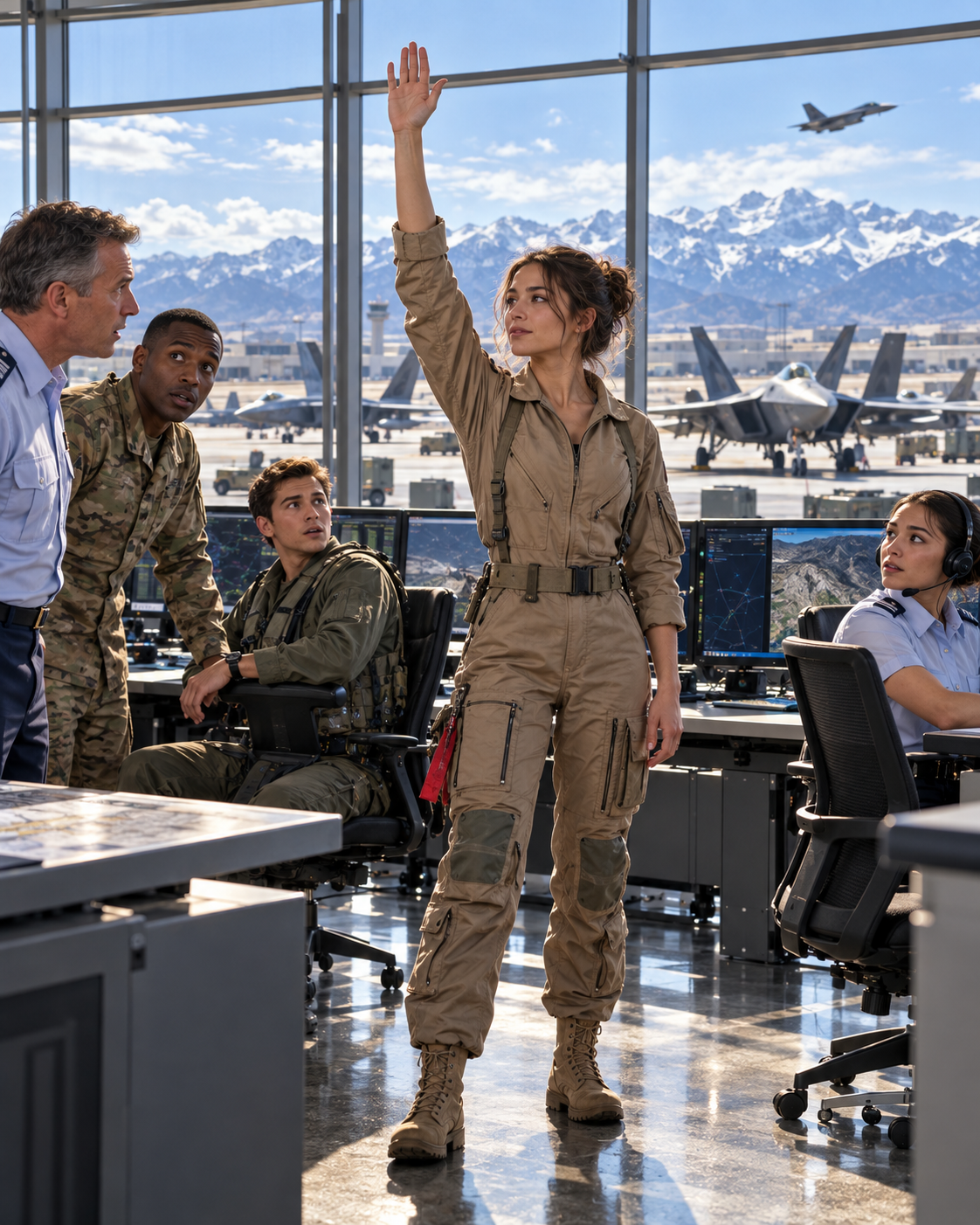
The voice crackling through the speakers asked a question no one in Hangar 6 expected to hear: “Has anyone here ever flown an F-22 Raptor?”
“Easy, Maria,” I said over the radio. “Keep the nose steady. You’re lined up. Don’t chase the crosswind.”
The airliner drifted left.
“Correct right. Just a little. Hold it there.”
For a moment, I thought the wind would push Flight 417 beyond the runway. Maria corrected, fighting the controls with the strength she had left. The aircraft dropped through the snow, its landing lights illuminating a strip of pavement that seemed impossibly short.
“Now,” I told her. “Bring it down.”
The main landing gear struck the runway hard enough to send a shudder through the airliner. The nose dipped, the tires screamed, and the aircraft began to slide.
I held my breath.
Maria fought to keep the jet centered as the braking system slowed its enormous mass. The runway disappeared beneath the fuselage, one light after another flashing past the cockpit windows.
Then the airliner stopped.
Five hundred feet of runway remained.
For several seconds, nobody spoke. I could hear only the static in my headset and my own breathing.
Then Maria came over the radio.
“Flight 417 is on the ground. We’re stopped.”
I closed my eyes.
“All passengers accounted for?” I asked.
“Emergency crews are approaching. The cabin is intact. The captain is breathing. Everyone’s alive.”
One hundred and sixty-two people had left the sky and returned to the ground.
I guided the Raptor away from the runway and headed back to base. I expected to feel triumphant, but what came instead was a strange, quiet exhaustion. The past had not disappeared. The Pacific accident was still part of my life, and I could not change what had happened back then.
But for the first time in years, that memory no longer felt like a verdict on everything I was capable of doing.
When I entered Hangar 6, my teammates were waiting.
The mechanic who had been standing beside me when the emergency call came through stepped forward first. His hands were still red from the cold. Someone had left a wrench on the workbench exactly where I had put mine down.
Nobody delivered a speech. Nobody called me a hero.
They simply began to applaud.
I looked at the faces around me—the people who had trusted me enough to let me go, and who had fought the storm from the ground while I fought it in the air. My eyes burned, and I tried to hide it by removing my helmet.
Colonel Doyle stood near the hangar doors.
“You could have stayed here,” he said.
“I know.”
“Why didn’t you?”
I looked down at the faded word on my helmet.
“Because they needed someone.”
He nodded, as if that answer was enough.
Later, after the aircraft had been secured and the emergency reports had begun, I learned that Maria had been reunited with her captain and that Ben Carter was being praised for his actions inside the cabin. The ground crew’s work had made the landing possible, and every member of that team had played a part in bringing the passengers home.
I had taken off believing I needed to prove I could still fly. I returned understanding that the real question had never been whether I could erase my past.
I couldn’t.
I could only decide what to do when the next person needed help.
For years, I had mistaken courage for certainty—the belief that a good pilot never hesitated, never failed, and never carried fear into the cockpit.
Now I understood something different.
Courage was the moment you heard a desperate call, felt every old wound telling you to remain silent, and raised your hand anyway.
That night, I hung my helmet beside my workbench. The call sign Ember was still faded, but I no longer wanted to hide it.
I had not undone the tragedy over the Pacific. I had not become the person I was before it.
I had simply stopped letting my worst day decide what I would do with every day that followed.
The Morning Ember Returned
The applause in Hangar 6 faded slowly, but the silence that followed stayed with me long after everyone had gone home.
I hung my helmet beside the workbench and returned to the familiar business of tightening bolts, inspecting fuel lines, and checking the maintenance logs. My hands knew what to do, even when my mind wandered back to the night before.
For the first time in years, I could think about flying without feeling as though the sky was waiting to punish me.
I thought that was the end of it.
I was wrong.
Three mornings later, I arrived at the base before sunrise and found Colonel Marcus Doyle standing outside my workshop. He held a thick folder under one arm, and his expression was serious enough to make me stop halfway through unlocking the door.
“Captain Hale,” he said.
I stared at him.
Nobody had called me that in years.
“Colonel?”
“Come inside. We need to talk.”
He placed the folder on my workbench. My name appeared on the cover, followed by a classification marking and a date from six years earlier.
The date of the Pacific accident.
My stomach tightened.
“I thought that investigation was closed.”
“It was,” he replied. “But something has come to light.”
I did not touch the folder.
“Something about the aircraft?”
“Something about the report.”
For a moment, the workshop seemed to grow smaller. I could hear the heating system rattling above us and the wind pushing snow against the hangar doors.
Six years earlier, I had been leading a training exercise over the Pacific when my wingman’s aircraft suffered a catastrophic systems failure. Lieutenant Daniel Mercer had been flying a few hundred yards off my right wing. We were practicing emergency maneuvering when his aircraft began losing control.
I had requested permission to break formation and assist.
The response had come too late.
Daniel’s jet entered a steep descent. I followed him down, trying to keep him in sight while the ocean rose toward us. When his ejection seat finally fired, the explosion of the canopy sent debris spinning through the air.
I remember seeing his parachute open.
I remember shouting his name over the radio.
I remember the water swallowing him before the rescue helicopter could reach him.
I had survived the incident with injuries and a damaged aircraft. Daniel had not survived the night.
The official investigation concluded that I had made an incorrect tactical decision during the emergency, placing myself in a position where I could neither stabilize my aircraft nor provide effective assistance.
I had accepted that conclusion because it gave my grief somewhere to go.
If I had made a mistake, then perhaps the world still made sense. Perhaps I could spend the rest of my life making sure I never made another one.
I left operational flying voluntarily. I declined counseling. I turned down administrative assignments. Eventually, I found my way to Alaska, where I could work on aircraft without ever having to sit inside one.
Now Colonel Doyle was standing in my workshop with a folder that threatened to reopen everything.
“What has come to light?” I asked.
He opened it.
“The telemetry from your wingman’s aircraft was reexamined after an unrelated systems review. Investigators discovered a discrepancy in the original sequence of events.”
He slid a photograph across the table.
It showed Daniel’s aircraft from an angle I had never seen before. A small section of the wing was visible, along with a dark streak near the engine housing.
“The failure began earlier than the original report indicated,” Doyle continued. “And the data suggests the control system may have been compromised before the exercise began.”
I looked up.
“Are you saying Daniel’s aircraft was defective?”
“I’m saying the original investigation may have blamed you for a failure you couldn’t have prevented.”
The words landed harder than I expected.
For six years, I had built my life around a verdict that might not have been true.
I gripped the edge of the workbench.
“Why am I only hearing about this now?”
“Because the review isn’t complete. The evidence is incomplete, and the investigators need testimony from the people involved.”
He paused.
“They need yours.”
I looked at the photograph again.
A part of me wanted to throw the folder across the room. Another part wanted to read every page until I found the sentence that would finally release me from the memory I carried.
But beneath both impulses was something quieter.
Fear.
“What if the original report was right?” I asked.
Doyle did not answer immediately.
“Then you’ll have to face that truth too. But you deserve to know what actually happened.”
After he left, I sat alone at the workbench for nearly an hour.
Outside, the sun rose over the frozen runway, turning the snow pale gold. My helmet hung beside me, the faded word EMBER barely visible beneath years of wear.
I reached for it, then stopped.
Saving Flight 417 had taught me that I could still make decisions under pressure. It had not taught me how to forgive myself for a decision made years ago.
I was beginning to understand that those were two different battles.
By noon, I had agreed to participate in the review.
Three weeks later, I traveled to a military investigation facility in Washington State. The building was ordinary, the conference room painfully bright, and the people seated around the table wore expressions that revealed nothing.
An investigator named Colonel Evelyn Shaw led the proceedings.
She asked me to describe the training exercise from the beginning.
I told her about the weather, the flight formation, Daniel’s position, and the first warning I saw on my instruments. I explained how I had tried to maintain visual contact while communicating with the other aircraft.
Then she displayed a recording of the radio traffic.
My own voice came through the speakers, younger and more confident than I remembered.
“Mercer, stabilize your nose. I’m coming around.”
A burst of static followed.
Then Daniel’s voice.
“Ember, I’ve lost control response. I’m not getting anything back.”
I closed my eyes briefly.
The recording continued.
I could hear myself asking for permission to descend. I could hear the controller issuing instructions that contradicted one another as the situation deteriorated.
Then came the sentence I had remembered for six years.
“Break off, Hale. Maintain separation.”
I had hesitated.
Only a few seconds, perhaps, but the recording made them feel endless.
Daniel had been falling. I had wanted to help him, but I had also known that following him into an unstable descent could create two emergencies instead of one.
I had obeyed the instruction.
By the time I turned back toward his position, he was already below the cloud layer.
The recording ended.
Colonel Shaw folded her hands.
“Captain Hale, why did you hesitate?”
I could have given the answer I had repeated to myself for years. I could have blamed confusion, conflicting instructions, or the limitations of my aircraft.
Instead, I told the truth.
“Because I was afraid that if I followed him, I would die too.”
Nobody moved.
“I knew the rules,” I continued. “I knew what the safest action was. But I also knew Daniel was running out of time, and I couldn’t accept that there might be nothing I could do.”
My voice weakened.
“I thought if I made the right decision, I could save him. When I couldn’t, I decided that meant I’d made the wrong one.”
Colonel Shaw studied me for several seconds.
“Those are not necessarily the same thing.”
I looked down at my hands.
She continued the examination.
The evidence revealed that a manufacturing defect had caused an intermittent failure in Daniel’s flight-control system. The defect had appeared in earlier maintenance records but had not been recognized as a potential hazard.
The controller’s instructions had also been delayed by a communications problem.
The investigation found that my actions had been consistent with the information available to me at the time. There were decisions worth examining, as there always were after a fatal accident, but the evidence did not support the conclusion that my hesitation had caused Daniel’s death.
When Colonel Shaw finally closed the file, I felt no sudden rush of relief.
I had imagined that hearing those words would make the past disappear. Instead, I felt something more complicated.
Grief remained.
So did the memory of Daniel’s voice.
But for the first time, I no longer had to carry a judgment that the evidence could not justify.
Outside the building, I sat on a bench and called Daniel’s mother.
I had not spoken to her in almost two years.
She answered on the fourth ring.
“Nora?”
Her voice was older than I remembered.
“Hello, Mrs. Mercer.”
There was a pause.
“I heard about Alaska,” she said. “Someone sent me the news report about the airliner.”
I swallowed.
“I wanted you to know that the investigation into Daniel’s accident has been reopened. They’ve found evidence that the aircraft had a serious systems defect.”
She was silent for a long time.
“Does that mean you didn’t cause it?”
“It means the evidence doesn’t support what they said about me. I still wish I’d been able to save him.”
“So do I,” she whispered.
I pressed my free hand against my forehead.
“I’ve been afraid to call you. I thought you might hate me.”
“Nora, I was angry for a long time. I wanted someone to explain why my son wasn’t coming home. You were there, and you were alive, and I didn’t know what to do with that.”
Her honesty hurt, but it did not feel like an accusation.
“I understand,” I said.
“No,” she replied gently. “I don’t think either of us understood much of anything back then.”
I heard her take a breath.
“Daniel loved flying with you. He used to say you were the only person who could make him feel both challenged and safe at the same time.”
Tears blurred the buildings across the street.
“He trusted me,” I whispered.
“He did. And I don’t think he would have wanted you to spend the rest of your life punishing yourself for surviving him.”
I could not speak.
For years, I had believed that surviving Daniel meant I owed the world a lifetime of caution. His mother’s words did not erase that belief in a single moment, but they gave me another way to look at it.
Perhaps remembering someone did not require destroying yourself.
Perhaps honoring them meant continuing to live.
When I returned to Alaska, Colonel Doyle was waiting beside my workbench.
“The review has issued its preliminary findings,” he said. “Your record is being corrected.”
I nodded.
“And there’s something else. The command wants to discuss your future.”
I stiffened.
“My future?”
“Your flight status can be formally evaluated. With the right training and medical clearance, you could return to operational duties.”
I stared at him.
The idea should have thrilled me. Instead, my first reaction was panic.
“What if I can’t do it?”
Doyle leaned against the workbench.
“Then you’ll know. But don’t confuse being afraid with being incapable.”
I looked toward the hangar doors, beyond which the runway stretched into the white distance.
“I don’t know if I want to go back.”
“Then don’t decide today.”
He picked up a wrench from the bench and turned it over in his hand.
“You’ve spent years believing that one mistake—or what you thought was one—had to define the rest of your life. You don’t have to replace that with another obligation. You don’t owe anyone a return to the cockpit.”
He set the wrench down.
“But you do owe yourself an honest choice.”
That evening, I walked out to the edge of the runway.
The storm had passed, leaving the sky clear enough for the first stars to appear. A maintenance crew was inspecting the lights, their figures moving slowly across the snow.
I thought about Flight 417.
I thought about Maria, fighting the controls with exhausted hands.
I thought about Ben Carter, who had entered a dangerous cockpit because he refused to abandon two unconscious strangers.
And I thought about my own crew, who had stepped into the blizzard to clear the runway.
None of them had possessed certainty.
Maria had been terrified. Ben had been an ordinary passenger with no training to handle a crisis of that magnitude. My mechanics had known the storm could hurt them.
Yet each had done what they could.
Perhaps courage had never meant being fearless.
Perhaps it meant understanding the risk, recognizing the limits of your control, and still choosing to do the necessary thing.
The next morning, I began the process of returning to flight training.
It was not a triumphant comeback. There were medical evaluations, psychological assessments, simulator sessions, and hours of reviewing procedures I had once known by instinct.
During my first simulator session, I made a mistake so basic that I wanted to tear off my headset and walk away.
I misjudged a crosswind correction during an emergency approach and allowed the simulated aircraft to drift beyond the safe landing envelope.
The instructor froze the simulation.
“Captain Hale, what happened?”
I stared at the instruments.
“I overcorrected.”
“Why?”
“Because I was trying to fix the drift before it became dangerous.”
“And what made your correction dangerous?”
I exhaled.
“I stopped trusting the instruments and started chasing the aircraft.”
He nodded.
“Good. Now tell me what you’ll do differently.”
I swallowed my frustration and began again.
For the next several weeks, I learned to tolerate being a beginner at something I had once done well. I learned to accept criticism without hearing it as a sentence. I learned that a mistake in a simulator was not proof that I should never fly again.
It was information.
And information, unlike shame, could help me improve.
My progress was neither dramatic nor consistent. Some days, I felt almost like my old self. Other days, the Pacific returned in flashes whenever an alarm sounded or the aircraft pitched unexpectedly.
When that happened, I learned to pause, breathe, and identify what was actually happening instead of reacting to what I feared might happen.
I also began speaking with a counselor who specialized in military aviation incidents. For the first time, I allowed myself to discuss the accident without turning every conversation into a trial.
Slowly, the memory changed.
Daniel’s death remained painful, but I could remember him laughing in the briefing room, teasing me about my terrible coffee, and insisting that he would someday beat my time on the training course.
I began remembering the person he had been, not only the moment I lost him.
Four months after my return to training began, I received an invitation to attend a safety conference in Anchorage.
Captain Maria Santos was scheduled to speak about Flight 417.
I nearly declined.
I had already heard that she had recovered fully and returned to flying. She had sent me a short message after the emergency, thanking me for helping her bring the airliner down safely.
I had never answered.
Part of me was ashamed that she had been forced to land a passenger jet while I watched from a fighter. Another part feared that seeing her would make me relive the night in every detail.
But I remembered Doyle’s advice.
Make an honest choice.
So I went.
The conference room was filled with pilots, engineers, air-traffic controllers, and emergency personnel. Maria stood at the front of the room, describing the moments when she had regained consciousness in the cockpit.
She explained that the oxygen masks had saved the crew, that Ben’s quick thinking had given them a chance, and that the guidance from the Raptor had helped her regain control.
Then she surprised me.
“People have asked me who saved Flight 417,” she said. “They expect me to name a single person. But there was no single person.”
She looked across the audience.
“The passenger who helped us breathe bought us time. The pilot who guided us gave us direction. The crew on the ground made a landing possible. The people in the tower kept us informed. And my captain, who was unconscious for most of the emergency, had trained me for years to handle difficult situations.”
She paused.
“I was the one holding the controls when the wheels touched the runway. But I didn’t get that aircraft home alone.”
My throat tightened.
After the presentation, I waited near the exit until she spotted me.
“Nora?”
I nodded.
She crossed the room and hugged me before I could think of anything to say.
“I wanted to thank you properly,” she said.
“You don’t have to.”
“Yes, I do. And I wanted to tell you something else.”
She stepped back and looked me in the eyes.
“I was terrified that night. I remember thinking I wasn’t good enough to land that aircraft. Every time the wind pushed us off course, I thought we were going to die.”
I understood that fear intimately.
“But you kept talking to me,” she continued. “You never made me feel stupid for being scared. You gave me one thing to do at a time.”
She smiled faintly.
“I think that’s what saved me. Not because you knew exactly what would happen, but because you helped me focus on what I could do next.”
I looked down, fighting tears.
“I was scared too.”
“I know.”
“How?”
“Because you sounded human.”
For years, I had thought my job was to become the kind of pilot who never let fear reach her voice. Maria had heard my fear and trusted me anyway.
That realization stayed with me long after the conference ended.
When I returned to base, I found an envelope waiting in my locker.
Inside was a handwritten letter from Daniel’s mother.
She wrote that the revised findings had brought her no happiness, because no explanation could return her son. But she was grateful to know that his death had not been the simple story she had once believed.
At the bottom, she had added one sentence.
I hope you will allow yourself to have a future, Nora. Daniel would have wanted that for you.
I folded the letter carefully and placed it beside my flight records.
The following week, I completed my final evaluation.
The evaluator was an older pilot named Major Thomas Reed, whose reputation for being demanding had reached every corner of the base. He put me through emergency procedures, instrument approaches, engine-failure scenarios, and difficult crosswind landings.
For nearly two hours, he offered little more than instructions and corrections.
Then, during the final approach, the simulator introduced an unexpected systems warning.
My heart lurched.
For one second, the Pacific seemed to open beneath me.
I could hear Daniel’s voice.
I could feel the old shame rising, demanding that I abandon the exercise before I failed again.
But I looked at the instruments.
I identified the warning, assessed the aircraft’s condition, and followed the procedure.
I did not pretend the fear was absent.
I simply refused to let it make the decision for me.
The landing was safe.
When I removed the headset, Major Reed studied the results.
“You’ve got a lot of experience,” he said.
“I’ve also got a lot of rust.”
“Rust can be removed. Judgment takes longer.”
He signed the evaluation.
“Your performance meets the standard. Your return to operational flying is approved, subject to the command’s final assignment decision.”
I stared at the signature.
I had imagined that approval would feel like reclaiming a lost identity. Instead, it felt like being offered a door I was finally free to walk through—or leave unopened.
Colonel Doyle met with me the next day.
“The command has an opening in the flight training program,” he said. “You could return to operational flying after further qualification. Or you could remain in maintenance and help develop our emergency-response training.”
I looked at him.
“You’re giving me a choice?”
“You’ve earned one.”
I thought about the years I had spent trying to prove I was still the person I had been before the accident.
Then I thought about Maria’s trembling voice, Ben’s desperate courage, and the mechanics who had cleared a runway in a blizzard because someone needed it.
I realized that I no longer needed to become my former self.
That woman had existed before the Pacific. She had been brave, ambitious, and talented, but she had also believed that competence meant never being uncertain.
I was someone different now.
I understood the importance of procedures, the danger of pride, and the value of asking for help. I knew that people could be capable and frightened at the same time. Most importantly, I knew that a person’s worth could not be measured by whether every decision they made ended perfectly.
“I want to teach,” I said.
Doyle raised an eyebrow.
“Are you sure?”
“No. Not completely.”
He smiled.
“That’s probably a good sign.”
I remained at the base, dividing my time between aircraft maintenance and the development of emergency training for pilots and ground crews. I did not abandon flying entirely. I continued to qualify on appropriate aircraft and flew training missions when my duties allowed.
But my most important work happened in classrooms, simulators, and workshops.
I helped develop scenarios in which pilots had to make decisions with incomplete information. We trained ground crews to recognize when a small maintenance discrepancy could become a serious hazard. We taught teams to communicate clearly under pressure and to question assumptions without fear of being ridiculed.
I insisted that every exercise include a debriefing.
Not simply a list of mistakes, but an honest examination of what people had seen, what they had understood, and why they had acted as they did.
Sometimes, a young pilot would leave the simulator angry with herself after a difficult exercise.
I recognized that expression immediately.
I would ask her to sit down.
“Tell me what happened,” I’d say.
She would begin listing everything she had done wrong.
I would listen, then ask a different question.
“What did you learn that you didn’t know before?”
At first, many of them struggled to answer.
Eventually, they learned.
And I learned from them, too.
One winter afternoon, almost a year after Flight 417, a new trainee named Lucas Bennett came to my office. He had failed an emergency exercise twice and had begun talking about withdrawing from the program.
“I think I’m not cut out for this,” he said.
I looked at the report on my desk.
“Why?”
“Because I made the wrong decision when the situation got complicated.”
“Did you understand why it was wrong?”
He nodded.
“Did you know how to respond differently the second time?”
“Yes.”
“Then what are you afraid of?”
He looked away.
“That I’ll make another mistake when someone else’s life depends on me.”
I leaned back in my chair.
“Lucas, you will make mistakes. Every pilot does. Every mechanic does. Every person responsible for other people makes decisions that turn out differently than expected.”
His face tightened.
“That doesn’t sound reassuring.”
“It isn’t supposed to. This job is serious. But the answer isn’t to become someone who never makes mistakes. The answer is to prepare, communicate, recognize when you’re wrong, and correct yourself before a mistake becomes a disaster.”
I paused.
“And when the situation is beyond your control, you have to accept that being responsible doesn’t mean being all-powerful.”
He sat quietly for a while.
Then he asked, “How did you learn that?”
I glanced toward my helmet, which now rested on a shelf above my desk.
“The hard way.”
Lucas returned to training the following morning.
He did not become the best pilot in his class, and he did not pass every evaluation on his first attempt. But he learned to ask questions earlier, listen more carefully, and recover more quickly when something went wrong.
Months later, he sent me a note after completing his final qualification.
It contained only a few lines, but one sentence stayed with me.
You taught me that failing an exercise is not the same as failing the people who trust you.
I placed the note beside Daniel’s mother’s letter.
By then, the story of Flight 417 had spread far beyond Alaska. Journalists wanted interviews. Aviation organizations invited me to speak. Some described me as a hero who had returned from exile to save an airliner.
I declined most of those invitations.
The story was never that simple.
I had not saved 162 people alone. I had been one part of a team, and the outcome had depended on dozens of decisions made by people whose names would never appear in a headline.
I did eventually agree to one interview, provided that the journalist also spoke with Maria, Ben, and several members of the maintenance crew.
When she asked what I considered the most important moment of the emergency, I thought about the instant I had set down my wrench.
“That was the moment I stopped pretending my fear was a reason to remain silent,” I said. “But the real lesson came afterward. We all had to trust one another, even when none of us could guarantee the outcome.”
The journalist asked whether I considered myself a hero.
I shook my head.
“I consider myself fortunate to have been in a position to help. And I consider the people who did their part that night fortunate to have had one another.”
The interview ended there.
Two winters later, on the anniversary of Flight 417, I received an unexpected visitor at Hangar 6.
Ben Carter stood in the doorway wearing a heavy coat and carrying a small wooden box.
For a moment, I did not recognize him. Then he smiled, and I remembered the passenger who had entered a cockpit in the middle of a crisis and placed oxygen masks on two unconscious pilots.
“I hope I’m not interrupting,” he said.
“Not at all. What brings you to Alaska?”
He held out the box.
“I wanted to give you something.”
Inside lay a small metal plaque bearing the flight number and the date of the emergency. Beneath it were the names of the passengers who had signed a letter of gratitude.
At the bottom, someone had engraved a sentence.
We made it home because no one gave up on the next step.
I read it twice.
“Thank you,” I whispered.
Ben shook his head.
“I should be thanking you.”
“You did something extraordinary.”
“So did you.”
He looked around the hangar, taking in the aircraft and the rows of tools.
“I used to think bravery was something people either had or didn’t. That night, I was terrified. I had no idea what I was doing. I just knew those pilots needed oxygen, and somebody had to help.”
He gave a small laugh.
“I suppose I didn’t have time to decide whether I was brave.”
“Most people don’t,” I said.
We stood together for a while, listening to the familiar sounds of the hangar.
Before he left, Ben asked whether I still flew.
“Sometimes.”
“Do you enjoy it?”
I considered the question.
“Yes,” I said. “But not for the reasons I used to.”
After he left, I carried the plaque to my office and placed it beside the letters and notes I had collected over the years.
That evening, I walked to the hangar doors.
Snow was falling softly over the runway. The lights shone through the darkness, steady and clear.
My helmet hung beside the workbench where I had once spent my days hiding from the sky. The word EMBER had faded further, but I no longer felt the need to restore it.
Its scars belonged there.
I thought about the woman I had been before Daniel’s accident. She had believed that courage meant being certain, that responsibility meant controlling every outcome, and that failure could cancel out everything good a person had ever done.
I wished I could tell her what I knew now.
I would tell her that grief could make a person confuse punishment with loyalty. I would tell her that accepting responsibility did not require accepting blame for everything beyond her control. And I would tell her that surviving a terrible day was not a debt she had to repay for the rest of her life.
Most of all, I would tell her that the future did not have to resemble the past in order to be meaningful.
I had once believed my call sign, Ember, represented the person I had lost.
Now I understood it differently.
An ember was not a roaring flame. It was a small piece of fire that remained after the blaze had passed, often hidden beneath ash, easy to overlook and difficult to extinguish.
Sometimes it needed protection.
Sometimes it needed air.
And sometimes, when the conditions were right, it could begin to burn again.
I returned to my workbench and switched off the light.
Tomorrow, there would be aircraft to inspect, trainees to teach, and decisions to make. Some would be easy. Others would leave me uncertain. I would never have complete control over every outcome, and I would never be able to promise that fear would not find me again.
But I no longer needed that promise.
I had learned that courage was not the absence of doubt. It was the willingness to face the truth, ask for help, and take the next responsible step.
I had learned that mistakes deserved examination, not worship, and that grief deserved compassion, not a lifetime sentence.
And I had learned that no one truly brings another person home alone.
Not a pilot in a cockpit.
Not a passenger in an emergency.
Not a mechanic clearing ice from a runway in the middle of a blizzard.
We survive because someone notices the danger, someone offers a hand, someone speaks when silence would be easier, and someone else finds the strength to listen.
The night Flight 417 came through the storm, I had believed that answering the call would prove I was still worthy of the sky.
Instead, it showed me that worthiness had never been the question.
I was not valuable because I could fly an F-22. I was not beyond forgiveness because I had survived an accident. I was not required to become the woman I had once been in order to build a life worth living.
I was simply a person who had suffered, learned, and chosen to help when help was needed.
And that was enough.
Outside, the snow continued to fall, covering the old tracks on the runway and leaving a clean surface for the morning crew.
I turned toward the door, then paused to look back at my helmet.
For years, I had treated the word EMBER as the name of someone who no longer existed.
Now I smiled at it.
The fire had changed.
So had I.
But neither of us was gone.
And when the next desperate voice came through the speakers, I knew I would listen—not because I was certain I could save everyone, but because I finally understood that uncertainty was never a reason to stop trying.
I stepped into the cold, pulled my jacket tight, and walked toward the first light of morning.
The sky above Alaska was vast and unforgiving, but it no longer looked like a place where my past waited to destroy me.
It looked like a place where tomorrow was still possible.