The showroom manager looked at the grease beneath my fingernails, then at my seven-year-old daughter, Maisie, standing beside me in her scuffed sneakers.
The following months changed our lives in ways I could never have predicted.
At first, the new work was simply an opportunity to keep my garage running without constantly worrying about the next bill. Sylvie Hawthorne paid fairly, respected my judgment, and never treated a question as a challenge to her authority. For someone who had spent years dealing with customers who believed the loudest voice deserved the final word, working with her was a welcome change.
But the most important change wasn’t financial.
It was the way Maisie began to see the world.
She had always been curious, but now her drawings became more ambitious. She sketched engines with tiny labeled components, drew cross-sections of gearboxes, and filled entire notebooks with questions about how machines worked.
One evening, while I was checking invoices at the kitchen table, she placed a drawing in front of me.
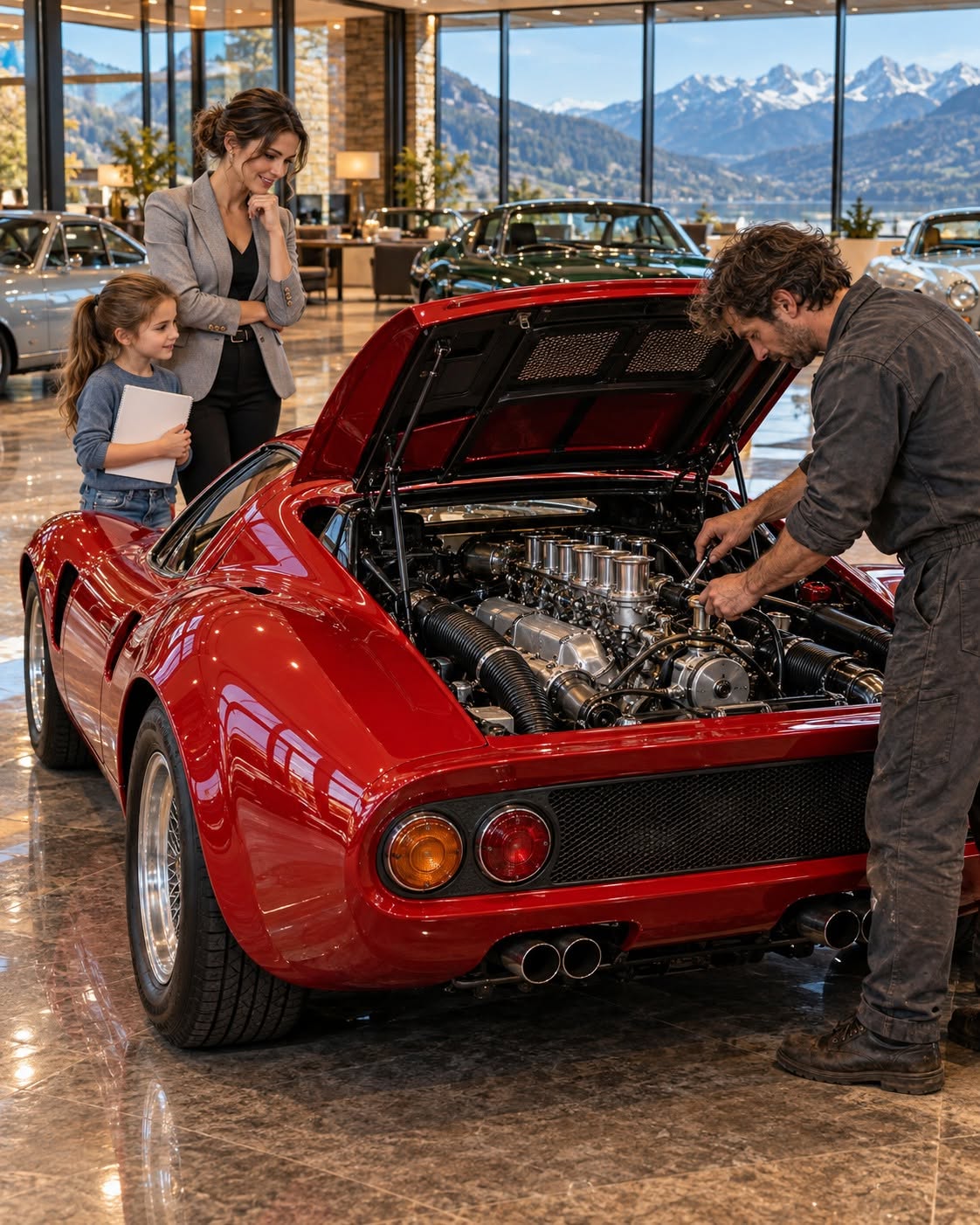
It showed the Alfa Romeo Tipo 33 Stradale, complete with its distinctive curves and impossibly small wheels.
Beneath it, she’d written something in uneven blue letters.
“EVERYTHING HAS A REASON.”
I smiled.
“That’s a pretty good motto.”
She pointed to a small figure standing beside the car. The figure wore a grease-stained jacket and had a little girl holding his hand.
“That’s you and me,” she explained. “The car was broken, but you didn’t give up. And the people who thought you weren’t important were wrong.”
I put down my pen.
“Sweetheart, there’s something I want you to understand.”
She looked up.
“Being good at your job doesn’t mean nobody will ever treat you unfairly. Sometimes people will still judge you. Sometimes they’ll even know you’re right and refuse to admit it.”
“Then how do you make them stop?”
“You can’t always make them stop. But you can decide what kind of person you’re going to be, no matter what they do.”
She considered this for a moment before returning to her drawing.
I thought that was the end of the lesson.
I was wrong.
Three weeks later, Sylvie called me with a problem that had nothing to do with engines.
“Could you come to the dealership tomorrow morning?” she asked. “There’s something I think you should see.”
Her voice sounded different. Not angry exactly, but restrained in a way that made me suspect she’d discovered something troubling.
When I arrived, the showroom was unusually quiet. A few salespeople stood near the reception desk, speaking in low voices. The manager who had turned me away was nowhere to be seen.
Sylvie met me in her office.
“His name is Richard,” she said, referring to the manager. “He’s been with the company for eleven years. His sales numbers have been excellent, and his department has consistently exceeded its targets.”
She paused.
“Unfortunately, I recently learned that those numbers tell only part of the story.”
She slid a folder across her desk.
Inside were customer complaints, staff reports, and several internal reviews that had been marked as resolved without any meaningful investigation.
The complaints described a pattern.
Customers who appeared wealthy received immediate attention. People who arrived in ordinary clothing were sometimes ignored or spoken to dismissively. Junior employees who challenged Richard’s decisions were routinely excluded from important meetings. One former employee had resigned after repeatedly being told that she lacked the personality required to sell luxury vehicles.
There were other complaints, too.
Several customers had been pressured into purchasing unnecessary services. Others had been discouraged from asking questions about repairs because, according to the complaints, Richard considered them incapable of understanding the technical details.
“Why wasn’t any of this addressed?” I asked.
“Because he delivered results,” Sylvie replied. “And because the people reviewing his performance kept looking at the same figures I did.”
She leaned back in her chair.
“I built a business that sells extraordinary machines. Somewhere along the way, I started measuring success by the number of cars leaving the showroom instead of the quality of the experience people had while they were there.”
I understood then that she wasn’t asking me to help punish one unpleasant manager.
She was beginning to question the system that had allowed him to behave that way.
“What are you going to do?” I asked.
“Conduct a proper investigation. Review the complaints independently. Speak to the employees without his involvement. And make it clear that no sales target excuses disrespect or dishonesty.”
She looked at me carefully.
“But I want you to know something. This isn’t happening because you repaired my Alfa Romeo. It isn’t happening because I owe you a favor. What happened to you and Maisie simply forced me to look at something I should have noticed years ago.”
I appreciated that distinction.
I had never wanted special treatment. I wanted the same ordinary courtesy that anyone walking through those doors should have received.
“What about Richard?” I asked.
“His position has been suspended while the investigation proceeds. The evidence will determine what happens next.”
I nodded.
It wasn’t my place to decide Richard’s future. If he had made mistakes, he deserved a fair process, just as the people he had mistreated deserved to be heard.
As I left the office, I noticed a young woman standing beside a silver sports car near the service entrance. She wore a dealership uniform and held a clipboard against her chest.
She looked familiar, though I couldn’t immediately remember why.
“Excuse me,” she said when I passed. “Are you the mechanic who fixed Ms. Hawthorne’s Alfa Romeo?”
“I am.”
Her expression changed from uncertainty to something resembling relief.
“My name is Elena. I used to work in sales here.”
She glanced toward the office before continuing.
“I was the one who filed several of those complaints. I thought nobody would ever read them.”
“I’m sorry you had to go through that.”
She gave a small, tired smile.
“I’m not sure I’m sorry anymore. I left because I thought staying meant accepting the way things were. But now they’re actually listening.”
She hesitated, then added, “Your story made a difference, you know.”
I frowned.
“What story?”
“The one about the mechanic and his daughter. People have been talking about it. Some employees heard what happened from the manager himself. Others heard it from customers. It made people start asking questions.”
I hadn’t realized how far the incident had traveled.
I certainly hadn’t expected it to encourage anyone else to speak up.
Elena adjusted the clipboard in her hands.
“I’m applying for a service-adviser position at another dealership. I used to love cars, but I started thinking maybe the industry wasn’t for me.”
“And now?”
“Now I think the industry needs people who remember why they loved it in the first place.”
I smiled.
“That sounds like a good reason to stay.”
She thanked me and walked away.
For the first time, I understood that the incident had become larger than my own hurt feelings. It had given people who had been dismissed or ignored a reason to believe that speaking honestly might lead somewhere.
Still, I wasn’t naive enough to think one investigation could transform an entire business overnight.
Real change would take more than an apology.
It would require people to keep paying attention after the headlines faded, after the uncomfortable meetings ended, and after the next set of sales figures arrived.
A month later, Sylvie invited me back to the dealership.
The investigation had concluded.
Richard had been found responsible for repeated violations of company policy, including discriminatory treatment of customers and retaliation against employees who raised concerns. He was dismissed from his management position following the formal review.
Sylvie had also introduced a new customer-service policy, created an independent channel for staff complaints, and required managers to undergo regular reviews that included feedback from employees and customers.
She wasn’t pretending those measures would solve everything.
But she had finally stopped treating strong sales figures as proof that everything else was working.
That morning, she asked me to attend a meeting with the dealership’s service team.
I nearly refused.
“I repair cars,” I reminded her. “I’m not a management consultant.”
“Exactly,” she replied. “And I want the people running this place to hear from someone who actually understands the work behind the polished showroom.”
I agreed on one condition.
“I won’t stand there and tell them I’m better than anyone. I’ll tell them what I know about machines and what I’ve learned about people. They can decide what to do with it.”
The meeting took place in a conference room overlooking the showroom.
Several technicians, advisers, salespeople, and managers sat around the table. Some looked curious. Others appeared skeptical.
I had no prepared speech.
Instead, I placed a small, worn component on the table.
It was an old fuel-pressure regulator I’d kept from an earlier repair.
“This isn’t from the Alfa Romeo,” I began. “It’s from a car that came into my garage years ago. The owner had already paid two shops to replace parts that weren’t broken. Both shops had tried to solve the problem by changing something expensive.”
I held the component up.
“The actual fault was small. But finding it required asking a different question.”
I looked around the room.
“Instead of asking which part was broken, I asked what conditions made the problem appear.”
The room became quiet.
“That’s how I approached the Alfa Romeo. Three specialists had already examined it. They weren’t fools, and they weren’t careless. They were experienced people working from assumptions that turned out to be incomplete.”
I set the regulator down.
“The difference wasn’t that I was smarter than they were. I simply looked at the evidence from another angle.”
A senior technician at the far end of the table nodded.
I continued.
“People can be treated the same way. We look at a person’s clothes, job title, accent, or bank account and decide we understand them. We stop asking questions because we believe we’ve already found the answer.”
I paused.
“Sometimes the most expensive mistake you can make is assuming you know what you’re looking at.”
Nobody applauded.
Nobody needed to.
The technician who had nodded earlier picked up the regulator and examined it. A young saleswoman began taking notes. One of the managers leaned forward as though he had heard something he needed to consider.
That was enough for me.
After the meeting, Sylvie walked me to the service entrance.
“You have a way of making complicated things simple,” she said.
“Machines are easier. They don’t care whether I sound impressive.”
“People care more than you think.”
“That’s probably the problem.”
She laughed, and for a moment she seemed less like a billionaire and more like someone who had spent years carrying a responsibility she had never fully understood.
Then she became serious again.
“I want to establish a technical apprenticeship program. Young people who are interested in mechanics but can’t afford expensive training would receive paid placements, proper instruction, and access to equipment they wouldn’t normally be able to use.”
“That could make a real difference.”
“I’d like your garage to be one of the participating workshops. You would have complete control over the technical training, and we’d cover the costs.”
I thought about my cramped workshop, my aging equipment, and the young people I’d occasionally seen hanging around the industrial units, watching mechanics work through open garage doors.
I also thought about Maisie.
She was seven, but she already understood what it felt like to be judged before anyone had bothered to learn her name.
If I could help someone avoid that experience, perhaps I should.
“I’ll do it,” I said. “But I have one request.”
“What’s that?”
“Don’t select apprentices based on who looks most promising on paper. Give them a chance to show you what they’re capable of.”
Sylvie smiled.
“I think that’s the entire point.”
The program began three months later.
Our first apprentice was a nineteen-year-old named Jordan, who arrived with a secondhand toolbox, a nervous smile, and a habit of apologizing every time he asked a question.
During his first week, he stripped a bolt while working on a stubborn bracket.
He stared at it in horror.
“I’m sorry,” he said. “I should have known better.”
I examined the damaged bolt.
“Did you force it because you were afraid to ask for help?”
He looked down.
“Yes.”
“Then the mistake wasn’t the bolt. It was believing that asking a question would make you look incompetent.”
I showed him how to remove the damaged fastener safely and replace it.
“Everyone makes mistakes,” I told him. “What matters is whether you learn to recognize them before they become habits.”
He worked more carefully after that.
By the end of the first month, he had become more confident. He still needed guidance, but he no longer treated every question as an admission of failure.
One afternoon, he solved an electrical fault that had puzzled him for nearly an hour.
When the engine finally ran properly, his face lit up.
“I actually found it.”
“You did.”
“I thought I was going to be terrible at this.”
I handed him the diagnostic notes.
“Being good at something doesn’t mean you understand everything immediately. It means you keep learning when you don’t.”
Jordan tucked the notes into his toolbox as carefully as if they were worth more than gold.
I recognized that expression.
It was the look of someone discovering that a door he’d assumed was closed had never been locked.
Meanwhile, Maisie continued to grow.
She started helping me organize spare parts, though I made her wear proper protective equipment and kept her away from any dangerous work. She learned to identify tools, read simple diagrams, and understand why patience mattered more than rushing.
She also became increasingly interested in the Alfa Romeo.
Whenever I visited Sylvie’s collection, she asked whether the car was still running properly.
“It starts every time,” I told her.
“Even when it’s hot?”
“Even when it’s hot.”
She seemed pleased by that answer.
Then, one Saturday morning, Sylvie invited us to a small gathering at her estate. She had arranged for several classic-car enthusiasts, technicians, and apprenticeship students to attend.
The Alfa Romeo stood at the center of the garage, its red body gleaming beneath the lights.
Maisie stared at it with the sort of wonder other children reserved for castles or spaceships.
Sylvie crouched beside her.
“What do you think of it?”
“It’s beautiful,” Maisie said. “But I like it better now that I know it works.”
Sylvie laughed.
“That’s a very good answer.”
A few minutes later, she asked me to start the engine.
I turned the key.
The V8 caught almost immediately, settling into a crisp, unmistakable mechanical rhythm.
The sound filled the garage.
People gathered around, smiling as though the car had performed a small miracle.
Maisie watched me for a moment, then tugged at my sleeve.
“Daddy?”
“Yes?”
“Can I tell everyone something?”
I was surprised, but I nodded.
She stepped forward, holding the little notebook she carried everywhere.
“I drew this car when Daddy fixed it,” she said. “But I also drew what happened before that.”
She opened the notebook to a page showing a showroom, a man standing behind a desk, and two small figures walking toward the door.
“I used to think that if someone was mean to us, it meant we weren’t good enough. But Daddy told me that people don’t always know what they’re looking at.”
She turned to the next page.
It showed a mechanic standing beside an expensive car. Around him were other people, each holding a different tool.
“Now I think everybody has something they’re good at. Some people know about engines. Some people know how to help others. Some people are still learning.”
She looked up at Sylvie.
“And some people have lots of money but still need to learn things.”
A few adults exchanged surprised glances.
Sylvie covered her mouth, trying not to laugh.
Maisie continued, completely unaware that she had just delivered a lesson more direct than anything I’d said in the conference room.
“I think the important thing is to give people a chance before you decide what they’re worth.”
For several seconds, nobody spoke.
Then Sylvie knelt and hugged her.
“Your daddy has taught you something very important.”
Maisie shook her head.
“He taught me about cars. I figured the other part out.”
That answer stayed with me long after the gathering ended.
Later that afternoon, while the guests were leaving, Sylvie and I stood beside the Alfa Romeo.
“I’ve been thinking about what happened at the dealership,” she said. “For a long time, I believed that treating people fairly meant giving everyone the same opportunity. But I didn’t pay enough attention to whether people were actually receiving that opportunity.”
“What do you mean?”
“Someone who has been ignored for years might need more than a sign on the wall saying everyone is welcome. They need to know that the promise is real. That their concerns will be heard, that their work will be recognized, and that they won’t be punished for speaking honestly.”
I nodded.
“Fairness isn’t just opening the door,” I said. “It’s making sure people aren’t pushed back outside once they walk through it.”
Sylvie looked at me thoughtfully.
“I wish I’d understood that sooner.”
“So do I,” I replied. “But understanding it now is better than refusing to understand it at all.”
That evening, I drove Maisie home in our old family car.
The sky above Vancouver had turned orange, and the streets were beginning to glow beneath the lights. She sat in the passenger seat, talking excitedly about Jordan, the red Alfa Romeo, and the possibility of designing her own engine someday.
Then she grew quiet.
“Daddy, do you think that manager ever learned anything?”
I kept my eyes on the road.
“I don’t know, sweetheart.”
“Do you think he knows he was wrong?”
“Maybe. Maybe not.”
She frowned.
“But if he never understands, doesn’t that mean he gets away with it?”
I considered my answer carefully.
“Being held accountable matters. People who hurt others shouldn’t be allowed to keep doing it just because they’re successful. But we can’t force someone to become a better person. We can only make sure their choices have consequences and decide what we will do differently ourselves.”
She leaned back against the seat.
“I think I’d want him to understand.”
“So would I.”
We drove the rest of the way in comfortable silence.
A few weeks later, I received a letter from the dealership’s human-resources department. Richard had requested permission to send a written apology to me and Maisie.
I wasn’t sure what to expect.
The letter arrived on a plain sheet of paper, without company branding or elaborate language.
Richard admitted that he had judged us by our appearance and made an assumption about our place in the showroom. He acknowledged that his position had made it easy to dismiss people without considering the consequences. He also apologized for making Maisie believe, even briefly, that she had done something wrong.
The letter ended by saying that losing his job had forced him to reconsider the way he treated people.
I read it twice.
Then I put it away.
I didn’t know whether his remorse would last. An apology could be sincere, or it could be a way to make an uncomfortable situation disappear. Only time and future actions could reveal the difference.
I didn’t feel obliged to forgive him immediately, nor did I feel the need to hate him forever.
When Maisie asked about the letter, I told her the truth.
“He apologized.”
“Do you believe him?”
“I believe he wrote the words. We’ll have to see what he does with them.”
She nodded, apparently satisfied.
“That’s like testing a car after you fix it.”
I laughed.
“Exactly like that.”
Months passed, and our lives settled into a new rhythm.
My garage remained small, but it became busier. The apprenticeship program helped us bring in better equipment, and Jordan grew into a capable young mechanic who treated every customer with the same patience, regardless of what they drove or wore.
Maisie still sat in the corner after school, drawing cars.
The difference was that now a few of the apprentices sometimes sat beside her, sketching designs of their own. They would ask questions, argue about engine layouts, and occasionally ask me to explain some technical detail that had sent them down an unexpected rabbit hole.
The workshop became more than a place to repair broken machines.
It became a place where people were allowed to be beginners.
One afternoon, I found a new drawing on my workbench.
It showed our garage, its rolling doors open, with sunlight spilling across the floor. Several people stood inside, working on different vehicles. In the background, a small red sports car sat beneath a row of lights.
At the top, Maisie had written a title.
“THE PLACE WHERE EVERYONE GETS A CHANCE.”
I pinned it to the wall above my toolbox.
Years earlier, I had walked out of a luxury showroom feeling angry, embarrassed, and determined not to let my daughter see how much the insult had hurt.
I hadn’t known then that the experience would lead to a rare engine, an unexpected partnership, a new training program, and a lesson that reached far beyond the automotive world.
I certainly hadn’t known that a seven-year-old girl would eventually express the whole thing more clearly than I ever could.
The Alfa Romeo had taught me that a difficult problem doesn’t always have an obvious cause. Sometimes, the answer appears only when you stop making assumptions and begin examining the conditions that produced the failure.
People are no different.
A person’s clothes cannot tell you how much they know. Their income cannot measure their integrity. Their job title cannot determine whether they deserve respect.
And a person’s mistake, while it may demand accountability, doesn’t have to become the only thing that defines them.
What matters is what we choose to notice, what we are willing to question, and whether we have the courage to change when the evidence proves us wrong.
I still work with grease beneath my fingernails.
I still drive an ordinary car, worry about invoices, and occasionally stay up too late trying to solve a mechanical puzzle. My life isn’t a fairy tale, and I haven’t become a billionaire simply because I repaired an extraordinary machine.
But I have something more valuable than the approval of a showroom manager.
I have a daughter who understands that dignity isn’t something wealthy people hand out to everyone else. It’s something every person deserves before they’ve proved anything at all.
And I have a garage where young people can learn that asking questions is a sign of curiosity, not weakness, and where the person who knows the least today may become the person who solves the hardest problem tomorrow.
Sometimes, I think about that first afternoon at the dealership.
The polished floor. The manager’s dismissive expression. Maisie’s small hand tightening around mine as we walked away.
I wish the incident had never happened.
But I no longer wish I’d responded differently.
I didn’t need to shout, threaten, or prove my worth to someone who had already decided not to see it. I simply needed to keep doing the work I knew how to do, protect the little girl who trusted me, and remain open to the people who were willing to look beyond appearances.
The engine eventually started.
The truth eventually surfaced.
And a closed door became the beginning of something neither of us could have imagined.
That is what I hope Maisie remembers when she grows up: not that we were underestimated, not that a wealthy woman came to our aid, and not that an expensive car changed our lives.
I hope she remembers that our worth was never waiting for someone else to recognize it.
We already had it.
All we needed was the courage to keep moving forward until we found a place where it could grow.
Because sometimes, the greatest measure of success isn’t the fortune you accumulate, the titles you earn, or the doors that open for you.
It’s the doors you choose to open for someone else.