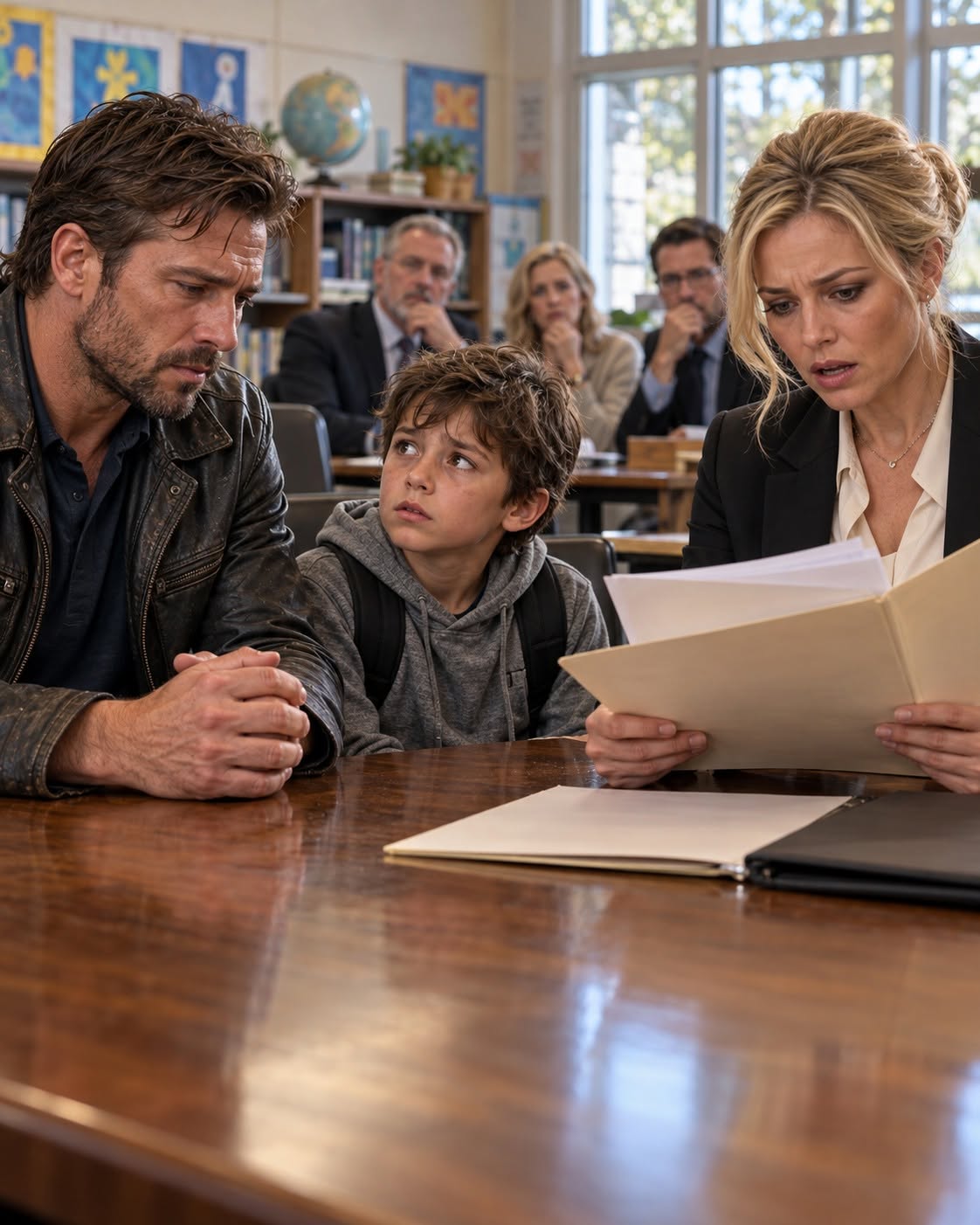
The principal looked at my grease-stained coveralls, then at the expensive suits surrounding the conference table.
The following Monday, I thought life might finally return to normal.
Jonah went back to school. I went back to the repair facility. The bills still arrived, the coffee still tasted terrible, and my old pickup still made a noise I kept promising myself I would investigate.
But something had changed.
Jonah no longer came home and disappeared into his room without saying a word. He started telling me about his classes again, about a science experiment that had gone wrong and a teacher who told a terrible joke.
Small things.
The kind of things I had missed while worrying about everything he wasn’t telling me.
Then, on a rainy Thursday afternoon, my phone rang while I was working beneath a city bus.
It was Principal Ellison.
“Mr. Carter, I need you to come to Westbrook as soon as you can.”
I slid out from beneath the bus and wiped my hands on a rag.
“Is Jonah all right?”
There was a pause.
“He’s physically fine. But something happened today, and I think you need to hear about it in person.”
My stomach tightened.
I told my supervisor I had to leave, washed the worst of the grease from my hands, and drove toward the school.
By the time I reached Westbrook Academy, rain was streaking across the windshield so heavily that the entrance lights looked like blurred stars.
Principal Ellison was waiting outside her office.
She looked more tired than she had during our first meeting.
“Jonah is in the counselor’s room,” she said. “He’s safe. But I want you to know that this time, he came forward himself.”
That sentence stopped me.
“What happened?”
“Another student reported an incident involving Pierce. When we began asking questions, Jonah decided to tell us something he hadn’t mentioned before.”
I followed her down the hallway.
Through the counselor’s open door, I saw my son sitting on a sofa with his hands clasped between his knees. Beside him sat a boy I recognized from the school photographs on the website.
Pierce Holloway.
He looked smaller than he had across the conference table. His expensive blazer was wrinkled, and his eyes were fixed on the carpet.
When Jonah saw me, he stood.
“Dad, I didn’t start anything this time.”
“I know, buddy,” I said.
He seemed to relax a little, but his fingers kept twisting together.
Principal Ellison invited us to sit.
“Yesterday afternoon, a student named Daniel Ruiz reported that Pierce had been threatening him,” she explained. “Daniel is new to Westbrook. He has a scholarship, and apparently Pierce has been making comments about his family’s financial situation.”
She glanced at Pierce.
“Today, Pierce took Daniel’s notebook and threw it into a puddle outside the science building. When Daniel tried to retrieve it, Pierce shoved him.”
I looked at Jonah.
“And you saw this?”
He nodded.
“I was walking to class. Daniel tried to get a teacher, but Pierce told him nobody would believe him. He said his father could make sure Daniel lost his scholarship.”
Pierce’s jaw tightened.
“That’s not exactly what I said.”
Jonah turned toward him.
“It is what you said.”
His voice wasn’t loud, but for the first time since this ordeal began, he didn’t look at the floor.
Principal Ellison folded her hands.
“Jonah witnessed the incident. More importantly, he gave us a detailed account without being prompted. He also brought forward messages Pierce had sent him over the past several months.”
I stared at my son.
“What messages?”
Jonah swallowed.
“I saved some of them. I didn’t want to show you because I thought you’d be disappointed that I kept answering him.”
“Why would I be disappointed?”
“Because I should have just ignored him.”
I leaned forward.
“Jonah, being targeted doesn’t mean you did something wrong by trying to defend yourself. And you don’t have to handle it alone.”
His eyes filled, though he blinked quickly to stop the tears.
Principal Ellison continued.
“The school has begun interviewing students and reviewing the previous complaints. We are also examining why the earlier reports were marked resolved when the underlying behavior continued.”
I looked at her carefully.
“Are you doing that because of what happened to Jonah, or because I have a file full of awards?”
She didn’t look away.
“Because of both the evidence and the fact that we failed to act appropriately before. Your question is fair. We should have taken these reports seriously regardless of who the parents were.”
It was the first answer from the school that sounded honest enough for me to believe.
Then Pierce spoke.
“My dad says people are always trying to make us look bad.”
Everyone turned toward him.
He looked at Principal Ellison, then at Jonah.
“If I get suspended, my dad is going to be furious.”
For a moment, I saw something beneath the arrogance.
Fear.
Not the fear of a child who had suddenly discovered that cruelty had consequences. Something more complicated. A boy who had learned that his father’s approval mattered more than admitting he was wrong.
Principal Ellison spoke gently.
“Pierce, your father’s reaction is not your responsibility to manage. Your choices are your responsibility.”
He lowered his head.
I expected him to argue. Instead, he began picking at a loose thread on his sleeve.
“I didn’t think Daniel would actually tell anyone,” he muttered.
“Why not?” the counselor asked.
Pierce shrugged.
“Because nobody ever did anything when I got in trouble before.”
The room fell silent.
His words didn’t excuse what he had done. But they revealed something none of us could afford to ignore.
The school had allowed a pattern to grow, and children had learned to measure what they could get away with by what adults were willing to overlook.
That afternoon, Principal Ellison informed us that Pierce would face disciplinary consequences while the investigation continued. Daniel would receive support from the counseling team, and Jonah would not be expected to participate in any meeting with Pierce unless he felt comfortable doing so.
I appreciated those decisions.
But before we left, Jonah asked if he could speak to Pierce for a minute.
I looked at him.
“Are you sure?”
He nodded.
Principal Ellison stayed nearby while the counselor stepped into the hallway with me.
Through the glass panel in the door, I watched my son stand several feet away from Pierce.
I couldn’t hear their words.
I could see Jonah’s shoulders tense, then settle. Pierce looked up once, and Jonah spoke again.
A minute later, Jonah opened the door.
“Ready?” I asked.
He nodded.
We walked toward the exit together.
Outside, the rain had softened to a mist.
After we climbed into the pickup, Jonah sat quietly for several minutes.
Finally, he said, “I told him I didn’t hate him.”
I turned the key but didn’t start the engine.
“What did he say?”
“He asked why.”
Jonah stared through the windshield.
“I told him that what he did was wrong, but I didn’t want to spend the rest of my life thinking about him.”
I let that settle between us.
Then he added, “I also told him I wasn’t going to pretend it didn’t happen just to make things easier for him.”
I looked at my son, and pride rose in my chest so suddenly that it almost hurt.
“That sounds like a pretty good balance.”
He gave a small smile.
“I learned it from somebody.”
I pretended to examine the dashboard.
“Must be a handsome guy.”
Jonah laughed.
It was a small laugh, but after months of watching him shrink into himself, it felt like sunlight breaking through clouds.
I drove us home.
I thought that would be the end of it.
I was wrong.
Three days later, I received an email from Westbrook Academy’s board of trustees.
The subject line read: REQUEST FOR MEETING REGARDING RECENT INCIDENTS.
My first instinct was to ignore it until after my shift. My second was to wonder what I had supposedly done this time.
I opened the message.
The board wanted to discuss the school’s disciplinary procedures, its handling of repeated bullying complaints, and the concerns raised during the meetings involving Jonah and Daniel.
They had requested my attendance as a parent.
Not as a technician. Not as someone with safety awards. Not as the man who had repaired a school bus in freezing weather.
As a parent.
I nearly declined.
I had no interest in sitting around another polished conference table while people with expensive watches debated whether children deserved to feel safe.
But Jonah found me reading the email at the kitchen table.
“You should go,” he said.
“Why?”
“Because if you don’t, they’ll just talk about what happened without listening to someone who was actually there.”
I looked at him.
“That’s a pretty strong argument.”
He shrugged.
“I guess I’ve had practice.”
So I went.
The boardroom was larger than Principal Ellison’s office. Tall windows overlooked the athletic fields, and framed photographs of distinguished alumni lined the walls.
Grant Holloway was already there.
He sat near the end of the table, speaking quietly with a man in a charcoal suit. When he saw me enter, he stood.
For a second, I expected another cold remark.
Instead, he approached.
“Mr. Carter, can I speak with you before we begin?”
I nodded.
He led me toward the windows.
“I owe you another apology,” he said.
“You already apologized.”
“I know. But I’ve been thinking about what you said. About not apologizing because someone reads a file.”
He looked out at the fields.
“I spent years teaching Pierce that being successful meant getting what you wanted. I thought I was preparing him for the world.”
He exhaled slowly.
“Somewhere along the way, he started believing that money could make other people insignificant. I didn’t notice how much of that belief he had learned from me.”
I said nothing.
He turned toward me.
“I never taught him to tear up a photograph of someone’s mother. But I did teach him, without realizing it, that certain people mattered more than others.”
There was no dramatic music, no sudden transformation, no convenient speech that erased everything he had done.
Just a wealthy man admitting something uncomfortable about himself.
“What are you going to do about it?” I asked.
He nodded as though he had expected the question.
“He’s beginning counseling. We’re also discussing how he can make amends without expecting forgiveness in return. And I’m meeting with the school about the complaints.”
“That’s a start.”
“I know.”
For the first time, Grant didn’t seem offended by the fact that I wasn’t impressed.
We took our seats.
The meeting lasted nearly two hours.
Some board members spoke about the school’s reputation. Others worried about liability. One suggested that the incidents were unfortunate but isolated.
Principal Ellison placed the documented complaints on the table.
“Seven reports involving one student,” she said. “Additional reports involving another. Multiple witnesses. Inconsistent follow-up. These are not isolated incidents.”
A trustee asked why the school had failed to intervene sooner.
The principal didn’t blame teachers, parents, or students.
She explained that several complaints had been closed after informal conversations, without documented follow-up or confirmation that the behavior had stopped. In other cases, students had been encouraged to work things out privately, even when one student had repeatedly intimidated another.
“We treated each report as a separate disagreement,” she said. “We failed to recognize the pattern.”
That admission mattered.
Patterns were what I understood.
A diesel engine rarely failed for only one reason. Sometimes a warning light came on because of a faulty sensor. Sometimes the sensor was only revealing a deeper problem. Replacing the visible part without investigating the cause meant the same failure would return.
Schools could make the same mistake.
They could punish one shove, one insult, one ruined notebook, and still leave untouched the conditions that made those incidents possible.
When the board asked for recommendations, I wasn’t sure I belonged in the conversation.
Then I thought of Jonah sitting on that sofa, twisting his fingers together because he had stopped believing adults would listen.
So I spoke.
“You need a process that doesn’t depend on whether a parent is wealthy, well-connected, or dressed in a way people respect,” I said. “Every complaint needs to be recorded. Someone needs to follow up. And the person reporting it needs to know what happens next.”
I paused.
“If a child tells you something is wrong, you don’t have to assume every detail is correct. But you do have to take the report seriously enough to investigate.”
One of the trustees leaned back.
“And what would you suggest for students who retaliate physically?”
“They should be held accountable,” I answered. “But accountability doesn’t mean pretending the events leading up to the incident never happened.”
I thought about Jonah’s hands folded in his lap.
“Kids need to learn that hitting someone is wrong. They also need to learn that repeatedly humiliating someone is wrong, even when it doesn’t leave a bruise.”
No one interrupted.
I continued.
“And if a student reports a problem seven times, the eighth report shouldn’t be the first time anyone decides it matters.”
That sentence seemed to settle over the room.
By the end of the meeting, the board had agreed to an independent review of the school’s complaint procedures. They would introduce a centralized reporting system, require documented follow-ups, and provide staff training on recognizing repeated bullying.
They also established a student support group where students could speak with a trained counselor without having to confront the person who had harmed them.
Principal Ellison asked whether I would serve on a parent advisory committee to help review the changes.
I almost laughed.
I repaired buses. I diagnosed fuel systems. I could identify a failing injector by sound and smell.
I wasn’t an expert in school policy.
But I knew what it felt like to watch someone you loved become quieter because the people around him had failed to listen.
“Yes,” I said. “I’ll help.”
The work was slow.
There were forms to review, meetings to attend, and disagreements about how much information should be shared with parents. Sometimes I came home exhausted and wondered whether any of it would make a difference.
Then, one afternoon, a message arrived from Daniel’s mother.
She thanked me for supporting the changes at Westbrook.
She explained that Daniel had begun sleeping better. He had started participating in class again. He was no longer asking whether they could transfer him to another school.
At the end of her message, she wrote, “He says he doesn’t feel invisible anymore.”
I read those words twice.
Then I showed them to Jonah.
He smiled.
“Good.”
That was all he said, but I knew what it meant.
For a long time, he had believed that his pain was something he needed to hide. Now he was seeing that speaking up could help someone else find the courage to do the same.
Weeks passed.
The investigation concluded that Pierce had repeatedly bullied Jonah and Daniel, and that the school’s earlier responses had been inadequate. Pierce received disciplinary consequences, a structured behavioral plan, and mandatory counseling. The school also required regular check-ins to make sure the behavior stopped.
Jonah received support, too.
His detention remained part of the disciplinary record, because pushing Pierce had still been a choice he needed to take responsibility for. But the school documented the surrounding circumstances and acknowledged that the repeated bullying had not been properly addressed.
I agreed with that decision.
Jonah wasn’t innocent of every mistake simply because he had been hurt.
He was a child who had reached a breaking point, and the adults responsible for his safety had failed to intervene soon enough.
Both things could be true.
One evening, several months after the first meeting, I found Jonah sitting at the kitchen table with a sheet of paper in front of him.
He was drawing a small rectangle.
“What are you working on?” I asked.
He covered it with his hand.
“Nothing.”
I raised an eyebrow.
He sighed.
“It’s a picture frame.”
I pulled out the chair beside him.
“For what?”
He went quiet.
Then he reached into his backpack and removed a photograph.
The picture of his mother.
It had been torn into several pieces when Pierce destroyed it. I had saved every fragment Jonah brought home, carefully placing them inside an envelope. I had never known whether to throw them away or try to repair them.
Now Jonah had arranged the pieces on the table.
The edges were uneven. A tiny section near the corner was missing. Some of the folds remained visible, and the paper had a pale crease running across his mother’s smile.
“I found a place that can restore photographs,” he said. “They told me they could probably repair it digitally and print a new copy.”
He glanced at me.
“I thought we could do that.”
I swallowed.
“Of course we can.”
He looked down at the fragments.
“I used to think that if I couldn’t keep the picture perfect, I’d lose something else about her.”
I pulled my chair closer.
“Your mom was never just a photograph, Jonah.”
“I know.”
He ran his finger along one of the torn edges.
“I think I’m finally starting to know.”
We sent the fragments to a restoration specialist. A few weeks later, a package arrived.
Inside was a carefully restored copy of the photograph.
The missing corner had been reconstructed from the surrounding image, and the torn lines were gone. But the specialist had also returned the original fragments in a protective sleeve.
Jonah held the restored photograph in both hands.
For a long time, he didn’t speak.
Then he asked if we could put it in a frame.
We chose a simple wooden one from a shop near our house.
Nothing expensive. Nothing fancy.
Just a frame that would hold something precious.
That night, we placed the photograph on the bookshelf beside the living room window.
Jonah stepped back to look at it.
“Do you think Mom would be proud of me?” he asked.
I felt my throat tighten.
“I think she’d be proud of the way you’re learning to stand up for yourself. And she’d be proud that you haven’t let what happened turn you into someone who enjoys hurting others.”
He considered that.
“Even when I pushed Pierce?”
“Especially because you’re willing to admit that you were wrong, too.”
He nodded slowly.
Then he leaned against me, resting his head on my shoulder the way he used to when he was little.
For a while, we stood there together.
The photograph caught the last light of the evening.
And for the first time since it had been torn apart, looking at it didn’t feel like reopening a wound.
It felt like remembering someone we loved.
The following spring, Westbrook held its annual community day.
The school invited families to visit student projects, meet teachers, and learn about its new support programs.
I arrived wearing my cleanest work shirt and the same old boots I had worn to that first meeting.
I considered buying new ones.
Then I decided I didn’t need to.
Near the entrance, a display board showed the changes the school had made after its investigation. There were clear instructions for reporting bullying, information about counseling, and a promise that complaints would be reviewed regardless of a student’s background.
Beside the board stood Principal Ellison.
She greeted me with a smile.
“I’m glad you came.”
“So am I.”
Across the courtyard, Jonah was helping Daniel demonstrate a science project. They had built a small model that used sensors to detect water leaks.
When I approached, Jonah pointed proudly to a tiny warning light.
“If the water reaches this level, the light comes on,” he explained. “That way, you can catch the problem before it gets worse.”
I studied the circuit.
“Good design.”
Daniel grinned.
“Jonah says it’s like finding a problem in an engine before the whole thing breaks.”
I looked at my son.
“Did he now?”
Jonah shrugged, smiling.
“Seemed like a good comparison.”
I stood there watching them explain their project to younger students.
Two boys who had once felt powerless were now helping other people understand how to recognize trouble before it became a crisis.
Then I noticed Pierce standing near the edge of the courtyard.
He was alone, holding a folded piece of paper.
When Jonah saw him, his smile faded slightly.
Pierce approached slowly.
“I wanted to give you something,” he said.
He held out the paper.
Jonah took it but didn’t unfold it immediately.
“What’s this?”
“A letter.”
Pierce glanced at me, then back at Jonah.
“I wrote it with my counselor. I know I can’t make things right just by saying I’m sorry. But I wanted to tell you that what I did was wrong.”
Jonah unfolded the letter.
I didn’t read over his shoulder.
It wasn’t mine to read.
After a moment, Jonah folded it again.
“Thank you,” he said.
Pierce looked surprised.
“Does that mean you forgive me?”
Jonah thought carefully before answering.
“It means I heard your apology.”
Pierce’s face fell a little.
Jonah continued.
“I don’t want to hate you. But I can’t promise everything will be normal just because you said you’re sorry. I need to know things are actually different.”
Pierce nodded.
“I understand.”
He started to leave, then stopped.
“Your mom’s picture… I shouldn’t have done that.”
“No,” Jonah said quietly. “You shouldn’t have.”
Pierce looked down.
“I’m sorry.”
This time, Jonah didn’t answer immediately.
Then he said, “I hope you become someone who doesn’t do things like that anymore.”
Pierce nodded once and walked away.
Jonah watched him go.
“Are you okay?” I asked.
He nodded.
“Yeah. I think I am.”
He slipped the letter into his backpack and returned to the science project.
I didn’t ask whether he had forgiven Pierce.
Forgiveness was not a debt Jonah owed anyone. It was something he could decide for himself, in his own time.
What mattered was that he no longer believed he had to remain silent to keep the peace.
Later that afternoon, Principal Ellison invited me to speak briefly to the families gathered in the auditorium.
I stood backstage, looking at the rows of seats.
I had spoken to students about engines and safety before. I knew how to explain why a machine failed and how to find the cause.
But talking about myself still felt uncomfortable.
Jonah stood beside me.
“You don’t have to do this if you don’t want to,” he said.
I smiled.
“Thanks for the permission.”
“I’m serious, Dad.”
“I know.”
I looked at him.
“But sometimes, if you know something needs fixing, you have to be willing to get your hands dirty.”
He grinned.
“That sounded rehearsed.”
“It wasn’t. I’m naturally inspiring.”
He laughed, and the tension in my shoulders eased.
When my turn came, I walked to the microphone.
I looked out at the audience. There were parents in expensive suits, parents in work uniforms, parents wearing scrubs, and parents who looked as tired as I often felt after a long shift.
I didn’t talk about my awards.
I didn’t talk about the bus I had repaired in freezing weather.
Instead, I told them about a boy who had reported a problem seven times and eventually stopped believing anyone would help him.
I told them about a photograph that had been torn apart, and about a father who hadn’t realized how much pain his son had been carrying.
Then I told them something I wished I had understood sooner.
“Children don’t always know how to explain what they’re going through. Sometimes they get angry. Sometimes they withdraw. Sometimes they make mistakes that are easier to see than the hurt underneath them.”
I paused.
“That doesn’t mean we ignore harmful behavior. It means we look closely enough to understand what happened, hold people accountable, and make sure the next child who asks for help doesn’t have to ask seven times.”
The room was quiet.
I continued.
“We often teach children to be strong. We tell them to stand up for themselves, to ignore insults, to walk away. But strength shouldn’t mean learning to suffer silently.”
I glanced toward Jonah.
“Sometimes strength is admitting you were wrong. Sometimes it’s speaking up when you’re frightened. And sometimes it’s being an adult who finally stops talking long enough to listen.”
When I finished, the applause was gentle at first, then grew.
I didn’t feel like a hero.
I felt like a father who had finally found the words to explain something he had carried for years.
Afterward, a mother approached me with her young daughter beside her.
She told me her daughter had been afraid to report teasing in her class because she didn’t want to be labeled a troublemaker.
“Would you mind talking to her for a moment?” the mother asked.
I knelt so I could meet the girl’s eyes.
“You know,” I told her, “you don’t have to prove something is terrible before you’re allowed to ask for help.”
She looked uncertain.
“But what if they don’t believe me?”
I thought of Jonah.
“Then you keep telling a trusted adult until someone takes the time to listen. And if the first person doesn’t help, that doesn’t mean you were wrong to speak up.”
The girl nodded.
Her mother thanked me.
As they walked away, I realized that the most important part of the day hadn’t been my speech.
It had been that small conversation near the auditorium doors.
A few months earlier, I had walked into Westbrook believing I needed to defend my son’s worth to people who measured value by clothes, money, and reputation.
I had thought the challenge was convincing them that Jonah and I deserved respect.
I understood something different now.
Respect wasn’t a prize that a school, a wealthy parent, or a room full of strangers could grant us.
It was something every child deserved before anyone knew their grades, their family income, or what their parents did for a living.
And accountability wasn’t about deciding who was entirely good and who was entirely bad.
It was about facing the truth, repairing what could be repaired, and changing the conditions that allowed harm to continue.
That evening, Jonah and I drove home with the windows cracked open.
The air smelled of rain and fresh grass.
He held the restored photograph carefully in his backpack, planning to show it to his teacher for a history assignment about family memories.
After several minutes, he spoke.
“Dad?”
“Yeah?”
“Do you ever wish you had a different job?”
I considered the question.
“Sometimes I wish the hours were shorter. I wish the bills were smaller. I wish I could buy you everything you wanted without checking my bank account first.”
He smiled.
“But do you wish you did something else?”
I shook my head.
“No. I like knowing that when something breaks, I can help make it work again.”
He looked out the window.
“I think that’s why I like you being my dad.”
I laughed softly.
“Only because I’m useful?”
“No.” He turned toward me. “Because you don’t throw things away just because they’re broken.”
I felt the words land somewhere deep inside me.
I thought about the bus in the freezing weather, the engine parts laid out on a workbench, the photograph restored from torn pieces, and the trust Jonah was slowly learning to rebuild.
“Some things can’t be fixed exactly the way they were before,” I said. “Sometimes you have to make them stronger in a different way.”
Jonah nodded.
“Like the school?”
“Like the school.”
“Like me?”
I glanced at him.
“Like all of us, buddy.”
At the next red light, I reached over and squeezed his shoulder.
The signal changed, and I drove on.
Our life wasn’t suddenly easy. I still worked long shifts. I still worried about money. Jonah still had difficult days, and some memories still hurt when he least expected them to.
But he had begun to understand that being hurt didn’t make him weak, that making a mistake didn’t define his entire character, and that asking for help was not something to be ashamed of.
I had learned something, too.
For years, I thought being a good father meant carrying every burden quietly so Jonah wouldn’t have to see how heavy it was.
I believed that if I worked hard enough, stayed patient enough, and sacrificed enough, I could protect him from the world’s cruelties.
I couldn’t.
No parent could.
What I could do was make sure he never had to face those cruelties believing he was alone.
I could listen when he spoke, notice when he grew quiet, and teach him that kindness did not require surrendering his boundaries.
I could admit when I was wrong and show him that responsibility was not the same thing as shame.
And when someone judged us by our clothes, our income, or the mistakes we had made, I could remind him that none of those things told the whole story.
A person’s worth was not measured by how impressive they looked when they walked into a room.
It was revealed by what they did when someone else was hurting.
Years later, Jonah might forget the exact words spoken in that conference room. He might forget the names of the trustees or the details of the school’s new policies.
But I hoped he would remember the moment he told the truth and watched an adult finally listen.
I hoped he would remember that his mother’s photograph could be torn without erasing the love it represented.
And I hoped he would remember that his father, standing in grease-stained coveralls among people who thought they were better dressed, had never needed to become someone else to deserve a seat at the table.
Because the truth was simple.
I repaired machines for a living.
But the greatest work I ever did was teaching my son that he didn’t have to be perfect to deserve love, that he didn’t have to be powerful to deserve protection, and that he didn’t have to stay silent to be strong.
Sometimes, the world breaks things.
Sometimes, people hurt one another.
Sometimes, even the adults who are supposed to protect us fail.
But broken things are not always beyond repair.
A damaged engine can run again when someone takes the time to understand the problem. A school can become safer when people stop protecting its reputation and start protecting its children. A family can learn to live with grief without letting grief erase its joy.
And a boy who once stared at the floor in a room full of powerful adults can learn to lift his head, speak his truth, and walk forward without being ashamed of who he is.
That is what I wanted Jonah to carry into the world.
Not my awards.
Not my job title.
Not the approval of people who had once looked down on me.
Just this:
You do not have to be rich to be valuable, flawless to be worthy, or fearless to be brave. You only have to keep choosing what is right, even when it costs you something.
And if you ever find yourself sitting in a room where people judge you before they know your story, remember that you are not obligated to prove your humanity to anyone.
Stand tall.
Tell the truth.
Take responsibility for your mistakes.
And when someone needs help, lend a hand.
Because in the end, the strongest people are not those who never break.
They are the ones who learn how to repair what matters, who refuse to let pain turn into cruelty, and who make sure that the next person who cries out for help does not have to cry alone.