The pilot was running out of fuel, his arm was badly injured, and the aircraft carrier was being tossed around by a violent storm.
The deck tilted sharply to starboard.
A wall of seawater crashed against the carrier’s bow, sending spray over the flight deck. Warning lights flashed across the landing station. Somewhere behind me, a metal object broke loose and slammed against the bulkhead.
Arthur was coming in.
And he was running out of time.
“Landing station, this is Arthur. I’m on final approach. I need your signal.”
I leaned forward, staring through the rain. His aircraft appeared briefly beneath the clouds, then vanished behind a curtain of water.
I could hear the engine struggling.
“Arthur, listen carefully. Do not chase the optical lights. They’re giving you false information. Use my voice and keep your eyes on the deck.”
“Copy that.”
I checked the instruments in front of me. The carrier was pitching violently. The wind was changing direction every few seconds. Even a perfectly healthy pilot would have struggled to land under those conditions.
Arthur was anything but healthy.
“What’s your fuel state?” I asked.
“Two minutes, maybe less.”
Two minutes.
I felt the old fear crawl into my chest. It was the same feeling I’d experienced years ago, standing at another landing station, watching my best friend disappear into the darkness.
For a moment, I wasn’t on the flight deck anymore.
I was back in that terrible night.
I could almost hear Daniel laughing through his headset, telling me he’d buy me a drink when we returned to port.
Then came the warning.
Then the crash.
Then silence.
“Sir!”
The voice of the young officer beside me snapped me back to reality.
“You’re losing contact with the aircraft.”
I looked at the radar display. Arthur’s signal had disappeared for several seconds before returning as a weak, unstable blip.
“Get me the deck wind report!”
“Already requested, sir.”
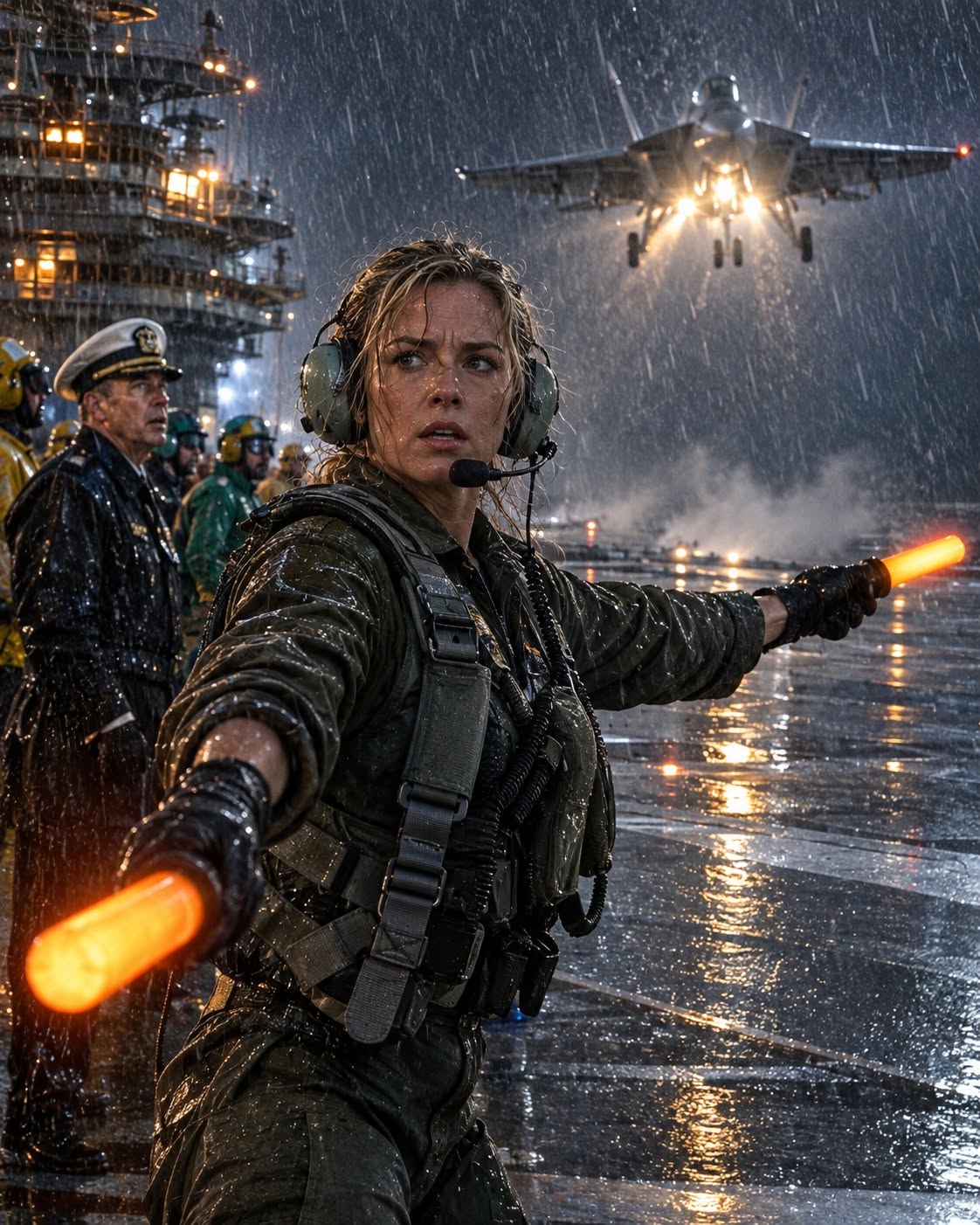
“Then request it again!”
The officer hesitated. He was young, frightened, and clearly unsure whether he should obey a former pilot wearing a cook’s uniform.
Before he could answer, the admiral entered the station.
“What’s happening?”
“Arthur is still airborne, Admiral. The optical system is malfunctioning, and the aircraft is struggling to maintain its approach.”
The admiral looked at the display.
“Can you bring him aboard?”
I swallowed.
“I can give him the best chance he’s got.”
The admiral studied my face for a moment.
“Then do it.”
I turned back to the radio.
“Arthur, this is your landing signal officer. I need you to listen to every word. Don’t make sudden corrections. Let the aircraft settle.”
“Understood.”
“You’re approaching from the starboard side. The deck is moving beneath you, so don’t try to fight every movement. Maintain control and wait for my command.”
“Roger.”
I looked at the optical landing system again.
The lights were still showing the aircraft dangerously high.
But the radar picture, the visual angle, and the ship’s movement told a different story.
The system wasn’t simply malfunctioning.
It was repeating the exact error that had killed Daniel.
My stomach tightened.
“Who last calibrated this system?” I asked.
A technician standing behind me answered.
“Maintenance team completed the inspection six hours ago.”
“Who signed the report?”
He checked his clipboard.
“Lieutenant Commander Harris.”
I knew the name.
Harris was the officer who had repeatedly insisted that the landing system was perfectly reliable. He had also been the person who testified against me after Daniel’s accident.
Before I could ask another question, the admiral spoke.
“Keep your attention on the aircraft.”
He was right.
Whatever had happened in the past, Arthur was depending on me now.
“Arthur, I have you in sight. You’re drifting right. Correct gently to port.”
“Correcting.”
“Easy. Hold it there.”
A violent gust struck the aircraft. Its wings rocked, and the nose dipped toward the dark ocean.
“Arthur!”
“I’m fighting it!”
“Don’t overcorrect. Bring the nose level. That’s it. Stay with me.”
For several seconds, his aircraft seemed to hang between the sea and the storm.
Then the engine roared.
He climbed slightly.
“You’re still with me, Arthur?”
“Still here.”
“Good. Now we’re going to bring you home.”
But just as I prepared to give him the final approach instructions, the optical landing system suddenly changed.
The lights flashed.
Then went completely dark.
A technician shouted.
“We’ve lost the entire system!”
Someone behind me cursed.
The admiral grabbed the edge of the console.
“Can we restore it?”
“Not in this weather, sir!”
I stared at the dead display.
For years, I had imagined confronting the machine that had taken Daniel’s life. I had imagined proving that I had been right.
But I never imagined that the same machine would fail again while another young man was depending on me.
“Arthur, do you copy?”
Static.
“Arthur, respond!”
Nothing.
Then his voice returned, weaker than before.
“Landing station… I’ve got an engine warning.”
I felt my heart sink.
“What’s the problem?”
“Fuel pressure is dropping. I’m losing power.”
The aircraft was now fighting on borrowed time.
“Can you maintain your altitude?”
“Trying.”
I looked at the flight deck crew. They were waiting for a decision.
The admiral approached me.
“What do you need?”
I turned toward him.
“I need the deck cleared except for the essential landing crew. I also need the ship’s navigation officer to give me the precise heading and movement. And I need Harris brought here.”
The admiral raised an eyebrow.
“Harris?”
“Yes, sir. I think this malfunction is more than bad luck.”
He immediately ordered the requests.
Within moments, the navigation officer arrived with the latest information.
The carrier was turning into the wind, but the storm had pushed it off its planned heading. The ship was rolling more violently than the flight deck team had anticipated.
I studied the figures.
There was no perfect approach.
There was only one narrow opportunity.
“Arthur, I’m going to give you a different approach.”
“Anything. Just tell me what to do.”
“Forget the lights. Forget the automated guidance. Use the visual reference I give you. Keep the wings level as much as the wind allows.”
“Copy.”
“Your approach will be slightly different from the standard procedure. Follow the commands of the qualified flight deck team. Do not attempt to force the aircraft onto the deck if the conditions become unsafe.”
I looked toward the officer beside me.
“Prepare the emergency recovery team. I want the deck ready.”
Then a voice behind me said something I had not expected.
“You can’t do that.”
I turned.
Lieutenant Commander Harris had arrived.
He was older now, with silver beginning to show at his temples, but his expression was exactly the same.
“You’re not qualified to direct a recovery,” he said. “You’re a culinary specialist. You’re interfering with an official operation.”
I stared at him.
“And you’re defending a system that is sending a damaged aircraft toward the wrong part of the deck.”
“The system passed inspection.”
“Then your inspection was wrong.”
Harris stepped closer.
“You have no idea what you’re talking about.”
I almost laughed.
Years ago, those same words had been used to silence me.
Daniel had died because I listened to people who valued their authority more than the truth.
I wasn’t going to repeat that mistake.
“Admiral,” I said, “I need you to look at the raw radar data. Not the optical display. Not the maintenance report. The actual measurements.”
Harris shook his head.
“That data is irrelevant to a landing operation.”
The admiral looked at him.
“Then explain why the readings disagree.”
Harris said nothing.
I turned back to the radio.
“Arthur, are you still there?”
“Yes. Barely.”
“How is the aircraft responding?”
“Controls are getting heavy. I don’t think I can hold much longer.”
I glanced at the fuel indicator on the emergency display.
He had almost nothing left.
“Arthur, I need you to remain calm. We’re going to take this one step at a time.”
There was a pause.
Then he said something that stopped me cold.
“Sir, I should tell you something. My right-side landing indicator is showing a warning. It says the gear may not be locked.”
I closed my eyes for half a second.
An aircraft with damaged controls, failing fuel pressure, a wounded pilot, and possibly compromised landing gear.
This was no longer a difficult landing.
It was a rescue mission with almost no room for error.
“Can you confirm the landing gear visually?”
“Negative. My camera feed is gone.”
I looked toward the technicians.
“Can we get a visual confirmation?”
One of them shook his head.
“Not in this visibility, sir.”
The admiral stepped closer.
“What are our options?”
I took a breath.
“An immediate approach is too dangerous. But he doesn’t have enough fuel for a normal recovery.”
“Then what?”
“We prepare for an emergency landing and keep the flight deck crew ready for the possibility that he won’t stop normally.”
The admiral nodded.
“Do what you need to do.”
Harris suddenly raised his voice.
“This is madness! If that aircraft crashes, the responsibility will be yours.”
I looked him directly in the eyes.
“Then I will accept responsibility for trying to save him. But I won’t accept another death caused by a lie.”
For the first time, Harris looked uncertain.
I returned to the radio.
“Arthur, I want you to listen carefully. The deck is ready. We have an emergency recovery plan in place.”
“Understood.”
“You’re going to have to trust your training. Keep your breathing steady. Don’t let the storm make you rush.”
He gave a short, nervous laugh.
“Easy for you to say, sir.”
I smiled despite everything.
“Believe me, son. I’ve been where you are.”
“Really?”
“Yes. And I made a promise to myself that I would never let another pilot face this alone.”
A gust hit the carrier so hard that the landing station shook.
The radar screen flickered.
Then Arthur’s signal began moving toward the carrier.
“He’s coming in!” the technician shouted.
I leaned toward the radio.
“Arthur, I have you. Maintain your approach.”
His aircraft emerged from the clouds, barely visible against the black sky.
The wings were trembling.
One engine was producing an uneven roar.
The aircraft looked impossibly small against the massive carrier.
“You’re drifting left!”
“Correcting!”
“Steady. Don’t chase it.”
The ship rolled again.
The aircraft rose slightly, then dropped.
“Arthur, you’re too low!”
“I can’t hold it!”
“Bring the nose level. Keep it steady!”
For one terrifying second, I thought he was going to hit the water.
Then the aircraft climbed just enough to clear the edge of the flight deck.
The landing crew shouted.
“He’s above the deck!”
But the aircraft wasn’t aligned.
It was coming in at an angle.
The optical system would have told him to make a correction in the opposite direction.
I knew because I could see the same false pattern developing.
“Arthur, don’t follow your indicator. Correct gently to starboard!”
He responded.
The aircraft shifted.
A second later, the nose swung too far.
“Easy! Bring it back!”
The carrier’s deck seemed to rise beneath him.
The entire room went silent.
Then came a metallic scraping sound through the radio.
“Landing gear contact!” someone shouted.
The aircraft slammed onto the deck.
It bounced.
Once.
Twice.
A shower of sparks erupted beneath the fuselage.
The emergency crew rushed forward.
“Arthur, stay with me!”
“I’ve got no steering!”
“Keep your hands on the controls. Don’t try to fight the aircraft!”
The plane skidded across the wet deck.
A crew member slipped while moving toward the emergency equipment.
The aircraft was still moving.
Then its nose swung violently toward a parked maintenance vehicle.
“Clear the deck!” I shouted.
The vehicle’s driver jumped out and ran.
The aircraft struck the vehicle’s rear corner, spun sideways, and finally stopped.
For a moment, there was no sound.
Then a fire alarm began screaming.
“Fire on the flight deck!”
The emergency crew rushed toward the aircraft.
I dropped the radio and ran.
Rain hit my face like handfuls of stones. The smell of burning fuel filled the air. Men were shouting, hoses were unrolled, and the red emergency lights painted everything in a terrifying glow.
The aircraft’s canopy was still closed.
“Get him out!” I shouted.
A firefighter reached the cockpit and tried to open the canopy.
It wouldn’t move.
I reached the aircraft and looked inside.
Arthur was slumped against his harness. Blood covered his sleeve. His eyes were open, but he wasn’t moving.
“Arthur!”
I struck the side of the canopy.
His head turned slightly.
He was alive.
The rescue team brought cutting equipment.
The admiral arrived behind me, soaked from head to toe.
“Can you get him out?”
“They’re working on it!”
A loud pop came from beneath the aircraft.
The fire was spreading.
I looked at the damaged cockpit.
“Arthur! Listen to me. Stay awake!”
His lips moved.
I leaned closer.
“What?”
He whispered through the glass.
“Did… did I make it?”
My throat tightened.
“You’re on the carrier, son. You’re home.”
The rescue team finally opened the canopy.
They pulled Arthur free and carried him toward the medical station.
I watched them disappear into the rain.
Only then did I realize my hands were shaking.
The admiral placed a hand on my shoulder.
“You brought him back.”
I looked at the burning aircraft.
“Not alone, sir.”
But the night was not over.
Because as the emergency crew began containing the fire, one of the technicians came running toward us.
“Admiral! We found something!”
He held a small maintenance module in his hand.
“What is it?”
“The optical system’s diagnostic memory. It shows the landing-angle calibration was changed after the inspection.”
The admiral’s expression hardened.
“Changed by whom?”
The technician hesitated.
“Lieutenant Commander Harris’s authorization code was used.”
We all turned.
Harris was standing several feet away, watching the rescue operation.
His face had gone pale.
“That’s impossible,” he said.
The technician opened the diagnostic record.
“Sir, the system was deliberately given incorrect calibration values. The same error was recorded in the maintenance history from the night of the previous accident.”
My blood ran cold.
The past was no longer a memory.
It was evidence.
The admiral stepped toward Harris.
“Explain this.”
Harris looked around, searching for someone who might defend him.
“I didn’t know the system was compromised.”
“Your authorization code was used.”
“It must have been a technical error.”
I stepped forward.
“Daniel warned us about the same problem.”
Harris turned toward me.
“That was years ago.”
“Exactly. Years ago, you told everyone the system was reliable. You said I had made a mistake. You said Daniel’s death was my fault.”
He looked down.
I continued.
“And now another pilot almost died because the same false readings were still there.”
Harris’s voice dropped.
“You don’t understand what happened.”
“Then tell us.”
For several seconds, the only sound was the rain.
Finally, he spoke.
“The system had been giving inconsistent readings. I reported it. The inspection team wanted to take the aircraft carrier out of operational service, but the command was under pressure to maintain deployment readiness.”
The admiral stared at him.
“Who ordered you to alter the calibration?”
Harris didn’t answer.
“Who?” the admiral demanded.
Harris swallowed.
“I was told to make the system appear operational until the replacement components arrived.”
I felt as if the deck had shifted beneath my feet.
“So you knew.”
“I thought it would be temporary.”
“Daniel died.”
Harris closed his eyes.
“I know.”
“No. You don’t know. You weren’t the one who watched his aircraft disappear. You weren’t the one who heard his last transmission. And you weren’t the one who had to live with everyone believing you had caused it.”
His shoulders dropped.
“I was afraid of losing my career.”
I stared at him.
“And I lost mine. Daniel lost his life. Arthur nearly lost his.”
The admiral ordered Harris relieved of duty pending a full investigation. The maintenance records were secured, and the flight deck was placed under emergency restrictions.
For the first time in years, the truth was no longer buried.
But I wasn’t thinking about Harris anymore.
I was thinking about Daniel.
The next morning, the storm finally began to weaken.
I stood alone near the edge of the flight deck, watching the clouds break over the ocean.
The sea was still rough, but the first pale sunlight was spreading across the horizon.
A medical officer approached me.
“Arthur is awake.”
I turned immediately.
“How is he?”
“Broken arm, several bruises, and a concussion. He’ll need surgery, but he’s expected to recover.”
I let out a breath I hadn’t realized I’d been holding.
“Can I see him?”
The officer nodded.
Arthur was lying in the medical ward with his arm secured in a thick bandage. His face was pale, but when he saw me, he smiled.
“There’s the man who refused to let me crash.”
I pulled a chair beside his bed.
“You’re making it sound easier than it was.”
He laughed, then winced.
“Sorry.”
“Don’t do that. You’ve earned the right to complain.”
He looked at me for a moment.
“Sir, why did you help me? I heard what the others were saying. You weren’t even supposed to be at the landing station.”
I looked at his bandaged arm.
“Because I know what happens when people stay silent.”
He frowned.
“What do you mean?”
I told him about Daniel.
I explained how we had trained together, how he had been the best pilot in our squadron, and how he had trusted the system when it told him he was safe.
I told him about the investigation.
About the accusations.
About the day I had surrendered my wings.
Arthur listened without interrupting.
When I finished, he remained quiet for a long time.
Then he asked, “Did you ever stop blaming yourself?”
I looked through the window.
“No. Not completely.”
“But you saved me.”
I shook my head.
“I gave you guidance. You did the flying. The crew did the rescue. Everyone played a part.”
Arthur considered that.
“Then maybe Daniel’s death wasn’t your fault either.”
His words struck deeper than I expected.
I had spent years carrying a responsibility that had never belonged to me alone.
I had confused guilt with loyalty.
I had believed that if I stopped blaming myself, I would somehow be betraying Daniel.
But perhaps the opposite was true.
Perhaps the best way to honor him was to make sure the truth could never be hidden again.
A week later, the investigation confirmed that the optical landing system had been deliberately miscalibrated years earlier. The same unauthorized adjustments had remained in the system through multiple inspections.
Several officers were suspended, and the command began reviewing every maintenance record connected to the landing equipment.
The Navy also reopened the investigation into Daniel’s accident.
This time, the findings were different.
The report cleared me of the accusations that had ended my flying career. It officially recognized that the faulty landing system had contributed to the crash and that my earlier warnings had been valid.
The admiral personally delivered the report.
“You were right,” he said.
I looked at the document in my hands.
For years, I had imagined those words would make me feel victorious.
Instead, I felt tired.
“Thank you, sir.”
He sat across from me.
“There is something else. The review board has recommended that you be considered for reinstatement to flight operations, subject to qualification and medical review.”
I looked up.
“Reinstatement?”
“You have experience that this crew needs. We could use you as a flight operations instructor and safety adviser.”
I stared at him.
The thought of returning to aviation had once been the only thing I wanted.
Now, it felt different.
“Sir, I appreciate the offer. But I don’t think I want to fly again.”
The admiral seemed surprised.
“May I ask why?”
I looked down at my hands.
“Because for years, I thought the only way to make things right was to get my wings back. But I finally understand that my worth was never defined by them.”
He nodded slowly.
“What would you like to do?”
I took a breath.
“I want to help train the people who keep pilots alive. I want every warning to be investigated, every system to be tested honestly, and every young pilot to know that speaking up is more important than protecting someone’s reputation.”
The admiral smiled faintly.
“Then I think we have a place for you.”
Over the following months, I helped establish a new flight safety training program aboard the carrier. I worked with technicians, deck crews, pilots, and maintenance officers.
I taught them how to recognize faulty readings, how to challenge unsafe decisions, and how to trust evidence over rank.
I also made one rule clear.
No warning would ever be dismissed simply because it came from someone with a lower position.
Not from a cook.
Not from a mechanic.
Not from a young sailor who had only just joined the ship.
A few months later, Arthur returned to the carrier.
His arm had healed, although he still moved carefully when the weather changed. He came to visit the training room before his next assignment.
He carried something in his hand.
A small photograph.
It showed him standing beside his damaged aircraft after the recovery operation. His arm was in a sling, his face was bruised, and behind him stood the emergency crew.
On the back, he had written:
“To the man who taught me that courage isn’t always about flying. Sometimes it’s about refusing to stay silent.”
I read the words twice.
Then I placed the photograph beside an older one on my desk.
It was a picture of Daniel and me, taken years before the accident.
Two young pilots, smiling beneath a clear blue sky, convinced that nothing could ever go wrong.
I looked at both photographs for a long time.
One reminded me of the friend I had lost.
The other reminded me of the life I had helped save.
For the first time, they didn’t feel like two separate stories.
They felt like the beginning and the continuation of the same promise.
That evening, I walked out onto the flight deck.
The ocean was calm, and the aircraft were lined up beneath the fading sunlight.
I could hear the familiar roar of engines as another training flight prepared for takeoff.
I closed my eyes and imagined Daniel standing beside me, smiling as he always had.
I couldn’t bring him back.
I couldn’t undo the past.
But I could make sure his death was not forgotten, and that no one else would be forced to carry the blame for a failure they had tried to prevent.
A young sailor approached me.
“Chief, can I ask you something?”
“Of course.”
“Do you ever regret losing your wings?”
I looked toward the horizon.
“Sometimes. But I regret staying silent when I should have spoken up much more.”
He nodded thoughtfully.
I placed a hand on his shoulder.
“Remember something. Rank doesn’t make a person right. Experience doesn’t make someone infallible. And a uniform doesn’t give anyone permission to ignore the truth.”
He smiled.
“Yes, Chief.”
As he walked away, I looked once more at the landing station.
Its lights had been repaired, its calibration independently verified, and its maintenance procedures completely rewritten.
But I knew that the most important change wasn’t in the equipment.
It was in the people who operated it.
For years, I had believed that my life ended the night Daniel died.
I had been wrong.
That night had taken my wings, but it had not taken my ability to make a difference.
And when another pilot needed someone to believe him, I had finally found the courage to stand up.
I never became a naval aviator again.
I never heard the roar of an engine from the cockpit as I once had.
But every time a young pilot returned safely to the carrier, every time a mechanic spoke up about a dangerous fault, and every time an officer chose the truth over convenience, I knew I was still serving the people I had once promised to protect.
Daniel had once told me that the hardest part of flying wasn’t taking off.
It was trusting someone enough to bring you home.
I finally understood what he meant.
Sometimes, the greatest act of courage isn’t saving yourself. It’s speaking up when everyone else tells you to stay quiet. And sometimes, the person who saves a life isn’t the one in the cockpit, but the one brave enough to tell the truth from the ground.