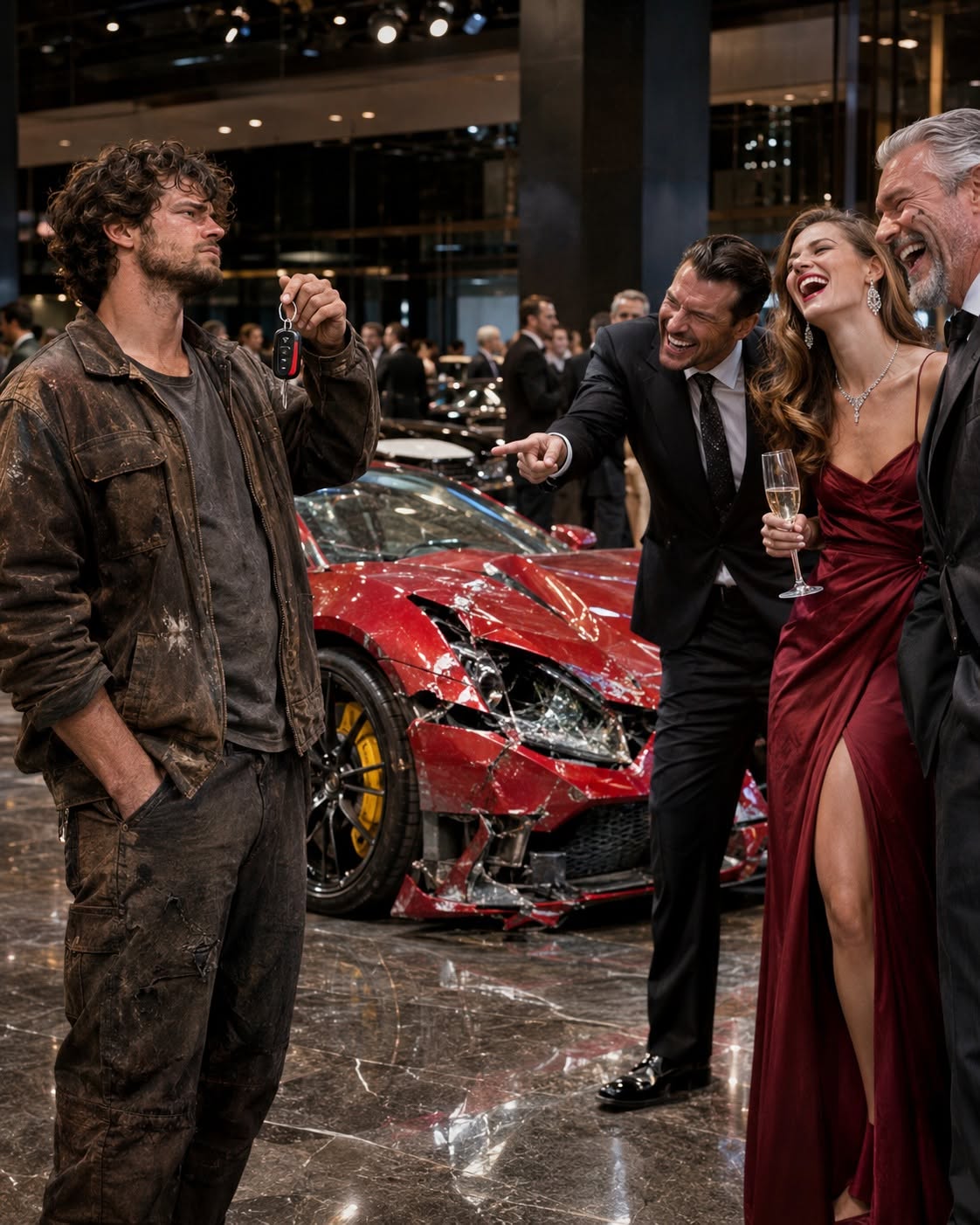
The moment I raised my hand and bid $50,000 on a wrecked red sports car, the entire auction room burst into laughter.
I didn’t sleep much that night.
The offer Grant had made was written on a piece of paper beside the restoration report. I had read it so many times that I could practically recite every number without looking.
It was enough money to change our lives.
Not just for a few months, but for years.
I could pay off every debt, replace the equipment in my garage, put money away for Chloe’s education, and finally stop wondering whether one unexpected repair bill would send us backward.
For a man who had spent years counting every dollar, that kind of security was difficult to ignore.
But there was something else I couldn’t ignore.
I had spent my entire career trying to prove that doing things properly still mattered, even when cutting corners would have made me richer. I had walked away from a comfortable job because I refused to sign my name to work I believed was unsafe.
And now, after everything, I was considering selling the greatest project of my life to a man who seemed to believe that money gave him the right to own everything.
I folded Grant’s offer and put it in a drawer.
The following morning, Chloe found me sitting at the kitchen table with two cups of coffee.
She climbed into her chair, placed her drawing beside my mug, and studied my face.
“You didn’t sleep, did you?”
I smiled.
“Is it that obvious?”
“Your hair looks like you fought a lawn mower.”
I laughed for the first time in days.
Then she pushed her drawing toward me.
It showed our garage, except the building had been painted bright blue, with a huge sign above the doors. In front of it stood the red sports car. Beside the car were two stick figures holding hands.
One was taller than the other.
Above them, she’d written:
“OUR GARAGE.”
I stared at it for a moment.
“That’s quite a building,” I said.
“Well, the old roof leaks.”
“Fair point.”
“And you need a bigger place for all your cars.”
“Also fair.”
She took a bite of her cereal before asking the question I had been avoiding.
“If we sell the red car, does that mean you won’t need the garage anymore?”
I put my coffee down.
“Why would you think that?”
“Because Mr. Mercer said you could stop worrying about money if you sold it.”
I looked at her.
“When did he tell you that?”
“Yesterday. Before he left. He said rich people don’t spend their lives fixing old things. They buy new things.”
I felt something tighten in my chest.
Grant had apparently decided that making an impression on a nine-year-old was another way to influence me.
“What do you think?” I asked.
Chloe shrugged.
“I think fixing things is important. If everybody threw things away when they got broken, you wouldn’t have a job.”
She returned to her cereal as though she’d just explained something obvious.
I looked down at her drawing again.
Maybe the answer wasn’t simply to keep the car or sell it.
Maybe I needed to understand what I was actually trying to preserve.
That afternoon, I called Clara and Frank and asked them to come to the garage.
I didn’t tell them why.
When they arrived, I placed Grant’s offer on the workbench.
Frank picked it up, read the number, and let out a low whistle.
“That’s serious money.”
Clara examined the document more carefully.
“He’s made this offer formally?”
“Through his attorney. He wants an answer by Friday.”
Frank looked at me.
“Well, if you want my opinion, I’d take it.”
I wasn’t expecting that.
He continued, “You’ve done something remarkable here. Nobody can take that away from you. But remarkable doesn’t pay the electric bill.”
Clara nodded thoughtfully.
“He’s right about one thing. The car has become a significant asset. You shouldn’t let sentiment make the financial decision for you.”
I leaned against the workbench.
“So you both think I should sell?”
Frank rubbed his chin.
“I think you should decide what matters most before you decide what to do with the money.”
Clara opened her briefcase and removed a folder.
“There’s something else you should see.”
She placed several photographs on the workbench.
They showed the car decades earlier, racing on a European circuit. Its original livery was unmistakable, and the number on the side matched the archival records she’d uncovered.
“During my research, I found a reference to the original racing team,” she explained. “They kept records of the car’s competition history, but there was a gap after its final documented race.”
She turned another page.
“The car was sold privately, passed through several owners, and eventually disappeared from the official records. I managed to trace some of that history through old registration documents and archived correspondence.”
“Why does that matter now?”
“Because the original team is still active. Their heritage department contacted me after I submitted the verification.”
Frank leaned closer.
“What do they want?”
Clara paused.
“They want to see the completed car. And they’ve asked whether you’d consider displaying it at an upcoming historic motorsport exhibition.”
I stared at her.
“An exhibition?”
“Yes. They’ve also expressed interest in discussing a possible restoration partnership.”
Frank looked at the car and smiled.
“Well, I’ll be damned.”
I didn’t smile.
“Does that mean they’re interested in buying it?”
“Not necessarily,” Clara replied. “They want to discuss several possibilities. But there’s something important you need to understand. The car’s value isn’t based solely on its rarity. Its documented history and the quality of the restoration are a significant part of what makes it special.”
She looked directly at me.
“Whatever you decide, don’t let someone pressure you into making a decision before you’ve explored every option.”
For the first time, Grant’s offer no longer felt like the only door standing open.
But I still had to decide whether to walk through it.
The next day, I received a phone call from an unfamiliar number.
The man introduced himself as Daniel Reeves, director of heritage collections for the original racing team.
He had a calm voice and spoke with the kind of precision I’d come to associate with people who understood that details mattered.
He told me he’d reviewed Clara’s preliminary findings and wanted to arrange a meeting.
“There’s something unusual about this particular car,” he said.
“How unusual?”
“Before I explain, I’d prefer to show you a few documents in person.”
We arranged to meet at my garage two days later.
I barely had time to process the conversation before Grant appeared again.
This time, he didn’t arrive alone.
A younger man in a dark coat followed him into the shop carrying a leather folder.
Grant looked at the red car, then at me.
“Have you made your decision?”
“Not yet.”
His smile disappeared.
“I gave you an extraordinarily generous offer.”
“I know.”
“Then what are we waiting for?”
“Some information I’d like to review.”
Grant glanced at Clara’s folders.
“More paperwork? You’ve already had the car inspected. What else could possibly matter?”
“Apparently, quite a bit.”
His companion stepped forward.
“I’m representing Mr. Mercer in this transaction. The offer is contingent on acceptance by Friday. After that, the terms may change.”
I folded my arms.
“That’s his choice.”
Grant’s expression hardened.
“You need to understand something. A garage like this isn’t a place to keep an asset of this value. You’re a mechanic, not a collector.”
I looked around my shop.
The oil-stained floor.
The old cabinets.
The flickering overhead light.
The workbench where Chloe had drawn pictures while I rebuilt an extraordinary machine.
“You’re right about one thing,” I said. “I’m a mechanic.”
I pointed toward the car.
“And that’s exactly why it’s standing here.”
Grant stared at me for several seconds before turning toward the door.
“Friday,” he said. “Don’t make a mistake you’ll regret.”
After he left, Frank emerged from the back workshop.
“That man has the bedside manner of a tax collector.”
Clara laughed.
I didn’t.
Something about Grant’s behavior had changed. His earlier offers had sounded almost casual. Now there was an urgency behind them that I couldn’t quite explain.
I decided to find out why.
That evening, Clara called.
“I’ve been reviewing the auction documentation again,” she said. “There’s an inconsistency.”
“What kind?”
“The ownership history supplied before the auction doesn’t match one of the archived racing records. Someone omitted a document.”
“Could it be a mistake?”
“It could. But I don’t think so.”
She explained that one of the original team’s internal documents referred to a special development program associated with the car. It wasn’t a separate racing model, but a limited engineering configuration that had been used during a particularly important season.
The car had served as a test vehicle for several components that later influenced the team’s championship-winning machines.
Three small markings visible in the auction photographs matched the old engineering records.
That was why I’d recognized something unusual.
And it was why Clara had been so determined to establish its provenance.
But there was another detail.
The records indicated that the original team had retained a technical archive associated with the car.
Some of the archive had never been digitized.
“Why wasn’t this information included in the auction description?” I asked.
“I don’t know yet. But I suspect the people who consigned the vehicle didn’t have access to the complete records.”
I sat quietly.
“Does Grant know?”
“I can’t prove that.”
The following morning, Daniel Reeves arrived at the garage.
He was in his early sixties, with silver hair and a modest manner. Unlike Grant, he didn’t look at the building with disappointment.
He looked at the car.
For several minutes, he said nothing.
Then he walked around it slowly, studying the bodywork and the details of the restoration.
“Beautiful work,” he finally said.
“Thank you.”
He crouched beside the front suspension.
“May I?”
I nodded.
He examined the restored mounting points, then looked toward Frank.
“Who handled the structural work?”
Frank raised a hand.
“That would be me.”
Daniel stood and shook his hand.
“I’ve seen photographs of this restoration. Seeing it in person is something else.”
He turned to me.
“Your specialist has confirmed the vehicle’s identity. What she may not have explained is the significance of its engineering history.”
Clara stepped forward.
“We’ve identified the development configuration.”
Daniel nodded.
“Correct. This car was used to evaluate a suspension and chassis package before the team introduced it on its later competition vehicles. Its surviving documentation is incomplete, but the records we have are important.”
He opened his briefcase and removed a photograph.
It showed the same red car, years younger, surrounded by engineers.
“That’s the original development crew,” he said. “Several of these men worked on the program. Only two are still alive.”
He placed the photograph on my workbench.
“One of them is my father.”
I looked at him.
“Your father worked on this car?”
“He was a junior engineer at the time. He has spoken about this vehicle for decades. He always wondered where it went.”
For a moment, the garage seemed unusually quiet.
Daniel continued.
“Our organization is preparing a permanent heritage exhibition. We’d like to include this car, along with its verified restoration history.”
“What exactly are you proposing?”
“We’d like to discuss a long-term loan or a partnership. We would cover the costs of transport, specialist insurance, and exhibition maintenance. You would retain ownership.”
I looked at Clara.
Then at Frank.
“Why would you offer that?”
Daniel smiled.
“Because a car like this shouldn’t disappear into a private collection where nobody can appreciate its history.”
He paused.
“And because the person who restored it deserves to have that work recognized.”
I looked at the car again.
For months, I’d thought the biggest question was whether to sell it.
Now another possibility had appeared.
I could keep ownership, allow the car to tell its story, and perhaps build something lasting around the work we’d done.
But there was still Grant.
And I had a feeling he wasn’t going to let this go easily.
On Thursday evening, he called me.
“I understand the heritage team has contacted you.”
I was silent.
“Interesting, isn’t it? They want to borrow your car. Very flattering. But let me give you some advice. Museums and heritage organizations are not in the business of making ordinary people wealthy.”
“Neither are collectors, apparently.”
He ignored the remark.
“My offer is still on the table. But I need an answer.”
“Why are you so interested in this particular car, Grant?”
There was a pause.
“Because I appreciate rare automobiles.”
“That’s all?”
“Of course.”
I looked toward the folder Clara had left on my desk.
“Then why did you know the car was unusual before the restoration was complete?”
Another silence.
Longer this time.
Finally, he said, “You have until tomorrow.”
The call ended.
I sat there wondering what I had just uncovered.
The next morning, Clara arrived carrying a thick envelope.
She placed it on the workbench and took a breath.
“I found something.”
She had obtained a copy of the original consignment correspondence from the auction company. It showed that the seller had provided additional historical documentation before the sale.
However, those documents hadn’t been included in the public catalog.
One of the letters had been sent to a private buyer several weeks before the auction.
The buyer’s name was Grant Mercer.
I read the page twice.
“Why would he let the car go to auction if he knew what it was?”
Clara turned another page.
“Because the previous owner had refused his offer. He apparently believed the car was too badly damaged to attract serious competition.”
Frank shook his head.
“So he thought he’d let the auction do the work for him.”
“Possibly,” Clara replied. “But there’s more.”
The correspondence showed that Grant had been trying to acquire the vehicle’s historical records for some time. The seller had declined to sell them separately.
Grant had known the car’s identity.
He had also known that its racing history might make it extremely valuable.
What he hadn’t anticipated was that a small independent mechanic would recognize the clues in the photographs and buy it before he could.
I felt a strange mixture of anger and relief.
The man who had laughed at me in the auction room hadn’t been laughing because he thought I was foolish.
He’d been laughing because he believed I had no idea what I’d purchased.
And after the restoration, he had tried to buy it from me before the full history became public.
Suddenly, every conversation made sense.
“Do we have enough evidence to prove he intentionally withheld information?” I asked.
Clara shook her head.
“We have evidence that he knew more than he admitted. Whether that constitutes wrongdoing is another matter. The auction company will need to review the documents.”
I nodded.
“Then let them review them.”
I wasn’t interested in revenge.
I was interested in making sure the truth was recorded.
That afternoon, I contacted the auction house and requested a formal review of the original consignment information. Clara provided copies of the correspondence and her provenance findings.
I also informed Grant, through his representative, that I was declining his offer.
Not because I wanted to punish him.
Not because I wanted to make him look foolish.
But because I had decided the car’s future shouldn’t be determined by his impatience.
His response arrived within an hour.
A short message.
“You’ll regret this.”
I read it once and deleted it.
That evening, Chloe came into the garage carrying another drawing.
This time, she’d drawn the red car in front of a much larger building.
There were people standing around it, looking at the vehicle.
Above the entrance, she’d written:
“THE PLACE WHERE OLD CARS GET NEW STORIES.”
I smiled.
“What’s this?”
“It’s your new garage.”
I laughed.
“That’s a very big garage.”
“Well, if the car is going to a museum, you need somewhere to build the next one.”
I knelt beside her.
“You think I should keep fixing cars?”
She gave me a look that suggested the question was ridiculous.
“Obviously.”
Then she hugged me.
And just like that, I knew what I wanted.
I didn’t want to sell the car and walk away from everything I’d built.
But I also didn’t want to keep it locked away simply because it was valuable.
I wanted it to become part of something bigger.
The following week, I traveled with Clara and Frank to meet the heritage team.
We reviewed the proposed agreement carefully.
The organization would display the car for an initial three-year period, with an option to extend by mutual consent. I would retain legal ownership. The vehicle would be insured at an independently agreed valuation, and the organization would cover transport, exhibition preparation, and routine preservation costs.
There was also a proposal that caught my attention.
They wanted to establish a small educational program about responsible restoration.
The program would bring apprentices into the workshop, teach them how to evaluate damaged vehicles, and emphasize the importance of structural safety, documentation, and ethical workmanship.
They wanted me to lead it.
I read the proposal several times.
“Why me?”
Daniel smiled.
“Because you did something most people wouldn’t. You refused to compromise safety when it cost you your career. Then you proved that the same principles could produce extraordinary work.”
Frank leaned back in his chair.
“Sounds like they’re offering you a job.”
“Not exactly,” Daniel said. “We’re offering him a chance to build something.”
I looked at the figures.
The program included funding for workshop equipment, apprentice wages, and the development of a proper training facility.
It wouldn’t make me wealthy overnight.
But it would give the garage a future.
More importantly, it would allow me to employ people, train young mechanics, and create the kind of workplace I’d once wished existed.
I signed the agreement three days later.
When the car was transported to the exhibition, I watched it disappear down the road on the back of a specialist carrier.
Chloe stood beside me, holding my hand.
“Will we see it again?”
“Of course.”
“Promise?”
I smiled.
“Every time you want.”
She looked at the empty space where the car had stood.
“I think it’s going to make a lot of people happy.”
“I think you’re right.”
The exhibition opened two months later.
The red sports car occupied the central position in the heritage hall. Beside it were Clara’s provenance documents, photographs from the original racing program, and a detailed account of the restoration.
There was also a display showing the damaged chassis before Frank’s work and the finished structure afterward.
My name appeared beneath the restoration credits.
Frank Doyle, chassis restoration.
Clara Vance, provenance research.
And mine.
Restoration lead.
I stood there longer than I intended.
For years, I’d believed walking away from my former employer meant I’d lost the opportunity to be part of something important.
Now I was standing in front of a car that had helped shape racing history, surrounded by people studying work that had begun in my little two-bay garage.
Then someone tapped my shoulder.
I turned.
Grant Mercer stood behind me.
He looked uncomfortable.
“I suppose congratulations are in order,” he said.
“Thank you.”
He glanced at the display.
“The car looks good.”
“It does.”
He stood silently for a moment.
Then he said, “I knew what it was when it went through the auction.”
I looked at him.
“I know.”
“I didn’t think you’d recognize it.”
“Apparently, you weren’t the only one who underestimated someone.”
He looked down at the floor.
For the first time since I’d met him, he didn’t seem to have an answer ready.
Finally, he said, “I made a mistake.”
I waited.
“I thought you were gambling with something you didn’t understand. I assumed you were just another mechanic who’d gotten lucky.”
I considered his words.
“Maybe I was gambling. But I knew enough to ask the right people before risking anything else.”
He nodded slowly.
Then he looked at the car.
“I’d still like to own it.”
I almost laughed.
“I figured.”
He extended his hand.
“Perhaps we can discuss it again someday.”
I shook his hand politely.
“Perhaps. But not today.”
He left without another word.
I watched him walk away.
There was a time when I would have imagined that moment as a victory. I would have wanted him to feel every ounce of embarrassment he’d once caused me.
But standing there, I realized I didn’t need that anymore.
The car had already taught me something more valuable.
Success wasn’t about making the people who doubted you admit they were wrong.
It was about building a life you didn’t have to apologize for.
The following spring, the training workshop officially opened.
It wasn’t the enormous facility Chloe had drawn, but it was a substantial improvement over my old garage. We had proper lighting, updated lifting equipment, a dedicated inspection area, and enough room to train six apprentices.
The old two-bay shop remained part of the operation.
I couldn’t bring myself to leave it behind.
We painted the front doors, repaired the roof, and installed a new sign.
Above the entrance were the words:
MERCER STREET RESTORATION & TRAINING.
I chose the name of the street, not the collector.
Frank became our senior chassis instructor.
Clara helped develop the documentation and provenance courses.
And our first group of apprentices arrived on a Monday morning.
Some were young people who had struggled to find a place in the industry. Others had been told they weren’t good enough to work on anything more complicated than routine servicing.
I recognized that look in their eyes.
The feeling of being underestimated.
During their first week, I gathered them around the red car’s restoration photographs.
I showed them the crushed front end, the damaged suspension mounts, and the original inspection notes.
Then I showed them the finished vehicle.
“Anybody can make something look good from a distance,” I told them. “But your real responsibility is making sure the work underneath is right.”
One apprentice raised his hand.
“What if doing it properly means losing money?”
I thought about my former employer.
I thought about the decision that had cost me my career.
And I thought about the fifty thousand dollars I’d once risked on a wrecked car.
“Then you lose the money,” I said. “You don’t lose your integrity.”
Frank smiled behind me.
The apprentices nodded.
And I hoped at least one of them would remember those words when the pressure came.
Life didn’t suddenly become perfect.
There were still difficult months. The training program required careful management, and the workshop wasn’t profitable every single quarter. I still worried about bills occasionally, although the fear no longer followed me into every room.
But Chloe’s education fund was growing.
The garage was stable.
And I was finally doing the kind of work I had always wanted to do.
One afternoon, almost a year after the auction, Daniel invited us back to the exhibition.
The heritage team had organized a special event honoring the engineers who had worked on the original racing program.
His father was there.
He was an elderly man with a walking stick and a face full of lines. Daniel helped him approach the car.
The old engineer stood in front of it for a long time.
Then he reached out and touched the edge of the display barrier.
“She’s still here,” he whispered.
Daniel looked at him.
“You remember it?”
The old man nodded.
“I remember the sound of the engine. I remember the engineers arguing over the suspension. I remember how much trouble we had getting everything right.”
He looked toward me.
“Who restored her?”
I stepped forward.
“I did, with a very good team.”
He studied my face.
Then he shook my hand.
“Thank you for bringing her home.”
I couldn’t speak for a moment.
Because those words meant more to me than any amount of money Grant could have offered.
The old engineer continued.
“People sometimes think these machines are important because of what they cost. But that’s never been the whole story. They’re important because of the people who worked on them, the problems they solved, and the memories they carry.”
He smiled at the car.
“Don’t ever let anyone tell you that the work doesn’t matter.”
I felt my eyes sting.
“Thank you, sir.”
Chloe, who had been standing beside Clara, stepped forward with a folded piece of paper.
“Would you like to see my drawing?”
The old engineer bent carefully to look.
It showed the red car surrounded by several smaller cars, each one painted a different color.
Beneath them, she’d written:
“EVERY CAR HAS A STORY.”
He smiled.
“That’s a very good title.”
Then he asked her a question.
“Would you like to design cars when you grow up?”
Chloe thought for a moment.
“Maybe. Or maybe I’ll fix them like Dad.”
The old man laughed.
“Either way, we need people who care about getting things right.”
That evening, I drove home with Chloe asleep in the passenger seat.
Her drawing rested on the dashboard.
At a red light, I glanced at it and thought about the auction.
The laughter.
The insults.
The fifty thousand dollars.
The months of uncertainty.
The temptation to accept Grant’s offer.
And the decision that had followed.
If I had sold the car, my family would probably have been financially comfortable. There was nothing wrong with choosing that. A parent has every right to put security first.
But I had discovered another kind of security.
The security of knowing that my daughter had watched me stand by something I believed in.
The security of having work that meant something beyond the next paycheck.
And the security of knowing that the people who came through our workshop would be taught that honesty wasn’t optional.
A few weeks later, I found Chloe sitting at my workbench after school.
She was drawing another sports car.
This one was blue.
“What’s that one?” I asked.
She looked up.
“My first design.”
“Planning something ambitious?”
“Yes.”
She turned the paper toward me.
“I want to build a car that people can afford to drive, but that doesn’t break all the time.”
I laughed.
“That’s a pretty good goal.”
“And it needs to be safe.”
“Especially safe.”
She nodded seriously.
“Because people have to trust the people who build their cars.”
I pulled up a chair beside her.
For a while, we sat together, sketching ideas and talking about engines, wheels, and designs.
Then she asked me something.
“Dad, do you remember what that man said at the auction?”
I knew exactly who she meant.
“Which man?”
“The rich one. The one who laughed at you.”
I smiled.
“I remember.”
“Was he wrong?”
I thought about it.
“He was wrong about the car. But more importantly, he was wrong about something else.”
“What?”
“He thought the value of something depended on what it looked like, what it cost, and who owned it.”
Chloe considered that.
“What does it depend on?”
I looked around the garage.
At Frank teaching an apprentice how to inspect a damaged mounting point.
At Clara’s carefully organized files.
At the photographs documenting every stage of a restoration.
At the drawing beneath Chloe’s hand.
“Sometimes it depends on what you’re willing to do to make it right.”
She smiled and returned to her drawing.
And I realized that the greatest thing I’d restored wasn’t the red sports car.
It was my belief that a person could build a good life without becoming someone they didn’t respect.
The car still stands in the heritage exhibition today. Its value has continued to rise, and Grant has occasionally sent inquiries about purchasing it. I’ve never accepted.
Not because I hate him.
Not because I think keeping a valuable car makes me a better person.
But because that particular car became the beginning of something I couldn’t have bought with money.
It gave an old racing machine a second life.
It gave a small garage a future.
It gave young mechanics an opportunity.
And it gave my daughter a memory of a father who chose to do things the right way, even when the easier choice was sitting right in front of him.
Sometimes people ask whether I regret not taking Grant’s offer.
I tell them the truth.
There were nights when I wondered whether I’d made the wrong decision. There were moments when the money would have made life considerably easier.
But then I remember the old engineer standing in front of the car, thanking us for bringing it home.
I remember the apprentices learning their first lessons.
And I remember Chloe’s drawing, with the words “EVERY CAR HAS A STORY” written beneath it.
I don’t regret it.
Because the fifty thousand dollars I spent at that auction wasn’t simply the price of a damaged sports car.
It was the beginning of a future I hadn’t known was possible.
And if there’s one thing I hope Chloe carries with her when she grows up, it’s this:
Never measure your worth by how loudly other people laugh at your dreams.
Don’t confuse an expensive offer with a good opportunity.
And never sacrifice your principles just because someone promises you an easier life.
Sometimes the most valuable thing you can restore isn’t a machine, a business, or even a broken dream.
Sometimes it’s the faith that doing the right thing is still worth it.
And that, more than anything else, is what I wanted my daughter to inherit.