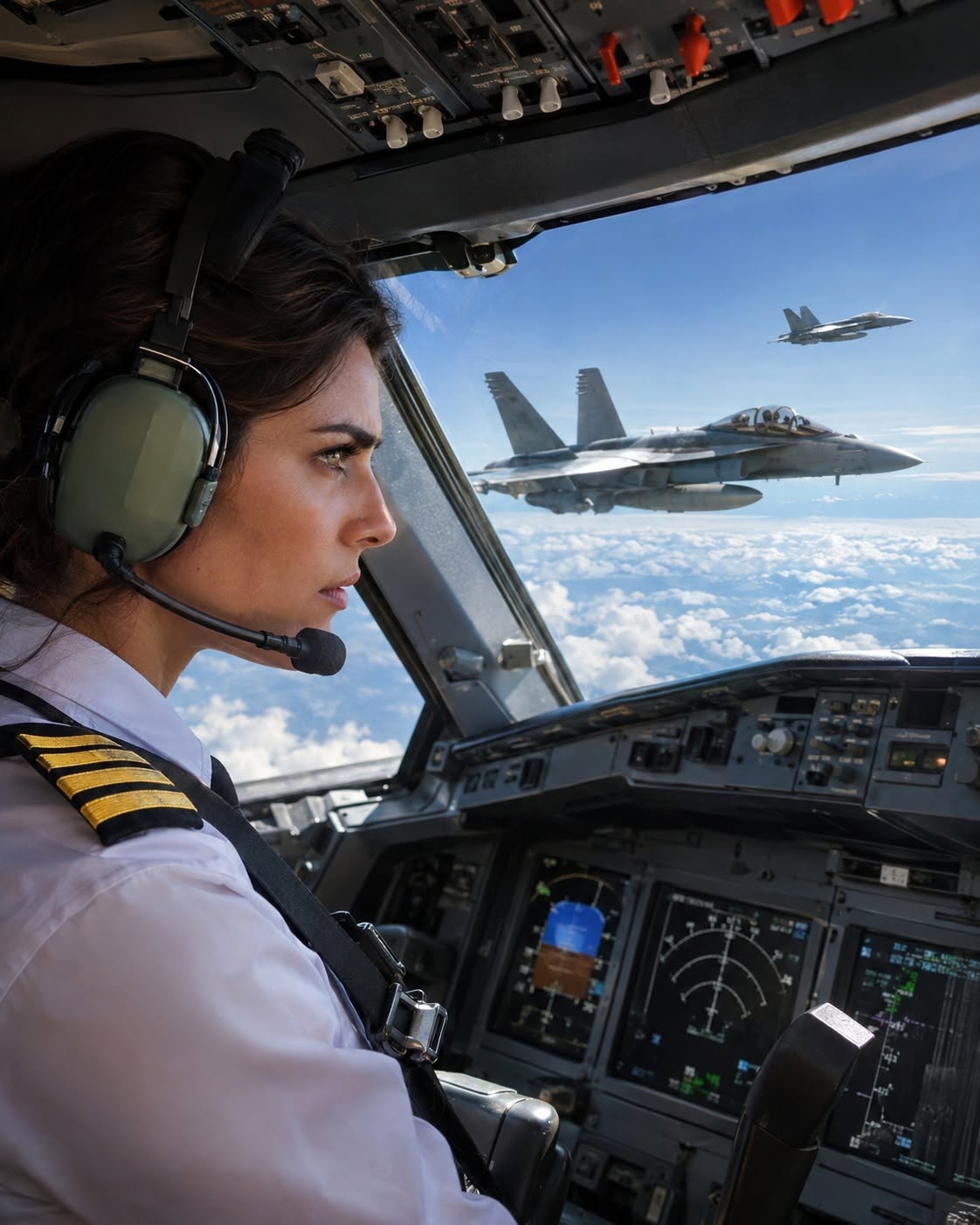
The MiG-29 pilot had just threatened to shoot down our Boeing 737 when Colonel Sterling shoved his way into the cockpit
“Then let me ask you something, Admiral,” I said, my voice barely above a whisper. “If I tell you what happened that night, will you promise me that the people responsible won’t be allowed to bury the truth again?”
Wheeler didn’t answer immediately.
He glanced at Master Chief Grant, then at the intelligence officer standing beside him.
“Everyone out,” he ordered.
Colonel Sterling stiffened. “Admiral, I believe I should remain.”
“That wasn’t a suggestion, Colonel.”
Sterling hesitated before turning toward the door. Lieutenant Mitchell followed him without saying a word. Viktor Sterling remained behind, his eyes fixed on me.
“Please,” I said. “You too.”
The old man nodded slowly.
Before leaving, he placed a trembling hand on my shoulder.
“Some debts take a lifetime to repay, Rebecca. Perhaps tonight is the night.”
When the door closed, Admiral Wheeler pulled a chair toward me.
“Start at the beginning.”
I looked down at my hands.
For eleven years, I had rehearsed what I would say if someone ever discovered my past.
But now that the moment had arrived, I couldn’t find the words.
“My real name isn’t Rebecca Hayes,” I finally said.
Wheeler leaned forward.
“My name is Lieutenant Commander Rebecca Anne Hayes. United States Navy. Former experimental flight instructor. Callsign Phantom Six.”
The admiral’s expression remained unreadable.
“Continue.”
I took a breath.
“Eleven years ago, I was assigned to a classified flight-testing program called Phantom. It wasn’t an ordinary squadron. We tested experimental aircraft, developed interception tactics, and trained pilots for missions that officially never happened.”
I paused.
“Six pilots were selected. Six aircraft. Six callsigns. We were supposed to be the best.”
“Supposed to be?” Wheeler asked.
“Because we weren’t all coming home.”
I closed my eyes.
The memories returned with terrifying clarity.
Eleven years earlier, Naval Air Station Fallon, Nevada.
The desert sun was just beginning to disappear when our commander called us into the briefing room.
Six pilots sat around a table.
I was twenty-nine, the youngest instructor in the program and the only woman among the original six.
My closest friend was Lieutenant Daniel Cross, callsign Phantom Two.
Daniel had a habit of smiling whenever things became dangerous.
It drove me crazy.
“If we’re going to die today, Rebecca,” he’d once told me, “I’d rather do it knowing I annoyed somebody first.”
That evening, he wasn’t smiling.
Our mission involved intercepting an unidentified aircraft carrying classified technology across an international corridor in the Pacific.
Intelligence suggested the aircraft had been compromised.
We were instructed to identify it, escort it to a designated location, and prevent its cargo from falling into unauthorized hands.
The mission was classified beyond our clearance level.
Even our squadron commander received only partial information.
What we didn’t know was that someone had already arranged for the aircraft to disappear.
And someone wanted us to disappear with it.
At 0215, we launched.
The first forty minutes were uneventful.
Then Phantom Two reported an unidentified contact approaching from the northeast.
“Control, this is Phantom Two. I have visual contact. Possible hostile aircraft.”
Static followed.
Then a second voice entered the frequency.
“Phantom Flight, abort mission immediately. Return to base.”
It was Admiral Wheeler’s voice.
I recognized it immediately.
At the time, he had been a senior operations officer.
“Sir, we have not completed identification,” I replied.
“That’s an order, Lieutenant Commander. Return immediately.”
Daniel came over our private channel.
“Rebecca, something isn’t right.”
I checked my instruments.
He was right.
A second aircraft had appeared on our radar.
Then a third.
They were approaching from different directions.
“Phantom Lead, requesting clarification,” I transmitted.
There was no response.
Instead, our radar suddenly began displaying false targets.
Someone was jamming our systems.
And then the unidentified aircraft transmitted a message.
It was in Russian.
I understood every word.
“To the Americans listening, the cargo is not what you think. They are planning to kill everyone involved.”
My stomach tightened.
The aircraft wasn’t carrying stolen technology.
It was carrying evidence.
Evidence of an illegal weapons transaction involving military contractors, foreign intelligence officers, and several people inside our own command structure.
Before I could process the message, the first missile warning sounded.
“Break left!” I shouted.
Daniel’s aircraft took a direct hit.
His right engine exploded in a brilliant flash.
“Phantom Two, eject! Eject now!”
His voice came through the radio, strained and broken.
“Controls are gone. I’m trying!”
I watched his aircraft spiral downward.
Then another voice entered the channel.
“Phantom Six, disengage. Leave the damaged aircraft. You are authorized to return alone.”
I stared at my instruments.
Daniel’s emergency beacon was still transmitting.
He was alive.
“Negative,” I replied.
“That’s a direct order.”
“I’m not leaving him.”
“Phantom Six, you will return immediately.”
I ignored the command.
I turned toward Daniel’s last known position.
That decision changed everything.
The second missile struck my aircraft before I could reach him.
The impact threw my body against the harness.
Warning lights filled the cockpit.
I tried to stabilize the aircraft, but the controls had become unresponsive.
“Mayday! Mayday! Phantom Six is hit!”
The cockpit began filling with smoke.
I reached for the ejection handle.
But something was wrong.
The canopy mechanism had partially failed.
I pulled once.
Nothing.
I pulled again.
The handle moved, but the system hesitated.
I remember the sound more than anything else.
A deafening explosion.
Then the entire world seemed to turn upside down.
The ejection seat finally fired.
The force crushed my body against the harness.
My wrists were torn against the metal restraints as the seat separated from the aircraft.
I lost consciousness before my parachute fully opened.
When I woke up, I was floating above the ocean.
My aircraft was gone.
My radio was silent.
And Daniel was nowhere to be seen.
I spent nearly fourteen hours drifting before a fishing vessel found me.
I had two fractured ribs, severe injuries to both wrists, and a spinal injury that required months of rehabilitation.
But the worst part came afterward.
Daniel Cross was declared dead.
His aircraft had disappeared from every official tracking system.
There was no wreckage.
No recovered remains.
No explanation.
The official investigation blamed me for violating orders and compromising a classified mission.
They said I had abandoned my assigned formation.
They said my unauthorized maneuver had endangered the entire operation.
They never mentioned the false radar signals.
They never mentioned the intercepted Russian transmission.
And they never mentioned the missile that had struck my aircraft.
Within weeks, the Phantom program was officially dissolved.
My military record was sealed.
I was offered a choice: remain silent and receive an honorable medical retirement, or challenge the investigation and risk exposing my family to an investigation that nobody could guarantee would remain within the law.
I had a younger sister.
She was sixteen.
My parents were already gone.
I couldn’t risk dragging her into something she couldn’t understand.
So I signed the documents.
I walked away.
And eventually, I became Rebecca Hayes.
When I finished speaking, Admiral Wheeler sat perfectly still.
For several seconds, the only sound in the room was the air-conditioning.
Then he asked, “What happened to the evidence?”
I looked directly at him.
“Daniel had a recording device in his aircraft. Before the attack, he managed to transmit part of the intercepted conversation. I received the transmission.”
“Do you still have it?”
“No.”
Wheeler frowned.
“Then where is it?”
I swallowed.
“Someone else has it.”
At that moment, the door opened.
Master Chief Grant entered, his face pale.
“Admiral, we have a problem.”
“What is it?”
Grant placed a tablet on the table.
“An encrypted transmission was intercepted less than twenty minutes ago. It originated from an unidentified vessel approximately forty miles from Guam.”
Wheeler opened the recording.
A Russian voice filled the room.
“Phantom Six. If you are alive, we know where you are. The package has been located. Come alone, or the remaining witnesses will die.”
My blood turned cold.
I knew that voice.
It belonged to Daniel Cross.
I stood so quickly that my chair fell backward.
“That’s impossible.”
Grant looked at me.
“You’re certain?”
I nodded.
“I would recognize that voice anywhere.”
Wheeler immediately contacted military intelligence.
“Locate the source. I want every available asset monitoring that vessel.”
I grabbed the tablet.
“Don’t.”
He turned.
“Lieutenant Commander, someone has just threatened you and possibly hundreds of other people. We are not ignoring this.”
“You don’t understand. If that’s Daniel, then he survived the crash.”
“Or someone is impersonating him.”
“No,” I said firmly. “Listen to the last three seconds.”
The recording played again.
A faint metallic clicking sound could be heard behind the voice.
Three clicks.
A pause.
Two clicks.
My hands began shaking.
Daniel and I had developed that signal during our training.
Three clicks meant danger.
Two meant trust no one.
It was a warning we had used when radio channels were compromised.
“He’s alive,” I whispered.
Wheeler stared at me.
“Then we need to find him.”
Before he could say anything else, the door opened again.
Colonel Sterling entered without permission.
“Admiral, I strongly advise against launching an operation based on an unverified transmission.”
Wheeler’s expression hardened.
“You were ordered to remain outside.”
“With respect, sir, this matter falls under my department’s jurisdiction.”
I turned toward him.
“Your department?”
Sterling’s jaw tightened.
I stepped closer.
“Colonel, where were you eleven years ago?”
He didn’t answer.
“Do you remember Phantom?”
His expression changed almost imperceptibly.
That was enough.
“You were there,” I whispered.
Wheeler looked between us.
“Explain yourself, Colonel.”
Sterling straightened his uniform.
“I was assigned to the intelligence oversight division at the time. I had no operational authority over the Phantom mission.”
“That’s a lie,” I said.
His eyes narrowed.
I remembered the briefing room.
The additional intelligence officer who had joined us shortly before launch.
The man who had delivered the final mission parameters.
He had introduced himself as Marcus Sterling.
Younger then.
But unmistakable.
“You changed the mission coordinates,” I continued. “You sent us into an ambush.”
“Careful, Lieutenant Commander.”
“Daniel discovered the weapons transaction. You knew the aircraft wasn’t carrying what we were told it was carrying.”
“Enough.”
“Did you order the missiles launched?”
The room fell silent.
Sterling looked toward Wheeler.
“Sir, this woman is emotionally compromised. She has been through a traumatic experience and is making accusations based on eleven-year-old memories.”
I stepped closer.
“Then why are you afraid of a recording?”
Sterling’s hand moved toward his jacket.
Grant noticed immediately.
“Colonel, keep your hands where I can see them.”
For a moment, nobody moved.
Then Sterling slowly raised both hands.
Two security officers entered and escorted him from the room.
But before he disappeared through the doorway, he turned toward me.
“You should have stayed dead, Phantom Six.”
Those words confirmed everything.
Wheeler waited until the door closed.
“Lieutenant Commander, I need you to tell me exactly what you know about that recording.”
I looked at him.
“Daniel was carrying a duplicate.”
“Where?”
“On a secure storage device hidden inside his flight equipment. He told me before launch that if anything happened, I should make sure it reached someone outside the program.”
“And who was that?”
I looked toward the window.
“Viktor Sterling.”
Wheeler’s eyes widened.
“The former Soviet pilot?”
I nodded.
“He wasn’t just a passenger on this aircraft. He was the Russian intelligence liaison who helped us investigate the original weapons transaction. He was supposed to be extracted after the mission.”
The admiral immediately requested his location.
But Viktor was nowhere to be found.
His seat aboard Pacific 227 had been empty when the aircraft arrived.
A security officer reported that he had left the aircraft through the rear service stairs shortly after landing.
I felt the pieces falling into place.
“He’s going to the vessel,” I said.
Wheeler turned toward me.
“How do you know?”
“Because he was the only person Daniel trusted besides me.”
I looked at the clock.
“We don’t have much time.”
Within twenty minutes, military intelligence had identified the vessel.
It was an aging cargo ship operating under a Panamanian registration.
Its official destination was Hong Kong.
Its actual location placed it inside a restricted maritime area near Guam.
Wheeler authorized a reconnaissance operation.
I asked to accompany the team.
He refused.
“You’re a civilian airline pilot now. You have no operational assignment here.”
I almost laughed.
“Admiral, I spent eleven years trying to forget what I was. But if Daniel is alive, I’m not leaving him again.”
He studied my face.
Finally, he nodded.
“You will remain under the protection of a Navy tactical team. You will not engage anyone unless absolutely necessary.”
“Understood.”
Before we departed, Master Chief Grant approached me.
“I owe you an apology.”
I looked at him.
“For what?”
“For recognizing you and making your past public without asking your permission.”
I shook my head.
“You didn’t know.”
“Maybe not. But you deserved to choose when your story was told.”
I looked at him for a moment.
“Thank you.”
He nodded.
Then he handed me a small object.
It was an old military identification tag.
Daniel’s.
My breath caught.
“Where did you get this?”
“Viktor left it with the security team. He asked me to give it to you.”
On the back, someone had scratched four words.
YOU DIDN’T LEAVE ME.
My eyes filled with tears.
For eleven years, I had believed Daniel died thinking I had abandoned him.
Now I knew he hadn’t.
The operation began shortly after midnight.
A Navy helicopter carried our team toward the cargo vessel.
The ocean below was almost completely black.
I sat beside Grant, holding Daniel’s identification tag in my hand.
As we approached, our communications officer reported movement on the upper deck.
Two armed men.
Then four.
Then six.
The vessel’s lights suddenly went out.
“That’s not good,” Grant muttered.
A burst of gunfire erupted from the deck.
Our helicopter climbed sharply.
“Incoming!”
The pilot banked away as several rounds struck the aircraft’s side.
Wheeler’s voice came through our communications channel.
“Abort if necessary. We are not risking another aircraft.”
Grant looked at me.
“We need another way aboard.”
I stared at the cargo vessel.
A smaller service boat was tied to its rear.
“Get us down on the water.”
Grant raised an eyebrow.
“That’s not exactly standard procedure.”
“Neither was tonight.”
We transferred to a smaller tactical boat and approached the ship from its blind side.
The boarding team secured the lower deck.
Inside, the vessel smelled of oil, rust, and seawater.
We moved through narrow corridors.
Then I heard something.
A familiar voice.
“Rebecca?”
I froze.
It came from somewhere below us.
“Daniel?”
Grant motioned for the team to hold position.
I moved toward the sound.
Behind a locked metal door, someone was breathing heavily.
I tried the handle.
Locked.
A tactical officer forced it open.
And there he was.
Daniel Cross.
Older.
Thinner.
His hair almost entirely gray.
A long scar ran from his forehead to his jaw.
But his eyes were exactly the same.
For several seconds, neither of us spoke.
Then he smiled.
“You’re late, Hayes.”
I dropped to my knees.
Tears blurred my vision.
“You’re supposed to be dead.”
“That’s what they told me, too.”
I grabbed his shoulders.
“I thought I lost you.”
He looked down at my wrists.
“I know.”
I couldn’t speak.
He pulled a small metal device from beneath his shirt.
“I kept my promise.”
The storage device.
The evidence.
Everything we had spent eleven years searching for.
But before he could hand it to me, a gunshot echoed through the corridor.
Grant shouted.
“Contact!”
A man appeared at the doorway.
Colonel Sterling.
He was holding a pistol.
Behind him stood two armed men.
“Step away from the device,” he ordered.
Daniel immediately moved in front of me.
Sterling laughed.
“Still playing the hero, Cross?”
“You should have let it end eleven years ago,” Daniel replied.
Sterling raised his weapon.
“Give me the recording.”
I slowly stood.
“Why?”
“Because you have no idea what it contains.”
“Then explain it.”
For the first time, Sterling seemed uncertain.
“The weapons transaction was part of a larger operation. Several countries were involved. People with enormous influence. The Phantom mission was designed to eliminate the witnesses before the investigation could reach them.”
“Us,” I said.
“Yes.”
“And you gave the order.”
Sterling’s face hardened.
“I followed instructions.”
“That’s what cowards say when they don’t want to admit they chose money over human lives.”
His pistol shifted toward me.
Daniel lunged.
The gun fired.
I heard Grant shout my name.
Daniel collapsed against the wall.
Everything happened at once.
Grant and the tactical officers returned fire.
Sterling was disarmed and forced to the floor.
I rushed toward Daniel.
Blood was spreading across his shirt.
“No. No, no, no.”
He struggled to breathe.
“Rebecca…”
“Don’t talk. Help is coming.”
He caught my hand.
“The device…”
I shook my head.
“Forget the device.”
“Eleven years,” he whispered. “Don’t let it disappear again.”
I pressed my hand against his wound.
“You’re not dying tonight. Do you hear me?”
He gave a faint smile.
“Still giving orders.”
Then his eyes closed.
For one terrifying moment, I thought I had lost him all over again.
But the medical team arrived within minutes.
They stabilized him and evacuated him by helicopter.
I remained beside him until we reached the hospital.
The storage device was secured by Admiral Wheeler.
And Colonel Sterling was arrested.
The investigation that followed lasted eight months.
The recording contained everything.
The intercepted conversations.
The unauthorized missile launch orders.
The financial arrangements between defense contractors and foreign intelligence intermediaries.
Most importantly, it contained a conversation proving that Sterling had deliberately redirected the Phantom squadron into the ambush.
He had known the aircraft was carrying evidence.
He had known the pilots would be targeted.
And he had known Daniel and I were likely to die.
But the investigation uncovered something even more disturbing.
Admiral Wheeler’s voice had appeared in one of the recordings.
For weeks, I wondered whether he had been involved.
Then he requested a private meeting.
He placed a folder on the table.
“I owe you the truth,” he said.
Inside were documents showing that Wheeler had tried to stop the operation eleven years earlier.
He had received intelligence suggesting the mission had been compromised, but his warning had been intercepted and suppressed.
The recording contained his repeated attempts to recall the squadron.
He had spent eleven years believing that his failure to reach us had cost two young pilots their lives.
“I should have found you,” he said quietly.
I closed the folder.
“You tried.”
“Not hard enough.”
I looked at him.
“Admiral, sometimes the truth is that people make mistakes. What matters is what they do after they discover them.”
He lowered his head.
The investigation eventually resulted in multiple arrests.
Several senior officers resigned.
Two defense contractors lost their government contracts.
The Phantom program’s records were declassified to the extent that national security allowed, and the official findings cleared my name.
Daniel survived.
His recovery was slow, but he was stubborn enough to make every doctor regret underestimating him.
Three months after the incident, I visited him at the rehabilitation center.
He was sitting near a window, struggling to button his shirt with his injured left hand.
“Need help?” I asked.
He looked up.
“Depends. Are you still terrible at tying knots?”
I laughed.
For the first time in eleven years, it came naturally.
I helped him with his shirt.
Then he reached into a drawer and handed me a folded piece of paper.
It was an old photograph.
Six pilots stood beside their aircraft.
All smiling.
All young.
All believing they were invincible.
Daniel pointed toward the center.
“Remember what we promised?”
I studied the photograph.
“That none of us would leave anyone behind.”
He nodded.
“We kept that promise.”
I looked at him.
“Not everyone made it home.”
“No,” he said. “But we didn’t forget them.”
A month later, I received an invitation from the Navy.
A formal ceremony was being held to recognize the Phantom pilots and correct the historical record.
I almost declined.
I had spent years building a life where nobody knew my name.
I wasn’t sure I wanted to become a public symbol.
But Daniel persuaded me.
“Rebecca, you spent eleven years letting other people tell your story. Maybe it’s time you told it yourself.”
So I went.
The ceremony took place at a naval air station.
Master Chief Grant stood in the front row.
Viktor Sterling was there, too.
He approached me before the ceremony began.
“I owe you an explanation,” he said.
I waited.
“Eleven years ago, I failed to deliver Daniel’s evidence to the people who could protect him. I was hunted, and I ran. I thought I was protecting the truth by keeping it hidden.”
“You were protecting yourself,” I replied.
He nodded.
“Yes. And I have regretted it every day.”
I looked at the old man.
“Then spend the rest of your life doing something useful with what you know.”
He smiled sadly.
“I intend to.”
When my name was announced, the room fell silent.
Admiral Wheeler stepped forward.
He spoke about the Phantom program, the pilots who had served, and the mission that had been buried for more than a decade.
Then he presented me with a medal.
I accepted it without feeling particularly heroic.
The applause was overwhelming.
But the moment I would remember forever came afterward.
A young female naval aviator approached me.
She couldn’t have been older than twenty-five.
“Ma’am,” she said nervously, “I read the report. I wanted to tell you that because of you, I applied to the flight program.”
I smiled.
“Why?”
She hesitated.
“Because I used to think I had to be twice as good as everyone else just to deserve the same opportunity.”
I looked at her carefully.
“And now?”
“Now I think I just have to be good enough to do the job.”
I placed a hand on her shoulder.
“That’s right. And never let anyone convince you that confidence and competence are things you have to apologize for.”
She smiled.
Then she asked the question I had heard countless times since the incident.
“Do you ever regret walking away from the military?”
I considered it.
“Sometimes I regret believing that disappearing was the only way to protect myself. But I don’t regret choosing a life where I could finally breathe.”
She nodded.
I continued.
“Your career doesn’t define your worth. Neither does a uniform, a rank, or someone else’s opinion of what you’re capable of. What matters is what you do when other people are counting on you.”
She thanked me and walked away.
For the first time, I understood something I had never considered before.
Perhaps the Phantom designation had never been the most important part of my story.
Perhaps it was never about the aircraft, the missions, or the classified records.
It was about the people who refused to abandon one another.
A few weeks later, I returned to commercial aviation.
My airline offered me a position as a senior captain and instructor.
I accepted.
Not because I wanted recognition, but because I still loved flying.
I loved the quiet moments before sunrise, the endless blue sky, and the trust passengers placed in the people sitting at the front of an aircraft.
Captain Pendelton recovered and eventually returned to flying.
On his first day back, he found me waiting outside the briefing room.
“First Officer Hayes,” he said with a grin. “I hear you’ve been keeping secrets.”
I laughed.
“Nothing worth mentioning, Captain.”
He shook his head.
“Well, I suppose I’ll have to start paying more attention to who sits beside me.”
We walked toward the aircraft together.
Life had returned to something resembling normal.
But I carried one final reminder of those eleven years.
Daniel’s old identification tag.
I kept it in the small pocket of my flight bag.
Not as a reminder of the night I nearly died, but as a reminder of the promise we had made.
Sometimes, when I looked at it, I thought about all the people who had been forced into silence.
The pilots whose stories were never told.
The families who waited for answers.
The people who were made to believe their sacrifices meant nothing.
And I realized that the greatest danger wasn’t always a missile approaching at 37,000 feet.
Sometimes, it was fear.
Fear of losing a career.
Fear of challenging authority.
Fear of speaking when silence seemed safer.
For eleven years, I had mistaken silence for peace.
It wasn’t.
Peace came when I finally stopped running from the truth.
On the anniversary of Pacific 227’s emergency landing, I received a message from Daniel.
It contained a photograph of the two of us standing beside an aircraft, both smiling like idiots.
Below it were five words.
“Still here, Phantom Six. Still here.”
I stared at the message for a long time.
Then I typed back.
“Always, Phantom Two.”
I put my phone away and walked toward the terminal.
Outside, another aircraft was preparing for departure.
Two hundred people were about to trust strangers with their lives.
I climbed into the cockpit, adjusted my headset, and looked out at the runway.
For a moment, I remembered the voice of that MiG pilot.
The warning.
The threat.
The fear in the eyes of everyone who had watched me take control.
Then I remembered something else.
A young woman who had been told to move aside.
A frightened pilot who had been ordered to abandon his friend.
And a choice that had changed everything.
I placed my hands on the controls.
“Ready for departure,” I said.
The aircraft began to move.
As the runway stretched ahead, I smiled.
My name was Rebecca Hayes.
I was a commercial airline captain.
I was a sister, a friend, and a survivor.
And somewhere beneath all those titles, I would always be Phantom Six.
But I no longer needed to hide from that name.
Because I had finally learned that being strong didn’t mean carrying every secret alone.
It meant having the courage to face the truth, the humility to admit when you needed help, and the determination to stand up for what was right—even when the cost was frightening.
The world might forget the people who quietly do the right thing.
History might bury their names.
But courage doesn’t disappear simply because nobody applauds it.
Sometimes, the most important flight isn’t the one that takes you into the sky.
It’s the one that finally brings you home.