The manager looked at my grease-stained clothes, pointed toward the exit, and told me a truck like that wasn’t meant for people like me.
Martin placed the bank’s verification report on the desk.
Derek Vance was not a regional director. He was a low-level data-entry clerk working on probation, and the executive title he had presented was forged. The attempted purchase had triggered a security investigation into suspected credit fraud.
“You told us you were authorized to make this purchase,” Martin said. “You’re not even authorized to represent yourself as an executive.”
Derek tried to explain, but the story fell apart under the evidence. Security escorted him out while the dealership prepared to cooperate with the authorities.
Evelyn stood frozen beside the desk. The man she had confidently associated herself with had just been exposed, while the person she had mocked was still standing there in grease-stained work clothes.
Then I stepped forward.
“Martin, thank you. Now I believe we should address the way this dealership treats its customers.”
Marcus finally looked directly at me.
“Mr. Thorne?”
I nodded.
“My name is Julian Thorne. My father built this company, and I own it today.”
The color drained from Marcus’s face.
I turned toward the sales team, many of whom had watched the entire scene unfold without saying a word.
“This company was built by a mechanic who believed every customer deserved respect. Today, I watched employees decide who mattered based on clothing, assumed wealth, and a job title that wasn’t even real.”
I looked at Clara.
“She followed the rules when everyone around her wanted to ignore them. She treated a stranger with kindness when doing so offered her no advantage. And she protected this company even when it cost her job.”
I turned back to Marcus.
“You were willing to risk the dealership’s integrity to impress a man you thought was powerful. You punished an employee for doing the right thing and humiliated a customer because you assumed he was beneath you.”
I suspended Marcus pending a formal investigation and suspended the sales employees involved in bypassing procedures. Their conduct would be reviewed under company policy.
Then I asked Clara to step forward.
“Your termination is rescinded,” I told her. “And if you’re willing to accept it, I’d like you to become the new general manager of this dealership.”
Her eyes widened.
“Me?”
“You,” I said. “Not because you were kind to me, but because you were fair when you had every reason to be afraid.”
Clara accepted the position, still struggling to process what had happened.
Later that afternoon, I completed the purchase of the 1956 cream pickup.
When I drove home, my mother was waiting near the front porch. I stepped out, walked around to the passenger side, and opened the door so she could see the truck clearly.
For a moment, she didn’t move.
Then she covered her mouth with both hands.
“Oh, Julian,” she whispered. “Your father always said he’d bring me one just like this.”
“I know, Mom.”
She ran her hand over the cream-colored paint, tracing the edge of the hood as tears slipped down her cheeks. I told her that Dad had never forgotten his promise, even if he hadn’t lived long enough to fulfill it himself.
She hugged me, and for the first time that day, I stopped thinking about the dealership, the fraud, and the people who had disappointed me.
I thought about the man who had taught me what our family name was supposed to mean.
My father had built an empire from a repair shop, but his greatest legacy was never the money or the buildings. It was the belief that dignity shouldn’t depend on wealth, clothing, or status.
That day, Clara reminded me that the values he taught me were still alive.
And my mother finally received the birthday gift she’d waited decades for.
Because in the end, the people who deserve the most respect aren’t necessarily the ones who look important.
They’re the ones who do the right thing when they think nobody important is watching.
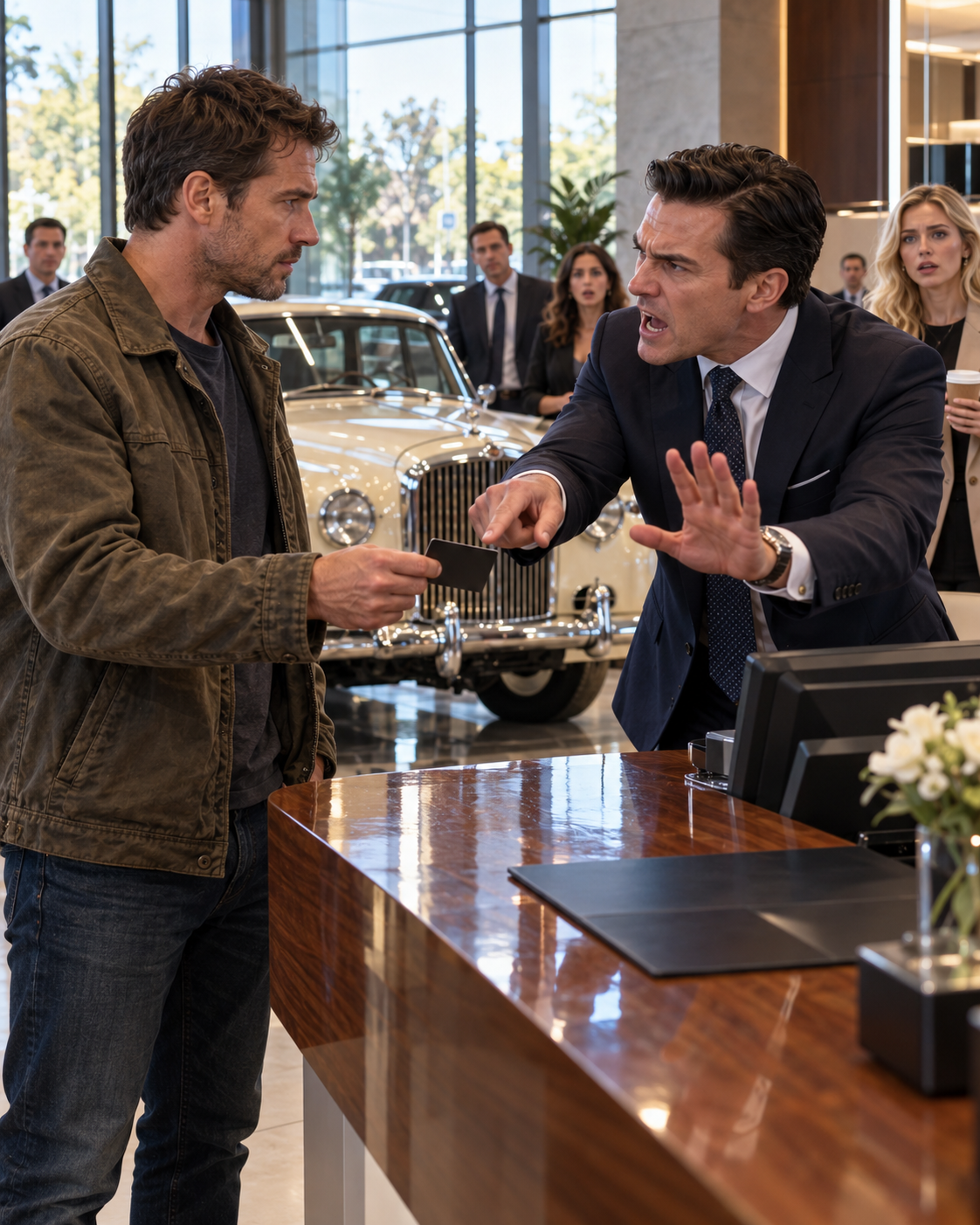
Martin placed the bank’s verification report on the sales desk, and the entire dealership seemed to fall silent.
Nobody moved. Even the cheerful music playing from the showroom speakers suddenly felt out of place.
Derek Vance stared at the papers as if they might disappear if he refused to acknowledge them. Marcus Finch stood beside him, his face reddening by the second, while Clara remained near the reception counter with her hands clasped tightly in front of her.
Martin opened the report.
“Derek Vance,” he began, speaking clearly enough for everyone in the showroom to hear. “You claimed to be a regional director authorized to make high-value purchases on behalf of a corporate client. Our verification process has established that you hold no such position. In fact, your actual employment record identifies you as a probationary data-entry clerk.”
Someone near the service department let out a startled breath.
Derek laughed nervously.
“This is a misunderstanding. I have connections here. The paperwork hasn’t caught up with my promotion.”
Martin didn’t blink.
“Your supposed appointment letter was issued using a company template without authorization. The executive signature on it is forged. Furthermore, the payment method you presented triggered a bank security alert because the transaction could not be authenticated.”
“That doesn’t mean anything!” Derek protested. “Banks make mistakes all the time.”
“Sometimes they do,” Martin replied. “That is why we investigate rather than make assumptions.”
He turned another page.
“The bank has requested that the transaction be stopped pending verification of the account holder’s authority. Our compliance team has also identified inconsistencies between your identification documents, your claimed employer, and the payment authorization you supplied.”
Derek’s expression changed.
For the first time since he had entered the dealership, he looked like a man who understood that confidence could not protect him from evidence.
Marcus stepped forward.
“Martin, perhaps we can handle this privately. Mr. Vance came here under the impression that he had the necessary authorization. There’s no reason to make a scene.”
I almost laughed at the sudden concern for appearances.
Only minutes earlier, Marcus had been ready to throw me out because my clothes offended his idea of a suitable customer. He had treated Clara as disposable because she refused to ignore a security warning. Now, with the truth standing in front of him, he wanted privacy.
Martin looked at him.
“You had an opportunity to handle this properly. Instead, you instructed an employee to override a security warning.”
“I was trying to close a sale.”
“You were trying to close a sale by disregarding the procedure designed to protect this business.”
Marcus opened his mouth, then closed it again.
Derek attempted one last defense.
“Listen, I can explain everything to someone higher up. I know people. This doesn’t need to go any further.”
Martin glanced toward the security officers waiting by the entrance.
“You’ll have an opportunity to provide your explanation to the investigators.”
When the officers approached, Derek’s carefully maintained confidence finally collapsed. He protested, demanded to speak to a lawyer, and insisted that everyone had misunderstood him. The officers escorted him outside while Martin instructed the compliance team to preserve the transaction records and cooperate with the appropriate authorities.
The showroom doors closed behind them.
For several seconds, nobody spoke.
Then Marcus turned toward Clara.
“This entire mess happened because you couldn’t handle a simple transaction.”
Clara’s face went pale.
“I followed the verification procedure.”
“You embarrassed a customer in front of the entire dealership.”
“I didn’t accuse him of anything. The terminal required bank verification.”
“And you couldn’t have waited until he left to sort it out?”
Clara lowered her eyes for a moment. I could see she was fighting to remain composed.
Then she looked up.
“You told me to process the payment even though the system had flagged it. I couldn’t do that.”
Marcus’s face hardened.
“You’re finished here.”
He said it with the casual cruelty of someone accustomed to making decisions he never expected to answer for.
I had heard enough.
“That’s an interesting decision, Marcus.”
He spun toward me, his annoyance spilling over.
“This is an internal personnel matter. Stay out of it.”
I took a slow breath.
“You fired her for refusing to break a security rule. Is that really the explanation you intend to give?”
Marcus looked me over again. His gaze traveled from my worn boots to the grease embedded in the seams of my work jacket.
“Sir, I don’t know who you think you are, but you are interfering with dealership operations. If you aren’t purchasing a vehicle, I suggest you leave.”
Martin closed the report.
“Marcus, I believe you should be careful about your next words.”
“Why? Because you walked in with a report and now everyone thinks they can tell me how to run my dealership?”
Martin looked at him with a disappointment that was somehow more frightening than anger.
“Your dealership?”
Marcus froze.
I stepped away from the wall where I had been standing.
“Martin, thank you for coming. I believe it’s time everyone understood what has actually happened here.”
Martin nodded once.
I turned toward the assembled staff.
“My name is Julian Thorne.”
The name produced almost no reaction at first. Then the realization began to spread.
One of the salespeople stared at me, looked toward Martin, and stared again. The receptionist at the adjoining desk covered her mouth. A technician who had wandered in from the service bay whispered something to the man beside him.
Marcus simply watched me.
“My father founded Thorne Holdings,” I continued. “He started with a small repair shop, a few borrowed tools, and a determination to treat people honestly. I inherited the company after he passed away. Today, I am its principal owner.”
Marcus’s lips parted.
“But that means—”
“It means the company you represent belongs to me. This dealership operates under my family’s name. And the man you repeatedly attempted to humiliate is the person responsible for deciding whether your conduct meets our standards.”
The blood drained from his face so quickly that I wondered whether he might fall.
He looked at Martin, hoping to find some sign that I was joking.
Martin gave him none.
“You knew who I was,” Marcus whispered to Martin.
“I did.”
“And you let this happen?”
“I came here because our systems raised a security concern,” Martin replied. “I did not instruct anyone to disrespect a customer, fire an employee, or ignore company policy. Those decisions belonged entirely to you.”
Marcus turned toward me.
“Mr. Thorne, I sincerely apologize. There has been a misunderstanding.”
“No,” I said quietly. “There has been a choice.”
I looked around the showroom.
“When I walked through those doors, you saw grease on my clothes and decided you knew the value of my character. You didn’t ask why I was there. You didn’t ask what I wanted. You decided that my appearance was enough to establish that I didn’t belong.”
I paused, remembering my father’s hands, rough and darkened by years of repairing engines.
“My father used to come home from the workshop with oil beneath his fingernails. He would sit at our kitchen table and explain that a person’s worth could never be measured by the price of his shoes. He built this company because he believed people deserved honest work and fair treatment.”
I looked directly at Marcus.
“You looked at the kind of man who built this company and treated him like he was unworthy of entering it.”
Nobody moved.
Then I turned toward the sales team.
“Some of you watched what happened and said nothing. I understand that speaking up can be difficult when your manager holds power over your livelihood. But this company cannot function if everyone chooses silence whenever doing the right thing becomes inconvenient.”
A young salesperson near the windows lowered his head. Another stared at the floor.
“I am not going to assume everyone who remained silent shares Marcus’s values. But I will expect every one of you to examine why you were willing to let it happen.”
I turned toward Clara.
“She offered a stranger coffee. She checked the records. She followed the security procedure. And when her manager demanded that she ignore a warning, she refused.”
Clara looked stunned to hear her actions described in front of everyone.
“She didn’t know my name,” I continued. “She didn’t know who owned the dealership. She didn’t know whether I could help her career. She simply saw someone standing in the rain who had been left waiting, and she chose to be decent.”
I faced Marcus again.
“You, on the other hand, were willing to risk this company’s reputation to impress a man whose credentials you never properly verified. You fired an employee for protecting the company and attempted to remove a customer because you assumed he was beneath you.”
Marcus swallowed.
“Mr. Thorne, I have given fifteen years to this company. I’ve worked weekends. I’ve exceeded my targets. I’ve—”
“Your sales numbers are not irrelevant,” I interrupted. “But they do not give you permission to abandon your responsibilities.”
His shoulders sagged.
I turned to Martin.
“Effective immediately, suspend Marcus from his management duties pending a formal investigation. Review the actions of every employee who participated in or authorized the attempted bypass of the security procedure. Preserve all relevant records and make sure the review is fair.”
Martin nodded.
“Understood.”
“And I want an independent review of customer complaints from this dealership over the past two years. Pay particular attention to complaints involving discrimination, intimidation, misleading sales practices, or employees being punished for following compliance rules.”
Marcus looked up sharply.
“That’s unnecessary.”
“Then the investigation will establish that.”
Security escorted him to the office to collect his belongings under supervision. He did not look at me as he passed. For the first time that morning, he seemed to recognize the difference between authority and power.
Authority was the position he had used to frighten people.
Power was the responsibility he had failed to understand.
Once Marcus was gone, the showroom began to stir again. Employees exchanged worried glances, and a few customers who had witnessed the confrontation quietly returned to their conversations.
I walked over to Clara.
“Would you come with Martin and me for a moment?”
She nodded uncertainly.
We moved into a small conference room behind the sales office. Martin asked an assistant to bring water, and Clara sat on the edge of her chair as though she expected another reprimand.
I wished I could erase the fear from her expression with a few reassuring words.
“Clara, I owe you an apology,” I said.
Her eyes widened.
“For what?”
“For allowing a workplace to operate under my name where an employee could be treated this way. I built policies and trusted people to enforce them, but I didn’t look closely enough at what was happening on the ground.”
She shook her head.
“You didn’t know what he was doing.”
“That doesn’t mean I have no responsibility for finding out.”
For a moment, she seemed unable to answer.
Then she asked a question I had not expected.
“Am I really fired?”
“No. Your termination has been rescinded. Your pay and employment status will be restored as though the termination never occurred. You will also receive written confirmation that you followed the correct procedure.”
She exhaled shakily.
“Thank you.”
I leaned forward.
“There’s something else I’d like to discuss. This dealership needs new leadership. Someone who understands that customers are people, not opportunities to impress a manager. Someone who can protect employees who do the right thing even when it is unpopular.”
Clara looked between Martin and me.
“I don’t understand what you’re asking.”
“I’m offering you the position of general manager.”
She stared at me in complete disbelief.
“I’m a receptionist.”
“Today, you demonstrated more judgment than the person who held the position.”
“I’ve never managed a dealership.”
“Then we’ll provide the training, mentoring, and support you need. I’m not suggesting that kindness alone qualifies someone to lead a complex business. I’m saying that integrity is the foundation on which those other skills must be built.”
She pressed her hands together.
“What if I make a mistake?”
“Then we’ll expect you to acknowledge it, learn from it, and correct it. We won’t expect you to be perfect. We will expect you to be honest.”
Her eyes glistened.
“I’ve worked here for six years,” she said. “I know how customers are sometimes treated when they don’t look wealthy. I’ve seen people ignored because they came in wearing work uniforms. I’ve watched elderly customers wait while salespeople competed for younger men in expensive suits.”
Martin’s expression changed.
“Were those incidents reported?”
“Some were. Most weren’t. People came to buy cars, not spend their afternoon making complaints. And the employees who spoke up were told to stop creating problems.”
Her words settled heavily in the room.
The security incident had not revealed a single bad afternoon. It had opened a door onto a larger failure.
I looked at Martin.
“Make sure her observations are included in the independent review.”
Then I returned my attention to Clara.
“I won’t ask you to accept this offer because you feel you owe me something. Think about it, speak to your family if you’d like, and review the responsibilities. We’ll give you a reasonable transition period and professional support.”
Clara wiped her cheeks.
“I’d like to accept.”
“Then we’ll work together to make sure you’re ready.”
She stood, still overwhelmed, and shook my hand. Her grip was firm despite her trembling fingers.
Before she left the room, I added one thing.
“Clara, don’t make the mistake of thinking you were promoted because you were kind to me. You were promoted because you acted responsibly when the easier option was to obey a bad instruction. Keep doing that, especially when the person asking you to compromise is someone you respect.”
She nodded.
“I will.”
The investigation took several weeks.
The bank’s report was only the first piece of evidence. Investigators identified discrepancies in Derek’s documents and established that he had attempted to use payment credentials without the proper authorization. His claimed executive identity was false, and the authorities received the relevant records. The dealership did not make public accusations beyond what the verified evidence supported, but we fully cooperated with the investigation.
Derek’s actions had consequences beyond the failed transaction. His employer began its own review, and his false claims became part of a formal inquiry. Whatever explanation he ultimately offered, he could no longer rely on an impressive suit and a confident voice to make the evidence disappear.
Marcus’s investigation was less dramatic but more revealing.
The auditors discovered that he had repeatedly pressured staff to prioritize high-value customers and had criticized employees for enforcing certain verification requirements when a sale appeared profitable. Several customer complaints had been marked as resolved without adequate follow-up. A number of employees described a workplace where questioning Marcus could damage their schedules, commissions, or chances of promotion.
Not every accusation proved true. A fair investigation required evidence, not revenge. We interviewed staff individually, examined records, and gave everyone involved an opportunity to respond.
But the overall pattern was impossible to ignore.
Marcus had built a culture in which appearances mattered more than conduct, and sales figures mattered more than the people responsible for producing them.
His employment was terminated after the investigation concluded that his actions had repeatedly violated company policy and undermined customer protections. Several other employees received disciplinary action appropriate to their individual involvement. Others were required to complete additional training and demonstrate that they understood the standards they were expected to uphold.
We also changed the way our dealerships evaluated managers.
Sales performance remained important, but it could no longer outweigh customer satisfaction, ethical conduct, staff retention, and compliance. Managers were required to explain how they handled complaints and protect employees who raised legitimate concerns. Our reporting system was redesigned so that workers could contact an independent compliance team without going through their direct supervisors.
Those changes cost time and money.
They were also long overdue.
Clara approached her new responsibilities with a seriousness that impressed everyone who worked with her. She spent her first month learning the dealership’s financial systems, customer management processes, staffing requirements, and inventory controls. Martin arranged for an experienced general manager from another location to mentor her.
She asked questions constantly.
She read reports that other managers had ignored. She spoke to technicians, salespeople, receptionists, and customers. She wanted to know not only whether the dealership made money, but whether it was making money honestly.
One afternoon, I visited without informing her in advance.
I found her in the service department, listening to an older mechanic explain why a customer had been charged for a repair that should have been covered under warranty.
The mechanic expected her to blame him.
Instead, she examined the paperwork, called the service adviser, and traced the mistake to an outdated internal procedure.
She corrected the customer’s bill and arranged for the process to be reviewed.
Afterward, she noticed me standing near the doorway.
“Mr. Thorne. I didn’t realize you were coming.”
“I wanted to see how things were going.”
She glanced at the mechanic, who had returned to his work.
“We have a lot to fix.”
“Do you regret accepting the position?”
She considered the question.
“Sometimes I miss being the receptionist.”
I raised an eyebrow.
“It was simpler,” she explained. “I could help someone with a problem and know exactly what I’d done. Now every decision affects dozens of people, and I can’t fix everything in a day.”
I nodded.
“That sounds like management.”
She smiled faintly.
“But I don’t regret it. People here are beginning to trust that speaking up won’t automatically cost them their jobs. That matters more than I realized.”
Her words reminded me why my father had insisted on knowing the names of the people who worked in his repair shop. He believed a business could not be healthy if the people inside it were afraid to tell the truth.
Clara was learning how to lead without becoming the kind of manager who had once intimidated her.
Meanwhile, I had another matter to attend to.
My mother’s seventieth birthday was only days away.
The restored 1956 cream-colored pickup had been waiting for us through years of searching and negotiating. My father had promised her a truck like it when they were young, when money was scarce and the future seemed full of possibilities. He had planned to restore one himself when the repair shop became successful enough to allow a little luxury.
But life had other plans.
The years passed. The business grew. He became busier, then ill, and finally too sick to work. He never forgot the promise, but he never had the chance to fulfill it.
After his funeral, my mother stopped mentioning the truck.
I assumed the wish had faded.
I was wrong.
When I finally completed the purchase, I arranged for the truck to be delivered to our family home on the morning of her birthday. I asked the driver to leave it beneath the old oak tree near the front porch, where my father used to sit after long days in the workshop.
Then I waited inside with a small envelope in my pocket.
My mother emerged from the house wearing a pale blue cardigan. She had been told that I wanted to show her something in the driveway, but she had no idea what awaited her.
At first, she looked at the vehicle with polite confusion.
Then she stopped.
The cream-colored paint caught the morning sunlight. The polished chrome reflected the branches overhead. The rounded fenders and broad hood looked almost exactly like the photographs she had kept in an old family album.
She took one cautious step forward.
Then another.
Her hand rose to her mouth.
“No,” she whispered.
I stood beside her.
“Yes, Mom.”
She approached the truck as though afraid that moving too quickly might wake her from a dream. Her fingers brushed the edge of the hood, following the smooth line of the paint.
“Oh, Julian.”
Her voice broke.
“Your father always said he would bring me one just like this.”
“I know.”
She looked at me, her eyes shining.
“Did you find it because I mentioned it to you?”
I shook my head.
“I remembered the stories he used to tell me. I thought it was time someone kept his promise.”
She leaned against me, crying quietly.
For a long while, neither of us spoke. We stood there with our arms around each other, listening to the faint sounds of the neighborhood waking up.
Finally, she drew back and studied the truck again.
“Your father would have loved this.”
“I think he would have insisted on checking the engine himself.”
That made her laugh through her tears.
“He would have complained about the price, too.”
“Probably.”
She walked around the vehicle, studying every detail. I opened the passenger door and helped her climb inside. She ran her palm across the seat, touched the dashboard, and looked through the windshield toward the old oak tree.
Then she noticed the envelope I had left on the seat.
“What is this?”
“Open it.”
Inside was a photograph of my parents standing outside the repair shop decades earlier. My father had one arm around her shoulders, and beside them sat an unfinished restoration project he had been working on at the time.
Beneath the photograph was a short note in my handwriting.
“Some promises take longer than we expect. That doesn’t mean they’re forgotten.”
My mother pressed the photograph against her chest.
I had worried that buying the truck would stir up her sadness, reminding her of everything my father had missed. Instead, she looked at the photograph with a tenderness that made the years between then and now seem to shrink.
“He never stopped thinking about it,” she said.
“No,” I replied. “I don’t think he did.”
She reached for my hand.
“Your father used to say that the real test of a person was how he treated someone who couldn’t do anything for him.”
I smiled sadly.
“He told me the same thing.”
“Did you believe him?”
The question caught me off guard.
“I thought I did.”
She looked toward the windshield.
“Believing something is easy when life gives you no reason to question it. Living by it is harder.”
I thought about Marcus and his expensive suit, about Derek and his invented title, and about Clara standing alone at the reception counter while her manager threatened her livelihood.
My mother squeezed my hand.
“Your father wasn’t perfect, Julian. He made mistakes. He sometimes worked too much, and he worried about money when he didn’t need to. But he tried to leave things better than he found them.”
She turned toward me.
“That is what made him a good man.”
I finally understood something I had spent years overlooking. My father’s legacy was not a set of rules to be admired from a distance. It was a responsibility that had to be practiced again and again, especially when it became inconvenient.
The dealership incident had begun with my own experiment. I had dressed like a mechanic because I wanted to see whether our values survived when nobody recognized my name.
But I had also needed the test.
I had inherited an empire and assumed that protecting my father’s legacy meant keeping the business profitable, expanding our operations, and preserving the family name. Those things mattered, but they weren’t enough.
A company could grow for decades while quietly losing the principles that had made it worth building in the first place.
Wealth could purchase a restored truck, a grand showroom, and a place at an executive table. It could not purchase integrity.
A forged title could impress a careless manager. It could not make a dishonest person trustworthy.
And a worn work jacket could conceal the owner of a billion-dollar business, but it could never diminish the dignity of the person wearing it.
A few months later, the Dallas dealership held a small gathering to recognize the employees who had helped rebuild its culture. Clara spoke briefly about responsibility, customer service, and the importance of making it safe for people to raise concerns.
She didn’t mention the promotion as though it were a personal victory.
Instead, she thanked the service technicians who had helped identify outdated procedures, the salespeople who had come forward during the investigation, and the receptionist who had covered her shifts while she completed her management training.
After the gathering, I found her standing near the front entrance, watching a family examine a used pickup truck.
A little boy sat in the driver’s seat while his father checked the tires. His clothes were dusty, and his boots were worn thin at the heels.
One of the salespeople approached them and greeted them warmly.
Clara noticed me watching.
“Things are changing,” she said.
“They are.”
She looked toward the family.
“We still have a long way to go.”
I followed her gaze.
“That is probably true. The day we decide the work is finished will be the day we stop paying attention.”
She smiled.
“You sound like your father.”
For once, I didn’t feel the need to correct her.
As I left the dealership, I passed the spot where Marcus had stood when he first ordered me to leave. The showroom had been cleaned, the displays rearranged, and the cream-colored truck was no longer parked near the windows.
Yet I could still remember his expression when I had told him who I was.
For a moment, I wondered whether the revelation had taught him anything. Perhaps he would reconsider the way he treated people. Perhaps he would only remember the humiliation of being exposed.
I could not control what he learned.
I could control what our company did next.
And that was enough.
On my mother’s birthday, she took the restored truck out for a slow drive around the neighborhood. I sat beside her, listening as she told me stories about my father that I had not heard since childhood.
When we returned home, she parked beneath the old oak tree and left her hand resting on the steering wheel.
“Thank you,” she said.
“You don’t have to thank me, Mom.”
“I know.”
She looked at me with a gentle smile.
“But gratitude isn’t something we offer only because we owe someone. Sometimes we offer it because someone has reminded us what matters.”
I thought of Clara’s cup of coffee, offered to a stranger when there was nothing to gain. I thought of my father’s hands, covered in grease but always ready to help. And I thought of the lesson that had followed me from the dealership to our family home.
The people who mattered most had never needed to look important.
They had simply needed the courage to act with decency when nobody was rewarding them for it.
My father built a repair shop that became an empire, but the most valuable thing he left me was not the company, the buildings, or the money. It was the understanding that success meant very little if the people around you had to surrender their dignity to survive beneath it.
I had gone to the dealership believing I was testing my employees.
In the end, they had tested me, too.
They reminded me that leadership was not about being the most powerful person in the room. It was about making sure the powerless were still treated fairly when the powerful were not watching.
And every time I saw that cream-colored truck beneath the oak tree, I remembered the promise my father had made, the woman who had waited for it, and the people who had shown me that his values were still worth protecting.
Because a person’s character is not revealed by how respectfully they greet someone who can reward them.
It is revealed by how they treat someone they believe can do nothing for them.
That is the kind of legacy worth inheriting.
And it is the kind of legacy worth leaving behind.