The last thing I saw that afternoon was my six-year-old daughter pressing her palm against the back window of a car I had spent twelve years paying for.
The room fell silent as Evelyn watched Maya hold the drawing against my chest. For a moment, I thought she might say something about the money, the workshops, or the magazine article that had brought her back into my life. Instead, she took a shaky breath and whispered, “I need to tell you something, Harrison. Something I should have told you years ago.”
I looked at her, then down at Maya.
“Whatever it is, we can talk about it,” I said. “But not here, and not in a way that makes our daughter feel she has to choose between us.”
Evelyn nodded, wiping her eyes with the back of her hand.
“I understand.”
But the expression on her face told me that what she had come to say was far more complicated than an apology.
Three days later, she called me.
I was in my office reviewing the budget for our new training center when her name appeared on my phone. For several seconds, I simply stared at the screen. There had been a time when seeing that name would have filled me with hope. Then there had been a time when it filled me with anger. Now, it reminded me of a chapter of my life I had worked hard to understand.
I answered.
“Harrison, could we meet somewhere?” she asked. “Just the two of us.”
“Is Maya okay?”
“She’s fine. This is about something else.”
I agreed to meet her at a small café near the courthouse where our marriage had officially ended.
When I arrived, Evelyn was already sitting by the window. She looked older than I remembered, although the years had changed me, too. The confidence she once carried so easily had given way to a tiredness that no amount of makeup could hide.
She had ordered coffee but hadn’t touched it.
“I don’t know where to begin,” she said.
“Start with the truth.”
She looked at me for a long time.
“When we divorced, I told myself I was making the right decision. I believed you were a good man, but I was tired of struggling. I was tired of watching you spend every spare dollar on tools, old engines, and projects that might never make us any money.”
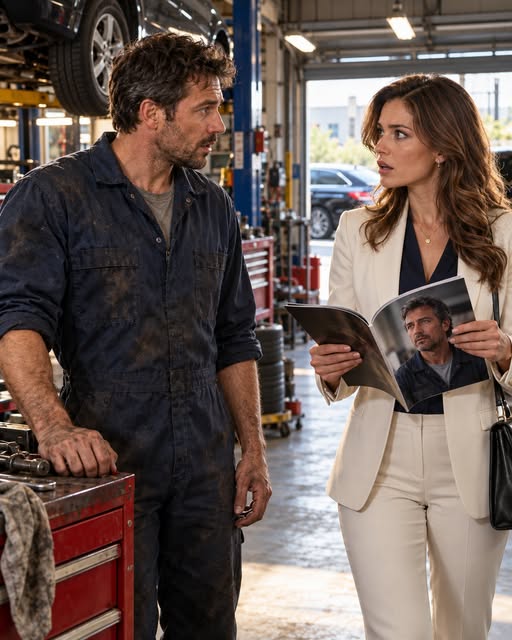
I listened without interrupting.
“I wanted a comfortable life. I wanted a house that didn’t need repairs, a car that didn’t break down, and a husband who could give me certainty. I convinced myself that you would never get beyond that little garage you kept talking about.”
She swallowed hard.
“When I met someone who seemed to have everything figured out, I thought I had finally found the life I deserved.”
Her hands tightened around the coffee cup.
“But the man I chose wasn’t who I thought he was. And by the time I understood that, I had already destroyed the life I had with you.”
I felt an old ache rise in my chest, but it wasn’t the sharp pain I had expected. It was more like pressing a finger against a scar and remembering how deeply the wound had once cut.
“Why are you telling me this now?” I asked.
“Because I saw your photograph. I saw what you built, and I realized how wrong I had been.”
She paused.
“Part of me wanted to believe that if I had stayed, I would be standing beside you in that picture. That maybe I would have shared in your success.”
There it was. The admission I had suspected but hadn’t wanted to hear.
I leaned back in my chair.
“Evelyn, if I had failed completely, would you still be sitting here telling me this?”
She opened her mouth, but no words came out.
I didn’t ask the question to humiliate her. I asked because I needed to understand whether she regretted hurting me or merely regretted the outcome of her decision.
Finally, she looked down.
“I don’t know,” she admitted. “And I hate myself for not knowing.”
Her honesty surprised me more than any apology could have.
“I spent years imagining what I would say if you ever came back,” I told her. “Sometimes I wanted to tell you that you had made the biggest mistake of your life. Sometimes I wanted you to see every difficult thing I had survived and feel ashamed.”
I glanced out the window toward the courthouse.
“But when I finally became successful, I discovered something. Making you regret leaving me wouldn’t have repaired anything. It wouldn’t have given Maya back the nights we missed together. It wouldn’t have made the lonely years disappear.”
Evelyn began to cry quietly.
“I know.”
“No,” I said gently. “I don’t think you understood it until now. But perhaps you do.”
For a while, neither of us spoke.
Then she reached into her handbag and placed a small envelope on the table.
“There is something else,” she said. “Something I have been afraid to tell you.”
Inside the envelope was a letter from a bank, along with several pages of financial documents. Evelyn explained that after her second relationship collapsed, she had tried to maintain the lifestyle she had grown accustomed to. She had borrowed money, signed agreements she barely understood, and trusted people who promised to help her recover her losses.
Eventually, the debts had grown beyond what she could manage.
“I don’t expect you to pay anything,” she said quickly. “I’m not asking you to rescue me. I just thought you should know why I have been so desperate lately.”
I studied the papers, then returned them to the envelope.
“Have you spoken to a qualified financial adviser?”
She shook her head.
“Then that’s where you start. Someone independent who can explain your options without taking advantage of you.”
She stared at me.
“You would help me find someone?”
“I can help you find a professional. That doesn’t mean I’ll pay your debts.”
“I understand.”
I hoped she did.
For years, I had confused kindness with sacrifice. I had believed that being a good man meant absorbing every loss, forgiving every injury, and making sure everyone else was comfortable even when I was falling apart.
Now I understood that compassion without boundaries could become another way of destroying yourself.
“I also want us to talk about Maya,” I continued. “She needs both parents to behave like adults. She doesn’t need to hear about our old arguments, and she certainly doesn’t need to feel responsible for either of our happiness.”
Evelyn nodded.
“I want that, too.”
When we parted, I didn’t feel victorious. I didn’t feel that I had finally won some contest that had begun outside the courthouse years earlier.
I simply felt relieved that we had spoken honestly without turning our daughter into a weapon.
But the real test of everything I had learned was still waiting for me.
And it arrived the following Sunday.
Maya was ten by then, old enough to notice things adults thought they were hiding. She came into my workshop carrying a backpack and a serious expression.
“Dad, can I ask you something?”
“Always.”
She sat on a stool beside my workbench.
“Mom says she’s sorry about what happened when you got divorced.”
I set down my wrench.
“What do you think about that?”
Maya considered the question.
“I think she’s sad. But I don’t know if she’s sorry because she hurt you or because her life didn’t turn out the way she wanted.”
The words were so close to the question I had asked Evelyn that I wondered whether children understood more than adults gave them credit for.
“You don’t have to figure that out for her,” I said.
“But what if she wants you to forgive her?”
“Forgiveness isn’t something you owe someone just because they ask for it. And it doesn’t mean you have to pretend nothing happened.”
Maya looked at the floor.
“Does that mean you still hate her?”
“No, sweetheart. It means I don’t want to spend the rest of my life carrying the hurt. Your mother made choices that hurt me. I’ve made mistakes, too. We can learn from those things without letting them decide who we become.”
She leaned against me.
“I’m glad you don’t hate her.”
I wrapped my arms around her.
“So am I.”
That evening, after Maya had gone home with her mother, I stayed late at the workshop. I walked through the rows of tools, the spotless repair bays, and the office where my employees had gathered around a table to plan the next phase of our training program.
I had built a business that once seemed impossible. I had helped families keep their cars on the road, given young people a chance to learn a trade, and created jobs for people who needed someone to believe in them.
Yet I realized that none of those achievements meant much if I couldn’t bring the same patience into my own home.
I decided that the next chapter of my life would not be measured only by revenue, new locations, or the number of people we employed.
It would be measured by what we could give others without making them feel small.
And I would begin with the place where everything had started.
The old wooden shed.
Mr. Oakwood’s family had sold me the property a year earlier, and I had spent months restoring the building. I kept the uneven wooden beams and the old concrete floor, repairing only what was necessary to make it safe. The original sign still hung above the entrance, its paint faded by years of rain and sunlight.
Some people thought I should tear it down and build something modern.
I refused.
One afternoon, I brought Maya to see the finished training center.
She walked slowly through the building, looking at the workbenches, the tool cabinets, and the small classroom where apprentices would learn mathematics, diagnostics, and business skills alongside practical repairs.
“Is this where you started?” she asked.
“Right over there.”
I pointed toward the corner where my first workbench had stood.
Maya stared at the space.
“You really had nothing?”
“I had a toolbox.”
“And two hundred dollars.”
I smiled.
“And two hundred dollars.”
She looked around again.
“Then why didn’t you give up?”
I thought about the question.
There had been plenty of reasons to give up. I had been exhausted, frightened, and ashamed of how quickly my life had collapsed. There were nights when I had wondered whether my daughter would grow up remembering me as a man who had tried and failed.
But every time I thought about quitting, I remembered the promise I had made to her.
“I didn’t know how everything would turn out,” I told her. “I just knew that if I wanted a better future, I had to take the next step. Not every step. Just the next one.”
Maya smiled.
“That’s a good lesson.”
“It’s an expensive lesson. I paid for it with a lot of sleepless nights.”
She laughed, and for a moment, the sound filled the old shed with something more valuable than money.
Hope.
The training center opened two months later.
We called it the Oakwood Skills Workshop in honor of the man who had given a struggling mechanic a chance when everyone else would have demanded proof that he was worth the risk.
At the opening ceremony, I stood before a small crowd of local families, teachers, business owners, and young people who had enrolled in our first training program.
Nathan stood beside me. He was no longer the uncertain teenager who had once struggled to look people in the eye. He had become a skilled technician, a patient teacher, and one of the most dependable people in my company.
When I introduced him, the audience applauded.
Nathan shook his head in embarrassment.
“Don’t make me sound like a hero,” he whispered as he stepped forward.
“You earned every word,” I told him.
He looked toward the apprentices seated in the front row.
“I used to think that dropping out of school meant my future was already decided,” he said. “Mr. Harrison taught me that making mistakes doesn’t mean you’re finished. It means you have something to learn.”
A young woman in the front row wiped her eyes.
Her name was Olivia. She had struggled through school while caring for her younger brothers and had almost abandoned the idea of getting a job because she couldn’t afford training.
Now she had a paid apprenticeship waiting for her.
When the speeches ended, she approached me.
“Mr. Harrison, can I ask you something?”
“Of course.”
“What happens if I fail?”
I looked at the old sign above the entrance.
“Then we figure out why you failed, make a plan, and try again. You’ll still be responsible for your work, but you won’t have to face every problem alone.”
She nodded slowly, as if she had never heard an adult say such a thing before.
That conversation reminded me why I had started the program.
Not because I wanted to be admired, but because I knew what it felt like to stand at the beginning of a future you couldn’t see.
For the first year, the center ran on a tight budget. We had more applicants than places, and our instructors often stayed late to help students who needed extra support. A few local businesses donated equipment, while others offered paid placements to graduates.
Then, one winter morning, I received a call that threatened to undo everything.
A regional transport company had discovered a serious discrepancy in its maintenance records. Several vehicles had experienced unexpected failures, and an internal review suggested that repairs billed to the company might not have been completed.
My company had serviced some of those vehicles.
The news spread quickly. A local reporter called for comment, and a business partner warned me that even an unproven allegation could damage our reputation.
I felt the familiar pressure of uncertainty settle over my shoulders.
For the first time in years, I was afraid that everything I had built could collapse because of something I hadn’t seen coming.
I called a meeting with Nathan and the senior technicians.
We reviewed every invoice, inspection report, and diagnostic record. At first, the discrepancies appeared to involve work performed by a subcontractor that had recently handled overflow repairs.
Then we discovered something worse.
Someone had been using our company credentials to approve invoices for work that had never been completed. The records appeared legitimate because they carried the correct authorization codes.
One of our own supervisors, a man I had trusted for years, had been approving the payments.
When I confronted him, he denied everything.
“You built this business on trust,” he said. “You can’t suddenly treat everyone like a criminal because a few records don’t match.”
“Trust doesn’t mean refusing to check the facts,” I replied.
We suspended his access while an independent auditor examined the evidence. We also informed the transport company and cooperated with its investigation.
The next few weeks were among the hardest of my career.
Rumors spread. A customer postponed a contract renewal. Another demanded an explanation before allowing us to service its fleet.
I barely slept.
One night, I sat alone in the office, staring at the financial reports. If the investigation went badly, the legal costs and lost contracts could force us to close two workshops. Worse, the training center might lose the funding that kept its apprentices employed.
Nathan found me there after midnight.
“You should go home,” he said.
“So should you.”
He pulled up a chair.
“Remember what you told me when I first started? Never charge someone for a repair they don’t need. Never pretend a mistake didn’t happen. And never make someone else pay for your dishonesty.”
I looked at him.
“I remember.”
“Then keep doing that. Even if it costs us.”
His words struck me harder than any accusation.
Because he was right.
The investigation eventually confirmed that the supervisor had falsified invoices and diverted payments through a separate business account. He was dismissed, and the matter was referred to the appropriate authorities. Our records showed that the fraudulent invoices had not been approved by me, but that did not erase our responsibility for failing to catch the misconduct sooner.
I issued a public statement explaining what we had discovered, what we had failed to monitor, and what we were changing.
We introduced independent invoice verification, stronger access controls, and regular audits across every workshop. We compensated the transport company for the legitimate losses attributable to our failures and invited customers to review our revised procedures.
The decision was expensive.
It was also necessary.
Some contracts returned quickly. Others took months. A few never came back.
But something unexpected happened.
Customers who had watched us face the crisis began recommending us precisely because we had not tried to hide behind excuses.
A small fleet operator wrote to say, “Mistakes happen. What matters is whether the people responsible tell the truth and put things right.”
That sentence stayed with me.
I had once believed that success meant reaching a place where life could no longer hurt me. Now I understood that no amount of money could offer that kind of protection.
The real test was what I did when the pain returned.
And then, just as the business began to recover, another challenge arrived.
Maya came home from school one Friday with tears in her eyes.
She was fourteen now, thoughtful and independent, but that afternoon she looked like the little girl who had pressed her palm against the back window of a departing car.
“Dad, I need to tell you something.”
I put my phone aside.
“I’m listening.”
She hesitated before speaking.
“Mom has been offered a job in another state. It pays well, and she says she needs a fresh start. She wants me to move with her.”
The room seemed to grow smaller.
“How do you feel about it?”
“I don’t know. I love Mom, and I know she’s trying to make things better. But I don’t want to leave you.”
I felt an instinctive urge to tell her that she could stay with me, that I would make sure she had everything she needed, that she should never have to choose between two homes again.
But I remembered what I had promised her years earlier.
I would never make her choose sides.
“You don’t have to decide what will make me happy,” I said. “You need to think about your school, your friendships, and the life you want to build. We’ll talk through every option together.”
“But what if you miss me?”
“I will.”
My answer made her look up.
“I’ll miss you more than you can imagine. But loving you means wanting you to have a life that belongs to you, not one built around my fears.”
She began to cry.
I held her until the tears subsided.
Over the next few weeks, we discussed the move as a family. Evelyn and I met with a mediator to understand the practical arrangements and make sure Maya’s wishes were heard. We considered school options, travel costs, holidays, and how we could preserve the time Maya needed with both of us.
Eventually, Maya decided to stay where she was for the remainder of the school year while Evelyn explored whether she could find a position closer to home.
The decision wasn’t perfect for anyone, but it was made without threats, guilt, or promises that no one could keep.
For the first time since our divorce, Evelyn and I worked together on a difficult decision without turning it into a battle.
One evening, after a meeting about Maya’s school, Evelyn lingered beside my car.
“I used to think you were weak because you avoided arguments,” she said.
I raised an eyebrow.
“And now?”
“Now I think I mistook patience for weakness. You could have made all of this much harder for me.”
“I could have,” I admitted. “But that wouldn’t have helped Maya.”
Evelyn looked toward the school building, where Maya was attending a rehearsal for the end-of-year concert.
“I can’t change the years we lost.”
“No,” I said. “But we can make better use of the years we have left.”
She nodded, and for once, I saw no attempt to turn the conversation toward my money or her regrets.
There was only a woman learning to live with the consequences of her choices, and a man who no longer needed her to suffer in order to feel whole.
That winter, I received a letter from Mr. Oakwood’s daughter.
Her father had passed away peacefully at the age of eighty-nine. Before his death, he had asked her to deliver a small wooden box he had kept in his study.
Inside was a photograph of the old shed as it had looked on the day I first rented it. Beside the photograph was a short handwritten note.
Harrison,
You came to me with almost nothing, but you never asked me to guarantee your success. You asked for a chance to work. I have watched what you did with it, and I hope you understand that the chance was never mine to give alone. You brought the determination. I merely opened the door.
Remember to keep opening doors for others.
I read the note twice.
Then I carried it to the training center and placed it in a frame beside the original photograph.
The next morning, I announced a new scholarship program in Mr. Oakwood’s name. It would cover training costs, tools, and transportation for young people who wanted to enter the automotive trade but lacked the money to begin.
We called it the Open Door Scholarship.
Applications arrived from across the region.
Some came from students who had struggled academically. Others came from young adults who had lost jobs, cared for sick relatives, or made mistakes that had closed doors they once thought would remain open forever.
One application came from a seventeen-year-old boy named Daniel.
He had been suspended from school several times and had a reputation for fighting. His teachers described him as intelligent but difficult to manage. His application was only a single page long.
At the bottom, he had written, “I don’t expect anyone to trust me. I just want someone to teach me how to earn it.”
I thought of Nathan.
I thought of myself, standing outside the courthouse with a toolbox and two hundred dollars, unable to imagine that the worst day of my life could become the beginning of something meaningful.
I invited Daniel for an interview.
He arrived late, wearing a jacket that was too thin for the weather. He sat stiffly across from me, prepared for rejection.
“Why should we give you this scholarship?” I asked.
He looked at the floor.
“Because I need it.”
“That tells me why you want it. It doesn’t tell me what you’ll do with it.”
He thought for a moment.
“I’ll probably make mistakes. But if you show me what I did wrong, I’ll try to fix them. I’m tired of everyone deciding who I am before I get the chance to prove anything.”
I studied him carefully.
Then I offered him a place in the program, with clear expectations about attendance, safety, and accountability.
He stared at me.
“Are you serious?”
“Completely.”
His eyes filled with tears, though he quickly turned his head to hide them.
I pretended not to notice.
Everyone deserved the dignity of having their feelings respected.
Over the following months, Daniel struggled. He missed a deadline, damaged a tool through carelessness, and nearly lost his place after arguing with another apprentice. We held him accountable every time.
But we also listened.
We discovered that he had been working late shifts to help support his younger sister while their mother recovered from an illness. We adjusted his schedule, connected his family with local support services, and helped him build a plan that allowed him to continue his training without neglecting his responsibilities at home.
Slowly, he changed.
Not because we rescued him from every consequence, but because we gave him a fair chance to learn from them.
At the end of his first year, he stood beside Nathan at the training center’s annual ceremony and received his certificate.
Afterward, he approached me with a small object wrapped in brown paper.
Inside was a hand-carved wooden sign.
It wasn’t particularly polished, and the lettering was slightly uneven.
It read: EVERYONE DESERVES A CHANCE TO BEGIN AGAIN.
“I made it in my spare time,” he said nervously. “I thought it belonged here.”
I ran my fingers over the carved letters.
“It’s going above the classroom door,” I told him.
He smiled in a way I would never forget.
Years earlier, I had believed that if I worked hard enough, earned enough money, and built something impressive enough, I could finally prove that my life had value.
Now I understood that value had never depended on the size of my bank account.
It had been there when I repaired a widow’s car for less than it cost me to do the work. It had been there when I taught Nathan how to diagnose an engine and how to admit a mistake. It had been there when I listened to Maya without asking her to protect my feelings.
And it had been there when I offered Daniel a chance without pretending that a chance was the same thing as a guarantee.
On Maya’s eighteenth birthday, we held a small celebration at the training center. Evelyn came, carrying a cake she had baked herself. Nathan brought photographs from the early days of the garage, and the apprentices decorated the classroom with paper banners.
Maya stood in front of the old sign, smiling as everyone sang.
After the celebration, she asked me to walk with her through the original shed.
We passed the first workbench, the shelves where I kept my oldest tools, and the spot where I had once slept on a narrow mattress during the worst months of my life.
She stopped beneath the faded sign.
“Dad, do you ever wish things had happened differently?”
I knew what she meant.
“Sometimes,” I answered. “I wish you hadn’t had to experience the pain of our divorce. I wish I had known how to protect you from the parts of it that belonged to the adults.”
She took my hand.
“But would you change everything?”
I looked at the old shed.
For years, I had asked myself the same question in different ways. If I could return to the courthouse, would I fight harder for the house? Would I refuse to sign away the car? Would I demand a different arrangement before walking out into the afternoon with two hundred dollars and nowhere to go?
Some of those choices deserved another look. I had learned that avoiding conflict wasn’t always the same as doing the right thing, and that protecting someone did not require abandoning my own needs.
But I could not honestly wish away every hardship that had followed.
Not because suffering was necessary for success, but because the life I had built afterward had taught me things I might otherwise have taken years to understand.
“I would change the things that hurt people unnecessarily,” I said. “But I wouldn’t trade the person you’ve become, or the people we’ve been able to help, for a life that looked perfect from the outside.”
Maya leaned her head against my shoulder.
“That’s what I thought you’d say.”
She reached into her bag and handed me a folded piece of paper.
For a moment, I thought it might be another drawing of the garage.
Instead, it was the original picture she had made at school years earlier. The paper had yellowed at the edges, and the crayon lines had faded slightly, but the words beneath the little garage were still visible.
MY DAD’S DREAM.
“I kept it all these years,” she said. “I wanted you to remember that you weren’t building it alone.”
I stared at the drawing, unable to speak.
Then I pulled her into a hug.
For the first time, I understood the full meaning of those five words.
When Maya had drawn that picture, she hadn’t known how many workshops I would eventually own or how much money I would earn. She hadn’t known about the scholarships, the training center, or the people whose lives would change because of a small garage.
She had simply believed in her father.
And that belief had been more powerful than any business plan I had ever written.
Evelyn stood in the doorway, watching us. When Maya invited her to join us, she came forward without hesitation.
The three of us stood together in the old shed, surrounded by the tools and memories that had shaped our lives.
We weren’t a family in the way we had once imagined we would be. The past could not be undone, and forgiveness could not transform every broken relationship into a perfect one.
But we had learned to stand in the same room without making our old wounds the center of everything.
That was enough for that moment.
As the evening sunlight slipped through the gaps in the wooden walls, I looked once more at the faded sign above the entrance.
HARRISON AUTO REPAIR.
I remembered the courthouse steps, the thin mattress, the empty wallet, and the fear that my daughter might one day believe I had disappeared from her life because I hadn’t fought hard enough to stay.
I remembered the customers who had trusted me when I had nothing to offer but honest work.
I remembered Mr. Oakwood, who had opened a door without demanding to know whether I would become successful.
And I remembered the promise I had made to Maya on those lonely evenings when all I had was a toolbox and a dream.
I had kept that promise, though not in the way I had first imagined.
I had built a place where people could learn, work, make mistakes, and begin again. I had learned to accept help without shame and offer kindness without sacrificing my own dignity. I had learned that success did not mean proving someone else wrong.
It meant becoming someone who could do the right thing even when nobody was watching.
Before we left, Maya looked up at me.
“Dad, what are you going to do next?”
I smiled.
“Tomorrow, we’ll open the doors for another group of students.”
“And after that?”
“After that, we’ll see what needs fixing.”
She laughed.
It was such a simple answer, but it contained everything life had taught me.
There would always be something broken. A car, a business, a friendship, a family, or a heart. No amount of money could prevent every loss, and no amount of success could guarantee that tomorrow would be easy.
But broken things were not always beyond repair.
Sometimes they needed patience. Sometimes they needed honest work. Sometimes they needed boundaries, accountability, or the courage to admit that a repair was no longer possible.
And sometimes they needed someone willing to look beyond the damage and see what might still be saved.
I had started with two hundred dollars, a toolbox, and a broken heart.
I had thought my greatest achievement would be building a fortune from almost nothing.
I was wrong.
My greatest achievement was learning that I did not need to become rich to be worthy of love, and that I did not need to make anyone regret leaving me in order to build a meaningful life.
The money had given me opportunities. The workshops had given me purpose. The training center had allowed me to pass those opportunities on to others.
But my daughter had given me the reason to keep going when none of those things existed.
As we stepped outside, Maya slipped her hand into mine, just as she had done when she was little.
I looked back at the old shed one last time.
The paint was faded. The floor still carried marks from years of work. The wooden beams creaked when the wind moved through them.
It was not the grandest building I owned, nor the most profitable.
It was the place where I had learned that losing everything you thought you needed could force you to discover what truly mattered.
And if I could leave one lesson behind for every young person who walked through those doors, it would be this:
Never measure your worth by what someone else chooses to leave behind. Measure it by what you choose to build with what remains.
Because life will not always give you a fair beginning. It will not always reward your honesty immediately, and it will not promise that the people you love will understand your dreams.
But you can still choose your next step.
You can work honestly, ask for help, protect your dignity, and make room for others to rise beside you.
You can turn pain into understanding without pretending the pain was good.
And you can build a future that is not defined by the worst day you ever lived.
That afternoon outside the courthouse, I believed my story had ended.
I was standing there with a toolbox in one hand, two hundred dollars in my pocket, and an empty space where my family had once been.
I could not see the workshops, the students, or the people who would one day call me their mentor.
I could not see the young man Nathan would become, or the confidence that would grow in Daniel, or the moment Maya would hand me back the drawing she had carried for twelve years.
All I could see was the car disappearing down the road.
But the road did not end there.
It turned toward a little wooden shed, a chance I had not earned through wealth or status, and a future I could only build one honest day at a time.
And somewhere along that road, I discovered that the greatest comeback is not making the people who hurt you wish they had treated you differently.
It is reaching a point where their choices no longer determine the person you become.
I could never recover every lost afternoon with my daughter. I could never rewrite the ending of my marriage or return to the man I had been before everything fell apart.
But I could be present for the days that remained.
I could keep my promises.
I could open doors.
And I could make sure that when another struggling mechanic, another uncertain teenager, or another frightened young person stood before me with almost nothing, they would hear the words Mr. Oakwood had once given me.
“Let’s see what you can make of it.”
That was how my second life began.
Not with revenge.
Not with a fortune.
But with a chance, a toolbox, and the decision to keep going.
And in the end, that was worth more than everything I had lost.