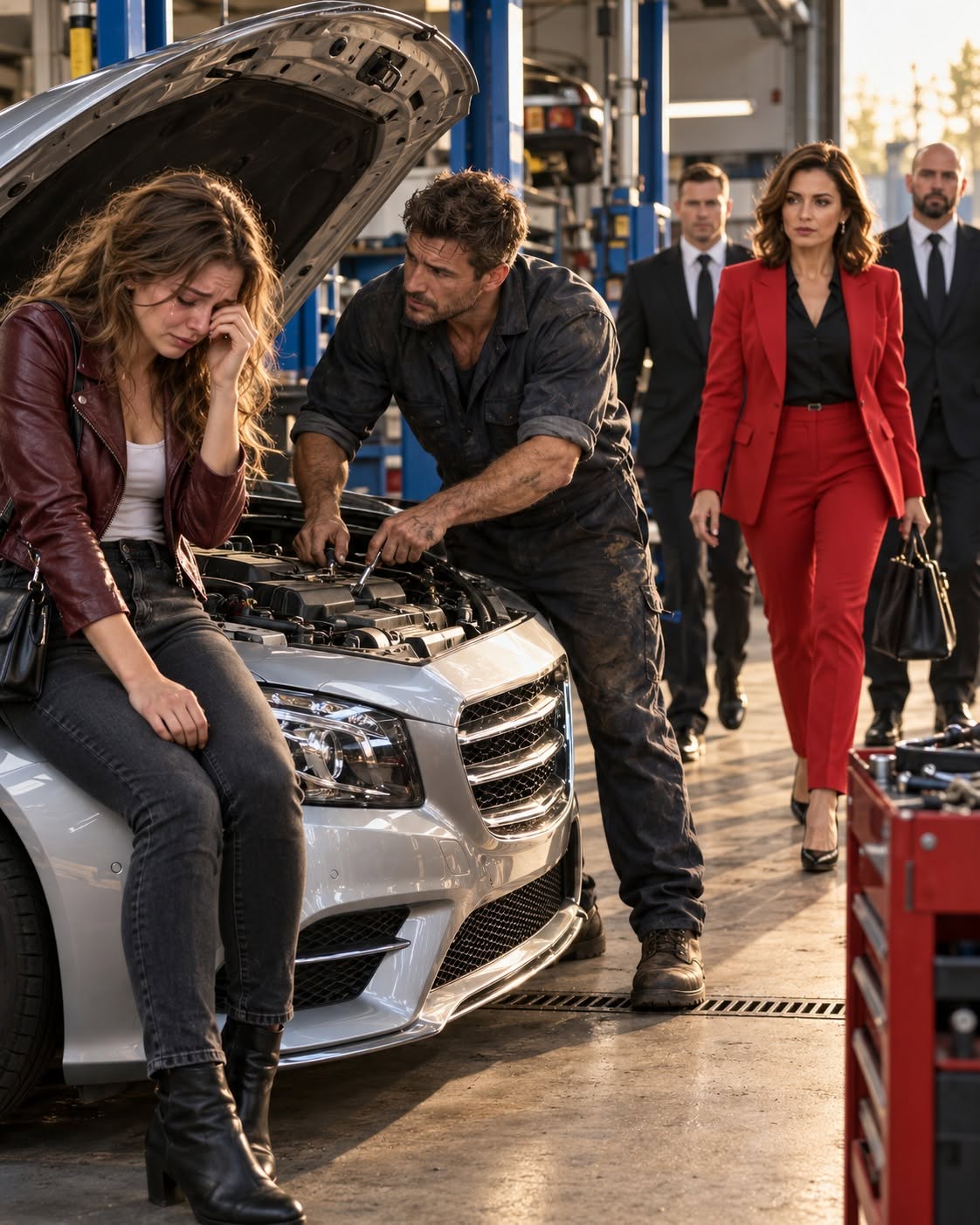
The girl in the soaked designer jacket stumbled into my garage at 9:47 p.m., shaking so badly she could barely tell me what was wrong with her car.
The Question That Changed Everything
I thought Victoria Sterling had come to my garage to buy my silence. I never imagined she would return to ask me how to save the place.
But sometimes, life changes in the smallest moments, when nobody is watching and nobody expects anything in return.
Three days after Victoria left my garage with her blank check folded inside her expensive coat, I was still thinking about the way she had looked at Toby.
It wasn’t pity. I knew what pity looked like. I’d seen it in the eyes of customers who noticed the overdue notices pinned behind my counter, and in the smiles of people who told me I was doing a wonderful job raising my son alone.
Victoria’s expression had been different.
It was as though she’d walked into my garage believing she understood the world and walked out realizing she might have misunderstood the most important part of it.
I didn’t have time to think about her for long.
On Monday morning, the compressor began making a terrible grinding noise. By noon, a customer was demanding his truck back before a delivery deadline. By three, my landlord was standing beside my office door with a folder of overdue invoices.
“Friday,” he told me. “That’s the deadline. If I don’t receive the payment by Friday, we’re going to have to discuss whether you can continue operating here.”
I nodded as though I had a plan.
I didn’t.
That evening, Toby found me sitting at the workbench, staring at a calculator.
“Dad?”
“Hey, buddy.”
“Are we in trouble?”
I immediately put the calculator down.
“Why would you ask that?”
“Because you stopped singing while you work.”
That nearly broke me.
I hadn’t realized I used to sing. Apparently, I had stopped sometime after the electricity company sent its final warning.
I pulled Toby onto my lap.
“Things are a little tight right now, but we’re going to be okay.”
He studied my face with the seriousness only a child can manage.
“Promise?”
I wanted to give him a guarantee. I wanted to be the kind of father who could promise that the roof would never leak, that the refrigerator would always be full, and that nobody would ever knock on our door asking for money we didn’t have.
Instead, I kissed his forehead.
“I promise I’ll do everything I can.”
He accepted that answer, but I could tell it wasn’t the one he wanted.
After he went to bed, I stayed in the garage until midnight, trying to work out how to keep a business alive when every dollar already belonged to somebody else.
Then I remembered Victoria’s question.
What would it take to keep this place open?
I had told her the truth. I hadn’t asked her to rescue me, and I certainly wasn’t going to call a billionaire and beg for a favor.
If the shop closed, I’d find another way to provide for Toby.
I had survived worse days than this.
At least, that was what I kept telling myself.
On Tuesday morning, a black SUV pulled into my lot.
Victoria Sterling stepped out, carrying a leather folder.
This time, there was no blank check.
“Good morning,” she said.
I wiped my hands on a rag. “If you’re here to make another offer, I’m not selling my dignity.”
For the first time, I saw the corner of her mouth lift.
“Good. I wasn’t planning to buy it.”
She placed the folder on my workbench.
“My company is reviewing its fleet maintenance arrangements. We need a local service partner capable of handling a portion of our commercial vehicles. Your shop is one of several businesses being considered.”
I looked at the folder without touching it.
“You’re serious?”
“Completely.”
“Because I helped your daughter?”
“Because you helped my daughter without knowing who she was. That earned you the opportunity to be considered. It does not earn you a contract.”
I studied her face.
It was the first thing she had said that made me trust her.
She opened the folder and explained the requirements. There would be inspections, turnaround targets, insurance requirements, quality audits, and penalties for missed deadlines. The initial contract would cover a limited number of vehicles. If my shop performed well, the arrangement could expand.
The financial projections were enough to make my hands go cold.
Steady work. Predictable revenue. A chance to repair the equipment that was slowly falling apart.
A chance to keep Toby’s home and my business.
But there was one problem.
“Your fleet requires more capacity than I have,” I said. “My equipment is old, and I don’t have enough qualified mechanics to handle that volume. If I promise what you’re asking for, I’ll be lying.”
Victoria closed the folder.
“Then don’t promise what you can’t deliver.”
I blinked.
She continued, “Build a plan. Identify the equipment you need, the staff you can hire, and the volume you can realistically handle. Submit your numbers. Our procurement team will evaluate them alongside the other proposals.”
“And if I can’t afford the expansion?”
“We can discuss financing tied to the contract, provided the numbers make sense. The terms will be written down. You’ll have the right to have them independently reviewed.”
She pushed the folder toward me.
“This is an opportunity, not charity. I won’t insult you by pretending otherwise.”
I finally picked it up.
“Why are you doing this?”
Victoria looked around the garage. Her eyes paused on the little desk where Toby did his homework when he came to visit me after school.
“Because I spent years believing money could solve every problem. Then I watched my daughter become afraid to tell me she was unhappy.”
Her voice softened.
“I knew what she ate, where she went, who her friends were, and how she performed at school. I could tell you every detail of her life. Somehow, I never learned how she felt about living it.”
For a moment, she looked less like a billionaire executive and more like a mother who had discovered she had been losing her child while believing she was protecting her.
“Don’t make the same mistake I did,” she said. “Build your business, but don’t let it become more important than the reason you’re building it.”
Then she left.
I stood there holding the folder long after her SUV disappeared.
For the first time in months, I wasn’t looking at a list of debts.
I was looking at a possibility.
That night, after Toby finished his homework, I spread the paperwork across the kitchen table.
He leaned over it.
“Is that a treasure map?”
“Something like that.”
“Are we going to be rich?”
I laughed. It was the first real laugh I’d had in days.
“No, buddy. We’re going to try to keep the lights on.”
He considered this.
“I like lights.”
“So do I.”
I worked on the proposal for two nights. I called former coworkers, contacted equipment suppliers, and spoke with a retired mechanic named Raymond who had spent thirty years maintaining commercial trucks. He agreed to look over my plan and immediately pointed out three mistakes I’d made.
“You’re calculating labor like you’re the only person who knows what he’s doing,” he said. “A business isn’t a one-man rescue mission.”
That sentence stayed with me.
For years, I had treated exhaustion like proof of character. If I worked longer, slept less, and carried every problem alone, I believed I was being a good father.
But I was beginning to understand that refusing help could become another kind of pride.
I revised the proposal.
Two weeks later, Victoria called.
“We’ve reviewed your submission,” she said. “Your projected capacity is realistic, your pricing is competitive, and your quality-control plan is better than several proposals from much larger shops.”
I gripped the phone.
“Does that mean—”
“It means you’re through to the final evaluation.”
I sat down.
She added, “You’ll be presenting to our procurement team on Thursday. They’ll ask difficult questions. Don’t expect me to answer them for you.”
“I wouldn’t want you to.”
“Good. Then we understand each other.”
When the call ended, I looked at the ceiling and whispered a thank-you to my late wife.
I wished she could have seen that moment.
She had always believed there was more to me than a mechanic with a bad roof and a stubborn streak.
For once, I was beginning to believe it too.
The presentation was held in a glass conference room on the twenty-third floor of Sterling Logistics headquarters.
I had never been inside a building like that. Everyone wore immaculate suits, carried expensive laptops, and spoke in the polished language of people who rarely had to wonder whether their next paycheck would cover rent.
I wore my cleanest shirt and the only jacket I owned without a grease stain on the sleeve.
Three executives sat across from me.
The first asked about staffing.
The second challenged my turnaround estimates.
The third questioned whether a small independent garage could maintain consistent quality across an expanding fleet.
I answered honestly.
I explained the equipment I would purchase, the mechanics I would hire, the inspections we would perform, and the limits I would impose on our workload.
I didn’t promise miracles.
I promised reliable work, documented procedures, and accountability when something went wrong.
Halfway through the presentation, the third executive leaned back.
“Mr. Carter, why should we trust your operation with vehicles that generate revenue for a company of our size?”
I glanced at Victoria, who sat silently at the far end of the table.
She offered no help.
I thought about Toby’s broken snow globe, about the way he had looked at me when he believed he had destroyed something precious.
Then I thought about Chrissy standing in my garage, shaking beneath her designer jacket.
“Because every vehicle represents somebody’s livelihood,” I said. “A delivery driver depends on a safe truck to earn a paycheck. A family depends on the deliveries that truck carries. My job isn’t just to replace parts. It’s to make sure the people who depend on that vehicle can trust it.”
The room went quiet.
I continued.
“I can’t offer you the biggest facility or the most impressive building. But I can offer you a mechanic who won’t sign off on unsafe work just to meet a deadline. If something needs another hour, I’ll tell you. If I make a mistake, I’ll own it. And if you give my shop this contract, you’ll never have to wonder whether I’m treating your fleet like a collection of numbers.”
The executives exchanged glances.
Then they thanked me and asked me to wait outside.
I sat in the hallway for twenty minutes, certain I’d ruined everything by speaking too much.
Finally, Victoria emerged.
“Congratulations,” she said. “Your proposal has been accepted for the initial contract.”
For a second, I couldn’t speak.
“You’re sure?”
“The decision was made by the committee. Your pricing, capacity, and service plan met their requirements.”
I let out a breath that seemed to have been trapped inside me for years.
Victoria extended her hand.
I shook it.
“Don’t celebrate yet,” she warned. “You still have to deliver.”
“I know.”
“And you’ll need to hire carefully. My company won’t lower its standards because I know your name.”
“Good,” I said. “I wouldn’t want you to.”
She smiled, and this time it reached her eyes.
But the contract was only the beginning.
The following month nearly broke me.
The financing took longer than expected. One equipment supplier delivered the wrong components. A mechanic I hired quit after four days, leaving me with a half-finished maintenance schedule and two angry customers.
I was back to working twelve-hour days.
One Friday evening, after a commercial truck failed its final inspection, I slammed my wrench onto the workbench.
“Damn it!”
The sound echoed through the empty garage.
Toby stood in the doorway, holding his backpack.
I hadn’t heard him arrive.
He looked at the wrench, then at me.
“Are you mad at me?”
The question struck harder than anything else that day.
I dropped to my knees.
“No, buddy. Never at you.”
“You look like you did when we thought we might have to leave our house.”
I pulled him close.
“I know. I’m sorry.”
He wrapped his arms around my neck.
“Maybe you should stop working for a little while.”
I almost laughed at the simplicity of it.
Then I realized that my son, who had spent months watching me worry, was offering me the kind of advice I had been too proud to give myself.
I called Raymond the next morning.
I asked him to help me restructure the work schedule, and I hired another experienced mechanic instead of trying to handle every emergency personally.
It cost more than doing everything myself.
It also meant I could get home in time to make dinner with Toby.
The business didn’t collapse because I admitted I needed help.
It became stronger.
Six months after signing the contract, the garage had three working bays, modern diagnostic equipment, and a team of four mechanics. The leaking roof had been repaired. The overdue notices were gone from behind the counter.
For the first time since my wife died, I could look at the coming month without calculating how many disasters I could survive.
Then, on an ordinary Wednesday afternoon, Victoria called.
“Chrissy wants to speak with you,” she said.
My stomach tightened.
“Is she okay?”
“She’s okay. Better than she was, actually. But she has something she wants to tell you herself.”
A moment later, I heard Chrissy’s voice.
“Hi, Mr. Carter.”
“Hey, Chrissy. How are you doing?”
There was a pause.
“Better. I think.”
She explained that she had begun seeing a counselor. Her mother had agreed to family sessions, and they were learning how to talk without every disagreement becoming a battle.
It hadn’t been easy.
Victoria still worried too much. Chrissy still sometimes shut down rather than explain what she needed. There were arguments, apologies, and awkward silences.
But there were also dinners without phones, conversations without interrogations, and evenings when Chrissy could tell her mother she was upset without fearing the consequences.
“I wanted to thank you,” she said.
“You already did.”
“No. I thanked you for fixing my car. I never thanked you for what happened after.”
I leaned against the workbench.
“I didn’t do anything special.”
“You did something nobody else did. You helped me before asking why I needed help.”
Her voice trembled slightly.
“That night, I thought if I went home, I’d have to pretend everything was fine. I was so overwhelmed that I couldn’t even think straight. I didn’t know how to tell my mother that her protection felt like a cage.”
I swallowed.
“I’m glad you found a way to tell her.”
“Me too.”
Then she said something that made me smile.
“Mom says you’re the only person who’s ever told her she was wrong without trying to get something from her.”
“Your mother has a very impressive talent for making people nervous.”
Chrissy laughed.
It was a light, ordinary laugh, and I realized how much better it sounded than the frightened silence I remembered from that rainy night.
Before we hung up, she asked whether she could visit the garage sometime.
“Of course,” I said. “Just don’t bring another smoking engine.”
“I make no promises.”
When she ended the call, I stood quietly for a moment.
The contract had saved my business.
But that conversation reminded me that the most important thing I had done that night had never appeared on an invoice.
I had given a frightened teenager a place where she didn’t have to earn kindness.
And somewhere along the way, she had found the courage to ask for what she needed.
A year after Chrissy first stumbled into my garage, Sterling Logistics announced a major expansion of its regional operations.
The additional fleet work was substantial, and the procurement team invited my shop to submit a proposal for a larger share of the contract.
This time, I wasn’t the desperate mechanic hoping someone would give him a chance.
I was a business owner with a reliable team, documented performance records, and a reputation built one repaired vehicle at a time.
We won the expanded contract.
The revenue allowed me to pay off the remaining emergency debts, invest in training, and establish a small apprenticeship program for young people who wanted to learn the trade.
Raymond helped supervise it.
One of our first apprentices was a nineteen-year-old named Marcus, who arrived with no experience, a battered backpack, and a determination to prove he wasn’t a failure.
During his first week, he accidentally damaged an expensive diagnostic tool.
He stood frozen beside the workbench, his face pale.
“I’m sorry,” he whispered. “You can take it out of my pay. I’ll work weekends. Just please don’t fire me.”
For a moment, I saw Chrissy in the rain.
I saw Toby beside the shattered snow globe.
I saw myself at nineteen, terrified that one mistake could ruin everything.
I picked up the damaged tool.
“Are you hurt?”
He shook his head.
“Then we’ll deal with the tool. First, we’ll figure out what happened. After that, we’ll figure out how to prevent it from happening again.”
He stared at me.
“You’re not going to fire me?”
“Not for making an honest mistake. But I am going to expect you to learn from it.”
His shoulders dropped.
It was a small moment, but I understood then that the garage was becoming more than the business I had fought to save.
It was becoming the kind of place where people could make mistakes, take responsibility, and grow without believing their lives were over.
Victoria noticed the change when she visited for the annual fleet review.
She watched Marcus working with Raymond, then looked at the new apprentices’ training schedule posted near the office.
“You’ve built something bigger than a repair shop,” she said.
“I built a place that fixes trucks.”
“Don’t pretend you don’t know what I mean.”
I smiled.
She had changed too.
The woman who once marched into my garage with a blank check now asked questions before offering solutions. She had learned to let Chrissy disagree with her, make decisions, and experience the ordinary consequences of growing up.
They still had difficult days.
Sometimes Victoria slipped into old habits, and sometimes Chrissy mistook concern for control. But now, when things went wrong, they returned to the conversation instead of retreating behind their walls.
One Saturday, Victoria invited Toby and me to dinner at her home.
I nearly declined.
Her house was enormous, the sort of place where the front entrance looked bigger than my entire living room. I imagined Toby touching something expensive, breaking it, and spending the rest of the evening apologizing.
But Toby was excited.
“Does she have a swimming pool?”
“I think so.”
“Does it have a diving board?”
“I have no idea.”
“Then we have to go.”
So we went.
Chrissy answered the door herself, smiling in jeans and a sweatshirt instead of the designer clothes I remembered.
She and Toby had become friends through occasional visits to the garage. They argued about video games, traded terrible jokes, and treated each other with the easy honesty of people who had never needed to impress one another.
Dinner was awkward for the first ten minutes.
Then Toby asked Victoria whether billionaires had to do their own laundry.
Victoria nearly choked on her water.
“Absolutely not,” Chrissy said. “She has people for that.”
“I do my own laundry sometimes,” Victoria protested.
“When?”
“When I want to.”
“Name one time,” Chrissy challenged.
Victoria opened her mouth, considered the question, and closed it again.
For the first time, I saw mother and daughter laughing at each other without fear or defensiveness.
After dinner, Toby asked permission to show Chrissy a new snow globe he had brought in a small box.
He had saved his allowance for weeks to buy it.
The glass globe contained a tiny red truck surrounded by miniature trees and white glitter. It reminded him of the one he had accidentally broken in the garage.
He held it carefully in both hands.
“I bought this because I wanted something that could remind me of Dad’s shop,” he explained. “But I don’t want to break it.”
Chrissy smiled.
“Then don’t carry it around all day.”
“I don’t.”
“You brought it to dinner.”
“That’s different.”
Victoria watched them with a tenderness that made her look years younger.
Later, while the children sat in the garden, she joined me on the terrace.
“I owe you an apology,” she said.
I turned toward her.
“For what?”
“For the first morning I came to your garage. I assumed the worst of you before giving you a chance to explain. I thought your circumstances made you vulnerable to corruption, when they were actually revealing your character.”
I leaned against the railing.
“You were frightened for your daughter.”
“That explains my behavior. It doesn’t excuse it.”
She looked through the glass doors at Chrissy.
“I used to think being a good mother meant preventing every possible danger. If I could control enough variables, I believed nothing bad would happen to her.”
“And now?”
“Now I understand that if I protect her from every difficult choice, I also protect her from learning that she can survive one.”
She was quiet for a moment.
“I nearly lost her while trying to keep her safe.”
I thought about my own mistakes.
There had been nights when I had been so consumed by keeping the business alive that I had barely listened to Toby. I had told myself I was sacrificing for him, without always noticing how much of me he needed in the present.
“I think we all confuse love with control sometimes,” I said. “We try to manage the future because we’re afraid of what might happen if we don’t.”
Victoria nodded.
“And sometimes the people we love need us to trust them.”
That evening, as we drove home, Toby fell asleep in the back seat with the snow globe secured beside him.
At a red light, I glanced in the rearview mirror.
He was smiling in his sleep.
I thought about the man I had been a year earlier, sitting alone at a workbench, calculating which bill I could afford to ignore. I remembered the humiliation of overdue notices, the exhaustion of working through the night, and the fear that I was failing the one person who mattered most.
I had believed that if I could just make enough money, everything would finally be okay.
Money had helped.
The contract had saved my business, given me stability, and allowed me to build something I could pass on to my son.
But money hadn’t taught me how to be present. It hadn’t repaired Victoria’s relationship with Chrissy. It hadn’t given Marcus the courage to admit a mistake.
Those things had come from something much simpler.
Someone had listened.
Someone had offered help without demanding payment in gratitude, obedience, or loyalty.
Someone had made it possible to try again.
A few weeks later, I put a sign above the garage office.
It read: EVERY PROBLEM DESERVES AN HONEST ANSWER. EVERY PERSON DESERVES A FAIR CHANCE.
Raymond said it sounded too sentimental for a mechanic’s shop.
I told him he could design the next sign.
Marcus said it made him feel less nervous about asking questions.
That was reason enough to keep it.
Years from now, I suspect I won’t remember the exact amount of money we made on our first fleet contract. I won’t remember the price of the compressor or how many hours it took to replace the old equipment.
But I’ll remember a rainy night at 9:47 p.m.
I’ll remember a frightened girl in a soaked designer jacket, standing beneath a leaking roof and whispering that she couldn’t go home.
I’ll remember choosing to fix her car without asking who her mother was, how much money her family had, or whether helping her would ever benefit me.
And I’ll remember the morning a billionaire walked into my garage carrying a blank check, convinced she could purchase silence, only to discover that the most valuable thing in the room wasn’t for sale.
It was the simple belief that people deserved kindness before they had proved themselves worthy of it.
Chrissy needed someone to help her through one terrible night. Victoria needed someone to challenge the fear that had disguised itself as protection. Toby needed a father who understood that providing for him also meant being there for him. And I needed to learn that asking for help wasn’t the same as giving up.
None of us received a perfect life.
We received something better: the chance to change the way we lived it.
Sometimes, doing the right thing won’t bring a reward. Sometimes, it will cost you time, money, sleep, or the convenience of pretending someone else’s suffering isn’t your problem.
But you should never underestimate what a single act of decency can set in motion.
You may never know what happens after the person you help walks away.
You may never see the courage they discover, the conversation they finally have, or the kindness they pass on to someone else.
You may never receive a thank-you.
Do it anyway.
Because the true value of kindness isn’t measured by what comes back to you. It’s measured by what becomes possible because, for one moment, you chose not to turn away.
And sometimes, when you help someone find their way through the darkness, you discover that you’ve been finding your own way out, too.