The first man reached for a terrified waitress with a gun in his hand. At the corner table, a tired single father slipped his little girl’s drawing into his jacket
The first thing I learned after that Thursday night was that surviving a dangerous situation was sometimes easier than surviving the days that followed.
For years, I had believed my military training was a chapter of my life that had ended when I left the service. I had traded tactical briefings and security operations for grocery lists, school drop-offs, and bedtime stories. I had convinced myself that the man I used to be belonged to another lifetime.
But the events inside that Chicago restaurant had dragged a part of my past into the present.
And I wasn’t prepared for what came next.
Three mornings after the robbery attempt, I received a call from the man who had offered me the security position. His name was Marcus Reed, and he managed security operations for several commercial buildings throughout the city.
“Daniel, I want you to come in early tomorrow,” he said. “There’s something we need to discuss before you officially start.”
I immediately worried that the offer had been withdrawn.
“Is there a problem?”
“Not exactly. But something happened last night, and I think you should know about it.”
The following morning, I dropped Chloe off at kindergarten and drove to Marcus’s office.
He was waiting beside a conference table covered with security reports and printed photographs.
One photograph showed the restaurant where I had stopped for coffee.
Another showed a black sedan parked across the street.
“Do you recognize this vehicle?” he asked.
I studied the image.
“No.”
“It belongs to a company that provides private transportation. One of the passengers was connected to the men who tried to rob the restaurant.”
I leaned forward.
“What does that have to do with me?”
Marcus hesitated before answering.
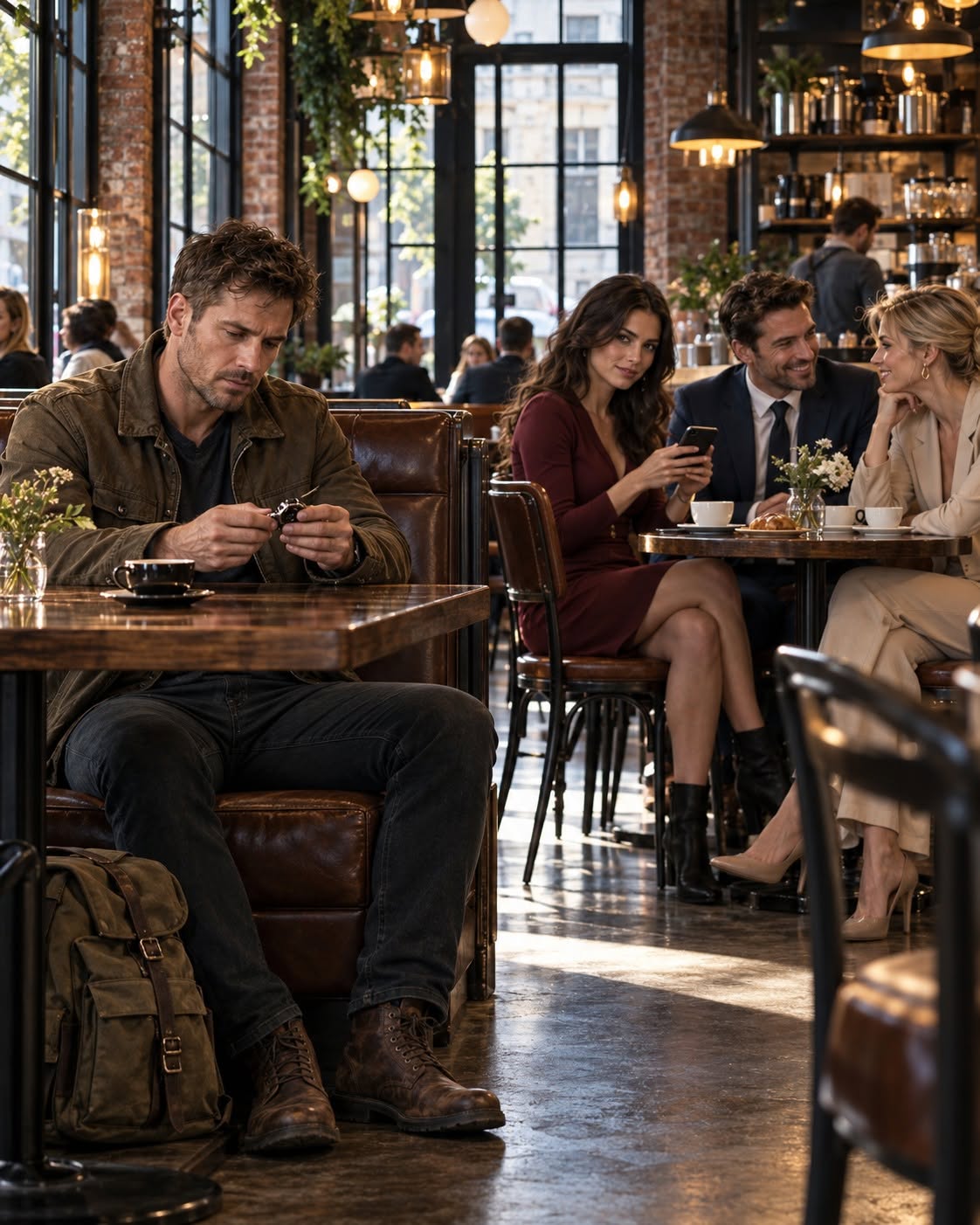
“Apparently, one of those men has been telling people that you embarrassed him in front of thirty-seven witnesses. He believes you ruined his reputation.”
I felt a familiar tension settle into my shoulders.
“I didn’t know his reputation was my responsibility.”
Marcus almost smiled, but his expression quickly became serious again.
“I agree. Unfortunately, people who make poor decisions don’t always accept responsibility for them.”
He explained that the three suspects had been arrested and were awaiting further legal proceedings. Investigators believed the restaurant had been targeted because several customers were carrying valuable watches, jewelry, and business documents.
The police were also examining whether the men were connected to other robberies.
Then Marcus pointed to another photograph.
It showed me standing outside the restaurant, helping an officer speak to the frightened customers.
“Someone took this picture and posted it online,” he said. “The story has spread farther than anyone expected.”
I stared at the photograph.
I had never wanted attention. I had only wanted to get home to my daughter.
Now strangers were discussing my military background, speculating about my past, and calling me a hero.
Some praised me. Others accused me of exaggerating what had happened.
A few even questioned why a man with my training was working an ordinary security job.
I pushed the photograph away.
“I don’t want any of this.”
Marcus nodded.
“Then don’t let it change who you are.”
I thought about that sentence for the rest of the day.
When I returned home, Chloe was sitting on the living room floor, arranging her stuffed animals inside the cardboard castle.
She had given each one a name, a job, and a very specific bedtime.
“Daddy, this is Captain Bear,” she announced, holding up a faded teddy bear. “He protects the castle.”
I smiled.
“Sounds like an important job.”
“It is. But he’s not allowed to scare anybody.”
She placed the bear beside a tiny paper bed.
“Protectors have to be nice, too.”
I froze for a moment.
Then I sat beside her.
“That’s a good rule, sweetheart.”
She looked at me with the same serious expression she used whenever she was explaining something she believed adults had forgotten.
“Mommy said being strong means helping people.”
I felt my throat tighten.
Sarah had been gone for three years, but her words still found their way into our home through Chloe.
That night, after Chloe fell asleep, I opened the small box where I kept Sarah’s belongings.
Inside was her wedding ring, a faded photograph, and a folded note she had written shortly before her death.
I had read it so many times that I knew almost every word by heart.
Still, I unfolded it carefully.
“If life ever becomes too heavy, Daniel, remember that you don’t have to be fearless. You only have to keep choosing love, even when fear tells you to close your heart.”
I sat in the dark for a long time.
For three years, I had mistaken silence for strength. I had buried my grief beneath exhausting work and told myself that if I never asked anyone for help, I would never become a burden.
But Sarah had understood something I was only beginning to learn.
A person could be strong and still need someone to stand beside him.
The next Monday, I started my new job.
Marcus had arranged for me to oversee security at a commercial complex near the river. The position involved monitoring access systems, coordinating with staff, inspecting equipment, and responding to incidents when necessary.
It wasn’t glamorous.
But it was honest work, and it came with a reliable salary, health insurance, and enough flexibility to take Chloe to school most mornings.
For the first time in years, I could plan more than a few days ahead.
I bought groceries without calculating the exact cost of every item. I filled Chloe’s prescription before the bottle was nearly empty. I even opened a small savings account in her name.
Every deposit was modest.
Every deposit felt like a promise.
Then, on my fourth week at the complex, everything changed again.
It happened shortly after six in the evening.
I was checking the access logs when a security guard hurried into the control room.
“Daniel, we have a situation in the parking garage.”
I stood immediately.
“What kind of situation?”
“A woman says someone is following her. She’s locked herself inside her car.”
I grabbed my radio and headed downstairs.
When I reached the third level, I found a woman sitting behind the steering wheel of a silver sedan. Her hands were shaking, and she kept glancing toward the concrete pillars.
A man stood several spaces away, pretending to look at his phone.
I approached the vehicle carefully and asked the woman to lower her window just enough to hear me.
“I’m Daniel. I work security here. Are you in immediate danger?”
She nodded rapidly.
“He’s been following me since I left the elevator. I told him to leave me alone, but he won’t.”
The man looked up.
“She’s overreacting,” he said. “We’re having a personal disagreement.”
I positioned myself where I could see both of them.
“You need to move away from the vehicle while we establish what’s happening.”
He laughed.
“Who are you supposed to be?”
“Security. And I’m asking you to step back.”
His expression changed.
For a second, I saw the same dangerous impatience I’d noticed in the restaurant gunman who had grabbed the waitress.
He took a step toward me.
I didn’t reach for him or raise my voice. I kept my distance, watched his hands, and gave the other guard instructions over the radio to contact the police.
“Last warning,” I said. “Step away from the car.”
He swore under his breath, then turned as though he intended to leave.
Instead, he suddenly lunged toward the woman’s door.
I moved between them, redirected his momentum, and forced him away from the vehicle. He stumbled against a concrete pillar, recovered, and tried to swing at me.
I blocked the strike and brought him under control without continuing the confrontation once he stopped resisting.
The other guard arrived seconds later.
By the time the police reached us, the woman was sitting in the security office with a bottle of water and a blanket around her shoulders.
She kept thanking me.
I told her she didn’t need to.
“You made it possible for me to get out safely,” she said. “I didn’t know what he was going to do.”
I looked at the trembling hands wrapped around her cup.
“I know what it’s like to feel trapped. I’m glad you’re safe.”
When the police finished taking statements, I returned to the control room.
My hands were steady, but my thoughts were somewhere else.
I imagined Chloe alone in a room, frightened and unable to find someone she trusted.
I thought about how many people endured situations like that without anyone noticing.
And I realized that protecting people wasn’t always about stopping a violent act.
Sometimes it was about recognizing fear before it became a tragedy.
The next morning, Marcus called me into his office.
“You handled that situation well,” he said.
“I followed procedure.”
“You also remembered that the woman needed reassurance, not another person shouting orders at her.”
I shrugged.
“Someone had to make sure she felt safe.”
Marcus studied me for a moment.
“That’s why I want you to help train our new security staff.”
I blinked.
“Train them?”
“Not just in physical response. I want you to teach them how to assess situations, communicate under pressure, and protect people without making a bad situation worse.”
I hesitated.
“I haven’t taught anyone in years.”
“You’ve been doing it your whole life. You just haven’t called it teaching.”
For the first time, I considered that my experience might be useful in a way I had never imagined.
I accepted.
Over the next several months, I helped develop training sessions that emphasized awareness, de-escalation, emergency communication, and the responsibility that came with wearing a security uniform.
I told the trainees that courage wasn’t measured by how quickly they moved toward a fight.
It was measured by whether they could think clearly enough to prevent one.
I also taught them something I had learned from the restaurant.
Never assume that a frightened person is weak, that a quiet person is harmless, or that an exhausted person has nothing valuable to offer.
The most important details were often the ones people overlooked.
One afternoon, Marcus brought me a letter.
It was from the nurse who had been sitting with her little boy at the restaurant on the night of the attempted robbery.
Her name was Emily Carter.
She wrote that her son, Noah, still talked about the man who had knelt beside him beneath the table.
“He says you told him to breathe slowly because he needed to help his mother stay calm,” the letter read. “He was terrified, but he believed you. Since that night, he has been less afraid of loud noises and more willing to talk about what happened.”
At the bottom, Emily had included a drawing.
It showed a man in a dark jacket standing between three stick figures and a group of people. Beside him was a small boy holding his mother’s hand.
Above the picture, Noah had written, “THE MAN WHO HELPED US.”
I read the letter twice.
Then I placed it inside my desk drawer, beside a photograph of Sarah and Chloe.
For years, I had measured my life by what I could provide: rent, meals, medicine, a safe home.
I had never considered that a stranger might remember something as small as a few calm words spoken beneath a table.
Perhaps the world was full of moments like that, moments we never heard about because the people we helped continued on with their lives.
Then came the phone call I had been dreading.
It was late on a Wednesday evening when my babysitter called to tell me Chloe had developed a high fever.
She had already contacted the pediatric clinic, but Chloe was getting more uncomfortable, and I needed to come home.
I left the complex immediately and drove through the cold Chicago streets, my mind racing through every possibility.
By the time I reached our apartment, Chloe was curled beneath her blanket, her cheeks flushed and her eyes glassy.
“Daddy,” she whispered.
I knelt beside her.
“I’m here, sweetheart.”
She reached for my hand.
“Don’t go away.”
The words struck deeper than she could possibly understand.
I had spent so many years afraid of failing her that every illness, every unexpected bill, every difficult night felt like a test I might not pass.
I called the clinic, followed the nurse’s instructions, and took Chloe in for an examination.
Thankfully, it was a common infection. The doctor prescribed treatment, explained what to watch for, and reassured me that she should recover with rest and care.
When we finally returned home, Chloe fell asleep with her hand wrapped around my finger.
I sat beside her until the room grew quiet.
My phone vibrated.
Marcus had sent a message asking whether I could cover an extra shift the following evening.
In the past, I would have agreed automatically. I would have told myself that one more shift meant a little more money, and a little more money meant a little more security.
This time, I typed a different answer.
“I’m sorry, but I need to stay home with my daughter tomorrow. I’ll be available for my next scheduled shift.”
I stared at the message before sending it.
It seemed like such a small decision.
Yet it was one of the hardest things I had done in years.
Marcus replied a few minutes later.
“Understood. Take care of Chloe. We’ll see you when you’re ready.”
I set the phone aside.
For the first time, I understood that rebuilding my life didn’t simply mean earning more money.
It meant learning that I was allowed to live inside the life I was working so hard to protect.
A few days later, Chloe’s fever disappeared, and her laughter returned to the apartment.
We celebrated by making pancakes shaped like stars, although most of them looked more like lopsided clouds.
She insisted they tasted better that way.
As I watched her eat, I thought about the restaurant, the parking garage, the security office, and the countless people who had helped me along the way.
The nurse who had written the letter.
Marcus, who had offered me a chance when I needed one.
The customers who had filled that envelope with enough money to help my daughter.
Even the businessman who had apologized for judging me by my clothes.
None of them had solved every problem in my life.
They hadn’t brought Sarah back or erased the years of struggle.
But each had reminded me that hardship didn’t have to turn into loneliness.
A few months later, Marcus invited me to speak at a company meeting about the importance of community safety.
I nearly refused.
I wasn’t a public speaker, and I had no interest in becoming a symbol of anything.
But when I mentioned the invitation to Chloe, she looked up from her coloring book.
“Are you going to tell them about the people you helped?”
“Maybe.”
“Tell them about the people who helped you, too.”
I stared at her.
“Why?”
She shrugged as though the answer were obvious.
“Because they helped you. That’s important.”
So I agreed.
At the meeting, I stood before a room full of security staff, property managers, and employees. I told them about the restaurant, the fear in the waitress’s eyes, and the little boy crying beneath the table.
I told them about the woman in the parking garage and the way she had clutched her cup after the danger passed.
Then I told them about Chloe.
I explained that before that Thursday night, I had believed a good father was someone who never needed help. I thought I had to carry every burden alone because asking for assistance would somehow make me less capable of protecting my daughter.
“I was wrong,” I said.
The room became quiet.
“Strength isn’t refusing every helping hand. It’s knowing what matters enough to protect, including your own well-being. And if we want people to trust us in a crisis, we have to treat them with dignity before the crisis begins.”
When I finished, no one applauded immediately.
For one brief moment, I wondered whether I had said something foolish.
Then a woman in the front row stood up.
She was the employee who had been followed in the parking garage.
She thanked me for helping her feel safe again.
One of the younger security officers followed. He said the training had helped him de-escalate an argument without anyone getting hurt.
Then another person spoke.
Soon, people were sharing stories about small acts of courage, quiet kindness, and moments when someone had stepped in before a situation became worse.
I stood there listening, overwhelmed by something I had never expected.
The restaurant had held thirty-seven people.
But the lesson from that night had reached far beyond those walls.
After the meeting, I drove home through the city as snow began drifting beneath the streetlights.
When I opened the apartment door, Chloe came running toward me.
“Daddy! I made something!”
She pulled me to the kitchen table.
On a sheet of paper, she had drawn a big house with a yellow sun above it. There were two figures standing outside, holding hands, and a little red heart floating over the roof.
At the bottom, she had written, “MY DADDY HELPS PEOPLE, AND PEOPLE HELP MY DADDY.”
I laughed, then felt tears gather in my eyes.
“That’s beautiful, sweetheart.”
She leaned against me.
“Are you happy, Daddy?”
I looked around our small apartment. The furniture was old. The kitchen table had a scratch down the middle. The cardboard castle still occupied half the living room, and there were bills waiting on the counter.
Our life wasn’t perfect.
But the refrigerator was full, Chloe’s medicine was paid for, and I had a job that allowed me to come home at the end of the day.
Most importantly, I no longer felt that the entire world rested on my shoulders alone.
“Yes,” I whispered. “I’m happy.”
She smiled and returned to her crayons.
That night, after tucking her into bed, I stood beside the window and watched the snow settle over Chicago.
I thought about the man I had been before Sarah died, the father I had become afterward, and the stranger who had stood up in a restaurant when three armed men threatened everyone inside.
They were all parts of the same person.
I hadn’t lost my strength when I left the military. I hadn’t lost my worth when I wore a frayed jacket or counted coins for coffee. And I hadn’t become a hero simply because I knew how to respond when danger arrived.
The real test had come afterward, in the ordinary days when I had to keep going, admit when I was struggling, and learn to accept the kindness of others.
I couldn’t promise Chloe a life without fear, loss, or disappointment.
No parent could.
But I could teach her that the world was not made only of people who took advantage of the vulnerable. It was also made of people who stopped, listened, apologized, offered a hand, and chose to care even when nobody was watching.
Thirty-seven people had witnessed what happened in that restaurant.
Some remembered the way I moved.
Others remembered the frightened waitress, the little boy beneath the table, or the businessman who apologized.
I remembered something different.
I remembered that, in the middle of all that fear, strangers had found a way to become a community.
And when I finally returned home, after the shouting and sirens and flashing lights had faded into the night, the greatest victory wasn’t that I had defeated three men.
It was that my daughter was waiting for me.
She didn’t care how many people had watched me stand up. She didn’t know what the internet had said or how many strangers had called me brave.
She only knew that her father had come home.
And when she wrapped her arms around my neck, I understood what I had spent three years trying to remember.
A man doesn’t become strong because he can face danger without trembling.
He becomes strong when he keeps showing up for the people who need him, when he allows others to stand beside him, and when he refuses to let hardship make him forget how to care.
That was the lesson I wanted Chloe to carry into the world.
Not that she should never be afraid.
Not that she should try to save everyone.
But that she should never mistake poverty for worthlessness, quietness for weakness, or kindness for something a person can afford only when life is easy.
Because sometimes, the person everyone overlooks is the one who will stand up when the room falls silent.
And sometimes, the hand that reaches out to help someone else is the very hand that will one day need help in return.
That doesn’t make the kindness smaller.
It makes it human.
As I turned off Chloe’s bedroom light, she stirred beneath her blanket.
“Daddy?”
“I’m here, sweetheart.”
“Will you be here in the morning?”
I smiled and kissed her forehead.
“Every morning I can be, I’ll be here.”
She closed her eyes, satisfied.
I stood in the doorway for another moment, listening to her quiet breathing.
Then I went to the kitchen, placed her drawing beside Sarah’s photograph, and finally allowed myself to rest.
For the first time in a very long while, tomorrow didn’t feel like another battle I had to fight alone.
It felt like another day I had the chance to live.
And that, I realized, was worth more than any applause, any title, or any reputation.
Because the world might remember the night I stood up to three armed men.
But Chloe would remember the father who came home, held her close, and taught her that even in a world full of fear, there was still room for courage, compassion, and hope.