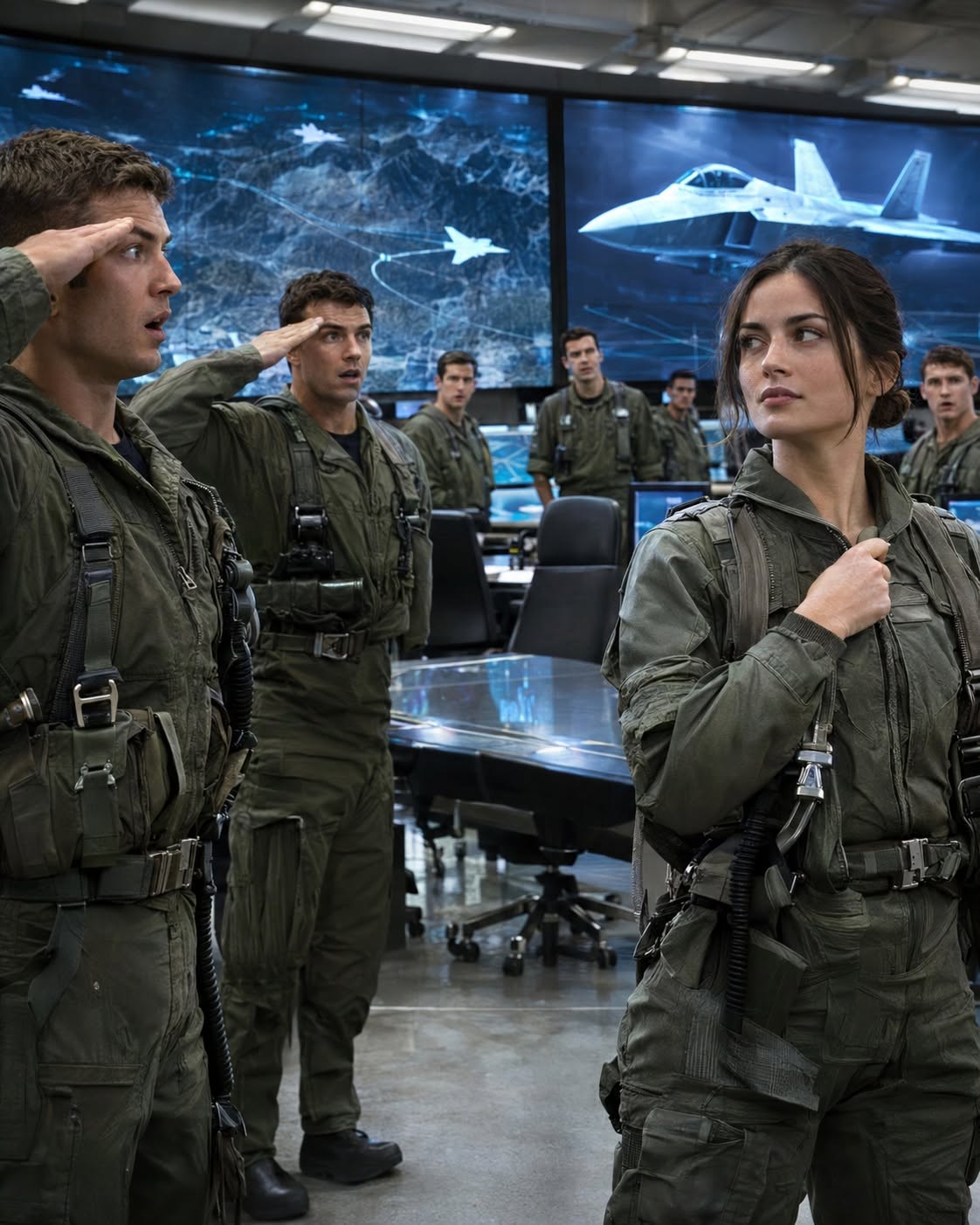
The F-22 pilots laughed when they saw me sitting in the briefing room, calling me a clueless civilian who had no business being near a fighter squadron
The instructor turned the folder toward the room.
“Lieutenant Evelyn Brooks is not simply an experienced test pilot. She’s the lead evaluation pilot for the X-91 experimental flight program, operating under a special-access assignment at Groom Lake.”
A murmur spread across the room.
He continued.
“She’s accumulated more than 4,200 flight hours, including over 1,100 hours in experimental aircraft. She’s been involved in the evaluation of advanced sensor systems, electronic warfare platforms, and next-generation flight-control technologies. Her work has contributed to several programs that remain classified.”
He paused, allowing the information to settle.
“And she’s one of only three pilots currently authorized to fly the aircraft designated Banshee.”
The room became completely silent.
Captain Mitchell stared at the folder.
“One of three?”
“Correct.”
The instructor closed it.
“Her assignment here isn’t to impress anyone. She’s participating in an evaluation of how conventional fighter platforms perform against advanced adversary systems. Today’s exercise was part of that evaluation.”
Mitchell slowly looked back at me.
“So this was a test?”
I shook my head.
“Not exactly. The exercise was real. Your mistakes were real. The simulated kills were real. The only difference is that I was also evaluating how your squadron responded under pressure.”
He looked down at the table.
For the first time since I’d met him, he didn’t have an immediate answer.
Then the instructor added something that changed the atmosphere again.
“There’s another reason Lieutenant Brooks was assigned to this exercise.”
He switched the display.
A new tactical diagram appeared.
It showed an aircraft profile unlike anything in the room’s standard training library.
“During recent classified evaluations, our intelligence analysts identified a potential vulnerability in several advanced aircraft operating systems. The vulnerability involves an interaction between sensor fusion, electronic interference, and certain terrain conditions.”
One of the senior pilots leaned forward.
“What kind of vulnerability?”
The instructor looked at me.
I nodded.
“An aircraft can have the best sensors in the world,” I explained, “but those sensors are only useful if the pilot understands what they’re actually seeing. When multiple systems receive conflicting information, the aircraft may present a picture that looks convincing but isn’t accurate.”
Mitchell crossed his arms.
“You’re talking about sensor deception.”
“Among other things.”
I pointed toward the diagram.
“The biggest danger isn’t losing information. It’s believing bad information.”
Nobody interrupted.
I continued.
“Today’s canyon engagement demonstrated how quickly a pilot can become dependent on the picture generated by the aircraft. Mitchell saw what his systems suggested was happening. He trusted that picture. He didn’t question whether the information matched the physical environment.”
Mitchell’s expression tightened.
“You could have explained that before the exercise.”
“Would you have listened?”
He opened his mouth.
Then closed it.
The instructor gave a small nod.
“That’s precisely why this evaluation was designed without advance disclosure.”
The briefing continued for another twenty minutes, but something had changed.
The pilots who had treated me like an unwanted visitor were now asking questions.
Not all of them were comfortable questions.
Some wanted to know how I had recognized Mitchell’s positioning so quickly. Others wanted to understand how I had managed to maintain control of the engagement while operating in such a demanding environment.
I answered what I could.
What I couldn’t discuss, I left alone.
When the meeting ended, Mitchell remained seated.
I was collecting my helmet when he approached.
“Lieutenant Brooks.”
I turned.
“Captain?”
He hesitated.
“I owe you an apology.”
I waited.
He looked uncomfortable, as though the words were unfamiliar.
“I judged you before I knew anything about you. I assumed you didn’t belong here.”
“That’s correct.”
His eyebrows rose slightly.
I continued.
“But don’t apologize because you discovered I have a better flight record than you. Apologize because you decided someone wasn’t worth listening to before they had a chance to speak.”
He considered that.
Then nodded.
“Fair enough.”
I picked up my helmet.
“There’s something else you should know, Captain.”
“What’s that?”
“Your flying wasn’t terrible today.”
A faint smile appeared on his face.
“That’s generous.”
“Your judgment was the problem.”
His smile disappeared.
I wasn’t trying to humiliate him. I wanted him to understand the distinction.
A talented pilot could make mistakes. An experienced pilot could make dangerous mistakes. But the most dangerous pilot was the one who refused to admit either.
Mitchell looked at the tactical display one last time.
“I’ll remember that.”
I believed him.
At least, I wanted to.
The following morning, everything changed.
At 0615, I received an encrypted message ordering me to report to a secure operations building on the northern side of the base.
The message contained only three lines.
PRIORITY ONE.
FLIGHT EVALUATION SUSPENDED.
BANSHEE ACTUAL REQUIRED.
I read it twice.
Something was wrong.
When I entered the operations room, Colonel Richard Hayes was standing beside a large digital display.
He was the senior officer overseeing the classified evaluation program and one of the few people who knew the full extent of my assignment.
He didn’t waste time with introductions.
“Brooks, we’ve got a problem.”
The display showed a satellite image of a restricted testing corridor in the Nevada desert.
“At 0440 this morning, one of our experimental aircraft experienced a serious systems malfunction during an autonomous flight evaluation.”
I studied the image.
“What aircraft?”
“An unmanned prototype designated Raven Six.”
“Is it still airborne?”
“Yes.”
I looked at him.
“Then why hasn’t it been brought down?”
Hayes exhaled.
“Because we can’t establish reliable control.”
He changed the display.
A red aircraft symbol appeared over the desert.
“Raven Six was designed to evaluate an advanced autonomous flight-control architecture. It was supposed to complete a series of navigation tests and return to its recovery zone.”
“What happened?”
“During the final phase, the aircraft began receiving conflicting navigation data. Its autonomous system rejected the ground control inputs. It then deviated from the assigned corridor.”
“Is it armed?”
“No.”
“Is it carrying classified equipment?”
Hayes didn’t answer immediately.
That was answer enough.
“What’s onboard?”
“An experimental sensor package containing technology we cannot allow to leave the restricted area.”
I leaned closer to the display.
“How much fuel?”
“Approximately forty minutes.”
“Where is it heading?”
Hayes pointed toward the map.
“Toward the western edge of the restricted airspace. If it continues along its current trajectory, it’ll approach a civilian flight corridor.”
I felt my stomach tighten.
“How many aircraft are available?”
“Two F-16s are being prepared. One will attempt visual identification. The other will provide support.”
“Who are the pilots?”
Hayes glanced toward the door.
“Captain Mitchell and Lieutenant Fisher.”
I looked up.
“Fisher?”
“He’s been assigned to your flight.”
I nodded slowly.
“Then I’ll take the lead.”
Hayes studied me.
“That’s what I was hoping you’d say.”
A few minutes later, Mitchell entered the room.
He looked at the display, then at me.
“What’s going on?”
Hayes briefed him quickly.
Mitchell’s expression became serious.
“So we’re intercepting an experimental drone?”
“That’s correct,” Hayes replied.
“What’s the engagement authority?”
“Your objective is visual identification and containment. You are not authorized to engage unless the situation becomes an immediate threat to civilian aircraft or personnel.”
Mitchell nodded.
Then he looked at me.
“You’re flying?”
“Yes.”
He glanced at the aircraft data.
“Which one?”
“The Viper.”
A short pause followed.
“Then I’ll take the lead aircraft.”
I shook my head.
“No. I’ll lead.”
He frowned.
“Lieutenant, this is an intercept operation. We need a formation leader with operational air combat experience.”
I met his eyes.
“And we need someone who understands the system we’re trying to recover.”
Hayes stepped between us.
“Brooks has operational authority for this evaluation. Mitchell, you’ll fly as her wingman.”
Mitchell didn’t argue.
But I could see the discomfort in his expression.
Not because he didn’t trust my ability anymore.
Because he was still learning how to work with someone he had once dismissed.
I turned toward the door.
“Let’s get airborne.”
Twenty minutes later, two F-16s were climbing into the cold morning sky.
The desert below us was covered in pale golden light.
Kyle Fisher was flying my aircraft again, with me in the rear seat.
Mitchell was in the second Viper.
“Raven Six, this is Viper Lead. We are approaching your last reported position.”
No response.
The drone’s transponder was transmitting intermittent signals.
I studied the data.
“There’s something wrong with this picture.”
Kyle glanced at the display.
“What do you see?”
“The aircraft’s reported altitude doesn’t match its radar return.”
Mitchell came over the radio.
“Could be a sensor error.”
“Possibly.”
I switched displays.
The drone’s projected flight path suddenly shifted.
Then shifted again.
“That’s not a normal navigation correction,” I said.
Hayes’s voice came through the command frequency.
“Viper Lead, we are observing irregular data transmission. Proceed with caution.”
I stared at the display.
The aircraft was moving toward a cluster of mountains.
Its speed was increasing.
“Raven Six, terminate autonomous navigation and return to recovery heading.”
Nothing.
I tried again.
Still nothing.
Then a warning appeared on the tactical display.
The drone had entered an unapproved flight corridor.
“Mitchell, move to the right and establish visual contact.”
“Copy.”
A few seconds later, he reported.
“I have visual. Small aircraft, no visible damage. It’s moving faster than expected.”
“Can you identify its flight attitude?”
“Affirmative. Nose slightly high. Appears stable.”
I studied the data.
Something wasn’t right.
“Captain, maintain distance. Don’t approach its nose.”
“Understood.”
Suddenly, the drone made a sharp turn.
Mitchell reacted immediately.
“Raven Six just changed heading!”
“I see it.”
The aircraft turned toward his position.
“Break right!” I shouted.
Mitchell pulled away.
The drone passed close enough to make the situation uncomfortable.
“That thing is maneuvering on its own,” Mitchell said.
“Negative,” I replied.
He sounded confused.
“Then what?”
I looked at the sensor readings.
“The flight-control system thinks it’s avoiding an obstacle. It’s reacting to false navigation information.”
“Can you shut it down?”
“Not from here.”
I switched to the emergency control frequency.
“Raven Six, this is authorized recovery aircraft Banshee Actual. Disengage autonomous flight mode.”
For a moment, the signal remained silent.
Then a faint digital response appeared.
CONTROL AUTHENTICATION ACCEPTED.
My heart skipped.
“Colonel Hayes, the aircraft has recognized my credentials.”
“Can you recover it?”
“Attempting.”
I transmitted the emergency recovery sequence.
The drone responded.
Its nose began turning toward the designated recovery corridor.
Then the screen flashed red.
AUTHENTICATION OVERRIDDEN.
I stared at the message.
“That’s impossible.”
Hayes came over the radio.
“Brooks, what’s happening?”
“Someone or something just overrode the recovery command.”
Silence.
Then Mitchell spoke.
“Are you suggesting somebody is controlling that aircraft?”
I watched the data.
“I don’t know yet.”
The drone accelerated.
Its new flight path pointed directly toward the edge of the restricted area.
And beyond it were civilian aircraft.
“Colonel, we have a potential containment failure.”
Hayes’s voice became sharp.
“Can you stop it?”
I looked at the remaining fuel indicator.
Then at the terrain.
Then at Mitchell’s position.
“Yes.”
I paused.
“But I need permission to take the lead aircraft closer than the current safety boundary.”
Hayes hesitated.
“Explain.”
“The drone is responding to false navigation inputs. If we can establish a stable visual reference and force its recovery system to recognize the correct position, we may be able to redirect it.”
“May?”
“That’s the best option available.”
A few seconds passed.
“Authorized. Maintain separation and protect civilian airspace.”
I looked at Kyle.
“Lieutenant, I need you focused.”
He nodded.
“Always, ma’am.”
I turned to Mitchell.
“Captain, I need you to position yourself between the drone and the civilian corridor. Do not engage unless I give the command.”
“Understood.”
The next several minutes were the longest of my career.
The drone was moving erratically.
Its navigation system was fighting its own flight-control computer.
Every time we transmitted a correction, the aircraft briefly responded before returning to its false trajectory.
Then the situation became worse.
A new warning appeared.
ENGINE TEMPERATURE CRITICAL.
The drone’s onboard computer had begun compensating for the unstable flight profile by demanding more power.
Its remaining flight time dropped rapidly.
“How long?” Kyle asked.
“Twenty minutes, maybe less.”
“Can it reach the recovery zone?”
“Not like this.”
I studied the telemetry.
There was something familiar about the pattern.
I had seen similar behavior during the early testing of the Banshee program.
The aircraft wasn’t simply receiving bad information.
It was prioritizing one corrupted data source over all the others.
I suddenly understood.
“Hayes, I need the original navigation reference.”
“What?”
“The baseline coordinates from before launch. Not the updated satellite feed. The original inertial reference.”
There was a pause.
“Stand by.”
I watched the drone.
Its position shifted again.
“Come on,” I whispered.
Then the data appeared.
I compared the coordinates.
There it was.
A discrepancy.
The drone’s navigation system had been fed a false position that placed it several miles away from its actual location.
Its autonomous computer was making perfectly logical decisions based on completely incorrect information.
The machine wasn’t malfunctioning in the way we had assumed.
It was obeying the wrong reality.
“Colonel, I found the problem.”
“Can you correct it?”
“I need the original flight-control authorization key.”
“That’s restricted.”
“I know. I’m requesting it.”
Hayes was silent for a moment.
Then he gave the authorization.
I entered the sequence.
The system accepted the key.
For three seconds, everything looked normal.
Then the drone began descending.
“Altitude dropping!” Mitchell shouted.
I watched the telemetry.
The aircraft was losing control.
Its recovery system had been compromised so deeply that restoring the correct navigation reference had created another conflict.
“Raven Six, stabilize.”
No response.
“Come on,” I muttered.
Kyle looked at me.
“Ma’am?”
I took a breath.
“Prepare for an emergency intercept.”
Mitchell came over the radio.
“Brooks, tell me what you need.”
I looked at the drone’s trajectory.
“Keep it away from the civilian corridor. If it turns toward you, maintain your position until I tell you otherwise.”
“Copy.”
I calculated the remaining distance to an uninhabited stretch of desert.
There was one possibility.
It was dangerous, and it depended on timing.
I needed to get close enough to establish a stable recovery link while the aircraft was still within a manageable flight envelope.
“Lieutenant Fisher, I’m taking the controls.”
“Yes, ma’am.”
My hands settled on the stick.
The Viper accelerated.
The drone was now descending toward the mountains.
“Colonel Hayes, I’m attempting a direct recovery transmission.”
“Understood.”
The distance closed.
The warning tones began sounding again.
Kyle gripped the side of his seat.
“Ma’am, we’re getting close.”
“I know.”
I adjusted our position and established the transmission.
For a brief moment, the drone responded.
Then its flight-control system rejected the signal again.
I tried once more.
Nothing.
My eyes moved across the display.
There was only one thing left.
The emergency recovery protocol had a secondary channel designed to operate independently of the primary navigation system.
It was rarely used because it required a precise authorization handshake.
I had helped test that system years earlier.
I knew its weaknesses.
I also knew it could work.
I entered the final sequence.
A warning appeared.
MANUAL RECOVERY AUTHORIZATION REQUIRED.
I pressed the transmit control.
“Banshee Actual requesting emergency recovery authority for Raven Six.”
Hayes answered immediately.
“Authority granted.”
I entered the final code.
The display changed.
RECOVERY CONTROL ESTABLISHED.
For the first time in several minutes, the drone’s flight path stabilized.
“Got you,” I whispered.
Its nose slowly turned away from the mountains.
Its altitude began leveling.
Mitchell reported from the other aircraft.
“Raven Six is responding. I’m seeing a controlled turn.”
I allowed myself one breath.
“Maintain escort.”
The drone continued toward the recovery zone.
But the crisis wasn’t over.
A final warning flashed across my display.
FUEL RESERVE CRITICAL.
It wouldn’t make it back to the original runway.
I studied the map.
There was a secondary emergency landing strip in a remote part of the testing range.
It was short, dusty, and rarely used.
But it was clear.
“Colonel, I’m redirecting Raven Six to the northern emergency strip.”
“That strip hasn’t been inspected this week.”
“Then we’ll make sure it doesn’t need to be.”
I guided the drone toward the alternate landing zone.
Mitchell maintained visual contact.
Kyle watched the telemetry.
For several minutes, nobody spoke.
Then the drone entered its final approach.
Its landing gear deployed.
Its speed decreased.
And finally, the aircraft touched down.
A cloud of dust rose behind it.
The telemetry showed the engine shutting down.
RAVEN SIX RECOVERED.
For a moment, the radio was completely silent.
Then Kyle let out a breath.
“Well, that was something.”
Mitchell laughed softly.
“Remind me never to underestimate your backseater again, Fisher.”
Kyle grinned.
“Already learned that lesson, sir.”
I leaned back.
My shoulders were aching.
But the most important part was that nobody had been hurt.
And a highly classified experimental aircraft had just been recovered without leaving the restricted range.
When we landed at Nellis, Colonel Hayes was waiting beside the hangar.
He approached as I climbed down.
“Excellent work, Brooks.”
“Thank you, sir.”
He glanced toward the second Viper.
“Mitchell did well too.”
I looked at the captain.
He removed his helmet and walked over.
“That was one of the most complicated intercepts I’ve ever flown.”
“Welcome to the test world.”
He shook his head.
“I used to think the hardest part of flying was controlling the aircraft.”
“And now?”
He looked toward the hangar where Raven Six was being prepared for inspection.
“Knowing when not to trust it.”
I smiled.
“That’s a good place to start.”
But the real surprise came later that afternoon.
The investigation team examined Raven Six and discovered that the navigation corruption hadn’t originated from an ordinary equipment failure.
A software update had introduced an unexpected interaction between two separate sensor-processing modules.
The problem had remained undetected during ground testing because the test environment hadn’t reproduced the combination of electronic interference and terrain conditions encountered during the flight.
The discovery had major implications.
The same architecture was being evaluated for several future military aviation programs.
If the vulnerability had gone unnoticed, it could have affected aircraft operating under completely different conditions.
My recovery sequence had also preserved the flight data.
That data allowed the engineering team to identify the precise moment the system began trusting incorrect information.
Within forty-eight hours, the entire evaluation program was suspended pending a technical review.
The colonel later told me that the findings could prevent similar failures in future aircraft.
I didn’t consider myself a hero.
I had simply recognized a problem, made a decision, and done what my training had prepared me to do.
Still, something about the experience stayed with me.
Not the drone.
Not the telemetry.
Not even the moment the recovery system finally responded.
It was the way the people around me had changed.
Three days after the incident, I received an invitation to attend another squadron briefing.
This time, when I entered the room, nobody laughed.
Mitchell stood near the front.
He looked at me and nodded toward an empty chair beside him.
“Lieutenant Brooks, we’ve saved you a seat.”
I sat down.
The briefing began.
For the next hour, we discussed the Raven Six incident, the technical findings, and the lessons from the Red Flag engagement.
Mitchell asked thoughtful questions.
He listened carefully.
And when a young pilot made an observation that challenged his original assessment, Mitchell didn’t dismiss him.
He asked the pilot to explain.
Afterward, as everyone began leaving, Mitchell approached me.
“Can I ask you something?”
“Of course.”
“Why didn’t you tell us who you were that first morning?”
I considered the question.
“Would it have changed how you treated me?”
He looked down.
“Probably.”
“That’s exactly why.”
He nodded slowly.
“I think I understand.”
I adjusted the strap on my flight bag.
“Captain, there’s nothing wrong with being proud of your aircraft. The F-22 is an extraordinary machine. Your squadron has earned its reputation.”
He smiled slightly.
“But?”
“But the aircraft doesn’t make the pilot. The pilot makes decisions. The aircraft simply gives those decisions more possibilities.”
He looked toward the flight line.
“I spent years believing that having the best equipment meant having the advantage.”
“And now?”
“Now I think the advantage belongs to whoever understands the situation best.”
I nodded.
“That’s the lesson.”
A week later, my assignment at Nellis came to an end.
I was returning to Groom Lake for the next phase of the Banshee program.
Before departure, Kyle Fisher found me near the hangar.
He looked more confident than he had on the morning of our first flight.
“Ma’am, I wanted to thank you.”
“For what?”
“For trusting me with the controls.”
I smiled.
“You were the one flying the aircraft. I just helped you see the fight differently.”
He shook his head.
“I’ve been thinking about what you said after the exercise. Good pilots question themselves.”
“Do you disagree?”
“No. I think I finally understand it.”
He paused.
“I used to believe confidence meant never being afraid of making mistakes.”
“And now?”
“Now I think confidence means being willing to admit when you’re wrong and learning before the next flight.”
I smiled.
“That’s how you become someone others can trust.”
He straightened.
“Hope we fly together again someday.”
“Keep your training sharp, Lieutenant. You never know.”
I climbed into the transport aircraft later that afternoon.
As it lifted away from Nellis, I watched the familiar desert landscape disappear beneath the clouds.
My phone vibrated with a secure notification.
A new assignment.
A new test aircraft.
A new set of unanswered questions.
I opened the message and read the first line.
BANSHEE PROGRAM — PHASE THREE.
ADVANCED HUMAN-AUTONOMOUS FLIGHT INTEGRATION.
I leaned back and smiled.
There was always another challenge waiting somewhere beyond the horizon.
But I knew something now that I wished every young pilot could understand.
The most advanced aircraft in the world could detect threats faster than a human being.
It could calculate thousands of possible outcomes in seconds.
It could process information at a speed no human mind could match.
Yet it could never completely replace judgment.
Because judgment wasn’t simply knowing what to do when everything worked.
It was recognizing what mattered when everything went wrong.
And leadership wasn’t about having the loudest voice in the briefing room, the most impressive uniform, or the most expensive aircraft.
It was about taking responsibility when the consequences were real.
Months later, during another classified evaluation, I received a message from Captain Mitchell.
It contained a photograph of his squadron standing beside their aircraft.
Underneath it, he had written:
“Remember that Viper engagement? We still use it in our training discussions. Turns out the most valuable lesson wasn’t how you defeated two Raptors. It was how quickly we learned that we could be wrong.”
I read the message twice.
Then I typed a reply.
“Good. Keep asking questions. That’s what keeps pilots alive.”
I put the phone away and walked toward the hangar.
The aircraft waiting inside was unlike anything most people would ever see.
Its exterior was dark and smooth, its systems hidden behind layers of experimental technology.
Somewhere inside that machine were thousands of hours of engineering, countless calculations, and the work of people who believed they were building the future.
But before it could fly, someone had to climb into the cockpit.
Someone had to take responsibility.
And someone had to remember that technology was a tool, not a substitute for wisdom.
I fastened my helmet and looked toward the waiting crew.
“Ready?”
The ground chief gave me a thumbs-up.
I climbed the ladder.
The canopy closed above me.
And as the engines came alive, I remembered the briefing room at Nellis, the laughter, the assumptions, and the two pilots who had learned a lesson they would never forget.
They had looked at my plain flight suit and decided I didn’t belong.
They had judged me by what they could see.
But the greatest mistake they made wasn’t underestimating my flying ability.
It was assuming that someone had to prove their worth before they deserved basic respect.
I had spent years learning to fly aircraft that pushed the boundaries of human performance.
Yet the most important lesson I’d learned had nothing to do with speed, altitude, or technology.
Never confuse someone’s quietness with a lack of capability.
Never mistake a simple uniform for an ordinary person.
And never become so confident in what you know that you stop being willing to learn.
Because the sky doesn’t care about your ego.
It doesn’t care about your reputation.
And when something goes wrong at thirty thousand feet, it certainly doesn’t care how many people laughed at you in a briefing room.
It only cares whether you can make the right decision when it matters most.
I pushed the throttle forward.
The aircraft began to move.
And somewhere beyond the desert mountains, another challenge was waiting.
This time, I wouldn’t need to prove anything to anyone.
I only needed to do the job.
THE END.