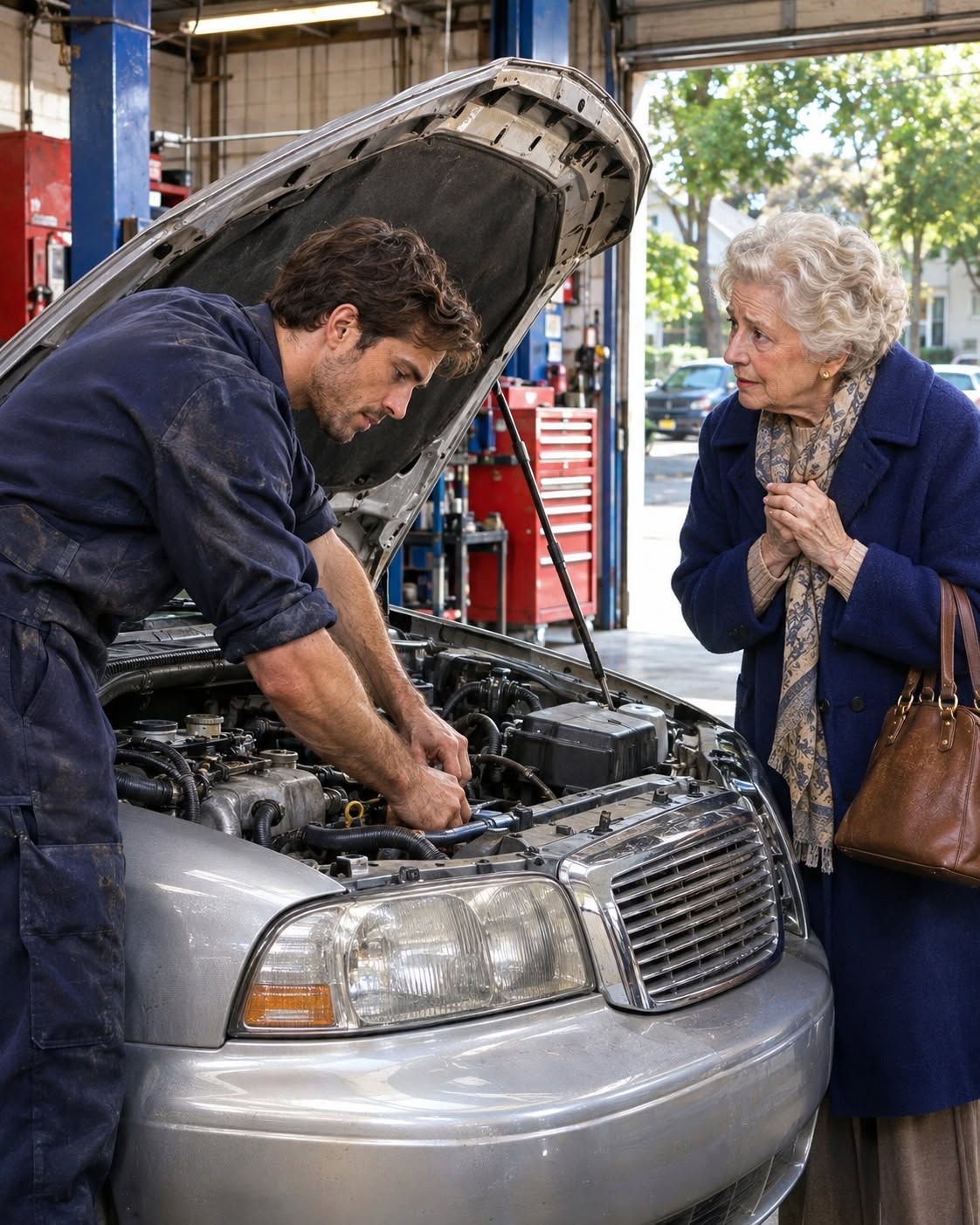
The elderly woman stood beside her broken-down silver sedan, clutching a $23 bill and looking like she was about to cry.
THE TWENTY-THREE DOLLARS THAT CHANGED EVERYTHING
The first year after Olivia’s partnership began was the best year I had experienced since my wife died.
For the first time in a long time, I wasn’t waking up at three in the morning wondering how I would pay the electricity bill. The shop had new equipment, fresh paint, a repaired roof, and more customers than I could handle on some days.
Lily had stopped asking whether we would have to move out of our little house. She had even started inviting friends over without worrying that I might tell her we couldn’t afford to feed another person.
And Martha had become such a regular part of our lives that I couldn’t remember what our Sundays had looked like before she came along.
She was there for birthday cakes, school projects, scraped knees, and the occasional dinner when I was too tired to cook.
Sometimes, when I came home late, I would find her sitting on the sofa with Lily, reading a book or watching an old movie.
It was a kind of happiness I hadn’t expected to find again.
But life has a strange way of reminding you that good things don’t always arrive without complications.
And ours began with a phone call on a rainy Thursday morning.
I was underneath a customer’s truck when my phone started vibrating on the workbench.
It was Olivia.
“Danny, I need you to come to Cleveland tomorrow. There’s something we need to discuss.”
Her voice sounded different. Not angry, exactly. Just unusually serious.
“Is something wrong with the partnership?”
There was a pause.
“Not over the phone. Just come when you can.”
I spent the rest of the afternoon wondering what could have happened.
Had the company discovered a problem with my shop?
Was there something in the contract I had overlooked?
Had I made a mistake by trusting a businesswoman whose company was worth more money than I could imagine?
When I got home, Martha was helping Lily with her homework.
I tried to act normal, but Martha noticed immediately.
“Something bothering you, Daniel?”
I told her about Olivia’s call.
She looked down at the papers in front of her.
“Sometimes people make decisions because they’re afraid of losing something,” she said quietly. “Just remember not to let fear make yours for you.”
I nodded, although I wasn’t entirely sure what she meant.
The following morning, I drove to Cleveland.
Olivia was waiting for me in a conference room on the twenty-second floor of her company’s headquarters. A man in a dark suit sat beside her, surrounded by folders and printed documents.
She introduced him as Robert, the company’s chief financial officer.
Then she slid a thick folder across the table.
“Daniel, I want you to read this carefully.”
Inside were financial statements, expansion plans, and a proposed restructuring agreement.
I read through the first few pages, but the further I went, the more confused I became.
The company was considering selling a major portion of its independent repair network to a national investment group.
My shop was included.
I looked up.
“Wait. What does this mean for me?”
Olivia folded her hands.
“The new owners want to standardize everything. They intend to replace independent operators with company-managed facilities. That includes your garage.”
My stomach tightened.
“So they’re buying my shop?”
“Not exactly. They’re buying the partnership network, including the rights connected to our agreement.”
I leaned back in my chair.
“What happens to my employees? My customers? My business?”
Robert answered before Olivia could.
“The transition would be handled according to the acquisition terms. Your compensation would be substantial.”
He named a figure.
I stared at him.
It was more money than I had ever seen in my life.
Enough to pay off my debts, buy a comfortable house, put Lily through college, and never worry about another repair bill.
For a moment, I imagined what that kind of security would feel like.
Then I asked the question that mattered.
“Would I still be running my shop?”
Robert glanced at Olivia.
“Probably not in the same capacity.”
I closed the folder.
“Then I don’t think I want it.”
Robert looked almost offended.
“Daniel, we’re talking about a life-changing amount of money.”
“I understand.”
“Most business owners would consider this an extraordinary opportunity.”
I stood up.
“Most business owners don’t have a little girl who thinks the garage is her second home.”
Olivia didn’t say anything.
She simply watched me gather my coat.
Before I left, she asked me to wait.
“There’s something else,” she said.
I turned around.
“Please don’t make a decision until you hear the whole story.”
She explained that the proposed sale wasn’t just about money. The investment group had been quietly pressuring her to increase profits for months.
Their plan involved closing smaller garages in rural communities, where operating costs were higher and customer numbers were lower.
Some of those shops were the only repair facilities within twenty or thirty miles.
People depended on them.
Older residents, farmers, single parents, and workers who couldn’t afford to drive to the city every time their vehicles needed attention.
Olivia had spent months fighting the proposal.
But the company’s board was beginning to turn against her.
“If I refuse to sell,” she said, “they may remove me as CEO.”
I looked at her.
“Then why are you asking me to sign?”
She gave a tired smile.
“Because I wanted you to know what you’re turning down. And because I think there’s another way.”
She opened another folder.
This one contained a proposal to create a new regional cooperative of independent repair shops.
Instead of selling to the investment group, Olivia wanted to separate the Ohio network into a privately managed organization.
The mechanics would retain control of their individual businesses.
The company would provide equipment, training, purchasing support, and customer referrals.
It was an ambitious idea.
But it would require significant investment, careful planning, and the support of the very people who might lose everything if the acquisition went through.
And there was one problem.
The proposed cooperative needed someone trustworthy to lead its operations.
Someone who understood what small garages actually needed.
Olivia looked directly at me.
“I want you to help me build it.”
I almost laughed.
“Olivia, I’m a mechanic. I barely understand the paperwork for my own shop.”
“That’s exactly why I want you.”
I didn’t answer immediately.
Instead, I thought about the elderly woman who had once stood in my garage holding twenty-three dollars.
I thought about all the people who came to us because they couldn’t afford dealership prices.
And I thought about Lily.
I had spent years trying to give her a stable life. I wasn’t sure I could risk the little security we had finally found.
That evening, I called Martha.
She listened without interrupting.
When I finished, she asked one question.
“Daniel, if you accept this position, will you still have time to be Lily’s father?”
I hadn’t expected that question.
“I hope so.”
“Hope isn’t a plan.”
She was right.
So I told Olivia I needed time.
For the next two weeks, I did something I had never done before.
I talked to people.
I visited independent garages in neighboring towns. I spoke with mechanics who had been working for thirty years and young technicians who were struggling to get started.
I listened to owners who had lost customers to large chains and families who had driven forty miles because their local repair shop had closed.
Their stories were remarkably similar.
They weren’t asking to become rich.
They wanted a fair chance to earn a living without being forced out by companies that could afford to undercut their prices.
One mechanic named Frank told me something I never forgot.
“My father opened this garage in 1978. I’ve spent my whole life keeping it alive. If it closes, it’s not just a business disappearing. It’s a piece of this town going with it.”
I returned home that night with a notebook full of ideas.
But I also had a decision to make.
The next morning, I sat down with Lily at the kitchen table.
She was drawing a picture of our family.
There was me, her, Martha, and a little silver car with a giant heart on the hood.
I smiled.
“What’s that?”
“That’s Grandma Martha’s car.”
“Why does it have a heart?”
“Because that’s the car that brought her to us.”
I sat beside her.
“Lily, Dad might have an opportunity to do something bigger with the shop. But it could mean more meetings and more responsibilities.”
She stopped drawing.
“Would you have to go away?”
I took her hand.
“I don’t want that. I want to make sure we still have our time together.”
She considered this for a moment.
“Then do it, Dad.”
I laughed softly.
“You don’t even know what it is.”
“I know you always tell me to help people when I can. Maybe you can help more people now.”
I looked at her drawing.
There was a little sentence at the bottom.
People are important, even when they don’t have money.
I realized my daughter had been listening to everything I had ever taught her.
And perhaps she understood the decision better than I did.
I called Olivia that afternoon.
“I’ll help you build the cooperative.”
There was a moment of silence.
Then she said, “I was hoping you’d say that.”
But our problems were far from over.
Three weeks later, the investment group made its move.
A representative named Charles arrived at my garage with a lawyer and a proposal.
He was polite, confident, and clearly accustomed to getting what he wanted.
He explained that the acquisition would proceed whether Olivia supported it or not.
Then he offered me a personal deal.
If I agreed to sell my partnership rights and publicly support the acquisition, I would receive an additional payment.
A very large one.
He also promised to arrange a comfortable management position for me at one of their regional facilities.
I listened carefully.
Then I asked him why he had come all the way to my little town to make such an offer.
He smiled.
“Because people like you have influence in communities like this. If you support the transition, others will follow.”
I understood then.
They weren’t just buying businesses.
They were buying trust.
And they wanted to use mine.
I declined.
Charles’s expression changed.
“You’re making an emotional decision, Mr. Daniel.”
“Maybe.”
“Business doesn’t work that way.”
I looked around my garage.
At the men working beneath vehicles.
At the customers waiting in the small reception area.
At Lily’s handwritten note still taped beside my toolbox.
“Then maybe business needs to learn a few things from ordinary people.”
He left without another word.
Two days later, things got worse.
A letter arrived from the company informing us that our partnership’s access to certain discounted parts would be suspended during the restructuring process.
Without those prices, our operating costs would increase dramatically.
Several other independent garages received similar notices.
The cooperative hadn’t even been approved, and we were already being squeezed.
Frank called me that evening.
“They’re trying to starve us out before we can organize.”
I looked at the financial figures on my desk.
He was right.
We had only a few months of operating capital.
If the cooperative failed, I could lose everything I had rebuilt.
For the first time, I seriously considered backing out.
Then Martha called.
She asked if she could stop by.
When she arrived, she was carrying an old wooden box.
“I think it’s time I showed you something,” she said.
Inside were photographs, letters, and several documents belonging to her late husband.
Martha told me that her husband, James, had been a mechanic for nearly forty years.
He had owned a small garage before his health deteriorated.
After he died, she had kept some of his belongings because she couldn’t bring herself to throw them away.
Among the papers was an old photograph of James standing beside a group of mechanics.
On the back, someone had written:
The first meeting of the Ohio Independent Mechanics Association, 1989.
I looked at her.
“Your husband was part of this?”
She nodded.
“He believed small repair shops should help one another. He used to say that no mechanic should have to choose between doing honest work and keeping his doors open.”
Then she pulled out a letter.
It was addressed to James from several other garage owners.
They had been planning to establish a cooperative purchasing organization, but the project had fallen apart after one of the founding members became seriously ill.
Martha had never known what happened to the remaining documents.
But she remembered something her husband had told her.
“James always said that one day, someone would finish what they started.”
I sat quietly, holding the letter.
For nearly forty years, people had been trying to solve the same problem we were facing.
Perhaps the answer wasn’t entirely new.
Perhaps it had simply been waiting for the right people.
Martha looked at me.
“Your kindness brought me to your garage, Daniel. But I think this is about more than my car now.”
That night, I showed Olivia the documents.
She studied them for almost an hour.
Then she looked up with an expression I had never seen before.
“These could change everything.”
The old association had included several garages that were still operating.
Their owners had families, employees, and relationships with suppliers throughout the state.
With their support, our cooperative might have enough credibility to stand independently.
We contacted every surviving member we could find.
Some were retired.
Some had sold their businesses.
But several were still working.
And when they heard what we were trying to accomplish, they wanted to help.
One of them, a seventy-six-year-old mechanic named Harold, agreed to attend our first organizing meeting.
He arrived carrying a battered leather briefcase.
Inside were the original membership records and a handwritten list of suppliers who had once supported the association.
“I thought these papers would end up in a dumpster when I was gone,” he said.
He looked around the room.
“Maybe I was wrong.”
For the next month, we worked harder than I had ever worked in my life.
Olivia handled the legal structure and negotiations.
I visited garages, explained the proposal, and tried to convince skeptical owners that working together didn’t mean surrendering their independence.
Martha helped organize community support.
She even convinced several local churches to host meetings.
And Lily?
She became our unofficial welcome committee.
She would sit at the front desk with a box of cookies and greet every mechanic who walked through the door.
One afternoon, she handed Frank a cookie and said, “Dad says we’re building something important.”
Frank smiled.
“Your dad’s building more than a business, sweetheart.”
I didn’t hear him say it.
But Lily told me later.
Then came the meeting that would decide everything.
The company’s board had agreed to consider Olivia’s proposal, but only if we could demonstrate that the cooperative was financially viable and had enough participating garages to support the regional network.
We had thirty-two signed commitments.
We needed forty.
And we needed them before the end of the week.
I spent three days calling people.
Some said no.
Some didn’t answer.
One owner told me he couldn’t risk his retirement savings on another businessman’s promise.
I couldn’t blame him.
On the final afternoon, we were still six garages short.
Olivia called me from Cleveland.
“The board meets tomorrow morning. If we can’t show them the numbers, they’ll approve the acquisition.”
I rubbed my forehead.
“I know.”
“I’ve done everything I can.”
There was a silence.
Then she said, “Daniel, whatever happens, I want you to know that you made me believe in this industry again.”
I thanked her and hung up.
That evening, I sat alone in the garage.
The lights hummed overhead.
Outside, snow was beginning to fall.
I wondered whether I had been foolish.
Maybe I should have accepted Charles’s money.
Maybe I should have stayed out of something bigger than myself.
Then I heard a knock.
It was Lily.
She had her winter coat on and was holding a piece of paper.
“Dad, I made something.”
She handed it to me.
It was a drawing of a large building with dozens of little garages surrounding it.
At the top, she had written:
The Helping Hands Garage Club.
I smiled.
“That’s a good name.”
“I thought maybe the other mechanics would like it.”
I hugged her.
And then I noticed something.
On the back of the drawing, she had written a list of names.
They were the names of people who had visited our garage during the previous month.
Customers.
Retired mechanics.
Neighbors.
People who had offered to help.
At the bottom, she had written:
We can ask them too.
I stared at the page.
The next morning, I took the drawing to the board meeting.
Not because I thought a child’s picture would change a corporate decision.
But because it reminded me why we had started.
I placed it beside the financial proposal.
Then I explained what the cooperative meant to the communities involved.
I talked about elderly people who couldn’t drive to distant repair centers.
About farmers who depended on their trucks.
About parents who needed reliable transportation to get to work.
I told them that a business wasn’t just a collection of buildings and equipment.
It was also a promise.
A promise that when someone needed help, there would be somebody nearby willing to answer.
When I finished, the room was quiet.
Then Olivia stood.
She presented the final financial model.
It showed that the cooperative could remain profitable while keeping independent ownership at the local level.
We had also secured provisional agreements from several additional garages.
But the most surprising moment came when Robert, the company’s CFO, stood up.
He had been the person who originally presented the acquisition terms.
I expected him to support the sale.
Instead, he admitted that the investment group had underestimated the value of the local repair network.
“Closing these garages would save money in the short term,” he said. “But it would also eliminate customer relationships that took decades to build.”
He explained that he had spent the previous week reviewing customer retention data.
The independent shops consistently had stronger loyalty rates in smaller communities.
Their customers weren’t simply choosing the cheapest service.
They were choosing people they trusted.
Robert recommended approving the cooperative proposal as a separate regional division.
The board members exchanged glances.
Then the chairman asked Olivia to leave the room while they discussed the matter.
Those twenty minutes felt longer than the entire previous month.
I sat beside the window, staring down at the city.
Olivia stood near the door, her hands clasped tightly.
Finally, the chairman returned.
“The board has reached a decision.”
He paused.
“We’re approving the Ohio cooperative pilot program.”
Olivia closed her eyes.
I felt my shoulders drop.
The chairman continued.
“The acquisition proposal will be suspended for the Ohio region. The cooperative will operate under a three-year performance agreement, with independent ownership preserved for participating garages.”
I looked at Olivia.
She was smiling.
Then she started crying.
Not loudly.
Just enough for me to realize how much this had cost her.
After the meeting, she hugged me.
“We did it.”
I shook my head.
“We did.”
But I knew something else.
We had only been given a chance.
Now we had to prove it could work.
The following year was filled with challenges.
Some garages struggled with the new systems.
Others needed help managing their finances.
There were disagreements over supplier contracts, training schedules, and customer referral policies.
More than once, I questioned whether I had taken on too much.
But the cooperative slowly found its rhythm.
We negotiated better prices for parts.
We organized technical training.
We created a shared emergency repair fund for small shops facing unexpected disasters.
And we established a rule that would become the heart of our organization:
Every participating garage would reserve a small amount of time each month for customers experiencing genuine financial hardship.
No one would be forced to give away services they couldn’t afford to provide.
But no one would be turned away without first being treated with dignity.
We called it the Twenty-Three Dollar Promise.
Martha insisted on the name.
“It should remind everyone where this started,” she said.
By the end of the first year, forty-eight garages had joined.
By the second, we had expanded into neighboring counties.
And something remarkable began happening.
Other mechanics started sharing stories.
A retired teacher received a repaired battery at no cost.
A young father whose truck had broken down on the way to work was given an affordable payment plan.
A woman caring for her disabled husband received emergency repairs so she could get him to his medical appointments.
None of these stories made anyone famous.
But they made life easier for people who needed help.
And that mattered more to me than any award.
Then, just when I thought things were finally settling down, I received another unexpected visitor.
It was a young man named Ethan.
He looked about twenty years old and stood awkwardly near the entrance, holding a folded résumé.
“Are you Daniel?”
“That’s me.”
“I heard you’re hiring.”
I looked at the paper.
He had some experience working at a dealership, but his employment history showed several gaps.
I asked why he had left his previous job.
He hesitated.
“My dad got sick. I had to take care of him. They said I was missing too many shifts.”
I nodded.
“Can you work on engines?”
“Yes.”
“Can you admit when you don’t know something?”
He looked confused.
“I guess.”
“That’s more important than you think.”
I offered him a trial position.
He accepted immediately.
Over the next few weeks, I noticed something familiar about him.
He was hardworking, but he seemed to carry the weight of the world on his shoulders.
One evening, after everyone else had left, I found him sitting beside an unfinished repair.
He was staring at his phone.
“Everything okay?”
He quickly put it away.
“Yeah. Just family stuff.”
I didn’t push.
But a few days later, I discovered the truth.
His father had been hospitalized.
Ethan had been using almost his entire paycheck to help with medical expenses.
He was sleeping in his car because he couldn’t afford rent.
I called him into my office.
“Why didn’t you tell me?”
He looked down.
“I didn’t want you thinking I was a problem.”
I remembered exactly how that felt.
I had spent years pretending I was fine because I didn’t want anyone to see how close I was to falling apart.
I told him about the Twenty-Three Dollar Promise.
Then I explained that asking for help wasn’t the same as failing.
We adjusted his schedule, helped him find temporary housing through a local community program, and arranged a small emergency grant through the cooperative.
He didn’t cry.
He simply stood there for a long moment before saying, “I don’t know how to thank you.”
I smiled.
“You can start by fixing that engine.”
He laughed.
And for the first time since joining us, he looked like someone who could imagine a future.
Months passed.
Lily turned thirteen.
She was becoming more independent, more outspoken, and increasingly interested in how the cooperative worked.
One afternoon, she asked if she could help with the monthly community repair program.
I told her she could help organize the customer applications, provided she understood that some of the stories might be difficult to hear.
She agreed.
It became her favorite responsibility.
She would read applications, organize schedules, and sometimes write little notes to people whose repairs had been approved.
One note read:
You don’t have to feel embarrassed about needing help. Everyone needs help sometimes.
I found it taped to the inside of the office cabinet.
I kept it there.
Then came the day that brought everything full circle.
It was a bitterly cold afternoon, almost exactly three years after Martha had first pulled into my garage.
A small blue sedan stopped outside.
A woman in her late seventies stepped out.
She was wearing a thin coat and holding a piece of paper.
She looked frightened.
I walked over.
“Can I help you?”
She explained that her car had started overheating on the way to a doctor’s appointment.
She had already called two garages.
Both had quoted her prices she couldn’t afford.
She opened her purse and pulled out a few crumpled bills.
“I have thirty-one dollars,” she said. “I know it’s not much. But I need to get home.”
For a second, I couldn’t speak.
I looked at the money in her hand.
Then I looked at Lily, who was standing beside the office window.
She had heard everything.
She came outside, carrying a warm cup of coffee.
“Why don’t you come inside?” she told the woman. “Dad will look at your car.”
The woman hesitated.
“But I don’t have much money.”
Lily smiled.
“That’s okay. You’re in the right place.”
I felt something tighten in my chest.
Because I suddenly understood that the most important thing I had built wasn’t the cooperative, the garage, or even the business that now supported my family.
It was a way of seeing people.
A way of teaching my daughter that compassion wasn’t something you practiced only when life was easy.
It was something you chose, especially when it was difficult.
We repaired the woman’s car that afternoon.
The problem turned out to be a damaged hose and a failing thermostat.
She offered me the thirty-one dollars again.
I gently closed her hand around the money.
“Keep it. You might need it for something else.”
She began crying.
Lily sat beside her until she calmed down.
Before leaving, the woman asked if she could take a photograph with us.
She wanted to remember the people who had helped her.
I agreed.
After she drove away, I found Lily looking at the photograph on my phone.
“Do you remember Grandma Martha’s car?” she asked.
“Of course.”
“Do you think she knew what would happen when she came here that day?”
I looked toward the garage.
Martha was sitting inside, waiting for us with a plate of homemade cookies.
“No,” I said. “I don’t think any of us knew.”
That evening, Martha joined us for dinner.
She was quieter than usual.
After Lily went upstairs, she handed me an envelope.
“I’ve been meaning to give you this.”
Inside was a photograph of James, her late husband, standing beside his old garage.
On the back was a handwritten message:
The greatest thing a mechanic can repair is not always a machine. Sometimes it’s someone’s faith in people.
I read it twice.
Martha smiled.
“James wrote that years ago. I think he’d be happy with what you’ve done.”
I looked at her.
“None of this would have happened without you.”
She shook her head.
“No, Daniel. You helped me because you thought it was the right thing to do. You didn’t know who my daughter was. You didn’t know what she could offer you. That’s what made it meaningful.”
I didn’t have an answer.
She continued.
“People often think kindness is valuable because it eventually comes back to them. But that’s not the point. The point is what happens to the person who receives it.”
I looked at the photograph again.
And I finally understood.
For years, I had thought of that afternoon as the day I gave away a few hours of work I couldn’t afford.
But the truth was, Martha had given me something too.
She had reminded me that my circumstances didn’t have to define my character.
And that lesson had reached far beyond the walls of my garage.
A few weeks later, the cooperative held its annual meeting.
There were more than a hundred people in attendance.
Mechanics, suppliers, local business owners, community leaders, and families who had benefited from the repair program.
Olivia asked me to speak.
I wasn’t comfortable standing in front of crowds.
I’d rather spend eight hours underneath a truck than five minutes holding a microphone.
But I agreed.
I stood at the front of the room and looked at the faces.
Some I knew well.
Others had traveled from towns I had never visited.
I told them about the day Martha arrived with twenty-three dollars.
I told them about my financial problems, my fears, and the moment I almost turned her away.
Then I looked toward Lily, who was sitting in the front row beside Martha.
“I used to think success meant building a business big enough that my daughter would never have to worry about money. And I still want that for her.”
I paused.
“But now I understand that success also means raising a child who doesn’t measure people’s worth by what they can afford.”
The room became quiet.
“I can’t promise that every act of kindness will lead to an opportunity. Sometimes you’ll help someone, and nothing will happen afterward. Sometimes you’ll sacrifice something and never receive anything in return.”
I looked at Martha.
“But you should never let that stop you from doing what you know is right.”
When I finished, the room erupted in applause.
I didn’t feel like a hero.
I felt like a man who had been given more chances than he deserved and was trying to make the most of them.
After the meeting, Olivia approached me.
She told me the company had decided to establish a permanent community repair fund, with the cooperative managing its distribution.
She also offered to expand our training program to help young people enter the automotive industry.
I thanked her.
Then I asked if we could make one more addition.
“What?”
“A scholarship for children who want to learn a skilled trade but can’t afford the training.”
She smiled.
“Consider it done.”
A year later, our first scholarship recipient was Ethan.
His father had recovered enough to return home, and Ethan had become one of our most reliable technicians.
He wanted to become a certified master mechanic.
At the small ceremony, he stood beside me and held his certificate.
“I used to think my life was over because I couldn’t keep everything together,” he said. “Then someone gave me a chance when I needed it most.”
He looked at Lily.
“Now I want to be that person for somebody else.”
Lily smiled proudly.
She was fifteen by then.
And although she still had the same curious personality she had possessed as a little girl, something about her had changed.
She no longer saw the world as a place where people simply got what they deserved.
She understood that circumstances could be unfair.
That people could struggle despite working hard.
And that sometimes the difference between someone giving up and someone finding a way forward was simply having another person believe in them.
One Sunday afternoon, I found her sitting beside Martha on the porch.
They were looking through the old photographs of James.
Lily pointed at one picture.
“Grandma, do you think Grandpa James would have liked Dad?”
Martha laughed.
“I think he would have liked him very much.”
“Even though Dad doesn’t know how to bake cookies?”
“Especially because of that.”
They both laughed.
I stood in the doorway, watching them.
For a moment, I felt the familiar ache of missing my wife.
I wished she could have seen Lily growing up.
I wished she could have watched the little girl she once held in her arms become someone who cared so deeply about others.
But then Lily noticed me.
“Dad! Come sit with us!”
I walked over and sat beside them.
Martha handed me a photograph.
It showed James standing outside his old garage, smiling beside a group of mechanics.
On the back, beneath his handwritten message, she had added something of her own.
Kindness is not a transaction. It is a legacy.
I looked at the words for a long time.
Then I turned toward Lily.
“Do you know why I fixed Martha’s car that first day?”
She shook her head.
“Because you were a good person?”
I smiled.
“Not exactly. I was scared. I was worried about money, worried about the shop, and worried about you. I didn’t know how I was going to make everything work.”
“Then why did you do it?”
“Because I knew what it felt like to need help. And I didn’t want someone else to feel alone if I could do something about it.”
She thought about that.
Then she rested her head against my shoulder.
“That’s why you’re my hero, Dad.”
I kissed the top of her head.
And I realized something I wished I had understood years earlier.
I had spent so much time worrying about what I couldn’t give my daughter that I had almost overlooked what I was already giving her.
She had a home.
She had people who loved her.
She had a community that cared.
And she had learned that being successful didn’t mean becoming the richest person in the room.
It meant becoming someone others could count on when life became difficult.
Today, the shop is still standing.
The old peeling paint is gone, the roof no longer leaks, and the little note Lily wrote years ago still hangs beside my toolbox.
The cooperative now supports more than a hundred independent repair shops across several states.
But I still keep a photograph of Martha’s silver sedan in my office.
Not because it reminds me of the opportunity I received.
But because it reminds me of the choice I made before I knew there was anything to gain.
Sometimes people ask me whether I would have repaired Martha’s car if I had known who her daughter was.
I always give them the same answer.
I hope I would have.
But I am glad I didn’t know.
Because that afternoon taught me something no amount of money or business success could ever teach me.
You never really know what someone is carrying when they walk through your door.
You don’t know how many nights they’ve spent worrying, how many people they’ve lost, or how close they are to giving up.
And you don’t always need to solve their entire problem.
Sometimes you just need to make the next hour a little easier.
A repaired car.
A warm place to sit.
A meal when someone is hungry.
A chance when someone has run out of options.
Those things may seem small to the person giving them.
But they can become enormous to the person receiving them.
I once thought I was saving an elderly woman’s twenty-three dollars.
In the end, that twenty-three dollars became the beginning of something much bigger.
It helped rebuild a struggling business, brought an unexpected grandmother into my daughter’s life, gave dozens of mechanics a second chance, and taught a little girl that kindness was worth practicing even when nobody was watching.
And if there is one thing I hope Lily remembers when she grows up, it is this:
Never measure the value of helping someone by what you might receive in return.
Because the greatest reward isn’t always the opportunity that comes afterward.
Sometimes it’s knowing that, on a cold afternoon when someone had nowhere else to turn, you chose not to look away.
And sometimes, without even realizing it, that one decision becomes the story that changes an entire family.