The eight Navy SEALs were trapped on a rocky ledge in northern Mali, surrounded by hostile fighters.
The morning after the mission, Lieutenant Commander Maya Reyes stood alone outside the hangar at FOB Kestrel, watching the first light of dawn spread across the desert.
The XA-91 Wolverine sat behind her, surrounded by maintenance crews and armed security personnel. Its dark fuselage was marked with fresh scratches, and several panels had been damaged by incoming fire. A technician was examining the landing gear while another inspected the nearly exhausted fuel system.
Maya had been awake for almost twenty-four hours.
Her flight suit was still stained with dust and hydraulic fluid. Her hands ached from gripping the controls, and a dull headache had settled behind her eyes.
But none of that bothered her as much as the silence.
She had brought eight men home. She had completed a mission that nobody in the briefing room believed she could handle. Yet she knew that by the time the official report was written, most of what had happened would disappear behind classified documents and carefully worded statements.
To the outside world, she would simply be another pilot returning from a routine assignment.
She was still thinking about that when a voice interrupted her.
“Lieutenant Commander Reyes.”
She turned.
Master Chief Daniel Rourke stood several feet away, holding two cups of coffee.
“Thought you might need this.”
Maya accepted one.
“Thank you, Master Chief.”
Rourke looked toward the aircraft.
“Eight men walked away from that mountain because you refused to leave them there.”
Maya lowered her eyes.
“We had a mission to complete.”
“That’s what you keep saying.”
He paused, studying her expression.
“Do you know what happened after we landed?”
“No, sir.”
“One of my guys asked me who was flying that aircraft. I told him your name. He said he wanted to remember it.”
Maya smiled faintly.
“That’s generous of him.”
“No,” Rourke replied. “It’s respect. There’s a difference.”
Before she could answer, another vehicle approached the hangar.
A black military SUV stopped near the entrance. Two officers stepped out, followed by a woman wearing the insignia of a senior Navy intelligence officer.
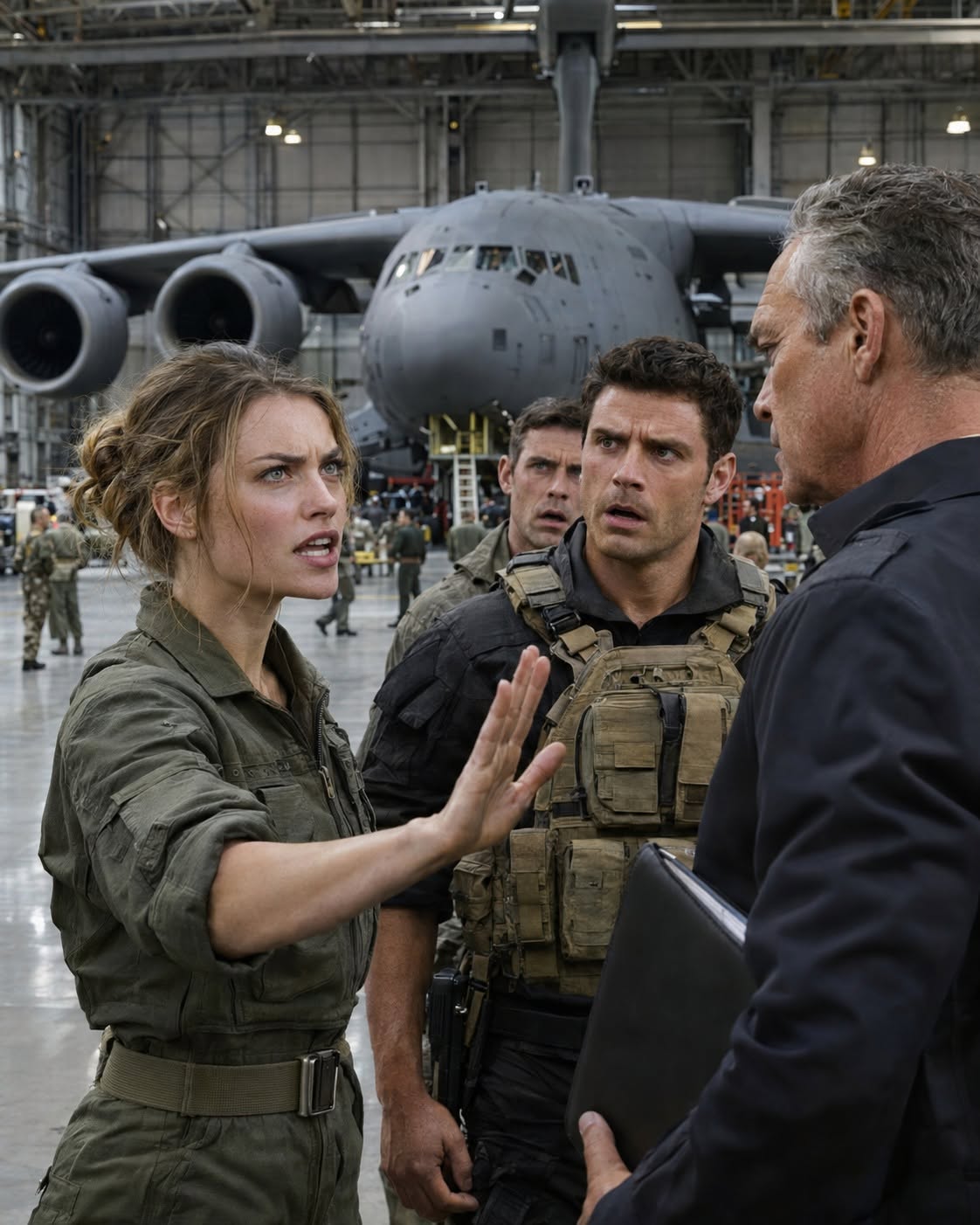
She carried a sealed folder.
“Lieutenant Commander Reyes,” she said. “I’m Captain Eleanor Whitaker. We need to discuss last night’s operation.”
Maya recognized the tone immediately.
This wasn’t a conversation about a successful extraction.
It was something else.
THE REPORT THAT COULD CHANGE EVERYTHING
Two hours later, Maya sat inside a secure conference room.
Captain Whitaker placed the folder on the table.
Across from her sat a representative from Naval Aviation Command, a defense intelligence officer, and a civilian engineer whose identification badge contained no department name.
The engineer opened a laptop.
“Your operation was successful,” Whitaker began. “All eight personnel were recovered. The target’s logistics network was disrupted, and there were no reported civilian casualties.”
Maya nodded.
“Then what’s the problem?”
The defense intelligence officer exchanged a glance with the captain.
“The problem is that your aircraft was never supposed to be deployed under those circumstances.”
Maya felt her stomach tighten.
“The mission authorization came through the joint operations center.”
“That’s correct. But the XA-91 was listed as unavailable for operational use outside its evaluation parameters.”
Maya looked at the engineer.
“Then someone should have informed the operations team.”
“We’re not questioning your authorization to fly,” Whitaker said. “We’re questioning how you managed to achieve what you did.”
The engineer turned the laptop toward her.
A series of flight recordings appeared on the screen.
“Your approach to the eastern ridge was outside the recommended operating profile. Your targeting solution was also considerably different from the one programmed into the aircraft.”
“I used manual control.”
“We can see that.”
“Then you already have your answer.”
The engineer leaned forward.
“No, Lieutenant Commander. We have the result. We don’t understand the decision-making process that produced it.”
For the next hour, Maya explained every major decision.
She described the wind conditions, the sensor limitations, the changing position of enemy fighters, and the reason she had abandoned the aircraft’s automated targeting sequence.
She explained that the civilian enclosure had created a margin for error too narrow for the original approach.
She had chosen a different angle because she believed it offered the best chance of protecting the people on the ground.
The engineer listened without interrupting.
Finally, he closed the laptop.
“Who taught you to think that way?”
Maya considered the question.
“Experience. Training. And a few mistakes I never wanted to repeat.”
For the first time, the engineer smiled.
“That’s exactly the kind of answer I was hoping to hear.”
Captain Whitaker wasn’t smiling.
“There’s another issue. Your involvement with the XA-91 evaluation program is still restricted. The mission report cannot identify the aircraft’s experimental capabilities or the nature of your previous assignment.”
“I understand.”
“Your contribution may therefore be difficult to recognize through conventional channels.”
Maya looked at her.
“Are you telling me I can’t receive credit?”
“I’m telling you that the process is complicated.”
Maya had heard that word before.
Complicated.
It was the word people used when the truth was inconvenient.
THE MAN WHO DIDN’T BELIEVE HER
Three days later, Maya returned to Djibouti.
She expected a routine debriefing and perhaps a few days of rest.
Instead, she found Master Sergeant Teller waiting outside the operations building.
He had been one of the loudest voices questioning her qualifications before the mission.
Now he looked uncomfortable.
“Reyes.”
“Teller.”
He shifted his weight.
“I owe you an apology.”
Maya waited.
“I thought you were trying to get yourself assigned to something beyond your experience. I thought the command was making a mistake.”
“And now?”
“Now I know I was wrong.”
Maya gave him a small nod.
“People make judgments with the information they have.”
“That’s not an excuse.”
“No,” she agreed. “It isn’t.”
Teller looked toward the parking area.
“Rourke told me what happened on the mountain. He said you could have pulled away when the fire started getting close. Nobody would have blamed you.”
Maya shook her head.
“I had eight people waiting for me.”
“Exactly.”
He looked down briefly.
“I’ve been in this business for twenty-two years. I’ve watched good pilots panic when everything went wrong. You didn’t.”
Maya didn’t know what to say.
Then Teller added something she hadn’t expected.
“My daughter wants to join the Navy. She’s sixteen. She keeps telling me people like her don’t get taken seriously in aviation.”
He paused.
“I used to tell her she was wrong.”
Maya looked at him.
“And now?”
“Now I think I need to explain why.”
For the first time since the operation, Maya felt that something meaningful had changed.
Not because Teller had apologized.
But because his understanding might reach someone who had not yet decided whether she belonged.
THE SECOND CALL
A week passed.
Maya returned to normal flight duties while the Wolverine underwent a detailed technical inspection.
The operation in Mali was already becoming a classified footnote.
Then, late one evening, her secure phone rang.
The caller was Captain Whitaker.
“We have a problem,” the captain said.
Maya sat upright.
“What kind?”
“The technical review has uncovered something unusual.”
“Explain.”
“During your extraction, the aircraft recorded a series of performance anomalies. At first, we thought they were caused by combat damage. But the data suggests the issue existed before you entered the mountain corridor.”
Maya frowned.
“Which system?”
“The flight-control stabilization module.”
She remembered the slight vibration during the final approach.
“How serious?”
“Serious enough that another pilot might have lost control during the landing.”
Maya was silent.
“Why wasn’t that discovered during the preflight inspection?”
“Because the malfunction was intermittent. The diagnostic software didn’t flag it.”
“Did the engineers reproduce it?”
“Not yet.”
Maya leaned back.
“Then don’t put another pilot in that aircraft until they do.”
“We agree.”
Whitaker hesitated.
“There’s something else. We want you at the evaluation facility in Nevada. The team needs your help.”
Maya looked at the clock.
“When?”
“Tomorrow morning.”
“Understood.”
She ended the call and remained seated for several minutes.
She had spent eighteen months testing the Wolverine. She knew its systems better than almost anyone outside the engineering team.
But she had never expected to return to the program because the aircraft might have nearly killed her.
The next morning, she arrived at the facility.
The lead engineer, Dr. Nathan Cole, greeted her beside the hangar.
He was in his early fifties, with tired eyes and the permanent expression of someone who had spent too many years solving problems nobody else could understand.
“Reyes. Glad you’re here.”
“What’s the situation?”
Cole led her toward a workstation.
A flight recording was displayed on a large screen.
“During your landing, the stabilization system briefly issued contradictory control inputs. The aircraft corrected itself, but the correction came dangerously close to exceeding its safe operating limits.”
Maya studied the data.
“Show me the final forty seconds.”
Cole replayed it.
She watched carefully.
Then she pointed toward a sudden fluctuation.
“Stop.”
The image froze.
“That’s not a random malfunction.”
Cole frowned.
“What do you mean?”
“The system is receiving conflicting information from two separate sensor sources. It thinks the aircraft is correcting a movement that isn’t actually happening.”
Cole moved closer.
“That shouldn’t be possible.”
“Yet it happened.”
He looked at the screen again.
Maya continued.
“The software trusts the secondary sensor during rapid altitude changes. But the secondary sensor is reporting an outdated position. The system is fighting itself.”
Cole stared at the data.
For several seconds, he said nothing.
Then he turned to his team.
“Run the same conditions through the test environment.”
Within minutes, the engineers began working.
The results confirmed Maya’s suspicion.
A flaw buried deep inside the stabilization architecture could produce dangerous control behavior under a specific combination of altitude, vibration, and sensor interference.
Cole slowly removed his glasses.
“If you hadn’t brought the aircraft down manually…”
He didn’t finish.
Maya understood.
The mission had not merely tested her ability to fly.
It had exposed a defect that could have cost another pilot’s life.
THE PRICE OF TELLING THE TRUTH
The discovery triggered an immediate suspension of the XA-91 flight program.
Several senior officers were furious.
The aircraft represented years of research, enormous funding, and the ambitions of a joint military development project.
Nobody wanted to hear that its most promising system contained a potentially fatal weakness.
Two days after the suspension, Maya was summoned to a meeting with Admiral Thomas Harlan.
He sat at the head of a long table, surrounded by senior program officials.
“Lieutenant Commander Reyes,” he began, “your findings have created a significant delay.”
Maya kept her expression neutral.
“Yes, sir.”
“Do you understand the consequences?”
“I understand the aircraft is unsafe until the issue is resolved.”
One of the program directors interrupted.
“We’re not disputing that. But the failure occurred under extreme conditions.”
Maya turned toward him.
“Those were the conditions the aircraft was designed to operate in.”
The room went quiet.
The director folded his arms.
“You are a pilot, Commander. Not a systems engineer.”
“That’s correct.”
“Then perhaps we should let the engineering team determine the appropriate solution.”
Maya nodded.
“That’s why I brought them the flight data.”
Admiral Harlan raised one hand.
“Enough.”
He looked directly at her.
“Your report recommends a complete review of the stabilization system. That could delay deployment by months.”
“Then it should be delayed by months.”
The admiral studied her.
“Do you realize how much pressure is being placed on this program?”
“Yes, sir.”
“And you still stand by your assessment?”
Maya didn’t hesitate.
“Absolutely.”
For a moment, nobody moved.
Then the admiral closed the folder.
“Very well. The flight suspension remains in place until the technical review is complete.”
Maya left the room knowing she had made herself unpopular with some very influential people.
But she also knew something else.
The eight SEALs on that mountain had trusted her with their lives.
The next pilot who climbed into the Wolverine deserved the same protection.
THE LETTER
Three weeks later, Maya received an envelope at her quarters.
It contained a handwritten letter.
The handwriting was unmistakable.
Daniel Rourke.
He wrote that his team had returned to their normal duties. Two men had already rotated home, and the others were preparing for their next assignment.
He also mentioned that the operation’s official record would contain almost nothing about the person who had flown them out.
Then came a paragraph that made Maya stop reading.
“One of my men asked me whether I thought you were brave. I told him that bravery wasn’t the word I would use. You were responsible. You understood that the people inside your aircraft were depending on you, and you refused to make their lives a calculation you could ignore.”
At the bottom, Rourke had written:
“Whatever happens with that program, remember that eight men know exactly what you did. And none of us will forget.”
Maya folded the letter carefully.
For the first time, she didn’t feel disappointed about the classified nature of her achievement.
She realized that recognition and impact were not always the same thing.
Sometimes the people who mattered most already knew the truth.
THE UNEXPECTED OFFER
Two months after the mission, Captain Whitaker called again.
This time, her voice sounded different.
“The stabilization issue has been corrected,” she said. “The revised system passed the latest evaluation.”
Maya smiled.
“That’s good news.”
“There’s more. The review board examined your performance during the Mali operation and your technical findings afterward.”
“And?”
“They want to offer you a permanent position with the joint aviation evaluation group.”
Maya looked out the window.
She had spent years working toward the opportunity to fly advanced military aircraft. The offer represented everything she had once imagined when she watched Navy jets passing over the cliffs of Puerto Rico.
But something about it made her hesitate.
“What would the position involve?”
“Flight evaluation, operational testing, and helping develop training standards for future pilots.”
“Would I still be flying operational missions?”
“Occasionally. But the primary responsibility would be testing and training.”
Maya thought about the Wolverine.
She remembered the mountain ledge, the incoming fire, the eight men waiting in the darkness.
She also remembered the malfunction.
“Can I ask you something?”
“Of course.”
“Will the program listen when pilots tell engineers something is wrong?”
Whitaker was quiet for a moment.
“After your report, it will be harder for them not to.”
Maya smiled.
“Then I’d like to discuss the position.”
A DIFFERENT KIND OF MISSION
Six months later, Maya returned to the evaluation facility.
The XA-91 Wolverine had undergone extensive modifications. Its stabilization architecture had been redesigned, and new safeguards had been incorporated into the flight-control system.
Maya was assigned to help develop the updated operational training program.
She insisted that every pilot learn not only how to operate the aircraft under ideal conditions, but also how to recognize when its automated systems were making dangerous assumptions.
Some engineers initially resisted.
They believed the training should focus on the aircraft’s capabilities.
Maya believed it should focus equally on its limitations.
“The best pilot isn’t the one who trusts the machine the most,” she told a group of trainees during their first briefing. “It’s the one who understands when the machine is wrong.”
Her words eventually became part of the evaluation curriculum.
The program also began changing how it selected test pilots. Technical ability still mattered, but so did judgment, communication, and the willingness to challenge an assumption when evidence demanded it.
Maya never claimed to be responsible for every improvement.
She knew dozens of engineers, technicians, and pilots had contributed.
But she was proud that her experience had helped make the aircraft safer.
Then, one afternoon, an unexpected visitor arrived.
A teenage girl stood near the hangar entrance, holding a folder against her chest.
She was accompanied by her father.
Maya recognized him immediately.
Master Sergeant Teller.
“Commander,” he said with a smile. “I hope we’re not interrupting.”
“Not at all.”
Teller stepped aside.
“This is my daughter, Emily.”
The girl looked nervous.
“Hello, ma’am.”
“Hello, Emily.”
Teller explained that his daughter had been accepted into a Navy aviation preparatory program. She had spent months studying mathematics, physics, and flight principles.
“She wanted to see the aircraft,” he said. “And she wanted to meet the pilot who made me rethink a few things.”
Maya glanced at Emily.
“Do you want to fly?”
The teenager nodded.
“More than anything.”
“Then keep studying. Work hard. And don’t let anyone convince you that you need permission to be interested in something difficult.”
Emily smiled.
“But what if people say I can’t do it?”
Maya thought for a moment.
“Some people will. Sometimes they’ll be wrong. Sometimes they’ll have a concern worth listening to. Your job is to learn the difference.”
Emily looked down at the folder in her hands.
“I brought some questions about flight school.”
Maya laughed softly.
“Good. I have a few hours.”
She led the girl into the hangar.
Behind them, Teller watched in silence.
He had once questioned whether a woman belonged in a military cockpit.
Now he was watching his daughter imagine herself in one.
And he understood that the most important part of Maya’s achievement might never appear in an official report.
THE LAST FLIGHT
A year after the operation in Mali, the Navy organized a private recognition ceremony for personnel involved in the Wolverine evaluation program.
Because of the classification restrictions, the event was held inside a secure facility.
There were no cameras, no reporters, and no public speeches.
Maya stood among the engineers, flight-test personnel, and operational crews who had contributed to the program.
Admiral Harlan stepped forward.
“Today, we recognize a group of individuals whose work has strengthened our aviation capabilities and improved the safety of our personnel.”
He discussed the aircraft’s development, the technical discoveries, and the improvements made after its evaluation.
Then he mentioned Maya.
“Lieutenant Commander Maya Reyes demonstrated exceptional judgment during an operational deployment and subsequently identified a critical weakness in an experimental flight-control system. Her actions protected the lives of military personnel and contributed to a safer aircraft for future crews.”
Maya accepted the commendation.
She didn’t look toward the audience immediately.
Instead, she thought about Aguadilla.
She remembered standing on the cliffs as a little girl, listening to the roar of aircraft overhead and imagining a future she couldn’t yet understand.
She remembered the years of training, the examinations, the long nights, and the moments when she wondered whether she had chosen a path that would always require her to prove herself twice.
Then she looked at the people standing before her.
Engineers who had spent countless hours fixing problems.
Technicians who had worked through the night.
Pilots who had risked their lives testing new technology.
And the eight men who, although unable to attend, had never forgotten the night she brought them home.
When the ceremony ended, Captain Whitaker approached her.
“You’ve earned this.”
Maya looked down at the commendation.
“I had a good team.”
Whitaker smiled.
“You always say that.”
“Because it’s true.”
Outside, the afternoon sun illuminated the runway.
A test aircraft was being prepared for another evaluation flight.
Maya walked toward the hangar, holding her helmet beneath one arm.
She knew there would be more challenges. There would be more people who doubted her, more difficult decisions, and more moments when doing the right thing would be considerably harder than doing what was expected.
But she no longer felt the need to answer every doubt with an explanation.
She had learned that confidence didn’t come from convincing everyone in the room.
It came from knowing your responsibilities, understanding your abilities, and being willing to stand behind your decisions.
WHAT THE MOUNTAIN TAUGHT HER
Several years later, Maya received a small package at her office.
Inside was a photograph.
It showed eight men standing together on a rocky ledge in northern Mali. Their uniforms were dusty, their faces exhausted, but every one of them was smiling.
On the back, Daniel Rourke had written:
“Eight men made it home. One pilot made sure of it. We still remember.”
Maya placed the photograph beside her desk.
She often looked at it before difficult evaluations.
Not because it reminded her of a victory, but because it reminded her of the responsibility that came with being trusted.
The world would probably never know the full story of the XA-91 Wolverine. The mission would remain classified, the details would stay buried in restricted files, and most people would never hear the name Maya Reyes.
That was all right.
Because her greatest achievement had never been flying an experimental aircraft.
It had been understanding that courage meant more than taking risks. It meant recognizing the lives affected by every decision. It meant speaking up when something was unsafe, even when doing so was unpopular. And it meant making room for the next person who might be capable of something extraordinary but hadn’t yet been given the opportunity to prove it.
Years earlier, eight men had watched a woman enter a briefing room and wondered whether she could handle their mission.
Now, somewhere in the Navy, a young pilot was preparing for her first flight evaluation. She had studied Maya’s training materials, learned about the importance of sound judgment, and decided that she wanted to follow a similar path.
She didn’t know the complete story behind the lessons she was studying.
She didn’t need to.
The lessons had already reached her.
And that was perhaps the most important part of Maya’s journey.
A single successful mission could save eight lives.
A single honest decision could prevent another pilot from losing theirs.
But one person choosing to believe in someone else could change the direction of an entire life.
Maya had once dreamed of flying above the cliffs of Puerto Rico.
She eventually flew an aircraft that most people would never know existed, into a place most people would never visit, to rescue men whose story might never be told.
She had returned with an empty fuel tank, a damaged aircraft, and eight living men.
But she had gained something far more valuable than recognition.
She had discovered that the strongest proof of ability wasn’t the applause that followed a difficult achievement.
It was the difference your actions made when nobody was watching.
And somewhere, beneath a vast desert sky, eight men still remembered the pilot who refused to leave them behind.
THE END