The debt collector was about to crush my late father’s 1969 Dodge Charger when a stranger walked into the scrapyard and said something that stopped everyone cold.
The auction manager lowered his voice.
“The auction house is willing to purchase the vehicle immediately, place the money in escrow, and cover the outstanding debt while its authenticity is investigated. But we need you to do something first. You have to challenge the seizure formally, and you must be willing to tell the truth about everything you know concerning this car.”
I stared at him.
“What truth? I don’t know anything about it.”
He glanced toward the Charger.
“Then perhaps it’s time you found out.”
The older stranger, whose name was Walter Hayes, placed a hand on my shoulder.
“Your father trusted you with something important. Whatever it is, I don’t think he intended for it to end up underneath a hydraulic crusher.”
The auction manager handed me a folder.
Inside were photographs of my father’s car, close-ups of its factory markings, and a preliminary report from a specialist who had examined the photographs Walter sent.
One sentence had been highlighted in yellow.
Possible surviving example of a factory experimental Dodge Charger produced during the 1969 model year.
I read it twice.
“How much is it worth?”
The manager didn’t answer immediately.
“Until we authenticate it, putting a number on it would be irresponsible. But if the identification is correct, we’re not talking about three hundred dollars. We’re potentially talking about several hundred thousand.”
My knees nearly gave way.
Several hundred thousand dollars.
The car that a collection agency had labeled worthless might be worth more than everything I had ever owned.
But before I could process that thought, the scrapyard supervisor came rushing toward us.
“Hey! We’ve got a problem.”
He pointed toward the far end of the yard.
The Charger was already attached to a heavy towing machine. Two workers were preparing to move it.
“I’ve got an order to process that vehicle before closing,” he said. “If you want to argue about paperwork, take it up with the collection agency.”
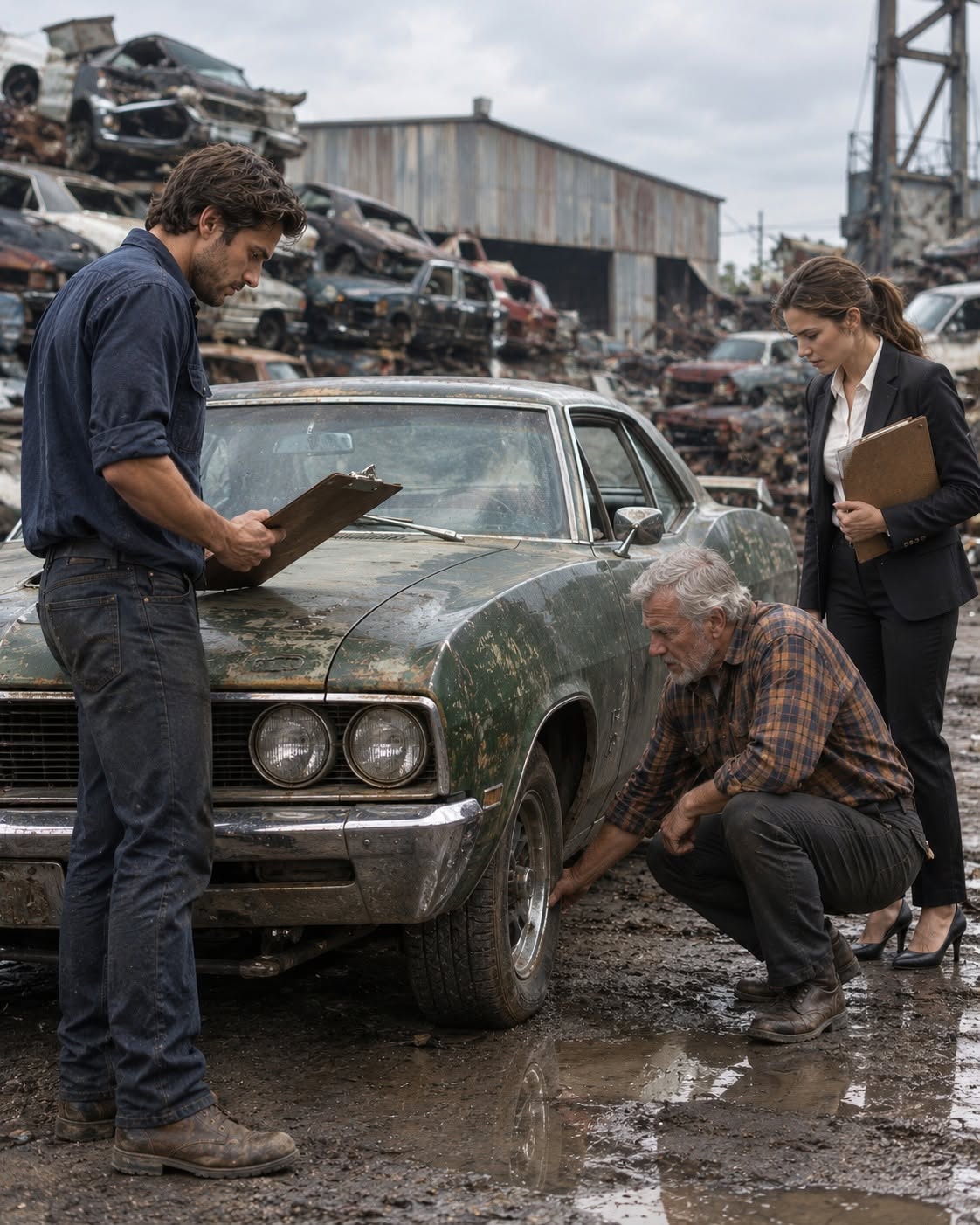
Walter stepped forward.
“Nobody touches that car.”
The supervisor shrugged.
“You’re not the owner.”
“Neither are you,” Walter replied.
The auction manager immediately opened his folder and pulled out a signed legal notice requesting an emergency hold on the vehicle pending a dispute over its valuation and seizure.
The supervisor read it, frowned, and disappeared into his office.
For several minutes, nobody spoke.
Then the towing machine stopped.
I watched the workers disconnect the equipment from the Charger.
It was the first time in months that I had felt something other than fear.
But the relief didn’t last.
The auction manager returned with his phone pressed against his ear.
He listened, said very little, and finally hung up.
“The collection agency has been notified,” he said. “They’re sending someone here.”
“Who?” I asked.
“Apparently, the regional director.”
Walter’s expression darkened.
“Then we may finally get some answers.”
Less than forty minutes later, a black SUV pulled through the scrapyard entrance.
A woman in an expensive gray coat stepped out, carrying a leather folder. She introduced herself as Margaret Collins, regional director of the collection agency.
She barely acknowledged me.
“I understand there’s been some confusion regarding the processing of this vehicle,” she said.
“Confusion?” I repeated. “You took my father’s car and sold it to a scrapyard for three hundred dollars without even checking what it was.”
Margaret looked at the auction manager.
“Our company followed the standard assessment procedure. The vehicle was old, non-operational, and had been stored in poor conditions.”
Walter gave a quiet laugh.
“An interesting assessment. Did anyone bother checking the factory identification plate?”
“That’s not part of our responsibility.”
“Then perhaps you should reconsider your profession.”
Her eyes narrowed.
The auction manager stepped between them.
“We have reason to believe this is a historically significant vehicle. The preliminary evidence suggests it may be a factory experimental Charger. We are requesting that the seizure and sale be suspended until an independent inspection is completed.”
Margaret folded her arms.
“That’s an extraordinary claim.”
“Yes,” the manager replied. “Which is why we’re asking you not to destroy the evidence.”
She turned toward me.
“Sir, you owe our client a substantial amount of money. This is not an opportunity to avoid your obligations by inventing an inflated value for an old car.”
I felt my face grow hot.
“I never said I didn’t owe the money. I said you had no right to destroy something without determining what it was worth.”
For the first time, she seemed uncertain.
The auction manager handed her a copy of the preliminary report.
She read it silently.
Then she looked at Walter.
“Who exactly are you?”
Walter reached into his jacket and pulled out an old photograph.
It showed a group of men standing beside a row of Dodge Chargers outside a factory building. One of the cars was unmistakably my father’s.
“My name is Walter Hayes. I spent thirty-one years working in automotive engineering and vehicle development. I worked with the Dodge engineering team during the late sixties.”
He pointed to a younger man standing beside the green Charger.
“That was me.”
Then he pointed to another man.
I recognized him immediately.
My father.
My breath caught.
“How did you know my dad?”
Walter stared at the photograph for a long moment.
“Because your father and I worked on this car together.”
I stepped closer.
“What?”
Walter nodded slowly.
“Your father wasn’t just a mechanic who happened to own a rare Dodge. He was part of a small group of people who helped preserve an experimental vehicle after the original development program ended.”
He looked at me.
“And he spent the last forty years making sure it survived.”
I felt as if the ground had shifted beneath my feet.
My father had never mentioned working for Dodge. He had always described himself as a mechanic who fixed trucks, repaired engines, and occasionally restored old cars for extra money.
Why would he hide something like this?
Walter continued.
“Back in 1969, Dodge was experimenting with several performance configurations. This particular Charger was assembled as a development vehicle. It had unusual factory specifications, experimental components, and a paint combination that was never offered to ordinary customers.”
“Was it a prototype?”
“Not quite in the way people imagine. It was an engineering test vehicle, not a production model. But its surviving documentation could make it extraordinarily important to collectors and automotive historians.”
He paused.
“Your father helped build it. Later, when the project was abandoned, he was involved in ensuring the car wasn’t destroyed.”
I looked toward the Charger.
Suddenly, the faded green paint seemed different.
The scratches, the rust around the wheel wells, and the cracked dashboard no longer looked like signs of an abandoned vehicle.
They looked like pieces of history.
But there was still something I didn’t understand.
“If it was so important, why did Dad let it sit in a garage for all those years?”
Walter lowered his eyes.
“Because he was waiting for the right time to restore it. And because he didn’t want someone buying it, stripping it for parts, and destroying its original configuration.”
Margaret interrupted.
“Interesting story. But stories don’t establish ownership or market value.”
Walter nodded.
“Agreed.”
He turned to the auction manager.
“Which is why I think we should look inside the car.”
The manager frowned.
“What are you expecting to find?”
“Something your father told me he would leave there.”
I felt a chill.
Walter approached the driver’s side and carefully opened the door.
The interior smelled of old leather, dust, and decades of trapped memories.
He ran his fingers along the underside of the dashboard.
Then he stopped.
“Here.”
He pointed to a small section of trim near the passenger-side footwell.
It looked ordinary.
Walter took a narrow tool from his pocket and gently released two hidden clips.
A thin metal compartment slid forward.
Inside was a sealed envelope wrapped in plastic.
My hands began shaking.
On the front, in my father’s unmistakable handwriting, were four words:
For my son, when ready.
I stared at it.
For a moment, I couldn’t bring myself to touch it.
The last time my father had written something specifically for me was on a birthday card years before he died.
Walter stepped back.
“That’s yours.”
I carefully opened the envelope.
Inside were several photographs, a folded engineering document, a small brass key, and a handwritten letter.
The first photograph showed my father standing beside the Charger in what appeared to be a factory workshop.
He looked young, confident, and proud.
The second showed the same car with its hood removed. Several men were gathered around the engine compartment.
On the back, someone had written:
Development unit 69-X. Final inspection, September 1969.
The engineering document contained a series of technical codes and a handwritten reference number matching the factory stamp Walter had discovered.
The auction manager leaned over my shoulder.
“These are important.”
But I was looking at the letter.
I unfolded it.
“My son,
“If you’re reading this, then I’ve probably been gone longer than I wanted to be.
“I know you never understood why I kept that old Charger. I also know you probably thought I was foolish for spending so much time protecting a car that couldn’t even start.
“But there’s something I never told you.
“When I was younger, I made mistakes. I trusted the wrong people, lost money, and nearly watched something important disappear because I was too proud to ask for help.
“That car became a second chance.
“I bought it for $800, but money was never the reason I kept it.
“I kept it because it represented the best work I ever did. It reminded me that even when something looks broken, it may still have value that other people cannot see.
“One day, someone may offer you a few hundred dollars for it. They may tell you it’s worthless. They may even make you feel foolish for refusing.
“Don’t let someone else’s desperation determine what something is worth.
“But remember this: the car is not your inheritance because of what it might sell for.
“It’s your inheritance because it carries the story of the people who built it and the people who refused to let it disappear.
“Never start that car until you understand what you’re holding.
“I don’t mean the engine.
“I mean the responsibility.
“Love,
“Dad.”
I couldn’t finish reading.
My eyes filled with tears.
For years, I had been angry with my father for leaving me a car that seemed more like a burden than a gift.
I had complained about the garage rent, the repairs, and the space it occupied.
I had even considered selling it several times.
And now, standing in a scrapyard, I realized that he had been trying to tell me something I hadn’t been ready to hear.
Walter gently placed a hand on my shoulder.
“He wanted you to find that letter when the time was right.”
I wiped my face.
“Why didn’t he just tell me everything?”
“Because he wanted you to make your own decisions. He didn’t want the car to become the only thing you saw when you looked at him.”
He glanced at the letter.
“Your father was proud of you, you know.”
I swallowed hard.
“He never said that.”
Walter smiled sadly.
“Some men from that generation were better at showing love through what they built than through what they said.”
Before I could respond, the auction manager examined the engineering document more closely.
“There’s another problem,” he said.
We turned toward him.
He pointed to a small handwritten notation at the bottom of the page.
“This reference number matches the vehicle’s identification, but we need to verify the original factory records. Without that, the car’s historical identity is still unconfirmed.”
Walter nodded.
“I know where we can start.”
He took out his phone and called someone.
A few minutes later, he was speaking to a retired Chrysler archivist who had worked with historical production records.
The conversation lasted almost twenty minutes.
Walter asked several questions, read out the identification number, and described the unusual markings.
Then his expression changed.
He looked at me.
“He’s found something.”
“What?”
“The original engineering file.”
The archivist had located a surviving record that matched the vehicle’s development number. It indicated that the Charger had been assembled as part of a limited experimental program and that only a handful of vehicles had been assigned comparable specifications.
More importantly, the record identified the person responsible for preserving the vehicle after the program ended.
My father.
I felt another wave of emotion.
But there was a complication.
The original file also contained a note stating that the vehicle was never officially released for public sale through ordinary dealership channels.
That meant its history had to be carefully documented before anyone could establish exactly how it had entered my father’s possession.
The archivist agreed to send copies of the relevant records to the auction house and recommend a specialist inspection.
The auction manager closed his folder.
“That changes everything.”
Margaret Collins, who had been standing quietly, finally spoke.
“I think we need to discuss the outstanding debt.”
I turned toward her.
“Yes. We do.”
She looked at the documents again.
“Your account balance is approximately forty-eight thousand dollars, including interest and collection costs.”
I knew the number.
I had been staring at it on letters, statements, and emails for nearly two years.
Forty-eight thousand dollars.
A number that had slowly destroyed my confidence and nearly cost me my business.
“What happens now?” I asked.
Margaret took a breath.
“Given the dispute over the vehicle’s value, our legal department will review the seizure. The destruction order will be suspended.”
“Suspended isn’t enough,” Walter said. “The vehicle needs to be released while its status is investigated.”
Margaret hesitated.
The auction manager opened another document.
“We are prepared to place the outstanding debt amount in escrow immediately, subject to the proper release of the vehicle and resolution of the ownership dispute. That protects your company’s financial interest without destroying a potentially significant asset.”
Margaret studied the proposal.
After several phone calls, she finally agreed to a temporary arrangement.
The Charger would not be crushed.
It would be transported to a secure restoration facility for independent inspection.
The collection agency would receive the amount owed through the escrow arrangement if the necessary legal conditions were met.
I signed the initial documents with a trembling hand.
For the first time in nearly two years, I could breathe.
But the biggest surprise was still waiting.
Three weeks later, I stood inside a restoration workshop surrounded by specialists, photographers, and automotive historians.
The Charger sat in the middle of the building, its green paint illuminated by bright overhead lights.
It looked more beautiful than I remembered.
The specialists had spent days checking the identification markings, comparing components, and examining the engineering records.
They discovered that several parts were original experimental pieces that had never appeared in ordinary production documentation.
The engine had also been modified during the development program, making it particularly important to preserve rather than replace.
The original factory stamp was genuine.
The engineering records matched.
And the photographs in my father’s envelope provided a continuous historical connection between the vehicle and the men who had worked on it.
The lead specialist finally called me into his office.
He was holding a thick report.
“I want to be careful about how I explain this,” he said. “Your father’s car is not simply a rare 1969 Charger. It’s a documented survivor of a factory engineering program.”
I waited.
“Based on its condition, provenance, and the current collector market, our preliminary valuation places it somewhere between $650,000 and $850,000.”
I sat down.
I couldn’t speak.
For years, I had been fighting to keep a plumbing business alive, worrying about overdue invoices, employee wages, and whether I could afford to repair my old work truck.
Now someone was telling me that the car my father had bought for $800 might be worth close to a million dollars.
But the specialist wasn’t finished.
“There’s something else. The engine and several original components are unusually well preserved. We strongly recommend against a complete restoration. Replacing original parts could actually reduce its historical value.”
I looked through the workshop window.
“Can it run?”
“Eventually, yes. But not until we’ve completed the safety and mechanical inspections.”
I remembered my father’s warning.
Never start that car until you understand what you’re holding.
Now I understood.
He hadn’t been warning me about some mysterious engine problem.
He had been warning me not to destroy the car’s identity in the name of making it look new.
For the first time, I felt as though my father was still teaching me something.
The auction house made a formal offer a few days later.
They were willing to pay $720,000, provided the vehicle passed the final authentication review and the ownership documentation was accepted.
The offer was more money than I had ever imagined seeing in my bank account.
I could pay the debt.
Save my business.
Buy a house.
Start over.
And perhaps never worry about money again.
But I didn’t sign immediately.
Instead, I asked Walter to meet me at the restoration facility.
We stood beside the Charger for a long time.
Finally, I asked him a question that had been bothering me.
“If Dad knew this car was so valuable, why didn’t he sell it when he was alive? He could have made his life easier.”
Walter looked at the green hood.
“Because he wasn’t trying to become rich.”
He paused.
“Your father once had the opportunity to sell the car to a private collector. The offer was substantial even back then. But the buyer wanted to remove several experimental components and turn it into an ordinary show car.”
“Why didn’t he?”
“Because those components were the reason the vehicle mattered. He believed that preserving the truth was more important than making a quick profit.”
Walter looked at me.
“Your father didn’t have much money, but he had something many wealthy people never develop. He knew what was worth protecting.”
I looked down at my hands.
My divorce had left me exhausted. My business had nearly collapsed. I had spent so much time trying to keep everything from falling apart that I had forgotten why I had started building a life in the first place.
My father had worked hard, too.
He had known what it meant to lose things.
But he had never allowed those losses to convince him that everything was worthless.
“I think I know what I want to do,” I said.
Walter smiled.
“Then make sure it’s your decision.”
The following week, I accepted a different arrangement.
The auction house would purchase a controlling interest in the car’s exhibition rights and organize a series of public appearances, while I retained ownership of the vehicle itself.
A portion of the proceeds from the arrangement would pay off my outstanding debt.
The collection agency received its money through the agreed settlement, and the seizure dispute was formally closed.
My business creditors were paid.
My employees received the wages they were owed.
And for the first time in months, I could look at my company’s accounts without feeling sick.
I didn’t become a millionaire overnight.
There were taxes, legal fees, restoration costs, and plenty of responsibilities attached to the arrangement.
But I was no longer drowning.
More importantly, I had a future.
Six months later, the Charger was unveiled at a major classic-car exhibition.
It wasn’t polished to look like a brand-new vehicle.
The restoration team had carefully preserved its original character, including small imperfections that told the story of its working life.
A plaque beside it explained its engineering history and the role my father had played in preserving it.
I arrived early that morning.
Before the doors opened, I stood alone beside the car and placed my hand on its roof.
For a moment, I imagined my father standing next to me, wearing his old work jacket and wiping grease from his hands.
I could almost hear him laughing at how serious everyone was being about his old Dodge.
Then I noticed an elderly man standing near the entrance.
He was holding a photograph.
It was a picture of my father, Walter, and several other engineers standing beside the Charger in 1969.
I approached him.
“Are you here to see the car?”
He smiled.
“I’m here to see what became of something your father saved.”
He introduced himself as Robert Miller, another retired member of the original development team.
He had heard about the car’s discovery and traveled several hours to attend the exhibition.
Then he handed me the photograph.
On the back was a handwritten message.
To the men who believed this machine deserved another chance.
I stared at it.
“Did you know my father well?”
Robert nodded.
“Your father was the reason that car survived. When the program ended, most of us moved on. He didn’t. He kept asking questions, contacting people, collecting documents, and making sure the vehicle wouldn’t disappear.”
He looked toward the Charger.
“Some people build things. Some people preserve them. Your father did both.”
I felt my throat tighten.
Robert smiled.
“You should be proud of him.”
That day, hundreds of people visited the exhibition.
Some came because they loved classic American muscle cars. Others were interested in the unusual engineering history.
A few simply wanted to see the vehicle that had nearly been crushed for three hundred dollars.
But one visitor stayed with me longer than the others.
A young man, perhaps twenty years old, stood in front of the plaque for several minutes.
Finally, he approached me.
“Is this really the car that belonged to your father?”
“Yes.”
He looked at the photographs.
“My grandfather had an old car like this. My family sold it when he got sick. They said it wasn’t worth keeping.”
I didn’t know what to say.
He continued.
“I always wondered whether it had been something special.”
I looked at him and smiled.
“Sometimes things don’t become valuable because someone gives them a high price. Sometimes they’re valuable because of the people and memories attached to them.”
He nodded slowly.
Then he asked if he could take a picture of the Charger.
I stepped aside.
“Of course.”
As he walked away, I realized something important.
My father’s car had become more than a valuable collector’s item.
It had become a reminder.
A reminder that history can disappear when people stop asking questions.
A reminder that something old isn’t automatically worthless.
And a reminder that financial hardship can make even good people forget what truly matters.
A year after the scrapyard incident, I made one more decision.
I established a small scholarship in my father’s name for students studying automotive restoration and mechanical engineering.
It wasn’t a huge program.
But it provided tools, training assistance, and financial support to young people who wanted to learn how to repair and preserve machines rather than simply replace them.
At the opening ceremony, Walter stood beside me.
He had brought a small wooden box.
Inside was the original brass key from my father’s hidden compartment.
“I think this belongs somewhere important,” he said.
I looked at the key.
“Where?”
Walter smiled.
“Somewhere your father would have wanted it.”
I placed it inside a glass display case next to the original photographs and engineering documents.
Beneath it, I added a small inscription:
Some things are worth more than their price. Some stories deserve to survive.
After the ceremony, Walter and I returned to the restoration facility.
The Charger was waiting in its usual place.
The mechanics had completed the safety checks, and the specialists had finally approved a controlled engine start.
I stood beside the driver’s door.
For a moment, I hesitated.
Then I remembered the letter.
I remembered my father’s warning.
And I remembered how close I had come to watching that car disappear beneath a crusher.
Walter stood beside me.
“Ready?”
I nodded.
I climbed into the driver’s seat.
The leather was still old. The steering wheel still showed years of wear. Nothing about the interior had been made artificially perfect.
I placed the key in the ignition.
Then I turned it.
The starter motor engaged.
For one long second, nothing happened.
Then the engine caught.
A deep, unmistakable roar filled the workshop.
The sound echoed off the concrete walls, and everyone nearby stopped what they were doing.
I felt the vibration through the steering wheel.
My eyes filled with tears.
I wasn’t thinking about the valuation.
I wasn’t thinking about the debt.
I wasn’t even thinking about the people who had nearly destroyed it.
I was thinking about my father.
About the thousands of hours he had spent protecting something he loved.
About all the times I had mistaken his silence for stubbornness.
And about the lesson he had left inside that old car.
When I finally switched off the engine, Walter was smiling.
“Your father would have liked that.”
I nodded.
“I think he would.”
Then I stepped out and looked at the Charger one last time.
It had once been purchased for $800.
It had nearly been destroyed for $300.
And now its documented value was estimated at hundreds of thousands of dollars.
But if someone offered me a million dollars that afternoon, I wasn’t sure I would sell it.
Not because I had suddenly become sentimental about an automobile.
But because I finally understood what my father had been trying to teach me.
A few weeks earlier, I had stood in a scrapyard believing that everything in my life was falling apart.
I thought I had lost my business, my marriage, my financial security, and the last meaningful thing my father had left me.
I believed that the car was simply another problem I couldn’t afford to solve.
But sometimes the thing we are most desperate to get rid of is the very thing that forces us to discover who we are.
I still run my plumbing business.
I still work long days.
I still deal with difficult customers, broken pipes, unexpected expenses, and the ordinary problems of life.
The difference is that I no longer measure my worth by how much money I have in the bank or how quickly I can recover from a setback.
I learned that lesson from an old green Dodge Charger.
And I learned it from a father who never had the chance to explain himself.
Today, whenever someone asks me about the car, I tell them the story.
Not just the story of a rare engineering vehicle that escaped a scrapyard.
I tell them about a man who quietly protected something he believed mattered.
I tell them about a stranger who refused to accept that a factory stamp was meaningless.
And I tell them about the day a collection agency nearly turned a piece of history into scrap metal because nobody bothered to look beyond its rust.
But most of all, I tell them about the letter.
The letter that reminded me that value isn’t always obvious.
Sometimes it is hidden beneath years of dust, behind a forgotten panel, or inside the words of someone who loved us but never quite knew how to say it.
My father was right about one thing.
I didn’t understand what I was holding.
Not until I almost lost it.
And now, every time I hear that engine start, I remember his final message:
Never judge something by what someone is willing to pay for it.
Understand its story first.
Because some things can be replaced.
Some things can be repaired.
But the things that carry our history, our sacrifices, and the love of those who came before us deserve something more than a price tag.
They deserve to be remembered.