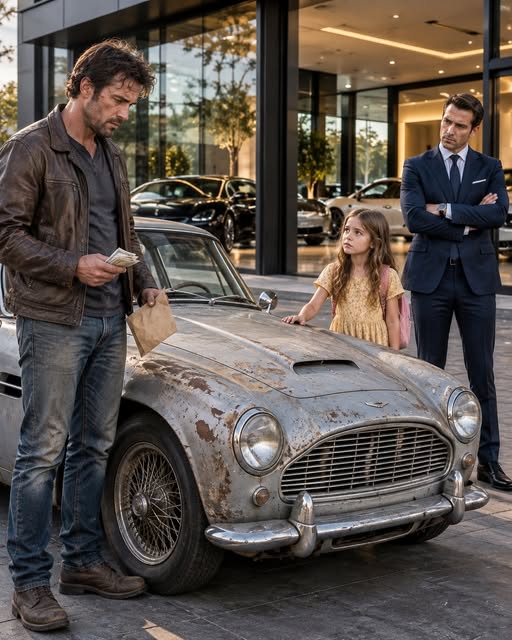
The dealership owner laughed when I offered to buy the rust-covered Aston Martin sitting forgotten in the back of his lot.
The specialist recommended a careful restoration followed by a full authentication process. If the car was what the documents suggested, every original detail could matter.
So Chloe and I got to work.
I handled the mechanical repairs and searched for the right parts, while Chloe helped clean the bodywork, sort small components, and keep track of the things we removed. We couldn’t afford careless mistakes, and we couldn’t afford to treat the car like an ordinary restoration project.
Some evenings, we worked until the light faded. Other nights, Chloe sat nearby doing homework while I studied technical notes and old records.
Whenever frustration got the better of me, she’d remind me of her original question.
“Are we making it beautiful, Daddy?”
“We’re getting there,” I’d tell her.
Slowly, the forgotten Aston Martin began to emerge from beneath years of neglect. More importantly, the evidence supporting its remarkable history grew stronger as specialists examined its identifying features and historical documentation.
Once the work was complete, independent experts conducted a thorough authentication. Their report confirmed that the car was an exceptionally rare historic racing model with documented provenance.
Then came the valuation.
The estimated figure was approximately $10 million.
I read the report once. Then again. I even wondered whether somebody had made a mistake with the numbers.
Ten million dollars.
For years, I’d measured progress in small amounts: another month’s rent saved, another bill paid on time, another little deposit into an account meant to secure Chloe’s future. Now I was looking at a sum I had never imagined seeing beside my name.
News of the car spread rapidly through the collector community. The same vehicle Victor had dismissed as a dead car was suddenly attracting serious attention from people who understood its historical importance.
Victor heard about it, too.
According to the reports circulating among collectors, he was stunned. The car he’d sold for a fraction of its potential value was now headed toward a major collector auction, just fourteen days after I’d purchased it.
Auction day arrived before I felt ready.
The hall was packed with collectors, specialists, and people eager to see the extraordinary Aston Martin for themselves. Chloe stood beside me in her best dress, holding my hand as the auctioneer introduced the car and began accepting bids.
The first offers came quickly.
Then the numbers climbed.
One bidder raised a paddle. Another answered immediately. Bids that once would have represented a lifetime of savings passed by in seconds. The auctioneer’s voice grew louder as the competition intensified.
Five million dollars.
Seven million.
Eight million.
I could barely breathe. Chloe squeezed my hand, and I realized she was watching me more closely than she was watching the auctioneer.
Then the bidding crossed $9 million.
Across the room, Victor stood frozen, staring at the car and the figures appearing on the board. He had come to witness the sale, but the outcome was unfolding far beyond anything he had anticipated.
Two bidders remained.
The auctioneer called for another offer.
One paddle rose.
A final counterbid followed.
Then, after a tense pause, the auctioneer brought down his hammer.
“Sold for $10 million!”
The room erupted in applause.
I stood there, unable to process what had just happened. Chloe threw her arms around me, and I hugged her tightly, finally allowing the tears I’d been holding back to fall.
The money meant security, education, and choices I had spent years hoping I could someday give my daughter. It meant she wouldn’t have to grow up believing that one unexpected setback could destroy everything we’d worked for.
But the greatest reward wasn’t the number on the auction report.
It was remembering the little girl who had looked at a rust-covered car and seen something worth saving when everyone else saw a lost cause.
Victor had judged the Aston Martin by the condition it was in. The collectors had judged it by its history. Chloe had simply believed it could become something beautiful again.
And as we left the auction hall together, I understood something I’d been trying to teach her all along: sometimes, the things everyone else gives up on still have a future worth fighting for.
The applause continued long after the auctioneer brought down his hammer, but I barely heard it. My daughter Chloe was wrapped in my arms, crying against my chest, and for a few precious seconds, the entire world seemed to disappear.
We had done it.
The rusty Aston Martin that everyone had called worthless had just sold for ten million dollars.
Yet, as I held Chloe, I realized that the hardest part of our journey might not have been restoring the car or convincing experts to believe in its history. It might be what came next.
Because money could change our lives overnight, but it could also change the people we became.
And I had no intention of letting that happen to us.
As we stepped away from the auction platform, a man in a charcoal suit approached us. He introduced himself as Richard Hale, a representative of the private collector who had won the bidding.
“Congratulations,” he said, extending his hand. “Your discovery has created quite a stir in the classic-car world.”
I shook his hand, still struggling to absorb everything.
“Thank you. We were just lucky to find it.”
Richard smiled politely.
“Luck may have helped you find it. But preserving the documentation, arranging the authentication, and bringing the vehicle to auction required considerably more than luck.”
He handed me his business card and explained that the buyer wanted to discuss the car’s future with me once the sale had been finalized.
Before I could ask what he meant, someone called my name from behind.
I turned.
Victor was standing several feet away.
The dealership owner looked nothing like the confident man who had laughed at me two weeks earlier. His face had lost its color, and his hands were buried in the pockets of his expensive coat.
For a moment, neither of us spoke.
Then he forced a smile.
“Well,” he said, glancing toward the Aston Martin, “you certainly got lucky.”
I looked at him, remembering the way he had shrugged when I asked about the car, the way his employees had laughed, and the careless certainty with which he had told me I was throwing my money away.
“Maybe,” I replied.
His smile tightened.
“I suppose I should have had it inspected more carefully.”
“You could have.”
He looked down.
There was something almost painful about watching a man who had once seemed so powerful struggle to find the right words. Part of me wanted to remind him of every insult. Another part wanted him to feel the embarrassment he had made me feel in front of his employees.
But Chloe was standing beside me.
She was watching us with wide, thoughtful eyes.
I remembered the lesson I had tried to teach her during those long evenings working on the car: the way people treat you when they think you have nothing tells you more about them than the way they treat you when they think you have everything.
So I simply said, “I hope the next time someone brings you something unusual, you’ll take the time to look at it properly.”
Victor opened his mouth, then closed it again.
“I suppose I deserved that.”
“You don’t need to hear it from me,” I said. “Just remember it.”
For the first time since I had met him, Victor looked genuinely ashamed.
He nodded once and walked away.
I thought that would be the end of our encounter.
I was wrong.
Three days later, my phone rang while I was making breakfast for Chloe.
The caller introduced herself as Margaret Ellis, the attorney handling the final transfer of the Aston Martin. She explained that the auction house had completed its initial checks, but one issue had arisen during the final review of the vehicle’s historical records.
My stomach tightened.
“What kind of issue?”
“A discrepancy involving the car’s ownership history,” she replied. “Nothing that necessarily undermines the authentication, but something we must resolve before releasing the full proceeds.”
I gripped the edge of the kitchen counter.
“Are you saying the sale might fall through?”
“Not necessarily. However, the records contain a reference to a former racing team whose archives were believed to have been lost decades ago. A newly located document suggests that another party may have information relevant to the car’s provenance.”
I glanced at Chloe, who was spreading jam across a slice of toast.
For two weeks, we had allowed ourselves to imagine that the danger was over. The car had been authenticated. The auction had been completed. The ten-million-dollar figure had appeared on the board before a room full of witnesses.
Now, suddenly, everything seemed uncertain again.
Margaret asked me to bring every original document I possessed to her office the following morning.
I agreed, thanked her, and ended the call.
Chloe looked up.
“Daddy? Is something wrong?”
I wanted to protect her from the uncertainty. I wanted to tell her that everything was fine, that our future was secure, that we could finally stop worrying.
But I had promised myself I would never build her life on promises I could not guarantee.
“There might be another problem with the car’s paperwork,” I said honestly. “We need to help the lawyers figure it out.”
She considered that for a moment.
“Does that mean the car isn’t special anymore?”
I knelt beside her chair.
“No. It means we still have something to learn.”
She smiled faintly and returned to her toast.
“Then we should find out.”
The following morning, I arrived at Margaret’s office carrying a folder so thick that its edges had begun to separate. Chloe was at school, and for the first time in weeks, I wished she were beside me.
Margaret greeted me in a quiet conference room. Two other people were waiting: a historian specializing in British motor racing and a gray-haired woman named Eleanor Whitmore.
Eleanor wore a simple navy jacket and carried a small leather case.
She introduced herself as the granddaughter of the man who had once managed the racing team associated with the Aston Martin.
My heart began to pound.
“I believe,” she said, “that the car you purchased may have belonged to my grandfather’s team before it disappeared from the racing records.”
She opened her case and placed several photographs on the table.
The images were faded and slightly curled at the edges. One showed a young racing driver standing beside a sleek Aston Martin. Another captured the same car crossing a finish line, its number painted clearly on the side.
I leaned forward.
It was unmistakably the car we had restored.
Eleanor pointed to the driver.
“That was my grandfather’s closest friend, James Whitaker. He drove this vehicle during the final season before the team was dissolved.”
The historian examined the photographs and compared them with the authentication report.
“Those markings are consistent with the period,” he said. “But the important question is how the vehicle passed from the team into private ownership.”
Eleanor nodded.
“My grandfather’s papers mention that the car was transferred after an accident during a private test. The team believed it had been shipped away for repairs. After that, it simply vanished.”
She looked at me.
“For decades, my family believed it had been dismantled.”
I listened as she described how her grandfather had kept a small collection of photographs, letters, and racing notes. He had died before she was born, but her mother had preserved the collection, hoping one day to understand what had happened to the car.
A letter, recently discovered among those papers, referenced a chassis number matching the Aston Martin.
The letter did not claim ownership. Instead, it documented the team’s decision to sell the damaged vehicle to a private mechanic, who intended to rebuild it.
That mechanic’s name appeared in the earliest ownership records I had found.
The historian looked up.
“This is the missing link,” he said. “It connects the racing history to the car’s subsequent private ownership.”
Margaret explained that the auction house had paused the final release of the funds because it wanted to establish whether Eleanor’s family had any legal claim to the vehicle.
I looked at Eleanor.
“Are you asking for the car back?”
She shook her head.
“No. My family never owned it after the sale. We have no evidence suggesting otherwise, and we aren’t trying to claim something that doesn’t belong to us.”
She paused before continuing.
“What we want is for my grandfather’s role in its history to be remembered. His name has disappeared from almost every account of that racing season.”
I glanced at the photographs again.
For the first time, I understood that the Aston Martin’s value was not simply the result of its rarity or the price collectors were willing to pay.
It carried the memories of people whose stories had nearly vanished.
Margaret explained that the new evidence could actually strengthen the vehicle’s provenance, provided the historian completed his review and the legal records were consistent.
But the matter had revealed something else.
The car had not been forgotten because it was worthless. It had been forgotten because the people who knew its story were gone, the documents had been scattered, and nobody had taken the time to put the pieces together.
That afternoon, I made a decision that surprised even me.
I asked Margaret to arrange a meeting with the auction house and the buyer’s representative.
I wanted Eleanor’s family’s photographs and records to be included in the car’s official historical archive. I also wanted a portion of the proceeds set aside to help preserve the remaining racing documents, digitize them, and make them available to researchers.
Margaret raised an eyebrow.
“You understand that this would be entirely voluntary?”
“I do.”
“You’ve only just acquired this money. You may want to think carefully before making commitments.”
“I’ve spent most of my life thinking carefully about money,” I replied. “That’s how I got here.”
Eleanor reached across the table and squeezed my hand.
“My grandfather would have been grateful.”
For the first time since the phone call, I felt my shoulders relax.
The remaining legal checks took another week. During that time, I continued going to work, packing Chloe’s lunch, and helping her with mathematics homework as if nothing extraordinary had happened.
The auction money had not yet reached my account, and I refused to make extravagant decisions before the transaction was complete.
Then, on a rainy Thursday morning, Margaret called.
Everything had been resolved.
The authentication stood. The historical documentation had been strengthened. The buyer had confirmed the purchase, and the proceeds were ready to be transferred according to the auction agreement.
Ten million dollars.
I sat in my old kitchen, staring at the wall while the words settled into my mind.
I had spent years calculating how much we needed to survive. Rent. Groceries. School supplies. Electricity. Repairs to a car that seemed to develop a new problem every few months.
I knew how to stretch a paycheck until it almost disappeared.
I had no idea how to think about ten million dollars.
That evening, after Chloe finished her homework, I sat her down at the kitchen table.
“Remember the car we bought?”
She nodded enthusiastically.
“Of course. The beautiful one!”
“Well, the sale is finally complete.”
Her eyes widened.
“Does that mean we’re rich?”
I laughed, surprised by how naturally the word came out of her mouth.
“It means we have an opportunity to make our lives much more secure.”
“Can we buy a mansion?”
I looked at her serious little face.
“Would you like a mansion?”
She thought for a moment.
“Would I still have to go to the same school?”
“If you wanted to.”
“Would I still see my friends?”
“Of course.”
“Would we still have movie night on Fridays?”
I smiled.
“Absolutely.”
She appeared satisfied.
“Then I don’t think we need a mansion.”
Something inside me softened.
I had spent so many years believing that a better life meant a bigger house, a newer car, and the ability to buy anything we had once gone without.
Chloe had reminded me that the life we wanted was already here in small pieces. We needed to protect it, not replace it.
Over the next several months, I worked with financial and legal professionals to create a sensible plan. I paid off our debts, established a secure fund for Chloe’s education, invested carefully, and set aside enough money to cover our living expenses for years to come.
We moved into a comfortable house with a small garden, not a mansion. Chloe chose the color of her bedroom walls, and we brought our old kitchen table with us because she insisted that it was where we had planned the entire restoration.
I continued working for a while, although I reduced my hours so I could spend more time with her.
The first thing we did together in our new home was plant a small apple tree in the garden.
Chloe knelt beside the hole, holding the young tree steady while I covered its roots with soil.
“Do you think it’ll grow big?” she asked.
“If we look after it.”
She pressed the earth gently around the trunk.
“Even if it starts out tiny?”
“Especially then.”
She gave me a knowing smile.
For a moment, I wondered whether she understood just how much that little tree resembled the car that had changed our lives.
Then came the second surprise.
Several months after the auction, I received an invitation from a local technical college. The school was organizing an event to raise money for young people interested in engineering, restoration, and skilled trades but unable to afford the necessary training.
They had heard about the Aston Martin and wanted me to speak.
My first instinct was to refuse.
I was not a businessman or a famous collector. I was a father who had stumbled across a forgotten car and taken a chance.
But Chloe insisted that I should go.
“Maybe someone else has a car nobody believes in,” she said. “You could tell them not to give up.”
So I agreed.
On the evening of the event, I stood before a room full of students, teachers, and local mechanics. Some were studying engineering. Others had spent years repairing vehicles in small garages. A few looked as nervous as I had felt when I first walked into Victor’s dealership.
I told them about the rust, the laughter, and the moment the specialist discovered that the documents might be important.
I explained that the auction price had been extraordinary, but the process had involved uncertainty, research, expert advice, and a willingness to admit what I did not know.
Then I told them about Eleanor and the photographs that had restored a forgotten driver’s place in history.
“The lesson isn’t that every abandoned car is worth ten million dollars,” I said. “Most aren’t. The lesson is that you shouldn’t confuse something’s appearance with its true value. And you shouldn’t mistake confidence for knowledge.”
The room grew quiet.
“Sometimes the person everyone dismisses has an idea worth hearing. Sometimes the object everyone overlooks has a story worth preserving. And sometimes the biggest mistake you can make is deciding something has no future before you’ve bothered to understand its past.”
After the event, a young man approached me.
He was perhaps nineteen, wearing an oil-stained jacket and holding a battered notebook against his chest.
“My family thinks I’m wasting my time learning to restore old engines,” he said. “They want me to get a job doing something more practical.”
I remembered Victor’s laughter. I remembered the uncertainty I had felt signing those papers.
“What do you want to do?” I asked.
“Build a workshop. Restore historic vehicles. Maybe design my own engine someday.”
“Then take it seriously,” I told him. “Learn everything you can. Find people who know more than you. Make mistakes while you’re learning, and be honest about them. But don’t abandon something you care about simply because other people can’t see where it might lead.”
He nodded, and I watched him return to the crowd.
That night, I established a small scholarship fund for students pursuing mechanical engineering and historic vehicle restoration. It wasn’t enormous compared with the money from the auction, but it was enough to help a handful of students each year pay for tools, tuition, and training.
I named it the Chloe Whitaker Fund, after the fictional name Chloe had given the racing driver when we first discovered the old photographs. She had decided that a man who drove such a beautiful car deserved a name worthy of an adventure.
When I told her about the scholarship, she looked surprised.
“Why did you name it after me?”
“Because you helped me remember what mattered.”
She shook her head.
“You did most of the work, Daddy.”
“Maybe. But I might never have started if you hadn’t believed we could make that car beautiful.”
She considered this before wrapping her arms around me.
“I still think it was beautiful before we fixed it.”
I held her close.
And I finally understood.
The car had been beautiful to her because she had never needed it to prove its worth.
A year after the auction, Victor contacted me again.
This time, he didn’t call to discuss money or ask whether I had discovered another rare vehicle. He sent a short message requesting a meeting.
I almost ignored it.
Then I decided that there was no reason to carry old anger into a future that no longer depended on it.
We met at a quiet café near his dealership.
Victor looked older than I remembered. He told me that the Aston Martin sale had forced him to reconsider how he ran his business. He had begun reviewing neglected inventory, consulting specialists about unusual vehicles, and training his staff to document a car’s history before dismissing it.
“I used to think experience meant knowing what was valuable the moment I saw it,” he admitted. “I was wrong.”
I listened without interrupting.
“I also treated you badly,” he continued. “You came to me with an honest offer, and I made you feel foolish for asking. I was arrogant, and I owe you an apology.”
For a moment, I saw the man who had laughed at me standing in the dealership, surrounded by employees who had followed his lead.
“I appreciate you saying that,” I replied.
He stared into his coffee.
“I’ve wondered whether you ever considered selling the car back to me before the auction.”
“No.”
He looked up, startled.
I smiled.
“Not because I wanted to punish you. I had already decided what the car meant to us. And by then, I knew it belonged to a much bigger story than either of us.”
Victor nodded slowly.
“I suppose that’s the difference between us.”
“Maybe the difference was that I was willing to ask questions.”
He gave a quiet, rueful laugh.
“That’s probably true.”
Before we parted, Victor told me that he had begun supporting a local apprenticeship program for young mechanics.
He did not ask for publicity, and I did not offer him praise he hadn’t earned. But when I left the café, I felt lighter than I had expected.
People could change.
Sometimes they needed a humiliating mistake to recognize it. Sometimes they needed to see the consequences of their arrogance. And sometimes, if they were willing to face themselves honestly, they could become better than the people they had been.
I hoped Victor would.
Life settled into a rhythm I had once thought impossible.
Chloe grew taller. Her homework became harder, her opinions stronger, and her questions more complicated. We still had Friday movie nights, though she eventually began choosing films I struggled to understand.
Our apple tree survived its first winter and produced a handful of tiny fruits the following autumn.
The scholarship fund helped its first student, a young woman named Emily, enroll in an automotive engineering program. She later wrote us a letter describing how she had spent years being told that engines were not a suitable interest for a girl.
Chloe read the letter twice.
Then she placed it in the same drawer where we kept the photographs of the Aston Martin.
“Do you think she’ll build something important?” she asked.
“I think she’ll have the chance to find out.”
Chloe nodded.
“That matters more.”
Years passed, and the story of the ten-million-dollar Aston Martin gradually became part of our family history. People occasionally recognized me at car shows or asked whether I had discovered another forgotten treasure.
I always gave them the same answer.
“No. And I don’t expect to.”
Because the truth was that the money had changed our circumstances, but it had not transformed our family into something unrecognizable. We still disagreed about chores. We still burned dinner occasionally. We still had days when nothing went according to plan.
The difference was that an unexpected bill no longer frightened me. Chloe could pursue her interests without worrying that one wrong decision would leave us struggling to pay rent. We had security, time, and choices.
Those were the real riches I had wanted all along.
Then, one afternoon, when Chloe was nearly grown, she came home carrying a small cardboard box.
“I found something at the school library sale,” she announced.
Inside was an old photograph of a racing car, its bodywork dark with grime, its driver standing beside it with one hand resting on the roof.
I recognized the shape immediately.
It was another Aston Martin from the same era, though not the car we had restored.
On the back, someone had written a name and a date.
Chloe placed the photograph on the table.
“It’s probably nothing,” she said. “But I thought we should look into it.”
I stared at the picture, then at my daughter.
The little girl who had once walked around a rust-covered car and asked whether we could make it beautiful again had grown into someone who understood that curiosity was often the beginning of something remarkable.
I laughed and pulled a chair beside me.
“All right. Let’s see what we can find.”
We spent the evening researching the photograph, checking old racing records, and making notes about the name written on its back.
We discovered no hidden fortune that night. There was no dramatic auction, no ten-million-dollar valuation, and no crowd waiting to applaud us.
There was only a photograph, a mystery, and two people who were willing to ask questions.
Somehow, that felt even better than the first time.
Later, as I stood in the garden watching the last light fade behind the apple tree, Chloe came outside and sat beside me.
“Daddy,” she said, “do you ever think about what would have happened if you hadn’t bought that car?”
“Sometimes.”
“Would we still be happy?”
I considered the question carefully.
“We might have been. We would have found other ways to build a good life. The car didn’t create everything good about us, Chloe. It simply gave us an opportunity we hadn’t expected.”
She leaned her head against my shoulder.
“And if you hadn’t bought it, we wouldn’t have met Eleanor or started the scholarship.”
“No. We wouldn’t.”
“So maybe the best thing about the car wasn’t the money.”
I looked at her.
“What do you think it was?”
She smiled toward the house, where the photograph lay waiting on the table.
“It showed us that something can be worth saving even when nobody else believes in it.”
I felt a familiar ache in my chest, the same feeling I had experienced when she first asked whether we could restore the Aston Martin.
“You’re right,” I whispered.
But as she stood and headed back inside, I realized there was one more thing I wanted her to understand.
“Chloe?”
She turned.
“Remember this, too. Believing in something doesn’t mean ignoring the risks. We checked the records. We asked experts. We made sure we understood what we were doing before we risked everything.”
She nodded.
“Hope needs a plan.”
I smiled.
“Exactly.”
She disappeared into the house, leaving me alone beneath the tree.
I thought about the man I had been before the Aston Martin entered our lives. I had believed that being a good father meant carrying every burden alone, working until exhaustion became normal, and never admitting how frightened I was about the future.
I had been wrong about that, too.
Being a good father meant showing Chloe how to face uncertainty without surrendering to fear. It meant teaching her to work hard while remembering that hard work alone could not guarantee success. It meant helping her understand that money was a tool, not a measure of a person’s worth.
Most importantly, it meant showing her that kindness was not weakness, that humility could be stronger than pride, and that a person’s value did not disappear simply because others failed to recognize it.
The Aston Martin had been buried beneath rust and neglect. Its history had been scattered across old records, forgotten photographs, and memories that almost vanished with the people who carried them.
It took patience to uncover the truth.
It took courage to take the first step.
And it took the willingness of several people, each contributing something different, to bring the entire story back to life.
I had bought a car because I hoped to give my daughter a better future.
Instead, the car had taught us what a better future could actually mean.
It was not a mansion or a life without difficulties. It was the freedom to make choices, the security to take thoughtful risks, and the opportunity to help others discover what they were capable of becoming.
Years earlier, Victor had looked at a rust-covered Aston Martin and seen a dead machine.
I had looked at it and seen a possibility.
Chloe had looked at it and seen something beautiful.
None of us had understood the whole truth at first.
That was the lesson I carried with me long after the auction hall had emptied and the headlines had faded.
Never decide that something has no value simply because its worth is not immediately visible. Never let someone else’s ridicule convince you that your hopes are foolish. And never confuse the courage to take a chance with the wisdom to take a reckless gamble.
Look closer. Ask questions. Learn what you can. Be willing to work for what matters.
Because sometimes, the greatest treasure is hidden beneath years of neglect, waiting for someone patient enough to recognize it.
And sometimes, when you set out to restore something everyone else has abandoned, you discover that the thing most in need of restoration was never the car at all.
It was your own belief in what the future could become.