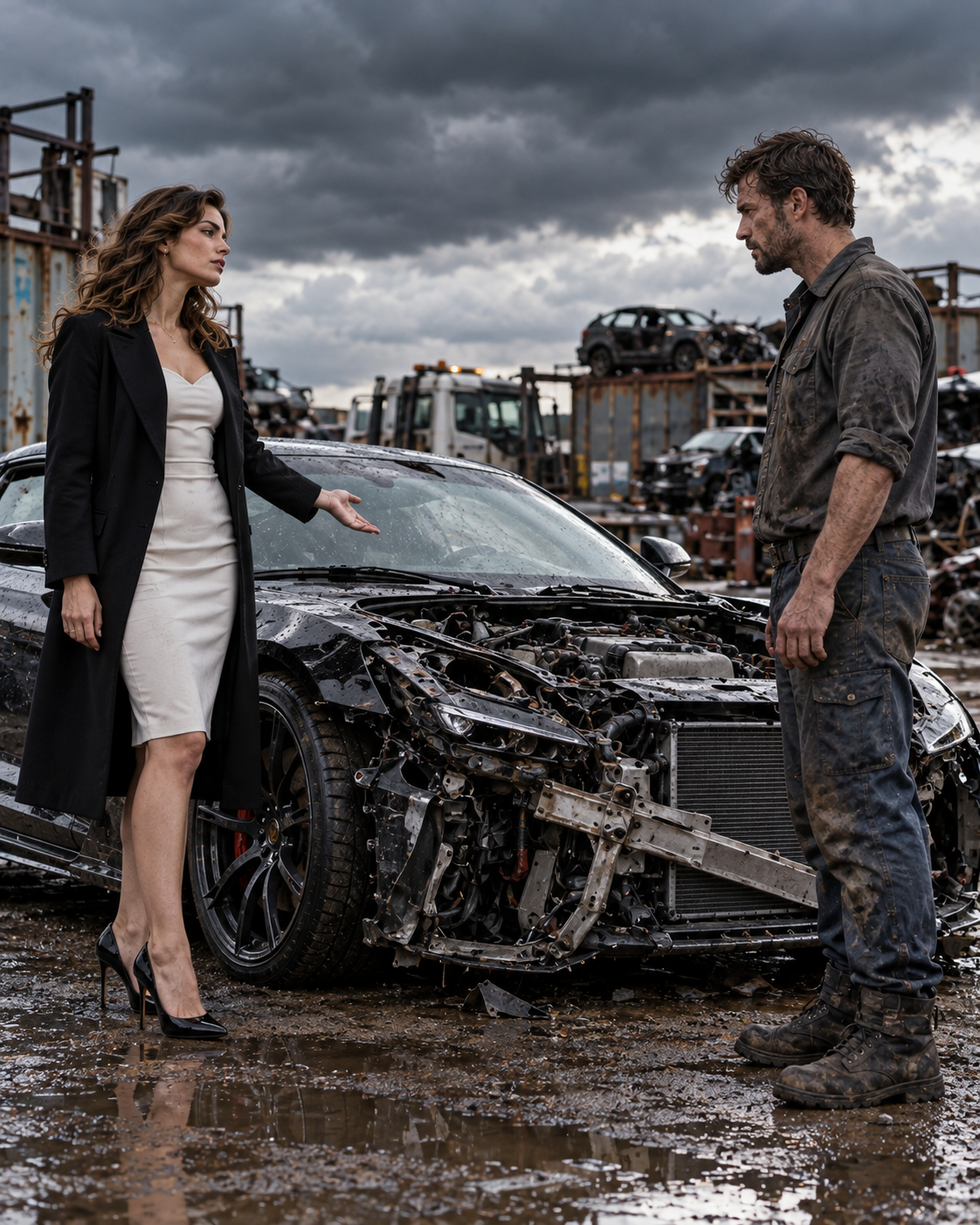
The CEO threw the wrecked electric car’s key into the mud and told me my salvage yard wasn’t worth her time.
Lawson arrived the next morning carrying a box of old engineering records and the same battered laptop he had used when we worked together.
We spent hours comparing my original blueprints with the damaged Vanta. The missing third response layer wasn’t an accident or a manufacturing oversight. The revised configuration matched the cost-cutting changes Garrett had pushed through years earlier.
“I told them this would happen,” I said.
“I remember,” Lawson replied. “You were the only one who refused to sign off on the change.”
That refusal had cost me my career. Now, it might be the only reason we could put the car right.
For the next two weeks, my salvage yard became an engineering workshop again.
We stripped away the damaged body panels, inspected every structural connection, and rebuilt the compromised sections according to my original specifications. I wouldn’t simply restore the Vanta to its former condition. If we were going to do this, the car had to be safer, more balanced, and more purposeful than the machine Mercer Velocity had abandoned.
I redesigned the exterior, too.
The new shape was low and clean, with dark bodywork flowing around the reinforced chassis. Piper watched from a safe distance, sketching while I worked.
“What are you going to call it?” she asked.
I studied the finished silhouette beneath the workshop lights.
“The Blackbird.”
She wrote the name in her notebook and drew a little bird beside it.
When we finally rolled the car outside, one of our neighbors happened to be filming from across the road. He captured the Blackbird emerging from my gates, its black finish gleaming in the Texas sunlight, looking nothing like the wreck that had arrived in the rain.
He posted the video online.
Within hours, it was everywhere.
People wanted to know who had built the car, how a salvage yard had transformed a ruined prototype, and why the vehicle’s structure looked unlike anything Mercer Velocity had publicly shown. Engineers began discussing the visible design details. Automotive enthusiasts shared the footage. Before long, the video reached the people who had the most to lose.
Celeste Mercer and Garrett Holloway arrived together.
This time, Celeste didn’t toss anything into the mud. She stepped out of her SUV and stared at the Blackbird in the workshop entrance.
Garrett looked furious.
“That car belongs to Mercer Velocity,” he said. “You need to hand it over immediately.”
I reached into a drawer and took out the signed salvage disposal documents Celeste had authorized when she abandoned the wreck.
“You sold it as salvage,” I said. “You signed the paperwork. You left the car here.”
Garrett started to answer, but Celeste raised a hand.
She had finally noticed the exposed engineering diagrams on my workbench. Her eyes moved from the plans to the reinforced chassis, then to the original design signature at the bottom of the page.
She recognized my name.
“You designed the Dynamic Spine,” she said quietly.
“I did. Before Garrett took my work and removed the safety layer that made it reliable.”
Garrett denied it, insisting the changes had been necessary to meet production targets. But Lawson had preserved the engineering records, and my original blueprints documented the system as it had been designed. The missing layer was no longer an abstract disagreement buried in corporate files. It was visible in the wreckage sitting behind them.
Celeste looked again at the Blackbird.
For years, she had trusted Garrett’s assurances and dismissed the possibility that the company’s success rested on work taken from someone who had been forced out. Now the evidence stood in front of her, rebuilt by the person she had treated as insignificant.
I didn’t shout. I didn’t ask her to apologize in front of my neighbors.
I simply held up the signed documents.
“You brought this car here because you thought it was worthless,” I told her. “You were wrong about the car. And you were wrong about me.”
For once, neither executive had an easy answer.
The legal questions surrounding the original designs would take time to resolve, and I knew one viral video couldn’t settle every dispute. But I had my records, my work, and a car that demonstrated what the original engineering could achieve when its safeguards were respected.
Celeste left without the Blackbird.
I kept building, this time with Lawson beside me and Piper filling notebooks with ideas for what we might create next.
I had spent years believing that losing my place in the industry meant losing the right to my own future. That wrecked coupe reminded me otherwise.
They had thrown away a machine they didn’t understand.
I had turned it into proof that my work—and my name—still mattered.
And when Piper taped her drawing of the Blackbird above my workbench, she added a final note beneath the wheels:
“Dad’s greatest car. Just the beginning.”
The note stayed above my workbench for weeks, held in place by a crooked blue magnet shaped like a dinosaur.
Every morning, I read it before I opened the gates.
Dad’s greatest car. Just the beginning.
I thought Piper had written those words because she believed in me. I didn’t realize how much I needed to believe in them myself.
For the first time in years, people were saying my name again.
At first, the attention felt harmless. Automotive enthusiasts stopped by to photograph the Blackbird. Engineers sent messages asking about the Dynamic Spine. Two universities invited me to speak to their students. Someone even offered to buy the car for a figure larger than anything I had ever seen on a bank statement.
I turned them all down.
The Blackbird wasn’t for sale.
But attention has a way of reaching places you would rather it never went.
Three days after Celeste and Garrett left my yard, a black envelope arrived at my gate.
Inside was a letter from Mercer Velocity’s legal department. It accused me of unlawfully possessing proprietary technology, modifying a company vehicle, and exploiting Mercer Velocity’s intellectual property for commercial attention.
The letter demanded that I surrender the Blackbird within forty-eight hours.
At the bottom, someone had typed a final warning: FAILURE TO COMPLY MAY RESULT IN IMMEDIATE LEGAL ACTION.
I read it twice, then set it on my workbench.
Lawson arrived that afternoon and found me staring at the page.
“They’re scared,” he said.
“Good. Maybe they’ll finally admit what they did.”
“Don’t mistake fear for honesty.” He pulled up a chair. “A company like Mercer doesn’t have to prove you’re wrong immediately. They only have to make it expensive for you to be right.”
He was right, of course.
I had a daughter, a salvage yard that barely covered its expenses, and no money to fight a corporation whose legal department probably employed more people than my entire town.
That evening, after Piper had gone to bed, I opened the metal case containing my original blueprints.
Beneath the drawings lay a small stack of correspondence from the final months of my employment at Mercer Velocity. My handwriting covered the margins of several pages. Each letter documented my objections to removing the third response layer from the Dynamic Spine.
There were dates, signatures, and references to test results.
I had kept everything.
For years, I had considered those papers reminders of a defeat I couldn’t undo.
Now they were a record of the truth.
I scanned every page and made three copies. One went to Lawson. Another went into a safe deposit box at the bank. The third I kept in the workshop, locked away from curious hands.
Then I called the lawyer who had helped me settle my old employment dispute.
His name was Daniel Reeves, and he had once told me that the most expensive mistake in any legal battle was believing the other side had already won.
When I explained the situation, he went quiet for a moment.
“Do you still have the original documents?” he asked.
“Yes.”
“Do you have anything proving Mercer authorized the disposal of the vehicle?”
I glanced at the signed papers in my drawer.
“Yes.”
“Then don’t surrender anything, don’t post accusations online, and don’t respond to that letter yourself. Send me everything tomorrow.”
For the first time since Celeste had thrown that key into the mud, I felt something stronger than anger.
I felt prepared.
Unfortunately, Mercer wasn’t prepared to wait.
The following Monday, two men in expensive suits arrived with another letter. This one informed me that the company was seeking an emergency order to prevent me from moving, displaying, or modifying the Blackbird until ownership and intellectual property disputes could be resolved.
They photographed the car from every angle and asked for access to my workshop.
Daniel instructed me to cooperate only with lawful requests, preserve the evidence, and avoid making any statements beyond what was necessary.
I followed his advice.
When the men left, Piper came out of the office holding her battered notebook.
“Are they going to take your car?”
I crouched beside her.
“I don’t know yet.”
“Because they think they made it?”
“Because they think everything they touch belongs to them.”
She studied the Blackbird through the open workshop doors.
“But you fixed it.”
“I did.”
“And you made it safer.”
“I believe I did. Now we have to prove it.”
Piper considered that for a moment, then opened her notebook to a clean page.
“I’ll draw the proof,” she announced.
I laughed, even though I didn’t feel much like laughing.
“That’s not exactly how it works, sweetheart.”
“Maybe not for grown-ups.”
She began sketching.
That night, I watched her work for nearly an hour. She drew the Blackbird from the side, then from above, then with its body panels removed to reveal the lines of the structural system.
At the center of the drawing, she added three narrow bands connected by curved arrows.
I leaned closer.
“What’s that?”
“The parts that help each other,” she said. “You told me the car stays safe because the pieces work together.”
I nodded slowly.
“That is what I told you.”
“So why would anyone take one away?”
I had no answer that an eight-year-old should have to understand.
Because someone thought the numbers looked better without it.
Because profit had become more important than the promise behind the machine.
Because the people making decisions had convinced themselves that the consequences would belong to somebody else.
I kissed her forehead and sent her to bed.
Then I went back to work.
For the next two weeks, Daniel and Lawson helped me prepare a complete record of the Dynamic Spine’s development. We organized the original designs, dated correspondence, engineering notes, test reports, and the disposal documents Celeste had signed.
Lawson also recovered files from an old external drive he had stored since leaving Mercer Velocity. Most were ordinary project records, but one folder contained internal discussions about the third response layer.
One message from Garrett stopped me cold.
The additional structure is unacceptable for the production budget. Remove it and adjust the software response to compensate. We cannot afford another delay.
A second message, sent months later, was worse.
The latest test remains within the approved operating envelope. Do not circulate the earlier failure analysis outside the engineering group.
Attached was a report I recognized immediately.
It was my report.
I had written it before Garrett pushed me out, warning that the revised configuration could create a dangerous chain reaction when the vehicle experienced a severe diagonal impact.
Someone had deleted my name from the document.
Someone had removed the warning.
And someone had signed the revised approval in its place.
Garrett Holloway.
Daniel stared at the screen for a long time.
“This changes the case,” he said.
“It proves he knew.”
“It provides evidence that he knew. That’s an important distinction. We’ll let the records speak for themselves.”
We sent copies to the appropriate legal representatives and requested an independent engineering review of the Blackbird and the original Vanta configuration.
For several days, nothing happened.
Then Celeste Mercer called me herself.
I almost let it go to voicemail.
When I answered, she didn’t sound like the woman who had stood in my yard and tossed a key into the mud.
“I need to speak with you,” she said.
“Your lawyers seem to be speaking for you quite effectively.”
“I know what the letter said.”
“Did you write it?”
“No.”
“But you approved the people who sent it.”
She fell silent.
I could hear faint voices in the background, followed by the sound of a door closing.
“You’re right,” she said at last. “I approved it.”
I hadn’t expected that answer.
“What do you want, Ms. Mercer?”
“I want to understand what happened to the Vanta.”
“You had two weeks to ask me that before you decided to treat me like a thief.”
“I deserve that.” Her voice faltered, then steadied. “But there is something you need to know. The accident that brought the car to your yard wasn’t the first incident involving that configuration.”
My grip tightened around the phone.
“What are you talking about?”
“Five months ago, a test vehicle experienced a structural failure during a controlled evaluation. The driver survived, but he suffered serious injuries. Garrett told me the incident had been caused by a sensor malfunction and driver error.”
“And you believed him?”
“The report was reviewed by our internal team.”
“That wasn’t my question.”
The silence stretched between us.
“Yes,” she finally said. “I believed him.”
I looked at my blueprints, spread across the workbench like a map of everything I had tried to protect.
“Why are you calling me now?”
“Because I read your report. The original one. And because the independent team reviewing the Vanta has found irregularities in the test records.”
“Then tell your board.”
“I have.”
“And?”
“They want the review completed before the next production announcement. Garrett insists the revised architecture is safe.”
“That doesn’t make it safe.”
“I know that now.”
“No. You suspect it now. There’s a difference.”
She didn’t argue.
Then she made a request that surprised me.
“Will you come to the Mercer test facility and review the data with our independent engineers?”
I thought about Garrett’s emails, the missing safety layer, and the way Celeste had looked at me as though I were a stain on her schedule.
I wanted to refuse.
I wanted her to experience the helplessness I had felt when I was pushed out of the company I had helped build.
But then I remembered Piper’s drawing.
The pieces had to work together.
If the Vanta really carried a defect, there could be more cars built around the same compromised design. Other test drivers, future customers, and families on ordinary roads might one day depend on a safeguard that somebody had removed.
This wasn’t just about my name anymore.
“I’ll come,” I said. “On three conditions.”
“Name them.”
“An independent review team with access to the unaltered records. No one from Mercer gets to rewrite my findings. And the company suspends any demonstration involving the disputed configuration until the review is complete.”
“That last condition could delay our launch.”
“Then I suppose you’ll have to decide what matters more.”
She was quiet for a moment.
“Agreed,” she said.
I didn’t trust her.
But I believed she had finally begun to understand the cost of looking away.
The Mercer test facility sat outside Crestfall behind tall fences and guarded gates. The last time I had visited, years ago, I had carried a box of personal belongings out through those gates while my colleagues avoided meeting my eyes.
This time, I arrived in my old pickup with Lawson beside me.
Celeste met us at the entrance.
No expensive smile. No impatient glance at her watch.
She simply held out her hand.
I shook it, though neither of us pretended that gesture could erase the past.
Inside the engineering center, several specialists had assembled around a large display. They greeted me politely, then brought up the Vanta’s original design files, revised specifications, and recorded impact data.
For hours, we compared the digital models against the wrecked chassis and my signed drawings.
The results were disturbing.
The modified system did not fail in every severe impact. That was precisely why it had survived internal evaluations. Under ordinary conditions, it behaved almost as intended. Under certain combined loads, however, the missing third response layer left the remaining structures working against one another instead of distributing the force as designed.
The software could compensate for some variations.
It could not replace the mechanical safeguard.
One of the engineers turned from the display.
“Your original architecture accounts for this interaction,” she said. “The revised version doesn’t.”
I stared at the simulation.
“How many vehicles use the revised configuration?”
The room went silent.
Celeste answered.
“Thirty-eight preproduction units. A small number of test vehicles. No retail deliveries.”
“Are all of them accounted for?”
“We’re verifying that now.”
“Then no vehicle should leave a secure facility until that verification is complete.”
Garrett, who had entered unnoticed, gave a short, humorless laugh.
“This is getting absurd. You’re treating an engineering disagreement as if we’re manufacturing explosives.”
The lead engineer turned to him.
“We have conflicting test records and a documented structural failure.”
“We also have dozens of successful tests.”
“Successful tests don’t invalidate a failure mode.”
Garrett looked at Celeste.
“You hired professionals to evaluate this, and now you’re allowing a former employee with an obvious grievance to direct the entire investigation.”
I stood slowly.
“I don’t expect you to trust me because I worked here. Trust the measurements. Trust the original records. Repeat the tests without changing the conditions, and let the results speak.”
He turned toward me.
“You’ve been waiting years for a chance to embarrass me.”
“Maybe,” I said. “But if I wanted revenge, I’d be asking you to pay for what you did to my career. I’m asking you to stop putting people at risk.”
For once, Garrett had nothing ready to say.
The independent team spent another week reviewing the evidence. Their final report identified significant deficiencies in the revised structural design and serious inconsistencies in the internal documentation.
It did not answer every question about the original accident, but it established that the omitted response layer had been a meaningful safety concern and that the company had failed to address it adequately.
Mercer Velocity postponed its production announcement.
The news spread almost immediately.
Investors wanted answers. Journalists asked why the Vanta’s launch had been delayed. Former employees began contacting Daniel with accounts of testing decisions and reports they said had been discouraged or altered.
Garrett responded with a public statement accusing unnamed individuals of misunderstanding complex engineering data.
He never mentioned my name.
He didn’t have to.
Everyone knew who he meant.
Two days later, he announced that Mercer Velocity would host a technical demonstration to address concerns about the Vanta. He promised to show the vehicle’s performance and prove that the company had nothing to hide.
The invitation landed in Celeste’s office.
She called me that evening.
“He intends to go ahead with the event,” she said.
“After the report?”
“He says the demonstration will prove the configuration is safe.”
“Is he planning to put a driver in the car?”
“He wants a live track demonstration followed by a high-speed handling test.”
“Absolutely not.”
“I agree.”
“Then cancel it.”
“He has argued that canceling now will look like an admission of guilt. The board is divided.”
I looked toward the office window. Piper was outside, drawing in the late sunlight while a neighbor’s dog inspected her lunchbox.
“Celeste, this isn’t about appearances anymore. You have a report describing an unresolved failure mode. You cannot erase that with a good lap around a track.”
“I know.”
“Then what do you need from me?”
“I need you to attend the event and present the original design and the findings. If we demonstrate anything, it must be done under independent supervision, with instrumented test equipment and no human driver exposed to the disputed risk.”
“Will Garrett agree to that?”
“No.”
“Then you already know the answer.”
She sighed.
“The board has approved an independent demonstration. Garrett is refusing to withdraw his own proposal. If I cancel the entire event without presenting the evidence, he’ll tell everyone the findings were inconclusive.”
For the first time, I understood what she was asking.
She wasn’t asking me to rescue her reputation.
She was asking me to stand beside her while she made a decision that might destroy the company she had spent her life building.
I agreed to attend.
The event took place the following Friday at the Mercer facility. Reporters filled the observation area, engineers stood behind protective barriers, and a line of spotless vehicles gleamed under the bright Texas sun.
The Blackbird sat at the end of the demonstration hall.
I had brought it only after the independent team confirmed the conditions for the test and Daniel secured written agreements concerning the vehicle’s handling and evidence. Its value had grown in the public imagination, but to me it was still a machine I had rebuilt with my own hands.
Garrett took the stage first.
He spoke about innovation, competitive pressure, and the difficulty of introducing new technology. He showed footage of successful Vanta tests and described the company’s structural architecture as one of the most thoroughly validated systems in its class.
Then he displayed a chart suggesting the Blackbird’s improvements were cosmetic rather than fundamental.
The crowd murmured.
He turned toward me.
“Mr. Hale has produced a striking vehicle, but appearance isn’t proof. A salvage-yard rebuild cannot replace a full industrial testing program.”
I waited until he finished.
Then I stepped onto the stage carrying my metal case.
“He’s right about one thing,” I said. “Appearance isn’t proof.”
I opened the case and laid my original blueprints under the document camera.
“These drawings show the Dynamic Spine as it was first designed. Here is the third response layer, including the connections and the sequence that prevents a dangerous interaction under combined loads. This is the version I refused to approve without it.”
The screen shifted to the revised design.
“This is the version Mercer later used in the Vanta.”
A comparison appeared beside it.
“And these are the sections removed from the vehicle before production testing.”
Garrett moved toward the microphone.
“Those diagrams do not establish—”
“I’m not finished.”
The words came out sharper than I intended, but the room fell silent.
I displayed the dated report I had written years earlier, complete with its original signature.
Then came the internal messages Lawson had recovered, the disposal documents, and the independent team’s findings.
I didn’t exaggerate what they proved.
I didn’t call Garrett a criminal or claim to know every decision he had made.
I showed the records and let the contradictions speak.
Finally, the lead independent engineer presented the test protocol. No person would be inside either vehicle. Instrumented test assemblies would compare the disputed structure with a correctly configured system under controlled impact conditions. The results would be recorded and released to the reviewing parties.
Garrett shook his head.
“This is unnecessary theater.”
Celeste stood from the front row.
“No,” she said. “It’s accountability.”
The room turned toward her.
“I approved the decisions that brought us here. I accepted assurances without demanding enough independent verification. I allowed our company to treat a serious engineering concern as a problem of perception rather than a problem requiring investigation.”
Her voice trembled, but she continued.
“I will not ask anyone to trust Mercer Velocity because of our reputation. We will earn that trust by releasing the findings, cooperating with the review, and correcting every vehicle affected by this design.”
Garrett stared at her as though she had struck him.
“You’re destroying the company,” he muttered.
“I’m trying to prevent us from destroying something far more important.”
The test began twenty minutes later.
The first instrumented assembly represented the revised Vanta architecture. The impact was controlled, the equipment calibrated, and the entire sequence observed remotely by the independent engineers.
When the results appeared, the disputed configuration showed the unstable response identified in the earlier analysis.
The test was halted so the team could verify the measurements.
The second assembly, configured according to the original Dynamic Spine specifications, responded differently. Its structures distributed the load across the intended sequence, limiting the dangerous interaction observed in the first test.
The room remained silent while the engineers checked the data.
Then the lead engineer removed her glasses.
“The results are consistent with the predicted difference,” she announced. “Further validation is still required, but the original safeguard addresses the failure mode identified in the revised design.”
A reporter raised a hand.
“Does this mean the Vanta is unsafe?”
The engineer answered carefully.
“It means the tested configuration has a documented structural concern that must be resolved before it can be responsibly approved for use. We are not making claims beyond the evidence.”
I looked at Garrett.
He was staring at the display, his face drained of color.
For years, I had imagined the moment he would finally be forced to look at what he had done. In my private fantasies, I delivered a speech that left him speechless while everyone cheered.
The reality felt nothing like that.
There was no triumph in the thought that people might have been put at risk. No satisfaction in seeing a company I had once loved brought to the edge of disaster.
There was only the weight of what had almost happened—and the relief that the truth had arrived before more people were hurt.
Garrett approached me after the event, away from the cameras.
“You’ve made your point,” he said quietly. “Now stop before you ruin everything.”
I looked at him.
“Everything was already at risk. You just counted on nobody noticing.”
“You don’t understand the pressure we were under.”
“I understood it when I refused to sign your approval. I understood it when I lost my job. I understood it when I had to choose between paying the rent and fighting a company that stole my work.”
He looked away.
“You could have come back,” he said.
“Back to what? A company that removed my name from my research and buried my warnings?”
“I was trying to save the project.”
“No. You were trying to save the version of yourself who believed he could never be wrong.”
He opened his mouth, then closed it again.
I left him there.
The months that followed were not as dramatic as the day of the demonstration, but they mattered more.
Mercer Velocity suspended production plans for the Vanta while a comprehensive review took place. Affected vehicles were secured, and the company funded further testing and structural corrections. Investigators examined the original crash, the altered reports, and the decisions that had allowed the disputed design to advance.
Garrett was removed from his position pending the internal and legal proceedings. Eventually, records and testimony established that he had authorized changes after repeated warnings and had concealed material information from senior leadership. The consequences came through formal reviews and legal settlements, not a single theatrical confession.
Celeste publicly acknowledged that Mercer Velocity had used engineering work developed by me without properly recognizing my contribution. The company reached an agreement restoring my authorship of the Dynamic Spine’s original architecture and compensating me for the rights and losses at issue.
I accepted the settlement, but I turned down her offer to return as a senior executive.
She asked me why during our final meeting.
I thought about the offices I had once walked through, the people who had looked away as I carried out my belongings, and the little yard where I had slowly remembered how to build things for the right reasons.
“Because I don’t want my daughter growing up believing that success means returning to the room where people hurt you,” I told her. “I want her to know she can build a better room.”
Celeste lowered her eyes.
“I can’t change what happened.”
“No,” I said. “But you can change what happens next.”
She nodded, and for the first time, I believed she understood the difference.
With the settlement money, I paid off the debts that had followed me through years of uncertainty. I repaired the workshop roof, replaced the oldest equipment, and hired two mechanics who had been laid off from a nearby plant.
Lawson joined me full-time.
Together, we established a small engineering and restoration company behind the salvage yard. We specialized in rebuilding damaged vehicles, developing safer structural systems, and helping young technicians learn to question assumptions rather than blindly follow instructions.
We called it Second Chance Engineering.
I kept the salvage yard open.
People asked why I didn’t move into a sleek building with glass walls and a company logo large enough to be seen from the highway.
I told them that machines didn’t become less valuable because they were old, and people didn’t become less valuable because the world had decided they were finished.
Besides, I liked the sound of the gates at 7:15 every morning.
Piper liked the new workshop even more.
She had a proper desk now, shelves full of notebooks, and permission to watch our work from the designated safe area. She was still eight, which meant she was just as likely to draw a race car with wings as she was to ask a question that stopped every engineer in the room.
One afternoon, she brought me a new drawing.
It showed the Blackbird beside another car, smaller and rounder, with an unusual body shape and three curved lines running through its frame.
“What is this one called?” I asked.
“The Sparrow.”
“Why a sparrow?”
“Because the Blackbird is the big one, and the Sparrow is the one that learns to fly.”
I smiled.
“That’s a good name.”
“I want to help build it someday.”
I looked at the drawing, then at the workshop filled with tools, engine parts, and people who had found a second chance of their own.
“You can help us design it now,” I told her. “We’ll teach you the rest as you grow.”
She thought about that, then pointed to the three lines in the frame.
“This part has to stay, though.”
“The response layers?”
She nodded solemnly.
“All of them. Even if they’re expensive.”
I crouched beside her.
“Especially if they’re important.”
She seemed satisfied with that answer and returned to her desk.
Several weeks later, Celeste visited our workshop without an appointment.
She arrived alone, carrying a small wooden box.
Inside was the key fob she had once thrown into the mud.
It had been cleaned, polished, and placed on a folded piece of black cloth.
“I thought you should have this,” she said.
I turned it over in my hand. A little dirt remained in the seam near the edge, impossible to remove completely.
“You could have mailed it.”
“I could have.”
She glanced toward the workshop, where Lawson was explaining a damaged steering assembly to one of our new apprentices.
“I also wanted to see what you’ve built here.”
“It’s not much to look at.”
“That’s not true.”
Her eyes settled on Piper, who was showing one of the mechanics her Sparrow drawing.
“She’s talented.”
“She is.”
Celeste watched her for a moment.
“My father used to tell me that the person who owns the machine is the person who deserves the credit.”
I slipped the key into my pocket.
“My father told me that what you do with your power matters more than how much of it you have.”
She absorbed that without answering.
Before she left, she asked whether I hated her.
I considered giving her the easy answer. It would have made the moment comfortable, and perhaps that was what she expected.
Instead, I told her the truth.
“I was angry with you. I still remember what you said when you stood in my yard. But hating you wouldn’t repair the damage, and it wouldn’t make me a better father.”
“What would?”
“Making sure Piper grows up in a world where people can admit they’re wrong without having to lose everything first.”
Celeste nodded slowly.
“I’m trying to learn how to do that.”
“Then keep trying.”
She left through the same metal gates she had once entered with such contempt.
I watched her SUV disappear down the road before returning to the workshop.
The key fob rested on my bench beside the blueprints.
For months, I had imagined that object as a symbol of everything Celeste had misunderstood: the wreck she had abandoned, the engineer she had dismissed, the work she had assumed was worthless.
But it had become something else.
A reminder that one careless decision can place a burden on people who never made it—and that the courage to correct a mistake must be greater than the pride that caused it.
That evening, after we closed the gates, Piper sat beside me at the workbench.
She glanced at the key fob.
“Is that the key to the Blackbird?”
“It was the key to the Vanta before we rebuilt it.”
“Are you going to keep it?”
I turned it over between my fingers.
“Yes.”
“Even though she was mean to you?”
“Especially because of that.”
Piper looked confused, so I explained.
“Sometimes the things people do to hurt us can teach us something important. But we get to decide what we do with that lesson. We can use it to become bitter, or we can use it to become wiser.”
She considered that while tapping her pencil against the notebook.
“I’m going to draw the key beside the Blackbird,” she said.
“Why?”
“So we remember where it started.”
I watched her draw a little black car beside the key, then add the three lines that had become her signature.
Above our heads, the old roof creaked as the evening breeze moved across the metal sheets. Outside, the yard was quiet, filled with discarded machines waiting for someone to see what could still be saved.
I had once believed my life had been reduced to those machines.
I thought the industry had taken my future, stolen my work, and left me with nothing but rust and memories.
But I had been wrong.
The yard hadn’t been the place where my dreams went to die. It had been the place where I learned to rebuild them without asking anyone’s permission.
And the Blackbird hadn’t proved that I was better than Celeste Mercer or Garrett Holloway. It had proved something more valuable: that the truth could survive neglect, that a second chance could come from an unexpected place, and that a person who had been pushed aside could still create something that mattered.
Piper finished her drawing and taped it beside the original note.
The two pictures hung above my workbench, one showing the Blackbird and the other showing the little Sparrow waiting to be built.
I switched off the workshop lights, leaving the drawings beneath the soft glow of the office lamp.
Then I locked the gates and walked home with my daughter.
The next morning, at exactly 7:15, I opened the salvage yard again.
The gates squeaked.
The coffee was already getting cold.
And a battered old pickup sat outside, waiting for a second chance.
I smiled, rolled up my sleeves, and reached for my tools.
Because I’d finally learned that the world was full of people who were quick to decide what was worthless.
A broken machine.
A discarded idea.
A man with grease on his hands and no powerful friends.
But value was never determined by the person who threw something away.
It was determined by what remained when someone cared enough to look closer.
And sometimes, the greatest thing you could rebuild wasn’t a car at all.
It was your belief that the future still belonged to you.