The CEO fired me in front of an entire engineering team because I refused to approve a $1 bolt on a $1.2 billion military aircraft.
The phone rang at 6:17 the following morning.
I was standing in the kitchen, making coffee and trying to figure out how I was going to explain unemployment to my daughter without making her feel that our lives were falling apart.
The number was unfamiliar.
I almost let it go to voicemail.
“Daniel Mercer?”
“Yes.”
“This is Claire Donnelly. I’m an independent safety auditor working with the Department of Defense. I need to speak with you about Whitcomb Defense Systems.”
I put my coffee down.
“I assume you’ve heard about the vibration test.”
“I have. That’s why I’m calling.”
There was a brief silence before she continued.
“Mr. Mercer, I have reviewed the preliminary incident report. Your name appears several times, but the documentation is inconsistent. According to the company’s records, you approved the original assembly before being terminated.”
I felt my stomach tighten.
“I never approved it.”
“That’s what I wanted to hear directly from you.”
I looked toward the kitchen table, where Zoe’s unfinished homework was still sitting beneath a half-empty glass of orange juice.
“Ms. Donnelly, I submitted a safety report before the test. I also have the original bolt they removed from the assembly. It was never approved for that application.”
“Do you still have it?”
“Yes. I secured it in an evidence bag before leaving the facility.”
“Don’t open it. Don’t alter anything. Can you meet me this morning?”
I looked at the clock.
“Where?”
“Somewhere outside Whitcomb. I’ll send you the address.”
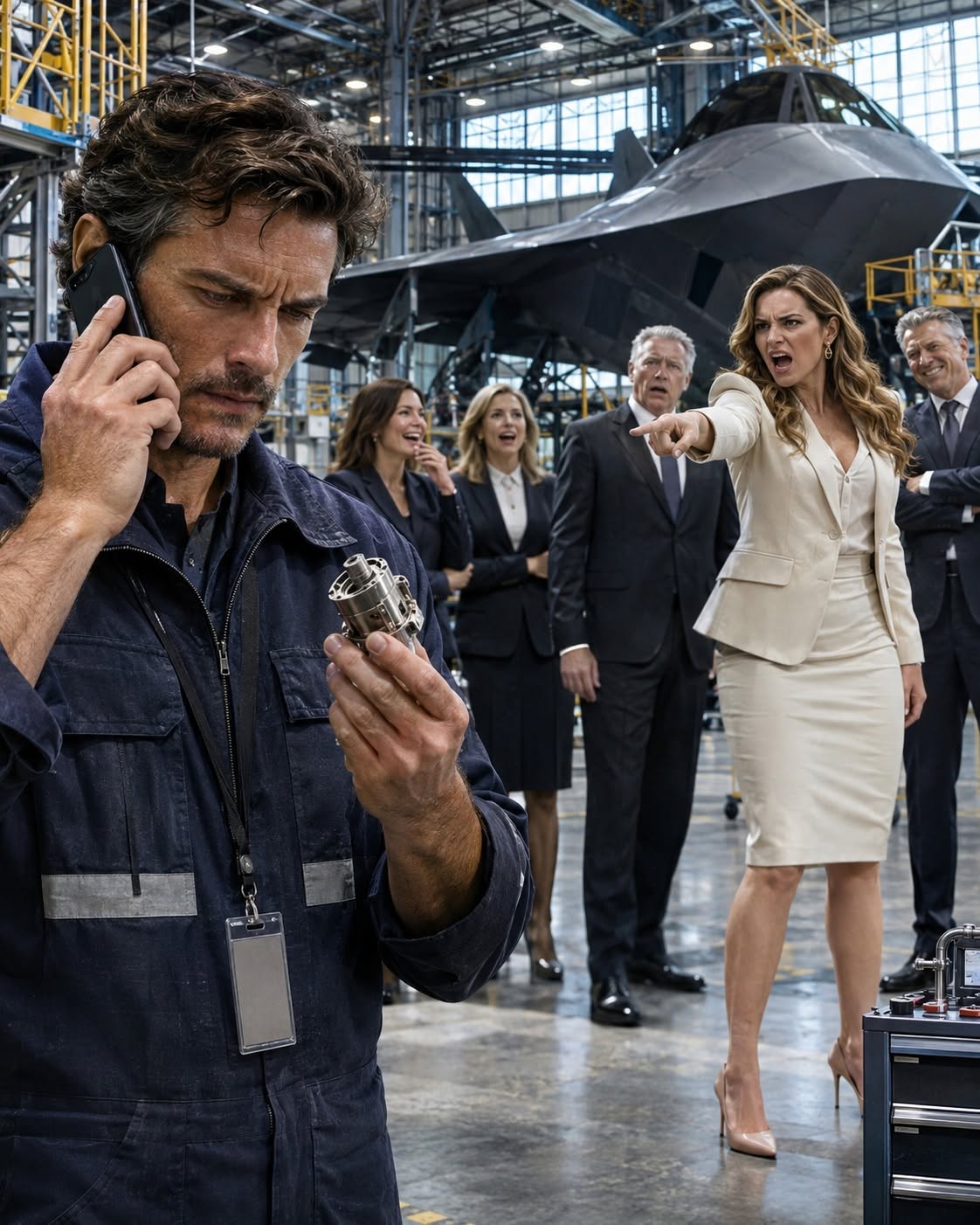
Before ending the call, she said something that made me pause.
“Daniel, there’s something else. I don’t think this investigation is going to be limited to a single defective bolt.”
I knew exactly what she meant.
And suddenly, I was no longer thinking about my lost job.
I was thinking about how many other aircraft might be carrying parts that someone had decided were good enough.
An hour later, I arrived at a small federal office building on the outskirts of town.
Claire was waiting in a conference room. She was in her early forties, with short brown hair, a navy blazer, and the kind of expression that suggested she had learned not to believe anything until she had seen the paperwork.
A laptop was open in front of her.
She stood when I entered.
“Thank you for coming.”
I placed my evidence bag on the table.
“Everything is exactly as I secured it.”
She examined the sealed bag without touching the contents.
“Good. We’ll have our evidence team document it.”
Then she opened a folder.
“Before we discuss the failed test, I want to understand your history with Whitcomb.”
I explained my nine years in quality control, my previous experience as a reliability engineer, and my involvement in the aircraft’s original development.
She listened without interrupting.
When I finished, she leaned back.
“So you weren’t simply inspecting a component. You understood why that particular component had been specified.”
“Exactly.”
“Explain it to me as if I know nothing about aircraft engineering.”
I appreciated the question.
“The tail actuator bracket transfers mechanical loads through the tail control system. The fastener isn’t decorative. It keeps the assembly secured when the aircraft experiences vibration, repeated stress, and changes in load.”
I took a sheet of paper and drew a rough diagram.
“The specified nickel alloy bolt was selected because of its fatigue resistance, tensile strength, and predictable behavior under the expected operating conditions. The commercial bolt might look identical. It might even fit perfectly. But fitting is not the same as being qualified.”
Claire studied the drawing.
“And the price difference?”
“Forty-two dollars.”
She looked up.
“Forty-two dollars?”
“That’s what the approved component cost compared with the replacement.”
For a moment, neither of us spoke.
Then she asked the question I had been expecting.
“Did Cassandra Whitcomb know?”
“I told her directly.”
“Was anyone else present?”
“Several engineers, technicians, and members of the executive team.”
“Would they confirm that?”
“They might be reluctant.”
“Why?”
I looked at her.
“Because people tend to remember who still signs their paychecks.”
Claire closed the folder.
“Then we’ll need evidence that doesn’t depend on anyone’s courage.”
Over the next three hours, I walked her through everything I remembered.
The original inspection.
The missing certification.
The altered records.
The warning tag Cassandra had torn away.
The exact sequence of events leading to my dismissal.
I also explained something I hadn’t included in my initial report.
Two weeks before the incident, I had noticed unusual substitutions in another aircraft assembly.
A certified locking washer had been replaced with a cheaper commercial equivalent. I had flagged it, and the part was eventually corrected.
At the time, I thought it was an isolated procurement mistake.
Now I wasn’t so sure.
Claire wrote down the part numbers.
“Did you report that?”
“Internally, yes.”
“Do you have a copy?”
“I kept a personal copy of the inspection discrepancy.”
Her expression changed.
“Daniel, that may be important.”
She called another investigator into the room.
By lunchtime, I had given a formal statement, surrendered the evidence bag for independent examination, and provided copies of every relevant inspection record I had preserved.
Before I left, Claire walked me to the door.
“I want you to understand something. This investigation could take months. Whitcomb has considerable resources, and its legal department will defend the company aggressively.”
“I’m not expecting an easy fight.”
“Are you prepared for the possibility that they’ll try to discredit you?”
I thought about Cassandra laughing in front of the engineering team.
I thought about the security guard escorting me out.
Then I thought about Zoe asking why I had come home early.
“I’ve already lost my job,” I said. “I’m not going to lose my conscience just to make the people responsible more comfortable.”
Claire nodded.
“Then let’s find out what really happened.”
That afternoon, Whitcomb Defense Systems released an official statement.
The company described the failed vibration test as an isolated technical anomaly caused by a supplier-related discrepancy.
It also mentioned that a former quality control employee had been dismissed after refusing to follow established procedures.
They didn’t mention my nine years of service.
They didn’t mention my engineering background.
And they certainly didn’t mention the original bolt.
Within hours, my name began circulating online.
Someone posted a photograph of me leaving the facility with a cardboard box.
The caption described me as a disgruntled employee who had sabotaged a billion-dollar project because he couldn’t accept criticism.
The comments were worse.
Some called me incompetent.
Others accused me of trying to extort the company.
One person even claimed I had deliberately installed the wrong bolt myself.
Zoe found the post that evening.
She was sitting on the living room couch with her tablet when I noticed her expression.
“Dad?”
“What’s wrong?”
She turned the screen toward me.
“Why are people saying these things about you?”
I read the comments.
My jaw tightened.
“They don’t know what happened, sweetheart.”
“But they’re saying you lied.”
I sat beside her.
“Sometimes people say things because they want others to believe a story that isn’t true.”
“Can you prove them wrong?”
I looked at her.
“That’s what I’m working on.”
She was quiet for a moment.
Then she leaned against my shoulder.
“I believe you.”
Those three words meant more to me than anything Cassandra could have said.
The following morning, I received a letter from Whitcomb’s legal department.
It was a cease-and-desist notice accusing me of making defamatory statements and unlawfully retaining proprietary company materials.
They demanded that I return all documents and stop communicating with government investigators.
I read it twice.
Then I called Claire.
She wasn’t surprised.
“Do not respond directly,” she advised. “Preserve the letter. Send us a copy. And don’t discuss the investigation publicly.”
I followed her instructions.
But the letter made one thing clear.
Whitcomb wasn’t merely trying to protect its reputation.
It was afraid of what I knew.
Three days later, Claire called again.
“Daniel, we have a problem.”
I sat down.
“What kind?”
“The inspection records you gave us are authentic, but the company’s electronic system contains a different version.”
“I told you they altered them.”
“We know. What we don’t know is who authorized the alteration.”
She paused.
“We’ve also discovered that your employee access credentials were used to approve the assembly after your termination.”
I stared at the wall.
“That’s impossible.”
“Your account was used at 8:42 that evening.”
“I was at home.”
“Do you have anything that can establish that?”
I thought for a moment.
“My daughter and I ordered dinner. I paid with a card, and the restaurant has a timestamped receipt. My home security camera also records the front entrance.”
“Keep everything. We’ll verify it.”
After the call, I felt a chill that had nothing to do with the weather.
Someone had used my identity to approve a component I had explicitly rejected.
They hadn’t simply erased my warning.
They had tried to make it look as though I had changed my mind.
And if the aircraft had passed certification, my name might have been attached to every consequence that followed.
Claire’s team soon obtained the server records through the appropriate investigative process.
The login had originated from a terminal inside Whitcomb’s engineering administration office.
The access credentials had been reset using an administrator account belonging to Preston Holbrook, the company’s chief operating officer.
That discovery changed the direction of the investigation.
Preston wasn’t some distant executive who signed paperwork without understanding what it meant.
He had been directly involved in the procurement process.
Claire arranged another interview.
This time, I was asked to identify several people from the engineering department.
One name immediately stood out.
Ethan Brooks.
Ethan had been a junior engineer when I first joined the inspection team. He was smart, hardworking, and unusually careful about documenting his decisions.
He had been in the room when Cassandra tore off my warning tag.
I remembered seeing him look down at the floor.
Claire noticed my reaction.
“You know him?”
“Yes.”
“Would he talk?”
“I don’t know.”
She studied me.
“Why not?”
“Because he has a young family. He just bought a house. And Whitcomb has a way of making people feel that their entire lives depend on keeping quiet.”
Claire made a note.
“Then perhaps we should give him a reason to believe the truth matters more.”
I didn’t know what she meant until two days later.
Ethan called me.
His voice was barely recognizable.
“Daniel, it’s Ethan.”
“Hey. What’s going on?”
“Are you alone?”
I looked toward Zoe’s bedroom.
“Yes.”
“I need to talk to you. But I don’t know if I can trust anyone at the company anymore.”
My heart started beating faster.
“Take your time.”
He exhaled.
“I was the one who processed the replacement bolt.”
I remained silent.
“I didn’t know it was going to be used in the aircraft,” he continued. “The purchase order was marked as an approved equivalent. Preston’s office sent the instruction directly.”
“Did you check the engineering authorization?”
“No. I should have.”
His voice cracked.
“When you rejected the part, I knew something was wrong. I wanted to say something, but Cassandra was standing right there. Everyone was watching.”
“Why are you calling now?”
“Because after the test failed, Preston told us to update the records. He said the substitution had been authorized before your inspection. He told me to make sure the system showed you had approved it.”
I closed my eyes.
“Did you do it?”
There was a long silence.
“Yes.”
The admission hurt more than I expected.
“Ethan, why?”
“My daughter is six. My wife isn’t working right now. I was scared.”
I understood fear.
I understood financial pressure.
I understood what it meant to be responsible for a child who depended on you.
But I also knew that fear could become a terrible excuse.
“Do you still have the original purchase order?”
“Yes.”
“Don’t send it to me. Don’t alter it. Contact Claire Donnelly and tell her everything.”
“Will they arrest me?”
“I can’t promise you what will happen.”
He went quiet.
“But I can tell you something,” I continued. “The longer you hide it, the more dangerous it becomes. And the people who gave you those instructions will never take responsibility for what they made you do.”
Ethan agreed to contact the investigators.
The next week, he provided a formal statement and turned over the original purchase order through the proper channels.
It contained a handwritten authorization from Preston.
But the most important discovery was hidden in the attachments.
A spreadsheet listed dozens of component substitutions across multiple defense projects.
Some involved bolts.
Others involved hydraulic fittings, electrical connectors, locking mechanisms, and pressure-rated assemblies.
The savings had been calculated down to the cent.
The potential consequences had not.
At the bottom of the spreadsheet was a column labeled PROJECTED COST REDUCTION.
The total exceeded $18 million.
Claire called me after reviewing it.
“Daniel, this is much bigger than we anticipated.”
“How many projects?”
“At least seven. We’re still checking.”
I rubbed my forehead.
“Are any of those aircraft operational?”
“We’re coordinating with the relevant authorities to determine whether any immediate safety action is necessary.”
“Claire, if unqualified components are installed in aircraft that are already flying—”
“I understand.”
“No, I don’t think you do. You can’t wait until another test fails.”
Her voice became firm.
“We’re not waiting. The appropriate safety and contracting authorities have been notified. Potentially affected equipment is being identified for inspection.”
I knew then that the investigation had crossed a threshold.
This wasn’t about proving that I had been right.
It was about preventing something far worse.
Over the next several days, the Department of Defense issued restrictions affecting several Whitcomb projects while independent engineering teams reviewed the components.
Two aircraft were temporarily grounded pending inspection.
A separate hydraulic assembly was found to contain an unapproved substitute fitting.
Fortunately, that issue was discovered before an operational failure occurred.
Then came the moment nobody at Whitcomb could explain away.
An independent laboratory completed its examination of the rejected bolt.
The metallurgical analysis confirmed that it did not meet the required aerospace material specification. Its fatigue performance was significantly below the approved component’s documented requirements.
The laboratory also determined that the bolt had not been manufactured under the certification controls required for the application.
The replacement bolt that failed inside the vibration chamber came from the same commercial supplier.
The test footage was equally devastating.
At the beginning, the aircraft assembly behaved normally.
Then the vibration increased.
The camera captured a small movement around the tail actuator bracket.
A few seconds later, the fastener failed.
The bracket shifted, and the test was terminated.
There was no explosion.
No dramatic fireball.
Just a small piece of metal failing under a load it was never designed to withstand.
But that small failure represented something enormous.
A commercial bolt worth one dollar had exposed an $18 million cost-cutting operation.
And it had nearly allowed a dangerous aircraft to pass certification.
Whitcomb’s leadership was running out of explanations.
Cassandra arranged a press conference.
She stood before a wall displaying the company logo and described the incident as an unfortunate breakdown in internal communication.
She expressed concern for the employees affected by the disruption.
She promised a comprehensive review of the company’s quality systems.
But when a reporter asked whether she had personally ordered the removal of my warning tag, she avoided answering.
Another reporter asked whether she had known that the original component was not approved.
She said she would not comment on an ongoing investigation.
Then came the question that finally unsettled her.
“Ms. Whitcomb, did you know that Mr. Mercer had been fired for refusing to approve the aircraft assembly?”
Cassandra adjusted her microphone.
“Mr. Mercer was an employee who failed to meet the company’s operational expectations.”
“Was he correct about the bolt?”
She stared at the reporter.
The question remained unanswered.
The board meeting took place the following Tuesday.
I wasn’t invited.
I had no desire to sit in a room with the people who had treated my warnings as an inconvenience.
But Claire later told me exactly what happened.
Cassandra arrived with a team of attorneys.
Preston sat beside her, carrying a thick folder.
The board members had received the independent laboratory results, the original inspection records, the altered electronic logs, and Ethan’s sworn statement.
They had also received the list of other affected projects.
Cassandra began by blaming procurement.
She claimed Preston had approved substitutions without informing her of the engineering consequences.
Preston immediately challenged that account.
He produced emails showing that Cassandra had personally authorized aggressive cost-reduction targets.
One message was particularly revealing.
It read:
“We cannot continue treating every engineering preference as a financial requirement. Find equivalent parts wherever possible. I want the savings reflected before the next quarterly review.”
Cassandra insisted she had been referring to legitimate substitutions.
Preston responded that her office had approved the procurement program and demanded that he meet the savings targets.
For nearly an hour, they argued about who had known what and when.
But the evidence was no longer ambiguous.
An email sent three days before my dismissal showed Cassandra had been informed that the tail actuator bracket contained an unapproved component.
Her response was only six words.
“Get this cleared before the test.”
There was another email from Preston.
“Quality is holding the assembly.”
And Cassandra’s reply:
“Then replace the person holding it.”
The board went silent.
According to Claire, even the attorneys stopped taking notes for a moment.
The directors voted to suspend Cassandra and Preston pending the outcome of the investigation.
Neither was permitted to participate in further engineering or procurement decisions.
But the consequences didn’t stop there.
The Department of Defense formally suspended new awards to Whitcomb while reviewing its contractual compliance.
Independent auditors examined the company’s financial records and discovered that the cost-reduction program had been presented to investors as evidence of improved operational efficiency.
The reported savings had helped justify executive bonuses.
Some executives had received performance payments based partly on procurement targets that encouraged the substitutions.
What Cassandra had called a business strategy had become a system of incentives that rewarded people for ignoring safety.
A month after my dismissal, the company announced a major restructuring.
Then came the contract termination.
The Department of Defense officially terminated Whitcomb’s $1.2 billion aircraft contract after determining that the company had failed to meet critical contractual and quality requirements.
The announcement sent shock waves through the industry.
Whitcomb’s stock fell sharply.
Several suppliers suspended shipments.
Investors demanded explanations.
And the company’s board began searching for someone who could explain how an organization with thousands of employees had allowed such a culture to develop.
Meanwhile, I was trying to figure out how to pay my mortgage.
The investigation had consumed nearly every waking hour, but the bills hadn’t stopped.
My savings were shrinking.
Zoe needed new school supplies.
The refrigerator made a strange noise that sounded increasingly expensive.
I had started sending out applications, but every employer wanted to know why I had left Whitcomb.
Some didn’t call back.
Others seemed uncomfortable when I explained the circumstances.
One recruiter finally told me that companies preferred candidates who didn’t come with complicated stories.
I thanked him and ended the call.
That evening, Zoe found me sitting at the kitchen table, staring at a stack of bills.
She placed a small envelope beside my hand.
“What’s this?”
“Open it.”
Inside was a drawing she had made at school.
It showed a man standing beside a giant airplane. The airplane had a smiling face, and the man was holding a clipboard.
Above them, she had written:
“MY DAD MAKES THINGS SAFE.”
I looked at her.
“What’s this for?”
“Because you’re always checking things.”
She smiled.
“And because you didn’t let them make the airplane dangerous.”
I swallowed hard.
“That’s very kind, sweetheart.”
She noticed the bills.
“Are we going to be okay?”
I wanted to give her an easy answer.
Instead, I told her the truth.
“We’re going to have to be careful for a little while. I don’t have another job yet, and some things might be different.”
She nodded slowly.
“Can I help?”
“You don’t have to worry about grown-up problems.”
“But I can still help.”
She disappeared into her room and returned with a small glass jar.
Inside were a few crumpled bills and coins.
It was her savings.
“For emergencies,” she explained.
I felt something break inside my chest.
I pushed the jar gently back toward her.
“Keep that, sweetheart. Your job is to be a kid.”
“But I want to help you.”
I pulled her into a hug.
“You already do.”
That night, after she went to bed, I looked at the drawing again.
For the first time since being fired, I stopped thinking about what I had lost.
I started thinking about what I could build instead.
The opportunity came unexpectedly.
Claire called me one afternoon.
“Daniel, there’s something you should know.”
“What is it?”
“The board has requested a meeting with you.”
I almost laughed.
“Why?”
“They want to discuss the possibility of bringing you back.”
I stared at my phone.
“Back to Whitcomb?”
“Yes. They’re considering a complete overhaul of the quality assurance department.”
I wasn’t sure whether to feel insulted or amused.
“After everything that happened?”
“They understand that the company has a credibility problem.”
I looked out the kitchen window.
A neighbor was walking his dog across the street.
“Claire, I’m not interested in becoming someone’s public relations solution.”
“I thought you might say that. But I would encourage you to hear them out. There may be an opportunity to make meaningful changes.”
I agreed to attend.
The meeting was scheduled for the following Friday.
When I entered the boardroom, I recognized several faces.
Some had attended the morning when Cassandra fired me.
Others had remained silent while she humiliated me.
The new interim chairman, a man named Robert Hayes, stood to greet me.
“Mr. Mercer. Thank you for coming.”
I sat across from him.
He placed a folder on the table.
“We owe you an apology.”
I waited.
He continued.
“The company failed you. Our leadership failed our employees. And our oversight failed the people who depend on our products.”
For a moment, I said nothing.
Then he explained the offer.
They wanted me to return as executive director of engineering integrity and independent quality assurance.
The position would report directly to the board.
I would have authority to stop testing when safety requirements were not met.
I would be permitted to report serious concerns to the appropriate external authorities without management interference.
And I would have the power to require independent verification of critical components.
The salary was more than I had ever imagined earning.
There was also a substantial signing bonus and a promise of full protection from retaliation.
Robert slid the contract across the table.
“We want you to help rebuild this company.”
I looked at the document.
Nine years of my life had been spent inside that building.
I knew the engineers.
I knew the technicians.
I knew the machines, the procedures, and the people who had worked hard to create something they could be proud of.
But I also knew how easily a good company could become dangerous when leadership stopped listening.
“What happens when the next CEO decides that a safety requirement is too expensive?” I asked.
Robert hesitated.
“That won’t happen again.”
I shook my head.
“That’s not an answer.”
The room became quiet.
“I need to know what happens when someone in this building challenges a decision made by the person sitting at the top. What happens when a junior engineer refuses to sign something? What happens when an inspector delays a test that could make the company millions?”
Robert folded his hands.
“They will have the authority to do so.”
“Even if it costs the company a contract?”
“Yes.”
“Even if it costs you your position?”
He looked at me for a long moment.
“Yes.”
I studied his expression.
Then I closed the folder.
“I appreciate the offer. But I need time to think.”
He nodded.
“Of course.”
I left the building without signing anything.
That evening, I sat with Zoe at the kitchen table.
She was working on a science project about bridges.
I told her about the meeting.
“They offered you a big job?”
“Yes.”
“Does that mean we’ll have more money?”
I smiled.
“Probably.”
“Are you going to take it?”
I looked at her project.
She had built a small bridge using wooden sticks and glue.
One of the supports was slightly crooked.
I pointed to it.
“What happens if this part isn’t strong enough?”
She examined it.
“The bridge might break.”
“Even if everything else is perfect?”
“Yes.”
I nodded.
“That’s what I was thinking about.”
She put down her pencil.
“Do you want to work there again?”
I considered the question carefully.
“I want to help people build things the right way. I’m just not sure that company is where I need to do it.”
She shrugged.
“Then maybe you should build something better.”
I laughed.
“That’s a pretty big idea.”
She smiled.
“You’re good at fixing things.”
I looked at her little bridge.
And suddenly, I had an idea.
The following week, I declined Whitcomb’s offer.
Instead, I used the contacts I had developed during the investigation to establish a small independent engineering consultancy.
I called it Mercer Reliability Group.
The idea was simple.
We would help manufacturers, aerospace suppliers, and defense contractors build independent quality systems that couldn’t be overridden by ordinary management decisions.
Our first clients were small companies that had been supplying components to larger defense manufacturers.
They needed someone who understood engineering requirements, inspection procedures, documentation, and the consequences of cutting corners.
I started with one rented office, two used computers, and a savings account that was getting dangerously low.
My first employee was Ethan Brooks.
He had cooperated with the investigation and accepted responsibility for his part in altering the records.
He had also agreed to testify about the instructions he received from Preston.
His decision hadn’t erased his mistake, but it had helped expose the truth.
When he approached me about joining the consultancy, I was hesitant.
“Why do you want to work with me?” I asked.
He looked down.
“Because I know what happens when people stay quiet. I don’t want to make that mistake again.”
I studied him for a moment.
“Then understand something. We won’t be perfect. We’ll make mistakes. But we will never hide them.”
He nodded.
“That’s why I’m here.”
Our first major assignment involved reviewing the quality procedures of a regional aerospace supplier.
During the initial audit, we found a documentation problem that had gone unnoticed for months.
The company wasn’t deliberately cutting corners. Its employees simply hadn’t been trained to recognize a critical traceability requirement.
We helped them correct the system.
Then another client called.
And another.
Within six months, Mercer Reliability Group had grown from two employees to eleven.
We weren’t becoming rich.
But we were building something I could believe in.
Meanwhile, the legal investigation continued.
Cassandra and Preston faced multiple civil claims, contractual consequences, and further scrutiny over their roles in the procurement program and falsified records.
Several former executives were required to provide testimony.
The investigation also resulted in a broader review of supplier qualification practices across several related defense programs.
Ethan testified about the altered records.
The original purchase orders were authenticated.
The electronic access logs were independently examined.
And the laboratory findings confirmed that the substituted fasteners did not meet the aircraft’s approved requirements.
My original warning became one of the central pieces of evidence.
I didn’t attend every hearing.
I didn’t need to.
I had already told the truth.
Months later, Claire called me with an update.
“The board has completed its internal review.”
“Anything surprising?”
“Quite a bit, actually. They found that several employees had raised concerns before you did. Some were ignored. Others were discouraged from documenting them.”
I leaned back in my chair.
“That explains a lot.”
“There’s something else. The board has approved a permanent independent safety oversight structure. They’re also funding a program to retrain quality personnel.”
“Good.”
“Would you consider helping design it?”
I thought about the offer.
“On one condition.”
“What’s that?”
“The people responsible for inspecting equipment must have the authority to stop work without fear of losing their jobs.”
Claire laughed softly.
“I had a feeling you’d say that.”
We eventually reached an agreement.
Mercer Reliability Group helped develop a training program focused on engineering accountability, traceability, and independent verification.
One of the first lessons was about the difference between a part that physically fits and a part that is actually qualified for its intended use.
I made sure every trainee understood that distinction.
Because the difference between those two things had once cost me my job.
And it had nearly cost someone else their life.
About a year after the failed test, I received an invitation to speak at an engineering safety conference.
The organizers wanted me to discuss the Whitcomb incident.
I wasn’t particularly excited about standing in front of a room full of strangers and revisiting the worst professional experience of my life.
But I accepted.
The conference was held in a large auditorium filled with engineers, inspectors, project managers, and executives.
I stood behind the podium and looked across the room.
For a moment, I remembered the morning Cassandra had fired me.
The crowded test room.
The executives.
The laughter.
The warning tag falling to the floor.
Then I began.
“I want to tell you about a bolt.”
A few people smiled.
“It cost one dollar. The approved replacement cost forty-three. On paper, that difference looked insignificant. To the executives responsible for the project, it was an opportunity to save money.”
I paused.
“But the bolt wasn’t supposed to be judged by its appearance or its price. It was supposed to be judged by whether it could perform its required function under the conditions it was designed to withstand.”
I displayed two photographs.
One showed the original commercial bolt.
The other showed the failed assembly inside the vibration chamber.
“The company believed it was dealing with a quality control employee who was making a problem out of nothing. What it was actually dealing with was a safety requirement that had been ignored.”
I looked toward the younger engineers sitting near the front.
“Some of you will eventually work for people who are under tremendous pressure. Deadlines will move. Budgets will shrink. Customers will demand results. And someone will eventually tell you that a small deviation doesn’t matter.”
I let the silence settle.
“Sometimes it won’t matter. But you need to know the difference between a harmless deviation and a compromise that puts someone’s life at risk.”
I told them about the altered records.
About Ethan.
About the investigation.
About the employees who had been afraid to speak.
And about the daughter waiting at home for a father who had suddenly lost his job.
I finished with one sentence.
“Your signature is not just ink on a page. It is your promise that you have done everything reasonably necessary to protect the people who will trust what you build.”
The auditorium remained quiet for several seconds.
Then the applause began.
After the presentation, a young woman approached me.
She looked no older than twenty-five and wore a company badge around her neck.
“Mr. Mercer?”
“Yes?”
“I’m a junior quality engineer. Last week, my supervisor asked me to approve a component without the required documentation.”
I listened.
“I refused,” she continued. “He told me I was being difficult and that I needed to learn how the real world works.”
She looked nervous.
“I’ve been thinking about quitting.”
I shook my head.
“Don’t make a decision just because someone made you feel uncomfortable for asking the right question. Document what happened. Follow your company’s escalation procedures. And if the issue presents a genuine safety concern, use the appropriate independent reporting channels.”
She nodded.
“Thank you.”
Then she asked something I hadn’t expected.
“Did you ever regret refusing to sign?”
I thought about the mortgage payments.
The months without steady work.
The public accusations.
The nights when I wondered whether I had made a mistake by standing up to someone with far more power than I had.
Then I thought about Zoe’s drawing.
“No,” I said. “I regretted the consequences. I regretted losing the job. I regretted that the company made doing the right thing so difficult. But I never regretted refusing to approve something I knew wasn’t safe.”
She smiled.
And I realized that perhaps the most important part of my story wasn’t what happened to Cassandra or the contract.
It was what happened to the people who heard it and decided they didn’t have to repeat the same mistakes.
That evening, I returned home later than usual.
Zoe was sitting on the couch, waiting for me.
She was older now, more independent, and increasingly convinced that she knew everything about the world.
“How did it go?”
“Pretty well.”
“Did people like your speech?”
“I think so.”
She grinned.
“Did you tell them about the dollar bolt?”
“I did.”
“Good. That’s the important part.”
I laughed.
She returned to her homework while I went into the kitchen to prepare dinner.
On the refrigerator, the old drawing was still there.
The paper had faded slightly, and one corner was held in place with a piece of yellowing tape.
It showed a man with a clipboard standing beside an airplane.
Above them were the words:
“MY DAD MAKES THINGS SAFE.”
I took it down carefully.
For a long time, I had thought my career was defined by the aircraft I helped design, the inspections I completed, and the years I spent working for Whitcomb.
But that drawing reminded me that none of those things had been the real measure of my work.
It was never about the title on my business card.
It was never about the size of the contract.
It was never about how many executives knew my name.
It was about the people who would eventually depend on the decisions I made.
A year earlier, Cassandra Whitcomb had stood in front of an entire engineering team and laughed because I refused to approve a one-dollar bolt.
She believed I was risking a billion-dollar project over something insignificant.
She was wrong.
The bolt was insignificant.
The decision was not.
Because the moment a company decides that a safety requirement is negotiable, every person who depends on its products becomes part of a gamble they never agreed to take.
And the people who build those products have a responsibility that no executive title can erase.
I had lost nine years of employment in a single afternoon.
But I had gained something far more valuable.
I had learned that doing the right thing doesn’t always protect your career. Sometimes it puts everything you’ve worked for at risk.
Sometimes the people who should support you will turn against you.
Sometimes the truth takes months, or even years, to emerge.
But integrity isn’t measured by how much applause you receive when you stand up for what is right.
It’s measured by whether you still stand when nobody is clapping.
I placed Zoe’s drawing back on the refrigerator.
Then I heard her calling from the living room.
“Dad, are we having dinner soon?”
“Five minutes!”
“That’s what you said ten minutes ago!”
I smiled.
For the first time in a long time, there was no billion-dollar deadline waiting for me.
No executive demanding an impossible shortcut.
No warning tag being torn off an assembly.
Just a quiet house, a daughter who believed in me, and the ordinary life I had fought so hard to protect.
And honestly, that was enough.
Because in the end, the greatest thing I ever built wasn’t an aircraft.
It was a life in which my daughter could look at her father and know that when the moment came to choose between what was easy and what was right, he chose right.
And no amount of money could ever buy that.