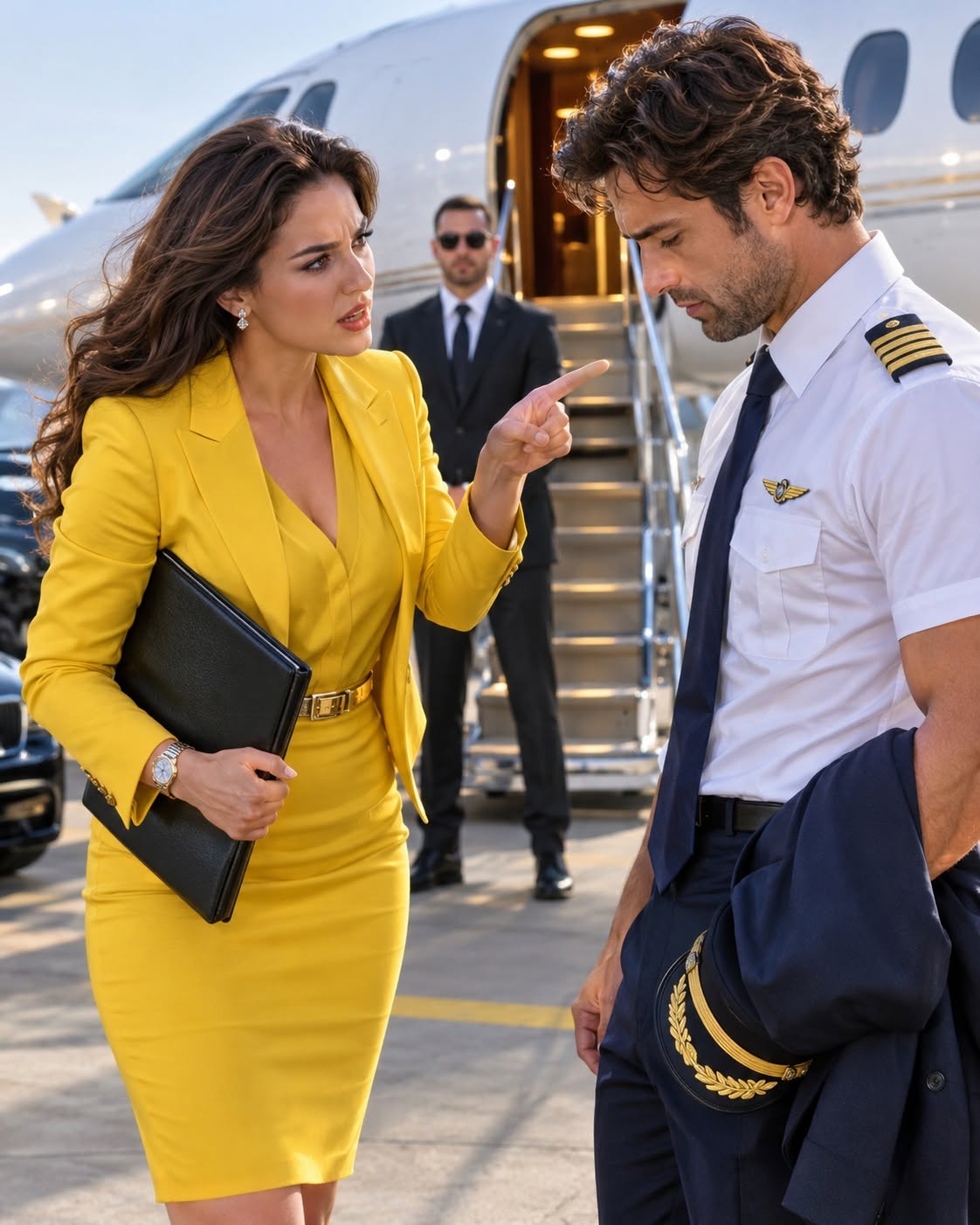
The billionaire CEO stood on the Palm Beach tarmac, pointed at my chest, and ordered security to revoke my credentials
The next few days were exhausting.
There were long nights, difficult inspections, and moments when I wondered whether we would ever get the aircraft back into service. Every component had to be examined, every maintenance entry verified, and every questionable signature investigated.
But the deeper we went, the more disturbing things became.
On the twenty-third day of the inspection, one of our engineers discovered something that changed everything.
A small electronic module had been installed behind the aircraft’s primary avionics panel. It wasn’t listed in the approved configuration documents, and it wasn’t part of the original engineering design.
At first, the team assumed it was an unauthorized tracking device.
Then we discovered what it actually did.
It could interfere with certain maintenance diagnostic signals, making intermittent system faults appear resolved during routine checks.
In other words, someone had deliberately designed a way to make a dangerous aircraft look perfectly healthy on paper.
I stared at the module for nearly a minute.
“Who installed this?” Kendra asked.
Nobody answered.
I examined the serial number and took several photographs.
Then I recognized something.
The manufacturing code belonged to a small electronics supplier that had appeared repeatedly in Arnold’s maintenance invoices.
The same supplier that had received more than $600,000 through his brother-in-law’s company.
“Don’t remove anything else,” I told the engineers. “Photograph the installation, preserve the connections, and notify the investigators. I want an independent technical examination before anyone touches it.”
Kendra looked at me.
“Are you saying Arnold knew about this?”
“I’m saying someone spent a considerable amount of money making sure these defects wouldn’t appear in the records. We need to find out who authorized it.”
That evening, I received a call from the FBI investigator assigned to the financial investigation.
His name was Special Agent Robert Collins.
“Mr. Hayes, we need to ask you about something we found in Arnold Wick’s office.”
“What is it?”
“A document authorizing an additional $1.8 million in aircraft modification expenses. Your electronic signature appears on the approval.”
I immediately sat upright.
“That’s impossible. I’ve never approved anything like that.”
“We thought you might say that.”
He explained that the document had been submitted electronically using my employee credentials approximately eight months earlier.
The authorization included a digital signature and a verification code.
But there was one problem.
I had been in Virginia at the time, attending my daughter’s school enrollment appointment. My flight records and personal calendar could establish that.
More importantly, I had never possessed the financial authorization required to approve a modification of that size.
Someone had used my identity to conceal a much larger scheme.
“Agent Collins, I have something you should examine.”
I sent him the original maintenance logs, my handwritten notes, and the photographs I’d taken during inspections.
There was a long pause.
“Mr. Hayes, I think your situation is considerably more serious than we initially understood.”
“What do you mean?”
“We’re no longer investigating only fraudulent invoices. We’re investigating whether someone intentionally falsified aircraft safety records and used your credentials to authorize unauthorized modifications.”
For the first time, I felt something colder than anger.
Fear.
Not for myself.
For the people who had been sitting inside that aircraft, trusting the instruments in front of them.
And Kendra was one of those people.
The following morning, she asked me to meet her in William’s old office.
It had remained almost untouched since his death.
The wooden desk, the leather chairs, and the framed photographs of aircraft still occupied their original places.
She was holding a sealed envelope.
“Elsa found this in a locked cabinet,” she said. “It’s addressed to you.”
I recognized the handwriting immediately.
William Blackwood.
My closest friend.
The man who had helped me survive the darkest period of my life.
I opened the envelope carefully.
Inside was a letter dated two months before he died.
Daniel,
If you’re reading this, I probably didn’t get the chance to tell you everything I wanted to say.
I’ve watched you rebuild your life after losing Sarah. I’ve watched you raise Nia while pretending that you aren’t exhausted. And I’ve watched you put your daughter’s happiness ahead of every opportunity that might have made you rich again.
I admire that more than you know.
But there’s something I want you to understand.
You were never just another employee to me.
You helped build something important, and you deserve to have a voice in how it’s protected.
I’ve made arrangements to ensure that your professional independence and your responsibilities as a father are respected.
Don’t let anyone convince you that doing the right thing makes you less valuable.
Some people measure success by the size of their bank accounts.
I measure it by the people who can sleep peacefully because someone like you was willing to stand up when it mattered.
William.
I read the letter twice.
Then I folded it and placed it back inside the envelope.
Kendra watched me quietly.
“My father talked about you often,” she said. “I knew you had worked with him, but I didn’t realize how close you were.”
“He was there when I had nothing left.”
She lowered her eyes.
“He also left instructions that I should never allow the company to compromise the safety of its aircraft for financial convenience.”
I looked at her.
“Then why did you?”
The question landed harder than I intended.
Kendra didn’t become defensive.
Instead, she pulled a chair away from the desk and sat down.
“Because I thought I was running the company my father built. I thought being decisive meant making difficult decisions quickly. Arnold understood that about me. He knew I hated delays, hated uncertainty, and hated hearing that something couldn’t be done.”
She paused.
“He learned how to tell me exactly what I wanted to hear.”
I nodded slowly.
“That’s how people like him survive.”
She looked up.
“And that’s how people like me let them.”
For the first time, I began to understand that Kendra wasn’t simply a wealthy executive who had made a mistake.
She was a woman who had inherited an empire, surrounded herself with people who never challenged her, and confused loyalty with obedience.
It didn’t excuse what she had done to me.
But it explained how it had happened.
“Daniel, I need to ask you something.”
“What?”
“If the investigation proves that someone deliberately compromised the aircraft, will you help us rebuild the entire aviation division?”
I considered the question.
Then I answered honestly.
“I’ll help you make it safe. Whether that means rebuilding the division or shutting it down is something we’ll have to determine.”
She nodded.
“Fair enough.”
But our problems weren’t over.
On the thirty-first day, Arnold Wick made his next move.
At 6:42 in the morning, I received a call from Gus.
“Daniel, turn on your television.”
A local news station was reporting that an anonymous source had accused Blackwood Industries of employing an unqualified pilot who had secretly performed unauthorized maintenance on a multimillion-dollar aircraft.
My photograph appeared on the screen.
The report claimed that I had purchased aircraft components without authorization, manipulated inspection records, and concealed dangerous defects from company management.
It was almost impressive how thoroughly the truth had been turned upside down.
Within an hour, three aviation industry publications had repeated the allegations.
My phone started ringing.
Former colleagues called to ask what was happening.
An old friend from the Navy sent me a message saying he hoped the story wasn’t true.
Then I received an email from a private aviation recruiter withdrawing an employment offer.
I sat at the kitchen table, staring at the screen.
Nia was eating cereal across from me.
“Daddy?”
I turned toward her.
“Yes, sweetheart?”
“Are you sad?”
I forced a smile.
“Just thinking about something.”
She studied my face for a moment.
“Did someone say you were bad at fixing airplanes?”
I looked at her.
“Why would you ask that?”
“Because yesterday you were happy. Today you look like when Mommy went to heaven.”
That sentence nearly broke me.
I reached across the table and held her little hand.
“Sometimes people say things that aren’t true, sweetheart. But that doesn’t change who we are.”
She nodded.
“Then don’t worry. I know you’re good.”
I kissed her forehead.
And I made a decision.
I wasn’t going to let Arnold turn my daughter into another casualty of his lies.
At 9:15, I called Agent Collins.
He told me investigators had already identified the source of the leak.
Arnold had been communicating with a former Blackwood communications consultant who had access to confidential personnel information.
But there was another discovery.
The fraudulent maintenance invoices weren’t the only financial misconduct.
Arnold had been transferring money into accounts connected to a company registered overseas. Investigators believed the payments were part of an attempt to purchase influence over the company’s upcoming investor agreement.
And that agreement was worth far more than the $2.2 million he’d stolen.
Blackwood Industries was preparing to sell a controlling interest in its aviation logistics division.
If the deal closed, Arnold would receive a substantial performance bonus.
His brother-in-law’s company would also receive a long-term maintenance contract.
The entire scheme had been designed to survive the sale.
If anyone discovered the fraud afterward, the responsibility would be buried beneath a new corporate structure.
And I had almost been the perfect person to blame.
That afternoon, Kendra called an emergency board meeting.
This time, she didn’t ask me to explain myself.
She asked me to present the evidence.
I stood before the board members with a presentation containing photographs, maintenance logs, financial records, and independent engineering findings.
I didn’t raise my voice.
I didn’t accuse anyone without documentation.
I simply explained what had happened.
When I finished, one of the directors leaned forward.
“Mr. Hayes, if these allegations are accurate, why didn’t you report everything directly to the FAA sooner?”
It was a fair question.
I took a breath.
“I reported the defects through the company’s established safety channels. I documented the problems, submitted maintenance discrepancies, and requested corrective action. When the records continued to show repairs that hadn’t happened, I began preserving independent evidence.”
“But you continued working on the aircraft.”
“Only within the limits of my qualifications and the applicable maintenance procedures. When an issue required licensed maintenance personnel or formal approval, I escalated it. I never authorized the aircraft to fly in an unsafe condition.”
The director nodded.
Another board member spoke.
“And what would you recommend now?”
I looked around the room.
“First, an independent safety office with authority to ground any aircraft without executive interference. Second, a complete audit of every maintenance provider. Third, protection for employees who report safety concerns. And finally, I recommend postponing the aviation division sale until the investigation is complete.”
The room became uncomfortable.
Kendra sat at the head of the table.
She knew what that recommendation meant.
The sale represented nearly a quarter of the company’s expected annual growth.
But she didn’t hesitate.
“I agree with Daniel.”
The board voted to suspend the transaction.
For the first time, Kendra had chosen an uncomfortable truth over an easy financial victory.
Two days later, the FAA issued a formal notice requesting additional documentation concerning the aircraft’s modified avionics configuration.
I spent the entire morning preparing the technical records.
Then Agent Collins called again.
“We’ve located the person who installed the unauthorized module.”
“Who?”
“Arnold’s brother-in-law. His name is Marcus Bell.”
I leaned back.
“Is he cooperating?”
“Not exactly. But he has something interesting to say.”
Apparently, Marcus had kept copies of several conversations with Arnold.
One recording contained a discussion about the aircraft’s recurring hydraulic warnings.
Arnold could be heard saying that the problems were temporary and that the aircraft needed to remain available until the investor meeting.
Marcus had questioned whether the equipment was safe.
Arnold’s response was chilling.
“Nobody checks the technical details. They check the paperwork. Make the paperwork clean, and everybody gets paid.”
I closed my eyes.
For months, I had been fighting against a system built on that exact belief.
Paperwork mattered.
But reality mattered more.
Agent Collins told me there was also a reference to a planned departure scheduled for the week after my termination.
The original intention had been to fly Kendra and two investors to a private meeting in the Bahamas.
If the replacement captain hadn’t discovered the defects during his inspection, the aircraft might have departed.
I thought about the passengers.
About Nia.
About the possibility that I might have spent the rest of my life wondering whether I could have prevented something terrible.
That evening, I drove home later than usual.
At 3:15, I had already picked up Nia, as promised.
We stopped at a small ice cream shop before going home.
She chose strawberry.
I chose nothing because I wasn’t particularly hungry.
While she ate, she looked at me and asked, “Daddy, when will your airplane be fixed?”
I smiled.
“When we’re absolutely sure it’s safe.”
“Even if it takes a long time?”
“Especially if it takes a long time.”
She considered that.
Then she said something that stayed with me.
“Mommy used to say good things shouldn’t be rushed.”
I looked down at her.
Sarah had said that countless times.
And somehow, hearing those words from our daughter made me feel as though a part of her was still sitting beside us.
The forty-seventh day finally arrived.
The G700 had undergone extensive inspections, replacement of compromised components, independent testing, and a complete review of its modified avionics system.
The unauthorized module had been removed under regulatory supervision.
The maintenance records had been reconstructed using verifiable documentation.
Every outstanding discrepancy had been addressed.
The FAA’s technical review team arrived that morning.
I met them at the hangar with Gus and the independent maintenance specialists.
For nearly six hours, they examined the aircraft.
They reviewed the engineering documentation, questioned the technicians, and inspected the systems themselves.
At one point, an inspector approached me.
“Mr. Hayes, your documentation is unusually thorough.”
“Thank you.”
“Why did you keep so many photographs?”
I smiled faintly.
“Because memories are unreliable. Records shouldn’t be.”
He nodded.
At 4:18 p.m., the inspection team completed its review.
The aircraft was not automatically cleared for commercial operation, but the required technical corrections had been accepted, and the remaining approval process was formally underway.
It was the first real sign that our work had paid off.
Kendra stood beside me, looking at the aircraft.
“Forty-seven days,” she said.
“Forty-seven days of finding things that shouldn’t have been there.”
She turned toward me.
“Do you think we’ll ever get back to normal?”
I considered that question.
“No.”
Her expression fell slightly.
Then I continued.
“But maybe that’s a good thing.”
She looked at me.
“We shouldn’t want to return to the way things were. The way things were allowed this to happen.”
She was quiet for a moment.
Then she nodded.
The following week brought another surprise.
The board approved my appointment as Chief Aviation Safety and Engineering Officer.
The position came with a substantial salary, independent oversight authority, and the ability to suspend any flight operation when safety requirements weren’t met.
But I insisted on something else.
I asked the company to establish a scholarship program for children of employees who had lost a parent.
Kendra looked at me across the boardroom table.
“Why that?”
“Because I know what it feels like to lose everything and wonder how you’re going to give your child a future.”
She didn’t answer immediately.
Then she said, “We’ll fund it.”
The program was named the William Blackwood Family Opportunity Fund.
Its first recipients were children of mechanics, ground crew members, and maintenance technicians.
People whose names rarely appeared in company announcements but whose work kept everyone else safe.
Meanwhile, Arnold’s situation deteriorated.
The FBI executed search warrants at several properties connected to the fraudulent maintenance companies.
Investigators recovered financial records, falsified invoices, deleted emails, and communications showing that Arnold had attempted to conceal evidence after my termination.
He was eventually indicted on multiple federal charges related to fraud, conspiracy, and falsification of aviation records.
Marcus Bell agreed to cooperate with investigators.
The case would take months to resolve.
I didn’t attend Arnold’s first court appearance.
I had more important things to do.
At 3:15 that afternoon, I was sitting in a preschool parking lot, waiting for my daughter.
A few weeks later, Kendra asked me to accompany her to the hangar.
The G700 was undergoing its final operational checks following the completion of the required regulatory approvals.
The replacement captain stood beside the aircraft, reviewing his checklist.
Kendra approached me.
“Would you mind telling me something?”
“What?”
“Do you still hate me?”
The question caught me off guard.
I looked at her for a moment.
“No.”
She seemed relieved.
“But I haven’t forgotten what happened.”
Her expression changed.
“I understand.”
“Forgiving someone doesn’t mean pretending they didn’t hurt you. And it doesn’t mean giving them permission to do it again.”
She nodded slowly.
“I suppose I needed to hear that.”
We stood quietly as the technicians completed their work.
Then Kendra said something unexpected.
“My father used to tell me that the best people in a company are the ones who can afford to walk away from it.”
I smiled.
“William said a lot of things like that.”
“He said you were one of those people.”
I looked at the aircraft.
“I think he was talking about something more important than money.”
“What’s that?”
“Principles. If you only do the right thing when someone is watching, you don’t really have principles. You have an audience.”
Kendra didn’t respond.
But I could tell she understood.
A month later, the company held a small ceremony to recognize the employees who had helped restore the aircraft’s safety systems.
There were no celebrities, no television cameras, and no extravagant speeches.
Just engineers, mechanics, pilots, technicians, and their families.
Nia wore a little blue dress and carried a drawing she’d spent the previous evening making.
When I stepped onto the stage, she waved both hands.
I smiled at her.
Then I looked at the people standing in front of me.
“I want to thank everyone who refused to accept an easy answer when a difficult question needed to be asked,” I began.
“For a long time, I thought my job was simply to keep an aircraft flying. I was wrong. My job was to make sure the people who trusted that aircraft could come home.”
I paused.
“There’s something else I’ve learned. A company isn’t protected by its reputation, its wealth, or the titles printed on its executives’ business cards. It’s protected by the people who are willing to tell the truth when telling the truth becomes expensive.”
The room fell silent.
“And if there’s one thing I hope we remember, it’s this: Never punish the person who brings you bad news just because you don’t like hearing it. Sometimes the warning you ignore is the disaster you spend the rest of your life wishing you’d prevented.”
People stood and applauded.
But I wasn’t looking at them.
I was looking at Nia.
After the ceremony, she ran toward me and wrapped her arms around my waist.
“Daddy, you were on a stage!”
I laughed.
“I was.”
“Does that mean you’re famous now?”
“Not even close.”
She thought about it.
“Well, you’re famous to me.”
I picked her up.
And for the first time in years, I felt completely at peace.
Not because my career had been restored.
Not because I had a better title or a larger paycheck.
But because I had finally reached a place where the two most important parts of my life no longer seemed to be competing with each other.
My daughter had her father.
And I had my purpose.
That evening, I took Nia to the airport observation deck.
The sun was setting over the runway, painting the clouds orange and gold.
A business jet rolled toward the departure end of the runway.
Nia pressed both hands against the glass.
“Where’s that airplane going?”
“Somewhere important, I suppose.”
“Will you ever fly again?”
I smiled.
“Maybe. But only when the right reasons come along.”
She looked up at me.
“What’s the right reason?”
I thought for a moment.
“Getting people where they need to go safely. And coming home to the people who need you.”
She nodded as if that made perfect sense.
Then she reached into her little backpack and pulled out a folded piece of paper.
“I made something for you.”
It was another airplane drawing.
This time, there were two people standing beside it.
One was tall.
The other was very small.
Above them, in uneven letters, she had written:
DADDY ALWAYS COMES HOME.
I couldn’t speak for several seconds.
I knelt down and hugged her tightly.
“That’s the best airplane drawing I’ve ever seen.”
She giggled.
“Because I made it?”
“Because it reminds me what’s important.”
Years later, people would remember the Blackwood aviation scandal as a major corporate fraud investigation.
They would remember the millions of dollars stolen, the executive who was convicted, and the company that had nearly destroyed its own reputation.
Some would remember the billionaire CEO who had fired a pilot and later apologized.
But I remembered something different.
I remembered a four-year-old girl waiting at preschool.
I remembered a friend who had believed in me when I couldn’t believe in myself.
I remembered the mechanics who refused to sign documents they knew were false.
And I remembered the moment on that Palm Beach tarmac when I could have shouted, argued, or begged for my job.
Instead, I walked away.
Not because I was powerless.
Not because I didn’t know my worth.
But because I had finally learned that my worth didn’t depend on whether someone like Kendra Blackwood recognized it.
Sometimes the strongest response isn’t proving your value to the person who underestimated you.
It’s refusing to abandon the values that made you valuable in the first place.
And sometimes, the greatest success isn’t the career you rebuild, the money you earn, or the title you receive.
It’s the promise you keep to the little person waiting for you at 3:15.
Because an airplane can always be repaired.
A company can always be rebuilt.
A reputation can sometimes be restored.
But childhood doesn’t wait for anyone.
And no amount of money in the world can buy back an afternoon you promised your child you’d be there.
I had spent years making sure other people could reach their destinations.
It took losing almost everything to understand that my most important destination had been waiting for me at home all along.