The bank director looked at my worn-out clothes, laughed, and ordered security to throw me out.
THE BANK DIRECTOR HUMILIATED A HOMELESS-LOOKING FATHER—THEN DISCOVERED WHO HE REALLY WAS
The officer’s next question made the entire room go quiet.
“Sir, before we proceed, I need to ask you something. Are you the same Commander Daniel Hayes who received the Navy Cross for rescuing seventeen American soldiers during the operation in Kandahar?”
I stared at him for a moment.
“Yes, officer. That was a long time ago.”
The officer slowly lowered his notepad.
“Sir, I thought you were dead.”
A murmur spread through the bank.
The director froze.
“What did you just say?”
The officer turned toward him.
“Mr. Whitmore, the man standing in front of you isn’t just a former Navy SEAL. He’s a decorated combat veteran who spent more than fifteen years serving this country. He was responsible for saving the lives of several members of my unit.”
The director’s expression changed from confusion to disbelief.
He looked at my worn jacket, my faded jeans, and the little girl holding my hand.
Then he looked at the four criminals lying on the floor.
For the first time that morning, he had absolutely nothing to say.
But I wasn’t interested in his reaction.
“Officer, the security guard needs medical attention. His name is Frank. Please make sure he gets the best care possible.”
“We already have paramedics on the way, Commander.”
I nodded and turned toward my daughter.
She was still trembling.
I knelt and brushed a strand of hair away from her face.
“Are you okay, sweetheart?”
She nodded, although tears were running down her cheeks.
“Did you make the bad men go away?”
I smiled.
“Yes, baby. They’re not going to hurt anyone anymore.”
She wrapped her little arms around my neck.
And right there, in the middle of a bank that had treated us like we were worthless, I realized something.
I had spent years trying to become invisible.
But perhaps it was time to stop hiding.
THE MAN BEHIND THE WORN-OUT JACKET
My name is Daniel Hayes.
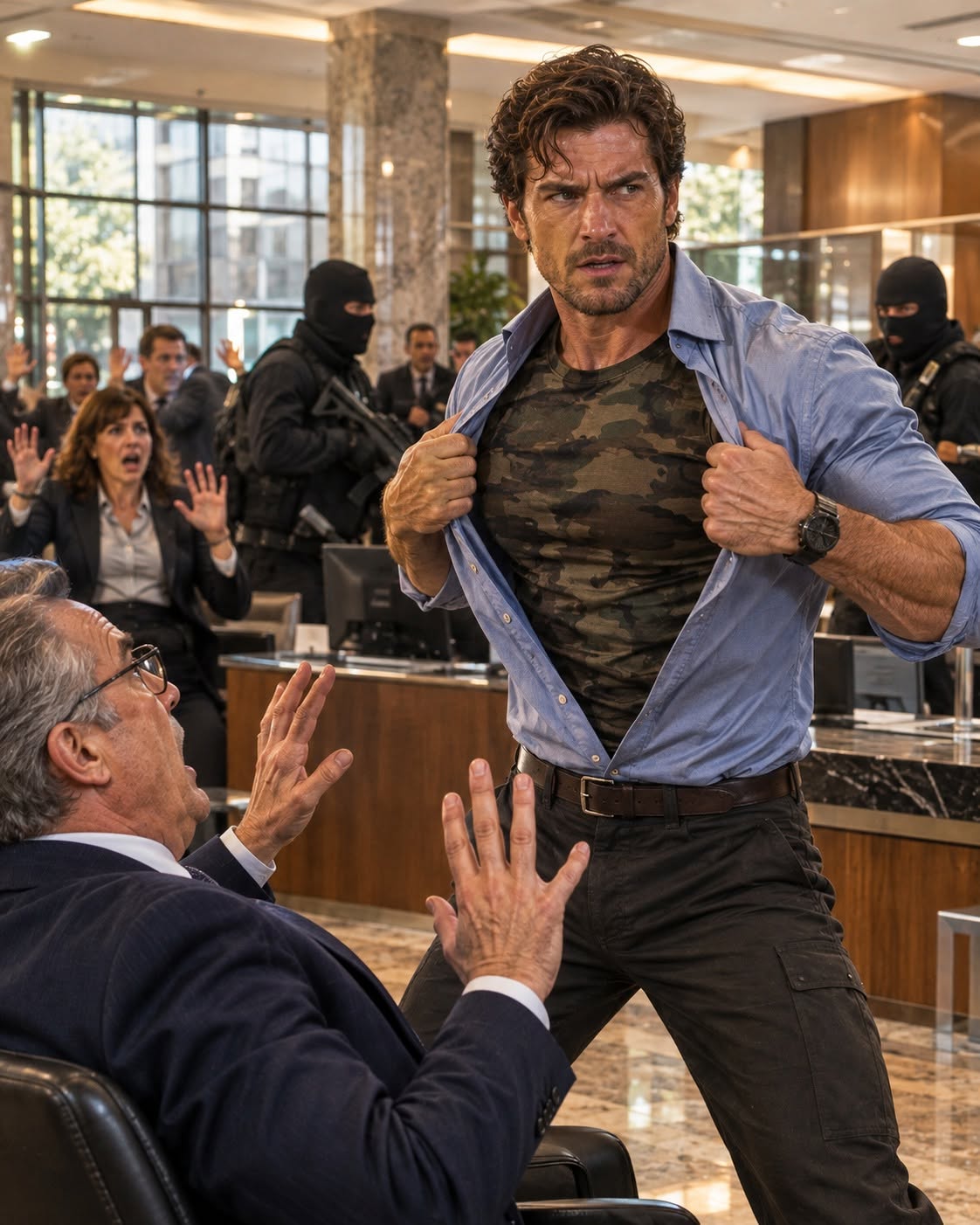
I was forty-three years old, a former Navy SEAL, a widower, and the father of a seven-year-old girl named Lily.
For most of my adult life, I had lived by one rule: never talk about what happened overseas.
People didn’t need to know how many missions I’d completed, how many men I’d lost, or how many nights I had spent staring at the ceiling because sleep brought back memories I couldn’t escape.
After retiring from the military, I met a woman named Emily.
She was a schoolteacher with a laugh that could brighten the darkest room.
She didn’t care about medals or military stories.
She cared about whether I remembered to buy milk, whether I helped with the dishes, and whether I was home in time for dinner.
For the first time, I understood what peace felt like.
We bought a modest house outside the city.
It had a small garden, a creaky front porch, and a bedroom that Emily painted yellow when she was pregnant with Lily.
She used to say that the house wasn’t beautiful because of its walls.
It was beautiful because of the people inside it.
Then, three years ago, cancer took her.
One day, she was sitting beside me, laughing at something on television.
A few months later, I was standing beside her hospital bed, holding her hand while the monitors went silent.
I never imagined that losing someone could make an entire world disappear.
But it did.
I tried to keep going for Lily.
I took a maintenance job at a local warehouse because it offered steady hours and health insurance. I sold my motorcycle, stopped eating out, and canceled almost every expense that wasn’t essential.
Even then, the bills kept coming.
Emily’s treatment had consumed most of our savings.
When I fell behind on the mortgage, I asked the bank for an extension.
That was how I ended up in Mr. Whitmore’s office.
And that was how the worst morning of my life became something neither of us would ever forget.
THE DIRECTOR’S FIRST MISTAKE
While police officers interviewed witnesses, Mr. Whitmore stood near the reception desk, speaking quietly with his assistant.
He kept glancing in my direction.
Eventually, he approached.
“Mr. Hayes?”
I looked up.
“Yes?”
He cleared his throat.
“I believe there has been a misunderstanding.”
I almost laughed.
A misunderstanding?
He had mocked a grieving father in front of his employees. He had ordered security to remove me without even listening to my situation.
And now he wanted to call it a misunderstanding.
“What exactly was misunderstood?” I asked.
He shifted his weight.
“Well, the situation earlier… I wasn’t aware of your military background.”
I looked directly into his eyes.
“Would that have changed how you treated me?”
He hesitated.
“Of course. I mean, we have tremendous respect for military personnel.”
“That’s not what I asked.”
His jaw tightened.
“Mr. Hayes, I was simply following bank policy.”
I glanced around the lobby.
A woman was comforting her elderly mother. A young employee was cleaning broken glass from the floor. One of the robbers was being placed in handcuffs.
“Your policy didn’t force you to laugh at me,” I said. “It didn’t force you to humiliate my daughter. You made those choices yourself.”
His face turned red.
Before he could answer, a police officer approached us.
“Mr. Hayes, we need you to come with us for a statement. Also, there’s something you should know about the robbery.”
“What is it?”
The officer glanced toward the director.
“One of the suspects had documents in his possession that appear to connect him to an employee of this bank.”
Whitmore immediately stiffened.
“What kind of documents?”
“That’s what we’re trying to determine.”
The officer opened a small evidence bag.
Inside was a folded sheet of paper containing several account numbers, employee identification codes, and a handwritten list of security procedures.
The director stared at it.
Then he whispered something that caught my attention.
“That’s impossible.”
The officer looked at him.
“Do you recognize it?”
“No. I mean… I don’t know what that is.”
But his expression told a different story.
And I had learned a long time ago that fear often revealed more than words.
THE SECRET INSIDE THE BANK
An hour later, I was sitting in a small conference room at the police station.
Lily was beside me, drawing flowers on the back of an old receipt.
An officer named Detective Morgan entered.
He was in his late fifties, with tired eyes and a calm voice.
“Mr. Hayes, I want to thank you for helping those people today.”
“I just did what anyone should have done.”
He shook his head.
“Most people don’t move toward danger when they have a chance to escape it.”
I didn’t respond.
He placed a folder on the table.
“We’ve been investigating a series of suspicious withdrawals involving this bank for nearly six months. Several customers reported unauthorized transfers. The amounts were relatively small, but they happened repeatedly.”
I frowned.
“What’s that got to do with the robbery?”
“We believe the robbery wasn’t simply an attempt to steal cash. The suspects may have been looking for access to certain internal records.”
He showed me a photograph of the man who had led the attackers.
“His name is Marcus Vance. He’s been connected to organized financial crimes in three states.”
I looked at the photograph.
“Why would someone like that target a neighborhood bank?”
“Because someone inside may have been helping him.”
Detective Morgan explained that several suspicious mortgage modifications had been processed over the previous year. Customers who had fallen behind on payments were sometimes charged unexplained fees, while others discovered that their loan balances had increased despite making payments.
The pattern was complicated.
But there was one thing that caught my attention.
“How many families were affected?”
“At least forty-two. We’re still investigating.”
I leaned back.
Forty-two families.
Forty-two people who might have been frightened, confused, and desperate.
People who might have been treated like they were the problem.
“Do you know who authorized these changes?” I asked.
“We’re looking at several senior employees, including the branch director.”
I looked down at Lily.
She had drawn a little house with a yellow roof.
“Detective, I don’t know anything about banking. But if someone is taking advantage of people who are already struggling, I hope you stop them.”
He nodded.
“We intend to.”
Then he paused.
“There’s one more thing. The injured security guard asked about you.”
“Frank?”
“Yes. He’s stable. The bullet passed through his upper arm, and doctors believe he’ll recover. He wants to thank you personally.”
I let out a breath I hadn’t realized I was holding.
“Can I see him?”
“Once the hospital clears visitors.”
For the first time that day, I felt something close to relief.
THE MAN WHO REMEMBERED MY NAME
Frank was discharged from the hospital two days later.
His arm was bandaged, and he walked with a slight stiffness, but he was smiling when I arrived.
“Well, I’ll be damned,” he said. “The quiet guy from the bank.”
I shook his good hand.
“How are you feeling?”
“Like somebody tried to turn my arm into Swiss cheese.”
Lily giggled.
Frank smiled at her.
“And who is this little soldier?”
“This is my daughter, Lily.”
She stepped forward and handed him a drawing.
It showed four stick figures lying on the floor, a tall man standing nearby, and a little girl behind a counter.
At the top, in uneven letters, she had written: MY DADDY IS BRAVE.
Frank studied it carefully.
“Well, sweetheart, I think your daddy is lucky to have you.”
He folded the drawing gently and placed it in his pocket.
Then he looked at me.
“Daniel, there’s something I need to tell you.”
“What is it?”
“That director has been treating people badly for years. I saw it every week. Elderly customers, single mothers, veterans… anyone who didn’t look important enough.”
He lowered his voice.
“I used to tell myself it wasn’t my business. I was just security. I needed the paycheck.”
He looked down at his bandaged arm.
“Yesterday, I realized how wrong I was.”
I sat beside him.
“Frank, you tried to protect those people. That’s what matters.”
He shook his head.
“No. What matters is what we do when nobody is watching.”
His words stayed with me long after we left.
THE PHONE CALL THAT CHANGED EVERYTHING
Three days after the robbery, my phone rang.
It was Detective Morgan.
“Mr. Hayes, we have a development.”
“What happened?”
“We executed a search warrant at the bank yesterday. We found records connecting the director to the fraudulent mortgage transactions.”
I sat down.
“How serious?”
“Very. There were forged authorization forms, altered account statements, and payments routed through a consulting company owned by his brother-in-law.”
I closed my eyes.
“So the director was involved?”
“We believe he played a central role. We’re still establishing the full extent of his involvement.”
Then the detective added something unexpected.
“There’s also evidence that Marcus Vance was hired to destroy certain records before our investigation reached them.”
I looked toward Lily, who was watching cartoons on the couch.
“Does that mean the robbery was planned?”
“That’s our current theory. The men were supposed to retrieve a storage device containing transaction records. When the operation went wrong, they took hostages.”
I thought about the people in that lobby.
The terrified woman.
The elderly customers.
The young teller crying behind her desk.
All of them had been placed in danger because powerful people believed they could manipulate others without consequences.
“Is Whitmore under arrest?”
“He’s being questioned. His attorneys are already involved.”
I thanked the detective and ended the call.
For several minutes, I simply sat there.
Then Lily walked over.
“Daddy?”
“Yes, sweetheart?”
“Are the bad people going to take our house?”
I pulled her onto my lap.
“No, baby. And even if we ever have to move, we’ll still have each other.”
She thought about that.
“Would Mommy still know where we live?”
My throat tightened.
I kissed her forehead.
“Your mommy would find us anywhere.”
She smiled and rested her head against my chest.
I wished I could promise her that nothing bad would ever happen again.
But I knew better.
All I could promise was that she would never have to face it alone.
THE BANK’S BIGGEST SURPRISE
The following Monday, I received an unexpected invitation.
The bank’s regional president wanted to meet me.
I almost declined.
I had no interest in becoming a public hero or appearing on television.
But Detective Morgan suggested that attending might help protect the customers affected by the investigation.
So I agreed.
When I entered the regional office, I found three executives waiting around a long conference table.
A woman in her early sixties stood and introduced herself.
“Mr. Hayes, I’m Margaret Collins, regional president of First National Community Bank.”
I shook her hand.
“Nice to meet you.”
She gestured toward a chair.
“Please, have a seat.”
A folder was placed in front of me.
Inside were copies of my mortgage records, payment history, and the original extension request.
Margaret looked uncomfortable.
“First, I want to apologize for the way you were treated at our branch.”
I nodded.
“Thank you.”
“Second, our internal review has uncovered irregularities in your account.”
I frowned.
“What kind of irregularities?”
She turned a page.
“Your mortgage was incorrectly assessed several penalty fees. In addition, a payment you made last year was never properly credited.”
I stared at the documents.
“Are you saying I wasn’t as far behind as the director told me?”
“That’s correct.”
She continued.
“Once we correct the errors, your outstanding balance will be substantially lower than previously reported.”
I felt a strange mixture of anger and relief.
For months, I had believed I was failing my family.
I had skipped meals, taken extra shifts, and sold almost everything I could.
And now I was learning that some of my suffering had been caused by deliberate dishonesty.
“Why are you telling me this?” I asked.
Margaret folded her hands.
“Because we intend to correct every affected account. Your mortgage will be placed under independent review, and all improper fees will be refunded.”
I looked at her.
“What about the other forty-one families?”
“Every one of them will receive a review.”
“Not just the families who complain?”
She nodded.
“Not just the families who complain.”
I leaned forward.
“Then put that in writing.”
Margaret seemed surprised.
I continued.
“People who are struggling financially often don’t know how to fight a bank. Some are elderly. Some don’t have lawyers. Some are embarrassed to ask questions. If you only help the people who know how to demand it, you’re going to miss the ones who need it most.”
The room became quiet.
Margaret exchanged a glance with the other executives.
Then she nodded.
“You’re right. We’ll establish a dedicated review team and contact every potentially affected customer.”
For the first time, I felt that someone in that building was actually listening.
THE DIRECTOR’S FINAL REQUEST
Two weeks later, I received another call.
This time, it was from Richard Whitmore.
He was no longer the confident director who had ordered security to throw me out.
His voice sounded exhausted.
“Mr. Hayes, I was hoping you might agree to meet with me.”
I almost hung up.
But something made me pause.
“Why?”
“I owe you an apology.”
I looked out the window.
“An apology?”
“Yes.”
He continued.
“I know my behavior was unacceptable. I know what happened at the bank was partly my responsibility.”
I said nothing.
He sighed.
“I have a family too, Mr. Hayes. I made mistakes. I was under pressure. I thought I was protecting my position.”
“By hurting people?”
“I know how that sounds.”
“It sounds like you made a choice.”
He went silent.
Then he said something that surprised me.
“My father lost his business when I was a boy. I remember standing outside a bank while people told him he wasn’t worth helping. I promised myself I’d never be powerless like that.”
I listened.
“Somewhere along the way, I became the person I hated.”
For a moment, I felt sorry for him.
But sympathy did not erase responsibility.
“Mr. Whitmore, I’m sorry for what happened to your father. But you don’t get to turn your pain into someone else’s punishment.”
“I understand.”
“Do you?”
He didn’t answer.
Finally, he asked, “Would you consider speaking on my behalf? If the investigators know you’re willing to accept my apology, perhaps…”
I interrupted him.
“No.”
His voice dropped.
“Why not?”
“Because an apology isn’t a favor you purchase with someone else’s forgiveness.”
He breathed heavily.
“I see.”
I continued.
“If you truly regret what happened, tell the truth. Cooperate with the investigation. Help the families recover their money. Accept whatever consequences come.”
He was silent for several seconds.
Then he whispered, “I suppose that’s fair.”
I ended the call.
I didn’t feel victorious.
I didn’t feel satisfied.
I simply hoped that, for once, he would do the right thing without expecting a reward.
A LETTER FROM A LITTLE GIRL
About a month later, the bank held a small gathering to recognize the people who had helped during the robbery.
I didn’t want to attend.
But Frank called me personally.
“Daniel, you don’t have to give a speech. Just come. There’s someone who wants to meet you.”
So Lily and I went.
The gathering was held in a community center, not inside the bank.
There were police officers, medical personnel, employees, and several customers who had been present during the attack.
Frank stood near the entrance, wearing a sling and a clean blue shirt.
When he saw us, he raised his good hand.
“There’s my favorite family.”
Lily ran toward him.
“Mr. Frank!”
He laughed.
A few minutes later, Margaret Collins approached with a microphone.
She thanked the police, the emergency responders, and the employees who had helped protect customers.
Then she spoke about the families whose mortgage accounts had been affected.
“Today, we are announcing an independent customer protection program. Every affected account will be reviewed, improper charges will be refunded, and customers facing genuine hardship will have access to a dedicated assistance team.”
People applauded.
I stood quietly at the back.
Then Margaret said my name.
“There’s one more person we would like to recognize. Daniel Hayes.”
I felt Lily squeeze my hand.
I walked forward reluctantly.
Margaret handed me a small plaque.
“Your courage saved lives that day. But what impressed us even more was your insistence that the bank take responsibility for the people it had failed.”
I accepted it.
“Thank you.”
Then I turned toward the audience.
“I appreciate the recognition. But I want to say something.”
The room grew quiet.
“I didn’t walk into that bank expecting anyone to admire me. I walked in as a father who had lost his wife and was trying to keep a roof over his daughter’s head.”
I looked around.
“Some of you were in that lobby. You saw what happened. You saw how quickly people can become afraid. You also saw how quickly strangers can become family when things go wrong.”
I paused.
“Being strong doesn’t mean having a military background. It doesn’t mean knowing how to fight. Sometimes strength is the person who calls an ambulance. Sometimes it’s the employee who hides a customer behind a desk. Sometimes it’s the stranger who holds someone’s hand while they’re terrified.”
My voice softened.
“And sometimes strength is simply asking for help when your pride tells you not to.”
I looked down at Lily.
“That’s something I hope my daughter remembers.”
The applause began slowly.
Then it filled the room.
But the most important moment came afterward.
A woman approached me with a teenage boy.
“Mr. Hayes, I was in the bank that morning,” she said. “I wanted to thank you.”
I nodded.
“You’re welcome.”
She hesitated.
“My husband lost his job last year. We fell behind on our payments. We were too embarrassed to ask for help.”
She glanced at the boy.
“After seeing what happened to you, I realized we shouldn’t be ashamed of struggling.”
I smiled.
“Nobody should.”
She took my hand.
“Thank you for reminding us.”
THE HOUSE WITH THE YELLOW BEDROOM
Three months passed.
The investigation moved forward, and the bank began compensating customers whose accounts had been improperly altered.
Whitmore eventually pleaded guilty to financial crimes connected to the scheme. He agreed to cooperate with investigators and provide information about the other people involved.
The four men responsible for the robbery faced serious criminal charges.
Frank completed physical therapy and returned to work, although he was given a less physically demanding position.
As for me, the bank corrected my mortgage balance.
The improper charges were removed, and I received a refund for the money that had been taken from my account.
More importantly, I was granted a temporary hardship arrangement that gave me enough time to get back on my feet.
I picked up additional work repairing equipment at a local veterans’ center.
It wasn’t glamorous, but it paid the bills.
One Saturday morning, Lily and I were in the garden.
She was planting flowers beside the porch.
“Do you think Mommy would like these?” she asked.
I looked at the little yellow flowers in her hands.
“She would love them.”
“More than roses?”
“Definitely.”
Lily smiled.
Then she looked at me with an expression I recognized.
It was the same thoughtful look Emily used to give me whenever she was about to ask something important.
“Daddy, why didn’t you tell the bank director you were a Navy SEAL?”
I considered the question.
“Because I didn’t think he needed to know.”
“But then he wouldn’t have been mean to you.”
I knelt beside her.
“Maybe. But sweetheart, here’s something you need to understand. You shouldn’t have to be famous, rich, strong, or important for someone to treat you with kindness.”
She frowned slightly.
“Why?”
“Because every person deserves respect. Even when they have nothing to offer you.”
She looked down at her flowers.
“Even the people who are poor?”
“Especially them.”
She thought about it for a moment.
Then she planted another flower.
“I want to be nice to everybody.”
I smiled.
“That’s a good place to start.”
THE MAN WHO CAME BACK
Six months after the robbery, I received a handwritten letter.
It was from Richard Whitmore.
I almost put it aside, but the envelope had my name written carefully across the front.
Inside was a single page.
“Mr. Hayes,
I don’t expect you to forgive me. I don’t even know whether I deserve to ask.
I have spent much of my life believing that respect came from money, position, and the ability to make other people listen.
When you stood in my office, I saw a man I considered unsuccessful. I never bothered to ask what he had endured to get there.
I now understand that my greatest failure wasn’t simply the financial misconduct. It was the way I treated people when I believed they had no power.
I have accepted responsibility for my actions and will continue cooperating with the authorities.
I also wanted you to know that the bank has completed its first round of customer reviews. Several families have received refunds and revised payment arrangements.
I know this doesn’t undo what happened.
But I wanted to tell you that your words stayed with me.
Richard Whitmore.”
I read the letter twice.
Then I folded it and placed it inside a drawer.
I didn’t forgive him immediately.
Maybe I never would.
But I didn’t need to spend the rest of my life carrying anger either.
Some people change because they finally understand the pain they’ve caused.
Others don’t.
That was his journey, not mine.
My responsibility was to make sure Lily grew up knowing that cruelty wasn’t something she had to accept, and that kindness wasn’t something she had to earn.
THE LAST SURPRISE
Nearly a year after the robbery, I was invited to a small ceremony at the veterans’ center.
I assumed it was another recognition event.
I was wrong.
When Lily and I arrived, Frank was waiting near the entrance.
He looked healthier than ever.
“Daniel, there’s somebody inside who wants to see you.”
“Who?”
He smiled.
“Go find out.”
We entered the main hall.
There were about thirty people sitting in chairs.
At the front stood Margaret Collins, Detective Morgan, and a woman I had never met.
Margaret stepped forward.
“Daniel, we have something we’d like to ask you.”
I looked at the woman beside her.
She introduced herself as Sarah Bennett, the director of a new nonprofit organization called Safe Harbor Families.
“We provide emergency financial assistance and legal guidance to families facing housing insecurity, particularly veterans and surviving spouses.”
I nodded.
“That’s wonderful.”
She smiled.
“We’ve been looking for someone to help us build a community outreach program. Someone who understands what it means to serve others, but also understands what families experience when life becomes difficult.”
I began to suspect where this was going.
She continued.
“We’d like to offer you the position of community program coordinator.”
I stared at her.
“Me?”
“Yes. The position is paid, full-time, and comes with benefits.”
I glanced at Lily.
She was looking up at me, smiling.
“I don’t have a degree in social work,” I said.
Sarah shook her head.
“We can provide training. What we can’t teach is the kind of understanding that comes from having been on the other side of a difficult situation.”
Frank stepped forward.
“And before you say no, I already told them you’re stubborn.”
Everyone laughed.
I looked around the room.
For years, I had believed that my military career was the most meaningful thing I would ever do.
I had spent my life protecting people in dangerous places.
But perhaps there was another way to serve.
A quieter way.
One that didn’t require a weapon or a battlefield.
I looked at Sarah.
“When would you need me?”
She smiled.
“Whenever you’re ready.”
I extended my hand.
“Then let’s get started.”
Lily jumped up and hugged my waist.
“Does this mean we’re going to help other families, Daddy?”
I lifted her into my arms.
“Yes, sweetheart. That’s exactly what it means.”
THE PROMISE
A year later, Safe Harbor Families had helped more than two hundred households avoid losing their homes.
Some received emergency financial assistance.
Others were connected with attorneys, employment opportunities, or counseling services.
We also established a program to help children whose families were experiencing financial hardship.
Lily named it the Yellow House Project.
She said every child deserved a place that felt safe, even when the grown-ups were having a difficult time.
The name stayed.
And every month, she helped me place small yellow flowers in the garden outside our community office.
One afternoon, as I was locking the front door, I noticed an elderly man standing near the entrance.
His clothes were worn.
His hands were shaking.
He held a folder against his chest.
“Excuse me,” he said. “I was told you might be able to help me.”
I stepped forward.
“Of course. Come inside.”
He looked embarrassed.
“I don’t know if I qualify. I’ve fallen behind on my rent, and my daughter doesn’t know I’m here. I didn’t want to bother anybody.”
I recognized that expression immediately.
It was the expression I had worn in Whitmore’s office.
I pulled out a chair.
“First, take a breath. You’re not bothering anyone.”
He sat down slowly.
Then he began explaining his situation.
I listened.
I didn’t interrupt.
I didn’t look at his clothes.
I didn’t ask why he hadn’t planned better.
I simply listened.
After a while, Lily came out of the back office carrying two cups of hot chocolate.
She placed one in front of the man.
“Here you go, sir.”
He smiled.
“Thank you, sweetheart.”
She returned to her coloring book.
The man looked at her, then back at me.
“She’s a lovely little girl.”
“She is.”
He hesitated.
“You’re lucky.”
I smiled.
“More than you know.”
That evening, as Lily and I drove home, she asked me a question.
“Daddy, do you remember the bank?”
“Of course.”
“Do you remember the man who laughed at you?”
I looked at her in the rearview mirror.
“I do.”
“Do you think he knows he was wrong?”
I thought about the letter, the investigation, and everything that had happened since that terrible morning.
“I think he’s learning.”
Lily nodded.
Then she said something that made me smile.
“Well, I hope he learned that people aren’t their clothes.”
I reached over and gently squeezed her hand.
“That’s a very important lesson, sweetheart.”
We turned onto our street.
Our little house stood beneath the evening sky, its porch light glowing warmly.
The yellow bedroom was still there.
Emily’s flowers were growing in the garden.
And for the first time in a long while, I felt that we were going to be okay.
I had once believed that saving people meant standing between them and danger.
Now I understood that it could also mean standing beside them when they had nowhere else to turn.
The bank director had looked at my worn clothes and decided I was worthless.
He had judged me by what he could see and ignored everything he couldn’t.
But the greatest lesson that day wasn’t that I had once been a Navy SEAL.
It wasn’t that I had saved four hostages or stopped four armed criminals.
It wasn’t even that the bank eventually admitted its wrongdoing.
The greatest lesson was much simpler.
A person’s worth is never measured by the clothes they wear, the money in their account, the house they own, or the position they hold.
You never know what someone has survived.
You never know how hard they are fighting to keep their family together.
And you never know whether the person standing quietly in front of you is one act of kindness away from believing in humanity again.
So be careful how you treat people when you think they have nothing to offer you.
Because dignity should never depend on status.
Kindness should never depend on wealth.
And respect should never have to be earned through suffering.
Sometimes, the person you look down on is the very person who will remind you what it means to be human.
THE END