Ten minutes before my first advanced training flight in eleven years, Commander Rodrigo Valenzuela took one look at the roster
The document lay between us, its corners worn and its surface marked with faded pencil lines. I recognized the coordinates immediately. They belonged to the archival maps I had spent years studying, including the forgotten route to the abandoned landing strip near the old mine.
But Commander Rodrigo Valenzuela wasn’t looking at the successful flight paths.
He was staring at a small handwritten notation in the lower-right corner of the page.
“Where did you learn about this mark?” he asked.
I leaned forward. Beneath a series of elevation figures, someone had drawn a tiny triangle with a line through its center. I had seen that symbol dozens of times in the archives, but I had never thought it meant anything beyond an old surveyor’s reference.
“My father taught me to recognize it,” I answered cautiously. “He used to say that the smallest marks on a map were sometimes the ones that mattered most.”
Valenzuela’s expression changed.
“Your father was a mechanic here?”
“Yes, sir. He worked on aircraft engines for years before he died.”
He lowered himself into the chair opposite me and turned the document over.
On the back was a photograph so old that its edges had begun to yellow. Six men stood beside a military aircraft on a runway, their uniforms faded by time. One of them was unmistakably Commander Valenzuela, much younger, with a full head of dark hair and the confident smile of a man who believed experience could protect him from anything.
Beside him stood another officer.
I recognized that face, too.
It was my father.
For several seconds, neither of us spoke.
“My father never told me he had worked with you,” I whispered.
“Because I asked him not to.”
The words struck harder than I expected.
Valenzuela folded his hands, then unfolded them again, as though searching for the courage to continue.
“Twenty-three years ago, your father helped maintain the aircraft involved in an emergency training operation. I was the lead pilot. The man standing beside me in this photograph was Captain Esteban Morales, my closest friend.”
He paused.
“Esteban died during that operation.”
I had heard fragments of that tragedy over the years. An aircraft lost in poor visibility. A navigation failure. A rescue team that arrived too late. The story had become a warning repeated during training, its details buried beneath official reports and the passage of time.
But I had never imagined my father had been part of it.
“What does that have to do with the coordinates?” I asked.
Valenzuela slid the document toward me.
“Everything.”
He explained that the aircraft had encountered a sudden instrument malfunction during a storm over the same mountain range. The crew had attempted to follow the standard return route, but a sudden shift in the weather had pushed them toward a narrow valley. Their last transmission indicated that they believed they were above safe terrain.
They were wrong.
The aircraft struck a ridge hidden beneath the clouds.
The investigation concluded that the crew had relied on unreliable instrument readings and outdated navigation information. No one had been formally blamed, but the accident changed the base forever. New procedures were introduced. Several routes were abandoned, and the surviving pilots were instructed to avoid unfamiliar landing grounds.
Valenzuela had carried that lesson into every decision he made afterward.
“I convinced myself that the safest pilot was the one who followed the approved procedures without question,” he said. “I stopped asking whether those procedures were enough.”
“And my father?”
Valenzuela looked at the photograph again.
“Your father discovered something during the investigation. He believed the crew’s navigation instruments had not failed in the way the report described. He found evidence that the aircraft’s backup compass had been giving inaccurate readings long before the flight.”
My heart began to pound.
“Why wasn’t that included in the report?”
“Because the maintenance records were incomplete. The aircraft had undergone several repairs, and no one could establish exactly when the problem began. Your father insisted that the discrepancy mattered. He wanted the entire fleet inspected.”
“Was he ignored?”
Valenzuela’s silence answered before his words did.
“He was told there wasn’t enough evidence to justify grounding the aircraft. The base was under pressure to resume operations, and the investigation had already reached its conclusion.”
I stared at the photograph, trying to reconcile the father I remembered with this newly revealed part of his life. The man who had taught me to listen to engines, who had shown me how to recognize a failing component by its smallest vibration, had once challenged an official explanation because he believed a machine was telling a different story.
“What happened to his findings?” I asked.
Valenzuela opened a folder beneath the document.
“Your father preserved copies of the original measurements. He believed the same problem might exist in other aircraft. He marked the affected navigation systems on the old maps, hoping someone would eventually understand the connection between the terrain, the instrument errors, and the routes that could become dangerous when those errors occurred.”
I looked again at the tiny triangle.
Suddenly, it no longer seemed insignificant.
“That symbol marks a location where the magnetic readings can become unreliable,” I said slowly. “The old survey notes mention unusual mineral deposits near the mine. If a compass is already giving inaccurate readings, that area could make the error worse.”
Valenzuela nodded.
“Your father believed the same thing.”
A chill moved through me.
The abandoned landing strip had been more than a forgotten place on an old map. It was part of a network of landmarks my father had studied because he understood how easily a pilot could be betrayed by a faulty instrument.
And that morning, I had unknowingly used his work to guide six aircraft away from danger.
“Sir,” I said, “did anyone ever inspect the navigation systems my father identified?”
“Some were inspected. Others were replaced over time. The original records were eventually archived, and the issue was considered resolved.”
“Considered resolved,” I repeated.
The phrase tasted bitter.
Valenzuela seemed to hear it.
“I know what you’re thinking. We need to determine whether those records still have operational significance.”
“No,” I replied, looking him directly in the eyes. “We need to determine whether the problem ever truly disappeared.”
For the first time since I had entered the tower, he did not interrupt me.
He closed the folder and stood.
“Tomorrow morning, we begin a full review of the navigation systems on this base. I want you involved.”
I hesitated.
“Why me?”
“Because you recognized the terrain when our instruments became unreliable. Because you used information that everyone else had forgotten. And because you have a personal connection to the original investigation that I should have acknowledged before today.”
He took a breath.
“But I won’t ask you to trust me simply because I apologized. I know I haven’t earned that.”
It was the first thing he had said that made me believe his apology might become something more than a moment of embarrassment.
“I’ll help,” I said. “But I want access to the original maintenance logs, the accident report, and every navigation discrepancy recorded since then.”
“You’ll have it.”
“And I want the inspections conducted independently. If we find a problem, I don’t want anyone deciding it’s harmless before the evidence is examined.”
Valenzuela studied me for a moment.
“Agreed.”
When I left the tower that evening, the sun was sinking behind the mountains. The six pilots I had guided home were gathered near the hangar, speaking quietly among themselves. Captain Alonso Beltrán approached me as I passed.
“I owe you an apology,” he said.
I stopped.
“For what?”
“For taking your place without asking why you had been removed from the roster. I knew you’d trained for that flight. I should have questioned the decision.”
I had expected defensiveness, perhaps even resentment. Instead, I found a tired man who had spent the afternoon confronting how close he had come to disaster.
“You didn’t know what was going to happen,” I said.
“Neither did you. But when it did, you helped us.”
He held out his hand.
“I hope I get the chance to fly with you someday.”
I shook it.
“You’ll get your chance. Just promise me you’ll never confuse confidence with certainty.”
A faint smile crossed his face.
“After today, I don’t think I’ll make that mistake again.”
That night, I barely slept.
I spread copies of the old maps across my kitchen table and compared them with the coordinates recorded during the emergency. I checked each aircraft’s estimated position against the terrain contours, then reviewed my calculations until I could explain every decision I had made.
At first, everything appeared consistent.
Then I noticed a discrepancy.
One aircraft had reported a heading correction that should have taken it farther from the abandoned landing strip. Yet its recorded track showed it moving toward the correct approach corridor.
I checked the numbers again.
The discrepancy remained.
My father’s old note lay beside the maps. I unfolded it carefully, its creases softened by years of being carried in my pocket.
Machines tell you what they can measure. Wisdom begins when you ask what they cannot.
I had always interpreted that sentence as a lesson about engines. Now I wondered whether he had been trying to warn me about something larger.
The following morning, I arrived at the maintenance hangar before sunrise.
Chief Technician Mara Ortega was already there, reviewing the inspection schedule. She had worked at the base for nearly thirty years and had known my father personally. When I showed her the old records, she became unusually quiet.
“I remember these markings,” she said. “Your father used to argue that we were treating symptoms instead of investigating causes.”
“Did you believe him?”
“I did. But I was a junior technician then. I didn’t have the authority to challenge the investigation.”
She tapped the page.
“If these discrepancies are still appearing, we need to know whether they’re isolated faults or signs of a wider problem.”
We began with the aircraft that had returned last.
Its primary navigation unit passed the initial test. The backup system did not.
The discrepancy was small, appearing only under certain simulated conditions. A reading would drift, stabilize, and then drift again. It was subtle enough to escape a routine inspection but significant enough to send an aircraft off course over unfamiliar terrain.
Mara repeated the test.
The same error appeared.
Neither of us spoke.
We inspected the remaining aircraft. Two showed similar anomalies. A fourth had an outdated component whose replacement interval had been incorrectly recorded. The final two passed our initial checks, but their systems required additional testing before we could declare them safe.
By midday, the base commander had ordered the affected aircraft grounded pending a comprehensive review.
Then the situation became more complicated.
An engineer from regional command arrived that afternoon carrying a preliminary report. According to his assessment, the discrepancies were too minor to justify suspending the entire training program. He argued that the aircraft could continue operating under enhanced monitoring while replacement components were obtained.
Mara read the report twice.
“Enhanced monitoring won’t help if the error goes unnoticed until the instruments disagree,” she said.
The engineer remained unconvinced.
“These systems are certified. We can’t shut down operations every time someone finds an irregularity.”
I recognized the argument immediately. It was the same reasoning that had buried my father’s concerns years earlier.
I stepped forward.
“Certification tells us that a system met its requirements under specified conditions. It doesn’t prove that the system will remain reliable under every combination of weather, terrain, and equipment failure.”
The engineer looked at me.
“And you propose we ground the fleet based on a handful of anomalies?”
“I propose we investigate before we expose another crew to a risk we already know exists.”
“You were removed from a training flight yesterday, weren’t you?”
The question was delivered with a thin smile, as though my history made my findings less credible.
For a moment, I felt the old humiliation rising inside me.
Then I remembered the voices coming through the radio, each one frightened and searching for a direction.
“This isn’t about my flight,” I said. “It’s about whether the evidence supports your conclusion.”
Commander Valenzuela entered the hangar before the engineer could respond.
“I’ve reviewed the results,” he announced. “The affected aircraft will remain grounded until an independent technical assessment is complete.”
The engineer protested that the decision would disrupt the training schedule.
“Then we will adjust the schedule,” Valenzuela replied. “We will not adjust the facts to preserve it.”
It was a small victory, but I understood how important it was. A dangerous assumption had finally met resistance before it could become another tragedy.
Over the next three days, the technical team worked around the clock. The investigation uncovered a combination of aging components, inconsistent maintenance records, and a software update that had never been properly validated against certain backup instruments. None of these issues alone explained every anomaly. Together, however, they created a chain of vulnerabilities that could become critical when severe weather and difficult terrain were involved.
The findings were sent to regional command with a recommendation for corrective action across every affected aircraft.
The old accident report was reopened for review.
My father’s original measurements were attached as supporting evidence.
For the first time in more than two decades, his warning was no longer buried in an archive.
But the most difficult moment came when Valenzuela asked me to accompany him to a memorial ceremony for Captain Esteban Morales and the other personnel lost in past training accidents.
The ceremony took place beneath a stone monument overlooking the runway. Families stood beside serving officers, and the morning air carried the distant sound of aircraft engines from another sector of the base.
Valenzuela spoke first.
He described the responsibility carried by every commander, not only to make decisions quickly but also to question the beliefs that shaped those decisions. He admitted that fear had made him too dependent on familiar methods and too dismissive of people whose experience differed from his own.
Then he turned toward me.
“I once believed that protecting my people meant preventing them from taking unfamiliar risks,” he said. “I understand now that protection also requires the courage to examine the risks we have already accepted.”
He asked me to speak about my father.
I had prepared nothing.
For a moment, I considered declining. I had spent years trying to make my achievements speak louder than other people’s assumptions, and standing before a crowd to discuss my father’s legacy felt strangely intimate.
But I stepped forward.
“My father never believed that machines were perfect,” I began. “He believed they deserved to be understood. When something failed, he didn’t ask who could be blamed first. He asked what had been overlooked, what could be learned, and how the same failure could be prevented from hurting someone else.”
I looked toward the monument.
“I think people deserve the same patience. We are all capable of mistakes, but our greatest danger begins when we decide that our experience makes us incapable of being wrong.”
The gathering remained silent.
Then Mara began to applaud. Others joined her, including the pilots who had returned through the storm.
I did not feel triumphant.
I felt grateful that a lesson my father had struggled to make others hear had finally reached them.
Two weeks later, regional command approved a new training initiative for navigation and emergency recovery. The program would combine traditional flight instruction with terrain analysis, instrument-failure simulations, and the study of historical incidents. Pilots would learn not only how to operate modern systems but also how to recognize when those systems could no longer be trusted.
Commander Valenzuela recommended me to lead the unit.
This time, the recommendation came with a formal review of my qualifications, an independent assessment of my performance, and an opportunity to present my proposed training plan before a selection board.
I passed.
On the day my appointment became official, I stood in the same control tower where I had watched six aircraft vanish into the fog. The room looked unchanged, but I did not.
Valenzuela entered carrying a flight authorization form.
“Your advanced training flight has been rescheduled,” he said.
I glanced at the document.
My name appeared in the space reserved for the pilot.
For a moment, I could not speak.
Eleven years of preparation had led me to that simple line of ink. I had imagined this moment so often that I had expected to feel nothing but satisfaction.
Instead, I felt the weight of every person who had helped me reach it, every hour I had spent studying forgotten maps, and every doubt I had learned to carry without allowing it to define me.
“Are you ready?” Valenzuela asked.
I looked through the window at the waiting aircraft.
“Yes, sir.”
He nodded.
Then, just as I turned to leave, he added, “There is something else you should know. The review board has recommended that your father’s original maintenance findings be included in the base’s permanent technical training archive.”
I held the authorization form more tightly.
“Thank you.”
“Don’t thank me for correcting something that should have been corrected years ago.”
His voice softened.
“Your father was right to keep asking questions. We should have listened.”
I wanted to tell him that my father would have appreciated those words. I wanted to say that perhaps, if he had heard them earlier, he would have felt less alone in the years when his warnings were dismissed.
Instead, I simply nodded.
Some regrets could be acknowledged without ever being fully repaired.
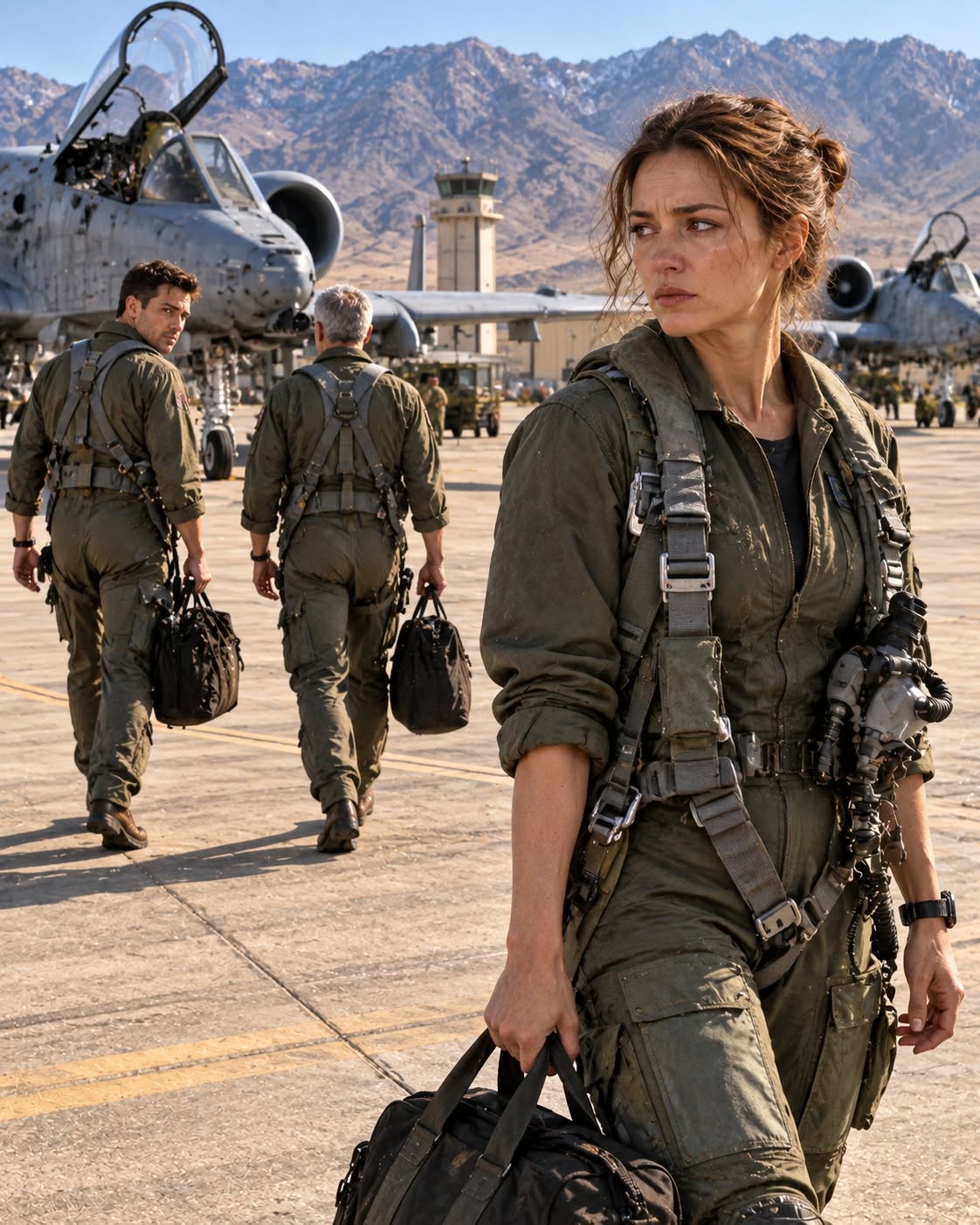
The morning of my flight arrived clear and cold. I walked across the tarmac with my helmet beneath my arm, hearing the familiar rhythm of engines warming inside the hangar. Captain Beltrán was among the pilots preparing for the day’s exercises.
When he saw me, he raised a hand in greeting.
“Try not to make the rest of us look bad,” he called.
I laughed, and the sound surprised me. For so long, I had treated every flight as an examination of my worth. Now I understood that I could learn from others without needing to defeat them.
Before climbing into the cockpit, I took my father’s old note from my pocket.
The paper had grown fragile, and the writing had faded, but I knew every word.
I folded it carefully and placed it inside the pocket of my flight suit.
Then I climbed aboard.
The aircraft lifted smoothly from the runway, and the base fell away beneath me. Mountains stretched toward the horizon, their ridges bright in the morning sun. I followed the assigned route, checked my instruments, and listened to the steady rhythm of the engine.
For the first time in eleven years, I was exactly where I had worked so hard to be.
Yet the moment did not feel like the end of a struggle.
It felt like the beginning of a responsibility.
I thought about the six aircraft trapped in the storm, about the narrow window in which a correct calculation could mean the difference between survival and disaster. I thought about the maintenance team that had refused to dismiss an inconvenient result, and about the commander who had finally learned that leadership was not the same as being certain.
Most of all, I thought about my father.
He had spent his life repairing machines that others had given up on. He had taught me that a tiny irregularity could reveal a greater failure, that experience mattered only when it remained open to new evidence, and that doing the right thing sometimes meant speaking when nobody wanted to listen.
I had once believed that earning my place in the cockpit would prove I had been right all along.
I knew better now.
My worth had not changed when Valenzuela crossed out my name. It had not increased when he apologized, and it would not be diminished by any future mistake I might make. What mattered was how I prepared, how honestly I faced the facts, and how I treated the people whose lives depended on my decisions.
When the training flight ended, I brought the aircraft back safely and completed every required procedure before shutting down the engine.
As I climbed from the cockpit, the crew chief approached with a clipboard.
“Everything within parameters,” he reported.
I smiled.
“Good. Let’s check the records anyway.”
He looked surprised, then nodded and followed me toward the hangar.
Above us, the sky remained wide and blue.
I knew there would be difficult days ahead. Equipment would fail. Weather would change. People would make decisions under pressure, and some would resist admitting that they had overlooked something important. No training program could eliminate every danger, and no pilot could promise that every flight would end safely.
But we could learn. We could listen. We could question the assumptions that made us comfortable and investigate the warnings that made us uneasy.
And we could remember that the most dangerous mistake was not always the one made in the cockpit.
Sometimes it began on the ground, when someone decided that another person’s voice was not worth hearing.
My father had taught me to listen to engines because they could reveal truths that words concealed.
Life had taught me to listen to people for the same reason.
I had not won by proving that Commander Valenzuela was a bad man or that I was a perfect pilot. I had found something more valuable: the courage to act with integrity when resentment offered an easier path, and the patience to turn an old wound into a lesson that could protect others.
That evening, I returned home and placed the faded photograph of my father beside the note he had left me. I no longer saw either as a reminder of what I had lost. Together, they represented the work he had begun and the responsibility I had chosen to continue.
I touched the edge of the photograph and whispered, “I finally understand.”
Forgiveness, I realized, was not the same as forgetting. It did not require me to excuse unfairness or pretend that a painful mistake had never happened. It meant refusing to let that mistake dictate my next choice.
And courage was not simply the willingness to fly into a storm.
Sometimes it was the willingness to question a trusted system, challenge a confident authority, or admit that the person standing beside you might see something you had missed.
The next morning, when I arrived at the base, a new trainee was waiting outside the navigation classroom. She looked nervous, clutching a stack of notes against her chest while several experienced pilots discussed the day’s exercises nearby.
I recognized the expression on her face. It was the look of someone who had worked hard to earn a place in a room where she was not yet certain she belonged.
I stopped beside her.
“First day?”
She nodded.
“I’m worried I’ll make a mistake.”
“You will,” I said gently. “So will I. So will everyone in this building, sooner or later.”
Her eyes widened.
I smiled.
“What matters is whether you prepare, whether you speak up when something seems wrong, and whether you’re willing to learn when someone corrects you. Never let anyone convince you that asking a question makes you weak.”
She glanced toward the classroom door.
“And if nobody listens?”
I thought of the old maps, the storm, and the six aircraft returning one by one through the fog.
“Then make your case with evidence,” I told her. “Find people who will examine that evidence honestly. And whatever happens, don’t let someone else’s refusal to recognize your ability become the measure of your worth.”
She straightened slightly.
“Thank you, ma’am.”
I watched her enter the classroom, then turned toward the hangars, where the day’s engines were beginning to roar.
For eleven years, I had chased a place in the sky because I wanted to prove that I deserved it.
Now I understood that the real purpose of reaching that place was not to stand above other people.
It was to see danger clearly, to help others find their way through it, and to remember that every life entrusted to us mattered more than our pride.
My father had been right.
Engines don’t lie.
But neither does character, when it is tested by the choices we make under pressure.
And sometimes, the person whose name is crossed off the roster is the very person who can teach an entire base how to listen.