Seven years ago, I saved a billionaire’s life in a collapsing building. Last week, his daughter walked into my little auto repair shop
The first Monday of my new job began at 6:15 in the morning, with a cup of cold coffee, a pile of paperwork, and a little girl standing in the kitchen doorway wearing mismatched socks.
“Dad?”
I looked up from the company laptop.
“Yeah, sweetheart?”
“Are you still going to pick me up today?”
The question was simple. The way she asked it wasn’t.
Chloe had been through enough changes since her mother died. She had watched me struggle through sleepless nights, learn how to make dinner without burning it, and pretend I wasn’t exhausted when she needed help with her homework. She had never complained about the small apartment above the garage or the fact that our vacations usually meant driving to a lake two hours away.
But she had noticed everything.
She noticed when I was worried. She noticed when customers called during dinner. And she noticed when I started looking at engineering drawings again.
I closed the laptop.
“Three o’clock,” I said. “I’ll be waiting outside your school. Same as always.”
She studied my face.
“Even if you’re busy?”
“Especially if I’m busy.”
She smiled, grabbed her backpack, and ran toward the front door.
I watched her leave, then looked at the laptop again.
For the first time in seven years, I was going back into the world I had once abandoned.
And I had no idea how much it was about to test me.
My first week at Vance Industries was a lesson in how much the corporate world had changed.
There were glass offices, executive assistants, conference rooms with enormous screens, and people who seemed to communicate almost entirely through calendar invitations.
My new office was on the fourteenth floor of the company’s regional headquarters in Nashville. It had a beautiful view of the city, a private conference table, and more square footage than my entire apartment.
I felt strangely uncomfortable sitting behind that desk.
Clara noticed.
“You look like someone just handed you the keys to a spaceship,” she said during my first morning.
“I’ve spent seven years fixing alternators and replacing brake pads. This is a little different.”
She laughed.
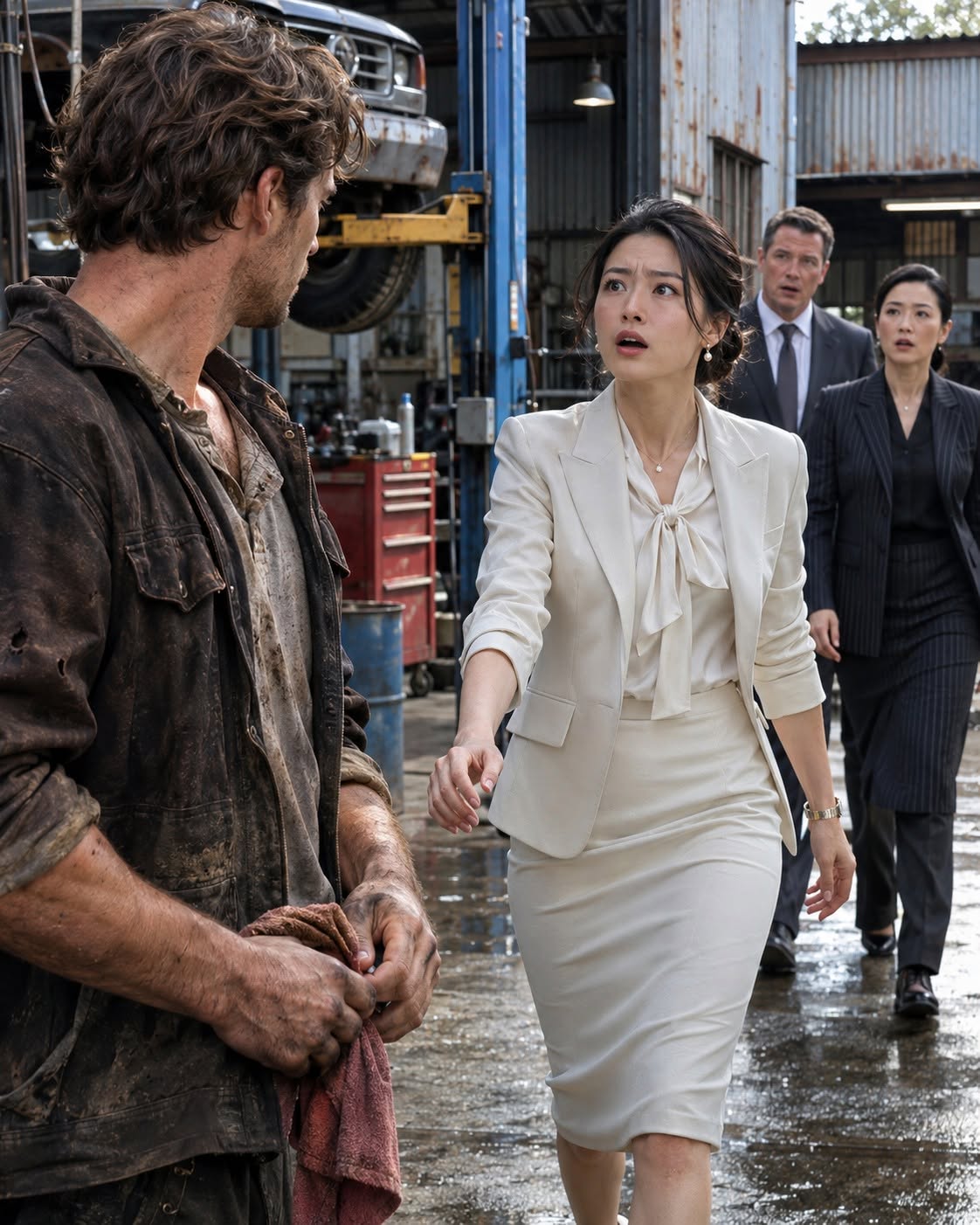
“You’ll figure it out.”
“I know how to inspect steel. I’m not sure I know how to manage three hundred engineers.”
“That’s why we hired you. Not because you know everything, but because you know what happens when people stop asking the right questions.”
I remembered Marcus Sterling’s expression when he dismissed me as a mechanic.
She was right about one thing.
I had learned something in that garage that no engineering textbook could teach.
A person’s job title didn’t determine whether they were worth listening to.
My responsibilities quickly became clear.
I would oversee safety reviews across twelve manufacturing facilities, supervise independent inspections, and report directly to Arthur and the board.
The first project was an audit of every major construction contract signed during Marcus’s tenure.
It was enormous.
There were hundreds of documents, thousands of invoices, and years of engineering decisions that needed to be examined.
I brought in a team of independent specialists and established one rule from the beginning.
Nobody would be allowed to approve their own work.
Every critical inspection would require two independent signatures, and every material supplier would undergo financial and technical verification.
Some executives complained.
They said the new procedures would slow down construction.
One vice president even suggested that I was creating unnecessary obstacles because of what had happened in Chattanooga.
I listened until he finished.
Then I asked him a question.
“If you were standing beneath a ceiling that you knew had been built with steel below specification, how much time would you be willing to save?”
He didn’t answer.
The new procedures stayed.
For the first few weeks, things went surprisingly well.
I attended meetings in Nashville, visited facilities in Georgia and Kentucky, and spent evenings reviewing reports after Chloe went to bed.
I also kept my promise to myself.
Every afternoon at 2:30, I closed my laptop.
At 3:00, I was outside Chloe’s school.
Sometimes she talked nonstop about her day. Sometimes she climbed into the passenger seat and said nothing.
I learned not to mistake silence for a problem.
One afternoon, she came out carrying a folded piece of paper.
“Look what I made.”
It was a drawing of our family.
There was a little girl in the middle, a woman with brown hair on one side, and a man holding a wrench on the other.
Above us, she had written:
MY TWO FAVORITE PEOPLE.
I stared at the drawing for a long moment.
“Where’s the new office?” I asked, trying to smile.
She pointed to a tiny building in the corner.
“That’s your other job.”
“And why am I holding a wrench?”
“Because you’re still my dad.”
I laughed, but my throat tightened.
That evening, I placed the drawing beside my computer.
It became the first thing I saw every morning.
Then, on a Thursday in late October, everything changed.
I was reviewing a safety report from a manufacturing facility outside Knoxville when I noticed something familiar.
The report contained measurements from a recently installed overhead crane support system.
The steel dimensions looked correct on paper, but the ultrasonic readings were inconsistent.
I checked the supplier information.
It was a company I recognized.
Redwood Industrial Materials.
The same supplier that had appeared in several of Evelyn’s fraudulent invoices in Chattanooga.
I immediately called Clara.
“Do you remember the shell company connected to Marcus’s brother-in-law?”
“Of course.”
“I think we’re looking at another version of the same operation.”
There was a pause.
“Are you certain?”
“No. But I want the Knoxville facility shut down until we know.”
Clara didn’t hesitate.
“Do what you need to do.”
Within an hour, I had contacted the facility manager and ordered an emergency inspection.
By the following morning, we had our answer.
Several critical support beams had been manufactured using steel that did not meet the required grade.
The crane system had not failed yet, but the defects were serious enough that continued operation could have caused a catastrophic accident.
The company immediately suspended operations in the affected section.
When I returned to Nashville, Arthur was waiting in my office.
He looked older than he had in Chattanooga. His hair was almost completely white, and he moved more slowly than I remembered.
But his eyes were still sharp.
“You found another one,” he said.
“I think so.”
He sat down.
“How many?”
“Possibly more than we know.”
He looked through the inspection report.
“Do you think Marcus was working alone?”
“I think Marcus was one person in a much larger system. Someone had to approve the suppliers, someone had to overlook the inspections, and someone had to make sure the paperwork looked clean.”
Arthur slowly closed the folder.
“Then we find everyone involved.”
For the next three weeks, my team worked almost around the clock.
Evelyn, who had been promoted to lead internal financial investigations, joined us.
She traced payments through several subcontractors and uncovered a network of shell companies operating across four states.
The pattern was disturbing.
Approved materials were being ordered at full price. Cheaper replacements were delivered to construction sites. The difference was divided among companies controlled by relatives, business partners, and former employees.
The paperwork was professionally prepared.
The inspection certificates looked legitimate.
And in several cases, the engineers who signed them had never visited the sites.
We discovered suspicious material deliveries at five facilities.
Three required immediate shutdowns.
One was already operating with a structural defect that could have caused a partial collapse.
Fortunately, we found it before anyone was hurt.
But the deeper we investigated, the more resistance we encountered.
An anonymous email arrived in my company inbox.
It contained a photograph of my daughter walking out of school.
Below it were six words.
SOME THINGS ARE BETTER LEFT ALONE.
I read the message twice.
Then I closed the laptop.
For several seconds, I couldn’t move.
I had spent seven years trying to build a safe, ordinary life for Chloe.
Now someone was bringing her into a corporate investigation.
I immediately called the school and arranged additional security procedures. I also contacted the authorities and informed Arthur.
He was furious.
“I’ll have security assigned to your family immediately.”
“I don’t want Chloe living like she’s in a fortress.”
“This is serious.”
“I know. But she’s ten years old. She deserves to feel like a child.”
Arthur went quiet.
Then he nodded.
“We’ll do this properly. Discreetly. But I won’t let anyone threaten your daughter.”
That evening, I sat beside Chloe while she finished her math homework.
She looked up from her notebook.
“Dad, why do you keep checking the window?”
I hadn’t realized I was doing it.
“Just making sure everything’s okay.”
She put down her pencil.
“Are we in trouble?”
I wanted to tell her no.
I wanted to tell her that everything was fine and that she never had to worry about anything.
But I had learned that children could recognize a lie long before they understood its purpose.
“Someone at my new job is making some bad decisions,” I said. “And I’m helping make sure people don’t get hurt.”
“Are they bad people?”
“Some of them, probably.”
“Are you scared?”
I looked at her.
“A little.”
She thought about that.
“Mom used to say being brave didn’t mean you weren’t scared.”
I felt something tighten in my chest.
“Your mother was right.”
Chloe reached across the table and took my hand.
“Then just be careful, okay?”
I promised her I would.
The following Monday, Evelyn called me at 7:20 in the morning.
“I found something,” she said.
Her voice was unusually quiet.
“Something about the supplier?”
“Something about the original Chattanooga project.”
I sat up straighter.
“What did you find?”
“The financial trail goes back further than we thought. And there’s a name you need to see.”
She sent me a document.
I opened it.
At the bottom of the payment authorization list was the name of Daniel Whitmore, former chief operating officer of Vance Industries.
I recognized the name immediately.
Whitmore had retired six months before the Chattanooga project began. He had been one of Arthur’s closest advisers and had personally recommended Marcus for the construction role.
But that wasn’t the most troubling part.
The records showed that Whitmore had continued receiving consulting payments from several companies connected to Redwood Industrial Materials.
Millions of dollars had moved through those accounts over four years.
I called Evelyn.
“Does Arthur know?”
“Not yet.”
“Don’t tell anyone until we have the complete evidence.”
“Agreed.”
I spent the next two days examining the original engineering records from Nagoya.
Something had bothered me ever since I saw the Knoxville measurements.
The steel substitutions were too consistent.
They weren’t random mistakes.
Someone was using the same technical strategy across multiple projects.
I pulled up the original designs I had created seven years earlier.
Then I compared them with the revised construction drawings from Chattanooga and Knoxville.
My stomach dropped.
The structural calculations had been altered.
Not carelessly.
Deliberately.
Someone had changed the load assumptions to make weaker materials appear acceptable on paper.
The revisions carried a digital approval certificate associated with the old engineering department.
But the approval date was impossible.
The certificate had been issued three months after the engineer whose credentials appeared on it had died.
I sat back.
This was no longer just financial fraud.
Someone had built an entire system designed to hide dangerous construction practices.
And someone high enough in the company had protected it.
Arthur called an emergency board meeting for Friday morning.
I prepared a complete technical report. Evelyn prepared the financial evidence. Clara gathered the project records.
The night before the meeting, I stayed in my office until almost midnight.
When I finally arrived home, Chloe was asleep on the couch.
There was a plate covered with aluminum foil on the kitchen counter.
Beside it was a note written in her uneven handwriting.
DAD,
I SAVED YOU SOME DINNER.
DON’T WORK TOO LATE.
LOVE, CHLOE.
I stood there for a long time.
Then I heated the food, sat at the kitchen table, and ate every bite.
I realized something important.
I had spent years believing that returning to engineering meant risking the life I had built.
But perhaps the real danger was allowing the people who had threatened that life to continue operating without consequences.
Friday morning arrived with heavy rain.
The boardroom was full when I entered.
Arthur sat at the head of the table.
Clara was beside him.
Evelyn had several folders arranged in front of her.
And across from us sat Daniel Whitmore.
He looked exactly like the polished executive I remembered from company photographs.
Silver hair. Expensive suit. Calm expression.
He even smiled when I walked in.
“It’s been a long time,” he said.
I didn’t return the greeting.
Arthur began the meeting.
Evelyn presented the financial records first.
She showed the shell companies, the fraudulent invoices, and the payment trails.
Whitmore listened without interrupting.
When she finished, he folded his hands.
“These transactions are being misunderstood,” he said. “I provided consulting services to legitimate businesses. I had no involvement in the construction decisions.”
Then I presented the engineering evidence.
I showed the original structural calculations, the altered load assumptions, and the false certification records.
I explained how the substitutions created dangerous conditions across multiple facilities.
Whitmore leaned back.
“Your findings are based on measurements taken by a mechanic who hasn’t worked as an engineer in seven years.”
I had expected that.
I placed another document on the table.
“This report was independently verified by three licensed structural engineers. Their measurements match mine.”
He looked at it.
For the first time, his expression changed.
Then he turned toward Arthur.
“You’re really going to destroy decades of business relationships because of this?”
Arthur looked at him sadly.
“No, Daniel. You’re the one who destroyed them.”
Whitmore’s confidence began to disappear.
But he still wasn’t finished.
He reached into his folder and removed a printed email.
“This is from seven years ago,” he said. “It concerns the Nagoya accident.”
My entire body went still.
He placed it in front of Arthur.
“The original inspection team had identified problems with the observation gallery before the collapse. There were recommendations to close it until repairs were completed.”
I looked at the email.
The date was familiar.
The sender was familiar too.
Daniel Whitmore.
He continued.
“The company was facing a major investor presentation. Closing the facility would have delayed the event. The recommendations were downgraded.”
The room became completely silent.
I felt the old memory return.
The twisting steel.
The falling concrete.
Arthur standing beneath the brace.
My arm taking the impact.
For seven years, I had believed that the collapse was the result of a serious construction failure.
Now I was learning that someone had known the structure was unsafe.
Arthur stared at the email.
“Did you know?” he asked.
Whitmore didn’t answer.
“Did you know people were working beneath that gallery?”
Whitmore finally spoke.
“I knew there were unresolved concerns. I didn’t believe the structure was going to fail.”
Arthur’s voice was quiet.
“You didn’t believe it, or you didn’t want to know?”
Whitmore looked away.
I studied the document again.
Then I noticed something.
The email included an attachment reference to an earlier inspection report.
I recognized the report number.
It was one I had personally submitted.
But the version attached to the email was not mine.
Someone had removed the section recommending immediate evacuation.
I looked at Arthur.
“The original report still exists in my personal archive.”
He turned toward me.
“Can you prove that?”
“I can.”
For the first time that morning, Whitmore looked genuinely frightened.
I had kept a copy of the original engineering files when I left the company. Not because I expected to use them again, but because I had always believed technical records should never disappear.
I sent the archived report to Evelyn.
Within minutes, she confirmed that its digital signature matched the original submission date.
The missing warning was there.
And beneath it was my recommendation that the observation gallery be closed immediately.
Arthur slowly stood.
“Daniel, you knew.”
Whitmore tried to speak.
But Arthur raised his hand.
“No more.”
The board voted unanimously to suspend Whitmore and refer the evidence to federal investigators.
By the end of the week, authorities had opened a formal investigation into the fraudulent contracts, falsified safety records, and the original Nagoya incident.
Marcus Sterling was also implicated in the wider scheme.
Several executives resigned.
Others cooperated with investigators.
The company announced that every affected facility would undergo independent inspection, regardless of cost or schedule.
It was the beginning of a long legal process.
But there was one thing I hadn’t expected.
Arthur called me into his office the following Monday.
He was standing beside the window, looking down at the city.
“I owe you an apology,” he said.
“For what?”
“For seven years.”
I didn’t understand.
He turned toward me.
“When you saved my life in Nagoya, I thanked you publicly. I gave you an award. I sent letters. But I never asked what happened to your career afterward.”
I said nothing.
“I knew you left engineering. I knew you returned to Tennessee. I told myself you wanted a quieter life.”
He paused.
“But I never considered that perhaps the company had failed you long before you ever walked away.”
I thought about the accident.
About the years I had spent wondering whether things might have been different if I had never stepped beneath that falling brace.
“Arthur, I made my own decision.”
“Perhaps. But that doesn’t mean we did everything right.”
He looked down at his hands.
“I’m not asking you to forgive the company. I’m asking you to help me make sure the next person who raises a safety concern doesn’t have to risk his life before anyone listens.”
I looked at him.
“That was the reason I accepted the job.”
He nodded.
“Then let’s finish what we started.”
The following months were difficult.
There were legal hearings, independent audits, employee interviews, and construction delays.
Some projects had to be completely redesigned.
The company lost millions.
Its reputation suffered.
But something else happened too.
Employees began reporting problems that had been ignored for years.
An electrician in Georgia reported faulty emergency wiring.
A maintenance supervisor in Kentucky identified a dangerous ventilation defect.
A young engineer in Alabama challenged a contractor’s material certification.
Before our new system existed, these people might have been afraid to speak up.
Now they knew someone would listen.
We established a confidential reporting channel and protected employees from retaliation.
We also created an independent safety committee with authority to stop work without seeking permission from project executives.
Arthur insisted that I chair it.
I agreed.
Not because I wanted another title.
Because I knew exactly what happened when a warning was ignored.
Then came the invitation I never expected.
Seven months after the Chattanooga discovery, Arthur asked me to attend the opening of a completely rebuilt section of the manufacturing facility.
The observation gallery had been redesigned from the ground up.
Every structural component had been independently tested.
Every weld had been inspected.
The new construction documents included a permanent record of every material certification and approval.
The opening ceremony was scheduled for a Saturday morning.
I almost declined.
Weekends were my time with Chloe, and I had no intention of turning every family day into a corporate event.
But Clara called with an idea.
“Bring her,” she said. “I think she’d like to see what her father helped accomplish.”
So I did.
Chloe wore a blue dress and white sneakers.
She held my hand as we entered the building.
The new gallery was bright, spacious, and supported by massive steel columns.
There were engineers, workers, executives, and local officials gathered around the viewing area.
Arthur approached us.
He bent slightly to greet Chloe.
“You must be the famous young lady who keeps your father on schedule.”
Chloe smiled.
“He promised he’d pick me up every day.”
Arthur looked at me.
“I’ve learned that promises matter more than job titles.”
Then he addressed the gathering.
He spoke about the investigation, the people who had raised concerns, and the importance of putting human lives ahead of financial targets.
But when he finished, he did something unexpected.
He invited me to speak.
I stood before the crowd, looking at the steel columns above us.
For a moment, I remembered Nagoya.
I remembered the sound of concrete cracking.
I remembered the terrible weight of the brace against my arm.
Then I looked at the people standing in front of me.
“I used to think engineering was about numbers,” I began. “Load calculations, material strength, safety margins, and design specifications.”
I paused.
“Those things matter. But eventually, every calculation comes down to one question. Will the people who enter this building today be able to go home safely tonight?”
The crowd was silent.
“Seven years ago, I learned how quickly a structure can fail when warnings are ignored. More recently, I learned how easily people can convince themselves that a small compromise doesn’t matter.”
I looked toward the workers.
“An engineer who reports a dangerous weld isn’t slowing down a project. A mechanic who notices something wrong isn’t stepping outside his expertise by speaking up. And an employee who asks difficult questions isn’t the enemy of a company.”
I took a breath.
“They may be the only reason everyone gets to go home.”
When I finished, the applause lasted longer than I expected.
But I wasn’t thinking about the applause.
I was watching Chloe.
She was smiling at me.
And for the first time since Sarah died, I felt that I had found a way to honor both the life I had lost and the life I still had.
After the ceremony, Arthur approached me with another envelope.
“What now?” I asked.
“Something I think you should see.”
Inside was a document establishing the Sarah Miller Safety Fellowship.
I stared at the name.
Arthur explained that the company would fund scholarships for engineering students who demonstrated exceptional commitment to public safety and ethical responsibility.
The fellowship would also support young engineers who wanted to investigate construction failures and improve safety standards in underserved communities.
“I thought it should carry your wife’s name,” he said.
I couldn’t speak for several seconds.
Sarah had never met Arthur.
She had never worked for Vance Industries.
She had simply been the woman who stood beside me when my career disappeared and helped me build a different life.
“She would have liked that,” I finally said.
Arthur nodded.
“I hope so.”
That night, after we returned home, Chloe placed the fellowship announcement on our refrigerator.
She stood back and admired it.
“Mom would be proud,” she said.
I looked at her.
“I think she would.”
Then she asked a question that caught me off guard.
“Dad, are you happy now?”
I sat beside her on the kitchen floor.
It was the same question I had been asking myself for months.
“I think I am,” I said.
“Even with the big job?”
“Even with the big job.”
“And the garage?”
“Still open.”
“And you’ll still pick me up?”
“Every single day.”
She considered this carefully.
“Then I think you’re doing pretty good.”
I laughed.
“That’s a very generous review.”
She leaned against my shoulder.
For a while, neither of us said anything.
A few weeks later, I made another decision.
Miller Auto Repair would remain open, but I would no longer try to run it alone.
I hired my longtime friend, Daniel Brooks, a mechanic who had helped me during the hardest years after Sarah died.
He became the garage manager, while I kept a small office there and continued working on cars whenever my schedule allowed.
It wasn’t the most efficient arrangement.
Some executives thought it was ridiculous.
But I didn’t care.
The garage reminded me where I came from.
It reminded me that a meaningful life wasn’t measured by the height of an office building or the number of people reporting to you.
Sometimes it was measured by the number of ordinary promises you managed to keep.
On a rainy Sunday afternoon, nearly a year after Clara first walked into my shop, I was closing the garage when I noticed a young man standing beside an old pickup truck.
He looked nervous.
“Sir, are you the guy who used to work on cars here?”
“I still do.”
He smiled awkwardly.
“I’m studying engineering at Chattanooga State. I heard about the safety program you started. My professor said I should talk to you.”
I invited him inside.
He told me he was the first person in his family to attend college. He wanted to become a structural engineer, but he wasn’t sure he was good enough.
He had failed an important examination and was considering quitting.
I listened.
Then I showed him the scar on my forearm.
“Do you know how I got this?”
He shook his head.
I told him about Nagoya.
I told him about the collapse, the rescue, and the years I spent away from engineering.
Then I told him something I wished someone had told me when I was younger.
“Being good at your job doesn’t mean you’ll never make mistakes. It means you learn to recognize them, take responsibility for them, and never let pride stop you from asking for help.”
He looked at the scar.
“Do you regret going back?”
I thought about Sarah.
About Chloe.
About the people who had been protected by the inspections.
About the young engineers who now had somewhere to turn when they discovered something dangerous.
“No,” I said. “But I would regret it if I ever forgot why I went back.”
The young man nodded.
Before he left, I gave him the contact information for the fellowship program and told him to apply.
He thanked me and drove away.
I watched his taillights disappear down the wet street.
Then I turned off the garage lights.
The next morning, I received a message from Clara.
It was a photograph of a new plaque installed inside the rebuilt Chattanooga facility.
The inscription read:
SAFETY IS NOT A COST TO BE REDUCED.
IT IS A RESPONSIBILITY WE OWE TO EVERY HUMAN LIFE.
Beneath it were the names of the engineers, inspectors, and workers who had helped uncover the fraud and rebuild the facility.
My name was there.
But so were Evelyn’s, Clara’s, and dozens of people who had refused to look the other way.
I saved the photograph.
Then I drove to Chloe’s school.
It was 2:57 when I pulled into the parking lot.
She came running out at exactly three, her backpack bouncing against her shoulders.
“Dad!”
I rolled down the window.
“Hey, sweetheart. How was your day?”
“Great! We have a science project.”
“What kind?”
“We’re building a bridge.”
I smiled.
“Sounds interesting.”
She climbed into the passenger seat and began explaining her plans.
Apparently, she wanted to build the strongest bridge in the class using nothing but wooden sticks and glue.
She had already decided that the bridge needed two support towers and a reinforced center.
I listened carefully.
Then she turned toward me.
“Do you think it will hold?”
I looked at her little drawing.
“I think it will, as long as you build it carefully and test it properly.”
She grinned.
“Then let’s do it.”
I started the engine.
As we drove home, I glanced at the scar on my forearm.
For seven years, I had seen it as a reminder of the day my old life ended.
Now I understood that it was also a reminder of something else.
A life can break apart without ending.
A career can disappear without destroying a person’s purpose.
And sometimes the most important opportunities arrive disguised as problems you never wanted to face again.
I had once believed that saving Arthur Vance’s life was the defining moment of my story.
It wasn’t.
It was what I chose to do afterward that mattered.
I had returned to engineering, but I hadn’t returned to the person I used to be.
I was still a father who made school pickups, a mechanic who enjoyed getting grease under his fingernails, and a man who missed his wife every day.
I was also someone who understood that success meant very little if the people you loved had to pay the price for it.
That evening, Chloe and I built her bridge at the kitchen table.
It collapsed twice.
The third time, it held.
She jumped up and cheered as if we had just won a championship.
I laughed so hard that I nearly knocked over the glue.
When we finished, she carried the bridge to her room and placed it beside the drawing she had made months earlier.
The drawing of our family.
The one with her mother, me, and the little building representing my other job.
I stood in the doorway for a moment.
“Dad?”
“Yeah?”
“Do you think Mom can see us?”
I swallowed.
“I don’t know, sweetheart. But I like to think she’d be happy with what we’re doing.”
Chloe nodded.
“I think so too.”
She climbed into bed, and I pulled the blanket up to her shoulders.
As I turned off the light, she reached for my hand.
“Tomorrow is three o’clock, right?”
I smiled.
“Tomorrow is three o’clock.”
And I meant it.
Because somewhere along the way, I had learned a lesson that no engineering degree, executive position, or corporate award could ever teach me.
You can build the tallest building in the world and still have nothing if you forget who is waiting for you at home.
You can save a man’s life in a collapsing building, but the greater challenge is making sure your own life doesn’t collapse under the weight of ambition, fear, or regret.
And you don’t have to choose between being successful and being present.
Sometimes you simply have to be brave enough to define success on your own terms.
I had spent years thinking my scar was proof of what I had lost.
Now, when I looked at it, I saw something different.
It reminded me that courage wasn’t about never getting hurt.
It was about choosing what was worth protecting, even after you had been hurt.
And if someone ever asked me whether I would make the same decision again, I would give them the same answer.
I would save Arthur.
I would return to engineering.
I would expose the corruption.
But I would also keep the garage, keep the school pickups, and keep every promise I made to my daughter.
Because in the end, the greatest thing I ever built wasn’t a manufacturing facility, a structural system, or a successful career.
It was a life in which my daughter never had to wonder whether she mattered more than my work.
And that, I finally understood, was a legacy worth leaving behind.