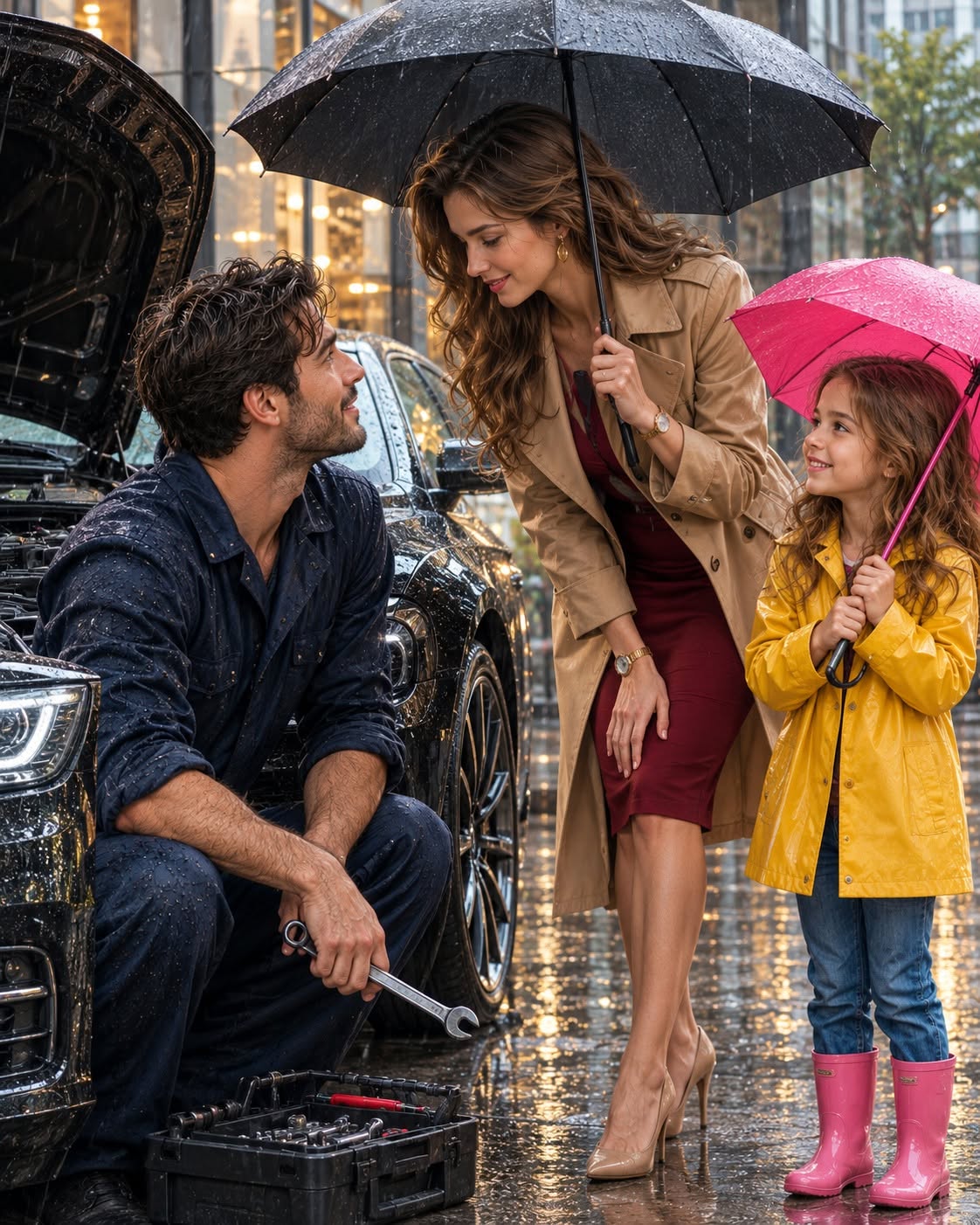
On a rain-soaked highway outside Philadelphia, I showed a wealthy woman the CUT brake lines on her $200,000 sedan
“Just dinner,” she said. “No business, no broken engines, and no meetings.”
I looked at her for a moment, trying to decide whether I was ready to let someone new into a life I’d spent three years carefully rebuilding.
“Friday,” I finally said. “I’d like that.”
Her smile was small, but genuine.
“Good. I’ll make a reservation.”
As she walked toward her car, Chloe came running out of the learning center with a drawing in her hands.
“Daddy! Daddy! Look what I made!”
She held up a picture of three people standing in front of a blue building. One was a little girl with brown hair. Another was a man holding her hand. The third was a woman wearing a yellow dress.
I recognized the woman immediately.
It was Samantha.
“Who’s that?” I asked, pretending not to know.
Chloe grinned.
“That’s Miss Samantha. She belongs in our family picture because she helps everybody.”
Samantha, who had been standing beside her car, heard every word.
For a second, her expression changed.
Then she crouched down and hugged Chloe.
“That’s the nicest thing anyone has ever said to me.”
I didn’t know it then, but that little drawing would eventually become the most important piece of paper in our lives.
Friday evening arrived faster than I expected.
I dropped Chloe off at my neighbor’s house and drove to a small Italian restaurant Samantha had chosen.
For the first time in years, I wore a clean shirt that didn’t have an oil stain somewhere on it.
When Samantha walked in, I almost didn’t recognize her.
She wasn’t wearing her usual expensive business suit. Instead, she had on a simple blue dress and her hair was loosely tied behind her head.
“You look different,” I said.
“So do you.”
We laughed.
Dinner started awkwardly.
We talked about the weather, the restaurant, and the progress at the learning center.
Eventually, Samantha put down her fork.
“Can I ask you something personal?”
“Go ahead.”
“Have you ever thought about getting married again?”
I took a sip of water.
“Honestly? No. Not seriously.”
“Because of Hannah?”
“Because I was afraid of what it would mean to Chloe. I didn’t want her to feel like someone was being brought in to replace her mother.”
Samantha nodded slowly.
“I understand.”
She looked down at her hands.
“My husband died seven years ago. A heart attack. He was only forty-two.”
I hadn’t known she had been married.
“He was a good man,” she continued. “But after he died, I buried myself in work. I convinced myself that if I became successful enough, I wouldn’t have to feel lonely.”
“Did it work?”
She smiled sadly.
“Not even a little.”
For the first time, I saw something beneath the confidence and authority everyone associated with Samantha Vance.
I saw a woman who had spent years pretending she didn’t need anyone.
And perhaps she saw something similar in me.
We didn’t kiss that night.
We didn’t make promises.
We simply talked until the restaurant began stacking chairs around us.
When I drove home, I realized I hadn’t thought about the past for nearly three hours.
That frightened me more than I wanted to admit.
But it also felt like breathing after being underwater for too long.
Over the following weeks, Samantha and I grew closer.
She never tried to become Chloe’s mother.
She never asked me to forget Hannah.
Instead, she made room for both of them in her life.
She remembered Chloe’s favorite ice cream.
She attended her school art exhibition.
And when Chloe had trouble with a mathematics assignment, Samantha sat beside her for almost an hour, patiently explaining fractions using pieces of chocolate.
One afternoon, Chloe asked her something that made my heart stop.
“Miss Samantha, do you think my mommy would like you?”
Samantha looked at me briefly before answering.
“I hope she would, sweetheart. But I think the more important question is whether you like having me around.”
Chloe considered that.
Then she nodded.
“I do. You don’t make Daddy sad.”
Samantha reached across the table and held her little hand.
“Then I’ll try very hard not to.”
I thought our lives were finally settling into something beautiful.
But happiness, as I would soon discover, doesn’t always arrive without a fight.
Three months after that first dinner, Samantha called me late one evening.
Her voice sounded different.
“Daniel, I need you to come to my office tomorrow morning.”
“Is something wrong?”
“I found something. Something about the old school.”
My stomach tightened.
“What happened?”
She hesitated.
“The property was never supposed to be sold to my company in the first place.”
The next morning, I arrived at her office and found her sitting behind her desk with a thick stack of documents.
Her eyes were red.
“I’ve been reviewing the original acquisition paperwork,” she explained. “The company paid for the property, but the ownership records contain something unusual.”
She slid a document toward me.
I recognized Hannah’s name immediately.
It was an agreement signed six years earlier.
Hannah had helped organize the learning program when the school was struggling financially. At the time, the original property owner, an elderly philanthropist named Walter Bennett, had been considering selling the building.
Hannah had persuaded him to preserve it as a community education center.
In exchange, Walter had created a charitable trust that gave the learning program the right to operate there for twenty years.
The agreement had been recorded with the local authorities.
But when Samantha’s company purchased the property, that document had mysteriously disappeared from the acquisition file.
“Who knew about this?” I asked.
“Three people. Walter Bennett, the attorney who prepared the trust, and someone inside my company.”
She turned another page.
The attorney had died two years earlier.
Walter Bennett had moved into a private retirement community.
And the employee who handled the acquisition paperwork was none other than Richard Hale.
My hands tightened around the document.
“Richard knew the school couldn’t legally be demolished.”
Samantha nodded.
“Which means he deliberately concealed the agreement.”
“But why?”
She looked toward the window.
“Because the distribution center wasn’t the only reason he wanted that property.”
She opened her laptop and showed me a series of financial transactions.
Richard had been working with a private development group. If the school were demolished, the land would become part of a much larger commercial development.
The company would receive a substantial payment.
Richard would receive a hidden percentage through an investment firm registered under another name.
But there was something even worse.
The original trust had also established a small educational fund for the children attending Hannah’s program.
Money had been set aside every year to purchase books, provide meals, and pay volunteer tutors.
That fund had disappeared.
Nearly two hundred thousand dollars was unaccounted for.
I stared at the screen.
“Those children were supposed to benefit from that money.”
“I know,” Samantha whispered.
“Did Hannah know about it?”
Samantha shook her head.
“I don’t think she ever found out.”
I leaned back in my chair.
For three years, I had thought Hannah’s biggest battle was simply trying to keep the learning center open.
Now I was discovering that someone had been stealing from the very children she had devoted her life to helping.
I felt anger rising inside me.
But Samantha placed her hand over mine.
“Daniel, I want you to understand something. We can’t let anger make us careless. Richard is dangerous, and he still has connections.”
She was right.
We needed evidence.
And we needed someone who knew the original agreement.
That afternoon, we drove to the retirement community where Walter Bennett lived.
He was eighty-one, thin, and used a wooden cane. But his eyes were remarkably sharp.
When Samantha introduced herself, he looked at her for a long moment.
Then his gaze shifted toward me.
“You’re Hannah’s husband, aren’t you?”
I nodded.
He smiled.
“She was a remarkable woman.”
He invited us into his apartment.
On a small table near the window sat an old photograph of a group of children standing outside the school.
Hannah was in the middle, holding a stack of books.
Walter pointed at it.
“That woman once convinced me that a building could be worth more than every dollar someone might offer for it.”
He explained that Hannah had visited him almost every week during the final year of his wife’s life.
His wife had been suffering from dementia, and Hannah’s students had made handmade cards for her.
Some of the children had even learned to write their names just so they could sign them.
“When my wife died, I didn’t know what to do with myself,” Walter said. “Hannah told me that grief needed somewhere to go. She said I could let it turn me bitter, or I could let it become useful.”
He looked directly at me.
“I chose to help her.”
Then he opened a drawer and removed a small metal box.
Inside were copies of the original trust agreement, handwritten notes, and several letters.
But one letter caught my attention.
It was addressed to Hannah.
The handwriting was unmistakably hers.
I opened it carefully.
Walter explained that Hannah had written it shortly before she died, asking him to keep the documents safe in case anyone ever tried to take the school away from the children.
I began reading.
“Dear Walter,
If you’re reading this, it probably means someone is questioning the future of our little school again.
I know you sometimes worry that what we’re doing isn’t enough.
But I want you to remember something.
A child who learns to read doesn’t just learn words. That child learns that the world is larger than the circumstances they were born into.
A child who discovers that someone believes in them may spend the rest of their life believing in others.
Please protect this place, not because my name is connected to it, but because the children who walk through its doors deserve to know that someone cared enough to leave a light on for them.
Hannah.”
I stopped reading.
My eyes filled with tears.
I had heard Hannah say similar things countless times.
But seeing her words again felt like hearing her voice after years of silence.
Walter waited patiently.
Then he said something that changed everything.
“There’s another reason I asked you both to come.”
He reached into the box and removed a smaller envelope.
“Richard Hale visited me six months ago. He offered me money to sign a document releasing the trust.”
Samantha sat forward.
“Did you sign it?”
Walter shook his head.
“Of course not. But he didn’t leave without making a threat.”
He handed us a copy of a letter.
It contained a warning that the trust could become financially responsible for legal expenses if it challenged the sale.
At the bottom was Richard’s signature.
Samantha photographed every page.
We finally had the evidence we needed.
Or so we thought.
Two days later, someone broke into the Hannah Cole Learning House.
Nothing valuable was stolen.
The computers were untouched.
The cash box was still there.
But every cabinet containing the old financial records had been emptied.
Worse, the original classroom photograph of Hannah had been torn from its frame and left on the floor.
Chloe found it when she arrived with me that Saturday morning.
She picked up the photograph and carefully brushed dust from Hannah’s face.
“Why would someone hurt Mommy’s picture?”
I knelt beside her.
“I don’t know, sweetheart.”
She looked at me with frightened eyes.
“Are they going to take the school away?”
I pulled her into my arms.
“Not if I can help it.”
Samantha arrived twenty minutes later.
When she saw the broken cabinets, her expression hardened.
She immediately called the police.
But before the officers finished inspecting the building, her phone rang.
It was the company’s board chairman.
He informed her that several board members had called an emergency meeting.
Richard had returned.
Not physically, but legally.
His attorneys had challenged his dismissal, claiming the company had violated internal procedures.
And now Richard was accusing Samantha of using company money to finance a personal relationship and manipulate the property acquisition.
The accusation was absurd.
But it was enough to create a crisis.
The board suspended her executive authority pending an independent review.
For the first time since I had met her, Samantha looked genuinely defeated.
“I should never have involved you in this,” she said.
I shook my head.
“You didn’t involve me. I stopped beside your car because someone needed help. Everything that happened afterward was my choice.”
She looked away.
“They’re going to destroy everything.”
“Then we’ll make sure they can’t.”
That evening, Samantha came to my house.
She sat at the kitchen table while Chloe slept upstairs.
For nearly ten minutes, neither of us spoke.
Finally, she whispered, “Maybe I should leave.”
I looked at her.
“Leave where?”
“Your life. Chloe’s life. Everything. I brought trouble into a world that was finally becoming peaceful for you.”
I understood her fear.
She had spent years protecting herself by walking away before anyone could hurt her.
But I wasn’t going to let her make that decision for both of us.
“Listen to me,” I said. “Hannah didn’t teach children because she believed life would always be fair. She taught them because she knew it wouldn’t be. She believed people needed someone who stayed when things became difficult.”
Samantha’s eyes filled.
“I don’t know if I’m strong enough.”
“You don’t have to be strong every minute. Just don’t make fear the person who decides your future.”
She reached for my hand.
And for the first time, I kissed her.
It wasn’t a dramatic movie moment.
It was quiet, uncertain, and honest.
But it was enough to tell us both that we weren’t walking away.
The following morning, I called an old friend named Marcus.
He was a retired police detective who now worked in private security.
I explained everything.
He listened carefully, then asked one question.
“Did anyone check the school’s old security cameras?”
I frowned.
“They haven’t worked in years.”
“Are you sure?”
I remembered something.
A few months earlier, one of the volunteers had installed a small motion-activated camera near the rear entrance after several bicycles went missing.
It was connected to a cloud account.
I contacted the volunteer.
An hour later, he sent me the footage.
At 2:17 in the morning, a black SUV pulled up behind the building.
Two men got out.
One wore a baseball cap.
The other had a distinctive tattoo on his left wrist.
Marcus recognized him.
“That’s Kevin Doyle,” he said. “Former security contractor for Vance Transportation.”
The footage showed the men entering the building.
But what happened next was even more important.
Before leaving, the man with the tattoo placed a small envelope inside the frame of Hannah’s photograph.
The police returned to the building.
Behind the frame, they found a folded piece of paper.
It contained a handwritten message.
“Stop looking into the trust. The next visit won’t be a warning.”
Samantha went pale when she read it.
Marcus immediately contacted the investigators handling the original sabotage case.
They discovered that Kevin had received payments from an account connected to a consulting company controlled by Richard’s business associate.
The investigation was reopened.
But we still needed the missing financial records.
That was when Chloe unexpectedly gave us the answer.
She had been helping one of the volunteers organize old books when she found a small wooden box hidden behind a loose panel beneath Hannah’s former desk.
Inside were several notebooks, receipts, and a USB drive.
I recognized the notebooks immediately.
They belonged to Hannah.
She used to write down the names of children who needed extra help, what they were struggling with, and what activities had worked.
But the last notebook contained something different.
It included notes about the charitable trust.
Hannah had apparently noticed that some payments were missing before her death.
She had written down dates, amounts, and the names of people who had signed the withdrawal requests.
One name appeared repeatedly.
Richard Hale.
The USB drive contained scanned copies of the original financial statements and correspondence between Richard and the development group.
There was even an email in which Richard discussed transferring the charitable funds into a private account before the property sale was completed.
We handed everything to the investigators.
Three weeks later, the truth finally came out.
Richard had been using his position to redirect charitable money, falsify property records, and arrange payments to people who helped conceal the scheme.
The brake sabotage was connected to the same operation.
Mark Ellis had been promised a large payment if Samantha was permanently removed from the company.
Richard believed that without her leadership, nobody would question the property acquisition or the missing funds.
The men who broke into the school had been sent to destroy the remaining records.
They had failed.
On a rainy Tuesday morning, Richard Hale was arrested outside his home.
Kevin Doyle was arrested later that afternoon.
Mark Ellis agreed to cooperate with investigators in exchange for consideration in his case.
And Samantha was cleared of the allegations against her.
The company’s board reinstated her as CEO.
But when reporters asked whether she intended to seek revenge against the people who had betrayed her, she gave an answer I would never forget.
“My responsibility isn’t to punish people personally. It’s to make sure the organization can never become a place where power matters more than integrity again.”
She announced a complete audit of the company’s charitable accounts and a new independent oversight committee.
She also transferred the recovered educational funds into a protected trust.
The Hannah Cole Learning House would never again depend on the goodwill of a wealthy company or the promises of a single executive.
It would belong to the community.
Six months later, the school held its official reopening ceremony.
The building looked completely different.
The roof had been repaired.
The classrooms were bright and welcoming.
There was a new library, a computer room, and a workshop where teenagers could learn practical skills.
But the most important thing hadn’t changed.
Children still came through the doors carrying backpacks that were sometimes too heavy for their small shoulders.
They still sat at old-fashioned wooden desks.
And someone still sat beside them whenever they struggled with a difficult lesson.
Samantha stood beside me during the ceremony.
She wore a simple white blouse and held Chloe’s hand.
A local journalist approached her.
“Mrs. Vance, you’ve invested a considerable amount of money in this project. Why was preserving this particular school so important to you?”
Samantha looked toward the building.
Then she looked at me.
“Because someone once helped my brother believe he wasn’t stupid. She didn’t ask for money. She didn’t ask for recognition. She simply gave him her time when he needed it most.”
She paused.
“Years later, I discovered that the woman who changed his life was the wife of the man who saved mine on a rainy highway. I think some things happen to remind us that the kindness we give away never really disappears.”
The journalist turned toward me.
“Mr. Cole, what would your wife think of all this?”
I looked at Hannah’s photograph above the entrance.
For a moment, I could almost imagine her standing there with her usual stack of books, telling everyone that the children were waiting.
“She’d probably tell us to stop talking and get back to work,” I said.
Everyone laughed.
But my voice broke slightly.
After the ceremony, Chloe ran toward the new library.
“Daddy! Come look!”
She pointed to a small reading corner near the window.
There were colorful cushions, shelves full of children’s books, and a wooden sign.
It read:
THE HANNAH CORNER.
Underneath were six simple words:
EVERY CHILD DESERVES SOMEONE WHO BELIEVES.
Chloe ran her fingers across the letters.
“Can I read here every Saturday?”
“Of course.”
“Can I help the little kids too?”
I smiled.
“That’s exactly what your mommy would want.”
She hugged me.
Then she looked at Samantha.
“Can we take a picture together?”
Samantha crouched beside her.
“Absolutely.”
Chloe handed her the drawing she had made months earlier.
The one with three people standing in front of the blue building.
But this time, she had added another person.
A little boy holding a book.
“Who’s that?” Samantha asked.
“That’s Uncle Ethan. You told me he learned to read here.”
Samantha’s eyes widened.
“Yes, he did.”
Chloe smiled.
“Now he can come teach the other kids.”
Samantha hugged her tightly.
That afternoon, something unexpected happened.
Ethan arrived.
He had driven several hours with his wife and two children to attend the reopening.
He was taller than I had imagined from the old photographs, with kind eyes and a slightly nervous smile.
When he saw Hannah’s picture, he stopped walking.
“Is that really her?”
I nodded.
“That’s Hannah.”
He stood there for a long time.
Then he turned toward me.
“I don’t know if I’ve ever properly thanked her.”
I shook my head.
“You don’t have to.”
But he insisted.
He told me that after his father died, he had struggled badly at school.
Teachers had described him as lazy, difficult, and incapable of keeping up.
He had begun believing them.
Hannah had been the first person to sit beside him without making him feel ashamed.
She had taught him to read one sentence at a time.
When he made mistakes, she never sighed or rolled her eyes.
She simply tried another way.
“She once told me that being slow at something didn’t mean I was unable to do it,” he said. “She told me I just hadn’t found the right way to learn yet.”
He smiled through tears.
“That sentence changed my life.”
Then he reached into his jacket and handed me a small envelope.
Inside was a photograph of him at his college graduation.
On the back, he had written:
“For the woman who taught me that my future was bigger than my difficulties.”
I placed it beside Hannah’s photograph.
And suddenly, I understood something I hadn’t fully understood during the three years since her death.
I had spent so much time grieving the life Hannah and I would never have together that I had forgotten to look at the lives she had already changed.
She wasn’t gone from every part of the world.
She was still there.
In every child who learned to read.
In every teenager who discovered a talent.
In every adult who finally believed they were capable of becoming something more.
That evening, after the guests had left, Samantha and I sat outside the school.
The rain had stopped.
The pavement was still wet, and the setting sun reflected in the puddles.
She rested her head against my shoulder.
“Do you think Hannah would have approved of us?” she asked.
I smiled.
“I think she would have asked why it took us so long.”
Samantha laughed.
Then she became quiet.
“Daniel, there’s something I’ve been wanting to ask you.”
I turned toward her.
“What’s that?”
She took a small velvet box from her handbag.
My heart began beating faster.
“Before you panic, I’m not proposing,” she said, laughing nervously. “At least, not yet.”
She opened the box.
Inside was a small silver key.
“What is it?”
“The key to the new workshop. I want you to run it.”
I stared at her.
“Me?”
“The board has approved a permanent vocational education program. We’ll teach teenagers basic mechanics, electrical repairs, carpentry, and other practical skills. You know how to fix things, Daniel. More importantly, you know how to teach people without making them feel small.”
I looked at the key.
For twenty years, I had worked in garages, fixing engines and repairing other people’s vehicles.
I had never imagined that the skills I used to pay the bills could become something bigger.
“What about my own garage?”
“You can keep it if you want. But I’d love to see you build something here.”
I looked through the window.
A group of volunteers were putting books away.
Chloe was helping Ethan’s daughter arrange colored pencils.
And Hannah’s photograph watched over the room.
For the first time, the future didn’t feel like something I had to face without the past.
It felt like something I could build with everything the past had taught me.
“I’ll do it,” I said.
Samantha smiled.
“Good.”
Then she took a breath.
“And now I do have one more question.”
I laughed.
“Should I be worried?”
“Probably.”
She looked directly into my eyes.
“Would you be willing to build a future with me? Not as a replacement for anything you’ve lost. Not because either of us needs someone to rescue us. Just because I love you, and I think we could make something good together.”
I didn’t answer immediately.
I thought about Hannah.
About the promise I had once made to myself that I would never allow another person into the life we had built.
I thought about Chloe.
About how she deserved to grow up watching people love each other honestly, without fear or guilt.
And I thought about the woman sitting beside me, who had once offered me ten thousand dollars for a kindness I had never considered selling.
I took her hand.
“Yes,” I said. “I’d like that.”
She leaned forward and kissed me.
And somewhere inside that little school, a child laughed.
It was the kind of sound Hannah would have loved.
One year later, the Hannah Cole Learning House celebrated its first anniversary.
The program had grown beyond anything we had imagined.
More than one hundred children attended weekly classes.
Several teenagers who had once struggled in school were now volunteering as teaching assistants.
Ethan visited every month to lead reading workshops.
Samantha established a scholarship fund for students who wanted to attend college or vocational training.
And I ran the mechanical workshop.
Chloe had become the youngest volunteer.
She liked helping children choose books and explaining simple science experiments.
One Saturday, I found her sitting beside a little boy who was struggling to read.
She pointed at a word, waited patiently, and encouraged him to try again.
When he finally read the sentence correctly, she clapped.
“See? You can do it!”
I stood in the doorway, watching.
For a moment, I saw Hannah.
Not in Chloe’s face exactly, but in the way she treated that little boy.
With patience.
With kindness.
With the quiet belief that every child deserved another chance.
Samantha came up beside me.
“She’s becoming just like her mother,” she whispered.
I shook my head gently.
“She’s becoming herself. Hannah just showed her what kindness looks like.”
Samantha slipped her hand into mine.
A few weeks later, we decided to get married.
We didn’t plan a huge ceremony.
We held it in the garden behind the learning center, surrounded by friends, volunteers, and the children whose lives had become part of ours.
Before the ceremony, I visited Hannah’s photograph.
I placed a small bouquet of white flowers beneath it.
“I hope you understand,” I whispered.
“I’m not leaving you behind. I’m just learning how to keep living.”
I stood there for another moment.
Then I walked back toward the people waiting for me.
Chloe was wearing a beautiful yellow dress.
She ran up and took my hand.
“Daddy, are you ready?”
I looked at her.
“More than you know, sweetheart.”
Samantha stood beneath a simple wooden arch decorated with flowers.
When our eyes met, she smiled.
And I realized that love hadn’t arrived to erase the past.
It had arrived to help us carry it without being crushed by it.
After the ceremony, Chloe gave Samantha a framed copy of the original drawing.
The one she had made on the day we first met.
Three people standing outside a blue building.
This time, beneath the picture, she had written a sentence herself.
“Families are made by the people who stay.”
Samantha hugged her and cried.
That night, after everyone had gone home, I stood outside the learning center one last time.
The lights were still on inside.
A few volunteers had stayed late to prepare lessons for the following week.
I thought about that rainy highway.
About the luxury car with its deliberately cut brake lines.
About the woman who had been one terrible decision away from losing her life.
And about the photograph that had fallen from her briefcase.
If I hadn’t stopped that night, I might never have known that my wife’s work had reached a family I had never met.
Samantha might never have discovered the truth about her company.
The school might have disappeared.
And hundreds of children might have lost a place where they were allowed to believe in themselves.
But I had stopped.
Not because I expected a reward.
Not because I knew who Samantha was.
I stopped because someone needed help.
And sometimes, that is where the most extraordinary stories begin.
I used to think that losing Hannah meant the most important chapter of my life had ended.
I was wrong.
Her chapter had simply become part of something larger.
She had taught children to believe in themselves.
Those children had grown up and carried that belief into the world.
One of them had become a successful businessman.
Another had become a volunteer.
And one little girl had learned that kindness was something you practiced, not just something you talked about.
As for me, I had learned that moving forward didn’t mean leaving someone behind.
It meant taking everything they had taught you and finding a way to pass it on.
The next morning, I unlocked the workshop for the first time as its official director.
A dozen teenagers were waiting outside.
One boy, perhaps fifteen, stood slightly apart from the others.
He had his hands in his pockets and his head lowered.
“Are you Mr. Cole?” he asked.
“That’s me.”
He hesitated.
“My school counselor said I should come here. But I’m not very good at school.”
I smiled and opened the door.
“That’s okay. What are you good at?”
He shrugged.
“Nothing, really.”
I looked at the row of engines waiting to be repaired.
Then I handed him a wrench.
“Well, let’s find out.”
He took it carefully.
And as the other students walked inside, I glanced at Hannah’s photograph hanging on the wall.
For the first time in three years, I didn’t feel the ache of someone missing from my life.
I felt the presence of someone whose kindness was still changing it.
I finally understood the greatest lesson Hannah had left me.
You never know how far a small act of kindness will travel. You may forget the moment you offered it, but someone else may spend the rest of their life remembering it.
And sometimes, the person who stops to help a stranger on a rainy highway doesn’t just save a life.
Sometimes, without even knowing it, he helps an entire community find its way home.