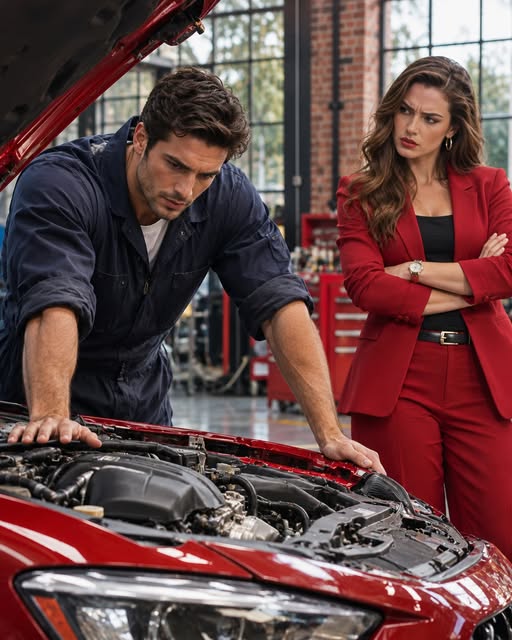
My $800,000 Ferrari sat dead in front of my Beverly Hills headquarters, and three of the most expensive mechanics in California couldn’t figure out why.
The Day Daniel Carter Saved More Than a Company
I used to believe that the greatest threat to a successful company was competition.
I was wrong.
Sometimes, the greatest threat is the very success that makes everyone inside the company afraid to tell the truth.
I learned that lesson on a Thursday morning, almost six months after Daniel Carter joined our engineering department.
It began with a phone call from our operations director, Michael Reeves.
His voice sounded unusually tense.
“Ma’am, we have a serious problem. I think you need to come to the headquarters immediately.”
I glanced at my calendar. I had two investor meetings and a presentation scheduled with our international partners.
“How serious?”
There was a pause.
“Serious enough that I wouldn’t discuss it over the phone.”
When I arrived, I found several senior executives gathered in the conference room. Nobody was drinking coffee. Nobody was looking at their phones. A large screen displayed a series of financial reports and engineering performance charts.
Michael stood at the head of the table.
He was a polished executive in his early fifties, the kind of man who always seemed to know exactly what to say. He had been with the company for eleven years and had played an important role in expanding our automotive technology division.
But that morning, he looked frightened.
“We’ve identified irregularities in the engineering department’s financial records,” he explained.
“What kind of irregularities?”
“Several maintenance contracts appear to have been significantly overcharged. There are also replacement components listed as necessary that may never have been installed.”
I leaned forward.
“How much money are we talking about?”
Michael swallowed.
“Approximately $2.4 million over the last eighteen months.”
The room became silent.
Two million four hundred thousand dollars.
I had built my company from a small operation into an organization worth hundreds of millions. I understood that mistakes happened. Projects failed. Budgets occasionally exceeded expectations.
But this wasn’t a budgeting problem.
It looked like someone had been stealing from us.
“Who discovered this?” I asked.
Michael looked toward the end of the table.
“Daniel.”
I turned.
Daniel Carter was sitting quietly with a folder in front of him. His expression was serious, but not angry.
“Would you explain what you found?” I asked.
He opened the folder.
“Three weeks ago, I noticed something unusual in a maintenance report. We had purchased several expensive control modules for vehicles that, according to the service records, had never received those components.”
He placed a document on the table.
“I checked the serial numbers. Some belonged to vehicles that had already been repaired using their original equipment.”
“Could it have been an administrative mistake?”
“That’s what I thought at first. So I checked other records.”
He continued.
“The same supplier appeared repeatedly. The same parts were billed at increasingly higher prices. And several jobs were marked as completed even though the technicians assigned to them said they had never worked on those vehicles.”
I studied the documents.
“How long have you known?”
“Long enough to be certain something was wrong. Not long enough to know who was responsible.”
Michael shifted in his chair.
“Daniel, I think we should be careful about making accusations. These records are complicated. There are explanations for some of the discrepancies.”
Daniel nodded respectfully.
“I agree. That’s why I brought the original invoices, inspection reports, and technician statements.”
He pushed another folder across the table.
“I didn’t want anyone accused without evidence.”
I looked at him.
That was Daniel. He never needed to raise his voice to make a point.
He simply brought the facts.
I asked our legal department to investigate immediately.
By the end of the afternoon, the situation had become considerably worse.
The supplier was a company called Sterling Automotive Solutions. It had received millions of dollars in payments from our engineering division over the previous two years.
And the person who had approved most of those contracts was Michael Reeves.
I couldn’t believe it.
Michael had worked beside me for more than a decade. He had attended my father’s funeral, celebrated our company’s biggest milestones, and once stayed awake for three nights helping us recover from a major production failure.
I had trusted him.
When I confronted him, he didn’t deny signing the contracts.
Instead, he argued that the company had been making necessary investments.
“You’re making a mistake,” he said. “Daniel doesn’t understand how large operations work. He comes from a neighborhood garage. He sees a few suspicious invoices and suddenly thinks he’s uncovered a conspiracy.”
I stared at him.
“Then explain the missing parts.”
He had no answer.
“Explain the technicians’ statements.”
Silence.
“Explain why the supplier is registered to a residential address and why its listed director has a financial connection to someone in this building.”
Michael’s expression changed.
For the first time, I saw something other than confidence in his eyes.
I saw fear.
The investigation continued for several weeks. Our auditors uncovered a network of fraudulent invoices, inflated service charges, and payments routed through intermediary companies.
Michael had not acted alone.
Two purchasing managers had helped approve questionable transactions. A senior procurement officer had deliberately concealed discrepancies. Together, they had turned a department responsible for maintaining our most advanced engineering systems into a source of personal profit.
The total losses eventually exceeded $3 million.
It was a devastating discovery.
But what happened next surprised me even more.
The morning after Michael was placed on administrative leave, Daniel came into my office.
He looked uncomfortable.
“Do you have a minute?”
“Of course.”
He sat down, placed his hands on his knees, and looked toward the window.
“I wanted to ask you something.”
“Go ahead.”
“Are the people who approved those invoices going to be fired?”
“After the investigation is complete, anyone involved in deliberate wrongdoing will be held accountable.”
He nodded.
Then he said something I hadn’t expected.
“What about the technicians?”
I frowned.
“What technicians?”
“The people working in the department. Some of them knew something wasn’t right, but they were afraid to speak up. Others were simply doing the jobs assigned to them. They didn’t have access to the financial records.”
I leaned back.
“Why are you asking?”
“Because they’re worried. Some think the entire department will be shut down. Others believe they’ll lose their jobs because of decisions made by people above them.”
He paused.
“Most of them have families. They have mortgages, children, and responsibilities. They shouldn’t have to pay for something they didn’t do.”
I looked at him for a long moment.
He had just helped uncover a multimillion-dollar fraud, and instead of asking for recognition, a promotion, or a bonus, he was worried about the ordinary employees who might suffer because of it.
“Daniel, we aren’t planning to punish innocent people.”
He nodded.
“Good. That’s all I wanted to know.”
Before leaving, he added one more thing.
“I also think we should create a way for employees to report problems without being afraid of losing their jobs.”
I smiled slightly.
“That’s a good idea.”
He stood up.
Then, almost as an afterthought, he said, “Emma has a school presentation next Friday. I was hoping I could leave a little early that afternoon.”
I laughed softly.
“Daniel, you just helped save this company millions of dollars. I think you can manage one afternoon off.”
He smiled.
“Thank you. She has been practicing her presentation all week.”
After he left, I remained at my desk.
I thought about the executives who had stolen from the company. They had impressive degrees, expensive offices, and salaries that most people could only dream about.
Yet they had risked everything for more money.
Daniel, meanwhile, had repeatedly shown me that integrity was something money couldn’t purchase.
And I was beginning to understand that the real problem wasn’t simply that dishonest people had entered our organization.
It was that our culture had allowed them to believe they could succeed without being questioned.
So I made a decision.
We would change the company.
Not through another corporate slogan or an expensive leadership seminar, but through the way we actually treated people.
We introduced independent purchasing reviews, transparent maintenance records, and a confidential reporting system.
We also created a program allowing employees from every department to suggest improvements directly to senior management.
Daniel helped design the engineering portion.
He insisted that technicians, apprentices, and administrative staff all have a voice.
“People closest to a problem usually understand it best,” he told me during one planning meeting. “They just don’t always have someone willing to listen.”
His words became one of the guiding principles of our new department.
But the biggest change was still ahead.
Three weeks after the investigation began, Daniel received a phone call from his daughter’s school.
Emma had been involved in an accident during recess.
She had fallen while playing and injured her arm.
Daniel was in the middle of a critical engineering review when the call came.
I was sitting across from him when his phone rang.
He listened for a few seconds.
His face went pale.
“Is she all right?”
Another pause.
“Which hospital?”
He stood immediately, gathering his keys.
“I’m sorry. I have to go.”
“Daniel, don’t apologize. Go.”
He hurried toward the door.
Then he turned back.
“The technical review is scheduled for two o’clock. The team still needs someone to explain the revised system.”
“I’ll handle it.”
He hesitated.
“Are you sure?”
I almost laughed.
“Daniel, your daughter needs her father. The meeting can wait.”
He nodded and rushed out.
That afternoon, I received a message from him.
Emma had fractured her wrist. She was going to be fine, but she would need several weeks to recover.
I sent flowers to the hospital.
The following morning, Daniel came to work with his arm in a sling.
Not his arm.
Emma’s.
He was helping her carry her schoolbag.
She had insisted on visiting the office because she wanted to see the place where her daddy worked.
I greeted them in the lobby.
“How are you feeling, sweetheart?”
Emma held up her small arm.
“Better. But I can’t color very well.”
“I’m sorry to hear that.”
She looked at me thoughtfully.
“Can I tell you a secret?”
I leaned closer.
“Of course.”
“Daddy stayed with me all night. He didn’t even go home to sleep.”
Daniel smiled awkwardly.
“Emma…”
“What? It’s true.”
I looked at him.
He shrugged.
“She was scared.”
Something tightened in my chest.
I remembered the years when I had allowed business emergencies to take priority over birthdays, family dinners, and important moments with the people I loved.
I had always told myself there would be time later.
Later, when the company was bigger.
Later, when the next deal closed.
Later, when things became less complicated.
But life had a way of reminding us that later wasn’t guaranteed.
I crouched slightly so I could look Emma in the eyes.
“You know something? Your daddy is a very important person here.”
She smiled proudly.
“I know.”
“But do you know why?”
She shook her head.
“Because he fixes cars?”
I smiled.
“That’s part of it. But he also helps people.”
Emma considered that for a moment.
Then she said, “He helps me the most.”
Daniel looked away.
I pretended not to notice the emotion on his face.
That afternoon, I made another decision.
I asked Daniel to help me create something our company had never offered before: a family-first workplace program.
Flexible schedules, paid family emergency leave, childcare support, and opportunities for employees to adjust their working hours without being treated as less committed.
Some executives questioned the expense.
One of them even suggested that such policies might weaken productivity.
I invited Daniel to the next leadership meeting.
He listened while the executives discussed costs, staffing requirements, and possible operational difficulties.
When they finished, he spoke.
“I understand the concerns. But I want to ask one question.”
Everyone turned toward him.
“How many people here have worked while worrying about a sick child, an elderly parent, or someone waiting for them at home?”
Nobody answered.
Daniel continued.
“How many of those people were really giving their best attention to their work?”
He paused.
“People don’t stop having families when they walk into this building. Pretending otherwise doesn’t make them better employees. It just makes them afraid to admit they’re human.”
The room was silent.
Then our chief financial officer, who had initially opposed the proposal, slowly nodded.
“He’s right.”
The program was approved.
Within six months, employee retention improved, absenteeism decreased, and internal satisfaction surveys showed the highest scores in the company’s history.
The financial results were encouraging.
But I was more interested in the stories.
An engineer who had finally been able to attend his son’s graduation.
A single mother who could adjust her schedule to pick up her children.
A technician who no longer had to choose between taking care of his sick father and keeping his job.
Daniel never took credit for those changes.
He simply kept doing his work.
Meanwhile, something wonderful was happening at his garage.
The business that had once consisted of a few tools, an aging lift, and a modest waiting room was growing.
Customers began traveling from neighboring cities because they had heard about the mechanic who refused to overcharge people.
Some brought ordinary family cars. Others arrived in expensive European vehicles.
Daniel treated them all the same.
He never asked how much someone could afford before deciding how carefully to inspect their vehicle.
One Saturday, I visited the garage unexpectedly.
I found him underneath an old pickup truck while a teenage boy stood nearby holding a flashlight.
“Careful,” Daniel said. “Keep it steady.”
The boy nodded.
I waited until Daniel slid out.
“Business looks busy.”
He wiped his hands.
“It has been.”
I noticed the teenager.
“Is he your apprentice?”
Daniel smiled.
“His name is Marcus. He’s sixteen. His mother asked if he could spend a few afternoons here. He’s interested in mechanics.”
Marcus looked embarrassed.
“I don’t know much yet.”
Daniel handed him a clean rag.
“That’s why you’re here.”
I watched the boy return to the vehicle.
“You’re teaching him?”
“Trying to.”
Daniel glanced toward the office, where Emma was drawing at her little table.
“His mother has been raising him alone. He’s a good kid, but he was starting to believe he wasn’t particularly good at anything.”
He paused.
“I told him he should at least give himself a chance.”
I looked around the garage.
There were now four employees, two apprentices, and more vehicles than the small workshop could comfortably accommodate.
“Have you thought about expanding?”
Daniel laughed.
“Every day.”
“Then why haven’t you?”
He shrugged.
“Money, time, planning. You know how it goes.”
I looked at him.
“Would you let me help?”
He became serious.
“What do you mean?”
“I mean the company could support a new training facility. Not just for our employees, but for young people who want to learn skilled trades.”
Daniel didn’t answer immediately.
I continued.
“We could build a proper workshop, provide paid apprenticeships, and give people a path into careers they might never have considered.”
He looked toward Marcus.
Then toward Emma.
Finally, he asked, “Would they actually get a chance? Or would it become another program that looks good in a brochure?”
I smiled.
“That’s exactly why I want you to run it.”
For the first time since I had known him, Daniel looked genuinely uncertain.
“I don’t know if I’m the right person.”
I thought about the Ferrari.
I thought about the $3 million fraud.
I thought about the frightened technicians who had found their voices because he had encouraged them.
Then I said, “Daniel, you have spent your entire life showing people what can be repaired. I think it’s time we gave you the opportunity to show people what can be built.”
He looked down.
And then he smiled.
“Let me think about it.”
Three months later, he gave me his answer.
He agreed.
We established the Carter Technical Development Center, a new facility dedicated to automotive engineering, diagnostics, and vocational training.
Daniel insisted that the program offer scholarships to students from low-income families.
He also wanted to reserve places for young people who had struggled in traditional schools but showed an interest in practical work.
Our board approved the funding.
Construction began that summer.
And when the doors finally opened, I was invited to attend the ceremony.
I expected a small gathering of executives, a few journalists, and some local officials.
Instead, the parking lot was full.
Parents stood beside their children. Former mechanics brought their grandchildren. Local business owners came to congratulate Daniel.
Some of the students had traveled more than an hour to attend.
Daniel stood near the entrance, looking uncomfortable in a new dark-blue shirt.
Emma was beside him, holding a small bouquet of flowers.
She was eight now.
When I approached, she smiled.
“Do you like the building?”
I looked at the spacious workshop, the bright classrooms, and the rows of equipment.
“It’s wonderful.”
She nodded proudly.
“Daddy designed where everything goes.”
I looked at Daniel.
“You did a beautiful job.”
He shook his head.
“We did.”
The ceremony began.
I gave a short speech about innovation, opportunity, and the importance of investing in people.
Then I introduced Daniel.
He walked to the microphone.
For several seconds, he simply looked at the audience.
“I’ve spent most of my life working with machines,” he began. “And one thing I’ve learned is that when something stops working, the first reaction is usually to replace it.”
A few people laughed.
“But sometimes, the problem isn’t as big as it appears. Sometimes, there’s just one small connection that has come loose.”
He looked around the room.
“People can be like that, too.”
The audience became quiet.
“Some of the students here may have been told they’re not smart enough. Some may have been overlooked because they don’t have the right qualifications or the right background. I want you to understand something.”
He paused.
“Your starting point does not determine your destination.”
Emma watched her father with shining eyes.
Daniel continued.
“I was lucky enough to have someone give me another chance when I wasn’t looking for one. I want this place to do the same for you.”
The applause was immediate.
I stood at the back of the room, feeling unexpectedly emotional.
Because I knew exactly what he meant.
I had thought I was giving Daniel a second chance when I hired him.
But the truth was that he had given all of us something we hadn’t known we needed.
A different way of seeing success.
The ceremony ended with the students touring the workshop.
I was standing beside one of the training vehicles when a young woman approached me.
She looked about nineteen and held a folder tightly against her chest.
“Excuse me. Are you the owner of the company?”
“I am.”
She hesitated.
“I wanted to thank you.”
“For what?”
“For helping Mr. Carter build this place.”
I smiled.
“Daniel deserves most of the credit.”
She nodded.
“I know. He interviewed me last week. I didn’t think I would get accepted because I don’t have much experience.”
“Did you?”
She smiled.
“Yes. I’m starting next month.”
I congratulated her.
Then she added something that stayed with me.
“My father always wanted me to become a mechanic, but he passed away before I could tell him I wanted to do it.”
Her voice trembled.
“Mr. Carter told me I didn’t have to be afraid of starting late.”
I looked toward Daniel.
He was helping a group of students examine an engine, patiently explaining the difference between two electrical connections.
I understood then that the center wasn’t simply teaching people how to repair vehicles.
It was helping them believe they had something valuable to contribute.
And that was worth more than any building we could construct.
A year passed.
The company continued growing. Our engineering division became more efficient, our employees were happier, and the training center graduated its first group of apprentices.
Daniel remained deeply involved in everything.
He still worked flexible hours.
He still picked Emma up from school whenever possible.
And he still visited his original garage every Saturday.
One afternoon, I received an invitation to Emma’s school.
She had been selected to participate in a special student exhibition called “The People Who Inspire Me.”
I attended, expecting to see a few drawings and school projects.
But when I entered the classroom, I stopped.
On the wall hung a large painting.
It showed a red Ferrari parked outside a small neighborhood garage.
Beside it stood a man holding the hand of a little girl.
Behind them was a much larger building with several cars and students working inside.
At the top, written in colorful letters, were the words:
“MY DADDY FIXES MORE THAN CARS.”
I stood there for a long time.
Then Emma appeared beside me.
“Do you like it?”
I smiled.
“I love it.”
She pointed to the Ferrari.
“That’s your car.”
“I recognize it.”
“And that’s Daddy.”
She pointed to the little girl.
“That’s me.”
Then she pointed toward the big building.
“That’s where he helps people learn.”
I nodded.
“Your daddy has done some wonderful things.”
Emma thought about that.
Then she said, “I think he was always able to do them. He just needed someone to help him.”
I couldn’t speak for a moment.
Because that simple sentence captured something I had spent years trying to understand.
Sometimes, talented people don’t need someone to teach them how to be extraordinary.
They need someone willing to recognize what is already there.
After the exhibition, I found Daniel waiting outside the classroom.
He was holding Emma’s jacket and carrying a small paper bag of snacks.
“She told me you were coming,” he said.
“Your daughter is an extraordinary artist.”
He laughed.
“She gets that from her mother.”
There was a quiet moment.
Then I said, “You know, I never properly thanked you.”
He looked surprised.
“For what?”
“For everything.”
He shook his head.
“You gave me an opportunity. I just tried to do something useful with it.”
“That’s exactly what I mean.”
I looked toward the classroom.
“Do you remember the first day we met?”
“Of course.”
“My Ferrari wouldn’t start. Three specialists couldn’t figure out the problem. You fixed it in less than an hour.”
He smiled.
“I remember the car.”
“I remember the bill.”
He laughed.
I continued.
“Back then, I thought I was hiring a mechanic. Then I thought I was hiring an engineer. Eventually, I realized I had hired someone who could teach an entire organization how to treat people.”
Daniel became quiet.
“That’s a lot to put on one person.”
“I’m not putting it on you. I’m telling you what I’ve learned.”
He looked down at Emma, who was now showing her drawing to another student.
Then he said, “I think people underestimate what a little encouragement can do.”
I nodded.
“Maybe that’s what we should have been investing in all along.”
He smiled.
“Maybe.”
That evening, I returned to my office and found the original invoice from Daniel’s first repair.
I had kept it in a drawer for nearly two years.
The amount was modest.
There was nothing particularly remarkable about the paper itself. It was an ordinary receipt from a small garage in Pasadena.
But beneath the description of the repair, Daniel had written a short note:
“Electrical connection repaired. Vehicle tested and operating normally.”
I looked at it for a long time.
Then I placed it in a frame and hung it on the wall behind my desk.
Not because it reminded me of an expensive Ferrari.
But because it reminded me of the morning my understanding of success began to change.
A few days later, one of our newest executives asked me why I kept such an ordinary piece of paper in such an important place.
I told him the story.
When I finished, he smiled politely.
“So the lesson is that we should hire people with practical experience?”
I shook my head.
“No. The lesson is that we should stop assuming we know someone’s value before we give them a chance to demonstrate it.”
He nodded slowly.
I continued.
“Daniel didn’t impress me because he could repair a Ferrari. He impressed me because he knew the difference between charging someone what he could afford and charging someone what was fair. He knew that being talented didn’t make him better than anyone else. And he understood that success meant nothing if it required sacrificing the people he loved.”
I glanced at the framed invoice.
“Those qualities are worth far more than a list of qualifications.”
The executive thanked me and left.
I turned back toward the window.
Outside, the city was glowing beneath the evening sky.
Somewhere in Pasadena, Daniel was probably closing his garage, checking Emma’s homework, or preparing dinner.
He was no longer the struggling single father I had first met.
He was a respected engineer, a successful business owner, and a mentor to dozens of young people.
But I knew that if I asked him what his greatest achievement was, he wouldn’t mention the company, the training center, or the millions of dollars he had helped save.
He would probably point to Emma.
And he would be right.
A few weeks later, I visited the training center again.
The first group of apprentices was preparing for their final assessments.
I found Daniel standing beside a young man who was struggling to diagnose an electrical fault.
The student had already spent nearly forty minutes examining the vehicle.
“I’m sure the control module is damaged,” the young man said.
Daniel shook his head gently.
“Maybe. But what have you actually proven?”
The student looked confused.
“Well, the diagnostic tool says…”
Daniel smiled.
“Tools give you information. They don’t replace thinking.”
He handed the student a multimeter.
“Start with the simplest possibility. Check the connection.”
The young man followed his instructions.
A moment later, his expression changed.
“There’s a break in the circuit.”
Daniel nodded.
“Now you know.”
The student laughed with relief.
“I was about to recommend replacing the whole module.”
Daniel placed a hand on his shoulder.
“That’s why we learn. So we don’t make expensive guesses.”
I watched them from the doorway.
Then Daniel noticed me.
“You’re early.”
“I wanted to see how things were going.”
He glanced toward the student.
“Pretty well. He’s learning.”
I looked around the workshop.
There were students everywhere, asking questions, testing circuits, and helping one another.
It was a far cry from the small garage where I had first met him.
Yet somehow, the atmosphere felt exactly the same.
Patient.
Honest.
Welcoming.
Emma ran into the workshop a few minutes later.
She was carrying another drawing.
“Daddy!”
Daniel crouched to greet her.
“What have you got there?”
She handed him the paper.
It showed a large building surrounded by cars. Several people stood outside, smiling.
There was a little girl holding a man’s hand.
And in the corner, she had drawn a small red Ferrari.
Daniel studied it carefully.
“That’s beautiful.”
Emma pointed to the building.
“That’s your school.”
“Our training center,” he corrected gently.
She shook her head.
“It’s where you help people.”
Daniel looked at her.
Then he smiled.
“You’re right.”
I asked if I could see the drawing.
Emma handed it to me.
At the top were six words written in her careful handwriting:
“DADDY MAKES PEOPLE BELIEVE IN THEMSELVES.”
I felt my eyes sting.
The first drawing I had seen from Emma had said her daddy could fix anything.
This one told me she had begun to understand what that really meant.
Daniel had never been able to fix everything.
He couldn’t bring his wife back.
He couldn’t prevent every hardship his daughter would face.
He couldn’t guarantee that every young person who entered his workshop would find an easy path through life.
But he could teach them to look at a problem without giving up.
He could show them that their mistakes didn’t define them.
He could remind them that their circumstances didn’t determine their worth.
And sometimes, that was the most important repair of all.
I returned the drawing to Emma.
“Your daddy is lucky to have you.”
She smiled.
“I’m lucky to have him.”
Daniel looked at us, then reached for his daughter’s hand.
I watched them walk toward the office together.
For a moment, I remembered that Monday morning when my Ferrari had refused to start.
I had been furious because an expensive machine had stopped working.
I had believed that the solution would come from the most expensive equipment, the most prestigious specialists, and the biggest invoice.
Instead, it came from a modest garage, a patient mechanic, and a little girl who believed in her father.
I had thought I was taking a broken Ferrari to be repaired.
I had no idea I was about to discover a completely different definition of wealth.
Today, that framed invoice still hangs behind my desk.
People sometimes ask why I keep it there.
I tell them it reminds me of three things.
First, never confuse the price of something with its value.
Second, never underestimate someone because of where they come from or how much money they have.
And finally, never build a successful life at the expense of the people who make that life meaningful.
Because the most expensive things in the world are not always the most valuable.
A Ferrari can be replaced.
A business can be rebuilt.
Money can be earned again.
But the time we spend with our children, the trust we build with others, and the opportunities we give someone who needs a chance are things we should never take for granted.
Daniel Carter repaired my Ferrari for less than an hour of labor.
But the lesson he gave me has lasted a lifetime.
And whenever I pass that little red sports car parked in our company garage, I no longer think about its $800,000 price tag.
I think about a father who refused to let success come at the cost of his daughter.
A man who chose honesty when dishonesty might have made him richer.
And a little girl whose simple drawings reminded an entire company what truly matters.
Sometimes, the person who fixes your biggest problem isn’t the person with the most impressive title.
Sometimes, they’re the person who quietly shows you what you’ve been missing all along.
And sometimes, the greatest thing a person can repair isn’t a machine, a business, or even a broken system.
It’s the way other people see the world—and the way they choose to live in it.