Major Arthur Vance called my A-10C Warthog a “useless museum piece” in front of an entire mission briefing room.
The first thing I heard after the emergency landing was the ticking of cooling metal.
It was a small sound, almost insignificant compared with the roar of the cannon, the screaming engines, and the explosions that had filled Tariq Gorge only minutes earlier. Yet sitting in the cockpit of my battered A-10C, with smoke drifting past the canopy and the desert wind carrying the smell of burning fuel, that ticking was the loudest thing in the world.
I tried to move my right hand.
Pain shot through my wrist.
I tried my left.
It responded, although my fingers trembled so badly that I could barely unclench them from the control stick.
“Warthog One, respond!” Chloe shouted through my headset. “Come on, answer me!”
I swallowed, tasted blood where I had bitten the inside of my cheek, and pressed the transmit switch.
“Still here, Chloe.”
For a moment, there was only silence.
Then she let out a breath that sounded almost like a sob.
“You absolute idiot.”
I managed a weak laugh. “You should see the other guy.”
“That isn’t funny.”
“No,” I admitted, looking at the twisted wing reflected in the canopy. “I guess it isn’t.”
I shut down what remained of the aircraft’s systems and reached for the canopy release. The mechanism resisted, then finally gave way with a metallic groan. Hot desert air poured into the cockpit.
When I lowered myself onto the wing, my knees nearly buckled.
Two ground crewmen came running across the dirt, followed by a medic carrying a trauma bag. One of them grabbed my arm before I could fall.
“Easy, Captain. We’ve got you.”
I looked back at the Warthog.
The right engine was a ruined mass of metal. The left wing had been torn open, exposing its internal structure. Black streaks ran along the fuselage, and a jagged hole near the cockpit showed exactly how close the anti-aircraft fire had come to ending my flight permanently.
She looked less like an aircraft and more like something that had crawled out of a burning scrapyard.
But she had brought me home.
And somewhere beyond the mountains, Major Arthur Vance was alive because she had refused to quit.
That thought was enough to keep me standing until the medics took over.
I didn’t know then that the worst part of Operation Desert Anvil hadn’t happened in the canyon.
It was waiting for us back at the base.
By the time the sun rose over the airfield, the mission had become the only thing anyone was talking about. Intelligence officers crowded into the operations center. Mechanics examined photographs of my damaged aircraft. Senior commanders demanded timelines, casualty assessments, and explanations for why an A-10 had descended into a hostile engagement zone after being explicitly ordered to maintain altitude.
I sat in the medical station with my wrist wrapped, a bandage above my eyebrow, and a cup of coffee I hadn’t touched.
Across from me, Vance sat with his hands clasped between his knees.
He had been checked for injuries and cleared to leave the medical station, but he hadn’t moved in nearly twenty minutes.
The arrogance was gone from his face. In its place was something much harder to look at.
Shame.
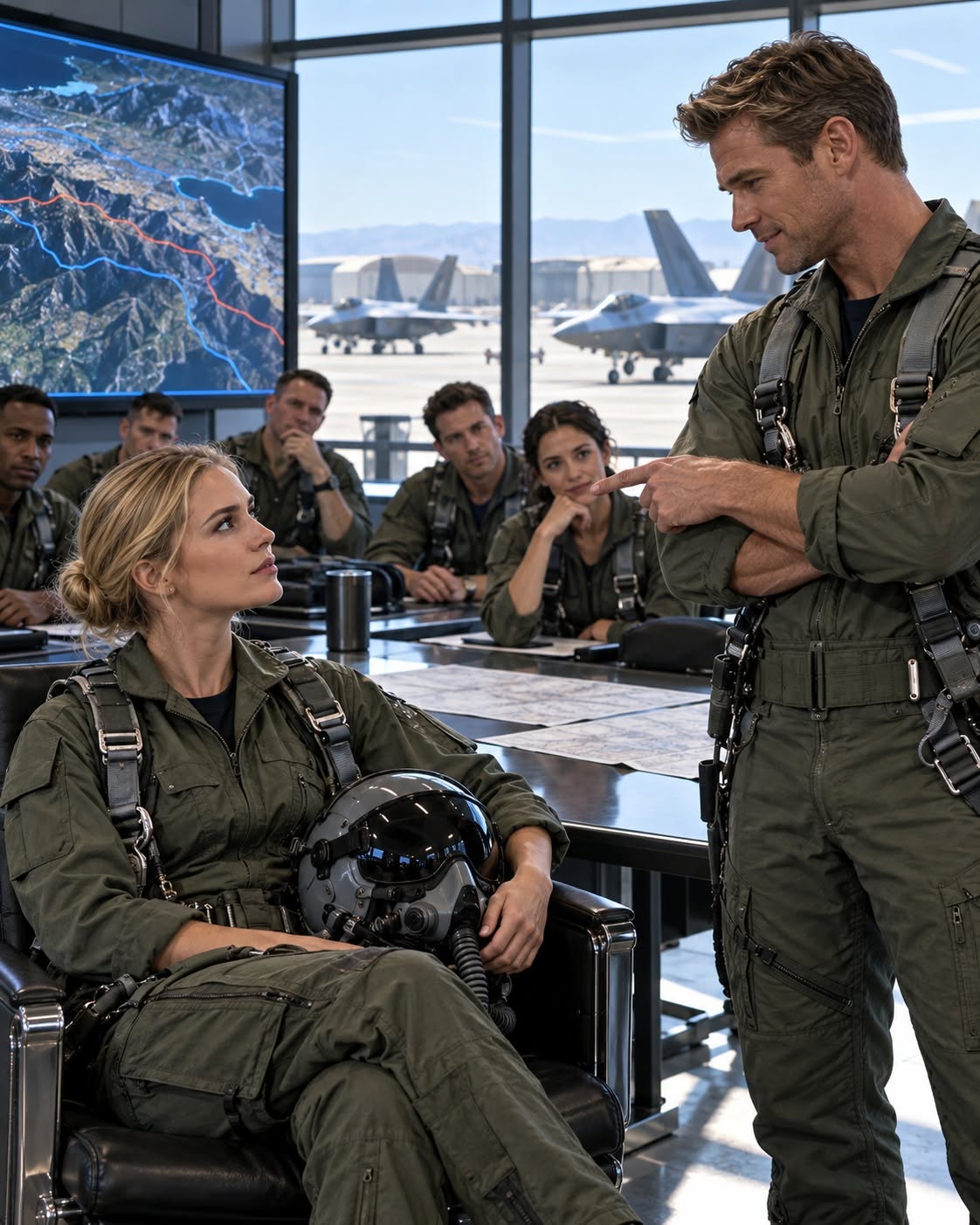
Finally, he broke the silence.
“How did you know I was still alive?”
I looked at him.
“I saw your parachute.”
“You couldn’t have known whether I’d landed safely.”
“No.”
“You couldn’t have known whether I was injured.”
“No.”
“And you knew the enemy would be waiting for you.”
I took a sip of coffee. It had gone cold.
“Major, I knew enough.”
He stared at the floor.
“My aircraft’s warning system gave me seconds. I tried to evade the first missile, but the second attack came from a different angle. By the time I realized what was happening, I’d lost control.”
He rubbed his palms together as if he could still feel the cockpit shaking around him.
“I remember looking down at the ground and thinking about all the things I’d never done. All the people I’d never called. I kept telling myself someone would come.”
He stopped.
Then he looked directly at me.
“When I saw your aircraft come over the ridge, I thought you were out of your mind.”
“I’ve been told that before.”
“I thought you’d leave after the first pass.”
“So did I.”
He almost smiled, but the expression faded quickly.
“You kept coming back.”
I set the coffee aside.
“You would have done the same for me.”
He didn’t answer immediately.
And in that silence, I realized that neither of us truly knew whether that was true.
Before he could respond, the medical station door opened.
Colonel Mercer, our squadron commander, stood in the doorway. His expression was controlled, but I had flown under him long enough to recognize the signs of a man who was furious and trying very hard not to show it.
“Captain,” he said. “Major. The operations commander wants both of you in the briefing room. Now.”
Vance rose.
I followed, despite the medic’s protest.
My wrist hurt with every step, and my legs felt as though I had run across the entire desert. Still, I wasn’t about to let someone else explain what had happened in Tariq Gorge.
The briefing room looked exactly as it had before the mission.
The same digital display. The same long table. The same chairs occupied by officers who had watched Vance ridicule my aircraft just hours earlier.
Only this time, nobody laughed when I entered.
A large image of the canyon filled the screen. Beside it was a photograph of my Warthog after landing.
Colonel Mercer stood near the front.
“Operation Desert Anvil resulted in the successful recovery of all eight trapped special forces operators and the downed pilot,” he began. “No American personnel were lost during the extraction.”
A quiet murmur passed around the room.
“However,” he continued, “we also suffered the loss of an F-35 mission-capable status, the near-total destruction of an A-10C, and multiple deviations from the assigned engagement plan.”
His eyes settled on me.
“Captain, you disobeyed a direct order to remain above the gorge. Explain.”
I had prepared several answers during the walk from the medical station.
None of them sounded particularly convincing now.
“Sir, Major Vance was on the ground, and enemy forces were moving to capture him. The rescue helicopters were still minutes away. I believed immediate suppression was necessary to prevent his capture and protect the extraction.”
“You were explicitly warned about the enemy air defenses.”
“Yes, sir.”
“You knew your aircraft could be destroyed.”
“Yes, sir.”
“And you proceeded anyway.”
“Yes, sir.”
Colonel Mercer folded his arms.
“Why?”
I glanced at the image of the canyon.
“Because the enemy wasn’t going to wait for us to finish discussing the risk.”
Nobody spoke.
Then the operations commander, General Harlan, leaned forward.
“Captain, courage is not a substitute for judgment. If you had been killed, we would have lost another pilot. If your aircraft had crashed near the rescue helicopters, you could have endangered the entire extraction.”
“I understand that, sir.”
“Do you?”
“Yes, sir. I also understand that if I had stayed at altitude, Major Vance might have been captured before the helicopters arrived.”
General Harlan’s expression hardened.
“Your decision was successful. That does not automatically make it correct.”
For the first time since entering the room, I had no immediate answer.
He was right about one thing.
Being alive at the end of a dangerous decision did not prove that the decision had been wise.
I had entered the canyon with a damaged plan, limited information, and the certainty that somebody needed help. I had trusted my aircraft and my instincts. But instinct could not erase the possibility that I might have made everything worse.
General Harlan turned toward Vance.
“Major, you were leading the flight. What is your assessment?”
Vance stood slowly.
Every eye in the room followed him.
“My aircraft was hit because we underestimated the threat,” he said. “We relied too heavily on the assumption that stealth would keep us safe. The canyon’s terrain and the enemy’s coordinated defenses created a situation we weren’t prepared to handle.”
He paused, then looked at me.
“Captain’s intervention prevented my capture. It also disrupted the enemy advance long enough for the rescue team to reach the special forces personnel.”
General Harlan nodded.
“And your assessment of the A-10?”
Vance’s jaw tightened.
For a moment, I thought he might defend his earlier remarks.
Instead, he said, “I was wrong.”
The words seemed to surprise even him.
“I dismissed the aircraft because it was old. I confused advanced technology with invulnerability, and I confused the price of a machine with the value of the person flying it.”
He turned to face the room.
“The A-10 wasn’t the right aircraft for every part of that mission. Neither was my F-35. But when the situation changed, the Warthog provided the kind of close support we needed. Captain’s actions gave us the time to get everyone out.”
He looked at me again.
“And I owe him more than an apology.”
General Harlan let the silence settle before speaking.
“The review board will determine whether Captain’s actions were justified under the circumstances. Until then, nobody in this room should mistake a successful outcome for permission to ignore command authority.”
His gaze moved across the officers.
“Nor should anyone mistake the failure of a plan for proof that the people executing it lacked competence.”
The meeting ended without a verdict.
As we filed out, Vance fell into step beside me.
“You realize I just admitted you were right in front of an entire room of people.”
“I noticed.”
“Could you at least pretend to be surprised?”
I looked at him.
“I’m still processing it.”
This time, his smile was genuine.
For the first time since I’d met him, I saw the man beneath the polished flight suit and expensive aircraft.
He wasn’t fearless.
He had simply spent years convincing himself that fear was something that happened to other people.
And now he had to learn how to live without that illusion.
The investigation lasted eleven days.
During that time, my Warthog sat inside a maintenance hangar while engineers examined every damaged component. They discovered that the aircraft had suffered far more structural damage than I had realized. The hydraulic failure had been catastrophic, and fragments from the anti-aircraft burst had damaged several systems that had remained functional long enough to get me out of the canyon.
One engineer showed me a photograph of a fractured assembly.
“Another few seconds under that kind of load, and you might have lost the ability to control the aircraft altogether.”
I studied the picture.
“Can it be repaired?”
He gave me a look.
“Technically? Maybe. Economically? That’s a different question.”
I glanced through the hangar doors at the Warthog.
“She’s earned the effort.”
He shook his head, smiling despite himself.
“Pilots always say that about their aircraft.”
“Maybe because you keep making us leave pieces of ourselves inside them.”
The engineer laughed.
But I wasn’t entirely joking.
Every aircraft carried memories for the people who flew it. Some remembered the first time they took off alone. Others remembered the missions that went wrong, the wingmen who didn’t return, or the moments when a familiar engine sound became the only reassurance in a sky full of uncertainty.
For me, the Warthog was more than a machine.
She was the reason I had survived the canyon.
And I wasn’t ready to see her reduced to a line in an inventory report.
On the twelfth day, the review board delivered its findings.
My decision to descend into the gorge had violated the standing order, but the board determined that the rapidly developing threat to an American pilot and the approaching rescue force had created exceptional circumstances. My actions were judged defensible, though the report made it clear that the mission had exposed serious weaknesses in our planning and coordination.
I received a formal reprimand for failing to communicate my intended maneuver before committing to it.
I accepted it without argument.
The report also recommended a complete review of our procedures for downed-pilot recovery in terrain dominated by short-range air defenses.
That recommendation mattered more to me than anything written about my own performance.
Because somewhere beyond the next mountain range, another pilot might find himself under a parachute, staring at an enemy patrol and wondering whether anybody was coming.
I wanted that pilot to have a better chance than Vance had.
Three days after the board’s decision, Colonel Mercer summoned me to his office.
On his desk lay a folder bearing the words AIRCRAFT DISPOSITION.
My stomach tightened.
“The Warthog?” I asked.
“She’s being considered for retirement from active service,” he said. “The damage is extensive, and the repair costs are difficult to justify.”
I sat down.
“Has the decision been made?”
“Not yet.”
He studied me for a moment.
“I’ve been flying long enough to know that people get attached to aircraft. But we can’t keep every old machine simply because it has a good story.”
“I know, sir.”
“Do you?”
I looked at the folder.
“I know an aircraft isn’t valuable because of what it means to one pilot. It’s valuable because of what it can do for the people who depend on it.”
Mercer nodded.
“Then tell me what it can still do.”
I leaned forward.
“The mission exposed a gap between our high-altitude capabilities and what we need when troops are trapped close to hostile forces. The A-10 can provide persistent visual support, carry a substantial weapons load, and remain useful in situations where positive identification and coordination with ground forces are essential.”
I paused.
“But it needs to operate within a coordinated plan. Better intelligence, better communication, and realistic contingency procedures. I shouldn’t have had to make that decision alone in the canyon.”
Mercer listened without interrupting.
“So your argument isn’t that the Warthog is invincible.”
“No, sir. It isn’t.”
“Or that an older aircraft is automatically better than a newer one.”
“Absolutely not.”
“Then what is your argument?”
I thought about the burning F-35, the enemy trucks racing across the valley, and the eight special forces operators waiting for rescue.
“My argument is that we should choose the right tool for the mission, not the newest tool because it makes us feel prepared.”
Mercer leaned back.
For a long moment, he said nothing.
Then he closed the folder.
“I’ll include your assessment in the final recommendation.”
It wasn’t a promise.
But it was enough to give me hope.
I left his office believing the Warthog might have one more flight left in her.
I had no idea how soon she would be needed again.
Two weeks later, an urgent operational alert shattered the quiet of the base.
A convoy carrying medical supplies and evacuation equipment had been ambushed near the eastern border. The surviving vehicles had taken shelter beside an abandoned mining settlement called Kharif, where a small security team was attempting to protect wounded personnel while waiting for extraction.
Enemy forces had occupied the surrounding high ground.
The roads were narrow, the terrain broken, and the available landing zones dangerously exposed.
Weather had also closed several routes that our helicopters would ordinarily use.
The mission briefing began with a familiar sentence.
“We need someone to hold the enemy away from the evacuation point.”
I sat at the back of the room, listening as the planners examined the terrain.
Then the commander turned toward the aircraft assignments.
“We have one available A-10C.”
A few officers exchanged glances.
The aircraft was mine.
Not the battered one from Tariq Gorge, which remained under evaluation, but another Warthog assigned to the same squadron.
A young pilot named Lieutenant Daniel Reeves raised his hand.
“Sir, why not send the F-35s first and have them neutralize the threat?”
“Because we don’t have reliable targeting data on the positions around the settlement,” the intelligence officer answered. “The enemy is mixed with abandoned industrial structures, and the security team is operating close to the evacuation zone. We need positive identification and close coordination before engaging.”
Reeves nodded, but his expression remained uncertain.
Then he glanced at me.
“Captain, can the A-10 really make the difference in terrain like that?”
I could have told him about Tariq Gorge.
I could have described the burning vehicles, the damaged wing, and the pilot who had once believed he could never be touched.
Instead, I answered the question in front of me.
“It can help, Lieutenant. But the aircraft isn’t going to make the decisions for us. We’ll need good intelligence, clear communication, and the discipline to leave a target alone if we can’t identify it.”
He considered that.
“And if the plan fails?”
“Then we adapt before the situation becomes unrecoverable.”
I stood and pointed toward the map.
“We’ll need the security team’s exact position, a reliable communications link, and a clear extraction corridor. We also need a contingency if the weather closes our return route. Nobody goes into that valley without knowing how we’re getting them out.”
General Harlan, who had joined the briefing remotely, nodded from the screen.
“That’s the right question, Captain.”
For the next hour, we rebuilt the plan.
We coordinated the aircraft, helicopters, intelligence officers, and ground team until everyone understood their responsibilities. We established clear abort conditions and alternative procedures if communications failed.
This time, nobody assumed that technology would solve every problem.
And nobody expected a single pilot to save the mission through sheer determination.
When we finally walked toward the hangar, Lieutenant Reeves fell into step beside me.
“Can I ask you something?”
“Go ahead.”
“Were you afraid when you went into Tariq Gorge?”
I stopped beside the aircraft.
The Warthog’s gray fuselage gleamed under the hangar lights. Ground crew members moved around her, checking panels and preparing the aircraft for departure.
“Yes,” I said.
Reeves looked surprised.
“You were?”
“Of course.”
“Then how did you do it?”
I rested my hand against the aircraft’s skin.
“Being afraid doesn’t mean you can’t act. It means you need to understand what you’re risking, why you’re risking it, and whether there’s a better way to accomplish the mission.”
I turned toward him.
“Courage isn’t the absence of fear, Lieutenant. It’s refusing to let fear—or pride—make the decision for you.”
He nodded slowly.
Then he climbed into his own aircraft preparation area, and I began my preflight checks.
The mission at Kharif lasted less than an hour.
It was difficult, tense, and full of uncertainty, but the plan held. The security team maintained communication with our aircraft, the enemy positions were identified, and the rescue helicopters reached the evacuation point under coordinated protection.
Every wounded person was recovered.
Every aircraft returned.
No one had to make a desperate last-minute decision in the middle of a canyon.
When I landed, Lieutenant Reeves was waiting near the hangar.
He gave me a tired grin.
“I think I understand now.”
“Understand what?”
He glanced at the Warthog.
“Why you still fly it.”
I smiled.
“Good. Just remember that understanding why an aircraft is useful isn’t the same as believing it can do everything.”
He nodded.
“Right aircraft, right mission.”
“Right people, too.”
That afternoon, I received a message from Major Vance.
He had been temporarily assigned to an evaluation program examining how advanced fighters and close-support aircraft could work together in complicated ground operations. His role would involve studying the circumstances surrounding the loss of his F-35 and identifying ways to improve coordination between aircraft operating at different altitudes and under different threat conditions.
His message was brief.
You were right about one thing. I had spent so long trying to prove my aircraft was the best that I forgot the mission wasn’t about proving anything.
A second message arrived.
I’m working on a new training scenario based on Tariq Gorge. I’d like your help making sure we don’t repeat our mistakes.
I read it twice before replying.
I’ll help. But we’re starting with the mission plan, not the aircraft.
His answer came almost immediately.
Wouldn’t have it any other way.
Months passed.
The Warthog from Tariq Gorge was eventually repaired, though she never returned to the same demanding operational schedule. The engineers replaced damaged components, rebuilt critical systems, and restored enough of her structure for limited flight testing. When I visited the hangar, she looked almost new from a distance.
Up close, the scars remained.
A maintenance officer pointed to one of the repaired panels.
“We could have replaced the entire section, but the engineers decided to preserve the original markings.”
I traced the edge of a faded maintenance stencil with my eyes.
“Good.”
“You really do love this thing, don’t you?”
I considered the question.
“I respect what it represents.”
He nodded as if he understood, though I suspected he had never watched an aircraft carry a friend home through a sky full of enemy fire.
The day the Warthog completed her final evaluation flight, I stood beside the runway with Chloe.
She had spent the months since Tariq Gorge making sure I never forgot how close I had come to dying.
Whenever I complained about my wrist, she reminded me that the alternative had been much worse. Whenever I praised the aircraft, she reminded me that the ground crew had spent weeks repairing the damage I had brought back.
She had a point.
A pilot might sit alone in a cockpit, but no aircraft ever flew because of one person alone.
The mechanics who kept the engines running, the intelligence officers who identified the threats, the controllers who coordinated the mission, the rescue crews who risked their lives, and the soldiers waiting on the ground all belonged to the same chain of responsibility.
The Warthog had carried me through the canyon.
But she had never been the only reason I came home.
Across the runway, a familiar figure emerged from the operations building.
Major Vance walked toward us, wearing a flight suit without the smug expression that had once seemed permanently attached to it.
He stopped in front of the aircraft and studied the repaired wing.
“They did a remarkable job.”
“They did.”
He ran a hand along the fuselage, then withdrew it.
“I used to think a good pilot was someone who could handle any situation because he had the best equipment.”
“And now?”
“Now I think a good pilot is someone who understands what his equipment can do, knows what it can’t do, and never forgets the people depending on him to make that distinction.”
Chloe folded her arms.
“That sounds suspiciously like something learned the hard way.”
Vance laughed.
“You have no idea.”
For a while, we watched the ground crew prepare the aircraft for its final test.
Then Vance turned toward me.
“I’ve been thinking about what you said in the medical station. About how I would have done the same for you.”
I waited.
“I don’t know if I would have,” he admitted. “Before Tariq Gorge, I might have convinced myself that protecting my aircraft, my career, or my reputation mattered more than taking a risk for someone else.”
He looked at the Warthog.
“I’d like to believe I would have gone after you. But I can’t honestly say that I would have.”
His admission carried more weight than any apology.
“Then don’t promise what you can’t know,” I told him. “Just make the next decision better than the last one.”
He nodded.
“I can do that.”
The ground crew chief raised a hand from beside the aircraft.
The Warthog’s engine started, its familiar rumble spreading across the runway. For one brief moment, the sound transported me back to the canyon, to the heat and smoke and the terrible certainty that I might not make it through the next turn.
Then the aircraft began to taxi.
It rolled toward the runway, gathered speed, and lifted into the morning sky.
The flight lasted only long enough to confirm that the repairs had held. The pilot returned without incident, and the crew gathered around the aircraft as it came to a stop.
No explosions.
No desperate maneuvers.
No enemy forces closing in.
Just a safe landing on a clear morning.
Somehow, that felt like the best ending the Warthog could have asked for.
Later that evening, I walked alone along the edge of the airfield.
The sun was sinking behind the mountains, painting the sky in shades of amber and red. Aircraft moved in the distance, their silhouettes crossing the fading light.
I thought about the day Vance had pointed at my assignment and called the Warthog a useless museum piece.
I had been angry then. Not because he had insulted me, but because he had dismissed years of experience, the work of the people who maintained our aircraft, and the lives those machines had helped protect.
I had wanted to prove him wrong.
And perhaps, somewhere inside me, a small part of my decision in Tariq Gorge had been driven by that desire.
I had wanted the old aircraft to demonstrate its worth.
I had wanted the pilot who mocked it to see what it could do.
That was an uncomfortable truth to admit.
Because the mission had never been about winning an argument.
If Vance had been someone else, if his aircraft had belonged to another squadron, if nobody had ever questioned the Warthog’s value, the enemy would still have been moving toward a stranded American pilot.
The decision would still have mattered.
And so would the consequences.
I had not gone into the canyon to prove that an old aircraft was better than a new one.
I had gone because a man was in danger, and I believed I had a chance to help him.
That distinction mattered more than I had understood at the time.
The next morning, I found a small envelope tucked beneath the edge of my office door.
Inside was a photograph taken from the airfield after the Warthog’s return. The damaged aircraft sat in the dirt, surrounded by ground crew members who looked exhausted but triumphant.
On the back, someone had written a short message.
For the people who bring us home.
There was no signature.
I placed the photograph beside my desk.
Over the following weeks, more pilots visited my office to ask about Tariq Gorge. Some wanted to know how the aircraft had survived the damage. Others asked what I had seen from the cockpit, how I had made the emergency landing, or what it felt like to hear the rescue crew confirm that Vance was aboard.
I answered their questions as honestly as I could.
I told them about the fear.
I told them about the mistakes.
I told them about the importance of knowing when to commit and when to withdraw.
And whenever someone called the Warthog a miracle machine, I corrected them.
“It wasn’t a miracle,” I would say. “It was an aircraft doing what it was designed to do, flown by a pilot who had help from an awful lot of people.”
One afternoon, Lieutenant Reeves asked me whether I thought the A-10 would still be flying ten years from then.
I looked out through the window toward the runway.
“I don’t know.”
He seemed disappointed.
“Really?”
“Aircraft have service lives. Missions change. Technology improves. One day, the Warthog will be replaced, just like every aircraft before it.”
“Then what happens to everything it taught us?”
I turned back toward him.
“That depends on whether we remember the lessons or just remember the machine.”
He thought about that for a moment.
I continued.
“The danger isn’t that an aircraft becomes old. The danger is that people start believing age tells them everything they need to know. Sometimes an old design remains useful. Sometimes a new design solves a problem the old one never could. Our responsibility is to understand the difference.”
“And if people forget?”
“Then we remind them.”
He smiled.
“I think I can do that.”
Years from now, I suspect the details of Operation Desert Anvil will become blurred. The reports will be archived, the photographs will fade, and the aircraft involved will eventually disappear from the flight line. New pilots will learn new systems, fly new machines, and face dangers that none of us can fully imagine today.
Major Vance may eventually forget the exact moment his F-35 was hit.
I may forget the precise force of the controls fighting against my hands as I dragged the Warthog through Tariq Gorge.
But I doubt either of us will forget what it felt like to look down at that valley and realize how little our reputations mattered.
A million-dollar aircraft could not guarantee its pilot’s safety.
An old aircraft could not guarantee its pilot’s survival.
And courage, by itself, could not guarantee a successful mission.
What mattered was the willingness to see the situation clearly, to trust the people beside you, to recognize the limits of your tools, and to make the best decision you could when someone else’s life depended on it.
Vance learned that lesson beneath a parachute, surrounded by enemy forces.
I learned it in the cockpit of a damaged Warthog, with the canyon walls closing around me.
Neither of us learned it because one aircraft was superior to the other.
We learned it because, for a few terrible minutes, everything we thought we knew about strength, technology, and control was stripped away.
All that remained was the mission.
And the people who needed us to finish it.
Sometimes, when the evening light falls across the airfield, I still walk out to the hangar where the repaired Warthog rests. I stand beside her battered fuselage and remember the pilot who once called her a museum piece.
I don’t feel anger anymore.
I don’t even feel the need to prove him wrong.
I simply feel grateful.
Grateful that the aircraft held together long enough to bring a frightened man home. Grateful that the people who built and maintained her had done their jobs so well. Grateful that my wingman stayed with me, that the rescue crews reached the valley, and that the people on the ground had one more chance to see their families.
And grateful that I survived long enough to understand something I should have known all along.
The true measure of a machine is not its price, its age, or the admiration it inspires on the runway.
It is the purpose it serves when everything goes wrong.
The true measure of a pilot is not the aircraft he commands, the decorations on his uniform, or the confidence with which he enters a briefing room.
It is what he chooses to protect when the cost becomes real.
And the true measure of a team is not whether its members always agree, but whether they can set aside their pride, learn from their mistakes, and stand together when lives are at stake.
The A-10 would not fly forever.
Neither would I.
But somewhere, someday, another pilot would find himself in a valley he could not escape, waiting for help he could not summon on his own.
When that moment came, I hoped the people responsible for bringing him home would remember Tariq Gorge.
I hoped they would choose their aircraft wisely, trust their training, respect the limits of their equipment, and never confuse the newest technology with the certainty of survival.
Most of all, I hoped they would remember that the person in trouble was never just a name on a mission display.
He was someone who mattered.
Someone whose life was worth the risk of doing the job right.
And if an old Warthog could still help save that life, then she had earned her place in the sky.
Not because she was invincible.
Not because she was better than every aircraft that came after her.
But because, when one of our own was falling toward the desert and the world seemed to be closing in, she had been there.
Sometimes, that is all greatness ever asks of us.
To be there when we are needed.
To do what we can with what we have.
And to bring one another home.