I wore a $12 flannel shirt and drove a battered 2009 Honda Civic to every blind date I went on. The women who rejected me thought I was broke.
That Sunday, Clare and I met beside the river and bought two cups of coffee from a food truck. They cost two dollars each, and somehow they tasted better than anything I’d ordered in an expensive restaurant.
We walked without a destination, talking about the things people usually save for the end of a relationship.
I told her about Sarah.
I explained how grief could make ordinary moments feel cruel: finding my wife’s favorite mug in the back of a cupboard, hearing a song she’d loved, or watching Leo reach for his mother in a crowded room before remembering she wasn’t there.
“I don’t want to replace her,” I admitted. “I just want to stop feeling like being happy again means I’m leaving her behind.”
Clare didn’t offer a convenient answer. She simply walked beside me until I could speak again.
Then she told me about loneliness.
People assumed that having power meant never being vulnerable, she said. They saw the title, the decisions, the expectations. Few cared enough to ask what it cost to carry them.
I thought she meant a demanding job and an exhausting life. I had no idea how literal her words were.
Our Sundays became a quiet ritual.
We walked by the river, tried food trucks, and took Leo to the park. Clare never pretended to understand every dinosaur fact he delivered, but she listened as if each one mattered. She remembered his favorite snacks and knew that he hated having his shoelaces tied too tightly.
One afternoon, Leo slipped his hand into hers as we crossed the street.
“Are you coming next Sunday, too?” he asked.
Clare glanced at me before answering.
“If your dad invites me.”
He did, of course.
And somewhere between cheap coffee and playground swings, I fell in love with her.
That was when my little experiment began to feel less like protection and more like cowardice.
I had built my life around the fear that someone would love my money instead of me. But now I was hiding the truth from a woman who had never asked what I earned, what I owned, or what I could give her.
What would happen when she found out?
I nearly told her several times. Once, when she asked about my work. Again, when Leo described my company as “Dad’s computer place.” Each time, I found an excuse to wait.
Meanwhile, Clare’s own secret was becoming harder to keep.
At Pat’s, she had begun documenting Kevin’s conduct, reviewing staffing practices, and tracing the decisions that allowed managers to mistreat employees. The deeper she looked, the more she understood how thoroughly the company’s leadership had lost touch with the people keeping its restaurants running.
She had come to the diner expecting to investigate a business problem.
Instead, she had found a waitress’s uniform that made her invisible to customers, a manager who abused his authority, and a father who defended a stranger without expecting anything in return.
One Sunday, after Leo ran ahead to inspect a display of carved wooden dinosaurs outside a shop, Clare stopped walking.
“There’s something I need to tell you,” she said.
Her expression was serious, and for a moment I thought she had discovered my financial secret.
Instead, she told me her real position at Oak and Ember Hospitality.
She was its CEO.
Pat’s Diner belonged to her company.
I stared at her, trying to reconcile the woman who had shared two-dollar coffee with me with the executive responsible for a multibillion-dollar restaurant empire.
“Why didn’t you tell me?” I finally asked.
“Because I needed to see what was happening inside my own company without everyone changing their behavior because of who I was.” She paused. “And because, with you, I wanted to be Clare before I was anyone else.”
I understood that feeling better than she knew.
My own confession came next. I told her about the software company, the $42 million, the old Honda, and the fear that had made me turn every date into a test.
She listened without interrupting.
When I finished, she looked disappointed—not because I had money, but because I’d decided for her what she was allowed to know.
“You wanted someone to love the real you,” she said. “But you never gave me the chance to decide whether I could trust you.”
She was right.
I apologized without asking her to make me feel better.
Clare needed time, and I gave it to her. I stopped trying to manage the outcome and let her decide what she wanted.
Weeks later, she agreed to meet Leo and me by the river again.
We didn’t pretend the secrets had never happened. We talked about trust, about the difference between privacy and deception, and about how neither of us wanted money or power to become the foundation of our relationship.
Clare continued cleaning up her company, holding managers accountable and making sure the people who worked in her restaurants were treated with dignity. I stopped using my bank account as a test of anyone’s character and started being honest about my life.
Our relationship didn’t become perfect overnight. It became real.
And one evening, as Leo walked between us holding both our hands, I realized something Sarah had taught me long before I lost her:
Love wasn’t about finding someone who could never hurt you.
It was about finding someone willing to know you fully—and choosing to build something honest together.
The first time I realized that love could survive the truth, I was standing outside a hospital room, holding a little boy’s dinosaur backpack and wondering whether I had already lost the two people who mattered most to me.
It happened on a rainy Thursday evening, three months after Clare and I decided to give our relationship another chance.
Our life had settled into something beautiful. Sunday walks by the river had become Saturday breakfasts, spontaneous trips to the bookstore, and evenings when Clare sat on my living room floor helping Leo construct elaborate dinosaur habitats out of cardboard boxes.
She had even learned that a Tyrannosaurus rex had approximately the same bite force as a small car engine, a fact Leo repeated whenever he wanted to win an argument.
For the first time since Sarah died, my house no longer felt like a museum dedicated to someone who wasn’t coming home.
It felt like a home again.
But happiness, I was learning, didn’t mean life had stopped testing you.
That Thursday, Clare called me at 6:17 p.m.
Her voice sounded different.
“Daniel, I need you to listen carefully. Leo is with you, right?”
“Yes. He’s doing his homework. Why?”
“Don’t panic, but I’ve had a call from my board. Someone leaked the investigation at Oak and Ember. They’re claiming I manipulated the company accounts to hide losses, and they’re threatening to suspend me.”
I stood up so quickly that my chair scraped across the kitchen floor.
“That’s ridiculous. You were investigating corruption.”
“I know what I was doing. Unfortunately, the people involved know exactly how to make a lie sound convincing.”
“Who did this?”
“I’m not certain yet. But there’s something else.” She paused. “They’ve found out about you.”
My stomach tightened.
“What do you mean?”
“They know you’re the founder of the software company. They know about the forty-two million dollars. Someone has been asking questions about our relationship.”
For a moment, all I could hear was the refrigerator humming.
The two secrets we had once kept from each other had somehow become weapons in someone else’s hands.
“Clare, I can help. My attorneys—”
“No.” Her answer was immediate. “Not yet. If your money suddenly appears in this story, they’ll say I’m using our relationship to protect my position.”
“So what am I supposed to do? Stand here and watch them destroy you?”
“I need you to trust me, Daniel. Just as I had to learn to trust you.”
Then she hung up.
I stared at the phone, feeling the old instinct rise inside me: call the best lawyers, buy the best investigators, make the problem disappear before it could hurt anyone.
Money had always offered me the illusion that every disaster could be solved if I moved fast enough.
But Clare had asked me for something money couldn’t purchase.
Trust.
I put the phone down.
For the next two days, I respected her request. I didn’t contact her board, approach the press, or send anyone to investigate her colleagues.
Instead, I picked Leo up from school, cooked his favorite spaghetti, and listened when he explained that his classmate had incorrectly identified a dinosaur fossil.
On Saturday morning, Clare called again.
“Can we talk?”
We met at Pat’s Diner, the place where our story had begun. Kevin was gone, dismissed after Clare’s investigation uncovered a pattern of intimidation, falsified safety reports, and retaliation against employees who complained.
The restaurant had changed. The fire exit was clear, the kitchen had been renovated, and a handwritten sign near the register invited staff to report concerns without fear of punishment.
Clare sat opposite me in a dark coat, looking exhausted.
“I owe you an explanation,” she said.
“I’m listening.”
“The board has appointed an independent committee to investigate the allegations. I could fight them publicly, but that would turn this into a spectacle. Several people are depending on me to handle this properly.”
“And the people who made the accusations?”
“We have evidence that someone altered internal documents. But we need to establish who did it and why.”
She looked down at her hands.
“I also need to know something, Daniel. If this becomes ugly, if the newspapers publish your financial details and people start asking whether our relationship is a business arrangement, will you still stand beside me?”
I reached across the table.
“I should have stood beside you without needing you to ask.”
Her eyes filled, but she didn’t look away.
“I don’t need you to rescue me,” she whispered. “I need you to remember that I’m capable of fighting my own battles.”
“I know.”
“And if I lose my position?”
“Then we’ll figure out what comes next.”
“What if the company suffers?”
“Then we’ll figure that out, too.”
She watched me for a long moment.
“That’s a very expensive promise.”
I smiled sadly.
“No. It’s the one thing I can offer you that has nothing to do with money.”
For the first time that morning, she smiled back.
We sat there until the coffee went cold, talking about what we could control and what we couldn’t. I told her I would answer questions honestly if the investigation required it, but I wouldn’t interfere with her decisions.
She agreed to let me support her without turning that support into another secret.
It seemed like a small victory.
We had no idea what was coming next.
On Monday, an article appeared on a popular business news website.
Its headline described Clare as a billionaire executive who had secretly dated a wealthy software entrepreneur while conducting an undercover investigation inside her own company.
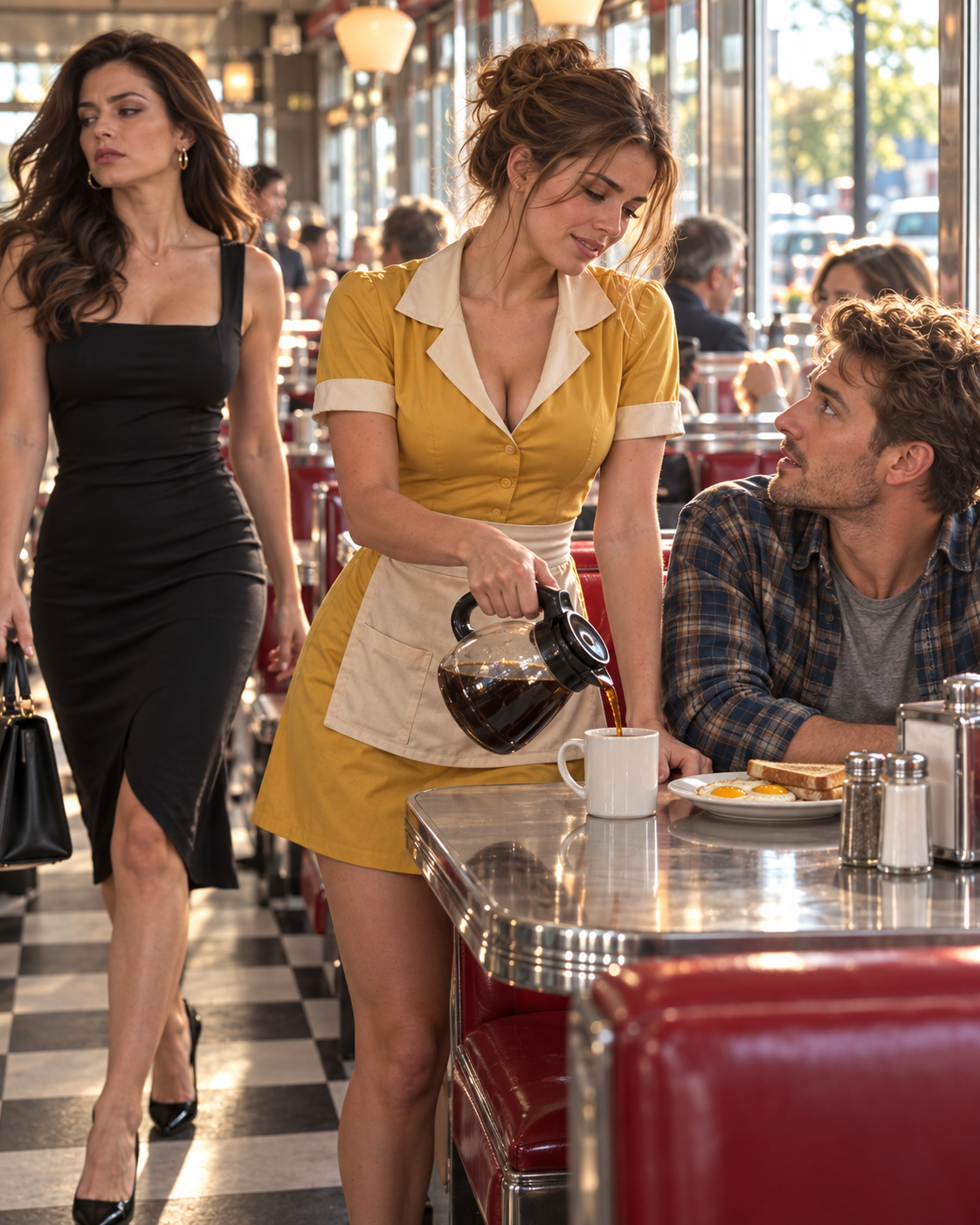
The article included photographs of us walking beside the river, a picture of my battered Honda, and a photograph of Clare in her mustard-yellow waitress uniform.
The writer had arranged the details to suggest that our relationship was an elaborate arrangement designed to manipulate the company.
According to the article, I had used my wealth to influence Clare’s decisions. In return, she had supposedly provided me with privileged information about Oak and Ember.
None of it was true.
But the story was written with enough selective facts to make the lies seem plausible.
By lunchtime, my phone had received more than a hundred messages.
Some people congratulated me for supposedly landing a billionaire girlfriend. Others accused Clare of corruption. Strangers called me a fraud, a manipulator, and a man who had disguised himself as poor to trap a wealthy woman.
The most painful messages came from people who had never met either of us but seemed certain they understood our motives.
Then someone posted a photograph of Leo outside his school.
The caption read: “Imagine having forty-two million dollars and still making your kid live like that.”
I felt the blood drain from my face.
They had taken my son’s ordinary backpack, his modest clothes, and the old car I drove him to school in, then turned them into evidence of a crime that existed only in their imagination.
I had chosen to protect my privacy.
I had never chosen to make my child a target.
I called the school immediately and asked them to follow their safety procedures. Then I contacted my attorney, not to attack the newspaper, but to protect Leo’s identity and request the removal of the photograph.
When I called Clare, she was already aware of the article.
“I’m sorry,” she said. “I never wanted this to reach him.”
“Neither did I.”
“The board is meeting tomorrow. They’re using the article as evidence that my judgment is compromised.”
“Then tell them the truth.”
“I will. But I need to tell you something else.”
Her voice trembled.
“If they force me out, I won’t let them turn this company into a place where employees are afraid to speak. Even if it costs me everything.”
I understood then that Clare’s position wasn’t merely a title or a fortune.
It was the responsibility she had accepted when she realized that thousands of people depended on the decisions made in the company’s boardroom.
She wasn’t afraid of losing her wealth.
She was afraid of failing the people who trusted her.
“Whatever happens tomorrow,” I said, “don’t make your decision based on what people will say about us.”
“And you?”
“I’ll do the same.”
That evening, I sat beside Leo’s bed while he examined a small plastic triceratops.
“Dad?”
“Yeah, buddy?”
“Are people saying bad things about you because of your car?”
I felt something tighten in my chest.
“Some people are saying things they don’t understand.”
“Why don’t you just buy a better car?”
The question was so innocent that I almost laughed.
“Because having a better car wouldn’t make those people understand.”
He considered that.
“Then why do you care?”
I looked at my son, whose mother had died before he was old enough to understand why the world sometimes became cruel without warning.
“Because sometimes people say things that hurt other people, even when they’re wrong.”
He nodded slowly.
“Like when someone says my dinosaur drawing is stupid?”
“Exactly.”
“But if I know it’s a good drawing, I don’t have to stop drawing dinosaurs.”
I swallowed hard.
“No, you don’t.”
He placed the triceratops on his bedside table.
“Then you should keep loving Clare.”
I stared at him.
“Why do you say that?”
“Because she makes you laugh like Mom used to.”
For a moment, I couldn’t speak.
Leo reached for my hand.
“I know Clare isn’t Mom. But I think Mom would want you to be happy.”
I leaned down and kissed his forehead.
“Thank you, buddy.”
After he fell asleep, I went downstairs and opened the small wooden box where I kept Sarah’s wedding ring and the letters she had written during her final months.
I hadn’t read them in years.
One letter had been folded twice, its edges softened by time.
In it, Sarah had written about the life she hoped Leo and I would have after she was gone. She had told me not to make grief the only proof that I had loved her.
“Don’t let missing me become the only way you remember me,” she had written. “Let the people you love bring new happiness into your life. It won’t take anything away from what we had.”
I sat in the quiet living room until midnight.
Then I made a decision.
The next morning, I contacted the independent committee investigating Oak and Ember and offered to provide a formal statement. I disclosed my financial interests, explained how I had met Clare, and agreed to answer questions about any communication between us.
I didn’t offer to finance the investigation.
I didn’t threaten anyone.
I simply provided the facts and asked that the committee protect the privacy of employees whose testimony might expose wrongdoing.
For the first time in my life, I chose not to use money to control the outcome.
Instead, I let the truth do its work.
The committee’s hearing took place three days later.
Clare sat at one end of a long conference table, surrounded by executives who had spent years treating her decisions as unquestionable until those decisions threatened their own positions.
She wore a simple black suit. Her hair was tied back, and her expression was calm.
I sat in the public gallery, Leo safely with my sister.
The committee chairman began by reviewing the allegations of financial misconduct. Then Clare was asked to explain why she had gone undercover at Pat’s Diner.
“I wanted to understand why our employees were leaving at an alarming rate,” she said. “Our reports suggested that working conditions were improving. The people I met told a different story.”
She described Kevin’s behavior, the blocked fire exit, and the safety violations. She explained how the investigation had uncovered complaints that had been dismissed or altered before reaching senior management.
Then she introduced the evidence.
Time-stamped photographs.
Original employee complaints.
Kitchen inspection records.
Internal emails showing that several managers had been warned about safety violations but had done nothing.
Finally, she presented a document that changed the atmosphere in the room.
It was an email from the company’s chief operating officer, Martin Hale, instructing a regional director to remove unfavorable inspection results from a quarterly report.
A second email showed Martin discussing how Clare’s investigation could be used against her.
If she continued, he had written, the company would need to question her judgment publicly before she could expose the people responsible.
The room fell silent.
Martin shifted in his chair.
“These emails have been taken out of context,” he said.
Clare didn’t raise her voice.
“Then explain the context.”
He couldn’t.
Over the next hour, the committee examined the records and heard testimony from two employees who had been afraid to speak until Clare’s investigation gave them a reason to believe someone might finally listen.
One of them was a single mother who had worked at Pat’s for six years.
She described being threatened with dismissal after reporting a broken refrigerator. When she refused to sign a false safety report, her hours were cut.
“I kept quiet because I needed the money,” she said. “I had two children to feed. I couldn’t afford to lose my job.”
Clare listened without interrupting.
When the woman finished, Clare thanked her.
It was a simple gesture, but I watched the employee’s shoulders relax, as though someone had finally acknowledged the weight she had carried.
By the end of the hearing, the committee had suspended Martin and two regional executives pending a full audit. It also confirmed that Clare’s investigation had been authorized and that the allegations against her lacked supporting evidence.
The chairman announced that the company would appoint an external auditor, review its employee complaint system, and publish the findings.
Clare had won the first battle.
But when the hearing ended, she didn’t celebrate.
She stood alone in the corridor, staring through a window at the city below.
I approached slowly.
“You did it.”
She shook her head.
“We took the first step.”
“That’s still something.”
She turned toward me, and I saw tears shining in her eyes.
“I was so afraid that no one would believe them.”
I took her hand.
“They believed you because you brought the truth. And because you gave people a chance to tell theirs.”
She rested her forehead against my shoulder.
For a few seconds, neither of us spoke.
Then she whispered, “I don’t want to spend the rest of my life proving I’m not the person strangers imagine me to be.”
“You don’t have to.”
“Neither do you.”
We stood together until the corridor emptied.
The scandal didn’t disappear overnight.
There were more articles, more rumors, and more strangers who insisted that our relationship was impossible to understand. Some people accused Clare of using her position to silence critics. Others accused me of hiding behind wealth while pretending to be ordinary.
We learned to distinguish between criticism that deserved an answer and noise that didn’t.
I also made a change that surprised everyone who knew me.
I stopped pretending to be poor.
I didn’t suddenly start wearing expensive suits or trading my Honda for a sports car. I simply stopped lying when people asked what I did.
I told the truth about building my software company, about the money I’d earned, and about the fear that had made me turn dating into a test.
Some people treated me differently afterward.
A few became unusually attentive. Others lost interest almost immediately.
This time, I didn’t punish the world for their reactions.
I paid attention to consistency, kindness, and the way people treated those who could offer them nothing.
I had learned that a person’s character couldn’t be measured by what they possessed.
But neither could it be measured by what they lacked.
Clare and I continued building our relationship slowly. We didn’t rush into moving in together or make promises designed to impress anyone watching us.
We kept our Sunday walks.
We kept our cheap coffee.
And when life became difficult, we learned to speak before silence could turn uncertainty into suspicion.
Six months later, Clare invited me to the reopening of Pat’s Diner.
The restaurant had been renovated, but she insisted that its familiar character remain. The scratched wooden booths were repaired rather than replaced. The old photographs on the walls stayed where they were. The coffee was still cheap, and the pancakes were still slightly too large for the plates.
The difference was in the people.
Employees now had a confidential reporting system, paid training time, and clear procedures for raising safety concerns. Managers were evaluated not only on sales but also on staff retention and workplace conduct.
Clare had also established an employee advisory council whose members could bring concerns directly to senior leadership.
When she spoke at the reopening, she didn’t stand behind a podium surrounded by executives.
She stood near the counter, beside the woman who had testified at the hearing.
“A company isn’t its buildings, its profits, or the titles printed on business cards,” Clare said. “It’s the people who show up every day and trust that their work will be treated with dignity.”
The room applauded.
I watched her, remembering the tired waitress who had poured me a free cup of coffee after a disastrous date.
She caught my eye and smiled.
For a moment, the noise around us faded.
Then Leo tugged at my sleeve.
“Dad, can I have pancakes shaped like a T. rex?”
“Of course.”
“With extra chocolate chips?”
“Let’s not get carried away.”
Clare laughed.
It was the kind of ordinary moment I once would have considered too small to matter.
Now I knew better.
A year after our first Sunday walk, I took Clare and Leo to the river where we had first talked about grief, loneliness, and the fear of being misunderstood.
The trees had turned gold, and the wind carried the smell of rain.
Leo ran ahead, chasing fallen leaves and explaining to a passing dog owner that dinosaurs would have been terrible swimmers compared with certain prehistoric reptiles.
Clare slipped her hand into mine.
“Do you ever miss the days when nobody knew who you were?” she asked.
“Sometimes.”
“Me too.”
“Would you go back?”
She considered the question.
“No. I was lonely then, even when I was surrounded by people.”
I looked at her.
“What about now?”
She smiled.
“Now I’m sometimes lonely, sometimes frightened, and occasionally furious with my board. But I don’t feel invisible anymore.”
I squeezed her hand.
“That’s a pretty good improvement.”
She laughed, then grew serious.
“Do you think we would have found each other if you’d told me about your money on the first day?”
“I don’t know.”
“Do you regret hiding it?”
“Yes,” I said. “But I don’t regret learning why I did it.”
She leaned against my shoulder.
“I think that’s the difference between a mistake and a wasted mistake.”
We watched Leo crouch beside a pile of leaves, arranging them into what he claimed was a scientifically accurate Cretaceous landscape.
Then Clare asked, “What happens next?”
I looked at the woman beside me, the boy in front of us, and the river moving steadily toward a horizon neither of us could see.
“Tomorrow, I take Leo to school. You have a board meeting. I have a software company to run. And sometime this week, we’ll probably argue about what to eat for dinner.”
“Romantic.”
“I thought so.”
She shook her head, smiling.
“But what about us?”
I took a breath.
For years, I had believed that protecting my heart meant controlling what other people could know about me. I had thought that if I concealed enough, tested enough, and prepared for every possible betrayal, I could make love safe.
Instead, I had nearly destroyed something real by refusing to let another person choose me with her eyes open.
“I want a life with you,” I said. “Not because I can promise we’ll never be hurt, and not because I think money can solve every problem. I want it because I trust the person you are, and because I want to keep learning how to be someone you can trust, too.”
Clare’s eyes filled with tears.
“That’s the first proposal I’ve ever heard that didn’t sound like a business plan.”
“I’m trying something new.”
She kissed me, gently and without an audience.
When we pulled apart, Leo came running toward us, his cheeks red from the cold.
“Are you guys getting married?”
Clare and I exchanged a startled look.
“Why would you ask that?” I said.
“Because I found a ring in Grandma’s jewelry box when Aunt Rachel came over, and she said it belonged to Mom. I thought maybe you were going to give it to Clare.”
My heart stopped.
Sarah’s ring.
I had left it in the wooden box, untouched for years. The thought of giving it to another woman had once felt like erasing the life I had shared with my wife.
But perhaps I had misunderstood what it meant to keep a memory.
That evening, after Leo had gone to bed, I opened the box again.
Sarah’s ring lay beside her letters.
I held it in my palm, remembering the woman who had taught me to laugh, who had loved our son before he was born, and who had asked me not to let grief become the only way I remembered her.
I wasn’t ready to give the ring to Clare. It belonged to a chapter of my life that would always be precious, and I didn’t want to turn its meaning into a symbol she might feel obligated to accept.
Instead, I bought a simple ring of my own choosing.
A week later, I took Clare back to the river.
Leo stood nearby, trying very hard to look as though he had no idea what was happening.
I held Clare’s hands.
“I used to think love was finding someone who couldn’t hurt me,” I said. “Then I thought it was finding someone who would never care about my money. I was wrong about both.”
She watched me quietly.
“Love is being honest enough to let someone make their own choice. It’s staying when life becomes complicated. It’s admitting when you’re afraid instead of turning fear into a test the other person never agreed to take.”
I took the ring from my pocket.
“I can’t promise that we’ll always get things right. But I can promise that I won’t hide behind my fears and call it protection. I’ll tell you the truth, even when it’s uncomfortable. I’ll listen when I hurt you. And I’ll keep choosing this life with you, one ordinary day at a time.”
I looked into her eyes.
“Clare, will you marry me?”
She covered her mouth with one hand.
For a moment, she couldn’t speak.
Then she laughed through her tears.
“Yes, Daniel. Of course I’ll marry you.”
Leo cheered so loudly that a couple walking their dog turned to look.
I slipped the ring onto Clare’s finger, and she pulled me into an embrace.
There were no photographers, no expensive restaurant, and no audience waiting to applaud our happiness.
There was only the river, the autumn wind, a little boy who had lost his mother and found another person who cared for him, and two adults who had finally learned that love couldn’t be built on secrets.
We married the following spring in a small garden ceremony.
Clare wore a simple dress. Leo carried the rings and nearly dropped them when he spotted a butterfly. My sister cried through the entire ceremony, and someone accidentally knocked over a tray of lemonade during the reception.
It was imperfect.
It was wonderful.
I kept the Honda for another year before finally replacing it, not because I was ashamed of it, but because its air conditioning had stopped working and Leo complained that the back seat smelled like an extinct animal.
The replacement was a practical family car.
No one applauded.
No one cared.
And that was exactly how I wanted it.
Sometimes, when Clare and I visited Pat’s Diner, I would sit in the same booth where Jessica had walked away from me. I’d remember how certain I had been that the world was full of people who wanted only what I could give them.
I understand now that my fear had made me just as judgmental as the people I resented.
I had judged women before they could know me. I had treated affection like evidence to be collected, and I had confused secrecy with safety.
Clare taught me that being seen was frightening, but being unseen was its own kind of loneliness.
Sarah taught me that moving forward didn’t mean leaving love behind.
And Leo taught me that sometimes the clearest wisdom came from a child who simply refused to make life more complicated than it needed to be.
Today, I still have money in the bank. Clare still leads a company that must constantly prove its values through its actions. Our life is full of school schedules, work emergencies, arguments over dinner, and the occasional dinosaur-related crisis.
We are not immune to disappointment.
We are not guaranteed an easy future.
But we no longer confuse perfection with happiness.
Because the greatest lesson I learned was never about money, status, or finding someone who could pass a test.
It was about the courage to stop testing people and start trusting them.
You can spend your entire life building walls to keep the wrong people out. You can disguise your wealth, hide your weaknesses, and convince yourself that nobody can betray you if nobody knows the truth.
But walls don’t only keep danger away.
They keep love out, too.
Real love doesn’t require you to be poor, rich, powerful, or invulnerable. It asks you to be honest enough to let another person see who you are, humble enough to admit when you’re wrong, and brave enough to accept that trust will always involve some risk.
And if you are fortunate enough to find someone who sees your imperfections and still chooses to walk beside you, don’t spend your life wondering whether they deserve the privilege.
Give them the chance to know you.
Give them the truth.
Then build something together that neither money nor fear could ever create alone.
Because in the end, the richest life isn’t the one with the largest bank account.
It’s the one in which, after everything you’ve lost, you still have the courage to love again.