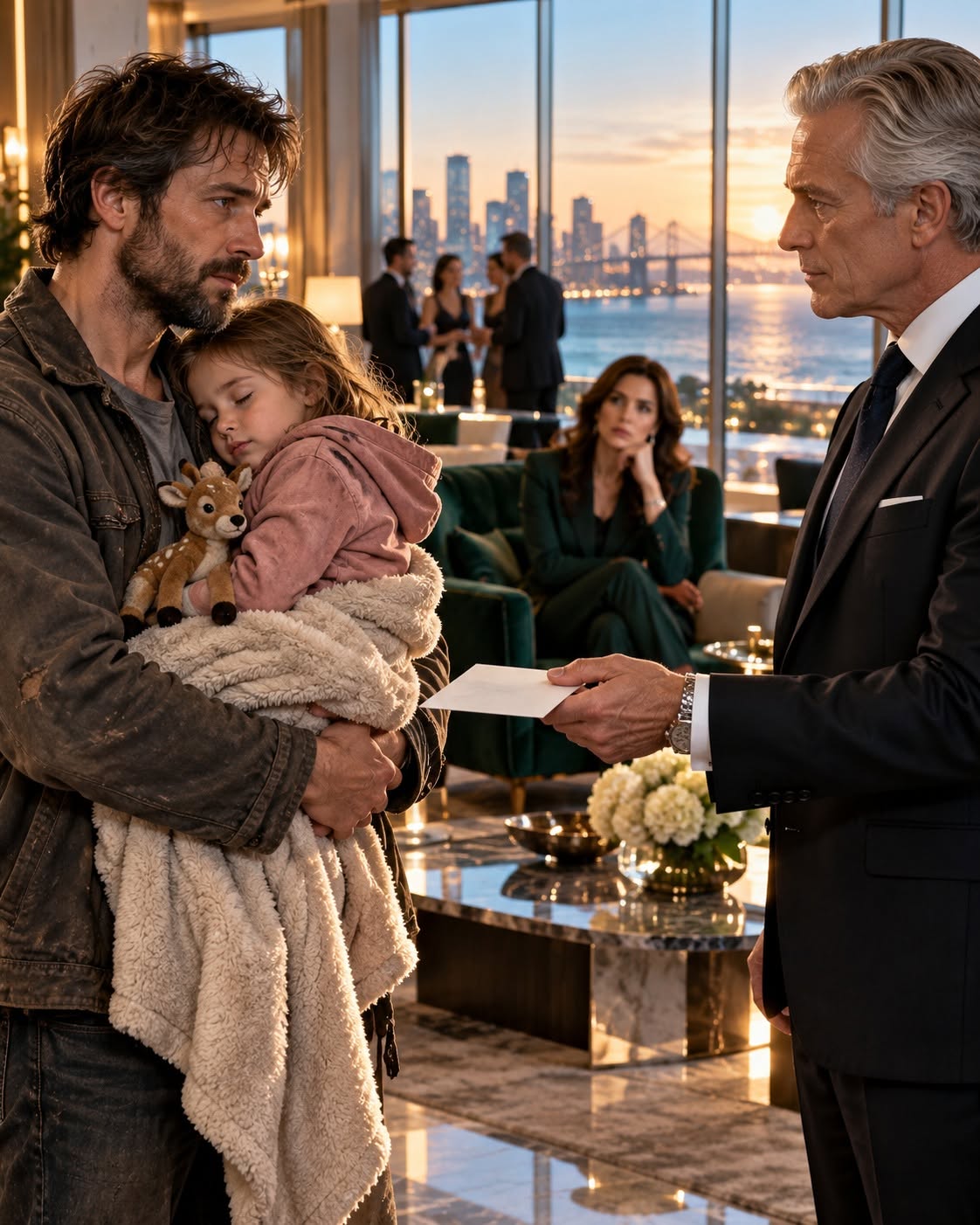
I was sitting on the floor of a luxury airport terminal in San Francisco, holding my sleeping daughter against my oil-stained jacket
THE MAN THEY THOUGHT WAS NOBODY
Arthur Vance turned toward Victoria Sterling and Harrison Croft, his expression hardening with every word.
“Daniel Mercer holds eighty percent of the equity in this enterprise. The foundational patents behind much of our fleet originated with his family’s aerospace company. He also controls the property interests and the master lease governing these terminal facilities.”
For several seconds, the only sound was the quiet hum of the airport’s ventilation system.
Harrison stared at Arthur, then at me, as though the man in the oil-stained jacket and worn work boots had somehow transformed into someone else before his eyes.
“That’s impossible,” he finally managed.
Arthur raised one eyebrow.
“Would you care to explain which part you find impossible, Mr. Croft? The ownership records are public. Perhaps you have simply never considered looking them up.”
Harrison’s face flushed red.
Victoria said nothing. Her hands, which had been folded confidently across her chest moments earlier, now hung motionless at her sides.
I adjusted Maya against my shoulder. My daughter was awake now, watching the adults with the uncertain expression of a child who could sense danger without understanding its source.
“Daddy?” she whispered.
I looked down at her.
“It’s all right, sweetheart.”
Then I faced Arthur.
“Let’s not turn this into a public spectacle. I want to understand what happened here, and I want everyone involved to understand what happens next.”
Arthur nodded slowly.
“That can be arranged.”
He turned toward Victoria.
“Please inform your board that an emergency review is being called. I suggest you bring every relevant employment record, complaint, disciplinary action, and family-leave request involving your terminal operations.”
Victoria swallowed.
“Surely this can be handled privately.”
“It can,” I replied. “But privately does not mean secretly.”
Harrison shifted his weight. His gaze wandered toward the terminal doors, perhaps calculating how quickly he could disappear.
I noticed the woman standing near the check-in counter, still holding her phone. She had witnessed everything, and judging by the expression on her face, she had recorded at least part of it.
“Sir,” she called hesitantly, “I’m sorry, but I think people should know what happened.”
Victoria turned sharply.
“You have no right to interfere in a private company’s personnel matters.”
The woman lowered her phone slightly.
“I work here. My husband works here, too. He missed the birth of our son because your company denied his leave.”
The words landed harder than the two-hundred-dollar bill ever could.
Victoria looked at her in disbelief.
“What is your name?”
“Emily Dawson. Customer services.”
“And your husband?”
“Michael. He works on the ground crew.”
Victoria opened her mouth, but no answer came.
I looked at Emily.
“Would you be willing to speak with an independent investigator?”
She nodded, though her eyes had filled with tears.
“Yes. I would.”
“Then someone will contact you. You won’t be asked to risk your job to tell the truth.”
I turned to Arthur.
“Make sure of that.”
He gave a firm nod.
As the executives were escorted toward a private conference room, Harrison brushed past me. For a moment, I thought he might offer an apology. Instead, he muttered, “This is a misunderstanding.”
I stopped him with a quiet question.
“If I had been exactly who you thought I was this morning, would anything you did have been different?”
He froze.
I waited.
He said nothing.
That silence told me more than any apology he could have offered.
An hour later, I sat in a conference room high above the terminal, listening as Arthur described the company’s growing problems.
The public face of Sterling Aviation was polished and impressive. Its aircraft were modern, its lounges were luxurious, and its executives appeared regularly in business magazines discussing innovation and operational excellence.
Behind that image, however, the company had been struggling.
Employees had submitted complaints about denied leave, unpaid overtime, and supervisors who threatened to replace anyone who questioned their decisions. Several maintenance workers had raised concerns about being pressured to finish inspections too quickly. Others alleged that requests for reasonable scheduling accommodations were routinely ignored.
Most complaints had been closed with a standard explanation: no evidence of wrongdoing.
I leaned back in my chair.
“How many of these complaints have been investigated by someone outside Sterling?”
Arthur glanced at the papers before him.
“None.”
“Why not?”
“Victoria assured the board that the company’s internal review process was sufficient.”
“And you believed her?”
Arthur looked down.
“Yes. At the time, I did.”
There was no attempt to excuse himself. That mattered.
Powerful people often imagined that wrongdoing required a villain who openly celebrated cruelty. In my experience, the damage was frequently done by people who preferred comfortable explanations over uncomfortable questions.
I turned to the window. Below us, aircraft moved along the runways beneath a pale California sky.
Years earlier, I had built my life around engineering, contracts, and the relentless pursuit of better machines. Then my wife, Claire, had died, and every achievement I had accumulated seemed suddenly insignificant.
Maya had been three years old. She did not understand why her mother would never return. She only understood that I was the person who tucked her into bed, prepared her breakfast, and held her when the world became frightening.
I had stepped away from executive meetings because I wanted to give her a childhood that belonged to her, not to my business empire.
Yet while I had been protecting my daughter from the uglier parts of the world, I had allowed other people to manage parts of that world in my name.
Perhaps the greatest mistake I had made was believing that good intentions were enough.
“Arthur,” I said, “I want an independent audit of the company’s employment practices, workplace safety procedures, and executive conduct. No one involved in the existing investigations should oversee it.”
“Understood.”
“And I want the employees who come forward protected from retaliation.”
“Absolutely.”
I paused.
“One more thing. No one is to be fired today simply because they were involved in what happened to me. We investigate first. We establish the facts. Then we act.”
Arthur nodded.
“I expected nothing less.”
By late afternoon, the video had spread across the internet.
Someone had uploaded the moment Harrison threw the money at my feet. The clip showed the contempt in his face, Victoria’s dismissive gestures, and the little girl sleeping against my chest.
It ended just as Arthur approached and addressed me as Chairman Mercer.
The headline attached to the video read: EXECUTIVE THROWS MONEY AT MECHANIC HOLDING SLEEPING DAUGHTER—THEN DISCOVERS WHO HE IS.
Within hours, the story had reached national news outlets.
My phone filled with messages from people I had not spoken to in years. Reporters waited outside the company’s headquarters. Investors demanded explanations. Former employees began posting their own stories.
Some praised me for standing up to arrogance. Others accused me of using my wealth to humiliate two executives who had made a mistake.
The criticism did not bother me nearly as much as one particular comment.
A former Sterling employee wrote that she had requested emergency leave to care for her dying father and had been told that personal problems were not the company’s responsibility. She had resigned rather than watch him suffer alone.
Her father had died three weeks later.
I read the post twice.
Then I read it again.
That evening, I returned home with Maya. Our house was quiet, tucked away in a residential neighborhood far from the city’s noise. There were no gold-plated fixtures or extravagant decorations. The kitchen counter was cluttered with crayons, school papers, and a half-finished puzzle.
It was exactly how I liked it.
Maya sat at the kitchen table while I warmed some soup.
“Daddy, were those people mean to you?”
I turned off the stove.
“They were.”
“Because your jacket was dirty?”
I considered my answer carefully.
“They made assumptions about me because of how I looked.”
“Is that why they gave you money?”
“Yes.”
She looked down at her hands.
“My teacher says we should share with people who need help.”
I pulled out the chair beside her.
“Your teacher is right. But sharing means offering help with kindness. It doesn’t mean giving someone money to make them feel small.”
Maya thought about that.
“Are you going to make them sorry?”
I was quiet for a moment.
“I want them to understand what they did. And I want to make sure they can’t treat other people that way again.”
She nodded, apparently satisfied.
Then she asked the question that would stay with me for years.
“If they hadn’t been mean to you, would you still help the people at their company?”
I stared at my daughter.
She was only six years old, yet she had found the question that every executive in that conference room should have been asking.
“Yes,” I said finally. “I should have been helping them before any of this happened.”
Maya reached across the table and wrapped her small fingers around mine.
“Then you can start now.”
The next morning, I went to Sterling Aviation’s headquarters.
I did not arrive by helicopter or walk through a private entrance. I drove an ordinary car and entered through the lobby used by employees. Several people recognized me immediately. Conversations stopped as I crossed the marble floor.
An administrative assistant hurried toward me.
“Chairman Mercer, the executive team is waiting upstairs.”
“Thank you. Before that, could you show me where the ground crew takes its breaks?”
She looked confused.
“The ground crew?”
“Yes.”
A few minutes later, I found a small break room behind a maintenance corridor. The chairs were mismatched, the refrigerator barely closed, and a handwritten notice on the wall warned employees that breaks exceeding their allotted time could result in disciplinary action.
Three mechanics sat around a table, eating sandwiches from paper bags.
They stood abruptly when I entered.
“Please, sit down,” I said. “I’m not here to inspect your uniforms.”
One of them, a broad-shouldered man with gray hair, looked at me suspiciously.
“Then why are you here?”
“To listen.”
His name was Thomas Reed. He had worked for Sterling for seventeen years and had once supervised a team of twelve mechanics. He told me that experienced employees were leaving because overtime had become unpredictable, staffing levels had dropped, and supervisors were increasingly demanding that crews complete tasks under unrealistic deadlines.
“We’re proud of our work,” he said. “Nobody here wants an aircraft to leave the ground unless it’s ready. But sometimes it feels like management only cares about departure times.”
“Have you reported those concerns?”
“Three times.”
“What happened?”
“The first report went nowhere. After the second, my supervisor told me I wasn’t a team player. After the third, I stopped expecting anything to change.”
I thanked him and asked whether he would be willing to speak with the independent review team.
He agreed.
Before I left, he added something that made me stop at the doorway.
“Sir, I don’t care whether you own eighty percent or a hundred percent. Just don’t come here for a week, promise us everything, and disappear when the cameras leave.”
I looked directly at him.
“You’re right to ask that. Don’t judge me by what I promise today. Judge me by what happens over the next year.”
That afternoon, the emergency board meeting began.
Victoria sat at one end of the conference table. Harrison occupied a chair near the door, separated from the other executives by an empty seat on either side.
Neither looked as confident as they had the previous day.
The independent legal team presented its preliminary findings. My treatment at the terminal was not an isolated incident. Records showed a pattern of denied leave requests, inconsistent disciplinary measures, and employee complaints that had not received meaningful review.
More troubling, several internal emails suggested that Harrison had encouraged supervisors to remove employees he considered inconvenient, even when their performance records were satisfactory.
One message referred to a mechanic’s request for time off to care for a sick child.
Harrison had responded: IF HE CANNOT PRIORITIZE THE BUSINESS, FIND SOMEONE WHO CAN.
Another email showed that Victoria had been informed of complaints about the practice months earlier.
She had replied that staffing flexibility was necessary to protect profitability and instructed her team to “resolve the matter without creating unnecessary exposure.”
I watched her read the emails on the screen.
Her face had lost every trace of color.
“Did you know these messages existed?” I asked.
Victoria’s voice was barely audible.
“I knew there had been complaints. I did not know every detail.”
“That wasn’t my question.”
She lowered her eyes.
“Yes.”
The room fell silent.
For the first time, Harrison looked angry rather than frightened.
“You approved the staffing targets,” he said, turning toward Victoria. “You told us to cut costs. You wanted higher margins. Now you’re acting as though I made these decisions alone?”
Victoria stared at him.
“You were responsible for employee relations in your division.”
“And you were responsible for the company!”
They began arguing, each desperate to push the blame toward the other.
I let them speak until their voices quieted.
Then I placed a copy of the employee complaints at the center of the table.
“These people were not asking for luxury offices or executive bonuses. They were asking for reasonable leave, safe working conditions, and the dignity of being heard. Meanwhile, you were arguing about which of you deserved credit for keeping expenses low.”
I looked around the room.
“This company does not belong to the people who sit in its executive offices. It exists because thousands of people do their jobs every day, often without recognition. If we forget that, we have no business leading them.”
The board authorized an expanded independent investigation.
Victoria was suspended from her duties pending the investigation’s findings. Harrison was removed from his leadership position, subject to the company’s formal disciplinary process.
Their departures were not announced as a public celebration. Their conduct would be assessed under established procedures, with documented findings and an opportunity to respond.
I insisted on that.
Accountability meant nothing if it merely replaced one kind of injustice with another.
But the hardest decision remained.
Several board members recommended terminating Sterling Aviation’s terminal lease immediately. As the majority equity holder and controller of the master lease, I had significant contractual rights. Yet exercising them without reviewing the relevant provisions and following the required procedures could create legal uncertainty and endanger innocent employees.
I refused to let anger make the decision for me.
“Our first obligation is to determine whether the contract permits termination and what protections apply to the workers,” I said. “If the evidence supports termination, we proceed lawfully. If the company can meet its obligations through enforceable conditions, we consider that option too. Either way, the people who did nothing wrong must not be abandoned.”
The board agreed.
For the next six weeks, the investigation uncovered more than any of us had anticipated.
There were employees who had worked through illnesses because they feared losing their positions. There were parents who had used unpaid vacation to care for newborns. There were maintenance workers whose warnings about understaffing had been dismissed as complaints from people unwilling to adapt.
One report described an elderly cleaner who had quietly purchased replacement supplies for her team because management had repeatedly delayed orders. She had never filed a complaint because she was afraid she would be labeled difficult.
The pattern was not simply a matter of two arrogant executives.
It was a culture in which numbers mattered more than people, silence was rewarded, and those who raised difficult questions were treated as problems to be removed.
The news cycle eventually moved on to another scandal, then another. But the investigation continued.
We established an independent employee hotline, strengthened family-leave protections, reviewed overtime practices, and required documented responses to safety complaints. We also created a committee with employee representatives who could bring recurring concerns directly to the board.
The changes cost money.
Some investors objected. One even demanded that I resign from active oversight, arguing that compassion was a distraction from the company’s business objectives.
I invited him to meet with the mechanics.
He declined.
A month later, the board formally removed Victoria from her position after the investigation confirmed that she had knowingly ignored serious employee concerns. Harrison’s employment was terminated after a separate review documented repeated misconduct and retaliation against staff members.
Neither decision gave me satisfaction.
Victoria had once helped build a successful company. Harrison had been an ambitious executive who believed he could climb higher by keeping the numbers impressive. I could understand how their choices had developed without accepting what they had done.
People rarely become cruel in a single moment. More often, they learn to excuse small acts of cruelty until those acts become ordinary.
The company’s lease situation was resolved through the contractual review. Sterling was required to meet strict compliance conditions, accept independent monitoring, and demonstrate sustained improvements. Its future operation at the terminal would depend on continued adherence to those requirements.
Several gate operations were reassigned when contractual conditions were not met. Employees affected by those changes received transition assistance, and eligible workers were offered positions with replacement operators.
The company lost some of its prestige, and its leadership had to rebuild trust. But the most important change was not the punishment of its executives.
It was the growing confidence of the people who had once believed that no one would listen.
Three months after the incident, I returned to the airport with Maya.
This time, I wore the same old jacket.
The oil stains were still there. I had considered replacing it, but Maya had insisted that it was her favorite because it smelled like home.
As we crossed the terminal, Emily Dawson approached us. She was smiling.
“Mr. Mercer, I wanted to thank you. My husband was finally granted leave when our son needed surgery. His supervisor even arranged coverage so he could stay with us.”
“I’m glad he could be there.”
She shook her head.
“You didn’t have to do any of this.”
I looked around the busy terminal.
“Yes, I did. I simply should have done it sooner.”
Thomas Reed joined us a few minutes later. He told me that the maintenance teams had received additional staffing, and that employees were finally seeing responses to the safety reports they submitted.
There were still problems. Change did not erase years of frustration overnight. But the atmosphere had begun to shift.
“People are talking again,” Thomas said. “Not just about what’s wrong. About how to fix it.”
I thanked him.
As the two men walked away, Maya tugged at my sleeve.
“Daddy, is this the place where the man gave you the money?”
“Yes.”
She looked at the polished floor where the bill had landed.
“Do you think he knows he was wrong?”
“I hope so.”
“Are you still angry with him?”
I knelt beside her.
“Sometimes I remember what happened, and it makes me angry. But being angry isn’t the same as wanting someone to suffer. I want him to learn. I want the people he hurt to be treated fairly. And I want us to do better next time.”
Maya considered this, then slipped her hand into mine.
“That’s better than throwing money.”
I laughed softly.
“Yes, sweetheart. Much better.”
As we walked toward the departure gates, I noticed a young man struggling with an overloaded suitcase. His shirt was rumpled, his shoes were worn, and he looked exhausted. A well-dressed traveler stepped around him with an irritated sigh.
For an instant, I remembered Harrison’s polished shoes and the expression on his face.
Then I remembered Claire.
Before she became ill, she used to tell me that wealth was not a measure of character. It was simply a tool, and a tool revealed the intentions of the person holding it.
I had spent years believing that the best way to raise Maya was to keep her away from the power and money that had consumed so much of my life.
Now I understood that shielding her from those things was not enough. I also had to teach her what they were for.
I approached the young man and offered to help with his suitcase. He looked embarrassed at first, then accepted with a grateful smile.
Maya watched us.
“Daddy,” she said, “you didn’t ask him who he was.”
I shook my head.
“No. I didn’t need to.”
She smiled and skipped ahead.
That evening, after we returned home, I tucked her into bed and read her favorite story. She fell asleep halfway through, her hand resting against my arm.
I stayed beside her longer than necessary, listening to her quiet breathing.
The following morning, another business report would arrive. There would be more contracts to review, difficult decisions to make, and people who needed someone to defend their interests. Running the company would not become effortless simply because I had learned a lesson at an airport.
But I no longer intended to lead from a distance.
I would ask questions before approving reports. I would meet the people whose work sustained the business. I would measure success not only in revenue and market share, but also in whether employees could care for their families without fear, whether safety concerns were heard, and whether the people at the bottom of the organization were treated with the same respect as those at the top.
My fortune had given me the power to make those decisions.
It had not given me the wisdom to make them until I had been forced to confront my own failures.
Sometimes, in the weeks that followed, I remembered the two-hundred-dollar bill Harrison had tossed at my feet. I thought about the way it had landed on the marble, faceup beneath the bright terminal lights.
He had meant it to be an insult, a price he believed could be placed on my dignity.
Instead, it had exposed something far more valuable than money could measure.
A person’s character is revealed by how they treat someone they believe has nothing to offer them.
Harrison had looked at my jacket and seen a man unworthy of respect. Victoria had looked at my circumstances and seen an inconvenience. Neither had considered that I might possess power, influence, or wealth.
But the truth was that I deserved respect even if I had owned nothing.
So did the cleaner who purchased supplies out of her own pocket. So did the mechanic who feared retaliation for reporting a safety concern. So did the father who needed a day off to care for his child.
And so did every person who had ever walked into a room and been judged before speaking a single word.
I could have used my fortune to make two executives suffer. I could have enjoyed the spectacle of watching their authority disappear. For a brief moment, the thought might even have felt satisfying.
But humiliation had started the entire story, and I had no desire to become another person who used power to humiliate others.
Justice required evidence. Leadership required responsibility. And real change required more than a dramatic encounter that millions of people could watch on their phones.
It required showing up again after the cameras had gone.
Months later, Sterling’s employee review committee published its first public report. It documented improvements in leave approvals, safety reporting, overtime procedures, and employee retention. It also listed the problems that remained unresolved and established deadlines for addressing them.
I read the report carefully, page by page.
Then I sent it back with one note written across the cover.
KEEP LISTENING.
Because no organization becomes decent simply by replacing a few people at the top. It becomes better when those with authority stop believing that authority makes them more valuable than the people beneath them.
As for the two-hundred-dollar bill, I eventually had it framed.
Not as a trophy, and certainly not as a reminder of my wealth. I placed it in a small office at home, beside a photograph of Claire holding baby Maya.
Beneath the bill, I wrote a single sentence:
NEVER CONFUSE SOMEONE’S CIRCUMSTANCES WITH THEIR WORTH.
When Maya was old enough to understand the story fully, I would tell her everything: about the airport, the executives, the company, and the choices that followed.
I would tell her that I had not always been a perfect leader, that I had failed to notice suffering when it happened far from my own life, and that doing the right thing was rarely as simple as winning a confrontation.
Most importantly, I would tell her that she had reminded me of what mattered.
Money could purchase comfort, influence, and opportunity. It could open doors that remained closed to others. But it could never determine who deserved kindness.
That morning in San Francisco, a millionaire executive had thrown two hundred dollars at a tired father holding his sleeping daughter, convinced that money could settle the matter.
He had been wrong.
The man in the stained jacket was not valuable because he owned an empire. He was valuable because he was human.
And the company he controlled was not worth saving merely because it made money. It was worth saving only if it could learn to treat people with dignity.
I had walked into the airport hoping to be an ordinary father for one quiet morning.
I left understanding that being a good father meant more than protecting Maya from the world’s cruelty. It meant showing her what to do when she encountered it.
Not revenge.
Not arrogance.
Not the belief that power gives one person the right to stand above another.
Instead, the courage to speak up, the patience to seek the truth, and the determination to leave a place better than you found it.
Years later, I would forget the headlines, the boardroom arguments, and the expressions on Harrison and Victoria’s faces.
But I would never forget Maya’s small hand holding mine as we walked away from that terminal.
She had no idea how much money I possessed. She did not care who controlled the company or whose signature could change its future.
She only knew that her father was beside her.
And that was exactly how I wanted her to remember me.
For all the wealth I had inherited, all the businesses I had built, and all the power I had spent years trying to escape, the greatest success of my life would never appear on a balance sheet.
It would be measured in the kindness my daughter learned to show, the dignity other families regained, and the lives made a little easier because someone finally decided to listen.
Because in the end, the true measure of a person is not the money in their pocket, the title on their office door, or the power written into their contracts.
It is what they do when they believe no one important is watching.
And it is what they choose to do when they finally understand that everyone was important all along.