I was sitting in seat 24C, somewhere over the Pacific at 38,000 feet, when the Boeing 777 suddenly lurched violently to the left
The first thing I heard was a sound I will never forget.
It wasn’t the applause.
It wasn’t the screaming passengers.
It was the sound of metal tearing.
“PHANTOM! LEFT WING!” Chen shouted.
I looked toward the damaged wing just as the aircraft touched down.
The main landing gear struck the runway with a brutal impact. The entire fuselage shook, and the aircraft veered sharply to the left.
I pulled against the controls, fighting to keep the nose pointed down the runway.
Then another explosion erupted outside.
A flash of orange light appeared beyond the cockpit window.
“Fire on the left side!” Chen yelled.
I could feel the aircraft pulling harder now. The damaged wing was no longer behaving like part of an airplane. It was fighting against every correction I made.
“Keep your hands on the controls!” I shouted.
Chen responded immediately.
We had trained for emergencies. We had discussed engine failures, hydraulic failures, and difficult landings.
But neither of us had ever imagined trying to stop a damaged Boeing 777 while part of its wing was literally coming apart.
The runway markings blurred beneath us.
Our speed was dropping, but not quickly enough.
“Brake pressure is falling!” Chen announced.
I glanced at the instruments.
One hydraulic system had completely failed. The remaining system was struggling.
We had perhaps ten seconds before the aircraft became impossible to control.
“Tell me the remaining options!”
“Emergency braking is available, but it could cause the aircraft to pull harder toward the damaged side!”
I understood immediately.
If I used too much braking, the aircraft might spin off the runway.
If I didn’t use enough, we would run out of pavement.
And beyond the runway was a frozen stretch of rough Alaskan ground.
There was no second chance waiting for us.
“Chen, I need you to contact the tower. Tell them to clear every vehicle from the far end of the runway.”
He grabbed the radio.
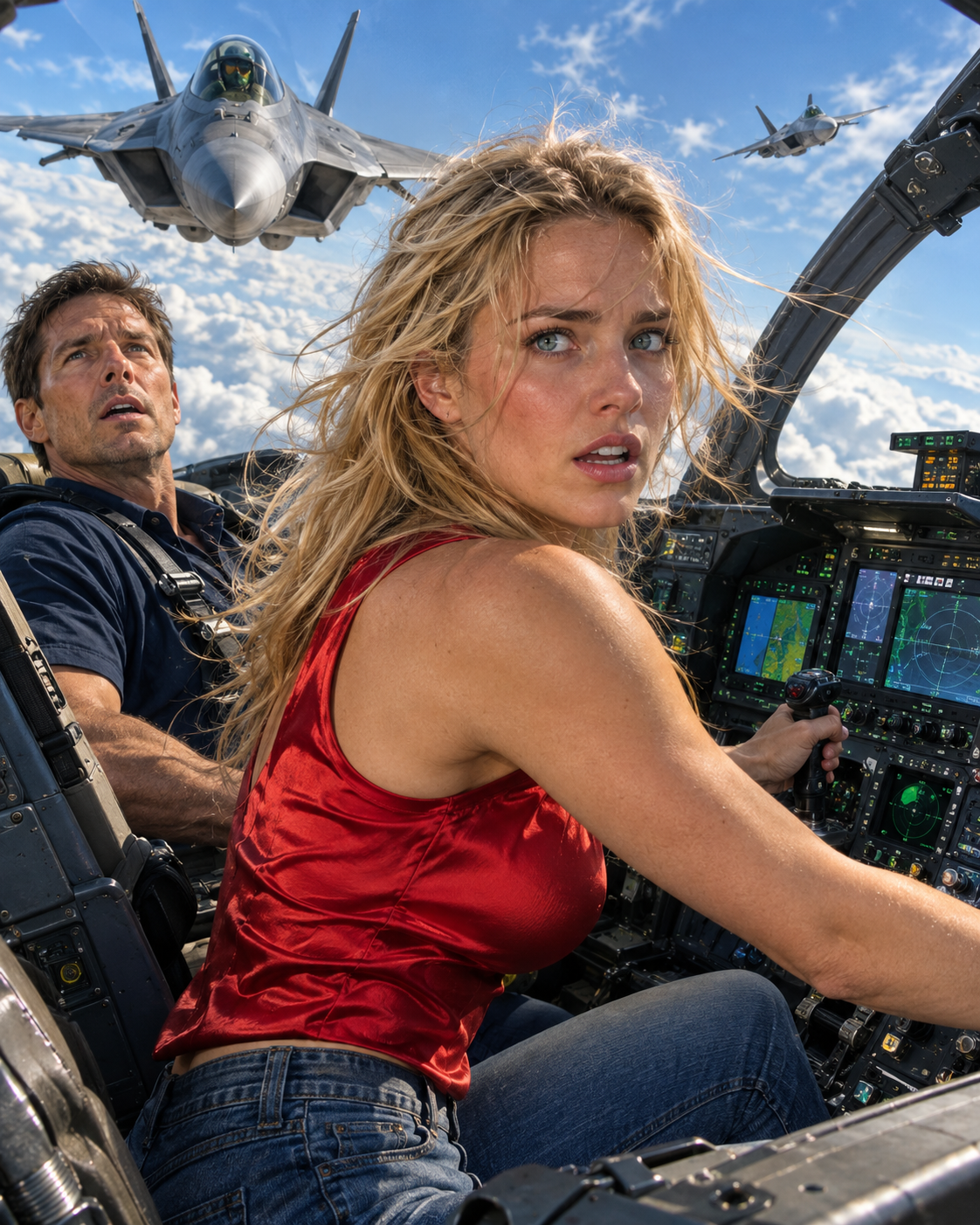
“Cold Bay Tower, this is Flight 702. We have severe directional control problems and possible wing fire. Clear the runway immediately!”
A voice answered through the static.
“Flight 702, emergency vehicles are standing by. Can you maintain your position?”
I almost laughed.
Maintain our position?
I was trying to keep 185 people alive inside a machine that was rapidly falling apart.
“Negative. We’re fighting for control.”
Then something unexpected happened.
A voice came over the radio.
“Phantom, this is Raptor Two. We’re observing your aircraft from the right side. Your left wing is shedding material. You need to stop as soon as possible.”
I recognized the voice.
The young F-22 pilot who had been flying beside us.
“Raptor Two, understood. Can you see the fire?”
“Affirmative. We also see something else.”
“What?”
There was a pause.
“Your left engine appears to be leaking fuel.”
My stomach tightened.
A fuel leak.
That changed everything.
If the leaking fuel reached the damaged electrical components, the entire aircraft could become a fireball.
I looked at Chen.
He had heard the transmission.
Neither of us said anything.
Then I made a decision.
“Chen, prepare for immediate evacuation.”
His eyes widened.
“On the runway?”
“If we stop.”
“And if we don’t?”
I looked straight ahead.
“Then we won’t have time to discuss it.”
I adjusted the aircraft’s direction again, trying to use the remaining control authority without putting excessive stress on the damaged wing.
The speed continued dropping.
Two hundred knots.
One hundred eighty.
One hundred fifty.
The aircraft shuddered violently.
Then the left wing made another terrible sound.
A long metallic crack echoed through the fuselage.
“Phantom!”
“I hear it!”
I applied the remaining braking carefully.
The aircraft drifted toward the left edge of the runway.
For one horrifying second, I thought we were finished.
Then the right landing gear struck a runway light.
The impact sent another vibration through the aircraft.
But somehow, impossibly, the nose swung back toward the centerline.
I corrected.
The aircraft straightened.
And finally, after what felt like an eternity, it stopped.
We had reached the end of the runway.
There were only a few hundred feet between us and the snow-covered ground beyond.
Chen stared through the windshield.
“Tell me that’s over.”
I looked at the instruments.
A warning light flashed.
Then another.
Then the smell of burning insulation became stronger.
“Not yet.”
I reached for the radio.
“Cabin crew, this is the cockpit. Prepare for emergency evacuation. Possible fuel leak and fire on the left side. Evacuate immediately when instructed.”
Jessica’s voice came back.
“Understood.”
I took one final look at the instruments.
Then I heard something that made my blood run cold.
A faint, repeated clicking sound.
Chen noticed it too.
“What is that?”
I recognized it.
An electrical system was failing somewhere behind the instrument panel.
“Get out of the aircraft,” I said.
He hesitated.
“Sir?”
“That’s an order. Move!”
We left the cockpit and entered the forward cabin.
Passengers were still strapped into their seats. Some were crying. Others were staring at us with the helpless expressions of people who had just survived something they couldn’t fully understand.
Jessica stood near the forward galley.
“Everyone needs to evacuate! Leave your belongings behind!”
I stepped into the aisle.
“Listen to her! Move quickly, but don’t push! Follow the crew!”
A man in the first row stood up, clutching a large suitcase.
“Wait! My passport and my wife’s medication are in here!”
I grabbed his shoulder.
“Sir, you can replace a passport. You cannot replace your life. Leave the bag!”
He looked at me.
Then he dropped it.
That small action seemed to break something open in the cabin.
People began moving.
The crew directed passengers toward the usable exits, keeping everyone away from the damaged side of the aircraft.
I helped an elderly woman who couldn’t walk without assistance.
Then I saw a little girl sitting alone beside the window.
She couldn’t have been more than seven.
Her face was covered in tears.
“Where’s my mommy?”
I crouched beside her.
“What’s your name?”
“Emily.”
“All right, Emily. I’m Daniel. We’re going outside now. Your mommy is waiting for you.”
She shook her head.
“She was sleeping next to me.”
I looked toward the opposite seat.
A woman was slumped against the window, unconscious.
“Jessica!” I called.
She hurried over.
Together, we helped the woman out of her seat.
She was breathing, but barely responsive.
Jessica took the girl while I supported the mother.
We moved toward the nearest safe exit.
Outside, firefighters were already approaching.
The cold air hit my face as soon as we reached the ground.
I helped the woman onto a stretcher.
Emily ran beside her.
“Mommy! Mommy!”
The woman’s eyes opened slightly.
“Emily?”
The little girl grabbed her hand.
“I’m here!”
I stepped away.
For a moment, I couldn’t move.
Sixteen years in combat had taught me to compartmentalize fear, grief, and exhaustion.
But seeing that little girl reunited with her mother almost brought me to my knees.
Then I heard a firefighter shouting.
“EVERYONE MOVE AWAY! POSSIBLE FUEL IGNITION!”
I turned.
The aircraft was still smoking.
A thin stream of black smoke rose from beneath the left wing.
I counted the passengers as they emerged.
One hundred.
One hundred fifty.
One hundred seventy.
Then Jessica appeared again.
She was helping a passenger with a bleeding forehead.
I approached her.
“Is everyone out?”
She looked toward the aircraft.
“I think so.”
“Think?”
Her expression changed.
“There’s one passenger unaccounted for.”
My heart sank.
“Who?”
“David. The man who was sitting beside you.”
I stared at her.
David.
The software engineer who had spent half the flight talking about his company.
I remembered him asking where I had served, joking about how boring long flights could be, and complaining about the coffee.
“Have you checked the rear cabin?”
“Yes. His seat is empty, but nobody saw him leave.”
I looked back at the aircraft.
Smoke was increasing.
The firefighters were preparing to move closer.
“Stay here,” I told Jessica.
She grabbed my arm.
“Daniel, don’t.”
I looked at her.
“Someone might still be inside.”
“The firefighters will search it.”
“They’re working on the fire. I know where his seat was.”
She shook her head.
“You’ve already done enough.”
I gently removed her hand.
“Not if somebody is still waiting for help.”
I ran toward the emergency crew.
A firefighter stepped in front of me.
“Sir, you cannot go back inside!”
“One passenger is missing.”
“We’ll handle it.”
“He’s somewhere in the rear cabin.”
The firefighter looked at the aircraft.
Then at me.
He knew the situation was deteriorating.
“Thirty seconds. That’s all I’m giving you. Stay away from the left side.”
I nodded.
A firefighter handed me a protective breathing mask.
I followed him through a usable exit.
Inside, the cabin was a nightmare.
Oxygen masks hung from the ceiling.
Luggage covered the floor.
Smoke was beginning to collect near the rear.
“David!” I shouted.
No answer.
We moved through the rows.
Then I heard a faint noise.
Three knocks.
A pause.
Three more.
I turned toward the rear galley.
“David?”
A voice answered.
“Help!”
We found him trapped between two rows of seats.
A metal luggage compartment had broken loose and fallen across his leg.
His face was pale.
His right hand was bleeding.
“What happened?” I asked.
“I went back to get my laptop bag. Then everything shifted.”
I stared at him.
“Your laptop bag?”
He looked ashamed.
“My entire company is on that computer.”
I shook my head.
“Forget the computer. We’re getting you out.”
The firefighter examined the obstruction.
“We need to lift this.”
Together, we tried.
It barely moved.
David screamed.
“Stop! My leg!”
The firefighter looked at me.
“We need more people.”
A deep rumble traveled through the aircraft.
I knew we were running out of time.
“On three.”
We positioned ourselves.
“One.”
David closed his eyes.
“Two.”
The firefighter tightened his grip.
“Three!”
We lifted.
The compartment shifted just enough.
David pulled his leg free.
We supported him between us and began moving toward the exit.
Halfway down the aisle, a sharp explosion erupted outside.
The aircraft shook.
A wave of hot air swept through the rear cabin.
“KEEP MOVING!” the firefighter shouted.
We reached the exit.
The firefighter climbed down first.
I helped David onto the emergency slide.
He landed awkwardly, but the medical crew caught him.
I was halfway out when the firefighter grabbed my shoulder.
“Move!”
I jumped.
A second later, flames burst from beneath the damaged wing.
The explosion sent a wave of heat across the tarmac.
I landed hard on my side.
For several seconds, I couldn’t hear anything.
Everything became a blur of flashing lights and moving figures.
Then someone grabbed my arm.
“Daniel!”
It was Chen.
His face was covered in soot.
“Are you hurt?”
I tried to stand.
“My shoulder.”
He helped me up.
“David made it?”
I looked toward the ambulance.
David was lying on a stretcher, surrounded by paramedics.
He raised one hand weakly.
I nodded.
“He’s alive.”
Chen looked at the burning aircraft.
Then he looked at me.
“How did you know someone was still inside?”
I thought about the empty seat.
The missing passenger.
The fact that a plane carrying 185 people had become a collection of individual lives, each one worth saving.
“I didn’t know,” I answered. “I just wasn’t willing to assume everyone was safe.”
Within minutes, the fire crews had surrounded the aircraft.
The left wing was engulfed in flames.
The emergency response team worked for nearly forty minutes before bringing the fire under control.
When the smoke finally cleared, the aircraft looked almost unrecognizable.
Its left wing was partially destroyed.
The engine had suffered catastrophic damage.
But the cabin remained largely intact.
And more importantly, every passenger was accounted for.
All 185 people had survived.
I sat on the back of an ambulance while a paramedic examined my shoulder.
A few feet away, Chen was speaking with another officer.
Jessica stood beside a group of passengers, distributing blankets.
Then I noticed David approaching.
He was walking with the assistance of a medical technician.
His right leg was bandaged.
His face was pale.
But he was alive.
He stopped in front of me.
For several seconds, he didn’t say anything.
Then he looked down at his hands.
“I almost killed myself for a laptop.”
I didn’t answer immediately.
He continued.
“Everything I built was on that computer. Every project. Every contract. Years of work.”
He swallowed.
“When the compartment fell, I realized something. I was going to die because I couldn’t let go of a machine.”
He looked at me.
“Why did you come back?”
I shrugged slightly.
“Because you weren’t outside.”
David shook his head.
“Most people would have left.”
“Maybe.”
“But you didn’t.”
I looked toward the wreckage.
“I’ve spent a lot of years flying with people who trusted me to bring them home. You don’t abandon someone just because the situation becomes difficult.”
He extended his hand.
I shook it.
“Thank you, Daniel.”
I nodded.
“Take care of that leg.”
He smiled faintly.
“Believe me. I’m going to take care of a lot more than that.”
Three hours later, the passengers were transported to a temporary shelter near the airport.
The authorities began collecting statements.
Investigators wanted to know everything.
What I had noticed before the emergency.
What I had seen in the cockpit.
Which decisions had been made during the descent.
Why I had entered the aircraft again.
I answered every question as accurately as I could.
But something bothered me.
The captain was still unconscious.
He had been transported to a hospital shortly after the landing.
Chen eventually came over and sat beside me.
“How’s your shoulder?”
“Nothing serious.”
He nodded.
Then he looked down at his hands.
“I need to tell you something.”
I turned toward him.
“What is it?”
He hesitated.
“Before you came into the cockpit, I thought we were going to die.”
I didn’t interrupt.
“I had been flying for three years. I’d trained for emergencies, passed every examination, and logged hundreds of hours. But when the captain collapsed, I couldn’t think clearly.”
He looked toward the dark windows.
“I knew the procedures. I just couldn’t make myself believe I was capable of handling everything alone.”
I remembered the expression on his face when I’d first entered the cockpit.
Fear.
Not cowardice.
Just the overwhelming weight of responsibility.
I placed my good hand on his shoulder.
“You know what separates an experienced pilot from a good one?”
He shook his head.
“Knowing that experience doesn’t make you invincible.”
He looked at me.
“Today, you stayed focused even when you were afraid. You listened. You communicated. You didn’t pretend you had all the answers.”
I paused.
“That’s what makes a good pilot.”
He looked away, fighting back tears.
“I thought I was going to lose everyone.”
“But you didn’t.”
“Because you came.”
I shook my head.
“Because we worked together.”
He nodded slowly.
Then he asked a question I wasn’t expecting.
“Do you ever miss flying?”
I looked toward the window.
Outside, snow was beginning to fall across the runway.
“Every day,” I admitted. “But sometimes I wonder whether I miss flying or whether I miss knowing exactly where I belong.”
Chen remained silent.
I understood that feeling better than I wanted to admit.
For sixteen years, my identity had been built around one thing.
Flying.
The military had given me purpose, structure, and a place where my abilities mattered.
When I retired, I thought I would be happy to leave that world behind.
Instead, I spent the following years trying to figure out who I was without it.
And now, after one terrible afternoon over the Pacific, I had found myself back in a cockpit.
Not because I wanted recognition.
Not because I missed the adrenaline.
But because someone needed help.
The following morning, Brigadier General Marcus Webb arrived at the medical facility.
He had been informed about the landing and the subsequent evacuation.
He stood beside my hospital bed.
“Phantom, you’ve managed to make quite an impression.”
I gave a tired smile.
“I was hoping to make it to Tokyo without attracting attention.”
He laughed.
Then he placed a folder on the table.
“There’s something you should know.”
I opened it.
Inside were preliminary reports from the emergency investigation.
The damage to the aircraft was worse than anyone had initially understood.
A section of the left wing structure had failed during flight.
The resulting damage had affected multiple systems.
But there was something else.
A maintenance discrepancy had been reported during the aircraft’s previous inspection.
It concerned a structural component near the left wing.
The discrepancy had been marked as resolved.
But investigators were now questioning whether the repair had been properly completed.
I looked up.
“Are you saying this could have been prevented?”
Webb nodded.
“That’s what the investigation is trying to establish.”
I closed the folder.
For the first time since landing, I felt anger.
Not the explosive anger of combat.
Something colder.
One hundred eighty-five people had boarded that aircraft believing they were protected by a system designed to keep them safe.
They had trusted the airline.
The mechanics.
The pilots.
The inspectors.
And someone might have failed them.
“Find out what happened,” I said.
Webb nodded.
“We will.”
Before leaving, he placed another item on the table.
It was a small black box.
Not a flight recorder.
A military challenge coin.
On one side was the insignia of his unit.
On the other were three words.
NEVER LEAVE ANYONE.
“Your old squadron’s motto,” he explained. “I thought you might appreciate it.”
I turned the coin over in my fingers.
“Thank you, General.”
He stopped at the door.
“One more thing. The military has received several calls about you. Apparently, your old reputation is still very much alive.”
I laughed.
“That’s unfortunate.”
He smiled.
“Maybe. But there’s a difference between having a reputation and deserving one.”
Then he left.
Two days later, the passengers were finally cleared to continue their journeys.
Some had already gone home.
Others were waiting for replacement flights.
Jessica found me near the airport entrance.
She was carrying a small envelope.
“I wanted to give you this.”
I opened it.
Inside was a photograph.
It showed the passengers standing together outside the temporary shelter.
There were smiles, exhausted faces, bandages, and several people holding handwritten signs.
At the center was a message.
THANK YOU FOR BRINGING US BACK TO EACH OTHER.
I stared at the photograph for a long time.
“Who organized this?”
Jessica smiled.
“David.”
I laughed quietly.
“How’s he doing?”
“His leg will heal. He says he’s going to rebuild his company, but he’s making a few changes first.”
“What kind of changes?”
“He told me he’s going to spend more time with his family.”
I nodded.
“That’s a good start.”
Jessica looked at me.
“You know, I thought I understood what bravery looked like before this flight.”
I raised an eyebrow.
“What does it look like now?”
She considered the question.
“Someone who keeps moving when everyone else is frightened. Someone who doesn’t need to be praised for doing the right thing.”
I smiled.
“Sounds like you just described yourself.”
She laughed.
Then she became serious.
“I was terrified, Daniel. I had never seen anything like that. But every time I looked toward the cockpit, I saw you and Chen working together. It gave the rest of us something to believe in.”
I folded the photograph carefully and placed it inside my jacket.
“That’s what leadership is supposed to do,” I said. “Give people a reason to keep going.”
She nodded.
We shook hands.
Then she walked away.
I remained near the entrance for a while, watching passengers arrive and depart.
People were dragging suitcases.
Children were running through the terminal.
Families were greeting one another.
Life was continuing.
And somehow, that ordinary sight seemed more extraordinary than anything I had experienced in the military.
A week later, I returned to Seattle.
My shoulder was healing, although the doctors had ordered me to avoid strenuous activity for several weeks.
I had barely unpacked when my phone rang.
The number was unfamiliar.
I answered.
“Daniel?”
“Yes.”
“This is Chen.”
I smiled.
“How are you doing?”
“Good, sir. Actually, I’m calling because I have something to ask you.”
“Go ahead.”
“I’ve been thinking about what happened. About the things you told me.”
I waited.
“I want to become a better pilot. Not just technically. I want to be the kind of person people can trust when everything goes wrong.”
I leaned back in my chair.
“That’s a good ambition.”
“Would you consider helping me?”
I looked out the window.
For years, I had avoided anything that reminded me of my military career.
I had convinced myself that the best way to move forward was to forget the person I used to be.
But perhaps I had misunderstood retirement.
Perhaps leaving the cockpit didn’t mean leaving behind everything it had taught me.
“Chen,” I said, “I’d be happy to.”
He sounded relieved.
“Thank you, sir.”
“One condition.”
“What’s that?”
“Stop calling me sir.”
He laughed.
“All right, Daniel.”
We spoke for another twenty minutes.
When the call ended, I sat quietly.
On the table beside me lay the photograph Jessica had given me.
I picked it up.
One hundred eighty-five faces.
One hundred eighty-five lives.
One hundred eighty-five people who had been given another chance.
I thought about the captain, who had survived and was recovering.
I thought about Chen, who had discovered that fear didn’t make him weak.
I thought about David, who had learned that a company could be rebuilt but a life could not.
And I thought about the little girl who had found her mother again.
For the first time in years, I didn’t feel like a retired fighter pilot.
I felt like a man who had finally understood what his years of service had been preparing him for.
Not recognition.
Not medals.
Not stories told in crowded rooms.
Something much simpler.
Being useful when it mattered.
Six months later, I received an unexpected invitation.
The airline had organized a small reunion for the passengers and crew of Flight 702.
They wanted me to attend.
I almost declined.
I had never been comfortable with ceremonies.
But then I received a message from Emily’s mother.
It was only three sentences.
“Emily still talks about the man who helped her find her mommy. She wants to see you again. We would be grateful if you came.”
I booked the flight.
This time, I wasn’t afraid of flying.
At the reunion, I recognized several faces immediately.
Jessica hugged me.
David shook my hand.
Chen was there too, looking considerably more confident than he had on that terrible day.
Then a little girl approached me.
She held a drawing.
It showed a large airplane, two smaller fighter jets, and a stick figure standing beneath them.
Above the figure, she had written one word.
HERO.
I crouched beside her.
“Is that me?”
She nodded.
“My mom says you helped save us.”
I smiled.
“Your mom helped save you too.”
She considered that for a moment.
Then she handed me the drawing.
“Can you keep it?”
I looked at her.
“Of course.”
Her mother stood behind her, smiling through tears.
I thanked her.
Then I looked around the room.
There were no uniforms.
No medals.
No military aircraft.
Just ordinary people who had shared one extraordinary experience.
And I realized something I wished I had understood years earlier.
We often imagine heroes as people who never feel afraid.
People who always know what to do.
People who somehow stand above everyone else.
But that isn’t what I had seen on Flight 702.
I had seen a young first officer fighting through his fear.
A flight attendant refusing to abandon her passengers.
Firefighters running toward a burning aircraft.
A stranger helping another stranger.
And 185 people choosing to trust one another when they had every reason to panic.
I had simply been one part of something much bigger.
That evening, before leaving, I walked outside and looked at the sky.
A passenger aircraft crossed overhead, its lights blinking against the fading sunset.
I watched until it disappeared.
My phone vibrated.
A message from Chen appeared.
“Training session tomorrow. Still on?”
I smiled and typed back.
“Wouldn’t miss it.”
Then I put my phone away.
For sixteen years, I had believed my greatest responsibility was to control an aircraft.
But that day over the Pacific taught me something more important.
Sometimes, the most difficult thing a person can do isn’t taking control.
It’s trusting others, staying calm, and refusing to leave someone behind.
The world doesn’t always give us the opportunity to choose when our courage will be tested.
Sometimes, it happens at 38,000 feet.
Sometimes, it happens in a burning cabin.
And sometimes, it happens in the quiet moments afterward, when nobody is watching and there is no applause.
My name is Daniel.
Some people still call me Phantom.
But I no longer think of that name as belonging to a fighter pilot.
It belongs to every person who chooses to stand up when someone else needs help.
Because in the end, the greatest victory isn’t surviving the impossible.
It’s making sure that the people beside you get the chance to live their lives.
And if there’s one thing I learned from Flight 702, it’s this:
You don’t have to be fearless to save someone. You just have to care enough not to walk away.